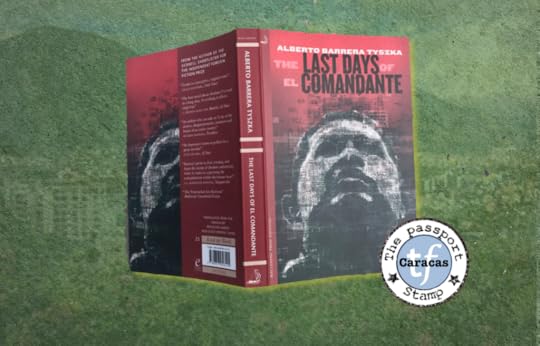
President Hugo Chávez’s cancer looms large over Venezuela in 2012, casting a shadow of uncertainty and creating an atmosphere of secrets, lies, and upheaval across the country. This literary thriller follows the connected lives of several Caracas neighbors consumed by the turmoil surrounding the Venezuelan president’s impending death.
Retired oncologist Miguel Sanabria, seeing the increasingly combustible world around him, feels on constant edge. He finds himself at odds with his wife, an extreme anti-Chavista, and his radical Chavista brother. These feelings grow when his nephew asks him to undertake the perilous task of hiding cell-phone footage of Chávez in Cuba. Fredy Lecuna, an unemployed journalist, takes a job writing a book about Chávez’s condition, which requires him to leave for Cuba while his landlord attempts to kick his wife and son out of their apartment. Nine-year-old María, long confined to an apartment with a neurotic mother intensely fearful of the city’s violence, finds her only contact with the outside world through a boy she messages online.
Alberto José Barrera Tyszka es un guionista, poeta y narrador venezolano. Se Licenció en Letras por la Universidad Central de Venezuela, de la que es profesor en la cátedra de Crónicas. En la década de los años ochenta participó en los grupos de poesía Tráfico y Guaire. Colaboraciones suyas han aparecido en diversas antologías y publicaciones de España, México, Argentina, Cuba y Venezuela. Articulista habitual desde 1996 en el periódico El Nacional, y colaborador regular en la revista Letras Libres. Guionista de telenovelas en Argentina, Colombia, México y Venezuela. Además, tiene publicadas varias novelas, libros de cuentos y de poesía; junto con la periodista Cristina Marcano es coautor de una biografía sobre Hugo Chávez, que ha tenido gran impacto internacional. Ha sido traducido al mandarín, francés, inglés e italiano.
Alberto Barrera Tyszka has written an award winning biography of Chávez, so he clearly knows his subject. Chávez was a very divisive figure in Venezuela’s recent history. Half the country loved him, and the other half hated him. Did he redistribute the country’s vast oil wealth to the poor, or was it syphoned off by his cronies into offshore funds? Did he die, as some say, on 28th December 2012 although the death was not announced until 5th March 2013? Why was there so much secrecy surrounding his treatment for cancer in Cuba?
Although the background to The Last Days of El Comandante is very much based on the facts with which Alberto Barrera Tyszka is so familiar, it is a work of fiction. The book is a novel featuring the interlocking stories of a number of Venezuelans (and an American journalist). The events are not connected to the impending death, but the impending death is very much the canvas against which they are painted – and each gives insights into everyday life into Venezuela at the time… a devastated economy, shortages of food and medicine, violence on the streets, and enormous problems in finding affordable accommodation. There are middle aged brothers – Miguel and Antonio – on opposite sides of the Chávez ‘love him or hate him’ divide, constantly trying to avoid the elephant in the room. There are Fredy, Tatiana and their son Rodrigo who live in an apartment in the same building as Miguel – rented from Andrenia who has returned from the States and is looking to evict Fredy and Tatiana. Fredy and Tatiana have nowhere in Caracas they can afford to move to… Fredy (an ex journalist and now embryonic author) heads to Cuba to research and write a book on what is happening to Chávez and his treatment. Their almost adolescent son, Rodrigo, is having an online ‘affair’ with a young lady of the same age called Maria. Maria and her mother live in self-inflicted virtual imprisonment in their apartment – because the mother is is scared (not entirely unreasonably) of venturing out onto the dangerous streets. And finally there is American journalist, Madeleine, who has left home in California to pursue her fascination with Chávez – and to write about him. Their lives are all intertwined.
The characters are well drawn and believable. And the reader gets a clear impression of how difficult life was in Caracas of the time. Reading the book is a great way of learning about what was happening. And, of course, life has arguably only got worse since the death of Chávez. His then deputy, and now president, Nicolás Maduro has hardly made life any easier or smoother.
The Last Days of El Comandante is recommended. A history lesson, well disguised as fiction.
For starters, I assume the other goodreads ratings and comments are higher than this one, but the reviews under this goodreads entry is criminally low. I will not give away any plot points because I think going in blind is best with this one (which is how I read it.)
This is an amzing book. I loved the fact that I didn't realize until the end that every character was a metaphor for different layers of Venezuela under Chavez. There are a lot of parallels to the current situation in the US and Chavez regime, and I am now engaged in looking up a bit more of Chavez to understand Venezuela a bit better.
This may be in my top ten books for 2025. Just go and read this one.