

What do you think?

Library of America #238
沙郡年紀:像山一樣思考,荒野詩人寫給我們的自然之歌
【最偉大的荒野詩人,最優美的自然哲思】他有著松樹般正直的靈魂以充滿哲思的文字凝視自然,寫下荒野的靈性之美啓發我們「像山一樣思考」土地倫理、生態平等的先驅之作當代最偉大的「自然保育聖經」!舉世聞名三大自然寫作者之一,與梭羅、繆爾齊名美國銷售逾百萬冊,紐約公共圖書館自然類「廿世紀十大好書」15幅全新生態插畫,工筆細繪;封面局部燙金、精緻立體設計,呈現自然的微物之美《沙郡年紀》由自然觀察漸次進入科學闡述,最後提升到哲學層次,被喻為是「保育界的聖經」、「自然寫作的經典」、「世紀之書」。──吳明益•國立東華大學華文系教授《沙郡年紀》以極優美的散文呈現,文字簡潔,含義卻極為深刻,就像所有最好的詩歌一樣,沒有一個字是多餘的,又正如一件精雕細琢的藝術品,在外表上卻看不到一點刻痕。──John Tallmadge•耶魯大學英文系教授在野性之中,蘊藏著世界的救贖李奧帕德,這位集科學家、田野工作者、詩人、哲學家等身分於一身的保育先驅,被譽為「美國生態保育之父」,其生平最重要著作《沙郡年紀》,出版半世紀以來影響深遠。本書第一部「沙郡年紀」是李奧帕德依季節、月份編寫的自然觀察筆記。在位於威斯康辛州
255 pages, Kindle Edition
First published January 1, 1949
About the author
Aldo Leopold
59 books1,126 followers
A Sand County Almanac
, published posthumously in 1949, of American writer and naturalist Aldo Leopold celebrates the beauty of the world and advocates the conscious protection of wild places.
His effect on resource management and policy lasted in the early to mid-twentieth century, and since his death, his influence continued to expand. Through his observation, experience, and reflection at his river farm in Wisconsin, he honed the concepts of land health and a land ethic that since his death ever influenced in the years. Despite more than five hundred articles and three books during the course of his geographically widespread career, time at his shack and farm in Wisconsin inspired most of the disarmingly simple essays that so many persons found so thought-provoking.
Life story of Aldo Leopold, the development of his career as a conservationist, scientist, and philosopher, and his open-mindedness, his vision, and the evolution of his thinking throughout his life inspire other persons to start or to further their own intellectual journey of discovery. A closer engagement with his story, his inspiration, and his family helps persons better to understand the contours of environmental history and the role in culture and to reflect on their own in the complex weave of the way in which our society relates to land. His vision of a society that cares about the connections between people and land provides a starting point for thinking about modern-day cultures, economies, ecosystems, and communities.
Starker Leopold, Luna Leopold, Nina Leopold, Carl Leopold, and Estella Leopold—children of Aldo—founded the Aldo Leopold foundation in 1982. People respected all members of the Leopold family as scientists and conservationists in their own right. They recognized the shack and farm as a focal point for legacy of their father for generations to come and for this primary reason established the foundation. This public charity owns and manages the Leopold center, including the Leopold shack and 264 surrounding acres in addition to several other parcels and also manages much of the adjoining 1,800-acre Leopold memorial reserve, which neighboring landowners established as an early trust in 1967. It acts as the executor of literary estate of Leopold, encourages scholarship on Leopold, and serves as a clearinghouse for information regarding Leopold, his work, and his ideas. It provides interpretive resources and tours for five thousand visitors annually, cooperates with partners on education and other programming off site, and maintains a robust website and numerous print resources. The Aldo Leopold foundation manages this Goodreads page.
His effect on resource management and policy lasted in the early to mid-twentieth century, and since his death, his influence continued to expand. Through his observation, experience, and reflection at his river farm in Wisconsin, he honed the concepts of land health and a land ethic that since his death ever influenced in the years. Despite more than five hundred articles and three books during the course of his geographically widespread career, time at his shack and farm in Wisconsin inspired most of the disarmingly simple essays that so many persons found so thought-provoking.
Life story of Aldo Leopold, the development of his career as a conservationist, scientist, and philosopher, and his open-mindedness, his vision, and the evolution of his thinking throughout his life inspire other persons to start or to further their own intellectual journey of discovery. A closer engagement with his story, his inspiration, and his family helps persons better to understand the contours of environmental history and the role in culture and to reflect on their own in the complex weave of the way in which our society relates to land. His vision of a society that cares about the connections between people and land provides a starting point for thinking about modern-day cultures, economies, ecosystems, and communities.
Starker Leopold, Luna Leopold, Nina Leopold, Carl Leopold, and Estella Leopold—children of Aldo—founded the Aldo Leopold foundation in 1982. People respected all members of the Leopold family as scientists and conservationists in their own right. They recognized the shack and farm as a focal point for legacy of their father for generations to come and for this primary reason established the foundation. This public charity owns and manages the Leopold center, including the Leopold shack and 264 surrounding acres in addition to several other parcels and also manages much of the adjoining 1,800-acre Leopold memorial reserve, which neighboring landowners established as an early trust in 1967. It acts as the executor of literary estate of Leopold, encourages scholarship on Leopold, and serves as a clearinghouse for information regarding Leopold, his work, and his ideas. It provides interpretive resources and tours for five thousand visitors annually, cooperates with partners on education and other programming off site, and maintains a robust website and numerous print resources. The Aldo Leopold foundation manages this Goodreads page.
Ratings & Reviews
Friends & Following
Create a free account to discover what your friends think of this book!
Community Reviews
Displaying 1 - 30 of 2,778 reviews

November 20, 2009
How is it possible that I earned a BS in natural resources (and slipping toward an MS in wildlife) without being required to read this book? Aldo Leopold is often called the father of wildlife management. But Sand County Almanac is not a text book, with nary a glossary, set of models, or flow chart within its pages. It does contain some pretty drawings, and some spellbinding imagery. Leopold goes beyond vividly describing a scene of chopping wood or canoeing a river; he pans back to ecological connectivity or the aesthetic importance of the natural world to humanity. He talks about the need for a land ethic, and it sounds very logical and obvious-- I have to remind myself that he wrote these essays before such a mindset was commonplace. Even if his views were not completely original for the time, he is undoubtedly remembered for being so darn eloquent. A master of the one-liner, it's no wonder that all of my nat res classes seemed to quote him several times each semester (and some classes on a weekly basis). I feel sheepish for not reading it much earlier in my career, but I'm very glad I picked it up. He was a remarkable naturalist and writer. I can see him clearly, squatting in ice-crusted mud before dawn breaks over the marsh, his shotgun poking through the reeds and ears open to the sounds of approaching waterfowl, all the while silently creating poetry.

October 24, 2018
“Does the economist know the grebe?”—Aldo Leopold
7/31/25: The folks at the EPA (The Environmental Protection Agency) that intend to eliminate safety regulations for Americans are not economists. And they are certainly not climate scientists or environmentalists. Their intention is to free American business so that it can make unbridled profits for its billionaire CEOs. Never mind that unprecedented floods and wind and rain and heat from climate change is already costing us us billions:
https://www.msn.com/en-us/news/politi...
There is nothing new in this struggle, as you would be able to see in Aldo Leopold and Rachel Carson and Wendell Berry and more recently Bill McKibben. I began my 2018 review with this news on the health of the planet:
https://www.yahoo.com/news/yahoo-news...
Sand County Almanac is a 1949 collection of essays by Wisconsin conservationist Leopold—some people now call him one of the fathers of “deep ecology”—that is one of the two most influential and well known environmental books of the twentieth century, the other being Rachel Carson’s Silent Spring. Today it continues to sell about 40,000 copies a year, though apparently that was not enough or perhaps influential enough to readers to stop the tide he saw rising as early as the middle of the nineteenth century, where shortsighted American corporate greed and consequent rapacious environmental destruction triumphed over what he called a “land ethic,” or a responsible relationship existing between people and the land they inhabit.
“There are two spiritual dangers in not owning a farm. One is the danger of supposing that breakfast comes from the grocery, and the other that heat comes from the furnace.”
Leopold knew that most Americans look at beautiful natural places and think profit:
“To those devoid of imagination a blank place on the map is a useless waste; to others, the most valuable part.”
But he writes with a deeper appreciation of that beauty:
“Our ability to perceive quality in nature begins, as in art, with the pretty. It expands through successive stages of the beautiful to values as yet uncaptured by language.”
Leopold loves art and music but worries that people might value art in a museum and music from a symphony more than the Colorado Rockies or “geese music.”
People, Leopold knew even then, are cut off from nature, couldn’t name as he does lovingly and knowingly the plants and animals that are around them, nor see how crucial they are to our survival on the planet; as English Romantic poet William Wordsworth wrote in 1807:
The world is too much with us; late and soon,
Getting and spending, we lay waste our powers;—
Little we see in Nature that is ours;
We have given our hearts away, a sordid boon!
Leopold thinks that we went wrong when we decided to teach chemistry in school but not ecological ethics along with it. Because he was one of the few educated at the time to know it, he felt isolated:
“One of the penalties of an ecological education is that one lives alone in a world of wounds. Much of the damage inflicted on land is quite invisible to laymen. An ecologist must either harden his shell and make believe that the consequences of science are none of his business, or he must be the doctor who sees the marks of death in a community that believes itself well and does not want to be told otherwise.”
The "marks of death" he was observing closely, and tracking from a century before. What would he write about now, when he was already so sad and mad then? These essays that I reread felt like a sad elegy to a time that he was already himself lamenting, when we might still could have made the choice to live in harmony with nature.
Here is Leopold in his essay, “Thinking like a Mountain”:
“We reached the old wolf in time to watch a fierce green fire dying in her eyes. I realized then, and have known ever since, that there was something new to me in those eyes - something known only to her and to the mountain. I was young then, and full of trigger-itch; I thought that because fewer wolves meant more deer, that no wolves would mean hunters' paradise. But after seeing the green fire die, I sensed that neither the wolf nor the mountain agreed with such a view.…I now suspect that just as a deer herd lives in mortal fear of its wolves, so does a mountain live in mortal fear of its deer. And perhaps with better cause, for while a buck pulled down by wolves can be replaced in two or three years, a range pulled down by too many deer may fail of replacement in as many decades. So also with cows. The cowman who cleans his range of wolves does not realize that he is taking over the wolf's job of trimming the herd to fit the range. He has not learned to think like a mountain. Hence we have dustbowls, and rivers washing the future into the sea.”
Our world has been shaped by ignorance, and shortsighted businessmen, and our preference for what he calls "gadgetry" (our love of tech, already in the forties) over the deep pleasures of the outdoors:
“The modern dogma is comfort at any cost.”
But at what price, for those of us facing the future now?
Why science’s warning about two little ol’ degrees of global warming is so crucial:
http://theconversation.com/why-is-cli...
My review of Mark Lynas’s Six Degrees:
https://www.goodreads.com/book/show/1...
Okay, so you don’t have time to read a whole book about ecology? Try his one essay, “Thinking like a Mountain:”
http://www.uky.edu/OtherOrgs/AppalFor...
The World Is Too Much With Us
By William Wordsworth
The world is too much with us; late and soon,
Getting and spending, we lay waste our powers;—
Little we see in Nature that is ours;
We have given our hearts away, a sordid boon!
This Sea that bares her bosom to the moon;
The winds that will be howling at all hours,
And are up-gathered now like sleeping flowers;
For this, for everything, we are out of tune;
It moves us not. Great God! I’d rather be
A Pagan suckled in a creed outworn;
So might I, standing on this pleasant lea,
Have glimpses that would make me less forlorn;
Have sight of Proteus rising from the sea;
Or hear old Triton blow his wreathèd horn.
7/31/25: The folks at the EPA (The Environmental Protection Agency) that intend to eliminate safety regulations for Americans are not economists. And they are certainly not climate scientists or environmentalists. Their intention is to free American business so that it can make unbridled profits for its billionaire CEOs. Never mind that unprecedented floods and wind and rain and heat from climate change is already costing us us billions:
https://www.msn.com/en-us/news/politi...
There is nothing new in this struggle, as you would be able to see in Aldo Leopold and Rachel Carson and Wendell Berry and more recently Bill McKibben. I began my 2018 review with this news on the health of the planet:
https://www.yahoo.com/news/yahoo-news...
Sand County Almanac is a 1949 collection of essays by Wisconsin conservationist Leopold—some people now call him one of the fathers of “deep ecology”—that is one of the two most influential and well known environmental books of the twentieth century, the other being Rachel Carson’s Silent Spring. Today it continues to sell about 40,000 copies a year, though apparently that was not enough or perhaps influential enough to readers to stop the tide he saw rising as early as the middle of the nineteenth century, where shortsighted American corporate greed and consequent rapacious environmental destruction triumphed over what he called a “land ethic,” or a responsible relationship existing between people and the land they inhabit.
“There are two spiritual dangers in not owning a farm. One is the danger of supposing that breakfast comes from the grocery, and the other that heat comes from the furnace.”
Leopold knew that most Americans look at beautiful natural places and think profit:
“To those devoid of imagination a blank place on the map is a useless waste; to others, the most valuable part.”
But he writes with a deeper appreciation of that beauty:
“Our ability to perceive quality in nature begins, as in art, with the pretty. It expands through successive stages of the beautiful to values as yet uncaptured by language.”
Leopold loves art and music but worries that people might value art in a museum and music from a symphony more than the Colorado Rockies or “geese music.”
People, Leopold knew even then, are cut off from nature, couldn’t name as he does lovingly and knowingly the plants and animals that are around them, nor see how crucial they are to our survival on the planet; as English Romantic poet William Wordsworth wrote in 1807:
The world is too much with us; late and soon,
Getting and spending, we lay waste our powers;—
Little we see in Nature that is ours;
We have given our hearts away, a sordid boon!
Leopold thinks that we went wrong when we decided to teach chemistry in school but not ecological ethics along with it. Because he was one of the few educated at the time to know it, he felt isolated:
“One of the penalties of an ecological education is that one lives alone in a world of wounds. Much of the damage inflicted on land is quite invisible to laymen. An ecologist must either harden his shell and make believe that the consequences of science are none of his business, or he must be the doctor who sees the marks of death in a community that believes itself well and does not want to be told otherwise.”
The "marks of death" he was observing closely, and tracking from a century before. What would he write about now, when he was already so sad and mad then? These essays that I reread felt like a sad elegy to a time that he was already himself lamenting, when we might still could have made the choice to live in harmony with nature.
Here is Leopold in his essay, “Thinking like a Mountain”:
“We reached the old wolf in time to watch a fierce green fire dying in her eyes. I realized then, and have known ever since, that there was something new to me in those eyes - something known only to her and to the mountain. I was young then, and full of trigger-itch; I thought that because fewer wolves meant more deer, that no wolves would mean hunters' paradise. But after seeing the green fire die, I sensed that neither the wolf nor the mountain agreed with such a view.…I now suspect that just as a deer herd lives in mortal fear of its wolves, so does a mountain live in mortal fear of its deer. And perhaps with better cause, for while a buck pulled down by wolves can be replaced in two or three years, a range pulled down by too many deer may fail of replacement in as many decades. So also with cows. The cowman who cleans his range of wolves does not realize that he is taking over the wolf's job of trimming the herd to fit the range. He has not learned to think like a mountain. Hence we have dustbowls, and rivers washing the future into the sea.”
Our world has been shaped by ignorance, and shortsighted businessmen, and our preference for what he calls "gadgetry" (our love of tech, already in the forties) over the deep pleasures of the outdoors:
“The modern dogma is comfort at any cost.”
But at what price, for those of us facing the future now?
Why science’s warning about two little ol’ degrees of global warming is so crucial:
http://theconversation.com/why-is-cli...
My review of Mark Lynas’s Six Degrees:
https://www.goodreads.com/book/show/1...
Okay, so you don’t have time to read a whole book about ecology? Try his one essay, “Thinking like a Mountain:”
http://www.uky.edu/OtherOrgs/AppalFor...
The World Is Too Much With Us
By William Wordsworth
The world is too much with us; late and soon,
Getting and spending, we lay waste our powers;—
Little we see in Nature that is ours;
We have given our hearts away, a sordid boon!
This Sea that bares her bosom to the moon;
The winds that will be howling at all hours,
And are up-gathered now like sleeping flowers;
For this, for everything, we are out of tune;
It moves us not. Great God! I’d rather be
A Pagan suckled in a creed outworn;
So might I, standing on this pleasant lea,
Have glimpses that would make me less forlorn;
Have sight of Proteus rising from the sea;
Or hear old Triton blow his wreathèd horn.

August 22, 2017
What a dull world if we knew all about geese!
Nature is refreshing. Even a short walk in a park can powerfully clear one’s head. For whatever reason—perhaps because our ancestors lived in trees—surrounding oneself with birches and maples produces in nearly everyone feelings of warmth, comfort, and peace. And for many people, nature is more than refreshing: it is awe-inspiring, even divine. Natural environments are, for some, more uplifting than cathedrals. Emerson might have captured this strain of mystical naturalism best:
In the woods, we return to reason and faith. … Standing on the bare ground,—my head bathed by the blithe air, and uplifted into infinite spaces,—all mean egotism vanishes. I become a transparent eye-ball; I am nothing; I see all; the currents of the Universal Being flow through me; I am part or particle of God.
I myself have had comparable experiences in the woods. Yet both Emerson and I are pure amateurs next to Aldo Leopold.
Leopold was a pioneering conservationist and forester. He was also a superlative writer, and in this brief book he covers a lot of ground. He begins with a month-by-month account of Sand County, a poor farming region in Wisconsin. This was my favorite section, since Leopold’s sensitivity to his environment is nearly superhuman. He has a keen sense of both the history of environments—how they change with the seasons, how they have evolved through time, how they have been warped by human activity—and the close-knit interdependence of ecosystems, how each organism shapes and is shaped by every other organism, forming a perfect whole.
As a stylist, he manages to be lyrical and poetic while sticking scrupulously to what he sees and hears. His sentences are short, his diction simple, and yet he manages to evoke a densely complex ecosystem. This is because, unlike Emerson or I—and more so than Thoreau—Leopold really understood his environment. He can name every species of plant, and tell what soils they prefer and what plants they like as neighbors. He can identify every bird by its call, and knows where it roosts, what it eats, when it migrates, and how it mates. Scratches on a tree tell him a deer is nearby, his antlers fully grown; the footprints in snow tell him a skunk has passed, and how recently.
All this is described with exquisite sensitivity, but no romantic embellishment. To borrow a phrase from E.B. White, Leopold had discovered “the eloquence of facts.” And, like White, Thoreau, and Emerson, his writing has a pleasing, folksy, rambling, ambling quality, wherein each sentence is nailed to the next one at an oblique angle.
In the rest of the book, Leopold puts forward a new philosophy of conservation. This train of thought reminded my very much of another book I read recently, The Death and Life of Great American Cities. In that book, Jane Jacobs explains how top-down approaches to city planning killed neighborhood vitality. Just so, when Leopold was a young man in the forestry service, he participated in the policy of removing predators—bears, wolves, and mountain lions—to protect livestock and to increase the supply of hunting animals, like deer. When hunting became necessary to control population, parks began building more and more roads to make access easier; and meanwhile the exploding deer population prevented new trees from growing. Thus the park was encroached upon by cars, and the ecosystem thrown off balance—in the same way that blindly building highways and public housing can destroy neighborhoods.
Leopold was, I believe, one of the first to popularize the idea that ecosystems act like one giant organism, with a delicate balance of cooperating and competing components. Every healthy ecosystem is a harmony that cannot be disturbed without unpredictable results. To again borrow from Jacobs, an ecosystem—like a city economy or a human brain—is an example of “organized complexity.” Thus ecosystems baffle attempts to understand them by thinking of their components separately, as a collection of individual species, or even statistically, as the average behavior of interchangeable parts. Complexity like this tends to be a product of historical growth, with each distinct component making minute adjustments to each other in a dense network of influence. Leopold doesn’t say this in so many words; but he does something even more impressive: he illustrates this quality using short anecdotes and schoolboy vocabulary.
His most philosophic contribution to the environmental movement is what he called a “land ethic.” Previous arguments for conservation were couched in terms of expediency: how national parks and nature reserves could benefit us economically. Leopold believed that this approach was too narrow; since hunting lodges and mechanized farms are always more profitable in the short term, this would eventually result in the destruction of wild ecosystems and the disappearance of species. We needed to move beyond arguments of expediency and see the land—and everything on it—as valuable for its own sake. Leopold believed that we had an ethical duty to preserve ecosystems and all their species, and that the aesthetic reward of wild nature was more valuable than dollars and cents could measure.
I want to go along with this, but I thought that Leopold was unsatisfyingly vague in this direction. It is simply not enough to say that we have an ethical duty to preserve nature; this is quite a claim, and requires quite a bit of argument. Further, aesthetic value seems like a slender reed to rest on. For every Emerson and Thoreau, there is a Babbitt whose tastes are not so refined. To his credit, Leopold does argue that a great part of conservation must consist in elevating the public taste in nature. Otherwise, conservation will consist of little more than the government using tax dollars to purchase large swaths of land. Individuals must see the value in wilderness and actively participate in preserving it. But molding tastes is no easy thing; and, more importantly, if we are to do so, there must be compelling reasons to do it.
The most compelling reasons for conservation are, I believe, expediency—but expediency in the widest sense. The difference between folly and wisdom is not that the former is preoccupied with expediency and the latter higher things; it is that wisdom considers what is expedient on a grander scale. Leopold comes close to making this same argument. He was, for example, ahead of his time in being deeply concerned about extinction. Every time a species disappears it is an irreplaceable loss; and considering that our medicine partly depends on new discoveries, extinctions may have terrible consequences for us down the line. (I saw a PBS special the other day about scientists trying to discover new antibiotics by shifting through raw soil.) Since Leopold's day—long before Silent Spring or An Incovenient Truth—we have learned plenty more ways that environmental destruction can be equivalent to self-destruction.
Carping aside, this is a deeply satisfying book: lyrical, descriptive, educational, and innovative. Leopold realized what Orwell also realized: that winning converts requires both argument and propaganda. He does not only argue for the value of nature, but he really captures the beauty of unspoiled environments and serves it up for his readers’ consideration. We are not only convinced, but seduced. This is propaganda in its noblest form—propaganda on behalf of nature.

November 10, 2016
Our ability to perceive quality in nature begins, as in art, with the pretty.*
-pause-
Our ability to perceive quality in nature begins, as in art, with the pretty. It expands through successive stages of the beautiful to values as yet uncaptured by language. The quality of cranes lies, I think, in this higher gamut, as yet beyond the reach of words.
There is nothing, nothing, beyond Aldo Leopold's reach of words. I've read, oh, sixty or seventy books so far this year - some inventive, some incisive - but nothing matches the magic of this writing. And so, I'll have to quote a lot.
Acts of creation are ordinarily reserved for gods and poets, but humbler folks may circumvent this restriction if they know how. To plant a pine, for example, one need be neither god nor poet; one need only own a shovel. By virtue of this curious loophole in the rules, any clodhopper may say : Let there be a tree--and there will be one. . . . God passed on his handiwork as early as the seventh day, but I notice He has been rather noncommittal about its merits. I gather either He spoke too soon, or that trees stand more looking upon than do fig leaves and firmaments.
-- -- -- -- -- -- -- -- -- -- -- --
There are other plants who seem to ask of this world not riches but room. Such is the little sandwort that throws a white-lace cap over the poorest hilltops just before the lupines splash them with blue. Sandworts simply refuse to live on a a good farm, even on a very good farm, complete with rock garden and begonias. And then there is the little Linaria, so small, so slender, and so blue that you don't even see it until it is directly underfoot; who ever saw a Linaria except on a sandblow? . . . There are birds that are found only in the Sand Counties, for reasons sometimes easy, sometimes difficult, to guess. The clay-colored sparrow is there, for the clear reason that he is enamored of jackpines, and jackpines of sand. The sandhill crane is there, for the clear reason that he is enamored of solitude, and there is none left elsewhere. But why do woodcocks prefer to nest in sandy regions? Their preference is rooted in no such mundane matter as food, for earthworms are far more abundant on better soils. After years of study, I now think I know the reason. The male woodcock, while doing his preening prologue to the sky dance, is like a short lady in high heels: he does not show up to advantage in dense tangled ground cover. But on the poorest sand-streak of the poorest pasture or meadow of the Sand Counties, there is, in April at least, no ground cover at all, save only moss, Draba, cardamine, sheep-sorrel, and Antennaria, all negligible imprediments to a bird with short legs. Here the male woodcock can puff and strut and mince, not only without let or hindrance, but in full view of his audience, real or hoped-for. This little circumstance, important for only an hour a day, for only one month of the year, perhaps for only one of the two sexes, and certainly wholly irrelevant to economic standards of living, determine the woodcock's choice of home.
-- -- -- -- -- -- -- -- -- -- -- --
For one species to mourn the death of another is a new thing under the sun. The Cro-Magnon who slew the the last mammoth thought only of steaks. The sportsman who shot the last pigeon thought only of his prowess. The sailor who clubbed the last auk thought of nothing at all. But we, who have lost our pigeons, mourn the loss. Had the funeral been ours, the pigeons would hardly have mourned us. In this fact, rather than in Mr. DuPont's nylons or Mr. Vannevar Bush's bombs, lies objective evidence of our superiority over the beasts.
-- -- -- -- -- -- -- -- -- -- -- --
Thus always does history, whether of marsh or market place, end in paradox. The ultimate value in these marshes is wildness, and the crane is wildness incarnate. But all conservation of wildness is self-defeating, for to cherish we must see and fondle, and when enough have seen and fondled, there is no wildness left to cherish.
-- -- -- -- -- -- -- -- -- -- -- --
There's an extended part of this book where the author and others saw through an old oak that has fallen on his property. He cites the history, backwards, as they saw through, ring by ring, year by year. It's splendid stuff and not conventional history like Hitler did this or General Sherman did that; but, more about carp planting and barbed wire and the things meadow mice have been know to do. At the end (beginning) of each decade, we hear: Rest! cries the chief sawyer, and we pause for breath. So, there's a musical cadence too.
-- -- -- -- -- -- -- -- -- -- -- --
Sorry for quoting so much, but I hope you see why I did. This book is in three parts: the first two are his observations of nature and the last part is kind of a call to arms for conservation of wilderness. This book was written almost 70 years ago and Leopold knew, even then, that what he was preaching was a lost cause. Yet this book remains in 'the higher gamut.'
-- -- -- -- -- -- -- -- -- -- -- --
Four boarding passes, and four light-rail link passes, gave their lives, in little torn pieces, to mark the many passages in this book worth remembering.
-- -- -- -- -- -- -- -- -- -- -- --
*I read almost this exact quote two weeks ago in the book Rendez-vous with Art. I went back and couldn't quite put my finger on it, so you'll have to trust me.
-pause-
Our ability to perceive quality in nature begins, as in art, with the pretty. It expands through successive stages of the beautiful to values as yet uncaptured by language. The quality of cranes lies, I think, in this higher gamut, as yet beyond the reach of words.
There is nothing, nothing, beyond Aldo Leopold's reach of words. I've read, oh, sixty or seventy books so far this year - some inventive, some incisive - but nothing matches the magic of this writing. And so, I'll have to quote a lot.
Acts of creation are ordinarily reserved for gods and poets, but humbler folks may circumvent this restriction if they know how. To plant a pine, for example, one need be neither god nor poet; one need only own a shovel. By virtue of this curious loophole in the rules, any clodhopper may say : Let there be a tree--and there will be one. . . . God passed on his handiwork as early as the seventh day, but I notice He has been rather noncommittal about its merits. I gather either He spoke too soon, or that trees stand more looking upon than do fig leaves and firmaments.
-- -- -- -- -- -- -- -- -- -- -- --
There are other plants who seem to ask of this world not riches but room. Such is the little sandwort that throws a white-lace cap over the poorest hilltops just before the lupines splash them with blue. Sandworts simply refuse to live on a a good farm, even on a very good farm, complete with rock garden and begonias. And then there is the little Linaria, so small, so slender, and so blue that you don't even see it until it is directly underfoot; who ever saw a Linaria except on a sandblow? . . . There are birds that are found only in the Sand Counties, for reasons sometimes easy, sometimes difficult, to guess. The clay-colored sparrow is there, for the clear reason that he is enamored of jackpines, and jackpines of sand. The sandhill crane is there, for the clear reason that he is enamored of solitude, and there is none left elsewhere. But why do woodcocks prefer to nest in sandy regions? Their preference is rooted in no such mundane matter as food, for earthworms are far more abundant on better soils. After years of study, I now think I know the reason. The male woodcock, while doing his preening prologue to the sky dance, is like a short lady in high heels: he does not show up to advantage in dense tangled ground cover. But on the poorest sand-streak of the poorest pasture or meadow of the Sand Counties, there is, in April at least, no ground cover at all, save only moss, Draba, cardamine, sheep-sorrel, and Antennaria, all negligible imprediments to a bird with short legs. Here the male woodcock can puff and strut and mince, not only without let or hindrance, but in full view of his audience, real or hoped-for. This little circumstance, important for only an hour a day, for only one month of the year, perhaps for only one of the two sexes, and certainly wholly irrelevant to economic standards of living, determine the woodcock's choice of home.
-- -- -- -- -- -- -- -- -- -- -- --
For one species to mourn the death of another is a new thing under the sun. The Cro-Magnon who slew the the last mammoth thought only of steaks. The sportsman who shot the last pigeon thought only of his prowess. The sailor who clubbed the last auk thought of nothing at all. But we, who have lost our pigeons, mourn the loss. Had the funeral been ours, the pigeons would hardly have mourned us. In this fact, rather than in Mr. DuPont's nylons or Mr. Vannevar Bush's bombs, lies objective evidence of our superiority over the beasts.
-- -- -- -- -- -- -- -- -- -- -- --
Thus always does history, whether of marsh or market place, end in paradox. The ultimate value in these marshes is wildness, and the crane is wildness incarnate. But all conservation of wildness is self-defeating, for to cherish we must see and fondle, and when enough have seen and fondled, there is no wildness left to cherish.
-- -- -- -- -- -- -- -- -- -- -- --
There's an extended part of this book where the author and others saw through an old oak that has fallen on his property. He cites the history, backwards, as they saw through, ring by ring, year by year. It's splendid stuff and not conventional history like Hitler did this or General Sherman did that; but, more about carp planting and barbed wire and the things meadow mice have been know to do. At the end (beginning) of each decade, we hear: Rest! cries the chief sawyer, and we pause for breath. So, there's a musical cadence too.
-- -- -- -- -- -- -- -- -- -- -- --
Sorry for quoting so much, but I hope you see why I did. This book is in three parts: the first two are his observations of nature and the last part is kind of a call to arms for conservation of wilderness. This book was written almost 70 years ago and Leopold knew, even then, that what he was preaching was a lost cause. Yet this book remains in 'the higher gamut.'
-- -- -- -- -- -- -- -- -- -- -- --
Four boarding passes, and four light-rail link passes, gave their lives, in little torn pieces, to mark the many passages in this book worth remembering.
-- -- -- -- -- -- -- -- -- -- -- --
*I read almost this exact quote two weeks ago in the book Rendez-vous with Art. I went back and couldn't quite put my finger on it, so you'll have to trust me.

December 27, 2018
I first read this book back in college as extra credit in a biology class. My reread was made more pleasurable this time around due to the fact that I wasn't being graded, and to the addition of Michael Sewell's stunning nature photographs.
The book features monthly entries, as Leopold guides you through a year spent on his one hundred and twenty acre Wisconsin farm. His writing style is warm and welcoming, and occasionally dosed with humor:
My dog does not care where heat comes from, but he cares ardently that it come, and soon. Indeed he considers my ability to make it come as something magical, for when I rise in the cold black pre-dawn and kneel shivering by the hearth making a fire, he pushes himself blandly between me and the kindling splits I have laid on the ashes, and I must touch a match to them by poking it between his legs. Such faith, I suppose, is the kind that moves mountains.
His observations are perceptive:
One swallow does not make a summer, but one skein of geese, cleaving the murk of a March thaw, is the spring.
A cardinal, whistling spring to a thaw, but later finding himself mistaken, can retrieve his error by resuming his winter silence. A chipmunk, emerging for a sunbath but finding a blizzard has only to go back to bed. But a migrating goose, staking two hundred miles of black night on the chance of finding a hole in the lake, has no easy chance for retreat. His arrival carries the conviction of a prophet who has burned his bridges.
And, I loved this line about the utter perfection of one particular month:
I sometimes think that the other months were constituted mainly as a fitting interlude between Octobers . . .
This edition concludes with some eloquent essays, pleas really, about the importance of conservation.
Leopold's book was published posthumously in 1949, and has never gone out of print. I highly recommend this one - words from a fine teacher offering important lessons on taking the time to observe the world around you.
The book features monthly entries, as Leopold guides you through a year spent on his one hundred and twenty acre Wisconsin farm. His writing style is warm and welcoming, and occasionally dosed with humor:
My dog does not care where heat comes from, but he cares ardently that it come, and soon. Indeed he considers my ability to make it come as something magical, for when I rise in the cold black pre-dawn and kneel shivering by the hearth making a fire, he pushes himself blandly between me and the kindling splits I have laid on the ashes, and I must touch a match to them by poking it between his legs. Such faith, I suppose, is the kind that moves mountains.
His observations are perceptive:
One swallow does not make a summer, but one skein of geese, cleaving the murk of a March thaw, is the spring.
A cardinal, whistling spring to a thaw, but later finding himself mistaken, can retrieve his error by resuming his winter silence. A chipmunk, emerging for a sunbath but finding a blizzard has only to go back to bed. But a migrating goose, staking two hundred miles of black night on the chance of finding a hole in the lake, has no easy chance for retreat. His arrival carries the conviction of a prophet who has burned his bridges.
And, I loved this line about the utter perfection of one particular month:
I sometimes think that the other months were constituted mainly as a fitting interlude between Octobers . . .
This edition concludes with some eloquent essays, pleas really, about the importance of conservation.
Leopold's book was published posthumously in 1949, and has never gone out of print. I highly recommend this one - words from a fine teacher offering important lessons on taking the time to observe the world around you.

April 22, 2017
I've had this book on my shelf for ages and decided to read it in honor of Earth Day. It's a little too cold for reading outside today but the sun is shining, I have the door wall open and I'm enjoying the fresh breezes and birdsongs of spring...while listening to a few of Bach's cello suites. Perfect!
Writing in 1948, Aldo Leopold was already lamenting the damage to nature and the environment caused by human greed and carelessness in the pursuit of more and bigger. He asks the question: "Is a higher 'standard of living' worth its cost in things natural, wild and free?"
Part I is written as an almanac of seasonal experiences at his weekend retreat on a sand farm in southern Wisconsin. "There are some who can live without wild things, and some who cannot. These essays are the delights and dilemmas of one who cannot."
Part II are sketches of forty years of travels across the continent and the issues of conservation he had observed.
In Part III The Upshot, Leopold lets loose some of his thoughts on what has become of our beautiful, wild country. And this was nearly 70 years ago! Quite depressing. And now that we have climate-change deniers in the administration and the EPA standards and regulations weakened or cancelled, is there any hope at all? Sad, sad, sad...
All these essay are beautifully illustrated by the drawings of Charles W. Schwartz.
Aldo Leopold died the same year this book was written (1948) while helping to fight a grass fire on a neighboring farm. This was shortly after becoming an advisor on conservation to the United Nations. He was posthumously named to the National Wildlife Federation's Conservation Hall of Fame in 1965.
Writing in 1948, Aldo Leopold was already lamenting the damage to nature and the environment caused by human greed and carelessness in the pursuit of more and bigger. He asks the question: "Is a higher 'standard of living' worth its cost in things natural, wild and free?"
Part I is written as an almanac of seasonal experiences at his weekend retreat on a sand farm in southern Wisconsin. "There are some who can live without wild things, and some who cannot. These essays are the delights and dilemmas of one who cannot."
Part II are sketches of forty years of travels across the continent and the issues of conservation he had observed.
In Part III The Upshot, Leopold lets loose some of his thoughts on what has become of our beautiful, wild country. And this was nearly 70 years ago! Quite depressing. And now that we have climate-change deniers in the administration and the EPA standards and regulations weakened or cancelled, is there any hope at all? Sad, sad, sad...
All these essay are beautifully illustrated by the drawings of Charles W. Schwartz.
Aldo Leopold died the same year this book was written (1948) while helping to fight a grass fire on a neighboring farm. This was shortly after becoming an advisor on conservation to the United Nations. He was posthumously named to the National Wildlife Federation's Conservation Hall of Fame in 1965.

September 12, 2021
“Conservation is getting nowhere because it is incompatible with our Abrahamic concept of land. We abuse land because we regard it as a commodity, belonging to us. When we see land as a community to which we belong, we may begin to use it with love and respect.”
Published in 1949, Aldo Leopold is an early conservationist, following in the footsteps of John Muir. The book is arranged seasonally in the essay format of an almanac. It is focused on the natural region of the author’s home in Wisconsin. It features lovely nature writing:
“On motionless wing they emerge from the lifting mists, sweep a final arc of sky, and settle in clangorous descending spirals to their feeding grounds. A new day has begun on the crane marsh.”
I very much enjoyed this book and recommend it to anyone interested in the history of conservation.
Published in 1949, Aldo Leopold is an early conservationist, following in the footsteps of John Muir. The book is arranged seasonally in the essay format of an almanac. It is focused on the natural region of the author’s home in Wisconsin. It features lovely nature writing:
“On motionless wing they emerge from the lifting mists, sweep a final arc of sky, and settle in clangorous descending spirals to their feeding grounds. A new day has begun on the crane marsh.”
I very much enjoyed this book and recommend it to anyone interested in the history of conservation.

March 20, 2020
First published in 1949, A Sand County Almanac and Sketches Here and There by Aldo Leopold was definitely way ahead of its time. Much of that stated within remains valid and relevant still today. It is a book about conservation and ecology and man’s relationship to land.
At the author’s death, in April 1948, the book existed in draft form. His son edited it and brought it into publication a year later.
The book has four parts. The first section reads as a monthly nature almanac. Here is recorded observations of flora and fauna on the author’s 120-acre property in Sauk County, Wisconsin. Thereafter follows snippets, stories, assorted writings at other locations in Wisconsin, Illinois and Iowa, Arizona and New Mexico, Chihuahua and Sonora in northwestern Mexico, Oregon and Utah and finally Manitoba, Canada. The third and then the final fourth section, more and more philosophical, academic and didactic in tone, have essays on conservation, ecology and what the author calls “land ethics”, which, simply put, is the relationship that should exist between the land and those inhabiting it.
As with all collections of essays, some essays are better than others. One’s appreciation of the first and second sections will depend upon the reader’s recognition of the flora and fauna spoken of. Knowing intimately the landscapes will add to one’s appreciation too. My interest was aroused when the creatures and plants I meet on daily walks in France and Sweden are mentioned. The same will be valid for others too.
The prose style is not lyrical. It is philosophical. The author voices his views. His self-assurance is manifest. He has a tendency to look down upon others. The last section is excessively academic and theoretical in tone. He categorically states that the final section will not be of interest to the layman. I found the essays in the second and third sections best and the theorizing in the final section overblown.
Many lines are wise and true. Note the irony embedded in some. Consider the following quotes:
“To those devoid of imagination, a blank place on the map is a useless waste; to others, the most valuable part.”
“All conservation of wildness is self-defeating, for to cherish we must see and fondle, and when enough have seen and fondled, there is no wilderness left to cherish.”
“Education is learning to see one thing by going blind to another.”
Speaking of a frightening but magnificent thunderstorm, Leopold says, “It must be a poor life that achieves freedom from fear.”
Speaking of two boys on a camping trip, he says, “The wilderness gave them complete freedom to make mistakes.”
Note the humor here, “Pines, like people, are choosy about their associates.”
And this, in speaking of how other writers and observers of nature fail to register the effects of wind on the bodies of fowl -- “They (other authors' books) are written behind stoves.”
“We grieve only for what we know.”
This is so very true!
Other times, that which Leopold says is questionable. How he looks at hunters and hunting is one example—he is a man of his time. It is stated that Europeans do not camp or partake of meals outside! That is just not true, and it had me questioning the validity of other statements made! This is, I suppose, merely a petitesse.
Much of that which is stated about the value of conservation is today accepted by all. The author speaks of the need to make people aware of the immense satisfaction husbandry of land can bring to a soul. He seeks to encourage the general public’s awareness and perception of nature’s magnificence and innate beauty. He warns us that we must care for it, preserve it for future generations. All of this I support, but tell me, who wouldn’t?! The book’s content is amazing, particularly if one considers how long ago it was written. And yet I must also say that the writing lacks the lyrical resonance of Rachel Carson’s Silent Spring. It does not pull you in as Carson’s does, not by a long shot.
Mike Chamberlain narrates the audiobook. He speaks clearly. The tempo is not rushed, but the reading is without modulation. He drones on and on. The audio performance I have given three stars.
********************
*Silent Spring 5 stars by Rachel Carson
*A Sand County Almanac and Sketches Here and There 3 stars by Aldo Leopold
At the author’s death, in April 1948, the book existed in draft form. His son edited it and brought it into publication a year later.
The book has four parts. The first section reads as a monthly nature almanac. Here is recorded observations of flora and fauna on the author’s 120-acre property in Sauk County, Wisconsin. Thereafter follows snippets, stories, assorted writings at other locations in Wisconsin, Illinois and Iowa, Arizona and New Mexico, Chihuahua and Sonora in northwestern Mexico, Oregon and Utah and finally Manitoba, Canada. The third and then the final fourth section, more and more philosophical, academic and didactic in tone, have essays on conservation, ecology and what the author calls “land ethics”, which, simply put, is the relationship that should exist between the land and those inhabiting it.
As with all collections of essays, some essays are better than others. One’s appreciation of the first and second sections will depend upon the reader’s recognition of the flora and fauna spoken of. Knowing intimately the landscapes will add to one’s appreciation too. My interest was aroused when the creatures and plants I meet on daily walks in France and Sweden are mentioned. The same will be valid for others too.
The prose style is not lyrical. It is philosophical. The author voices his views. His self-assurance is manifest. He has a tendency to look down upon others. The last section is excessively academic and theoretical in tone. He categorically states that the final section will not be of interest to the layman. I found the essays in the second and third sections best and the theorizing in the final section overblown.
Many lines are wise and true. Note the irony embedded in some. Consider the following quotes:
“To those devoid of imagination, a blank place on the map is a useless waste; to others, the most valuable part.”
“All conservation of wildness is self-defeating, for to cherish we must see and fondle, and when enough have seen and fondled, there is no wilderness left to cherish.”
“Education is learning to see one thing by going blind to another.”
Speaking of a frightening but magnificent thunderstorm, Leopold says, “It must be a poor life that achieves freedom from fear.”
Speaking of two boys on a camping trip, he says, “The wilderness gave them complete freedom to make mistakes.”
Note the humor here, “Pines, like people, are choosy about their associates.”
And this, in speaking of how other writers and observers of nature fail to register the effects of wind on the bodies of fowl -- “They (other authors' books) are written behind stoves.”
“We grieve only for what we know.”
This is so very true!
Other times, that which Leopold says is questionable. How he looks at hunters and hunting is one example—he is a man of his time. It is stated that Europeans do not camp or partake of meals outside! That is just not true, and it had me questioning the validity of other statements made! This is, I suppose, merely a petitesse.
Much of that which is stated about the value of conservation is today accepted by all. The author speaks of the need to make people aware of the immense satisfaction husbandry of land can bring to a soul. He seeks to encourage the general public’s awareness and perception of nature’s magnificence and innate beauty. He warns us that we must care for it, preserve it for future generations. All of this I support, but tell me, who wouldn’t?! The book’s content is amazing, particularly if one considers how long ago it was written. And yet I must also say that the writing lacks the lyrical resonance of Rachel Carson’s Silent Spring. It does not pull you in as Carson’s does, not by a long shot.
Mike Chamberlain narrates the audiobook. He speaks clearly. The tempo is not rushed, but the reading is without modulation. He drones on and on. The audio performance I have given three stars.
********************
*Silent Spring 5 stars by Rachel Carson
*A Sand County Almanac and Sketches Here and There 3 stars by Aldo Leopold

April 16, 2014
This latest and best issue of the classic A Sand County Almanac captures Leopold's philosophy with magnificent photographs by Michael Sewell.
This edition, in conjunction with the Aldo Leopold Foundation (which fosters an ethical relationship between people and land), includes some facsimiles of the original almanac and, more importantly, a number of short essays on The Land Ethic.
This edition, in conjunction with the Aldo Leopold Foundation (which fosters an ethical relationship between people and land), includes some facsimiles of the original almanac and, more importantly, a number of short essays on The Land Ethic.

October 10, 2017
As a conservationist, Leopold was an heir to Thoreau and a thinker ahead of his time, yet I expect few people know how much of our current philosophy of wildness and the human impact on the world is indebted to him. This was first published in 1949, the year after Leopold’s death, but so many of his musings ring true today: how we only appreciate wildlife if we can put an economic value on it, the troubles we get into when we eradicate predators and let prey animals run rampant, and the danger of being disconnected from the land that supplies our very life. And all of this he delivers in beautiful, incisive prose. The almanac itself, a month-by-month account of life in his native patch of Wisconsin, contributes less than half of the length of the book; the rest is composed of occasional pieces set everywhere from Mexico to Manitoba. Although I liked the almanac best, there are memorable lines strewn throughout. (Charles W. Schwartz’s black-and-white illustrations are also wonderful.)
“We abuse land because we regard it as a commodity belonging to us. When we see land as a community to which we belong, we may begin to use it with love and respect.”
“There are two spiritual dangers in not owning a farm. One is the danger of supposing that breakfast comes from the grocery, and the other that heat comes from the furnace.”
“A conservationist is one who is humbly aware that with each stroke he is writing his signature on the face of his land.”
“whereas I write a poem by dint of mighty cerebration, the yellow-leg walks a better one just by lifting his foot.”
“We abuse land because we regard it as a commodity belonging to us. When we see land as a community to which we belong, we may begin to use it with love and respect.”
“There are two spiritual dangers in not owning a farm. One is the danger of supposing that breakfast comes from the grocery, and the other that heat comes from the furnace.”
“A conservationist is one who is humbly aware that with each stroke he is writing his signature on the face of his land.”
“whereas I write a poem by dint of mighty cerebration, the yellow-leg walks a better one just by lifting his foot.”

August 16, 2023
Aug 16, 620am ~~ Review asap.
512pm ~~ This is beautifully written, but I felt very sad through most of the book because many of the topics the author discussed back in 1949, when they had only been getting started, are still with us in 2023 and causing more trouble than even Leopold could have imagined.
I was struck by my late night reading of a section in this book where the author talks about invasive plants and grasses and how from the time the first Europeans arrived in the New World, the flora began to change due to introduced species that otherwise would never be here at all. The coincidence was that later this morning I saw an article where scientists say that non-native grasses in Maui most likely contributed to the rapid spread of the horrendous fires that have devastated so many lives.
I was telling my husband about this book and he wanted me to add it to the pile for our Zapata Reading Club, so one of these days when it gets picked I will be re-reading and I will make more comments in an update of this review. Maybe by then I will be able to get past wanting to scream "Why didn't anyone ever listen?!"
I have a biography of the author waiting for me in a different pile, and I will try to get to that soon so I can get to know Aldo Leopold a little better.
512pm ~~ This is beautifully written, but I felt very sad through most of the book because many of the topics the author discussed back in 1949, when they had only been getting started, are still with us in 2023 and causing more trouble than even Leopold could have imagined.
I was struck by my late night reading of a section in this book where the author talks about invasive plants and grasses and how from the time the first Europeans arrived in the New World, the flora began to change due to introduced species that otherwise would never be here at all. The coincidence was that later this morning I saw an article where scientists say that non-native grasses in Maui most likely contributed to the rapid spread of the horrendous fires that have devastated so many lives.
I was telling my husband about this book and he wanted me to add it to the pile for our Zapata Reading Club, so one of these days when it gets picked I will be re-reading and I will make more comments in an update of this review. Maybe by then I will be able to get past wanting to scream "Why didn't anyone ever listen?!"
I have a biography of the author waiting for me in a different pile, and I will try to get to that soon so I can get to know Aldo Leopold a little better.

June 11, 2026
Very few books have given me as much pleasure at Aldo Leopold's A Sand County Almanac with Other Essays on Conservation From Round River. The book is a kind of literary testament on the importance of conservation but more than that, an uplifting elegy on the nature of changing landscapes in America.
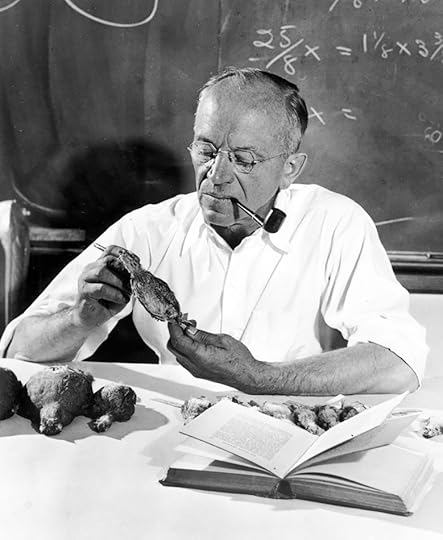
It serves as an anthology of Leopold's observations on nature over many years, not a sequential narrative on natural phenomena, nor thoughts on an imperiled natural world, as with Silent Spring by Rachel Carson, a work often compared to Leopold's.
The author seemingly fashions commentary on every ground squirrel, river otter or sparrow he encounters on his Wisconsin acres, with each a proud & dutiful tenant & each an important contributor to the balance of nature. Leopold raises every chirp of a bird to the level of a chant or a carol and he displays an almost anatomical awareness of every blade of grass, type of weed & obscure flower, linking each of them together as necessary units within the natural world.
Amidst the nostalgia for the experience of a lost wilderness and a tale hearkening back to Paul Bunyan, there is more than a hint of sardonic humor in Leopold's book, commenting that while he is landlord over his acreage, his animal & avian tenants are rather lax about paying rent.
Leopold is not adverse to hunting game but does so with bow & arrow, not a high-powered rifle with a scope. At one point, Aldo Leopold takes aim at a buck with an arrow but misses, the deer scampering away. He reflects wistfully that "the buck & I were both actors in an allegory."
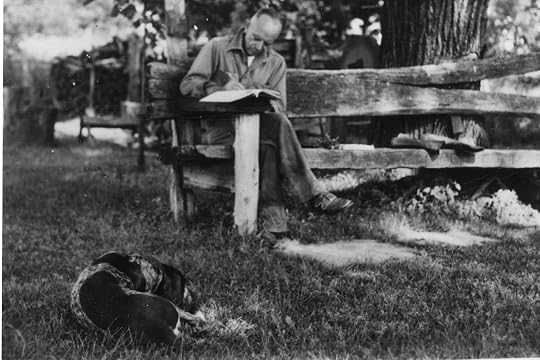
There is a touch of pessimism to some of what Leopold says, as when he declares that "education, I fear is learning to see one thing while going blind to another." He asserts that "non-conformity is the highest evolutionary attainment of social animals." Beyond that, "a good hobby like fly-fishing, may be a solitary revolt against the commonplace, or it may be a joint conspiracy of a congenial group."
And, the author fears the ravages of "the recreation industry & motorized tourism", further commenting that "attempts at conservation are ultimately self-defeating, for to cherish, we must see & fondle and when enough have seen & fondled, there is no wilderness left to cherish. Thus, all history, whether of marsh or marketplace, ends in paradox."
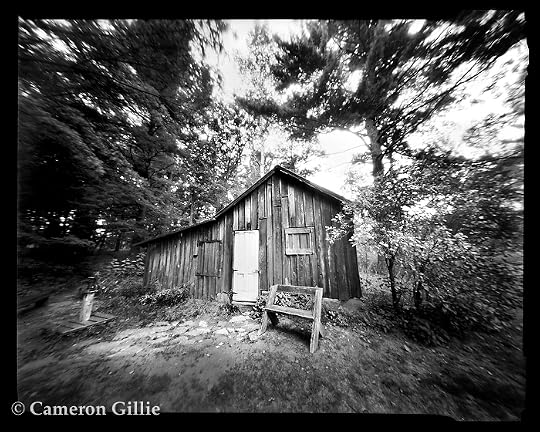
The Sand County Almanac portion of my edition of Leopold's book represents a month by month observation of the seasonal changes on his acreage. The remaining 75 pages include the author's multiple essays, which I found the most compelling part of the book, particularly the "Marshland Elegy" and "The Land Ethic", the latter being Leopold's prescription for mankind's required care of the land.
Aldo Leopold frames his concept of a land ethic thusly: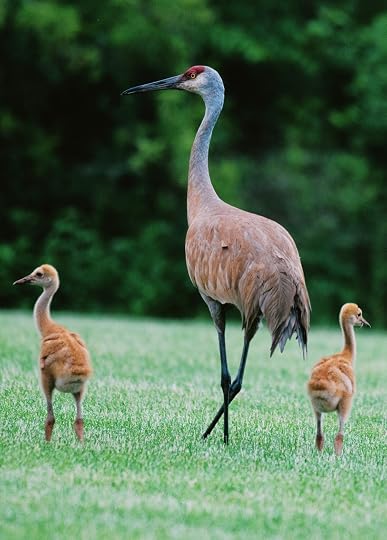
The real fascination of Leopold's book involves his use of language, as with his observation of Sandhill Cranes:
My 2nd-hand, hardcover edition of this book is a gift from my wife. It bears the rather ornate inscription: Property of Norman T. Adams and it was apparently a gift to him in February 1970 from someone named Clyde, who wrote: "I hope you enjoy parts of this as much as I did." There is no telling how much of Aldo Leopold's book Mr. Adams read, nor where it has been in the 56 years since 1970 but I will continue to shepherd this memorable book and will continue to refer to it while it remains in my possession.
*The included black & white illustrations by Charles W. Schwartz are an excellent complement to Leopold's prose.
**My edition of A Sand County Almanac represents the 1966 "enlarged edition" of Aldo Leopold's 1948 work, by Carolyn Clungston Leopold & Luna B. Leopold, including the authors essays on conservation.
***Included within my review are images of Aldo Leopold, his Wisconsin cabin, and the image of Sandhill Cranes.
It serves as an anthology of Leopold's observations on nature over many years, not a sequential narrative on natural phenomena, nor thoughts on an imperiled natural world, as with Silent Spring by Rachel Carson, a work often compared to Leopold's.
The author seemingly fashions commentary on every ground squirrel, river otter or sparrow he encounters on his Wisconsin acres, with each a proud & dutiful tenant & each an important contributor to the balance of nature. Leopold raises every chirp of a bird to the level of a chant or a carol and he displays an almost anatomical awareness of every blade of grass, type of weed & obscure flower, linking each of them together as necessary units within the natural world.
The outstanding scientific discovery of the 20th century is not television or radio, but rather the complexity of the land organism. If the land mechanism as a whole is good, then every part is good, whether we understand it or not. To keep every cog & wheel in place is the first precaution of intelligent tinkering.Aldo Leopold's background was initially in forestry, with a degree from Yale in that field but for the rest of his life, he continued to broaden his scope, seemingly enhancing his embrace of nature with every step he took. His rustic cabin in central Wisconsin and its surrounding 120 acres became a kind of laboratory for lifelong learning and Leopold detailed what he observed with exceedingly poetic imagery.
Ecology is a science that calls for a reversal of specialization; it attempts this feat on a plane perpendicular to Darwin. Conservation is a state of harmony between man & land, with the land as one organism.
Amidst the nostalgia for the experience of a lost wilderness and a tale hearkening back to Paul Bunyan, there is more than a hint of sardonic humor in Leopold's book, commenting that while he is landlord over his acreage, his animal & avian tenants are rather lax about paying rent.
Leopold is not adverse to hunting game but does so with bow & arrow, not a high-powered rifle with a scope. At one point, Aldo Leopold takes aim at a buck with an arrow but misses, the deer scampering away. He reflects wistfully that "the buck & I were both actors in an allegory."
There is a touch of pessimism to some of what Leopold says, as when he declares that "education, I fear is learning to see one thing while going blind to another." He asserts that "non-conformity is the highest evolutionary attainment of social animals." Beyond that, "a good hobby like fly-fishing, may be a solitary revolt against the commonplace, or it may be a joint conspiracy of a congenial group."
And, the author fears the ravages of "the recreation industry & motorized tourism", further commenting that "attempts at conservation are ultimately self-defeating, for to cherish, we must see & fondle and when enough have seen & fondled, there is no wilderness left to cherish. Thus, all history, whether of marsh or marketplace, ends in paradox."
The Sand County Almanac portion of my edition of Leopold's book represents a month by month observation of the seasonal changes on his acreage. The remaining 75 pages include the author's multiple essays, which I found the most compelling part of the book, particularly the "Marshland Elegy" and "The Land Ethic", the latter being Leopold's prescription for mankind's required care of the land.
Aldo Leopold frames his concept of a land ethic thusly:
Stop thinking about decent land-use as solely an economic problem. Examine each question in terms of what is ethically & aesthetically right, as well as what is economically expedient. A thing is right when it tends to preserve the integrity, stability & beauty of the biotic community. It is wrong when it tends otherwise.
The real fascination of Leopold's book involves his use of language, as with his observation of Sandhill Cranes:
The quality of cranes lies, I think, in a higher gamut, as yet beyond the reach of words. The crane & I were sharing our wilderness with the wildest of living fowl. We & they had found a common home in the remote fastness of space & time; we were both back in the Pleistocene. In walking about my acres, it is not only boundaries that disappear but the thought of being bounded.While not a cohesive narrative, The Sand Country Almanac is a fundamentally important & wonderfully uplifting book, one I would place on a bookshelf beside Arctic Dreams by Barry Lopez, as I will do within our own rustic Wisconsin cabin, an hour from Aldo's Leopold's acreage.
My 2nd-hand, hardcover edition of this book is a gift from my wife. It bears the rather ornate inscription: Property of Norman T. Adams and it was apparently a gift to him in February 1970 from someone named Clyde, who wrote: "I hope you enjoy parts of this as much as I did." There is no telling how much of Aldo Leopold's book Mr. Adams read, nor where it has been in the 56 years since 1970 but I will continue to shepherd this memorable book and will continue to refer to it while it remains in my possession.
*The included black & white illustrations by Charles W. Schwartz are an excellent complement to Leopold's prose.
**My edition of A Sand County Almanac represents the 1966 "enlarged edition" of Aldo Leopold's 1948 work, by Carolyn Clungston Leopold & Luna B. Leopold, including the authors essays on conservation.
***Included within my review are images of Aldo Leopold, his Wisconsin cabin, and the image of Sandhill Cranes.

August 9, 2015
Foreword
A Sand County Almanac
January
--January Thaw
February
--Good Oak
March
--The Geese Return
April
--Come High Water
--Draba
--Bur Oak
--Sky Dance
May
--Back from the Argentine
June
--The Alder Fork
July
--Great Possessions
--Prairie Birthday
August
--The Green Pasture
September
--The Choral Copse
October
--Smoky Gold
--Too Early
--Red Lanterns
November
--If I Were the Wind
--Axe-in-Hand
--A Mighty Fortress
December
--Home Range
--Pines above the Snow
--65290
Sketches Here and There
Wisconsin
--Marshland Elegy
--The Sand Counties
--Odyssey
--On a Monument to the Pigeon
--Flambeau
Illinois and Iowa
--Illinois Bus Ride
--Red Legs Kicking
Arizona and New Mexico
--On Top
--Thinking Like a Mountain
--Escudilla
Chihuahua and Sonora
--Guacamaja
--The Green Lagoons
--Song of the Gavilan
Oregon and Utah
--Cheat Takes Over
Manitoba
--Clandeboye
The Upshot
--Conservation Esthetic
--Wildlife in American Culture
--Wilderness
--The Land Ethic
A Sand County Almanac
January
--January Thaw
February
--Good Oak
March
--The Geese Return
April
--Come High Water
--Draba
--Bur Oak
--Sky Dance
May
--Back from the Argentine
June
--The Alder Fork
July
--Great Possessions
--Prairie Birthday
August
--The Green Pasture
September
--The Choral Copse
October
--Smoky Gold
--Too Early
--Red Lanterns
November
--If I Were the Wind
--Axe-in-Hand
--A Mighty Fortress
December
--Home Range
--Pines above the Snow
--65290
Sketches Here and There
Wisconsin
--Marshland Elegy
--The Sand Counties
--Odyssey
--On a Monument to the Pigeon
--Flambeau
Illinois and Iowa
--Illinois Bus Ride
--Red Legs Kicking
Arizona and New Mexico
--On Top
--Thinking Like a Mountain
--Escudilla
Chihuahua and Sonora
--Guacamaja
--The Green Lagoons
--Song of the Gavilan
Oregon and Utah
--Cheat Takes Over
Manitoba
--Clandeboye
The Upshot
--Conservation Esthetic
--Wildlife in American Culture
--Wilderness
--The Land Ethic

November 3, 2024
All conservation of wildness is self-defeating, for to cherish we must see and fondle, and when enough have seen and fondled, there is no wilderness left to cherish.
I loved the first half, in essence the titular Sand County Almanac but then things went Bruce Chatwin (I suppose there are myriad factors influencing this ambivalence). I appreciated the digressions on birdsong and the innumerable chains of being which link even copse of trees.
The second and third sections broaden the scope and become prescriptive. I suppose the lingering assertion that people who want to develop a relationship with nature need to think about amateur study rather than the relatively destructive outdoor activities hunting, fishing and even hiking and camping. Much like a Tractaus for soil conservation there is limited utility in such harsh characterization, I suppose we kick the ladder over. I was unexpectedly sad by the details of his death, helping a neighbor battle a grass fire he was struck by an unexpected heart attack. I’m not sure if I’ll explore more Leopold.
I loved the first half, in essence the titular Sand County Almanac but then things went Bruce Chatwin (I suppose there are myriad factors influencing this ambivalence). I appreciated the digressions on birdsong and the innumerable chains of being which link even copse of trees.
The second and third sections broaden the scope and become prescriptive. I suppose the lingering assertion that people who want to develop a relationship with nature need to think about amateur study rather than the relatively destructive outdoor activities hunting, fishing and even hiking and camping. Much like a Tractaus for soil conservation there is limited utility in such harsh characterization, I suppose we kick the ladder over. I was unexpectedly sad by the details of his death, helping a neighbor battle a grass fire he was struck by an unexpected heart attack. I’m not sure if I’ll explore more Leopold.

August 30, 2012
This is a difficult book to rate.
On the one hand, there is incredible value to be gained from the author's keen sense of observation. The first set of essays, the Sand County Almanac, takes us through a year of observing nature at work on Leopold's farm. He discovers firsthand how certain plants fare better when collocated. He bands chickadees and later discovers the bands in the pellets of a screech owl. He gains broad insights from small things that most of us pass by every day without considering. It's an ode to getting out of the classroom and into the field.
He also supplies us with several formidable quotes and anecdotes on the importance of wilderness and conservation, especially in the later essays. The Flambeau River story (pp. 112-113) and his musings on the hidden uses of adversity (p. 84) are two that especially come to mind.
But Mr. Leopold is also a product of his time, and it shows. He decries the decline of the grizzly (whose numbers have since recovered) but shares a tasty outdoor recipe that uses bear fat. He decries the overhunting of various species, but then goes fishing for rainbow trout and comments with some satisfaction of smoking on a midstream rock while he could hear the trout "kicking in the bed of wet alder leaves at the bottom of the creel" (p. 38). Cruel. In some respects, the work is as much an ode to hunting as to conservation. I don't oppose hunting, but I also feel the author fails to adequately address how hunting holds a proper place in the balance of things.
Leopold also demonstrates substantial hubris towards his fellow man. He mocks a birder who attempts to describe a particular bird call in his log (p. 160), then goes on to admit that he himself will never understand the meaning of the call. Why be so nasty?!? I was personally insulted when he divided humans into four camps, including three types of hunters and one other type, the "non-hunter":
I recognize that he - inevitably - carries assumptions of his own time. I just question whether his message, which was highly appropriate and advanced for his time, still resonates as effectively. It certainly should be required reading for any student of conservation or ecology, in order to understand the historic roots of the movement. For the layperson, though, I for one would rather turn someone on to contemporary nature writers such as Robert Macfarlane or Roger Deakin.
I enjoyed the illustrations of my edition. Any new printing would benefit, I think, from the inclusion of color plates that illuminate key topics such as the loss of biodiversity on the plains.
On the one hand, there is incredible value to be gained from the author's keen sense of observation. The first set of essays, the Sand County Almanac, takes us through a year of observing nature at work on Leopold's farm. He discovers firsthand how certain plants fare better when collocated. He bands chickadees and later discovers the bands in the pellets of a screech owl. He gains broad insights from small things that most of us pass by every day without considering. It's an ode to getting out of the classroom and into the field.
He also supplies us with several formidable quotes and anecdotes on the importance of wilderness and conservation, especially in the later essays. The Flambeau River story (pp. 112-113) and his musings on the hidden uses of adversity (p. 84) are two that especially come to mind.
But Mr. Leopold is also a product of his time, and it shows. He decries the decline of the grizzly (whose numbers have since recovered) but shares a tasty outdoor recipe that uses bear fat. He decries the overhunting of various species, but then goes fishing for rainbow trout and comments with some satisfaction of smoking on a midstream rock while he could hear the trout "kicking in the bed of wet alder leaves at the bottom of the creel" (p. 38). Cruel. In some respects, the work is as much an ode to hunting as to conservation. I don't oppose hunting, but I also feel the author fails to adequately address how hunting holds a proper place in the balance of things.
Leopold also demonstrates substantial hubris towards his fellow man. He mocks a birder who attempts to describe a particular bird call in his log (p. 160), then goes on to admit that he himself will never understand the meaning of the call. Why be so nasty?!? I was personally insulted when he divided humans into four camps, including three types of hunters and one other type, the "non-hunter":
The deer hunter habitually watches the next bend; the duck hunter watches the skyline; the bird hunter watches the dog; the non-hunter does not watch (p. 208).Mr. Leopold, I beg to differ.
I recognize that he - inevitably - carries assumptions of his own time. I just question whether his message, which was highly appropriate and advanced for his time, still resonates as effectively. It certainly should be required reading for any student of conservation or ecology, in order to understand the historic roots of the movement. For the layperson, though, I for one would rather turn someone on to contemporary nature writers such as Robert Macfarlane or Roger Deakin.
I enjoyed the illustrations of my edition. Any new printing would benefit, I think, from the inclusion of color plates that illuminate key topics such as the loss of biodiversity on the plains.

March 22, 2017
This book is a true classic and canonized piece of Nature Literature. Leopold was an ecology scientist at the U of Wisconsin, Madison, who bought a small piece of property in the Sand County region in central Wisconsin, where he and his family would take long weekends and vacations, fixing the place up and enjoying nature.
The essays collected in this amazing book are Leopold's musings and observations on his little chunk of the wilderness, reflecting on everything from sipping coffee outside in the morning as he listens to the litany of chickadees and nuthatches surrounding him in the post-sunrise woods, to the balance of an ecosystem captured in the description of a childhood experience of shooting a wolf. The prose is rich and deep, and draws the reader along into looking at the world through a fresh lens -- a lens that accentuates the ordinary and helps us gain a more proper perspective on life.
I love this book. I've read it many times, and have pushed it onto many a hapless reader . . . including my kids. If you have even a tiny bit of appreciation for nature and the outdoors, you will love this book. That is not something I say about very many of the Nature Lit type books, but this is one. I've taught it many times as part of the reading list in my college Nature Lit course, and have had numerous students tell me they were stunned at how good this book is, and how it changed the way they look at the world around them.
Get it. Read it. It's that simple.... :-)
The essays collected in this amazing book are Leopold's musings and observations on his little chunk of the wilderness, reflecting on everything from sipping coffee outside in the morning as he listens to the litany of chickadees and nuthatches surrounding him in the post-sunrise woods, to the balance of an ecosystem captured in the description of a childhood experience of shooting a wolf. The prose is rich and deep, and draws the reader along into looking at the world through a fresh lens -- a lens that accentuates the ordinary and helps us gain a more proper perspective on life.
I love this book. I've read it many times, and have pushed it onto many a hapless reader . . . including my kids. If you have even a tiny bit of appreciation for nature and the outdoors, you will love this book. That is not something I say about very many of the Nature Lit type books, but this is one. I've taught it many times as part of the reading list in my college Nature Lit course, and have had numerous students tell me they were stunned at how good this book is, and how it changed the way they look at the world around them.
Get it. Read it. It's that simple.... :-)

February 2, 2009
Aldo Leopold's A Sand County Almanac is a compelling blend of beautiful depictions of nature, personal opinion and reflection, and political commentary. Leopold extols the beauty of nature and emphasizes how much humans are a part of it. As members of the natural world, humans have a dramatic effect on the environment, and Leopold does not shy away from this issue. Rather than advocate for total preservation of wilderness, Leopold expresses the value of hunting and using the resources present in the wild. Hunting, he argues, is actually a way to become more attuned to the subtleties of a natural environment. Leopold's commentary about how nature should be used is one of the most striking things about the book, second only to the reverent appreciation of nature that he expresses.
Leopold depicts hunting as a meditative process in which the hunter becomes part of his environment and develops an understanding of and respect for his prey. This seems reasonable, despite my personal instinct that an environmentalist must be against hunting. Of course, Leopold cannot condone all methods of hunting. The new age of “gadgeteers” (214) and the hunters who buy their wares are not in tune with nature. Leopold wonders if they are “absorbing cultural value” or “just feeding minks” with the birds missed by their hasty shots (215). It is interesting to hear someone with such respect for nature also acknowledge that he enjoys killing animals. I didn't particularly respect this position; I am glad to hear that he does not use too many high tech gadgets, and I know that hunting is something of a national pastime, but I can't wrap my mind around it as acceptable unless it is done for subsistence. This is not to say that I haven't enjoyed wild turkey meatballs and venison sausage killed by the local hunters in my town, but hunting seems so barbaric. Yet we are animals with all the instincts that entails, and meat sure does taste good. Somehow I can only approve of hunting when it is done only with tools found in nature and made by hand. Paleolithic hunting methods are pretty much the only ones I can condone, but maybe I need to get over my romanticized ideas about nature. I have always thought that if everything we build our bodies with comes from nature, and we eat animals that have suffered and been tortured, and then we turn their cells into our cells, we are building ourselves out of sorrow.
Leopold depicts hunting as a meditative process in which the hunter becomes part of his environment and develops an understanding of and respect for his prey. This seems reasonable, despite my personal instinct that an environmentalist must be against hunting. Of course, Leopold cannot condone all methods of hunting. The new age of “gadgeteers” (214) and the hunters who buy their wares are not in tune with nature. Leopold wonders if they are “absorbing cultural value” or “just feeding minks” with the birds missed by their hasty shots (215). It is interesting to hear someone with such respect for nature also acknowledge that he enjoys killing animals. I didn't particularly respect this position; I am glad to hear that he does not use too many high tech gadgets, and I know that hunting is something of a national pastime, but I can't wrap my mind around it as acceptable unless it is done for subsistence. This is not to say that I haven't enjoyed wild turkey meatballs and venison sausage killed by the local hunters in my town, but hunting seems so barbaric. Yet we are animals with all the instincts that entails, and meat sure does taste good. Somehow I can only approve of hunting when it is done only with tools found in nature and made by hand. Paleolithic hunting methods are pretty much the only ones I can condone, but maybe I need to get over my romanticized ideas about nature. I have always thought that if everything we build our bodies with comes from nature, and we eat animals that have suffered and been tortured, and then we turn their cells into our cells, we are building ourselves out of sorrow.

October 22, 2017
Aldo Leopold’s A Sand County Almanac is one of the foundational texts of the conservation and environmental movements, a text that now over 70 years past its publication date is still repeatedly commented upon and cited by activists arguing for the preservation and guardianship of the natural world. It has inspired any number of important nature writers, not only because of Leopold’s astoundingly detailed and passionate descriptions of the natural world and its intricacies, but also, and perhaps even more importantly, because of the ethical imperative he argues must define and guide our relationship with land—and by land he means not only the land itself but also all the flora and fauna that live there. More on this in a moment.
The text is divided into three parts: an almanac of Leopold’s observations of the natural world during a year at his farm in Wisconsin; an assortment of occasional essays mostly on his excursions to other parts of the US and Canada; and four essays, in a section appropriately entitled “The Upshot,” that provide the philosophical grounding of his environmental ethics. As a biologist and a professor of wildlife management (the first one at the University of Wisconsin), Leopold brings the eye of the trained scientist to the sensitivity of a far-thinking humanist, an integrated vision that may not seem all that striking now (given the wealth of nature writing in the past several decades, in part spurred by the climate crisis) but was quite revolutionary back in Leopold’s day.
Whatever his startling presentations of the natural world, it’s Leopold’s conception of what he called “a land ethic” that has had such a crucial impact on generations of conservationists and environmentalists. Leopold argued that for most people land was merely property, the only relation economic. In challenging this perspective, Leopold called for extending the boundaries of ethics beyond the human community to the community of the natural world—“soils, waters, plants, and animals, or collectively: the land.” “In short, Leopold writes, “a land ethic changes the role of Homo sapiens from conqueror of the land-community to plain member and citizen of it. It implies respect for his fellow-members, and also respect for the community as such.” At the center of his ethical system was this touchstone: “A thing is right when it ends to preserve the integrity, stability, and beauty of the biotic community. It is wrong when it ends otherwise.”
In the coming dire years wrought by the climate crisis, let’s hope more people (and corporations, if that’s possible) come round to Leopold’s thinking.
The text is divided into three parts: an almanac of Leopold’s observations of the natural world during a year at his farm in Wisconsin; an assortment of occasional essays mostly on his excursions to other parts of the US and Canada; and four essays, in a section appropriately entitled “The Upshot,” that provide the philosophical grounding of his environmental ethics. As a biologist and a professor of wildlife management (the first one at the University of Wisconsin), Leopold brings the eye of the trained scientist to the sensitivity of a far-thinking humanist, an integrated vision that may not seem all that striking now (given the wealth of nature writing in the past several decades, in part spurred by the climate crisis) but was quite revolutionary back in Leopold’s day.
Whatever his startling presentations of the natural world, it’s Leopold’s conception of what he called “a land ethic” that has had such a crucial impact on generations of conservationists and environmentalists. Leopold argued that for most people land was merely property, the only relation economic. In challenging this perspective, Leopold called for extending the boundaries of ethics beyond the human community to the community of the natural world—“soils, waters, plants, and animals, or collectively: the land.” “In short, Leopold writes, “a land ethic changes the role of Homo sapiens from conqueror of the land-community to plain member and citizen of it. It implies respect for his fellow-members, and also respect for the community as such.” At the center of his ethical system was this touchstone: “A thing is right when it ends to preserve the integrity, stability, and beauty of the biotic community. It is wrong when it ends otherwise.”
In the coming dire years wrought by the climate crisis, let’s hope more people (and corporations, if that’s possible) come round to Leopold’s thinking.
September 2, 2017
Wow. Even though my parents owned few books and yet did own this, I never got around to it. And maybe as a child I wouldn't have enjoyed it so much. But now, goodness, I recognize that it belongs on the same shelf as Thoreau, Rachel Carson, Bernd Heinrich, and Michael Perry. The man is indeed a hero for the conservation movement, and writes beautifully.
Wisconsin's wilderness, and the nation's perception of the value wilderness and of diverse ecosystems, owes much to him. We have made progress since his day. Yes, much has been lost with our increasing material wealth and population growth, but much has been gained in our attempts to live more in harmony with nature and to let some of it remain free.
"Like many another treaty of restraint, the pre-dawn pact lasts only as long as darkness humbles the arrogant. It would seem as if the sun were responsible for the retreat of reticence from the world. At any rate, by the time the mists are white over the lowlands, every rooster is bragging... and every corn shock is pretending to be twice as tall as any corn that ever grew. By sun-up every squirrel is exaggerating some fancied indignity to his person, and every jay proclaiming with false emotion about suppositious dangers to society, at this very moment discovered by him."
"Hard years, of course come to pines as they do to men, and the are recorded as shorter thrusts, i.e. shorter spaces between the successive whorls of branches. These spaces, then are an autobiography that he who walks with trees may read at will."
The book is not perfect, as there are references that need bibliographic notes and there are a few unfinished thoughts or incomplete conclusions. Some modern readers might object, too, to the bits about hunting (though Leopold himself seemed a bit ambivalent, as he himself hunts but doesn't approve the methods or aims of most others who do). But it is a classic, and still relevant.
Wisconsin's wilderness, and the nation's perception of the value wilderness and of diverse ecosystems, owes much to him. We have made progress since his day. Yes, much has been lost with our increasing material wealth and population growth, but much has been gained in our attempts to live more in harmony with nature and to let some of it remain free.
"Like many another treaty of restraint, the pre-dawn pact lasts only as long as darkness humbles the arrogant. It would seem as if the sun were responsible for the retreat of reticence from the world. At any rate, by the time the mists are white over the lowlands, every rooster is bragging... and every corn shock is pretending to be twice as tall as any corn that ever grew. By sun-up every squirrel is exaggerating some fancied indignity to his person, and every jay proclaiming with false emotion about suppositious dangers to society, at this very moment discovered by him."
"Hard years, of course come to pines as they do to men, and the are recorded as shorter thrusts, i.e. shorter spaces between the successive whorls of branches. These spaces, then are an autobiography that he who walks with trees may read at will."
The book is not perfect, as there are references that need bibliographic notes and there are a few unfinished thoughts or incomplete conclusions. Some modern readers might object, too, to the bits about hunting (though Leopold himself seemed a bit ambivalent, as he himself hunts but doesn't approve the methods or aims of most others who do). But it is a classic, and still relevant.

April 16, 2022
Somehow, I missed this book, until now.
Although the general public believes that landscape architects design planting plans for homeowners, largely relying on imported ornamental plants, there is a long tradition of environmental stewardship in my profession starting with Olmsted, and continuing through the years.
And, although I studied landscape architecture at the dawn of the environmental movement in the early 1970s, and I read Rachel Carson’s Silent Spring and Ian McHarg’s Design with Nature, among other books that focused on ecological thinking, I was not introduced to A Sand County Almanac. Perhaps my California education thought it too local to the Midwest.
Today, or at least in the recent past, and especially here in the Midwest, I think it is considered basic reading for entering landscape architectural students. I see why. It is an examined recounting of the months of a year, while noting the flora and fauna and, importantly their interactions and connectedness, in central Wisconsin. At the end of the almanac, there is a rousing, passionate call for land ethics.
This book was written in the late 1940s, ahead of its time, for sure! It is easy reading that will make you think. Its core message I’d still relevant, perhaps more so as we wrestle with climate change. I give it 4.5 stars, rounded up to 5.
Although the general public believes that landscape architects design planting plans for homeowners, largely relying on imported ornamental plants, there is a long tradition of environmental stewardship in my profession starting with Olmsted, and continuing through the years.
And, although I studied landscape architecture at the dawn of the environmental movement in the early 1970s, and I read Rachel Carson’s Silent Spring and Ian McHarg’s Design with Nature, among other books that focused on ecological thinking, I was not introduced to A Sand County Almanac. Perhaps my California education thought it too local to the Midwest.
Today, or at least in the recent past, and especially here in the Midwest, I think it is considered basic reading for entering landscape architectural students. I see why. It is an examined recounting of the months of a year, while noting the flora and fauna and, importantly their interactions and connectedness, in central Wisconsin. At the end of the almanac, there is a rousing, passionate call for land ethics.
This book was written in the late 1940s, ahead of its time, for sure! It is easy reading that will make you think. Its core message I’d still relevant, perhaps more so as we wrestle with climate change. I give it 4.5 stars, rounded up to 5.

January 15, 2014
This book provided great inspiration and insight for my current novel-in-progress, which has an environmental element.
It was actually published shortly after the author died of a heart attack, in 1949. Leopold's life was cut far too short, and I can't help but wonder how much further America's conservation efforts might have evolved in the past 50 years had he lived longer. Many of his observations and warnings from the early part of the 1900s still ring true today. In that respect, this book was somewhat of a bittersweet read for me. I read his biography, A Fierce Green Fire, a couple of years ago, and this was a nice complement to that.
In this collection of essays about the land he loved, Leopold shared his views as a conservationist, scientist and observer of life in lovely, often literary, prose that surprised me and hit an emotional chord. His essay, Thinking Like a Mountain, brought a lump to my throat and an ache in my heart as he described how he once participated in the killing of wolves in his "conservation" work for the federal government, and how in doing so he learned what a great mistake and tragedy it was.
"Only the mountain has lived long enough to listen objectively to the howl of a wolf."
It was actually published shortly after the author died of a heart attack, in 1949. Leopold's life was cut far too short, and I can't help but wonder how much further America's conservation efforts might have evolved in the past 50 years had he lived longer. Many of his observations and warnings from the early part of the 1900s still ring true today. In that respect, this book was somewhat of a bittersweet read for me. I read his biography, A Fierce Green Fire, a couple of years ago, and this was a nice complement to that.
In this collection of essays about the land he loved, Leopold shared his views as a conservationist, scientist and observer of life in lovely, often literary, prose that surprised me and hit an emotional chord. His essay, Thinking Like a Mountain, brought a lump to my throat and an ache in my heart as he described how he once participated in the killing of wolves in his "conservation" work for the federal government, and how in doing so he learned what a great mistake and tragedy it was.
"Only the mountain has lived long enough to listen objectively to the howl of a wolf."

September 12, 2010
A thing is right when it tends to preserve the integrity, stability, and beauty of the biotic community. It is wrong when it tends otherwise.
So simple and so direct that one was struck by how obvious these statements are, and yet these words seemed like a newly discovered insight, especially as they came logically after a series of vivid expositions on nature and natural history. Nature is beautiful and if we preserve it, we truly deserve it. If we destroy it, we are killjoys. Simple as that.
A foundational text on environmental ethics, A Sand County Almanac by Aldo Leopold was a master statement of one who spent a lifetime of thinking in terms of nature and who has meditated on the imperiled future of wildlife. Leopold's long experience in the subject made him a credible person to tackle the impending environmental crisis that resulted under the 'care' of man.
In the book, Leopold presented a sound case for the protection of wilderness areas and the flora and fauna inhabiting them. Leopold’s philosophical ideas outlined and prefigured the major ecological strategies of nature tourism, economic valuation of environmental resources, wildlife conservation, biodiversity management, and environmental education. It was the latter that Leopold emphasized as education (and research) is just the thing that can transform the old thinking on the use of natural resource base (utilitarianism) into a modern and progressive thinking on the harmony between man and nature (co-existence). The book was a clamor for an intellectual revolution in ecology; its intelligence was deep and came from a heart and mind so attuned to the daily cycles of birth, growth, vigor, death, reminiscence, and rebirth in nature.
The poetic language was actually a foil for the deep-set values that Leopold harbored while staying in the Sand County. He built up his hermetic ideas into an exposition of an environmental worldview starting from a monthly calendar of natural cycles of plant and animal journeys, to some of the best sketches of nature writing ever put on a canvas, and concluding with an ethical sequence which unfolded like a jamming session of a philosopher in the underbrush of trees.
One’s “prairie birthday” was clearly marked sometime in July:
This of course was a challenge from a proud man, and one could take it up without regret. Reading the prose was in itself a discovery of plant-birthdays when the natural curiosity suddenly flowered, took flight, and aspired for a higher education.
A very fine sensibility to and perception of the natural world, Leopold’s writing was filtered through a powerful lens of human-ecological experience and consciousness. There was a slow internal rhythm to the first two parts of the book (“A Sand County Almanac” and “Sketches Here and There”), but immediacy and freshness lent itself to some of the best passages of nature literature ever written. The prose poetry that alighted on the essays here was awe-inducing.
The middle part was an on-the-road, freestyle riffs on some of the memorable but fast disappearing wild places in America. Each place was unique for some reason, but really each place was the same. They were all found in one and the same location because they sprang from the same idea of something good, something transient, and something we encounter with, even if only once in a lifetime, authentic and humbling gladness. They are “here and there”, all around us, and they are waiting for us. We need to commit them to memory, to record them indelibly, and to believe that they can be lived again.
The final section, "The Upshot", was a cogent argumentation for environmentalism that was not tainted by the usual gloom-and-doom rhetoric. It contained Leopold's dictums on what consists of right and wrong when it comes to human-environment nexus. The “Land Ethic” essay in this last section had been anthologized many times over in scores of books on environmental ethics. I think I own two or three other books where this essay was reprinted.
It was a further achievement of the book that it was able to integrate the principles and concepts of ecology, then a pioneering science, into a style of writing that will be appreciated even by a layman. I recommend this book (actually, shoving it) to nature lovers and naturalists, but really, to general readers who want to escape the inertia of urban living and retreat into the folds of wilderness.
(based on a review posted in my blog 06/2009)
So simple and so direct that one was struck by how obvious these statements are, and yet these words seemed like a newly discovered insight, especially as they came logically after a series of vivid expositions on nature and natural history. Nature is beautiful and if we preserve it, we truly deserve it. If we destroy it, we are killjoys. Simple as that.
A foundational text on environmental ethics, A Sand County Almanac by Aldo Leopold was a master statement of one who spent a lifetime of thinking in terms of nature and who has meditated on the imperiled future of wildlife. Leopold's long experience in the subject made him a credible person to tackle the impending environmental crisis that resulted under the 'care' of man.
In the book, Leopold presented a sound case for the protection of wilderness areas and the flora and fauna inhabiting them. Leopold’s philosophical ideas outlined and prefigured the major ecological strategies of nature tourism, economic valuation of environmental resources, wildlife conservation, biodiversity management, and environmental education. It was the latter that Leopold emphasized as education (and research) is just the thing that can transform the old thinking on the use of natural resource base (utilitarianism) into a modern and progressive thinking on the harmony between man and nature (co-existence). The book was a clamor for an intellectual revolution in ecology; its intelligence was deep and came from a heart and mind so attuned to the daily cycles of birth, growth, vigor, death, reminiscence, and rebirth in nature.
The poetic language was actually a foil for the deep-set values that Leopold harbored while staying in the Sand County. He built up his hermetic ideas into an exposition of an environmental worldview starting from a monthly calendar of natural cycles of plant and animal journeys, to some of the best sketches of nature writing ever put on a canvas, and concluding with an ethical sequence which unfolded like a jamming session of a philosopher in the underbrush of trees.
One’s “prairie birthday” was clearly marked sometime in July:
During every week from April to September there are, on the average, ten wild plants coming into first bloom. In June as many as a dozen species may burst their buds on a single day. No man can heed all of these anniversaries; no man can ignore all of them. He who steps unseeing on May dandelions may be hauled up short by August ragweed pollen; he who ignores the ruddy haze of April elms may skid his car on the fallen corollas of June catalpas. Tell me of what plant-birthday a man takes notice, and I shall tell you a good deal about his vocation, his hobbies, his hay fever, and the general level of his ecological education.
This of course was a challenge from a proud man, and one could take it up without regret. Reading the prose was in itself a discovery of plant-birthdays when the natural curiosity suddenly flowered, took flight, and aspired for a higher education.
A very fine sensibility to and perception of the natural world, Leopold’s writing was filtered through a powerful lens of human-ecological experience and consciousness. There was a slow internal rhythm to the first two parts of the book (“A Sand County Almanac” and “Sketches Here and There”), but immediacy and freshness lent itself to some of the best passages of nature literature ever written. The prose poetry that alighted on the essays here was awe-inducing.
The middle part was an on-the-road, freestyle riffs on some of the memorable but fast disappearing wild places in America. Each place was unique for some reason, but really each place was the same. They were all found in one and the same location because they sprang from the same idea of something good, something transient, and something we encounter with, even if only once in a lifetime, authentic and humbling gladness. They are “here and there”, all around us, and they are waiting for us. We need to commit them to memory, to record them indelibly, and to believe that they can be lived again.
The final section, "The Upshot", was a cogent argumentation for environmentalism that was not tainted by the usual gloom-and-doom rhetoric. It contained Leopold's dictums on what consists of right and wrong when it comes to human-environment nexus. The “Land Ethic” essay in this last section had been anthologized many times over in scores of books on environmental ethics. I think I own two or three other books where this essay was reprinted.
It was a further achievement of the book that it was able to integrate the principles and concepts of ecology, then a pioneering science, into a style of writing that will be appreciated even by a layman. I recommend this book (actually, shoving it) to nature lovers and naturalists, but really, to general readers who want to escape the inertia of urban living and retreat into the folds of wilderness.
(based on a review posted in my blog 06/2009)

May 9, 2021
First published in 1949, this is a 3-part series of essays by prominent wilderness-advocate Aldo Leopold. Part 1, A Sand County Almanac, is Leopold's month-by-month observations on his Wisconsin farm. Parts 2 and 3, Sketches Here and There and The Upshot, are essays he wrote about his ideas on land use and wildlife conservation.
Personally, I thought Part 1 was the best. The monthly info was kind of nice, although not nearly as charming as Hal Borland's lesser-known Beyond Your Doorstep: A Handbook to the Country (published in 1962). Borland's observations were more complete and wide-ranging (and is much more than a monthly accounting) and gave a better feeling for what his farm was like than Leopold's. But this book became a chore to read in Parts 2 and 3 when he gives his prescriptions for the issues of the day. Part 2 especially reminded me of a saying I once heard that an environmentalist is someone who already has his cabin in the woods (or farm in the country, in this case) and complains about the more recent arrivals than himself. And Part 3 just sounded seriously outdated - which makes sense since it was written 70 years ago.
I don't recommend this book simply because there are much better options. If you're interested in outdoor writing because you want a little escape, I highly recommend the above mentioned Borland book, or perhaps A Naturalist Goes Fishing if you're into that. If you're looking for a travelogue-of-sorts of some of our environmental messes/challenges, I recommend John McPhee's The Control of Nature. If you're looking for more serious histories about environmental problems I'll offer several suggestions: Nature Wars, Engineering Eden, Four Fish, or Megafire. If you don't mind a little controversy, I'd also recommend The New Wild as a very thought-provoking read. After all, there's only so much time to read - make it count.
Personally, I thought Part 1 was the best. The monthly info was kind of nice, although not nearly as charming as Hal Borland's lesser-known Beyond Your Doorstep: A Handbook to the Country (published in 1962). Borland's observations were more complete and wide-ranging (and is much more than a monthly accounting) and gave a better feeling for what his farm was like than Leopold's. But this book became a chore to read in Parts 2 and 3 when he gives his prescriptions for the issues of the day. Part 2 especially reminded me of a saying I once heard that an environmentalist is someone who already has his cabin in the woods (or farm in the country, in this case) and complains about the more recent arrivals than himself. And Part 3 just sounded seriously outdated - which makes sense since it was written 70 years ago.
I don't recommend this book simply because there are much better options. If you're interested in outdoor writing because you want a little escape, I highly recommend the above mentioned Borland book, or perhaps A Naturalist Goes Fishing if you're into that. If you're looking for a travelogue-of-sorts of some of our environmental messes/challenges, I recommend John McPhee's The Control of Nature. If you're looking for more serious histories about environmental problems I'll offer several suggestions: Nature Wars, Engineering Eden, Four Fish, or Megafire. If you don't mind a little controversy, I'd also recommend The New Wild as a very thought-provoking read. After all, there's only so much time to read - make it count.

September 15, 2008
it is a shame that some of the most important and beloved books become also the most neglected. taken for granted, these works are thus robbed of both majesty and worth (to say nothing of efficacy). it's as if certain books are deemed classic and then left to impart their wisdoms from atop a dusty shelf.
a sand county almanac is roundly acknowledged as one of the most seminal titles in the nature/conservation/environmental writing genre, and like all great books it remains imperatively relative despite the passing years. leopold's writing is consistently vivid and animated, but it is in the final four essays that it nears brilliance in clarity and reasoning. in a time of gross disharmony over environmental policy, one would be well served in (re)reading this book to consider a well-delineated perspective articulated soundly.
written in the late 1940's:
...but wherever the truth may lie, this much is crystal-clear: our bigger-and-better society is now like a hypochondriac, so obsessed with its own economic health as to have lost the capacity to remain healthy. the whole world is so greedy for more bathtubs that it has lost the stability necessary to build them, or even to turn off the tap. nothing could be more salutary at this stage than a little healthy contempt for a plethora of material blessings.
~
a system of conservation based solely on economic self-interest is hopelessly lopsided. it tends to ignore, and thus eventually to eliminate, many elements in the land community that lack commercial value, but that are (as far as we know) essential to its healthy functioning. it assumes, falsely, i think, that the economic parts of the biotic clock will function without the uneconomic parts.
~
ability to see the cultural value of wilderness boils down, in the last analysis, to a question of intellectual humility. the shallow-minded modern who has lost his rootage in the land assumes that he has already discovered what is important; it is such who prate of empires, political or economic, that will last a thousand years.
a sand county almanac is roundly acknowledged as one of the most seminal titles in the nature/conservation/environmental writing genre, and like all great books it remains imperatively relative despite the passing years. leopold's writing is consistently vivid and animated, but it is in the final four essays that it nears brilliance in clarity and reasoning. in a time of gross disharmony over environmental policy, one would be well served in (re)reading this book to consider a well-delineated perspective articulated soundly.
written in the late 1940's:
...but wherever the truth may lie, this much is crystal-clear: our bigger-and-better society is now like a hypochondriac, so obsessed with its own economic health as to have lost the capacity to remain healthy. the whole world is so greedy for more bathtubs that it has lost the stability necessary to build them, or even to turn off the tap. nothing could be more salutary at this stage than a little healthy contempt for a plethora of material blessings.
~
a system of conservation based solely on economic self-interest is hopelessly lopsided. it tends to ignore, and thus eventually to eliminate, many elements in the land community that lack commercial value, but that are (as far as we know) essential to its healthy functioning. it assumes, falsely, i think, that the economic parts of the biotic clock will function without the uneconomic parts.
~
ability to see the cultural value of wilderness boils down, in the last analysis, to a question of intellectual humility. the shallow-minded modern who has lost his rootage in the land assumes that he has already discovered what is important; it is such who prate of empires, political or economic, that will last a thousand years.

May 24, 2007
Are you one of those people who actually likes to read Thoreau? Well then you’re missing out! Aldo Leopold is sooooo much better. Leopold’s writing is poetic yet it also calls the common person to action. Likewise Leopold walks the walk when it comes to protecting the environment. While this book didn’t pass the random page test, if you like authors like Thoreau, then you should definitely check out The Sand County Almanac, which is the bible to environmentalists. First Page: There are some who can live without wild things, and some who cannot. These essays are the delights and dilemmas of one who cannot…the opportunity to see geese is more important than television, and the chance to find a pasque-flower is a right as inalienable as free speech. Page 20: Is education possibly a process of trading awareness for things of lesser worth? The goose who trades his is soon a pile of feathers. If you are a die-hard environmentalist (or you just like to read poetic things) this book is for you.

April 6, 2022
It is safe to say that Aldo Leopold would have hated our modern world. This book was published in 1949 and already he was lamenting the vanishing wilderness, the intentional or accidental extermination of wildlife, and the invasion of field and forest by tourists and day-trippers. As more and more people crowded once-pristine areas, more roads were built to give them access, which only encouraged even more people to come, in a never-ending cycle of destruction. Politicians were of little help, then or now, because they will accede to the wishes of industry to dam rivers or lease public lands for timber, or they will support the public clamoring for easier access to parks, bringing along with them the rat race they sought to get away from.
A few years back I read an article about the ranchers who lease government land to pasture their cattle. They mocked government oversight, claiming that their families had been doing this for a hundred years, and knew far more about conservation than the distant bureaucrats. However, as this book shows, and I am sure it is still true today, their idea of conservation is entirely based on their own self interest; they will do the minimum possible to maintain the land in a condition to support grazing, and if their cattle destroy the stream banks and pollute the water, it is not their responsibility and they will just move on to new locations. Any requests made to consider the larger ecological impacts of their actions will be met by them sticking their hands out – they will not lift a finger for the greater good unless they are paid for it.
And yet, this book had a major impact on conservation efforts. It is one of the foundational texts of the modern movement to preserve wild places, and opened people’s eyes to understanding that short term selfishness will have long term consequences, and that plants and animals should not be considered as simply impediments to progress. Because of this book the conservation movement got a major boost; new groups were formed that used their money and organization to speak the language of lobbying that politicians understand. Working with government and university biologists and wildlife experts they achieved some notable successes in setting aside wilderness lands and adding sustainability concerns to capacity planning for national parks and recreation areas.
It was also this book that impressed on people the concept of sustainability through balance. If you kill all the predators their prey – such as deer or antelope – will reproduce beyond the carrying capacity of the land. They will eat everything in reach, destroying saplings, stripping bark, damaging trees to get to the leaves, and grazing down to the bare earth, increasing erosion and runoff into streams. Many of them will die anyway, slow deaths from hunger and exposure, since in their emaciated state they cannot survive winters. Even if the predators are re-introduced it takes decades for the balance to be re-established. As Leopold memorably describes it, “Everyone knows, for example, that the autumn landscape in the north woods is the land, plus a red maple, plus a ruffled grouse. In terms of conventional physics, the grouse represents only a millionth of either the mass or the energy of an acre. Yet subtract the grouse and the whole thing is dead. An enormous amount of some kind of motive power has been lost.” (p. 122)
The book is beautifully written, often with a sad, elegiac tone as Leopold recounts the wide open spaces of his youth, many of which he cannot bear to return to since he knows what happened to them in the succeeding decades. These early memories took place in the 1910s and 20s, and by the 40s the places had already been degraded by roads, housing tracts, and tourist attractions. It is painful for the reader to consider what they must be like today, filled with strip malls and fast food places, loud music, trash, beer cans everywhere, and the only animals around being pigeons, seagulls, and aggressive squirrels grown used to being fed by people.
Leopold has a remarkable writing style, which I found a pleasure to read. He explains what he sees, then places it into its larger environmental larger context, and then proceeds to enliven the scenes with endearing commentary. It is difficult to find the right words to describe what he does in these instances. It is clearly a kind of anthropomorphism, but one that attributes human characteristics without ever implying that there is anything human about these creatures. For instance, “What we actually find is beyond predicting: a rabbit, suddenly yearning to be elsewhere; a woodcock, fluttering his disclaimer; a cock pheasant, indignant over wetting his feathers in the grass,” (p. 40) or “It is on some, but not all, of these misty autumn daybreaks that one may hear the chorus of the quail. The silence is suddenly broken by a dozen contralto voices, no longer able to restrain their praise of the day to come.” (p. 49) This kind of human-like attribution gives the reader a clear picture of the scene without ever turning the animals into human surrogates. No wonder his style has been copied by legions of nature writers.
He was also an avid fisherman and hunter, and saw no conflict between these and his conservationist views. From his perspective it was all about maintaining balance, and a healthy forest or river has enough surplus capacity to sustain a reasonable amount of hunting and fishing. The problem is that we are not good at managing things like this; for instance, the national parks have a dual mandate: protect the wild spaces and promote tourism. You can’t do both well.
He is often charmingly self-deprecating, humorously recounting his own mistakes, real or imagined. For instance, during a walk in the hours before dawn, “when a flock of bluebills, pitching pondward, tears the dark silk of heaven in one long rending nose-dive, you catch your breath at the sound, but there is nothing to see except stars. This same performance, in daytime, would have to be looked at, shot at, missed, and then hurriedly fitted with an alibi.” (p. 55)
If you enjoy nature writing and haven’t yet read this book, you should definitely put it on your reading list. It is a classic, but a living classic, as fresh and entertaining today as it was when it was published, and his commentary on preserving nature is as valid and important as ever.
A few years back I read an article about the ranchers who lease government land to pasture their cattle. They mocked government oversight, claiming that their families had been doing this for a hundred years, and knew far more about conservation than the distant bureaucrats. However, as this book shows, and I am sure it is still true today, their idea of conservation is entirely based on their own self interest; they will do the minimum possible to maintain the land in a condition to support grazing, and if their cattle destroy the stream banks and pollute the water, it is not their responsibility and they will just move on to new locations. Any requests made to consider the larger ecological impacts of their actions will be met by them sticking their hands out – they will not lift a finger for the greater good unless they are paid for it.
And yet, this book had a major impact on conservation efforts. It is one of the foundational texts of the modern movement to preserve wild places, and opened people’s eyes to understanding that short term selfishness will have long term consequences, and that plants and animals should not be considered as simply impediments to progress. Because of this book the conservation movement got a major boost; new groups were formed that used their money and organization to speak the language of lobbying that politicians understand. Working with government and university biologists and wildlife experts they achieved some notable successes in setting aside wilderness lands and adding sustainability concerns to capacity planning for national parks and recreation areas.
It was also this book that impressed on people the concept of sustainability through balance. If you kill all the predators their prey – such as deer or antelope – will reproduce beyond the carrying capacity of the land. They will eat everything in reach, destroying saplings, stripping bark, damaging trees to get to the leaves, and grazing down to the bare earth, increasing erosion and runoff into streams. Many of them will die anyway, slow deaths from hunger and exposure, since in their emaciated state they cannot survive winters. Even if the predators are re-introduced it takes decades for the balance to be re-established. As Leopold memorably describes it, “Everyone knows, for example, that the autumn landscape in the north woods is the land, plus a red maple, plus a ruffled grouse. In terms of conventional physics, the grouse represents only a millionth of either the mass or the energy of an acre. Yet subtract the grouse and the whole thing is dead. An enormous amount of some kind of motive power has been lost.” (p. 122)
The book is beautifully written, often with a sad, elegiac tone as Leopold recounts the wide open spaces of his youth, many of which he cannot bear to return to since he knows what happened to them in the succeeding decades. These early memories took place in the 1910s and 20s, and by the 40s the places had already been degraded by roads, housing tracts, and tourist attractions. It is painful for the reader to consider what they must be like today, filled with strip malls and fast food places, loud music, trash, beer cans everywhere, and the only animals around being pigeons, seagulls, and aggressive squirrels grown used to being fed by people.
Leopold has a remarkable writing style, which I found a pleasure to read. He explains what he sees, then places it into its larger environmental larger context, and then proceeds to enliven the scenes with endearing commentary. It is difficult to find the right words to describe what he does in these instances. It is clearly a kind of anthropomorphism, but one that attributes human characteristics without ever implying that there is anything human about these creatures. For instance, “What we actually find is beyond predicting: a rabbit, suddenly yearning to be elsewhere; a woodcock, fluttering his disclaimer; a cock pheasant, indignant over wetting his feathers in the grass,” (p. 40) or “It is on some, but not all, of these misty autumn daybreaks that one may hear the chorus of the quail. The silence is suddenly broken by a dozen contralto voices, no longer able to restrain their praise of the day to come.” (p. 49) This kind of human-like attribution gives the reader a clear picture of the scene without ever turning the animals into human surrogates. No wonder his style has been copied by legions of nature writers.
He was also an avid fisherman and hunter, and saw no conflict between these and his conservationist views. From his perspective it was all about maintaining balance, and a healthy forest or river has enough surplus capacity to sustain a reasonable amount of hunting and fishing. The problem is that we are not good at managing things like this; for instance, the national parks have a dual mandate: protect the wild spaces and promote tourism. You can’t do both well.
He is often charmingly self-deprecating, humorously recounting his own mistakes, real or imagined. For instance, during a walk in the hours before dawn, “when a flock of bluebills, pitching pondward, tears the dark silk of heaven in one long rending nose-dive, you catch your breath at the sound, but there is nothing to see except stars. This same performance, in daytime, would have to be looked at, shot at, missed, and then hurriedly fitted with an alibi.” (p. 55)
If you enjoy nature writing and haven’t yet read this book, you should definitely put it on your reading list. It is a classic, but a living classic, as fresh and entertaining today as it was when it was published, and his commentary on preserving nature is as valid and important as ever.

March 17, 2024
“There are some who can live without wild things, and some who cannot. These essays are the delights and dilemmas of one who cannot… We of the minority see a law of diminishing returns in progress; our opponents do not.”
Some of my favorite writing is contained within these essays: stunning, intelligent, nostalgic, artistic, meticulously-crafted lines that continued from the first page to the last beautiful sentence. I was at once filled with wonder, then with a tragic sense of loss, moved beyond my expectations by the heartbreaking simplicity and overwhelming significance of the ideas contained within this too short book.
“If I were to tell a preacher of the adjoining church that the road crew has been burning history books in his cemetery, under the guise of mowing weeds, he would be amazed and uncomprehending. How could a weed be a book?…
It might be wise to prohibit at once all teaching of real botany and real history, lest some future citizen suffer qualms about the floristic price of his good life.”
A pivotal piece of environmentalist literature, A Sand County Almanac does many things, and all of them with extreme care and precision. The first half of the text comprises a walk through nature of sorts, snippets of life on Aldo Leopold’s farm throughout the months and seasons. Interspersed between descriptions of the various inhabitants of his farm are explorations of humankind’s—with an emphasis on the local and national—relationship with the Land.
“When we see land as a community to which we belong, we may begin to use it with love and respect.”
Leopold, who in the latter half of this book defines in more direct terms the idea of a “land ethic”, shares within these first intimate and reflective passages his personal philosophy concerning the nature of wilderness, the biotic community as a whole, and how we as a species can be a better member of it. He does so not only through showcasing the beauty of the land and wildlife he so obviously cherishes, but through a candid look at the effect we have thus far had on the natural world.
“What a thousand acres of Silphiums looked like when they tickled the bellies of the buffalo is a question never again to be answered, and perhaps not even asked.”
Leopold does not simply philosophize whether or not we can live amongst nature and restore it, nor does he unilaterally demonize those who are imperfect members of this biotic community. He builds within the reader a great respect and understanding for the shift in mindset we must undertake in order to become better as a people, as an environmental neighbor, and as inhabitants of a planet that gives us everything.
Being myself a lover of nature, a gardener, and an Earth dweller amongst other things, this book was perfectly engineered to grab me and not let go. It has managed to dig its way under my skin, where its presence shall remain. Over the months I have spent slowly reading this book, it has sprouted within me renewed love, reverence, and fierce protectiveness of all aspects of our world. It has inspired me to continue listening to the songs of small birds who call in the night, and to cheer on the slow growing tree, to remember that I am a small, important piece of a much grander whole.
Some of my favorite writing is contained within these essays: stunning, intelligent, nostalgic, artistic, meticulously-crafted lines that continued from the first page to the last beautiful sentence. I was at once filled with wonder, then with a tragic sense of loss, moved beyond my expectations by the heartbreaking simplicity and overwhelming significance of the ideas contained within this too short book.
“If I were to tell a preacher of the adjoining church that the road crew has been burning history books in his cemetery, under the guise of mowing weeds, he would be amazed and uncomprehending. How could a weed be a book?…
It might be wise to prohibit at once all teaching of real botany and real history, lest some future citizen suffer qualms about the floristic price of his good life.”
A pivotal piece of environmentalist literature, A Sand County Almanac does many things, and all of them with extreme care and precision. The first half of the text comprises a walk through nature of sorts, snippets of life on Aldo Leopold’s farm throughout the months and seasons. Interspersed between descriptions of the various inhabitants of his farm are explorations of humankind’s—with an emphasis on the local and national—relationship with the Land.
“When we see land as a community to which we belong, we may begin to use it with love and respect.”
Leopold, who in the latter half of this book defines in more direct terms the idea of a “land ethic”, shares within these first intimate and reflective passages his personal philosophy concerning the nature of wilderness, the biotic community as a whole, and how we as a species can be a better member of it. He does so not only through showcasing the beauty of the land and wildlife he so obviously cherishes, but through a candid look at the effect we have thus far had on the natural world.
“What a thousand acres of Silphiums looked like when they tickled the bellies of the buffalo is a question never again to be answered, and perhaps not even asked.”
Leopold does not simply philosophize whether or not we can live amongst nature and restore it, nor does he unilaterally demonize those who are imperfect members of this biotic community. He builds within the reader a great respect and understanding for the shift in mindset we must undertake in order to become better as a people, as an environmental neighbor, and as inhabitants of a planet that gives us everything.
Being myself a lover of nature, a gardener, and an Earth dweller amongst other things, this book was perfectly engineered to grab me and not let go. It has managed to dig its way under my skin, where its presence shall remain. Over the months I have spent slowly reading this book, it has sprouted within me renewed love, reverence, and fierce protectiveness of all aspects of our world. It has inspired me to continue listening to the songs of small birds who call in the night, and to cheer on the slow growing tree, to remember that I am a small, important piece of a much grander whole.

July 2, 2021
A celebration of the wilderness and wildlife as well as a cri de coeur mourning the on-going loss of habitats and species, Aldo Leopold’s "A Sand County Almanac" belongs right up there with "Walden" as a piece of brilliant philosophical nature writing and with "Silent Spring" as a desperate call to ecological arms. Every page brims with beautiful prose, wry wit, detailed observation, and a love of the natural world.
A couple nits: I am not a hunting/fishing fan, so the parts of the book that dealt with these topics were a bit lost on me; also, the final chapters of the book (Part III: The Upshot), while required reading because of their vital ideas about ethical land conservation, are a bit drier than the preceding sections.
It could also be interesting to read a version of this book annotated with updates about the state of some of the topics today. Some ecological areas of concern expressed here have no doubt gotten worse, while others--bolstered perhaps by warnings coming from visionaries such as Leopold and books such as his--may have improved. For example, Leopold states that (presumably circa 1948), there are “6000 grizzlies officially reported as remaining in areas owned by the United States, 5000 (of them) in Alaska” (198). A quick Google search (7/2/21) reveals that there are currently 1500 in the lower 48 (so 500 more than during Leopold’s time) but 30,000 in Alaska (6x more!).
I am now excited to pay a visit the Aldo Leopold Foundation (https://www.aldoleopold.org/) up in Baraboo, WI. I’m guessing there will be a lot more current information there about the state of things Leopold was concerned about in his day, and I look forward to learning more about that and about Leopold himself.
Meantime, I am so happy to have finally “discovered” this masterpiece, which has been on my mental want-to-read list since the 1980s (!). Don’t wait as long as I did to get to it. It is essential reading for every citizen who appreciates lovely writing that speaks to the soul, the heart, and the mind and who cares about the fate of our natural world.
A couple nits: I am not a hunting/fishing fan, so the parts of the book that dealt with these topics were a bit lost on me; also, the final chapters of the book (Part III: The Upshot), while required reading because of their vital ideas about ethical land conservation, are a bit drier than the preceding sections.
It could also be interesting to read a version of this book annotated with updates about the state of some of the topics today. Some ecological areas of concern expressed here have no doubt gotten worse, while others--bolstered perhaps by warnings coming from visionaries such as Leopold and books such as his--may have improved. For example, Leopold states that (presumably circa 1948), there are “6000 grizzlies officially reported as remaining in areas owned by the United States, 5000 (of them) in Alaska” (198). A quick Google search (7/2/21) reveals that there are currently 1500 in the lower 48 (so 500 more than during Leopold’s time) but 30,000 in Alaska (6x more!).
I am now excited to pay a visit the Aldo Leopold Foundation (https://www.aldoleopold.org/) up in Baraboo, WI. I’m guessing there will be a lot more current information there about the state of things Leopold was concerned about in his day, and I look forward to learning more about that and about Leopold himself.
Meantime, I am so happy to have finally “discovered” this masterpiece, which has been on my mental want-to-read list since the 1980s (!). Don’t wait as long as I did to get to it. It is essential reading for every citizen who appreciates lovely writing that speaks to the soul, the heart, and the mind and who cares about the fate of our natural world.
February 12, 2013
In honor of re-reading this book I take an hour walk in my neighborhood before I write my review. Behind the loud barking of too many dogs and below the many paved roads and above the blooming non-native eucalyptus and acacia I hear the trilling of the junco and call of red shouldered hawk. I see light sparkling on a natural stream that flows open to the air. I smell the Douglas fir, and I feel the sun pouring out her loving warmth and light. I envision bat houses and blooming native plants at the too perfect grounds of the Mormon temple, and I make a ritual out of speaking to the man who is digging up long untouched soil to redo a fence. I mourn at the spot where wild honeybees have been evicted from the hollow of a eucalyptus tree and I admire the honeycombs the bees had built.
Let Aldo Leopold speak to you, and who knows what you might notice in your neighborhood. I'm planning to attend a gathering near Point Reyes in one month, Geography of Hope, and this year's inspiration behind the gathering is Aldo Leopold's land ethic. We will see a film called "Green Fire," and I can't wait to be with others who are still inspired by this man who lived 1887-1948. Deep Green Passion, here I come.
A quote from Mr Leopold: "One of the penalties of an ecological education is that one lives alone in a world of wounds." (p. 183) That penalty also includes waves of pure joy.
Let Aldo Leopold speak to you, and who knows what you might notice in your neighborhood. I'm planning to attend a gathering near Point Reyes in one month, Geography of Hope, and this year's inspiration behind the gathering is Aldo Leopold's land ethic. We will see a film called "Green Fire," and I can't wait to be with others who are still inspired by this man who lived 1887-1948. Deep Green Passion, here I come.
A quote from Mr Leopold: "One of the penalties of an ecological education is that one lives alone in a world of wounds." (p. 183) That penalty also includes waves of pure joy.

December 29, 2013
I want to tie this book to my heart like a kite and fly it daily. I want to know my grandfather and father found Leopold long before I did. I want the chance to talk to them about it, about conservation, about the way they taught me so much by letting me watch the way they loved and respected the woods, the lake, the pristine heartbeat of our wild places. I want to memorize full chapters to be able to recite them to the trail on long runs, my legs becoming one with the timeless stories only trees can tell.
[Five brilliant stars for a voice to move, and save, mountains.]
[Five brilliant stars for a voice to move, and save, mountains.]
Displaying 1 - 30 of 2,778 reviews