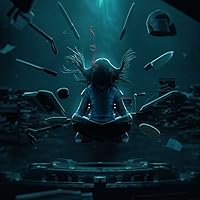
A routine hyperspace jump went catastrophically wrong leaving the Sarafina, a Camel II class trader, dead in space with all of the crew other than the pilot in coldsleep. The pilot, Gregor, has to restore power and save the rest of the crew... and together they have to find out why once populated worlds have been wiped clean of humanity.
Join the crew of the Sarafina in a battle for survival for themselves and the rest of humanity.
I got a free copy of this if I promised a fair review so…
So, it was a fun read with a pretty good story but personally I feel it could be better here and there. I'm not a writer or an editor so I cannot with any certainty say what or how can be improved. There were places I would have loved a bit more detail, history, description (at the end of the book I still don't have a clear picture of the Sarafina in my head: somewhat streamlined and oval shaped is all.). And there were places I think the story focused a bit too long on things (Fumi's death comes to mind) But I understand these things are difficult to balance and probably different for every reader.
The ending is open with lots of things untold, so if there is a sequel someday, I’d certainly love to read it.
Esta es la historia de Gregor un expiloto que decide cambiar su vida y tomar un nuevo rumbo, pero todo se complica cuando la vida tranquila que cree que seria tranquila se mezcla en una aventura que lo lleva a una dura batalla por salvar a la humanidad junto a la tripulación de su nave espacial.
El autor presenta una historia muy interesante de ciencia ficción en el espacio, han pasado 100 años desde que la humanidad ha ido dominada por una colonia de parásitos y ahora nos muestra un panorama post apocalíptico, hace un buen desarrollo de la historia y maneja bien a los personajes en este entorno en el que se desarrollan logrando incluso que te entristezcas por ciertas situaciones.
El único detalle es que las descripciones tienen algunas fallas por lo que no siempre se comprende el diseño de ciertas cosas y siento que se pudo desarrollar mejor a los personajes pero en general es una historia con bastante potencial.
This is the story of Gregor, an ex-pilot who decides to change his life and take a new course, but everything gets complicated when the quiet life that he thinks would be calm mixes up in an adventure that leads him to a tough battle to save humanity together. to the crew of his spaceship.
The author presents a very interesting science fiction story in space, 100 years have passed since humanity has been dominated by a colony of parasites and now he shows us a post-apocalyptic panorama, he develops the story well and handles well the characters in this environment in which they develop, even making you saddened by certain situations.
The only detail is that the descriptions have some flaws, so the design of certain things is not always understood and I feel that the characters could have been developed better, but in general it is a story with a lot of potential.
When I first started reading this book I expected it to be the typical science fiction book, but I was surprised to see that it was not. I loved it and the ethnic the characters have about what they have to do. I think it added to the personality of the characters. I felt bad to see Fumi die but I understand why she had too. All in all the book should be a series, maybe an audiobook with multiple readers and maybe sounds like a dramatization. I hope to see more in line of books. Thank you for sharing this with me.
With Misjump, Mark Long, er, jumps, into the realm of sci-fi novel writing. Set some time in the future at some place in both this and an alternate universe (to be explained later), Misjump follows the crew of a small interstellar trading craft named the Sarafina.
Getting right into the action, we meet our hero Gregor on the very first page, regaining consciousness after something has happened to the Sarafina during a jump. Think of a jump as a form of warp travel, where, for two weeks after initiating a jump, a ship and its crew exist outside the normal time-space realm. Many bad things can happen during a jump, as Gregor points out several times and for the Sarafina, this “misjump” flings them into an alternate universe and back about 100 years behind their time. Gregor, a former naval officer, is the only one awake for the jump and contrives to figure out what happened and what needs to be done to fix it. The first step is getting back power-for it seems that the incident/accident knocked out all electrical power around the ship. The second step is to stabilize the crew in cold sleep until he can restart main power and awaken them. Using a powercell that survived the incident, Gregor stabilizes the beds of all the crew except one, Fumi. He then macgyvers a solution to restart main power using all the powercells he can find aboard ship. (It seems the incident drained all the electrical systems aboard ship of their power.) We meet most of the crew during this operation - Fumi, Lori (the ship’s medic), and Ivo, a jack of all trades but also cross-trained in engineering.
After getting main power back, Gregor returns to warm up the crew from cold sleep. Lori is first, as the ship’s medic she can do a better job of warming up the others and helping Fumi, whose capsule is still blinking warning lights. Lori wakes the other crew and we finally get to meet all of them. In addition to the four already up, we meet Jax, who specialized in security and cargo handling. Fumi is the ship’s admin and legal specialist, and also has implants in her brain, which play an important part later on. Last is Meilin, the ship IT specialist (and later revealed to be the purser, as well) whose coffee is powerful and bitter, leading Lori to wonder if IT specialists lived on the stuff - kind of like this universe’s IT specialists. After all except for Fumi are awake, we find out that the Sarafina had been attempting to jump from Neuholme to their next destination. After exploring options, the crew decides to jump back to Neuholme and seek help. And here we find that jump points are fixed, an important consideration later on.
On returning to Neuholme the crew discovers the planet is dead-almost literally. Nothing above an insect appears to be alive. Scraping together bits and pieces of information, they discover the truth about the misjump into the past and an alternate universe. They also grab any essential supplies, including nanites to help with reviving Fumi. Due to the old tech and dead planet, there is no way to revive Fumi that is guaranteed to work. Adapting the nanites they found to try to revive her results in an unexpected result - she becomes the ship’s AI system. An interesting philosophical point here can the consciousness of a person be uploaded into a computer? For Fumi seems to exhibit all the traits she had as a real person.
With the ship restocked and refueled, the next decision is where to go next? They decided to go to Ironstone, an industrial planet to trade for supplies and information they couldn’t get at Nueholme. But because of the desolation, it is decided to go in “hot”, in case an unpleasant surprise awaits - and it does. Coming through the jump point to Ironstone they are immediately attacked. But with their preparations they are able to escape via the next jump point to Klondike, an old mining system and colony. There they find allies and learn a little more about the situation in this alternate universe. A form of life has invaded this universe that converts living beings into something akin to zombies. This colony has been able to keep the invaders at bay for a long time. Trading information (including the ability to duplicate AIs (and people) for raw material and labor, the two sides join forces to build jump ships and system defense boats - with only a minor rebellion among the colonists to snag their plans.
There are several action points after this - the invaders (called Greenies) attempt to take over Klondike but are repulsed at the jump point. After this the Sarafina, leading a ragtag group of ships (cue Battlestar Galactica music) returns to Ironstone in an attempt to reclaim the planet. Although initially successful, the Sarafina loses another crew member, Ivo. But he had been duplicated and is reunited with Fumi (turns out they were a thing).
Here this chapter of the story ends, leaving us with questions: 1) several times the book asserts that you are in Tau space (the jump space) for 6-8 days after initiating a jump, but it doesn’t make clear if that is for every jump or is it just concidental that every human or alien occupied system can be reached in a jump of that length? Why, after landing at Grossemarkt city center on Neuholme to pick up crew with heavy supplies, does Gregor waste fuel returning to the spaceport? Clearly, he could have returned to the vacuum from where he landed. Why waste fuel when you are uncertain where (or when) you are and where (or when) might be your chance to refuel? Why does Fumi need an alias? Turns out that is not her real name and only a short explanation does she give. There are also several other minor nits that raised questions, mostly technical in nature, but none impact that main story.
All told, I find the book a good read and look forward to the next in the series, as this one ends with several issues and questions left open.
At first this book bored me a little because of too many technical details. It’s a good thing to know the details, only I wish it were counterbalanced with other aspects. Even though it gets better as the plot unfolds, still the style is too mechanical for my taste. I like things more vivid and picturesque.
All characters have personality (and occupation), including the secondary ones. You can feel these differences behind names. I loved imagining them. I like how you depicted Gregor, my compatriot. A bit stereotypical, but still good.
The idea of digitalizing human consciousness is very thought-provoking. It’s a great way of dealing with a deplorable fact of our mortality.
Most of all I enjoyed the atmosphere of adventure and uncertainty like each page makes you wonder what the heck is going on here. The author doesn’t give away answers easily.
The plot. While it has several unexpected turns, delivering action to a craving reader, it seems saggy and slow-paced in some parts. Doesn’t feel balanced properly. The general idea of fighting zombies in space is awesome which makes up in plenty for the mentioned shortcomings. It was interesting to follow and worth waiting when it wasn’t.
This entire review has been hidden because of spoilers.
A cargo ship on a long haul misjumps out of hyperspace into a sideways universe. Things are just like home, except that humanity has been taken over by a parasitic colony that now controls them... and it happened 100 years ago. The crew of the Sarafina has heavy damage to their ship, one of their crew could not be woken from cold sleep, and they are almost out of fuel. Now what?
REVIEW: This one took me about 10 chapters before I really got into it. Bits are slow, with repetitive and some unnecessary narrative, and not all the characters are fully fleshed out. But the key players: Captain Gregor, Ai specialist Meilin, and their medic Lori are indeed likeable characters who I wanted to learn more about.
This book was by a relatively unknown author, with good but not plentiful reviews. I'm about 50/50 on books I read by well-known authors vs. unknowns.
first thing came up to my mind when I started reading this book was something like interstellar with humour, but as i read more, it's not the same at all.
the crew of the sarafina were sooo great. i mean imagine you're just an ordinary cargo crew but there's this situation that you have no choice but to survive, fighting some greenies when you have no idea what was it.
overall this book was great. there were some complicated things since it's a sci-fi story but you'll get the explanation right within the paragraph. the third last part of the book was my favourite. i felt the dilemma where you have to choose human or humanity. and, oh, imagine you're dead but there's a chance you'll be 'reborn' again in an other way, not gonna lie that part brought me to think that i would choose death, haha
I enjoyed the book a lot. The character relationship was wonderful, storyline was also great and the word description was perfect. The author did a good job with this book and I expect more from him.
☆|| BOOK REVIEW ||☆ contains spoilers ⭐️⭐️⭐️⭐️ Let me start with a confession this was my first ever sci-fi book ever. Its an ebook and yes, I took my time reading it. (I was going through a lot)
QUICK OVERVIEW It was a cargo run, of ship Sarafina, with multiple beings accidentally enter an alternate reality. This universe they have come to is in danger by 'Greenies'.
Greenies are these people who are infected by some space virus. The crew of the Sarafina what dangers they have to face and which universe they are in.
The crew of the ship are ordinary people who now have no idea how they might get back to their own reality. Slowly, they understand the nature of threat is and how they can fight it. They need to fight way more that just infected humans.
Pace One word 'Slow' but enjoyable, where I am sure some other readers find it agonising but I think it was fine(ish). I like to read weird details and the book delivered on that bit at some places I felt that I was being dragged but I did it.
Characters/Development: So we have a variety of characters from a Russian guy Gregor, Ivo, Jax, Mielin, and Fumi. (I feel like I am missing a name here but none the less) Each character is unique with different expertise that actually help them in the character development.
I truly fell in love with Fumi, especially as she became an AI.
My views: As a reader, I loved it because it was my first sci-fi all the descriptions helped me to imagine everything. Yes the slow parts are just a drag but the pace changes and we get somewhat of a multiple POV. I liked it. If you like reading details I say go for it.
As someone who is very slowly writing a book of her own. Yeah I learnt some lessons of what to do and what not to do. Details are good hearty but at time they were way too obvious. Somewhat predictable.
I guess that's it.
This entire review has been hidden because of spoilers.
I like how it started and how all the characters in the book were introduced, one thing that was the switch in the accent of Gregor from normal English in the first chapter to the accented one used throughout the whole book. I also could relate to a lot of the technical terms and I liked how they were used, but I feel it could have been simplified a little bit to make it more accessible to other less technically minded people.
I used to read a lot of Sci-Fi in my youth, and reading this book felt very much the way I used to feel back in those days. Very reminiscent, in my view, of classic Arthur C. Clarke. I started off a little unsure, as I thought it was going to be another of those stories where the main protagonist is woken up from stasis to find that there’s been a problem. In movie-terms I was thinking of “Alien” or “Pitch Black”. That feeling subsided and I enjoyed the character development and the descriptions of the new worlds the crew found.
The text is very technically dense, so it does take a bit of effort to get through some of the sections without resorting to some skip-reading. There’s a step-change in action from about 75% through and it was a little difficult to keep up with the pace, given the tech I needed to digest. Again, in movie terms I think a lot of the latter sections would have ended up on the cutting room floor, just so the viewer would not get bored. The book is like the “Movie Directors Cut” for the die-hard fans.
Very impressive for the author’s first step into the classic Sci-Fi genre.
This sci-fi book has a definite eighties feeling to it, despite some more developed technology. It is written in such a style that one goes on a journey with the characters – there is no clear destination but hurdles are overcome by the group at every point. The reader is simply along for the ride, reading on to see where we will all end up.
The style of the book itself is fine. There is a good attempt at diversity, but it did not translate well into the writing – a character constantly saying “da” instead of “yes” showcases that – despite the good intentions. Each part of the story makes sense in relation to the previous part, which is positive considering the lack of a clear red thread (a good thing, in my opinion, as I like to be surprised).
While I am glad that I read the book because of its story, I felt that I could not quite immerse myself into it because some parts felt like they were not properly worked out. The book feels slightly unfinished and the afterword seems like a bit of a disclaimer. Still, the writer shows great promise and I will be looking out for other works by this author.
Misjump is Author Mark Long’s first attempt at hard Science Fiction. This book is better than many from the same genre by experienced authors. Long has what I characterize as a natural touch for this field. This is Long’s third book; the first two published in 2013 and 2017 are fantasy. I haven’t read them and so cannot comment. If you are a hard SF fan, however, you need to read Misjump.
Long handles FTL travel in an interesting way that is convincing within his context. As the title implies, his characters jump from A to B but end up at C, or perhaps it’s Z. How they rise to the occasion and how the story flows from there makes for an engrossing read. As I said, if you are a hard SF fan, you will want to read this book.
It’s been some time now, but I hope Long is planning another volume with these characters and the universe they find themselves in.
I received a free version of this book in exchange for a review. Admittedly, space travel and hard sci-fi are not my first choice, but following the misjump this book temporarily presents as a post-apocalyptic tale which is right up my alley. I was expecting the misjump itself to be more than just a device to set up the rest of the story, especially with how it presents so insidiously. However, once I moved on from that disappointment I was able to just look in on the fight with the unique "greenie" enemies.
This entire review has been hidden because of spoilers.
This book had me in the first Chapter and kept me interested to the very end. Although there is a lot of sci-tech in the story it was easy to plunge right in and understand it. The characters are believable as is the interesting situation they find themselves in. I’ll definitely want more from this author.
I normally am not into space ships and science fiction but I enjoyed this book! It has all the sci fi elements but with surprising twists and during the story you start to care about the characters. Worth a read!
Highly imaginative with several original concepts, realistic dialogue, really excellent characters and a plot worthy of Heinlein. Also well edited, which is a plus. I'll be reading more from this author.
This science fiction novel is adventure of a ship which caught between jumps. The biggest strength of this novel is it reads like star trek but there is more.
For full disclosure, I was provided a free copy of this novel for reviewing purposes. I have taken a considerable amount of notes to give a fair, honest, thorough, and hopefully useful review. This review ended up being so long that I needed to break it up due to work character limits? I posted part 2 below in a comment.
PART 1
WARNING: there are plot spoilers below.
The quick and dirty: I would characterize this novel as a charming embarrassment of riches which – despite its flaws – remains an ambitious story with lots of potential. I initially had doubts and feared that it would fail to maintain my enthusiasm (I plan on discussing in detail some of its flaws). I was pleasantly surprised more than once and can see the author’s passions beaming through this work. Overall I feel it delivered on its promises. It took a while to get us there, and there were some issues with the execution, but I was sold with the idea of an ensemble cast of a ship crew fighting [spoilers] space zombies [spoilers]. A few other reviewers described it as feeling old-fashioned, and it definitely reminds me of some old school hard SF along the lines of your Poul Anderson, Isaac Asimov, Arthur C. Clarke, etc. Unfortunately, while this style of storytelling has its niche and readership (hard SF is one of the pillar subgenres), it also suffers from some of the same criticisms that hard SF often encounters: poor character development, lengthy info-dump style exposition chunks, lots of summary via narration versus engaging action. I think I can see the novel that this was trying to be and respect its ambition and style (which influenced me a ton when I was first introduced to SF as a kid). I got all kinds of nostalgic feels and root for the indie authors who know exactly what kind of story they're writing. That said, let's launch into the full review.
Plot summary (contains spoilers):
This novel starts right away and jumps in with...a misjump. A camel class transport ship named the Sarafina has mysteriously dropped out of hyperspace/warp drive at an unplanned location with power failures and unexplained critical failures. The pilot (mission commander?) Gregor wakes up from suspended animation alone and has to do alot of wrench-turning and detective work as he tries to find out what the problem is and how to get the ship running properly again. This is a great way to start a novel and reminded me alot of the beginning of the classic horror SF film Pitch Black. Unfortunately, Gregor isn't a very charismatic character and we get all of the initial suspense/conflict/obstacles via lengthy chunks of distant 3rd POV exposition and summarizing/editorializing. It felt more like being lectured to by an astronaut in a class about a hypothetical scenario than a scene from a novel. It was very hard to gain access to Gregor emotional head space and relate to him as a character.
By chapter three I was very happy when crew member Lori was woken up by Gregor. I was really dying for some dialogue and anyone besides Gregor frankly. She had alot of character and personality: a sass-talking, snarky person who was a welcomed contrast to Gregor's stoic and linear by-the-book nature. In addition to infusing some charm and wit, having talking characters reveals some of the worldbuilding - some of which is revealed through future dialects and slang (a common language is *Aglic*).
The novel up until this point spends alot of time on explanations (and speculations - this is a common feature right up until the end) to convince the reader that the ship is broken, which I would have easily believed. It halts alot of initial momentum because there are many places where it feels like the story stops in its tracks to tell the reader something. As a SF writer, I totally understand the need to educate the reader, but there are all sorts of tricks that we can use to keep that from interfering with the progression of the plot. I was having traumatic college flashbacks because I felt like a student who had to cram for a test that I had no hopes of acing. Alot of that up front exposition was at the cost of giving the reader the time and means to immerse themselves in the story and get oriented. We don't get alot of time to meet the crew or understand the universe/galaxy that we're in. If I had to take a test on who was who and what their personalities and backgrounds were I would fail. I wasn't even sure who the commander was (I naturally assumed that someone would be a leader, but it wasn't clear based on their behavior and dynamic - there were times when multiple character displayed leadership traits and qualities) and what the expectations were in terms of giving orders, getting things done, having contingency plans and standard operating procedures, etc. It felt like everything was being made up on the spot. The crew do seem competent though. There is also an emerging tendency of characters getting together in a room to talk about the plan and then going to the next scene where they get together to talk about the plan as they do the plan.
I do this in my work too, I admit, so I just feel the need to call it out. @___@
Alot of character actions get summarized. From scene to scene I wasn't clear what the plot evolution was or if we were even progressing the story to the next plot point. The early parts of the story had some serious pacing issues and could have used an internal clock (IE a ticking clock) to inject more urgency into the story. All of the potential for that was there too (IE we need to land this ship somewhere fast because of XYZ ship issues). It would have been cool to see how the crew acted if they weren't so unflappable. What if they were incompetent? If they had beef and on top of that a dwindling air supply or something? Maybe they discuss their plans aloud but there are debates and some jerk trying to hijack the meetings and assume control? I was just dying for some conflict and obstacles or to see the plot naturally develop from a logical problem that got set up earlier. Gregor and Lori have a relationship that’s vague – does it need to be? Maybe there can be a ticking clock tied in to resource management (food/air/water) or the cargo? Their destination? Maybe they need to deliver a life-saving vaccine?
As they try to find out where they are and the cause of the misjump and ship failures they get attacked by another commercial ship that has been beefed up with some military grade hardware. It was sudden - which is fine - but seemed to resolve itself a little fast. The crew seemed to take it well considering their situation and almost getting killed. Gregor schedules an afternoon meeting for the next day? Urgency? Threat? Security? I feel like that was a missed opportunity to get the plot moving and leads to another scene where they get together to speculate in another meeting.
Around page 50 the Sarafina lands on a colony called Neuholme and I got really interested. There's a curious power loss similar to what happened on the ship – the streets are vacant. There's evidence of firefights. A raid? It gave me old school Outer Limits/Firefly/Stargate SGU vibes. Adventures in space. I’m in! Ugh - I would have liked to see more caution or even fear front the crew, but this was a very welcome change of scene. At this point, the crew don't have many clues to go on about what happened on the colony and the missing people. Honestly, the story relies much more of characters speculating and thinking aloud than DC Comics style detective storytelling. Whip out a tricorder. Take reading and soil samples or something. Long range sensor sweeps. Get some hard data and then speculate and brainstorm.
Another cool plot development is that one of the crew members - named Fumi, tragically dies as a result of a suspended animation error (one of the critical ship failures tied in with the initial misjump and power failures). Using some cool future tech her mind gets downloaded and she effectively becomes a simulated mind and the ship's AI. I think it was a great concept with alot of potential but there are all sorts of questions this poses and other ideas that could have been played with. What are the social/ethical/spiritual ramifications? How common is it for dead people to become backed up AI sims? It seemed like a unique thing too the crew and death is still a feared thing in this universe. Can you back up your mind before you go into battle? It's becoming a popular facet in SF and especially among transhumanists, but it's a really fascinating idea that I think deserved more fleshing out. The author treats this is a very rooted, hard SF way, showing lots of restraint. In another novel this development alone could have made up the bulk of the story.
They go to another system and contact another commercial ship - there's the possibility of trade and getting answers. It's also a way to sneak in exposition – meet some more characters. It’s a big universe. The ship is operated by a roguish guy named Zeek. He reveals that space (sector? the entire galaxy?) has been overrun with folks that his people call greenies - basically space zombies that are humans (or animals) who have been infected with parasitic aliens. They possess some kind of intelligence and can apparently operate ships and machinery, but act more like social insects in a hive than individuals with independent minds. I got Borg vibes, also the flood from the Halo series. Their ships had weird, caveman-esque brutish modifications that reminded me of the Orks in the Warhammer 40k universe. Their level of intelligence and origins aren't clear, but it's revealed that they have intelligence that increases when their populations reach a critical mass and concentration (IE like the protomolecule in the Expanse series).
The crew and Zeek reach a mining settlement called Klondike with all sorts of cool shady rock rats. The crew starts talking with the locals about trade and what they need – great! That kind of stuff really drives a scene and moves the plot forward. Kurt Vonnegut has rules about storytelling (specifically for short stories, but they're widely applicable). Characters should want/need something. What if the crew really needed essentials and the colonists were trying to stiff them? Instant conflict! What if the crew got jumped and their supplies (or even their ship ) was stolen? The colonists have been under siege by the greenies and are also getting desperate. I was also fine with them working with the crew because they did say that they lost contact with other humans and might have appreciated the company of other humans. It's unclear how many greenies there are what their exact nature is. To be honest, I'm still not sure what caused the Sarafina's misjump and where the crew ended up? At one point, it's suggested that they might have jumped into another time or parallel universe? I feel like that gets dropped. There are some other details that get a little muddy, but I wanted the greenies at least to be a well fleshed out antagonistic force.
Colony/settlement working with the crew – them being agreeable meant that the tension dropped off and the story started to get leisurely again. The narrator goes into detail with the mining ships and tech. There were some good details about how they look ratty and sometimes have mismatching parts, but it goes on a bit. Places like that it why we need a ticking clock or just some kind of internal clock. Eventually the crew get betrayed when the miners have some internal conflict and get a new leader. I couldn’t see the lead up to this, so it doesn’t feel like a natural or logical/organic result of something developed in the plot. The new leader might as well be a faceless block. Conflict doesn't need to be literal gun battle conflicts, and it resolves itself in a way that makes me wonder if it was even needed.
In the third act we get a battle between a fleet of mining ships that have been built/remodeled specifically for battle against the greenies. The lead up to it felt a little mechanical. It just seemed like the greenies showed up when they were supposed to because the plot called for it. Gregor is in command of the fleet, but that doesn’t feel earned. Should there have been something like a rousing speech before the miners go into battle? Gregor wouldn’t be the one to give it because he isn’t very charismatic. The main battle scene was well done – there was a good balance of details, character actions, brief descriptions, action, etc. They get to study a greenie body and there is some impressive-sounding medical tech talk, but I wasn’t exactly sure what it meant? And as they’re speculating about the greenies (not so much about their intentions because they do possess some intelligence, but HOW smart they are and their odds of survival against them) it’s used as another excuse for one of those info dump scenes that disengages me and breaks immersion. Lori comes up with a somewhat convoluted plan to use weaponized nanites (nanotechnology is another feature in this novel) to defeat a critical population mass of greenies on Neuholme (I'm not sure why the crew didn't encounter any greenies on Neuholme when they landed there, but I might have missed that). I’m all about weaponized nanties and think that’s cool – Captain Janeway did the same on Star Trek Voyager. It’s just that, the entire novel was building up to it, and it bordering on contrived. I can’t even summarize how the process works because the characters/narrator were barreling through the exposition so fast. It will work because this complicated Rube Goldberg machine of a plan needs to. These are the last 20 or so pages of the story we're talking about – it feels a bit rushed – more like something desperate. There are so many unknowns and X factor variables when it comes to the greenies. And to make up for any sense of disbelief that I might have, there are more paragraphs dedicated to a very detailed breakdown of the technicalities of delivering nanites onto a planet, including wind and rain effects. The crew delivers their payload into the planet. The author doesn't make it easy for our heroes - there is some ostensible resistance and a kind of prop fight with some greenie vessels (by this point, the story has already blown its wad - the final battle is not a big climax). There is no main antagonist to root against. Wiping out the greenies was like wiping out a nest of vermin. The story is in a rush to wrap itself up and resolve but doesn’t feel earned. And by the end, there are still some loose ends that need wrapping up. We still don't know how many greenies there are in the galaxy, if the crew are in a parallel universe, or what caused the misjumo that the title is named after. Is the misjump even central to the story? When I'm left with questions at the end of a story, it feels like a bit of a damp squib.
I'm going to post this part now and continue with part 2.
The story felt like a few other sci-fi stories of its type but a little more focus on the mundane part of the adventures; An a example of an average Space style adventure, but with limited technology so quite a few obstacles to solve the issues as the crew moves along. Possibilities for more adventures and new crew members.
I enjoyed the book. I'm really into artificial intelligence and nanotechnology and reading it has broadened my perspective. It was a good read (haha, see what I did there). It was far from perfect but I would read the sequel.
This entire review has been hidden because of spoilers.
This book has a problem and I am barely into the second chapter. The problem is on the first page. The pilot/engineer looks out of the ship and the stars are moving so fast he nearly gets nausea. And yet the author claims he is weightless inside the ship. A spinning ship would create a kind of artificial gravity due to the misnamed "centrifugal force". This might be more of a hindrance than a help depending on conditions but there would not be simple weightlessness that the author describes.
Not good getting really simple physics wrong in the first chapter. I didn't buy this, just got a 5 chapter free sample. Now I wonder how many SF readers notice and/or care. For amusement I try to imagine Arthur C. Clarke making this mistake. Does this author know better but decided to ignore a useless complication in the interest of the story?
Now this is funny. In the second chapter the pilot/engineer is testing the emergency beacon. The author tells us, in the thoughts of the engineer, that the signal strength decreases by the square of the distance. That is fine but is this supposed to be hard SF or not. Get centrifugal force wrong but then want to do mathematics for electromagnetic radiation? Is this book for nerds or not?
I just found that the author calls this story "hard SF". Not! Centrifugal force error not acceptable in that subgenre. Check out Robert Heinlein's Orphans of the Sky, 1940s SF.
This entire review has been hidden because of spoilers.
At the very beginning I would like to thank the author and Booktasters for the opportunity to read this book. I guess the first thing that pleasantly surprised me was the different ethnicities of the characters, which further distinguished their personalities. At the beginning I was worried that I wouldn't be able to understand everything because of the strongly technical vocabulary, but once I got into the story I practically didn't pay attention to this anymore. This was probably mosty thanks to the good and clear descriptions. At times there were moments that felt a little long, but I can understand why. I was very drawn in by the idea of the book and in my opinion it was led in the right direction.
I am not a huge fan of Science Fiction but I really enjoyed this book! In one word...WOW. Please, please, please keep them coming ! , Thanks for Reader's House too