

What do you think?

Frames: The Freddie Montgomery Trilogy #1
كتاب الشهادة
"حين أقول إنها لم تكن طيبة لا أقصد أنها كانت شريرة أو فاسدة. إن عيوبها لا تُذكر مُقارنة بالشروخ الحادة التي تقطع روحي بالعرض. فأقصى ما يُمكن أن يتهمها الواحد به هو ضرب من الكسل الأخلاقي. ثمة أشياء لم تكن تُكلف نفسها القيام بها مهما كان حس الالتزام ليدفع بتلك الأشياء في وجه تركيزها المتآكل. لقد أهملت ولدنا، ليس لأنها لا تُحبه -بطريقتها- ولكن لأن احتياجاته لا تجذب انتباهها. وكثيراً ما كنت أضبطها جالسة على كرسي تتطلع إليه وفي عينيها تعبير من ينظر إلى شيء من بعيد. وكأنها تُحاول أن تتذكر من أو ماذا يكون بالضبط، وكيف انتهى به الأمر هنا قرب قدميها يتدحرج على الأرض في وسخه."
يعود إلى وطنه ليستعيد لوحة فنية نادرة ورثها عن أبيه، لكنه يُقدم بأعوامه الثمانية والثلاثين على جريمة مروعة دون مُبرر أو قصد، وهو يروي تفاصيل ما حدث له على مسامع القضاء في شهادة أدبية من الفخامة بمكان، هي الرواية كلها.
------------------------------------------------
"كتاب الشهادة عمل أدبي جديد ومهم، حيث اللحظات الرقيقة كُلها تتفجر في هدوء لتكشف ومضة بعد أخرى دواخل المُجرم."
- دون ديليلو
"ها هنا رواية مُقلقة رغم قصرها، كأن من اصطادها وجدها في الجحيم."
- نيويورك تايمز بوك ريفيو
جون بانفيل مُرشح لنيل جائزة نوبل للآداب.
القائمة القصيرة لجائزة مان بوكر 1989.
يعود إلى وطنه ليستعيد لوحة فنية نادرة ورثها عن أبيه، لكنه يُقدم بأعوامه الثمانية والثلاثين على جريمة مروعة دون مُبرر أو قصد، وهو يروي تفاصيل ما حدث له على مسامع القضاء في شهادة أدبية من الفخامة بمكان، هي الرواية كلها.
------------------------------------------------
"كتاب الشهادة عمل أدبي جديد ومهم، حيث اللحظات الرقيقة كُلها تتفجر في هدوء لتكشف ومضة بعد أخرى دواخل المُجرم."
- دون ديليلو
"ها هنا رواية مُقلقة رغم قصرها، كأن من اصطادها وجدها في الجحيم."
- نيويورك تايمز بوك ريفيو
جون بانفيل مُرشح لنيل جائزة نوبل للآداب.
القائمة القصيرة لجائزة مان بوكر 1989.
241 pages, Hardcover
First published January 1, 1989
About the author
John Banville
150 books2,559 followersWilliam John Banville is an Irish novelist, short story writer, adapter of dramas and screenwriter. Though he has been described as "the heir to Proust, via Nabokov", Banville himself maintains that W.B. Yeats and Henry James are the two real influences on his work.
Banville has won the 1976 James Tait Black Memorial Prize, the 2003 International Nonino Prize, the 2005 Booker Prize, the 2011 Franz Kafka Prize, the 2013 Austrian State Prize for European Literature and the 2014 Prince of Asturias Award for Literature. He was elected a Fellow of the Royal Society of Literature in 2007. Italy made him a Cavaliere of the Ordine della Stella d'Italia (essentially a knighthood) in 2017. He is a former member of Aosdána, having voluntarily relinquished the financial stipend in 2001 to another, more impoverished, writer.
Banville was born and grew up in Wexford town in south-east Ireland. He published his first novel, Nightspawn, in 1971. A second, Birchwood, followed two years later. "The Revolutions Trilogy", published between 1976 and 1982, comprises three works, each named in reference to a renowned scientist: Doctor Copernicus, Kepler and The Newton Letter. His next work, Mefisto, had a mathematical theme. His 1989 novel The Book of Evidence, shortlisted for the Booker Prize and winner of that year's Guinness Peat Aviation award, heralded a second trilogy, three works which deal in common with the work of art. "The Frames Trilogy" is completed by Ghosts and Athena, both published during the 1990s. Banville's thirteenth novel, The Sea, won the Booker Prize in 2005. In addition, he publishes crime novels as Benjamin Black — most of these feature the character of Quirke, an Irish pathologist based in Dublin.
Banville is considered a contender for the Nobel Prize in Literature. He lives in Dublin.
Banville has won the 1976 James Tait Black Memorial Prize, the 2003 International Nonino Prize, the 2005 Booker Prize, the 2011 Franz Kafka Prize, the 2013 Austrian State Prize for European Literature and the 2014 Prince of Asturias Award for Literature. He was elected a Fellow of the Royal Society of Literature in 2007. Italy made him a Cavaliere of the Ordine della Stella d'Italia (essentially a knighthood) in 2017. He is a former member of Aosdána, having voluntarily relinquished the financial stipend in 2001 to another, more impoverished, writer.
Banville was born and grew up in Wexford town in south-east Ireland. He published his first novel, Nightspawn, in 1971. A second, Birchwood, followed two years later. "The Revolutions Trilogy", published between 1976 and 1982, comprises three works, each named in reference to a renowned scientist: Doctor Copernicus, Kepler and The Newton Letter. His next work, Mefisto, had a mathematical theme. His 1989 novel The Book of Evidence, shortlisted for the Booker Prize and winner of that year's Guinness Peat Aviation award, heralded a second trilogy, three works which deal in common with the work of art. "The Frames Trilogy" is completed by Ghosts and Athena, both published during the 1990s. Banville's thirteenth novel, The Sea, won the Booker Prize in 2005. In addition, he publishes crime novels as Benjamin Black — most of these feature the character of Quirke, an Irish pathologist based in Dublin.
Banville is considered a contender for the Nobel Prize in Literature. He lives in Dublin.
Ratings & Reviews
Friends & Following
Create a free account to discover what your friends think of this book!
Community Reviews
Displaying 1 - 30 of 663 reviews

April 21, 2015
John Banville never spares his personages. And he doesn’t spare his readers too.
What mind is capable to commit an ugly, senseless crime? The Book of Evidence is a story of a deviated mind and John Banville tells his tale masterfully. Art and crime get interconnected and the book is full of despondency.
There is no repentance or chagrin – this kind of mind can’t have a pity for anything in the world, it can only have a pity for itself.
No mind can stay outside morals, completely unpunished; retribution is always around the corner, even if it is merely an inner retribution.
Statistics, probability theory, that was my field. Esoteric stuff, I won't go into it here.
What mind is capable to commit an ugly, senseless crime? The Book of Evidence is a story of a deviated mind and John Banville tells his tale masterfully. Art and crime get interconnected and the book is full of despondency.
That fat monster inside me just saw his chance and leaped out, frothing and flailing. He had scores to settle with the world, and she, at that moment, was world enough for him.
There is no repentance or chagrin – this kind of mind can’t have a pity for anything in the world, it can only have a pity for itself.
Time was split in two: there was clock time, which moved with giant slowness, and then there was that fevered rush inside my head, as if the mainspring had broken and all the works were spinning madly out of control.
No mind can stay outside morals, completely unpunished; retribution is always around the corner, even if it is merely an inner retribution.

September 7, 2014
Irish novelist John Banville—known to readers of mystery fiction as Benjamin Black—had been writing novels for twenty years when, in 1989, The Book of Evidence was short-listed for the Booker. Every page of this elegant psychopathic monologue—a thief and murderer's intelligent and restrained account of his inane and violent crime—reveals Banville to be a master of his craft.
Protagonist Freddie Montgomery is—like Humbert Humbert—an unreliable narrator. He and Humbert are unreliable, however, not because they lie to us, but because their amorality and lack of feeling rob them of the capacity to connect their own actions with consequences, and therefore they are deprived of the ability to create a coherent emotional identity. Freddie, in fact, may commit his crimes—and write his "book of evidence" too—in a vain attempt to feel something—anything—and, through such feelings, to comprehend his ever elusive self. But—just like the monkey-artist in Nabokov's preface to Lolita—the first, the only, portrait he can fashion is a picture of the bars of his cage.
In addition to the unreliability of his narrator, Banville resembles Nabokov in the beauty of his prose. Though his style is less resplendent and concentrated, it is also more melodious and precise. The jeweled splendor of Nabokov is perhaps inimitable, but one could do worse than imitate Banville's flowing, pellucid style.

July 1, 2021
“A man with a decent accent can do almost anything.”
Freddie Montgomery is apparently defending his actions to a judge: he stole a small painting and brutally murdered the servant who saw him do so. He admits the crimes. The story is Freddie’s account, and only his, of why, with a bit of how.
“To do the worst thing, the very worst thing, that’s the way to be free.”
It’s a chilling insight into the cold heart and twisted mind of a clever, entitled, amoral, and beguiling raconteur.
“I never imagined there would be anything so vulgar as a police investigation.”
As a character, he’s utterly convincing, but what he says is clearly not. That is the intrigue.

Image: Bloody hands (Source)
The mind of a cold-blooded criminal
“None of this means anything.”
Freddie’s pompous, slightly self-pitying account mixes self-aggrandisement (“I see myself like the villain of an old three-reeler”) with excuses (circumstances and coincidences), and deflected blame (“Why did she not run away?”). He actually says, “It was all so unfair” while relishing the infamy of his crimes and wanting the reader to believe that his defence lawyer likes him and a young prisoner fancies him.
He accuses his wife of “moral laziness”, describes his mother as “majestic and slovenly”, and an American of “euphoric self-regard” - all of which probably apply more to him. He mentions “the impatient assurance of the rich” who have “this gilded ease” - envy, rather than projection.
His emotional detachment from “the child” (his seven-year old son), his wife (“I don’t know that I love Daphne in the manner that the world understands by that word”), and his mother, are surely psychopathic. The working class are “these people” and even “these grotesques”.
He says he has no remorse because he does not expect forgiveness - typically twisted logic.
“The feeling of power… It sprang not from what I had done, but from the fact that I had done it and no one knew.”
The allure of gloves
Freddie needs money urgently (he claims his comfortable Mediterranean expat life came to an abrupt halt after hubris got him in trouble with a local crime boss). The way he is drawn to one particular picture, “Portrait of a Woman with Gloves”, is more of a mystical compulsion than a way to maximise filthy lucre.
“There is something in the way the woman regards me, the querulous, mute insistence of her eyes, which I can neither escape nor assuage.”

Image: Portrait of a Woman with Gloves, “Workshop of Rembrandt”, in the National Gallery of Ireland. (Source)
He imagines a detailed backstory and he describes her gloves, but he doesn’t acknowledge their utility to criminals nor their seductive potential (especially with one, teasingly off, and the other still on).
“It’s as if she were asking me to let her live.”
A strange excuse for theft, and ultimately, the unnamed woman in the picture is the opposite of Josie Bell, the maid he murders.
“Failure of imagination is my real crime, the one that made the others possible. For me she [Josie] was not alive.”
The last sentence is a horrifying admission with the rare ring of truth.
Paradox?
“How much is true?
All of it. None of it. Only the shame.”
If an unreliable narrator admits they’re unreliable, is that admission reliable? (The claim of shame isn’t.)
“It’s my story and I’m sticking to it.”
Noxious smells and dirty light
Evocative descriptions of stinks, sunlight, and mist are trademarks of Banville’s writing (see my review of some of his other books, HERE). Sometimes he combines the two:
“The light outside seemed moist and dense as glair, I imagined it in my mouth, my nostrils.”
Comparing prison with boarding school is a cliché, but the fug marks this as Banville:
“It’s just like school, really, the mixture of misery and cosiness, the numbed longing, the noise, and everywhere, always, that particular smelly grey warm fug.”

Image: Prison yard, in grey (Source)
“The daylight too is strange, even outside, in the yard, as if something has happened to it, as if something has been done to it, before it is allowed to reach us. It has an acid, lemony cast, and comes in two intensities: either it is not enough to see by or it sears the sigh. Of the various kinds of darkness I shall not speak.”
Literary links
From the first page, comparisons with Lolita are inevitable (see my review HERE). The similarities are strong, but there are many differences and this is worthwhile in its own right. Furthermore, a casual murder will be less upsetting to some readers than paedophilia.
Oedipus, Freud (especially dreams), and Lady Macbeth are the more interesting comparisons.
Quotes
• “Flower children of all shapes and colours fell into my bed, their petals trembling.”
• "There is something about gin, the tang in it of the deep wildwood, perhaps, that always makes me think of twilight and mists and dead maidens. Tonight it tinkled in my mouth like secret laughter."
• “I enjoy the inappropriate, the disreputable… In low dives… the burden of birth and education falls from me.”
• “Pity is always, for me, the only permissible version of an urge to give weak things a good hard shake.”
• “His clothes had more substance than he did.” [An old man near death]
• “Evil, wickedness, mischief, these words imply an agency, the conscious or at least active doing of wrong. They do not signify the bad in its inert, neutral, self-sustaining state. Then there are the adjectives: dreadful, heinous, execrable, vile, and so on. They are not so much descriptive as judgmental. They carry the weight of censure mingled with fear.”
• “All sorts of unspoken things swam in the air between us like slithery, dangerous fish.”
• “The silence was fraying at the edges.”
• “It was out of a muddled conflation of ideas of knight errantry and rescue and reward that my plan originated.” [He also claims not to have had a plan]
• “Shadows hung down the walls like fronds of cobweb.”
• “I could feel my horrible smile, like something sticky that had dripped onto my face.”
Freddie Montgomery is apparently defending his actions to a judge: he stole a small painting and brutally murdered the servant who saw him do so. He admits the crimes. The story is Freddie’s account, and only his, of why, with a bit of how.
“To do the worst thing, the very worst thing, that’s the way to be free.”
It’s a chilling insight into the cold heart and twisted mind of a clever, entitled, amoral, and beguiling raconteur.
“I never imagined there would be anything so vulgar as a police investigation.”
As a character, he’s utterly convincing, but what he says is clearly not. That is the intrigue.
Image: Bloody hands (Source)
The mind of a cold-blooded criminal
“None of this means anything.”
Freddie’s pompous, slightly self-pitying account mixes self-aggrandisement (“I see myself like the villain of an old three-reeler”) with excuses (circumstances and coincidences), and deflected blame (“Why did she not run away?”). He actually says, “It was all so unfair” while relishing the infamy of his crimes and wanting the reader to believe that his defence lawyer likes him and a young prisoner fancies him.
He accuses his wife of “moral laziness”, describes his mother as “majestic and slovenly”, and an American of “euphoric self-regard” - all of which probably apply more to him. He mentions “the impatient assurance of the rich” who have “this gilded ease” - envy, rather than projection.
His emotional detachment from “the child” (his seven-year old son), his wife (“I don’t know that I love Daphne in the manner that the world understands by that word”), and his mother, are surely psychopathic. The working class are “these people” and even “these grotesques”.
He says he has no remorse because he does not expect forgiveness - typically twisted logic.
“The feeling of power… It sprang not from what I had done, but from the fact that I had done it and no one knew.”
The allure of gloves
Freddie needs money urgently (he claims his comfortable Mediterranean expat life came to an abrupt halt after hubris got him in trouble with a local crime boss). The way he is drawn to one particular picture, “Portrait of a Woman with Gloves”, is more of a mystical compulsion than a way to maximise filthy lucre.
“There is something in the way the woman regards me, the querulous, mute insistence of her eyes, which I can neither escape nor assuage.”
Image: Portrait of a Woman with Gloves, “Workshop of Rembrandt”, in the National Gallery of Ireland. (Source)
He imagines a detailed backstory and he describes her gloves, but he doesn’t acknowledge their utility to criminals nor their seductive potential (especially with one, teasingly off, and the other still on).
“It’s as if she were asking me to let her live.”
A strange excuse for theft, and ultimately, the unnamed woman in the picture is the opposite of Josie Bell, the maid he murders.
“Failure of imagination is my real crime, the one that made the others possible. For me she [Josie] was not alive.”
The last sentence is a horrifying admission with the rare ring of truth.
Paradox?
“How much is true?
All of it. None of it. Only the shame.”
If an unreliable narrator admits they’re unreliable, is that admission reliable? (The claim of shame isn’t.)
“It’s my story and I’m sticking to it.”
Noxious smells and dirty light
Evocative descriptions of stinks, sunlight, and mist are trademarks of Banville’s writing (see my review of some of his other books, HERE). Sometimes he combines the two:
“The light outside seemed moist and dense as glair, I imagined it in my mouth, my nostrils.”
Comparing prison with boarding school is a cliché, but the fug marks this as Banville:
“It’s just like school, really, the mixture of misery and cosiness, the numbed longing, the noise, and everywhere, always, that particular smelly grey warm fug.”
Image: Prison yard, in grey (Source)
“The daylight too is strange, even outside, in the yard, as if something has happened to it, as if something has been done to it, before it is allowed to reach us. It has an acid, lemony cast, and comes in two intensities: either it is not enough to see by or it sears the sigh. Of the various kinds of darkness I shall not speak.”
Literary links
From the first page, comparisons with Lolita are inevitable (see my review HERE). The similarities are strong, but there are many differences and this is worthwhile in its own right. Furthermore, a casual murder will be less upsetting to some readers than paedophilia.
Oedipus, Freud (especially dreams), and Lady Macbeth are the more interesting comparisons.
Quotes
• “Flower children of all shapes and colours fell into my bed, their petals trembling.”
• "There is something about gin, the tang in it of the deep wildwood, perhaps, that always makes me think of twilight and mists and dead maidens. Tonight it tinkled in my mouth like secret laughter."
• “I enjoy the inappropriate, the disreputable… In low dives… the burden of birth and education falls from me.”
• “Pity is always, for me, the only permissible version of an urge to give weak things a good hard shake.”
• “His clothes had more substance than he did.” [An old man near death]
• “Evil, wickedness, mischief, these words imply an agency, the conscious or at least active doing of wrong. They do not signify the bad in its inert, neutral, self-sustaining state. Then there are the adjectives: dreadful, heinous, execrable, vile, and so on. They are not so much descriptive as judgmental. They carry the weight of censure mingled with fear.”
• “All sorts of unspoken things swam in the air between us like slithery, dangerous fish.”
• “The silence was fraying at the edges.”
• “It was out of a muddled conflation of ideas of knight errantry and rescue and reward that my plan originated.” [He also claims not to have had a plan]
• “Shadows hung down the walls like fronds of cobweb.”
• “I could feel my horrible smile, like something sticky that had dripped onto my face.”

November 28, 2016
A Hangover with a Vengeance
Is it possible to explain a crime without rationalising and therefore justifying it; that is, understanding it as reasonable while recognising it as immoral? This is the issue posed in The Book of Evidence. And it is an important issue in criminal law not just in moral theory. There is probably no living writer in the English language who could better find the words to explore this question. Banville's particular skill in two domains, alcohol poisoning and the subtleties of Irish snobbery, provides the framework for exploration.
Drink and drunkenness play a big role in Banville's Quirke mysteries, but in Evidence he really does turn alcoholism into a literary event. I stopped drinking 40 years ago, but could feel the pull of the beast forcefully in his acute descriptions of the man desperate for relief from his life through more or less continuous self-medication. The fact that this man doesn't really know what he wants release from is captured just as concisely in his 'Castle Catholic' disdain for most people everywhere and for all people rural and Catholic in post WW II Ireland. "This is a wonderful country," the protagonist says, "A man with a decent accent can do almost anything."
Colm Toibin's introduction in my edition, however, seems somewhat off the mark. Toibin thinks that the key to the story is a sort of dual identity in the protagonist, in the manner of Dr. Jekyll & Mr. Hyde. I can't see it. Yes, Frederick Montgomery's actions are inexplicable to himself after the fact; he even compares himself to Dr. Jekyll while waiting for his arrest. And he is certainly a different person after his crime, both psychologically and existentially. But this difference in in the manner of Kafka or Dostoevsky not Stevenson. The 'selves' involved appear to be the quite normal acting self and reflecting self, not two separate personalities.
When Frederick attempts to analyse himself, he sounds much more like St. Paul than Dr. Jekyll: "It's hard to describe. I felt that I was utterly unlike myself. That is to say... it was as if I - the real, thinking, sentient I - had somehow got myself trapped inside a body not my own, ...the person that was inside me was also strange to me." Given his Catholic/Calvinist bloodline, his confusion is more likely to be down to his religious background rather than anything more demonic.
By his own admission Frederick has 'drifted' into his situation. He does not believe he is insane. Nor does he perceive himself or the human species as inherently evil given the acts of gratuitous kindness he has given as well as received. But the accumulated effects of otherwise insignificant choices have been a fatal if 'slow subsidence'.
Whatever remnant of his Christian upbringing there is, it is also not sufficient to provide an explanation. Original sin just isn't a satisfying theory: "I ask myself if perhaps the thing itself - badness - does not exist at all, if these strangely vague and imprecise words are only a kind of ruse, a kind of elaborate cover for the fact that there is nothing there?" His crime has provoked a crisis in the self that would not occurred without it: an existential emptiness that is even more frightening than religious evil.
When we, we as civilised persons as well as we of civilisation, can't find the words for a thing, this emptiness has terrifying substance. Could this be the punishment that obviates the need for explanation? The very lack of explanation is excruciating for Frederick. The peace that passeth all understanding eludes him. It is "...hangover time with a vengeance." And he gets to share it with precisely the class of folk he has despised all of his life. Could this be hell?
Is it possible to explain a crime without rationalising and therefore justifying it; that is, understanding it as reasonable while recognising it as immoral? This is the issue posed in The Book of Evidence. And it is an important issue in criminal law not just in moral theory. There is probably no living writer in the English language who could better find the words to explore this question. Banville's particular skill in two domains, alcohol poisoning and the subtleties of Irish snobbery, provides the framework for exploration.
Drink and drunkenness play a big role in Banville's Quirke mysteries, but in Evidence he really does turn alcoholism into a literary event. I stopped drinking 40 years ago, but could feel the pull of the beast forcefully in his acute descriptions of the man desperate for relief from his life through more or less continuous self-medication. The fact that this man doesn't really know what he wants release from is captured just as concisely in his 'Castle Catholic' disdain for most people everywhere and for all people rural and Catholic in post WW II Ireland. "This is a wonderful country," the protagonist says, "A man with a decent accent can do almost anything."
Colm Toibin's introduction in my edition, however, seems somewhat off the mark. Toibin thinks that the key to the story is a sort of dual identity in the protagonist, in the manner of Dr. Jekyll & Mr. Hyde. I can't see it. Yes, Frederick Montgomery's actions are inexplicable to himself after the fact; he even compares himself to Dr. Jekyll while waiting for his arrest. And he is certainly a different person after his crime, both psychologically and existentially. But this difference in in the manner of Kafka or Dostoevsky not Stevenson. The 'selves' involved appear to be the quite normal acting self and reflecting self, not two separate personalities.
When Frederick attempts to analyse himself, he sounds much more like St. Paul than Dr. Jekyll: "It's hard to describe. I felt that I was utterly unlike myself. That is to say... it was as if I - the real, thinking, sentient I - had somehow got myself trapped inside a body not my own, ...the person that was inside me was also strange to me." Given his Catholic/Calvinist bloodline, his confusion is more likely to be down to his religious background rather than anything more demonic.
By his own admission Frederick has 'drifted' into his situation. He does not believe he is insane. Nor does he perceive himself or the human species as inherently evil given the acts of gratuitous kindness he has given as well as received. But the accumulated effects of otherwise insignificant choices have been a fatal if 'slow subsidence'.
Whatever remnant of his Christian upbringing there is, it is also not sufficient to provide an explanation. Original sin just isn't a satisfying theory: "I ask myself if perhaps the thing itself - badness - does not exist at all, if these strangely vague and imprecise words are only a kind of ruse, a kind of elaborate cover for the fact that there is nothing there?" His crime has provoked a crisis in the self that would not occurred without it: an existential emptiness that is even more frightening than religious evil.
When we, we as civilised persons as well as we of civilisation, can't find the words for a thing, this emptiness has terrifying substance. Could this be the punishment that obviates the need for explanation? The very lack of explanation is excruciating for Frederick. The peace that passeth all understanding eludes him. It is "...hangover time with a vengeance." And he gets to share it with precisely the class of folk he has despised all of his life. Could this be hell?

July 1, 2019
Sometimes I wonder what strange motives we have for picking up a certain book at a certain time!
As I had just finished rereading Albert Camus' L'Étranger, I thought I would try something completely different to soothe my nerves, and I picked up Banville in a secondhand bookstore, knowing exactly nothing about the story, plot and character of The Book of Evidence. And what do I find? An Irish stranger, a man who walks around trying to make sense of his own senseless violence and indifference.
Why is he living like that? Why does he become a murderer? Why does he do what he does? He doesn't know himself, but unlike Camus' antihero, he is curious and interested in understanding himself. That is why he is telling his story, big events and small recollections mixed together to a semi-fictional account of a gospel of a confused mind according to itself.
"I am not human", he realises at some point. And at the same time, he wants to be understood, to be admired even. He has glorified the notion of a criminal mind to the point that he is disappointed with the reality of the prison from where he is telling his story.
Is there any truth in his story? All or nothing, he admits. The shame is true for sure.
As I had just finished rereading Albert Camus' L'Étranger, I thought I would try something completely different to soothe my nerves, and I picked up Banville in a secondhand bookstore, knowing exactly nothing about the story, plot and character of The Book of Evidence. And what do I find? An Irish stranger, a man who walks around trying to make sense of his own senseless violence and indifference.
Why is he living like that? Why does he become a murderer? Why does he do what he does? He doesn't know himself, but unlike Camus' antihero, he is curious and interested in understanding himself. That is why he is telling his story, big events and small recollections mixed together to a semi-fictional account of a gospel of a confused mind according to itself.
"I am not human", he realises at some point. And at the same time, he wants to be understood, to be admired even. He has glorified the notion of a criminal mind to the point that he is disappointed with the reality of the prison from where he is telling his story.
Is there any truth in his story? All or nothing, he admits. The shame is true for sure.

December 9, 2024
'The Book of Evidence' is a monologue of a murderer, his confession. Although Freddy Montgomery is called the 'unreliable narrator', I would not quite agree with that. On the contrary, not many people can be so honest and objective in evaluating one's personality. Freddie is an intelligent but irresponsible and selfish person. It seems he is immature, thoughtless and devoid of empathy. He fits into the definition of sociopath - 'a person who consistently shows no regard for right and wrong and ignores the rights and feelings of others'. He makes the people around him suffer but he does not care and this path leads him to committing an absurd crime.
However, Freddie is a shrewd observer of himself and his environment and a philosopher deep down. It seems to me he does not want to feel but he cannot help it. He is much more complex than this mask of sociopath, cynic and clown he is wearing. He is both repellent and fascinating. That is why it so interesting to follow his train of thought, his inner struggle and his story.
'I have never really got used to being on earth. Sometimes I think our presence here is due to a cosmic blunder, that we were meant for another planet altogether, with other arrangements, and other laws, and other, grimmer skies. I try to imagine it, our true place, off on the far side of the galaxy, whirling and whirling. And the ones who were meant for here, are they out there, baffled and homesick, like us? No, they would have become extinct long ago. How could they survive, these gentle earthlings, in a world that was made to contain us? – it’s scary how true that feels, looking at how people behave. Who else could live in a world designed for us? Even animals give up here on earth.'
---------------------------------------------------------------------------
'I am just amusing myself, musing, losing myself in a welter of words. For words in here are a form of luxury, of sensuousness, they are all we have been allowed to keep of the rich, wasteful world from which we are shut away.
O God, O Christ, release me from this place.
O Someone.'
---------------------------------------------------------------------------
'The long process of his dying wearied and exasperated me in equal measure. Of course I pitied him, too, but I think pity is always, for me, only the permissible version of an urge to give the weak things a good hard shake.'
--------------------------------------------------------------------------
'This is the worst, the essential sin, I think, the one for which there will be no forgiveness: that I never imagined her vividly enough, that I never made her be there sufficiently, that I did not make her live. Yes, that failure of imagination is my real crime, the one that made the others possible. What I told that policeman is true –I killed her because I could kill her, and I could kill her because for me she was not alive. – this is why I always believed people who are cruel suffer some imagination deficit. How can someone be cruel if they can imagine how it feels. Maybe schools should introduce imagination classes.'
However, Freddie is a shrewd observer of himself and his environment and a philosopher deep down. It seems to me he does not want to feel but he cannot help it. He is much more complex than this mask of sociopath, cynic and clown he is wearing. He is both repellent and fascinating. That is why it so interesting to follow his train of thought, his inner struggle and his story.
'I have never really got used to being on earth. Sometimes I think our presence here is due to a cosmic blunder, that we were meant for another planet altogether, with other arrangements, and other laws, and other, grimmer skies. I try to imagine it, our true place, off on the far side of the galaxy, whirling and whirling. And the ones who were meant for here, are they out there, baffled and homesick, like us? No, they would have become extinct long ago. How could they survive, these gentle earthlings, in a world that was made to contain us? – it’s scary how true that feels, looking at how people behave. Who else could live in a world designed for us? Even animals give up here on earth.'
---------------------------------------------------------------------------
'I am just amusing myself, musing, losing myself in a welter of words. For words in here are a form of luxury, of sensuousness, they are all we have been allowed to keep of the rich, wasteful world from which we are shut away.
O God, O Christ, release me from this place.
O Someone.'
---------------------------------------------------------------------------
'The long process of his dying wearied and exasperated me in equal measure. Of course I pitied him, too, but I think pity is always, for me, only the permissible version of an urge to give the weak things a good hard shake.'
--------------------------------------------------------------------------
'This is the worst, the essential sin, I think, the one for which there will be no forgiveness: that I never imagined her vividly enough, that I never made her be there sufficiently, that I did not make her live. Yes, that failure of imagination is my real crime, the one that made the others possible. What I told that policeman is true –I killed her because I could kill her, and I could kill her because for me she was not alive. – this is why I always believed people who are cruel suffer some imagination deficit. How can someone be cruel if they can imagine how it feels. Maybe schools should introduce imagination classes.'

March 15, 2009
It struck me that quite a number of novels are written from the point of view of a really repulsive man, one of those bombastic egomaniacs who you'd walk over broken glass to avoid, yet in a novel you're trapped with this guy in your ear, in your brain, on every page, every sentence. No let up. Why would any writer saddle themselves and why would readers want to get saddled with such inescapable loathsomeness? In case you're wondering, here are examples of what I mean :
The Room - Hubert Selby
Extinction - Thomas Bernhard
Tropic of Cancer - Henry Miller
Lolita - Nabokov
The Mad Man - Delany
The Fermata - Nicholson Baker
Gould's Book of Fish
Atomised - Houellebecq
The Killer Inside me - Thompson
Herzog - Bellow
Earthly Powers - Burgess
1982 Janine - Gray
Money - Amis
What I Lived For - Oates
Anything in the first person by Philip Roth
I the Supreme - Roa Bastos
and
The Book of Evidence - Banville
Certainly some bombastic egomaniacs are fun to be with (for instance Christopher Hitchins, a guy who could have been fictional, but wasn't), and a couple of the above might be said to be good company - the guy in The Fermata, he certainly does funny stuff whilst being a repulsive sexual predator, and John Self in Money sure has a way with words while he's sniffing and defiling ladies' underwear. Humbert Humbert is a real entertainer too, except that his wit and ebullience wear thin quite quickly. Probably he's our best example - Nabokov hopes, I think, to skewer the reader - we are entranced by that voice, that voice, not to mention the propulsion of the narrative, so much so that we can't wrench free of this hideous story even though we are perfectly aware of its ghastliness. That's certainly true in What I Lived For - we can't wait for this gross bastard to crash into the brick wall of his own life, and JCO let's us have it in stunning slowmotion. But some of these creeps have no redeeming features - the guy in Atomised, the loony in The Killer Inside Me, the full-time hater of everything in Extinction, and the windbag poseur in The Book of Evidence, and Henry Miller in all his glory - the agony of reading Tropic of cancer knowing that HM lived to be a ripe old age! You just want to nail their heads to the nearest escritoire. So I can't say i know what those novels think they're doing.
As a ps, and this might be my limited reading experience talking, I can't think of any novels from the point of view of an unbearable egomaniac female. Maybe someone could suggest a few.
The Room - Hubert Selby
Extinction - Thomas Bernhard
Tropic of Cancer - Henry Miller
Lolita - Nabokov
The Mad Man - Delany
The Fermata - Nicholson Baker
Gould's Book of Fish
Atomised - Houellebecq
The Killer Inside me - Thompson
Herzog - Bellow
Earthly Powers - Burgess
1982 Janine - Gray
Money - Amis
What I Lived For - Oates
Anything in the first person by Philip Roth
I the Supreme - Roa Bastos
and
The Book of Evidence - Banville
Certainly some bombastic egomaniacs are fun to be with (for instance Christopher Hitchins, a guy who could have been fictional, but wasn't), and a couple of the above might be said to be good company - the guy in The Fermata, he certainly does funny stuff whilst being a repulsive sexual predator, and John Self in Money sure has a way with words while he's sniffing and defiling ladies' underwear. Humbert Humbert is a real entertainer too, except that his wit and ebullience wear thin quite quickly. Probably he's our best example - Nabokov hopes, I think, to skewer the reader - we are entranced by that voice, that voice, not to mention the propulsion of the narrative, so much so that we can't wrench free of this hideous story even though we are perfectly aware of its ghastliness. That's certainly true in What I Lived For - we can't wait for this gross bastard to crash into the brick wall of his own life, and JCO let's us have it in stunning slowmotion. But some of these creeps have no redeeming features - the guy in Atomised, the loony in The Killer Inside Me, the full-time hater of everything in Extinction, and the windbag poseur in The Book of Evidence, and Henry Miller in all his glory - the agony of reading Tropic of cancer knowing that HM lived to be a ripe old age! You just want to nail their heads to the nearest escritoire. So I can't say i know what those novels think they're doing.
As a ps, and this might be my limited reading experience talking, I can't think of any novels from the point of view of an unbearable egomaniac female. Maybe someone could suggest a few.

January 22, 2009
I really enjoyed this book because I really enjoy despair and self-pity. Especially if it’s couched in a good story by an Irish writer with a fabulous vocabulary.
Banville is the saint of sumptuous sentences. Although the book is riddled with them, there’s a real knock-out on page 32:
“I drank my drink. There is something about gin, the tang in it of the deep wildwood, perhaps, that always makes me think of twilight and mists and dead maidens. Tonight it tinkled in my mouth like secret laughter.”
Okay, that’s three sentences. It’s mostly the center one I mean, but also the sequencing of these three with 1) the simple set-up, 2) the sensual ravishing, and 3) the kill-off, is masterful.
He also hits the bullseye when evoking the senses.
"...I caught a whiff of something, a faint, sharp, metallic smell, like the smell of worn pennies.”
“I had not thought paper would make so much noise, such scuffling and rattling and ripping, it must have sounded as if some large animal were being flayed alive in here.”
As above, he’s fabulous with “as if.”
“His left eyelid began to flutter as if a moth had suddenly come to life under it.”
“She drove very fast, working the controls probingly, as if she were trying to locate a pattern, a secret formula, hidden in this mesh of small deft actions.”
“Her pale colouring and vivid hair and long, slender neck gave her a startled look, as if some time in the past she had been told a shocking secret and had never quite absorbed it.”
“When I spoke to her the poor girl turned crimson, and wincingly extended a calloused little paw as if she were afraid I might be going to keep it.”
His words savor color and light:
“I have always loved that hour of the day, when that soft, muslin light seeps upward, as if out of the earth itself, and everything seems to grow thoughtful and turn away.”
Lying in bed, the main character describes watching lights scan across the room:
“Now and then a car or lorry passed by, and a box of lighted geometry slid rapidly over the ceiling and down the walls and poured away into a corner.”
There’s so much more! Just read the book if you like good writing. I warn you that the murder is horrible and sad. Also, the characters are horrible and/or sad. I recommend this to anyone who thinks the “general awfulness of everything” can be redeemed by art.
Banville is the saint of sumptuous sentences. Although the book is riddled with them, there’s a real knock-out on page 32:
“I drank my drink. There is something about gin, the tang in it of the deep wildwood, perhaps, that always makes me think of twilight and mists and dead maidens. Tonight it tinkled in my mouth like secret laughter.”
Okay, that’s three sentences. It’s mostly the center one I mean, but also the sequencing of these three with 1) the simple set-up, 2) the sensual ravishing, and 3) the kill-off, is masterful.
He also hits the bullseye when evoking the senses.
"...I caught a whiff of something, a faint, sharp, metallic smell, like the smell of worn pennies.”
“I had not thought paper would make so much noise, such scuffling and rattling and ripping, it must have sounded as if some large animal were being flayed alive in here.”
As above, he’s fabulous with “as if.”
“His left eyelid began to flutter as if a moth had suddenly come to life under it.”
“She drove very fast, working the controls probingly, as if she were trying to locate a pattern, a secret formula, hidden in this mesh of small deft actions.”
“Her pale colouring and vivid hair and long, slender neck gave her a startled look, as if some time in the past she had been told a shocking secret and had never quite absorbed it.”
“When I spoke to her the poor girl turned crimson, and wincingly extended a calloused little paw as if she were afraid I might be going to keep it.”
His words savor color and light:
“I have always loved that hour of the day, when that soft, muslin light seeps upward, as if out of the earth itself, and everything seems to grow thoughtful and turn away.”
Lying in bed, the main character describes watching lights scan across the room:
“Now and then a car or lorry passed by, and a box of lighted geometry slid rapidly over the ceiling and down the walls and poured away into a corner.”
There’s so much more! Just read the book if you like good writing. I warn you that the murder is horrible and sad. Also, the characters are horrible and/or sad. I recommend this to anyone who thinks the “general awfulness of everything” can be redeemed by art.

August 18, 2022
رواية "كتاب الشهادة" للكاتب الأيرلندي "جون بانفيل"، تأتي في شكل سيرة ذاتية لشخصية متخيلة، يسرد فيها تفاصيل حياته التي أدت إلى ارتكابه جريمة قتل، أو دعنا نقول: تورط فيها، أو قادته ظروفه إليها، فلندعُنا من الأسباب، فهو قد شرحها وزادها شرحاً، المهم هو ما وصلنا إليه، وهو أن السرد من أول لحظة إلى آخر لحظة هو بمثابة شهادة على لسان "فريدي مونتجومري"، وهذا أجمل ما في الرواية: أنها رواية صوت واحد، طوال الأحداث، لكنها لا تزال جديرة بالاهتمام والثناء.
وذلك السرد الرتيب أحياناً، والشيق أحياناً، كالحياة، كان لمحبي الروايات الدرامية، التي نعلم فيها ترتيب الأحداث، وليس هناك نهاية مُدوّية في آخر الصفحات، لكننا نقرأ لنفهم دوافع الشخصيات، وفي حالتنا هنا، شخصية واحدة، كيف يصف حياته من البداية، كل أولئك الأشخاص الذين قابلهم، يستدعي كل الأحداث المهمة في حياته، أحبائه وأقربائه وأصدقائه، زوجته وابنه، حتى أعدائه ومن يكرههم، إنه سرد دافئ ومتوالٍ، لا يكفّ عن تعرية نفسه أمامنا، لا يتورع في ذكر كل قبيح حوله، حتى لو كانت فكرة عابرة مرت على ذهنه، فما الذي يضرّه على أي حال؟ إنه ينقاد إلى الموت، فلا بأس بقليل من الصدق، أو الكثير منه، وصدقوني، الصدق يحتاج إلى الكثير من الجرأة، وستجده هنا بكل تأكيد.
رواية مؤلمة، وسوداوية للغاية، الأحداث تكاد تقطر بؤساً، والسرد، ورغم بساطته، ستشعر أن صاحبه ينزف دماً على حياته، وتلك السكتات التي كان يقف عندها، وذلك السؤال المؤرق الذي كان يسأله كثيراً لنفسه، ما الذي جعلني أصل إلى هذه الحال؟ إنها رواية عن عبثية الحياة، وظلمها، عن النفس البشرية وخباياها، وما تحمله من شرور، ستجد فيها لمحة من "دوستويفسكي"، وعلى الأخص روايته "الجريمة والعقاب"، وعندما تقرأها، ستعرف عن أي تشابه أتحدث. وبكل تأكيد، لن تكون تجربتي الأخيرة مع الكاتب جون بانفيل.

October 29, 2021
CRITIQUE:
Testimony
From the beginning, I thought this novel was going to mimic the design of Vladimir Nabokov's "Lolita". (1)
It purports to be a book of evidence or testimony by Freddie Montgomery, who has been accused of both theft and murder.
His barrister would have preferred that he not give any evidence or statements to the police or the court. However, Freddie fails to heed his counsel's advice. Having never been in prison before, he has no inkling what life imprisonment will be like, and thus doesn't appear to fear the prospect.
Freddie writes his account while he is being held in custody on remand, pending his trial (which, at the time of the testimony, has not occurred yet).
He addresses his testimony, variously, to My Lord (the judge) and the members of the jury. As in the case of "Lolita", this places us, the readers, in the guise of either the judge or a jury member. We must assess the veracity of the testimony.
Many readers believe that Humbert Humbert was an unreliable narrator. I never sympathised with this point of view. I felt (and still feel) that many readers apply this term to somebody, a narrator, with whom they disagree, on any basis. There has to be some reason to disbelieve a narrator, other than the reader's preconceived notions about the subject matter about which they disagree. (I would suggest a physical or intellectual impairment, the influence of alcohol or drugs, or a motive to obtain a material benefit from their dishonesty or lack of candour. I mean the narrator's, not the reader's!)
"A Man With a Decent Accent"
That said, there isn't as much reason to disagree with Freddie as there might have been with Humbert. His crimes are not of a sexual nature, nor do they relate to children.
However, this isn't meant to imply that we have any reason to sympathise with Freddie. He is some type of scientist who has recently returned, married (to Daphne) and with a young son, from ten years in the United States. Like Humbert, he is well educated, and thinks and writes eloquently [still, I can't work out how he is able to write as well as John Banville, a dedicated and highly accomplished writer ;)]. He seems to be middle to upper class, and believes that -
To which statement, the reader can add "...and get away with it."
This composite statement is, at most, hypothetical, because Freddie doesn't seek to get away with anything, or to escape punishment, or to plead in mitigation of penalty, for what he has done. He doesn't deny what he has been accused of, he doesn't assert that he has any legitimate cause, excuse or defence that would exonerate him or reduce his life sentence.
From his counsel's point of view, he should have said and written nothing at all. Freddie's testimony is tantamount to a voluntary confession, and can only assist the prosecutor to successfully convict him. His counsel wants him to plead not guilty, so he can endeavour to get him off the charges. Freddie doesn't want to play that game.
As in the case of "Lolita", the reader has to ask, why would you make such a confession, to your own prejudice? Freddie doesn't supply us with any reason, so we are left to guess. (I maintain that Humbert's sole purpose was to express his love for Dolores, regardless of the legal consequences.) Unfortunately, by the end of Banville's novel, we have no better idea. As this quandary fascinated me in both novels, the failure to resolve it was one of the few aspects of the novel which I found wanting.
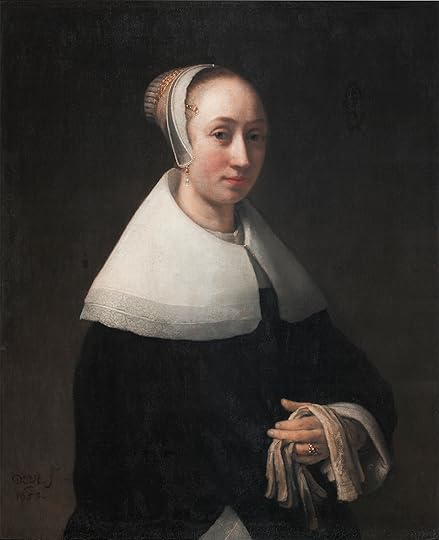
"Portrait of a Woman" (attributed to Willem Drost), one of a number of possible sources for the fictional description of the painting in the novel
Freddie's Guilt Edge
Banville circles around the quandary in the first, unnumbered chapter, and this is where I found the prose most captivating. He is a master of sentencecraft, on the same level as Javier Marias. Nowhere was his prose more exhilarating than in the first chapter where Freddie was struggling with his own quandary.
In later chapters, Banville's prose is more descriptive of the external environment, the actions and dialogue of the characters. In a way, this detail is less interesting, because we have come to believe that it isn't contentious or in dispute. It is more like a summary of agreed facts, upon which a judge or jury could make a finding of law or fact. (Of course, this point of view assumes that we find Freddie credible, which, by and large, I do [even if he is something of a scoundrel]. There seems to be enough external, objective evidence (the "stark essentials" referred to below) to convict Freddie, so why would he seek to contradict or question it, if he was prepared to plead guilty?)
Freddie's Story
The answer to this question is perhaps that this is Freddie's story, and he wants to tell it his own way. His motive is a kind of hubris.
When he reads a copy of the first draft police statement based on his interrogation by a policeman -
"Frills and Fancy Bits"
The police statement is primarily purposive (i.e., it's intended to be used for the exclusive purpose of criminal prosecution and criminal justice), although Freddie believes that it's constrained by its excessive, single-minded purposiveness.
His statement doesn't recognise that he is a "self-made man". It denies his self. It has taken the "I", the ego, the self, the subject, the psychological intention or motive of the subject out of his own account. It has taken the subject (and the subjective) out of his own story. It has to content itself with objective, provable facts.
The novel, which is effectively Freddie's subjective testimony, is his attempt to put himself (and his subjectivity) back into his own story, complete with "frills and fancy bits" (2). At the level of Banville's novel, this means that he has put the novel back into the story, and constructed a work of literature, albeit the entire novel is a work of fiction.
Banville's sentences are compound without being pretentious or unduly complicated. (3)
His achievement is to flesh out Freddie's story without using overtly purple prose, even if he relies on Freddie's gravitas and his air of menace, as well as his "frills and fancy bits", some of which might actually be unreliable.
FOOTNOTES:
(1) As my homage to the novel below hints, it also has much in common with the style and concerns of Albert Camus.
(2) "I was thirty-eight, a man of parts, with a wife and a son and an impressive Mediterranean tan, I carried myself with gravitas and a certain air of menace..."
(3) "I am remembering a certain moment, when Anna lifted her bruised, glistening mouth from between Daphne's legs and, glancing back at me with a complicitous, wry little smile, leaned aside so that I might see the sprawled girl's lap lying open there, intricate and innocent as a halved fruit."
[This description of a menage a trois (and, elsewhere, the suggestion that Freddie might love Anna Behrens) is almost certainly fanciful, if not wholly unreliable. If so, does one instance of unreliability taint the rest of the narrative?]
"She [Anna] drove very fast, working the controls probingly, as if she were trying to locate a pattern, a secret formula, hidden in the mesh of small, deft actions. I was impressed, even a little cowed. She was full of the impatient assurance of the rich."
"To do the worst thing, the very worst thing, that's the way to be free."
THE STRANGER (AN HOMAGE):
Mother died three days ago. Or thereabouts. Somebody, person or persons unknown, has already arranged her funeral for this coming Friday.
I didn't know about her demise or funeral until the police (a burly man and a tall, sleek woman) roused me from my sleep in my room at the Southern Star Hotel in Dublin about 11am this morning.
I hadn't had breakfast, but they insisted that I get dressed and accompany them to the station immediately. When I enquired why, they disclosed that the stable-girl/maid (I think her name is Joanne) had told them that my mother and I had had an almighty row a day or so before her death. As if that might have caused her to expire!
Joanne didn't overhear the entire conversation between us, but they knew that it concerned the fact that my mother had sold a number of valuable paintings from my parents' home to a diamond miner, art trader and conman named Helmut Behrens. He would later claim to be a friend of the family. What a parasite! My mother used to call him Binkie for some reason. It sounds like a term of sexual endearment. Maybe it's true what they say in the village - that they were having an affair. She seemed to have disgraced the family name, before ever I did.
The paintings had formed part of my father's estate, and though he had granted my mother a first option to retain them, she was aware that they had more sentimental value to me than economic value to her. "Portrait of a Woman with Gloves", in particular, had been my gift to my father on his 75th birthday only a few years before.

"Portrait of a Woman with Gloves" (Attributed to Rembrandt) [Freddie: "I have stood in front of other, perhaps greater paintings, and not been moved as I am moved by this one."]
When my mother revealed that she had sold them for what I regarded as a pittance, I was angry. (She sold "Portrait" for less than 10% of what I'd paid for it.) But I exploded when she told me that she planned to invest the proceeds in her newly acquired pony hobby (to which her similarly acquired man-friend, a trainer, had introduced her).
After exchanging a few belligerent words, I exited the lounge room through the French doors, slamming them from the outside, tearing a gauze curtain in the process.
"I did not know what I was doing, or what I would do next. I did not know myself. I had become a stranger, unpredictable and dangerous."
Unsurprisingly, I suppose, the police wanted to speak to me about the alleged murder of the Behrens family's maid, a day or two after my mother's death. When we arrived at the police station, it seemed that they regarded the murder as a crime passionel, though why they would consider me a suspect is beyond me. She was so commonplace - ordinary and uninteresting in both appearance and temperament - that I couldn't (and still can't) even remember her name. It just never registered.
As the police proceeded unimaginatively through their list of questions, it also emerged that one of the paintings that Behrens had bought from my mother had gone missing and hadn't been found yet. My view, which they didn't seem to have considered, was that Behrens had probably already on-sold it to a third party for a handsome profit, and was trying to recover its alleged value, either from me or an insurance company, if the police could pin the theft on me.
Perhaps my mother sold the paintings to Binkie as a revenge, not on me, but on my father, for his pathetic, shameful and sordid affair with that waitress at the pub, Penelope.
To be honest, the theft was the charge about which I was initially the most apprehensive. At that stage, it was the charge for which they had the most objective, reliable and persuasive evidence, even if I do say so myself, and I am no lawyer.
If they charged me, it would be a case of her word against mine. I had had no prior contact with Joanne, not having visited my mother for ten years, while I had been living and working in America. There should be no reason why Joanne might have any preconceptions about or prejudice against me.
My counsel would have to insinuate that she was some kind of slut. Whether or not there was any corroborative evidence. This shouldn't be too difficult. It's still standard practice in criminal and family law cases, though it must be done subtly. Even judges, especially the men, get a kick out of listening to the insinuations and watching the witness squirm.
My counsel would regard it as his solemn duty to destroy the case and the merit of any evidence against me. I, on the other hand, felt I could be more composed, even relaxed, as if a disinterested spectator at my own trial and tribulation. In this time of COVID lockdowns and restrictions, my deepest, most ardent desire was to be unmasked. Though not to be found guilty by judge or jury or audience. I wished to get as close to the crest of the wave as I could, without being dumped.
SOUNDTRACK:
Testimony
From the beginning, I thought this novel was going to mimic the design of Vladimir Nabokov's "Lolita". (1)
It purports to be a book of evidence or testimony by Freddie Montgomery, who has been accused of both theft and murder.
His barrister would have preferred that he not give any evidence or statements to the police or the court. However, Freddie fails to heed his counsel's advice. Having never been in prison before, he has no inkling what life imprisonment will be like, and thus doesn't appear to fear the prospect.
Freddie writes his account while he is being held in custody on remand, pending his trial (which, at the time of the testimony, has not occurred yet).
He addresses his testimony, variously, to My Lord (the judge) and the members of the jury. As in the case of "Lolita", this places us, the readers, in the guise of either the judge or a jury member. We must assess the veracity of the testimony.
Many readers believe that Humbert Humbert was an unreliable narrator. I never sympathised with this point of view. I felt (and still feel) that many readers apply this term to somebody, a narrator, with whom they disagree, on any basis. There has to be some reason to disbelieve a narrator, other than the reader's preconceived notions about the subject matter about which they disagree. (I would suggest a physical or intellectual impairment, the influence of alcohol or drugs, or a motive to obtain a material benefit from their dishonesty or lack of candour. I mean the narrator's, not the reader's!)
"A Man With a Decent Accent"
That said, there isn't as much reason to disagree with Freddie as there might have been with Humbert. His crimes are not of a sexual nature, nor do they relate to children.
However, this isn't meant to imply that we have any reason to sympathise with Freddie. He is some type of scientist who has recently returned, married (to Daphne) and with a young son, from ten years in the United States. Like Humbert, he is well educated, and thinks and writes eloquently [still, I can't work out how he is able to write as well as John Banville, a dedicated and highly accomplished writer ;)]. He seems to be middle to upper class, and believes that -
"A man with a decent accent can do almost anything."
To which statement, the reader can add "...and get away with it."
This composite statement is, at most, hypothetical, because Freddie doesn't seek to get away with anything, or to escape punishment, or to plead in mitigation of penalty, for what he has done. He doesn't deny what he has been accused of, he doesn't assert that he has any legitimate cause, excuse or defence that would exonerate him or reduce his life sentence.
From his counsel's point of view, he should have said and written nothing at all. Freddie's testimony is tantamount to a voluntary confession, and can only assist the prosecutor to successfully convict him. His counsel wants him to plead not guilty, so he can endeavour to get him off the charges. Freddie doesn't want to play that game.
As in the case of "Lolita", the reader has to ask, why would you make such a confession, to your own prejudice? Freddie doesn't supply us with any reason, so we are left to guess. (I maintain that Humbert's sole purpose was to express his love for Dolores, regardless of the legal consequences.) Unfortunately, by the end of Banville's novel, we have no better idea. As this quandary fascinated me in both novels, the failure to resolve it was one of the few aspects of the novel which I found wanting.
"Portrait of a Woman" (attributed to Willem Drost), one of a number of possible sources for the fictional description of the painting in the novel
Freddie's Guilt Edge
Banville circles around the quandary in the first, unnumbered chapter, and this is where I found the prose most captivating. He is a master of sentencecraft, on the same level as Javier Marias. Nowhere was his prose more exhilarating than in the first chapter where Freddie was struggling with his own quandary.
In later chapters, Banville's prose is more descriptive of the external environment, the actions and dialogue of the characters. In a way, this detail is less interesting, because we have come to believe that it isn't contentious or in dispute. It is more like a summary of agreed facts, upon which a judge or jury could make a finding of law or fact. (Of course, this point of view assumes that we find Freddie credible, which, by and large, I do [even if he is something of a scoundrel]. There seems to be enough external, objective evidence (the "stark essentials" referred to below) to convict Freddie, so why would he seek to contradict or question it, if he was prepared to plead guilty?)
Freddie's Story
The answer to this question is perhaps that this is Freddie's story, and he wants to tell it his own way. His motive is a kind of hubris.
When he reads a copy of the first draft police statement based on his interrogation by a policeman -
"[He]marvelled at how he had turned everything to his purpose, mis-spellings, clumsy syntax, even the atrocious typing. Such humility, such deference, such ruthless suppression of the ego for the sake of the text. He had taken my story, with all its...frills and fancy bits, and pared it down to stark essentials. [These are not my words.] It was an account of my crime I hardly recognised, and yet I believed it. He had made a murderer of me."
"Frills and Fancy Bits"
The police statement is primarily purposive (i.e., it's intended to be used for the exclusive purpose of criminal prosecution and criminal justice), although Freddie believes that it's constrained by its excessive, single-minded purposiveness.
His statement doesn't recognise that he is a "self-made man". It denies his self. It has taken the "I", the ego, the self, the subject, the psychological intention or motive of the subject out of his own account. It has taken the subject (and the subjective) out of his own story. It has to content itself with objective, provable facts.
The novel, which is effectively Freddie's subjective testimony, is his attempt to put himself (and his subjectivity) back into his own story, complete with "frills and fancy bits" (2). At the level of Banville's novel, this means that he has put the novel back into the story, and constructed a work of literature, albeit the entire novel is a work of fiction.
Banville's sentences are compound without being pretentious or unduly complicated. (3)
His achievement is to flesh out Freddie's story without using overtly purple prose, even if he relies on Freddie's gravitas and his air of menace, as well as his "frills and fancy bits", some of which might actually be unreliable.
FOOTNOTES:
(1) As my homage to the novel below hints, it also has much in common with the style and concerns of Albert Camus.
(2) "I was thirty-eight, a man of parts, with a wife and a son and an impressive Mediterranean tan, I carried myself with gravitas and a certain air of menace..."
(3) "I am remembering a certain moment, when Anna lifted her bruised, glistening mouth from between Daphne's legs and, glancing back at me with a complicitous, wry little smile, leaned aside so that I might see the sprawled girl's lap lying open there, intricate and innocent as a halved fruit."
[This description of a menage a trois (and, elsewhere, the suggestion that Freddie might love Anna Behrens) is almost certainly fanciful, if not wholly unreliable. If so, does one instance of unreliability taint the rest of the narrative?]
"She [Anna] drove very fast, working the controls probingly, as if she were trying to locate a pattern, a secret formula, hidden in the mesh of small, deft actions. I was impressed, even a little cowed. She was full of the impatient assurance of the rich."
"To do the worst thing, the very worst thing, that's the way to be free."
THE STRANGER (AN HOMAGE):
Mother died three days ago. Or thereabouts. Somebody, person or persons unknown, has already arranged her funeral for this coming Friday.
I didn't know about her demise or funeral until the police (a burly man and a tall, sleek woman) roused me from my sleep in my room at the Southern Star Hotel in Dublin about 11am this morning.
I hadn't had breakfast, but they insisted that I get dressed and accompany them to the station immediately. When I enquired why, they disclosed that the stable-girl/maid (I think her name is Joanne) had told them that my mother and I had had an almighty row a day or so before her death. As if that might have caused her to expire!
Joanne didn't overhear the entire conversation between us, but they knew that it concerned the fact that my mother had sold a number of valuable paintings from my parents' home to a diamond miner, art trader and conman named Helmut Behrens. He would later claim to be a friend of the family. What a parasite! My mother used to call him Binkie for some reason. It sounds like a term of sexual endearment. Maybe it's true what they say in the village - that they were having an affair. She seemed to have disgraced the family name, before ever I did.
The paintings had formed part of my father's estate, and though he had granted my mother a first option to retain them, she was aware that they had more sentimental value to me than economic value to her. "Portrait of a Woman with Gloves", in particular, had been my gift to my father on his 75th birthday only a few years before.
"Portrait of a Woman with Gloves" (Attributed to Rembrandt) [Freddie: "I have stood in front of other, perhaps greater paintings, and not been moved as I am moved by this one."]
When my mother revealed that she had sold them for what I regarded as a pittance, I was angry. (She sold "Portrait" for less than 10% of what I'd paid for it.) But I exploded when she told me that she planned to invest the proceeds in her newly acquired pony hobby (to which her similarly acquired man-friend, a trainer, had introduced her).
After exchanging a few belligerent words, I exited the lounge room through the French doors, slamming them from the outside, tearing a gauze curtain in the process.
"I did not know what I was doing, or what I would do next. I did not know myself. I had become a stranger, unpredictable and dangerous."
Unsurprisingly, I suppose, the police wanted to speak to me about the alleged murder of the Behrens family's maid, a day or two after my mother's death. When we arrived at the police station, it seemed that they regarded the murder as a crime passionel, though why they would consider me a suspect is beyond me. She was so commonplace - ordinary and uninteresting in both appearance and temperament - that I couldn't (and still can't) even remember her name. It just never registered.
As the police proceeded unimaginatively through their list of questions, it also emerged that one of the paintings that Behrens had bought from my mother had gone missing and hadn't been found yet. My view, which they didn't seem to have considered, was that Behrens had probably already on-sold it to a third party for a handsome profit, and was trying to recover its alleged value, either from me or an insurance company, if the police could pin the theft on me.
Perhaps my mother sold the paintings to Binkie as a revenge, not on me, but on my father, for his pathetic, shameful and sordid affair with that waitress at the pub, Penelope.
To be honest, the theft was the charge about which I was initially the most apprehensive. At that stage, it was the charge for which they had the most objective, reliable and persuasive evidence, even if I do say so myself, and I am no lawyer.
If they charged me, it would be a case of her word against mine. I had had no prior contact with Joanne, not having visited my mother for ten years, while I had been living and working in America. There should be no reason why Joanne might have any preconceptions about or prejudice against me.
My counsel would have to insinuate that she was some kind of slut. Whether or not there was any corroborative evidence. This shouldn't be too difficult. It's still standard practice in criminal and family law cases, though it must be done subtly. Even judges, especially the men, get a kick out of listening to the insinuations and watching the witness squirm.
My counsel would regard it as his solemn duty to destroy the case and the merit of any evidence against me. I, on the other hand, felt I could be more composed, even relaxed, as if a disinterested spectator at my own trial and tribulation. In this time of COVID lockdowns and restrictions, my deepest, most ardent desire was to be unmasked. Though not to be found guilty by judge or jury or audience. I wished to get as close to the crest of the wave as I could, without being dumped.
SOUNDTRACK:

December 29, 2022
کتاب شواهد انگار از جهنم سرفه شده. قاتل با یک تکگویی پیوسته و غیرخطی در حالی که پشت میلههای زندان در انتظار محاکمه نشسته، نشخوار فکری خود را در قالب اعترافنامه اظهار و خوانندگانش را به عنوان قاضی و هیئت منصفه تصور میکند. با این حال به زودی مشخص میشود که این جنایت از طمع، انتقام یا هر انگیزه قابل تشخیص دیگری الهام نگرفته. قاتل مرتکب جنایت شده، فقط به خاطر اینکه میتوانسته مرتکب قتل شود. همین و بس. شبیه مورسو احساس میکند در این سیاره بیگانه است و پاسخی برای رنجهای بیپایان بشری پیدا نکرده و خودش را قهرمان فراموششدهی یک رمان روسی میداند. جان بنویل مفهوم متعارف انگیزه در جنایات را به چالش کشیده. بنویل حتی واقعیت اعترافات قاتل را زیر و رو کرده و صحتشان را مورد تردید قرار میدهد. در طول کتاب بارها از خودم پرسیدم آیا راوی غیرقابلاعتماد واقعاً تحت تاثیر جاذبهی آنی تابلوی نقاشی مرتکب جنایت شده یا صرفاً در حال خواندن خیالات یک دیوانه هستم که قرار است در پایان کتاب برملا شود! قاتل در توضیح (یا شاید توجیه) قتل دختر خدمتکار، جرم واقعیاش را نه قتل که شکست قوهی تخیلش میداند. یعنی چون نتوانسته مقتول را به شکل واضح به عنوان یک شخص تصور کند، او را کشته. اما به نظرم جنایتکار اصلی جان بنویل است که توانسته قاتلی غیرکلیشهای خلق کند. بنویل با نثر نرم و باحوصلهاش قمار کرده و یک هیولا خلق کرده و اتفاقاً در این قمار برنده شده

Read
December 8, 2023Did not finish, unfortunately (so, no rating). Banville presented in this fairly early work, 1989, a (very) long monologue by criminal Freddy Montgomery to the chairman and jury of the court in which he is on trial. It is an ‘oratio pro domo’, of course, in which the cunning Freddy analyzes how things could have gone so wrong in his life. And he is clearly not just anyone, he openly philosophizes about evil and free will, and that occasionally produces great passages, such as this one: “By the way, leafing through my dictionary I am struck by the poverty of the language when it comes to naming or describing badness. Evil, wickedness, mischief, these words imply an agency, the conscious or at least active doing of wrong. They do not signify the bad in its inert, neutral, self-sustaining state. Then there are the adjectives: dreadful, heinous, execrable, vile, and so on. They are not so much descriptive as judgmental. They carry a weight of censorship mingled with fear. Isn't this a queer state of affairs? It makes me wonder. I ask myself if perhaps the thing itself—badness—does not exist at all, if these strangely vague and imprecise words are only a kind of ruse, a kind of elaborate cover for the fact that nothing is there. Or perhaps the words are an attempt to make it be there? Or, again, perhaps there is something, but the words invented it.”
It is clear that Banville with Freddy Montgomery has presented yet another variation of an unreliable narrator. Or maybe a variation on the theme of L'Étranger (Camus), since Freddy is accused of a murder without motif. But, to be honest, I was only mildly interested. Freddy's excessive flow of words was sometimes too much, and the many descriptive passages did not conform to the monologue form. In the words of Freddy himself: “None of this means anything. Anything of significance, that is. I am just amusing myself, musing, losing myself in a welter of words. For words in here are a form of luxury, of sensuousness, they are all we have been allowed to keep of the rich, wasteful world from which we are shut away.”
It is clear that Banville with Freddy Montgomery has presented yet another variation of an unreliable narrator. Or maybe a variation on the theme of L'Étranger (Camus), since Freddy is accused of a murder without motif. But, to be honest, I was only mildly interested. Freddy's excessive flow of words was sometimes too much, and the many descriptive passages did not conform to the monologue form. In the words of Freddy himself: “None of this means anything. Anything of significance, that is. I am just amusing myself, musing, losing myself in a welter of words. For words in here are a form of luxury, of sensuousness, they are all we have been allowed to keep of the rich, wasteful world from which we are shut away.”

October 1, 2015
Through his remarkable and dark-humorous writing, Banville lets his hero Freddie narrate or plead GUILTY to his jury/ audience - We, the readers - You, "Who must have meaning in everything, who lusts after meaning, your palms sticky, and your faces on fire!" It would be difficult not to think of Nabokov when you listen to self-pity story of Freddie and the way he addresses the readers or mocks them, at times.
Nevertheless, this is beautifully written and not lengthy. You would not be disappointed if you read this book of not much of an evidence.
Nevertheless, this is beautifully written and not lengthy. You would not be disappointed if you read this book of not much of an evidence.

March 19, 2014
Never have I liked a book more in the first 10 pages that I hated more in the next 210 pages. The basic premise is that the main character (I hesitate to call him the protagonist) is in jail for killing someone and we find out over the course of the novel what happened. He is clearly a psychopath or sociopath or...something, I don't know, he's crazy.
At first I was hoping this was going to be some sore of Hannibal Lecter/Professor Moriarty evil genius walks us through his crime situation. Not so much. It is clear that the author doesn't care about his character, so why should we.
I see what the author is going for, he wants us to be in the mind of this completely delusional person. I suppose on that front, he succeeded. But the experience is completely devoid of joy. Now don't take that to mean "unhappy." I've read books about brutal killers/killings that were very grim but I can always take joy out of a story told well.
Here, the story is so boring. So boring! I get that the killing and the reason behind it were supposed to be boring because that's what the author was going for but just because that's what he was going for does not mean that it works.
Some of the phrases in this book were beautiful. Some of the quotes, fantastic. There's clearly a good writer inside of John Banville dying to get out but these good spots only highlighted the turd of a book I was actually reading.
I can't give this more than 1 star because I really don't want anyone else to have to read this. I don't want to encourage books like this to exist. Banville wanted to punish the reader here. Great, thanks, you have succeeded.
At first I was hoping this was going to be some sore of Hannibal Lecter/Professor Moriarty evil genius walks us through his crime situation. Not so much. It is clear that the author doesn't care about his character, so why should we.
I see what the author is going for, he wants us to be in the mind of this completely delusional person. I suppose on that front, he succeeded. But the experience is completely devoid of joy. Now don't take that to mean "unhappy." I've read books about brutal killers/killings that were very grim but I can always take joy out of a story told well.
Here, the story is so boring. So boring! I get that the killing and the reason behind it were supposed to be boring because that's what the author was going for but just because that's what he was going for does not mean that it works.
Some of the phrases in this book were beautiful. Some of the quotes, fantastic. There's clearly a good writer inside of John Banville dying to get out but these good spots only highlighted the turd of a book I was actually reading.
I can't give this more than 1 star because I really don't want anyone else to have to read this. I don't want to encourage books like this to exist. Banville wanted to punish the reader here. Great, thanks, you have succeeded.

April 10, 2020
المثير دائما وابدا في عالم الكتب والقراءة انها دائما بقدر تقدم لك المفاجآت السعيدة، والدهشة من الابداع الانساني مهما تخيلت ان أوان الدهشة والمفاجأة فاتوا.
الرواية دي معجزة سردية، علشان دي تُقرأ بمزاج وصفاء، رواية تُرشح اكثر مرة، تُرشح للقاريء الباحث عن عظمة أدبية، وتُرشح لأي حد مهتم بالكتابة المحترفة حد الدهشة، وتُرشح لكل كاتب عايز يتعلم جديد، وحزين جدا اني مكنتش اعرف الكاتب، والترجمة جيدة جدا.
الرواية دي معجزة سردية، علشان دي تُقرأ بمزاج وصفاء، رواية تُرشح اكثر مرة، تُرشح للقاريء الباحث عن عظمة أدبية، وتُرشح لأي حد مهتم بالكتابة المحترفة حد الدهشة، وتُرشح لكل كاتب عايز يتعلم جديد، وحزين جدا اني مكنتش اعرف الكاتب، والترجمة جيدة جدا.

April 22, 2011
Fourth attempt, fourth time abandoning The Book of Evidence.
I made it a little farther this time, as I do each time I take a crack at it, but I've still not reached one hundred pages, and I can't see myself ever picking this book up again. But it's John Banville, and I am an Irish Lit guy, so I feel like something is wrong with me; I can't read his books.
But there's definitely something wrong with this book that isn't about me. John Banville doesn't care about his protagonist, Freddie Montgomery. When one writes a first person narrative and one doesn't care for one's narrator, the book can be excruciating to read. At least it is so for me. And I've to wonder why Banville bothered.
Still, maybe there is something to be said for Banville's achievement. He wrote a book about someone he doesn't care for, and he wrote it well. I can't deny that. His prose is beautiful and occassionally brilliant. But I can't imagine writing a book about a character I don't care about. I can write a book about someone I dislike or even loathe, but I have to care about them even so. Banville seems to have written about a character, however, that he both disdains and doesn't care for. It is something I can't do, and it is also something that I can't read because Banville's attitude becomes my attitude, and I can't carry on reading without caring about the character(s) I am asked to spend time with.
So do I try The Book of Evidence again sometime, when I think I am in the mood for some uncaring misanthropy? Do I try The Sea, even though it won the Booker Prize and probably sucks? Or do I just stop trying to appreciate Banville? Can't decide right now. Help me out gentle readers. Is there a Banville you think I may like?
I made it a little farther this time, as I do each time I take a crack at it, but I've still not reached one hundred pages, and I can't see myself ever picking this book up again. But it's John Banville, and I am an Irish Lit guy, so I feel like something is wrong with me; I can't read his books.
But there's definitely something wrong with this book that isn't about me. John Banville doesn't care about his protagonist, Freddie Montgomery. When one writes a first person narrative and one doesn't care for one's narrator, the book can be excruciating to read. At least it is so for me. And I've to wonder why Banville bothered.
Still, maybe there is something to be said for Banville's achievement. He wrote a book about someone he doesn't care for, and he wrote it well. I can't deny that. His prose is beautiful and occassionally brilliant. But I can't imagine writing a book about a character I don't care about. I can write a book about someone I dislike or even loathe, but I have to care about them even so. Banville seems to have written about a character, however, that he both disdains and doesn't care for. It is something I can't do, and it is also something that I can't read because Banville's attitude becomes my attitude, and I can't carry on reading without caring about the character(s) I am asked to spend time with.
So do I try The Book of Evidence again sometime, when I think I am in the mood for some uncaring misanthropy? Do I try The Sea, even though it won the Booker Prize and probably sucks? Or do I just stop trying to appreciate Banville? Can't decide right now. Help me out gentle readers. Is there a Banville you think I may like?

March 17, 2017
Oh, look at me liking evil psychopaths! John Banville, hats off!

February 5, 2021
4.75 Stars — JB, you’ve done it again.
The first 15 or so pages of book of evidence are perhaps the most elegant written in any first 15-20 pages in crime-fiction history. The prose that oozes from the mind of Banville is reminiscent of a divine interlude from the lord’s harpsichord. Just wonderful, poetic and dense with excellence.
It doesn’t dilute from then on either, it is just that once past this point you have raised your standards of prose so much that the remainder may initially seem ‘only’ marvellous in comparison.
The protagonist in book of evidence is about as mentally stimulating as those locked-up could ever be. The story adds a rawness to the mix and an air of something-ain’t-right fills the pages as you bury your head into this wonderful story by one of the true masters of contemporary literature.
Bearing in mind, that the second novel — The sea — is every bit as engrossing and will on an altogether different Dias, thrill and inspire you with its whimsy, wisdom and elements of hidden altruism.
The first 15 or so pages of book of evidence are perhaps the most elegant written in any first 15-20 pages in crime-fiction history. The prose that oozes from the mind of Banville is reminiscent of a divine interlude from the lord’s harpsichord. Just wonderful, poetic and dense with excellence.
It doesn’t dilute from then on either, it is just that once past this point you have raised your standards of prose so much that the remainder may initially seem ‘only’ marvellous in comparison.
The protagonist in book of evidence is about as mentally stimulating as those locked-up could ever be. The story adds a rawness to the mix and an air of something-ain’t-right fills the pages as you bury your head into this wonderful story by one of the true masters of contemporary literature.
Bearing in mind, that the second novel — The sea — is every bit as engrossing and will on an altogether different Dias, thrill and inspire you with its whimsy, wisdom and elements of hidden altruism.

August 15, 2018
Korektno, ali nedovoljno za očaranost.
Načelno, ovo je "Lolita" bez Lolite, a sa značajno neubedljivijim Hambertom, pa vuče na sindrom "od drveća ne vidim šumu" ili neki srodni oblik zabunjenosti.
Banvilov lepi stil je prepoznatljiv, no ovde ušećeren na neki njorav način (ali ne, daleko bilo, albaharijevski njorav, pre darelovski... njoruckast), kao da je pisano po porudžbini sa nadom u novi angažman. Ovo je njegov četvrti roman koji sam čitala i - sasvim zanimljivo, iako najverovatnije slučajno - dva koja su prevodili muškarci ("More" i "Kepler") su mi se dopala mnogo više od onih koje su prevodile žene ("Pokrov" i "Knjiga dokaza"). To, međutim, ne znači da je Arijana Božović loš prevodilac, upravo suprotno.
Ko pročita, neće se pokajati. Ko ne pročita, preživeće.
Trojka je, ali ne kvarim prosek nikome, naročito ne Ircima.
Načelno, ovo je "Lolita" bez Lolite, a sa značajno neubedljivijim Hambertom, pa vuče na sindrom "od drveća ne vidim šumu" ili neki srodni oblik zabunjenosti.
Banvilov lepi stil je prepoznatljiv, no ovde ušećeren na neki njorav način (ali ne, daleko bilo, albaharijevski njorav, pre darelovski... njoruckast), kao da je pisano po porudžbini sa nadom u novi angažman. Ovo je njegov četvrti roman koji sam čitala i - sasvim zanimljivo, iako najverovatnije slučajno - dva koja su prevodili muškarci ("More" i "Kepler") su mi se dopala mnogo više od onih koje su prevodile žene ("Pokrov" i "Knjiga dokaza"). To, međutim, ne znači da je Arijana Božović loš prevodilac, upravo suprotno.
Ko pročita, neće se pokajati. Ko ne pročita, preživeće.
Trojka je, ali ne kvarim prosek nikome, naročito ne Ircima.
October 24, 2008
This book is so believable I became throughly depressed reading it. The self justification of the main character and self absorbed sociopath tendencies he displays were really quite upsetting. I believed him, I was engaged, pulled in and wanted to do nothing more than to pull him out of the book and shake him until he could learn to feel emotions for other people, and to feel remorse. The writing is amazing, Banville is a genius. This is one of the best books I've read, but also one of the hardest - the writing is fluid, the plot pulls you in but I had to take a few sanity breaks to stop myself hurling into a whirlwind of thoughts about the evils people can do.

April 30, 2018
Freddie Montgomery is unmistakably guilty - he stole and killed. The confession he writes, while in jail and awaiting trial, may be unreliable, but then, I don’t think it is about reliability. You could see it as a confession of a psychopath, or as a story about a man whose life is missing some essential element. But it has depth, and self-reflection. It has something that gripped me, like no other story that I read recently. Not because Freddie is likable, because believe me - he is not, but because his story it is so dense with evidence - nothing he says is unnecessary, everything matters and every sentence carries so much meaning… .
He killed because he could, because there was nothing stopping him. The life that lead to this apotheosis was one rather without rules, he is portraying himself as a man with no virtuous and in a way without moral restraint. He glides through life not really engaging in anything, or with anyone. Nothing has consequences, and when it comes to the point of no return, the girl that he kills and the act itself, doesn’t appear real enough, to stop him from committing the murder. Real things hurt, and not much did hurt in his life until that point. Then there comes a shock, and guilt, and the stain of blood that just like lady Macbeth's can’t be wash of his hands. And it is not until then, that he in a way becomes wholly human, and while not able to seek forgiveness since his act was unforgivable, he must now see his victim and imagine her back into existence again.
It is an excellent and thought-provoking story, written in such a fluent prose and I would like to recommend it to all of you, analytic and psychologically inclined souls out there - who like to see under the surface or things, and search for a reason and meaning. For those of you, I am sure, “The book of evidence” will be an unforgettable treat.
He killed because he could, because there was nothing stopping him. The life that lead to this apotheosis was one rather without rules, he is portraying himself as a man with no virtuous and in a way without moral restraint. He glides through life not really engaging in anything, or with anyone. Nothing has consequences, and when it comes to the point of no return, the girl that he kills and the act itself, doesn’t appear real enough, to stop him from committing the murder. Real things hurt, and not much did hurt in his life until that point. Then there comes a shock, and guilt, and the stain of blood that just like lady Macbeth's can’t be wash of his hands. And it is not until then, that he in a way becomes wholly human, and while not able to seek forgiveness since his act was unforgivable, he must now see his victim and imagine her back into existence again.
It is an excellent and thought-provoking story, written in such a fluent prose and I would like to recommend it to all of you, analytic and psychologically inclined souls out there - who like to see under the surface or things, and search for a reason and meaning. For those of you, I am sure, “The book of evidence” will be an unforgettable treat.

May 18, 2009
I read this book based on the recommendation/review of a friend, and I am absolutely floored. John, where have you been all my life? I second all the reviewers' praise of Banville's language - even found myself feverishly writing down scattered phrases or entire paragraphs. - And how beautifully Banville controls the story - delivering just the right amount of plot detail and character insight at just the right time. Finally, I am struck by the juxtaposition of Banville's vigorous prose with his protagonist' (and interlocutor's) general apathy (or "accidie," as Banville would have it). It is, in a word, perfect.

January 6, 2011
I was rather surprised by how much I enjoyed this book, particularly since the main character and narrator, Freddie Montgomery, is an arrogant and self-absorbed man who feels no remorse or guilt for his crimes and is more concerned about saving his own skin than protecting his friends or admitting fault. Montgomery takes us through the events that led to his crimes and ultimate arrest, including various flashbacks to his youth, with a strange detachment that doesn’t tell whether he is narrating his story before or after his trial (this does become clearer in the final pages…depending on your interpretation). The prose is beautifully descriptive and Banville has a definite talent for capturing the colourful lilting speech of the Irish which can often be lost in the written word. Banville has also managed to create a character in Montgomery that the reader (and the writer it would seem) can detest but who manages to awaken some strange sense of pity as the reality of his crimes sinks in.

November 13, 2017
4.5 stars. A beautifully written story about the prison testimony of Freddie Montgomery who killed a maid trying to stop him stealing a painting. Set in Ireland. Freddie writes about his mother, his wife and his friends/associates. A great character study. A book to reread.

May 3, 2013
This felt like an Irish John Updike. Freddie Montgomery is arguably worse than Rabbit; but the time period is the same and the language use and description was similar. Also reminded me a bit of McEwan's despicable main character in Solar.
Unfortunately, it was a bit repetitive; I am starting to feel rather repetitive myself, ever since reading Didion my main complaint is that everything is repetitive. Is this an example of life imitating art or just that through art I have finally noticed the repetitiveness of everything?
Anyway, Banville has a few themes and he is not afraid to stroke them repetitively throughout. Most frequently, he addresses the criminal's wish for self-efficacy and fame (and the psychological desire for attention and notice that is rewarded upon arrest and imprisonment): "I confess I had hopelessly romantic expectations of how things would be in here. Somehow I pictured myself a sort of celebrity, kept apart from the other prisoners in a special wing, where I would receive parties of grave, important people and hold forth to them about the great issues of the day, impressing the men and charming the ladies." He is so relieved as to be almost glorious in his arrest: "Yes, to be found out, to be suddenly pounced upon, beaten, stripped, and set before the howling multitude, that was my deepest, most ardent desire." and then in the capture: "From now on I would be watched over, I would be tended and fed and listened to, like a big, dangerous babe."
He also loves to discuss the lack of intention in our actions. Freddie is convinced that he set out without purpose and that simple random coincidences led to his criminal behavior. This is, of course, absurdly ridiculous and yet 100% true. Always, in life, we can stop our actions or change course. However, most frequently it is easier to succumb to inertia and just follow along paths which previous actions have blazed. I really liked some of Banville's turn of phrase on this point: "[the question] assumes that actions are determined by volition, deliberate thought, a careful weighing-up of facts, all that puppet-show twitching which passes for consciousness. I was living like that because I was living like that, there is no other answer. When I look back, no matter how hard I try I can see no clear break between one phase and another." Later he again argues, "There is no moment in this process of which I can confidently say, there, that is when I decided she should die. Decided? I do not think it was a matter of deciding. I do not think it was a matter of thinking, even."
A third theme is the inhumanity of humans. Like all nasty (self serving, self aware, and malicious) characters, Freddie is able to analyze his own actions and frequently describes himself as something less than human. He pardons himself with the excuse that he is really two beasts, the one under control and then the other under the surface. Freddie declares: "To do the worst thing, the very worst thing, that's the way to be free. I would never again need to pretend to myself to be what I was not."
He is also: "Never wholly anywhere, never with anyone, either, that was me, always. Even as a child I seemed to myself a traveller who had been delayed in the middle of an urgent journey. Life was an unconscionable wait, walking up and down the platform, watching for the train." I love this description because it captures one of my favorite life issues (gotta figure out how to live in the moment to be happy), while simultaneously giving the example of this extremely dissatisfied being who cannot ever live in the moment.
One complaint I have is that the narrator was not completely honest. He describes himself in the opening paragraph (which is well crafted and definitely grabs the reader's attention) as a cannibal: "the girl-eater, svelte and dangerous, padding to and fro in my cage". I was actually (surprisingly) sort of disappointed when it turned out that he just walked away from Josie while she was still alive. Certainly, leaving her to die on her own is horrid; but I read the whole book under the impression that Freddie would really lose it in the end and anticipated a gory scene that just didn't occur.
Overall it was an interesting read with some worthwhile moments.
Unfortunately, it was a bit repetitive; I am starting to feel rather repetitive myself, ever since reading Didion my main complaint is that everything is repetitive. Is this an example of life imitating art or just that through art I have finally noticed the repetitiveness of everything?
Anyway, Banville has a few themes and he is not afraid to stroke them repetitively throughout. Most frequently, he addresses the criminal's wish for self-efficacy and fame (and the psychological desire for attention and notice that is rewarded upon arrest and imprisonment): "I confess I had hopelessly romantic expectations of how things would be in here. Somehow I pictured myself a sort of celebrity, kept apart from the other prisoners in a special wing, where I would receive parties of grave, important people and hold forth to them about the great issues of the day, impressing the men and charming the ladies." He is so relieved as to be almost glorious in his arrest: "Yes, to be found out, to be suddenly pounced upon, beaten, stripped, and set before the howling multitude, that was my deepest, most ardent desire." and then in the capture: "From now on I would be watched over, I would be tended and fed and listened to, like a big, dangerous babe."
He also loves to discuss the lack of intention in our actions. Freddie is convinced that he set out without purpose and that simple random coincidences led to his criminal behavior. This is, of course, absurdly ridiculous and yet 100% true. Always, in life, we can stop our actions or change course. However, most frequently it is easier to succumb to inertia and just follow along paths which previous actions have blazed. I really liked some of Banville's turn of phrase on this point: "[the question] assumes that actions are determined by volition, deliberate thought, a careful weighing-up of facts, all that puppet-show twitching which passes for consciousness. I was living like that because I was living like that, there is no other answer. When I look back, no matter how hard I try I can see no clear break between one phase and another." Later he again argues, "There is no moment in this process of which I can confidently say, there, that is when I decided she should die. Decided? I do not think it was a matter of deciding. I do not think it was a matter of thinking, even."
A third theme is the inhumanity of humans. Like all nasty (self serving, self aware, and malicious) characters, Freddie is able to analyze his own actions and frequently describes himself as something less than human. He pardons himself with the excuse that he is really two beasts, the one under control and then the other under the surface. Freddie declares: "To do the worst thing, the very worst thing, that's the way to be free. I would never again need to pretend to myself to be what I was not."
He is also: "Never wholly anywhere, never with anyone, either, that was me, always. Even as a child I seemed to myself a traveller who had been delayed in the middle of an urgent journey. Life was an unconscionable wait, walking up and down the platform, watching for the train." I love this description because it captures one of my favorite life issues (gotta figure out how to live in the moment to be happy), while simultaneously giving the example of this extremely dissatisfied being who cannot ever live in the moment.
One complaint I have is that the narrator was not completely honest. He describes himself in the opening paragraph (which is well crafted and definitely grabs the reader's attention) as a cannibal: "the girl-eater, svelte and dangerous, padding to and fro in my cage". I was actually (surprisingly) sort of disappointed when it turned out that he just walked away from Josie while she was still alive. Certainly, leaving her to die on her own is horrid; but I read the whole book under the impression that Freddie would really lose it in the end and anticipated a gory scene that just didn't occur.
Overall it was an interesting read with some worthwhile moments.

June 27, 2010
Just arrived from Australia through BM. A magnificent book!!

December 16, 2022
The first chapter is one of the most compelling openings to any novel I’ve read recently. Freddie Montgomery, a louche self-absorbed poseur, recounts the elements of his life that led him to a Mediterranean island where he carelessly ran up a debt to a local Mafia-like boss; he returns home to Ireland in order to – he says – borrow the repayment from his people, leaving his wife and son behind as security. In fact, he’s running away.
The “Evidence” is in the form of a self-indulgent declamation, a Humbert-like speech that Freddie imagines he will be making in his own defence at his trial for murder, thus revealing himself as a truly repellent sociopath as well as hopelessly naïve.
So, a brilliant start, but, but … it was all downhill from there. Because Freddie is also boring. Yes he is amoral, which could be thrilling, but he is not even a dynamic hateful character - it’s all endless repetitive reveries and whiny justifications with self-loathing at its heart.
His brutal crime – with a hammer purchased on the spur of the moment - is pointless even within the twisted logic of a murderer: it wasn’t passion (he reserves that for the painting he stole) or revenge, and it didn’t enable him to escape undetected; he did it "because he could":
So while he said the murder wasn’t premeditated, Freddie actually wanted to go on with it once he’d delivered the first blow. He even claimed to be compelled by fate to carry it out. And despite pretending to fully acknowledge his guilt, he whines about how unfair it is that he’ll eventually be apprehended.
On and on and round and round … have I made my point? Of course, Freddie is very likely an unreliable narrator – he makes that pretty obvious – and it was the sheer unbelievability of everything that unfolded that kept me reading. For that I’d give it almost three stars.
Yet, I don’t think Banville’s creation was very successful, certainly not compared to Max in The Sea. There were, no doubt, clever allusions to other writers besides Nabokov, but that didn’t cut it for me.
I read this in preparation for Banville’s latest book The Singularities but now I think I’ll read something else before that.
The “Evidence” is in the form of a self-indulgent declamation, a Humbert-like speech that Freddie imagines he will be making in his own defence at his trial for murder, thus revealing himself as a truly repellent sociopath as well as hopelessly naïve.
So, a brilliant start, but, but … it was all downhill from there. Because Freddie is also boring. Yes he is amoral, which could be thrilling, but he is not even a dynamic hateful character - it’s all endless repetitive reveries and whiny justifications with self-loathing at its heart.
His brutal crime – with a hammer purchased on the spur of the moment - is pointless even within the twisted logic of a murderer: it wasn’t passion (he reserves that for the painting he stole) or revenge, and it didn’t enable him to escape undetected; he did it "because he could":
“To do the worst thing, the very worst thing, that’s the way to be free.”(that is, not actually free, but free of his pretensions and true to his real loathsome self.)
So while he said the murder wasn’t premeditated, Freddie actually wanted to go on with it once he’d delivered the first blow. He even claimed to be compelled by fate to carry it out. And despite pretending to fully acknowledge his guilt, he whines about how unfair it is that he’ll eventually be apprehended.
On and on and round and round … have I made my point? Of course, Freddie is very likely an unreliable narrator – he makes that pretty obvious – and it was the sheer unbelievability of everything that unfolded that kept me reading. For that I’d give it almost three stars.
Yet, I don’t think Banville’s creation was very successful, certainly not compared to Max in The Sea. There were, no doubt, clever allusions to other writers besides Nabokov, but that didn’t cut it for me.
I read this in preparation for Banville’s latest book The Singularities but now I think I’ll read something else before that.

May 20, 2021
“No es fácil esgrimir un martillo dentro de un coche. Al darle el primer golpe esperaba oír el chasquido agudo y definido del acero sobre el hueso, pero fue más parecido a machacar barro o masilla endurecida. En mi mente apareció la palabra fontanela.”
Para hacer posibles las reflexiones criminológicas del personaje esta novela, que nos lleva al asombro e inquietante relatar en primera persona es transitar por lo irónico de la vida misma, quien desde la cárcel confiesa un asesinato, un crimen el cual no fue movido por la codicia, la venganza o cualquier otro motivo, más bien es un asesino movido por el accidente de un hecho. Freddie Montgomery, un talentoso científico, tras ser detenido secuencia las debilidades y vulnerabilidades del hombre ante un interrogatorio del cual no tiene más escapatoria que sentirse culpable. Imagina sus declaradas cavilaciones ante la corte.
“Pero no, no son solo las drogas. Ha desaparecido algo esencial, nos han arrancado la esencia. Ya no somos del todo humanos. ”
Como diría Jean Baudrillard en El crimen perfecto: “Si no existieran las apariencias, el mundo sería un crimen perfecto, es decir, sin criminal, sin víctima y sin móvil. Un crimen cuya verdad habría desaparecido para siempre, y cuyo secreto no se desvelaría jamás por falta de huellas.” Las apariencias de este personaje se cubren en el mismo hecho del auto engaño, pues no siempre lo que parece ser por la impresión que nos da, mas bien es un monologo del cuan nos damos cuenta cómo va tejiendo lo que deviene a ser. Un tipo que se mete en un lio de maleantes, pues al tomar un dinero prestado, no puede pagarlo, no tiene más salida que irse corriendo, pero vaya decisión, sino que tuvo dejar a su familia en mano de los maleantes para regresar a Irlanda con el fin de recaudar fondos como intercambio. Es aquí donde comienza la gran tormenta, cuando se roba un cuadro a la luz del día en la casa de un amigo, pero llevándose de paso a la sirvienta, la mata. La muerte de esta sirvienta es el móvil acusatorio que lo lleva por los devaneos de sentirse condenado, pero este condenado insiste en tener un trato justo, vaya ironía de la vida.
Es un texto que nos recuerda a El Extranjero de Albert Camus, quien va de la mano con el personaje de un asesino sin sentido, un personaje que a todas luces se siente extraño en este mundo, quien busca las respuestas apropiadas para salir de debajo de una roca, pero motivado en la decisión de plasmar su historia en el papel porque teme que no se le permita declarar, y eso no lo ve bien "No es justo. Incluso un perro como yo debe tener su día». Mientras Meursault vaga por la vida condenado por no llorar en el funeral de su madre, Freddie va de un lado a otro con el asombro entumecido de un amnésico. Un personaje que ya nada le importa de la vida, ni el sufrimiento humano, un espíritu oscuro "Me sentí como el héroe lúgubre de una novela rusa".
Es un buen libro, donde este desgraciado personaje, desde la primera página te vas identificando con él, un personaje que nada se le escapa, todo lo detalla, ama la ginebra, odia a los perros y los bigotes, desea a su esposa junto a su mejor amiga. Rencoroso, burlón, con un destello de humor mordaz. "Había algo en estar esposado que me pareció casi relajante, como si fuera un estado más natural que el de la libertad sin trabas". Esta viene a ser la primera novela de la Trilogía Freddie Montgomery: El libro de las pruebas, Fantasma y Atenea.
Para hacer posibles las reflexiones criminológicas del personaje esta novela, que nos lleva al asombro e inquietante relatar en primera persona es transitar por lo irónico de la vida misma, quien desde la cárcel confiesa un asesinato, un crimen el cual no fue movido por la codicia, la venganza o cualquier otro motivo, más bien es un asesino movido por el accidente de un hecho. Freddie Montgomery, un talentoso científico, tras ser detenido secuencia las debilidades y vulnerabilidades del hombre ante un interrogatorio del cual no tiene más escapatoria que sentirse culpable. Imagina sus declaradas cavilaciones ante la corte.
“Pero no, no son solo las drogas. Ha desaparecido algo esencial, nos han arrancado la esencia. Ya no somos del todo humanos. ”
Como diría Jean Baudrillard en El crimen perfecto: “Si no existieran las apariencias, el mundo sería un crimen perfecto, es decir, sin criminal, sin víctima y sin móvil. Un crimen cuya verdad habría desaparecido para siempre, y cuyo secreto no se desvelaría jamás por falta de huellas.” Las apariencias de este personaje se cubren en el mismo hecho del auto engaño, pues no siempre lo que parece ser por la impresión que nos da, mas bien es un monologo del cuan nos damos cuenta cómo va tejiendo lo que deviene a ser. Un tipo que se mete en un lio de maleantes, pues al tomar un dinero prestado, no puede pagarlo, no tiene más salida que irse corriendo, pero vaya decisión, sino que tuvo dejar a su familia en mano de los maleantes para regresar a Irlanda con el fin de recaudar fondos como intercambio. Es aquí donde comienza la gran tormenta, cuando se roba un cuadro a la luz del día en la casa de un amigo, pero llevándose de paso a la sirvienta, la mata. La muerte de esta sirvienta es el móvil acusatorio que lo lleva por los devaneos de sentirse condenado, pero este condenado insiste en tener un trato justo, vaya ironía de la vida.
Es un texto que nos recuerda a El Extranjero de Albert Camus, quien va de la mano con el personaje de un asesino sin sentido, un personaje que a todas luces se siente extraño en este mundo, quien busca las respuestas apropiadas para salir de debajo de una roca, pero motivado en la decisión de plasmar su historia en el papel porque teme que no se le permita declarar, y eso no lo ve bien "No es justo. Incluso un perro como yo debe tener su día». Mientras Meursault vaga por la vida condenado por no llorar en el funeral de su madre, Freddie va de un lado a otro con el asombro entumecido de un amnésico. Un personaje que ya nada le importa de la vida, ni el sufrimiento humano, un espíritu oscuro "Me sentí como el héroe lúgubre de una novela rusa".
Es un buen libro, donde este desgraciado personaje, desde la primera página te vas identificando con él, un personaje que nada se le escapa, todo lo detalla, ama la ginebra, odia a los perros y los bigotes, desea a su esposa junto a su mejor amiga. Rencoroso, burlón, con un destello de humor mordaz. "Había algo en estar esposado que me pareció casi relajante, como si fuera un estado más natural que el de la libertad sin trabas". Esta viene a ser la primera novela de la Trilogía Freddie Montgomery: El libro de las pruebas, Fantasma y Atenea.

August 10, 2014
Frederick Montgomery erzählt, scheinbar vor Gericht, wie es zum Mord an einem Dienstmädchen kam. Dabei entwickelt er seine Ideen über den freien Willen und das Böse und beschreibt sein Verhältnis zu anderen Menschen (auffällig ist, dass er sich selten einen Namen merken kann und oft sehr verächtlich reagiert). Wie in dem kürzlich gelesenen Distelfink von Donna Tartt geht es auch hier um ein altes niederländisches Gemälde, das sehr lebendig wirkt und den Erzähler quasi zu seiner Tat veranlasst. Eine moderne Version von 'Schuld und Sühne'.


April 23, 2018
This book was a neverending monologue, filled with rich descriptions which turned the attention away from the actual story. Which of course I couldnt understand really, trying to navigate through neverending memories.
I was prepared for something exciting and thrilling. After 10-20% in the book my excitement to know what happens next felt to the ground and i just read without really reading to the end.
The style didn‘t pass to the message in my opinion. It was like a monologue of a person with a maniacal disorder who sits in front of a wall and speaks.
I was prepared for something exciting and thrilling. After 10-20% in the book my excitement to know what happens next felt to the ground and i just read without really reading to the end.
The style didn‘t pass to the message in my opinion. It was like a monologue of a person with a maniacal disorder who sits in front of a wall and speaks.
Displaying 1 - 30 of 663 reviews