Jump to ratings and reviews
Rate this book

Typhoon Kingdom

Rate this book
Based on the seventeenth-century journal of a shipwrecked Dutch sailor, and testimonies of surviving Korean 'Comfort Women,' Typhoon Kingdom is a story of war, romance, and survival that brings to life the devastating history of Korea at crucial moments in its struggle for independence.

In 1653, the Dutch East India Company’s Sparrowhawk is wrecked on a Korean island, and Hae-jo, a local fisherman, guides the ship’s bookkeeper to Seoul in search of his surviving shipmates. The two men, one who has never ventured to the mainland, and the other unable to speak the language, are soon forced to choose between loyalty to each other, and a king determined to maintain his country’s isolation.

Three-hundred years later, in the midst of the Japanese occupation, Yoo-jin is taken from her family and forced into prostitution, and a young soldier must navigate the Japanese surrender and ensuing chaos of the Korean War to find her.

'…brilliantly original, persuasive, revelatory and affecting.' — Gail Jones, author of The Death of Noah Glass

264 pages, Kindle Edition

First published January 1, 2019

7 people are currently reading
50 people want to read

About the author

Matthew Hooton

4 books14 followers

Ratings & Reviews

What do you think?
Rate this book

Friends & Following

Create a free account to discover what your friends think of this book!

Community Reviews

5 stars
15 (40%)
4 stars
10 (27%)
3 stars
11 (29%)
2 stars
1 (2%)
1 star
0 (0%)
Displaying 1 - 9 of 9 reviews
Profile Image for Lisa.
3,842 reviews492 followers
March 11, 2023
Matthew Hooton's Typhoon Kingdom is a terrific book which deserves more attention than it's had.  I bought it last year in a sale at UWAP, where you can still buy it for a song, and I'm here to tell you that you should get a copy before they're all gone.  This is the blurb that attracted my interest:
Based on the seventeenth-century journal of a shipwrecked Dutch sailor, and testimonies of surviving Korean 'Comfort Women,' Typhoon Kingdom is a story of war, romance and survival that brings to life the devastating history of Korea at crucial moments in its struggle for independence.

In 1653, the Dutch East India Company’s Sparrowhawk is wrecked on a Korean island, and Hae-jo, a local fisherman, guides the ship’s bookkeeper to Seoul in search of his surviving shipmates. The two men, one who has never ventured to the mainland, and the other unable to speak the language, are soon forced to choose between loyalty to each other, and a king determined to maintain his country’s isolation.

Three-hundred years later, in the midst of the Japanese occupation, Yoo-jin is taken from her family and forced into prostitution, and a young soldier must navigate the Japanese surrender and ensuing chaos of the Korean War to find her.

Matthew Hooton is a teacher of creative writing at the University of Adelaide, but has also worked as an editor and teacher in South Korea where as his UWAP author page tells us, he first encountered stories of the Dutch shipwreck and plight of Korean ‘Comfort Women.’ 
His first novel, Deloume Road, which also features scenes set during the Korean War, was published in 2010 by Knopf/Vintage in Canada, and Jonathan Cape/Vintage in the UK. It was awarded the Greene & Heaton Prize for best manuscript from the Bath Spa Creative Writing MA Program in 2008, and the Guardian’s ‘Not the Booker Prize’ in 2010.
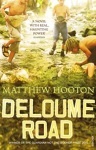
(Now I'm on a mission to source a copy of Matthew Hooton's first novel Deloume Road. None of my libraries have it but I'll find one somewhere! Amazon has it.)

Typhoon Kingdom begins in the 17th century, also known as the Age of Exploration.  Though Hooton's characters land in the hermit kingdom of Corea (Korea) by misadventure, the novel shows that lands being 'explored' by the Europeans were already inhabited and had their own government, customs and foreign policy.  Unfortunately for the sailors of the shipwrecked 'Sparrowhawk', trading with Nagasaki for the Dutch East India Company, six of them are escorted to the king on the mainland and the other is covertly whisked away to a much worse fate.  While the six are not ill-treated as they expect to be, they are not allowed to return home because they have knowledge of modern military weapons that the king intends to acquire from them.  (Then, as now, there is hostility between Korea and Japan.) Van Persie, however, rescued by the fisherman Hae-Jo, is kidnapped by a pseudo-shaman who first tortures him, ostensibly to appease the spirits, and then exploits him as a caged exhibit because his blond hair and blue eyes makes him an oddity.

This first section of the novel is told from the perspectives of different characters: the fisherman Hae-Jo; the fictionalised Hyojong, the 17th king of Joseon; and the shipwrecked Dutch sailor Van Persie.  Hae-Jo is poor and ignorant, but his life on the island has insulated him from the cruel mores of the mainland.  He has a sense of humanity which guides him to rescue Van Persie and try to reunite him with the others.  Ji-hoon had warned him about what to expect on his perilous journey:
'Stay clear of the King's roads, take shelter in the trees at night, and do not speak to anyone if you can help it.  The King has spies in every village, at every crossing.'

Ji-hoon had also told him many useful and worrying things about the mainland—further rumours of famine, and customs that seem beyond belief.

'In the capital, there are men who own more slaves than we have grains of rice. This is true.  If a woman kills her husband she is buried up to her neck by the roadside with a saw left next to her. So I am told. And no woman, not even the rich, are permitted outside of their homes during daylight.'

And though he cannot help but laugh at the thought of telling the women divers of his own island such a thing, he is troubled by how deeply different the customs of the mainland are, and he fears he knows even less than he once imagined.  He is a poor guide, a stranger leading a stranger through a strange land. (pp.58-9)

Through the terrors of Van Persie's experience—alone, vulnerable, unable to communicate and having no agency of his own—Hooton deftly portrays an inversion of what so often happened when Europeans captured 'exhibits' to take home for exploitation.  But he does find mercy in the woman who cares for his wounds and from Hae-Jo who risks everything in his quest.

To read the rest of my review please visit https://anzlitlovers.com/2023/03/11/t...
Profile Image for Jill.
1,111 reviews1 follower
September 1, 2020
After visiting Korea recently I wanted to know more about its complex history so decided to read this book. The novel is set in two time periods... the 17th century Joseon Dynasty when the country was closed to contact with the outside world and the 20th century when the country is in turmoil. In the 1940s the country was occupied by Japan and its population were abused and massacred. In the 1950s the civil war between the North and the South destroyed cities and infrastructure and divided the population. In each period there are multiple points of view which creates a very episodic story. While this can be distracting, the story is powerful and immensely sad.
600 reviews8 followers
June 8, 2025
In my quick and rather shallow dive into Korean literature to accompany my visit there in April 2025, I feel as if I have come full circle with this book. Matthew Hooton's Typhoon Kingdom is written in two parts, separated by 290 years. The first section is set in 1652 when Dutch accountant van Persie is shipwrecked on Jeju Island en route to a trading post in Japan. Six other sailors survived too, and were sent to the Emperor in Seoul. Van Persie is captured too and taken to a shaman, who slashes his tongue (not permanently) before he is handed over to a fisherman Hae-Jo who is charged with taking him to the Emperor Hyojong of Josean to join the other six sailors. Before embarking on the journey, his wounds are tended by one of the diving women of Jeju Island, and he carries this vision of his healer with him, as he is forced to place his fate in the hands of Hae-Jo as they traverse the kingdom on route to the emperor. The present tense narrative is told by three narrators: Van Persie, Hae-Jo and Emperor Hyojong himself.

The second part of the book is set in 1942, and it too is told by three narrators in the present tense. One is General Macarthur, impatient to take the fight to Korea after being forced to withdraw by his American commanders. The other two narrators are Yoo-jin, a young woman who uses her healing skills to treat a young villager with blue eyes, Won-je, who has joined the resistance to the Japanese occupation. Yoo-jin is captured by the Japanese (who have already been in control of Korea for the past 30 years), who use 'insurgent' women as 'comfort women' for the Japanese troops. In the chaos of the immediate post-war period, as Yoo-jin travels south to return home, Won-je continues to look for this woman healer.

I found the second part of the book more - what to say? engaging, compelling, affecting- than the first and I wondered if the first part of the book was even necessary, given its distance from the events in the second part. But on second thought, there is a slight narrative link between the two section, and the events are a mirror-image of each other. In both, there is a woman who heals and in both there is a search to find the healer again; one narrative heads up towards Pyongyang, the other heads south back to Jeju Island.

For my complete review, please visit:
https://residentjudge.com/2025/06/08/...
Profile Image for Jennifer (JC-S).
3,602 reviews290 followers
July 8, 2023
‘All along the island’s storm-beaten coastline of black rock, flattened cuttlefish hang from scrub pines like lost kites, and the cool air reeks of brine.’

This novel is based on two separate episodes in Korean history: the shipwreck of the Dutch East India Company’s Sparrowhawk in 1653, and in 1942 when Korea is under Japanese control. Both are written in the present tense; each addresses a pivotal point in Korean history.

The novel opens in 1653, with van Persie surviving shipwreck on Jeju Island. He is treated as a freak by a local shaman who has him on display in chains, together with deformed fish, birds, and animals for profit. The experience is traumatic, as is his subsequent journey to Seoul in search of his surviving shipmates. Van Persie travels with Yi Hae-jo, a local fisherman who has never been to Seoul.

During his travel to Seoul, van Persie encounters Korean language and culture, and is aware of the spirit world which is so much a part of life for the people of Jeju. As they travel, Van Persie remembers the woman who treated his wounds while Yi Hae-jo communicates with the Jeju Grandmother spirit about what lies ahead of him at the hands of the king. Yi Hae-jo has a difficult choice to make, complicated by the king’s determination to keep his country isolated from outsiders who might exploit it.

In 1942, during the Japanese occupation of Korea, Park Yoo-jin is taken from her family and forced to become one of the ‘comfort women’ servicing Japanese troops. Men from remote villages, including Kim Won-jae, join the resistance against the Japanese. After the Japanese defeat, and General Douglas Macarthur’s speculation that atomic bombs could be used on Communists everywhere, the Korean War begins over a line drawn arbitrarily by the Americans just north of Seoul. A Korean woman survived the Japanese brothels because both her language skills and knowledge in treating the sick, made her valuable to the Japanese. She is sustained by communicating with her grandmother’s spirit, and remembers a blue-eyed Korean fighter, Kim Won-jae.

In these two stories from the past, with 17th century Korea avoiding outsiders and 20th century Korea divided by war, I wonder what the future holds?

This is a beautifully written novel which captured and held my attention from beginning to end.

Jennifer Cameron-Smith
2 reviews
September 5, 2020
This book is a beautiful, unexpected lense into Korea and the shocking events that have shaped it over the last three hundred years. The writing is both beautifully personal and rich in cultural references. It reminded me of the early work 'The Famished Road' by West African author Ben Okri and the poignant 'The Expedition to the Baobab Tree' by Wilma Stockenstrom. Wonderful writing, uplifting, confronting and deeply moving.
522 reviews3 followers
March 14, 2021
Two stories in one - the first set in 1653 and based on the story of a shipwreck off the coast of Korea.
A surviving Dutch sailor kept a journal of his adventures.
In WWII, there is still a struggle for independence, freedom and a traditional way of life under Japanese occupation of Korea.
Both periods, 300 years apart, are still ruled by superstition and many gods whose will the people struggle to understand.
It is a story or war, cruelty and death in a place that should be paradise.
Profile Image for Ernie.
344 reviews8 followers
November 11, 2019
I did not expect to read a novel set in Korea and written and published in Australia but this is one of the many benefits of living in a multicultural nation. Hooton thanks the assistance of the famous Australian expert on Asia, Nicolas Jose in his research at the University of Adelaide and the result for me is a realistic representation of life in Korea, commencing in the 16th century in the period of first contacts with traders and sailors from the Netherlands before moving to 1942 and through the devastating years of war to 1953 and the beginning of the demilitarized zone between the North and South governments. In these pages I learnt things I had not known about the war, namely the bombing of the dams producing devastation and starvation and the use of napalm and carpet bombing that I am sadly knowledgeable about from the Vietnam war. Points of view and narration change suddenly and briefly to include even an emperor of 16th century Corea and General MacArthur who became the virtual emperor of Japan and Korea during those two terrible wars.
The novel begins with Van Persie, a Netherlands sailor wrecked with seven other survivors on the rugged shores of a tiny island off the coast of Corea, then a closed kingdom like Japan and China. Van Persie is separated from the other six and held prisoner by a shaman who tortures and exploits him to improve his hold over the fisher folk of the village who fear death for not having immediately taken the foreigner to Seoul, the capital as the emperor demands. The Coreans are fascinated by Persie's blue eyes and one woman who heals him, has sex with him and becomes pregnant. One courageous fisherman saves him from the shaman and takes him to the emperor whose soldiers are searching for, and capturing the other six sailors. Another Netherlander, resident in Seoul for twenty years, acts as interpreter to negotiate either their execution or return to the Netherlands trading post in Japan but all are caught up in a failed attempt at a coup.
Surprisingly, the story jumps to 1942 through the point of view of Park Yoo-jin, a trainee nurse who saves the wounded hand of a Korean boy, Won-jae who has blue eyes and so the link is immediately apparent. Then the point of view changes to Won-jae as the boy escapes in a Japanese soldier's uniform and the story follows the trials of these two characters during 1942-1953 in the terrible years of war. Other links are made with references to the girl's protecting ancestral spirits and the dreadful continuity of the vicious enmity from the Japanese to the Koreans over the centuries. The girl is forced to become a comfort woman and the boy faces death at the hands of both the Japanese and their Korean collaborators. There are brief moments of compassion from a Japanese doctor who understands that the women's “bodies have been stolen” and from a disfigured Japanese boy soldier who is one of the fifteen men that Yoo-jin must service with sex every night.
The portrayal of General MacArthur reminded me of the Chinese poem that a general's reputation is made from a mountain of corpses as Hooton makes him aware of the symbolism that his Tokyo headquarters have basements filled with skeletons as the Japanese were unable to bury so many during the fire bombing.
Hooten mediates his text by suggesting the horrors rather than exploiting the details to shock me; the facts of those years are shocking enough. He sustains a brisk pace throughout but maintains the humanity of his characters and my empathy with them.
289 reviews1 follower
August 31, 2019
Probably 3.8. The sad story of the people of Korea and the brutal occupation by Japan, the horrific story of comfort woman. Then the occupation by the Americans, who ignored the corruption by the Korean collaborators and INSTALLED President who was probably corrupt. A story of family, love hope. A story of Korea. Explains some of the problems of Korea today without the blinkers of the American propaganda.
Profile Image for Linda.
83 reviews
June 17, 2021
Evocative writing, superb character development, compelling parallel story lines, intriguing location and historical context. In short, a brilliant historical novel that had me hooked from the first chapter. A can't-put-downer. I loved it!
(And all the better because the author is from my own hometown. But I would have given the book 5 stars, regardless.)
Displaying 1 - 9 of 9 reviews