Jump to ratings and reviews
Rate this book

Oak Flat: A Fight for Sacred Land in the American West

Rate this book
NATIONAL BESTSELLER • A powerful work of visual nonfiction about three generations of an Apache family struggling to protect sacred land from a multinational mining corporation, by MacArthur “Genius” and National Book Award finalist Lauren Redniss, the acclaimed author of Thunder & Lightning

“Brilliant . . . virtuosic . . . a master storyteller of a new order.”—Eliza Griswold, The New York Times Book Review (Editors’ Choice)

NAMED ONE OF THE BEST BOOKS OF THE YEAR BY KIRKUS REVIEWS

Oak Flat is a serene high-elevation mesa that sits above the southeastern Arizona desert, fifteen miles to the west of the San Carlos Apache Indian Reservation. For the San Carlos tribe, Oak Flat is a holy place, an ancient burial ground and religious site where Apache girls celebrate the coming-of-age ritual known as the Sunrise Ceremony. In 1995, a massive untapped copper reserve was discovered nearby. A decade later, a law was passed transferring the area to a private company, whose planned copper mine will wipe Oak Flat off the map—sending its natural springs, petroglyph-covered rocks, and old-growth trees tumbling into a void. 

Redniss’s deep reporting and haunting artwork anchor this mesmerizing human narrative. Oak Flat tells the story of a race-against-time struggle for a swath of American land, which pits one of the poorest communities in the United States against the federal government and two of the world’s largest mining conglomerates. The book follows the fortunes of two families with profound connections to the contested the Nosies, an Apache family whose teenage daughter is an activist and leader in the Oak Flat fight, and the Gorhams, a mining family whose patriarch was a sheriff in the lawless early days of Arizona statehood.

The still-unresolved Oak Flat conflict is ripped from today’s headlines, but its story resonates with foundational American the saga of westward expansion, the resistance and resilience of Native peoples, and the efforts of profiteers to control the land and unearth treasure beneath it while the lives of individuals hang in the balance.

281 pages, Hardcover

First published November 17, 2020

129 people are currently reading
10499 people want to read

About the author

Lauren Redniss

16 books203 followers
Lauren Redniss is the author of Century Girl: 100 years in the Life of Doris Eaton Travis, Last Living Star of the Ziegfeld Follies and Radioactive: Marie & Pierre Curie, A Tale of Love and Fallout, a finalist for the 2011 National Book Award for non fiction. Her writing and drawing has appeared in numerous publications including the New York Times, which nominated her work for the Pulitzer Prize. She was a fellow at the Cullman Center for Scholars & Writers at the New York Public Library in 2008-2009, became a New York Institute for the Humanities fellow in 2010, and is currently Artist-in-Residence at the American Museum of Natural History. She teaches at Parsons the New School for Design in New York City.

Ratings & Reviews

What do you think?
Rate this book

Friends & Following

Create a free account to discover what your friends think of this book!

Community Reviews

5 stars
792 (39%)
4 stars
822 (41%)
3 stars
310 (15%)
2 stars
50 (2%)
1 star
10 (<1%)
Displaying 1 - 30 of 327 reviews
Profile Image for Jennifer ~ TarHeelReader.
2,785 reviews31.9k followers
December 14, 2020
Thank you for the gifted copy, Random House.

Oak Flat is a mesa belonging to the Apache. It’s a holy place where girls have a ritual to celebrate their coming-of-age. Reading about this had me in awe because the culture celebrates women and their femininity.

In 1995, a copper reserve was found nearby, and ever since, a conflict has been waged on who this land belongs to and what it should be used for (as if that should really be a question?! But I digress). I’ve read about conflicts between the federal government and Native lands before, but I was not familiar with Oak Flat. It makes me wonder how many more there are that we don't hear about often enough.

Oak Flat is a stunning and powerful portrayal, a true experience of a read, important, timely, and thought-provoking. I loved it so much I plan to listen to the audio while I gaze and study the visuals inside the book. A can’t miss. I highly recommend a physical copy due to the artwork.

I received a gifted copy. All opinions are my own.

Many of my reviews can also be found on my blog: www.jennifertarheelreader.com and instagram: www.instagram.com/tarheelreader
Profile Image for Evie.
737 reviews760 followers
November 5, 2020
I have read the print edition while listening to the audio and that's how I would recommend approaching this work of nonfiction. The illustrations are an important part of the book but at the same time, the audio is phenomenal.

All in all, this is an important and illuminating piece filled with meaningful stories that are both heartbreaking and awe inspiring.
Profile Image for Jenny (Reading Envy).
3,876 reviews3,714 followers
November 30, 2020
"Oak Flat is a serene high-elevation mesa that sits above the southeastern Arizona desert, fifteen miles to the west of the San Carlos Apache Indian Reservation. For the San Carlos tribe, Oak Flat is a holy place, an ancient burial ground and religious site where Apache girls celebrate the coming-of-age ritual known as the Sunrise Ceremony. In 1995, a massive untapped copper reserve was discovered nearby. A decade later, a law was passed transferring the area to a private company, whose planned copper mine will wipe Oak Flat off the map--sending its natural springs, petroglyph-covered rocks, and old-growth trees tumbling into a void...The book follows the fortunes of two families with profound connections to the contested site: the Nosies, an Apache family whose teenage daughter is an activist and leader in the Oak Flat fight, and the Gorhams, a mining family whose patriarch was a sheriff in the lawless early days of Arizona statehood."

I understand the print version of this to have stunning visuals; I enjoyed the audio with multiple narrators. I appreciated that the issues raised are more broadly shared with various indigenous groups but I also enjoyed learning more about Apache ceremony and this one family's experiences with it.

I had free access through Random House Audio's Volumes app since they have me on the yes list.
Profile Image for RuthAnn.
1,297 reviews195 followers
January 1, 2021
Thank you to Random House for my free copy!

I am very conflicted about this book. It's a physically beautiful object, inside and out. The combination of illustration and language is very effective. The author uses a script-like format for the dialogue, based on what must have been hours of interviews, so there's not a lot of transition text. I certainly learned a lot from it. But I feel very uncomfortable that this book about Indigenous sacred land is written by a white woman. To date, I haven't been able to find commentary or critique of this book from an Indigenous perspective, and that makes me even more nervous.
Profile Image for Rod Brown.
7,367 reviews282 followers
January 17, 2021
The flat and dull text is kept from sinking this book by throwing in lots of illustrations by the author. But the art isn't that great either.

I support the cause of preserving Oak Flat for the Apache who hold it sacred against a destructive copper mining project planned for the area, but the narrative meanders around so much and noodles about in digressions, I'm not sure there is a persuasive point made nearly as effectively as the subtitle. And its one of those books that wants to draw attention to an issue, throwing in opposing viewpoints and tons of quotes from people effected, but the author never definitively comes out and says this sucks, let's oppose it and let's do these things to stop this crap.

This isn't history. This is happening right now. Without taking a stand and offering an action plan, the whole thing becomes a big shrug: "Aah, so sad. Now what will my next book be about?"
Profile Image for Emma.
310 reviews18 followers
March 5, 2021
This is a luxurious book. When I picked it up from the library I was surprised at how heavy it was. The pages are on such thick paper that I kept thinking I was turning two pages at once. To me, the physical weight of it communicated the care and attention with which the author and publisher handled the contents. I don’t think I have ever been so impressed by how a book physically feels in my hands.

I was also surprised after picking it up from library when I thumbed through it and saw the illustrations. I can’t remember what whim led me to requesting this from the library, but I had no idea that it was “visual nonfiction” and I’m happy to say that it was a pleasant surprise. Again, the illustrations communicated the author’s care and the time she spent researching the book. I loved how they at times were text in and of themselves, and at other times served to accompany the text. They are lovely.

The author jumps between prose, interviews, investigative reporting, and what seemed like poetry at times. I don’t know if I have read anything like it. At times the jumps were jarring, but mostly they were well placed and well executed. Sometimes I felt like the connections between various people in the story were hard to grasp because they came so quickly. A family tree or visual element that I could refer back to would have been helpful. But even still I could imagine the author sitting and chatting with the members of the town and the reservation.

I wish that there was more at the end, but of course the struggle to preserve Oak Flat is ongoing so I can’t really fault the author for that. I will for sure be looking for information about it in the news, if there is any! I hope that this book will encourage more news coverage.
Profile Image for Conner Horak-Flood.
223 reviews2 followers
November 17, 2020
This book is a marvel. A self- described "visual nonfiction," Oak Flat provides a sweeping yet intimate examination on the treatment of indigenous peoples in the United States through the lens of a mining town in Arizona and the elevated plateau above it called Oak Flat, where there is still, today, an ongoing political fight between a copper company who wants to mine the huge ore deposits beneath Oak Flat, and the indigenous people who claim it as scared land. If it sounds familiar, it's because it is. Disgustingly familiar. Redniss expertly illustrates, both literally and figuratively, how perverted and corrupt the system has been and continues to be against native people, but with a touch so gentle, you are left to discover your own outrage which makes it all the more powerful. The book is journalism perfected, riveting, and a piece of art unto itself. With a certain holiday just around the corner (currently mid-November as of the writing of this review), I can't help but feel that reading this book is all the more pressing. You won't be disappointed.
Profile Image for Tom Mooney.
917 reviews400 followers
January 15, 2021
On the face of it, this is a beautiful work of visual non-fiction about a global mining giant attempting to extract vast amounts of copper from under sacred Apache land in Arizona.

But rather than give us an easy moral conundrum, Redniss delves deep into the community of both the San Carlos Apaches and the nearby small town, which like many in Arizona has mining in its blood.

What we get is a balanced, thoughtful and deeply moving investigation and a springboard to explore the great questions of our age.

How do we protect the environment and also create jobs?

How do we access the resources needed in our daily lives without causing destruction of our natural environments?

How do we deal with the injustices of the past while also looking to the future?

Is capitalism viable any more and, if not, what then?

How the hell do we live now?

What the fuck have we done??

What the fuck do we do???

Redniss gives us none of the easy answers because there aren't any. Only great conundrums we are going to have to solve if we still want to exist as a species in a century's time.
Profile Image for Kate Belt.
1,339 reviews6 followers
November 20, 2020
I really expected to love this book. The illustrations were lovely, but the text was tedious in places. I've read other books written in a more engaging, narrative style offering the same broader historical details. This was a specific place that had its own story, and its people had their own stories, but my reading experience was to feel far removed from them.
Profile Image for Elizabeth☮ .
1,821 reviews14 followers
May 3, 2021
This is an interesting way to learn the history of Oak Flat and the battle for indigenous lands. My oh my. The native nations were so wronged by the American government. Capitalism always wins.

Oak Flat is known for having copper. Lots of copper. What happens next? A big company comes in to create a mine. The Apache nations fight it, but guess what? You know what: the mine is under construction.

The book has illustrations that are a nice addition. Redness tries to give all perspectives of the situation. There are good notes in the back also.
Profile Image for Ann.
1,117 reviews
March 28, 2021
This book is a unique blend of narrative, artwork, and dialogue. It helped me understand this situation which is still unresolved. Sadly, it’s not hard to imagine that money & lies are going to win out over the environment, archeology, and land that is sacred to the Apache people.
Profile Image for Varsha Ravi.
488 reviews140 followers
Read
November 22, 2021
Oak Flat by Lauren Redniss is an important and beautifully produced piece of visual nonfiction that tells a very human narrative of the ongoing contested fate of Oak Flat, a high elevation tableland in southwestern Arizona that is sacred to the Apache people. However, for decades they’ve been fighting to protect this land from a large copper mining corporation, backed by powerful politicians and billions of dollars, from mining in Oak Flat and destroying the land. Redniss charts out the fortunes of two families on opposing sides of the conflict with a deep-rooted connection to the land. The Nosies, an Apache family, whose young teenage daughter is an activist and advocate for the Apache sentiment and the importance of these sacred lands to her people. On the flip side, you also follow the Gorhams, a family whose livelihood has been around mining for generations and whose patriarch was the first sheriff of the town back in the lawless days of Arizona state. It’s appreciable that Redniss tries to present all sides of the ongoing conflict, but you can’t help but deeply sympathize and root for the Apache people and the profound love and connection they have for their sacred land, hoping against all odds that the big mining corporation will not win this fight. Since it is an ongoing issue, you don’t get the resolution you may be looking for, but the text provides the context necessary to understand the turbulent history the Apache people have faced and the important traditions associated with the Oak Flat. The simple hand-drawn illustrations accompanying the text ground the narrative and help in place-making, and in creating a strong sense of the landscape. A minor quibble I had was that there are several conversations in the text presented in an interview format with several different people. At times, I found this disjointed and confusing to keep straight who’s who. Perhaps those sections could have been edited for clarity or given context before a specific conversation. On the whole, though, I found it well worth a read.
Profile Image for Gerry Durisin.
2,286 reviews1 follower
April 20, 2020
I received an ARC of this book from Penguin Random House in exchange for an objective review.

This non-fiction book is unlike anything I have ever read. It combines history, testimony, art, and poetry to examine a serious and controversial issue: the proposal to allow the Resolution Copper Company to begin mining copper on land previously set aside as part of an Apache Indian Reservation. The mining company has already succeeded in persuading the US Congress to allow a "land exchange" whereby the Oak Flat land, held as sacred by the Apache tribe, will be turned over to the mining company in exchange for other land yet to be designated. The Native population holds conflicting views on this issue: some see the mine as a sign of progress and a way to boost the local economy and bring new opportunities for work to the residents of the area; others object that the mining operation will destroy sacred lands that have been used for centuries for religious and cultural practices that are crucial to the Apache identity. Redniss presents all sides of the debate, leaving the reader to draw his own conclusions.

The art work illustrating this book is amazing! I must admit I enjoyed the illustrations more than the text. Colorful drawings portray the beauty of the land, while more somber line drawings show the various individuals interviewed for the book. The combination of text and images provides an enlightening glimpse of a culture with which most white Americans are unfamiliar, including descriptions of Apache myths and traditions, historical documents, and personal testimony. A very worthwhile read!
Profile Image for Liz.
824 reviews8 followers
December 14, 2020
The editor/author does a really good job of allowing the Native voices of the Apache peoples to shine here and tell their story. On the surface level, this book is about a sacred site being taken away from Native people for mining or capitalist purposes. There are court cases, congressional hearings, and internal tribal disputes about the titular Oak Flats. It's a lot in a small book.

The reader can feel the significance of the site to specific rites within the Apache culture. Beyond that, there is a deepening of the broader, popular cultural understanding of what Apache means. The name is more than a stolen name brand for clothes or software and Geronimo on display for the public. They are people who are alive and dealing with further attempts at cultural genocide through the invalidation of their first amendment rights. The book makes the argument that best fits this sort of desecration: if there were precious metals under the Vatican, would it be acceptable to mine there for profit? It's equally abhorrent to mine in the Oak Flats.

What amount of money is worth destroying a nation's religious practices? What amount of money is worth desecrating and destroying an ancient, holy site?

It's these questions that really draw the stark reality of what it means to have rights in the U.S. --and something that this book presents well. There are parallels to other less religious sites such as the ongoing struggle with DAPL, which ring equally poignantly to the necessity of environmental and racial justice for BIPOC peoples.
Profile Image for Diogenes Grief.
536 reviews
January 24, 2021
Lily Meyer of NPR gave a great review of this book, so I won’t bother (https://www.npr.org/2020/11/20/936989...). The Apache people fight against the rapacious greed of the mining industry, and I wish them all the best in their fight.

”There are 15,000 members of the San Carlos Apache Tribe. About 10,000 live on the 1.8 million acre San Carlos Reservation. According to tribal officials, there is 70 percent unemployment in San Carlos. The median income is $25,000. Approximately 45 percent of tribal members live below the poverty line, including 59 percent of children under 12. One in two children in San Carlos tests positive for drugs or alcohol at birth. In 2015, the life expectancy of a Native American in Arizona was 60, 16 years shorter than non-Natives in the state.

Resolution Copper has invested more than a billion dollars in the proposed mine and expects to sink some $7 billion more into the project before any minerals are pulled from the ground. The company estimates it will extract $144 billion worth of copper over the life of the mine. Resolution’s parent companies, BHP and Rio Tinto, run mining operations in Chile, Papua New Guinea, Indonesia, Zimbabwe, Madagascar, Namibia, South Africa, Australia, Canada, Peru, Mexico, Columbia, Brazil. In 2018, BHP employed some 62,000 people and reported profits from operations of $16 billion. Rio Tinto employed 47,000 people and took in $18 billion in profits from operations”
(p. 26).

It’s a Faustian fight either way they go. The utter lack of enforcement of the American Indian Religious Freedom Act (AIRFA) of 1978 is one more tragic farce in the United States of Hypocrisy, where “Thousands of years of indigenous culture are shoehorned into cursory preambles before the real story begins, with the appearance of white settlers. Indians are people who exist in the past tense, whose claim to the land is a distant memory” (p. 146). Redniss proves that the indigenous people of the Americas are still fighting, from Alaska to Chile, and especially in Arizona, and they’re not alone. No surprise Bernie Sanders (pre-mittens meme) and his ilk support Native rights. In solidarity \m/
Profile Image for Marthine.
89 reviews17 followers
December 21, 2021
A beautiful book that's also made with care. It's a different kind of book for me, somewhere between a graphic novel and an art book. I appreciate Redniss's awarenes of her position as an outsider and therefore the emphasis on elevating the Apache people's voices and emphasizing the ongoing life of their culture and traditions. She also presented the opinions of folks local to the area outside the tribe, and tribal members who support mining for its economic benefits. The downside of this approach is that it's hard to get a real sense of arc and narrative. Each chapter presents a point of view and information to understand it, but the author recedes so far that the clarity of where she stands or what she thinks of the whole story is a bit buried. It's also perhaps the risk of writing about an ongoing, unresolved attack on Indigenous religious practice, culture, and land stewardship -- there's no way to write an ending when it's all still happening. I do feel better informed about the different perspectives, different losses and gains due to the fight over mining in Arizona, and I feel like I have a deeper sense of the landscape of the Southwest and the Indigenous people's relationship to it.
Profile Image for cardulelia carduelis.
684 reviews39 followers
January 3, 2025
What's going on over in Arizona? Well, the same thing that's been going on since the America's were colonized. This time with more paperwork.
Oak Flat is a sumptuous running history of the US bypassing their own laws to pave way for big business, flattening Native culture and cultural sites in the process: what a bonus!

Over the course of the book Redniss paints the picture of an insidious machine that is dead set on mining the eponymous region for copper. She does this through a mix of recorded dialogue, interviews, and editorials. Some of the material includes the history of the town of Superior, a short distance from Oak Flat, and a former mining town many times over.


We spend a lot of time with a white family that grew up working in the industry that was generated by the former mine, across 3-4 generations. In juxtaposition are a family from the San Carlos Apache reservation, the Nosie's, who are intimately familiar with Oak Flat as a ground for the coming of age ceremony for adolescent women. The dialogues have a lot of balance: acknowledging the poverty (and the cause of it) on the reservation, coupled with the cultural richness. Likewise over in Superior we see the great industry the mine brought as well as the environmental and health calamities.


This story goes beyond Arizona though, it touches upon so many aspects of the US's war on the native population that it serves as a flyover introduction to the history as a whole.
Many of the stories here I hadn't heard before. One that horrified me, probably because it is so close to my own work, was the story of the Mount Graham observatories.
You can read a summary of the construction of the telescope from the fascinating blog here: astrobites link.
Essentially, Mount Graham used to be a sacred place for the Apache people much like Oak Flat before it was removed from them by the US government in the late 1800's. Although now a government park, the Apache nation still visited regularly for foraging, events, pilgrimages. It is also a known ecological reserve to a specific type of squirrel. However, because of the clear skies, low moisture, low ambient light, and altitude it was also the proposed location for a telescope array.


As pressure from ecological groups and the Apache Survival Coalition increased, backers at various academic institutes began to drop out. But then the Vatican stepped in. And despite having heartily endorsed the preservation of Native culture and religion, when push came to shove:
We are not convinced by any of the arguments thus far presented that Mt. Graham possesses such a sacred character which precludes responsible and legitimate use of the land.
. The telescopes were built. Horrifying stuff, performed in the name of fundamental physics.
If a Native monolith like Mount Graham couldn't hold out against scientific curiosity, there seems little hope that Oak Flat will hold out against American big business. But read it yourself and see if you agree.

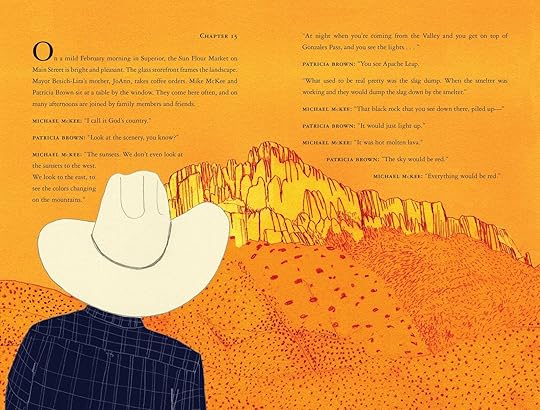
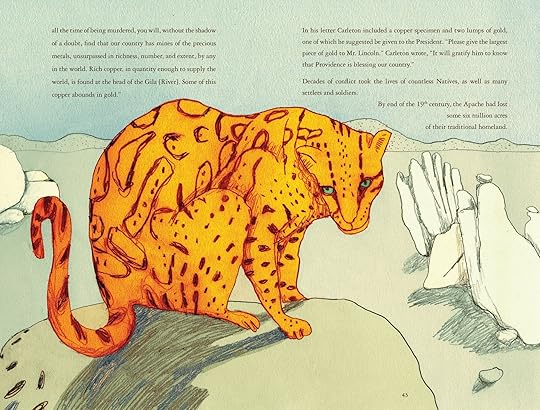
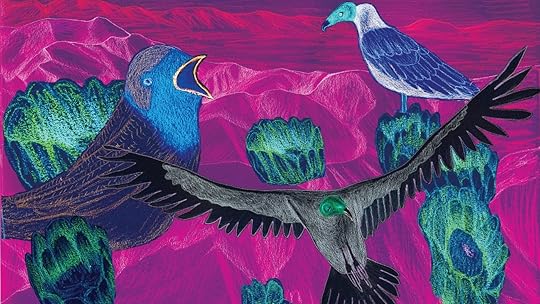
The presentation of the book is absolutely breathtaking. it is packed with full colour sketches of the landscape and the story every 3-4 pages:


There is a well-segregated blend of facts about the natural world, industrial process, politics, interviews, and beautiful descriptions.

I can't recommend this enough. I think if I listed everything I liked, every tidbit and beautiful piece of writing I'd be copying out the entire book. It's breathtaking how much nuance is conveyed in such a small book. Redniss and her editors got the balance just right.
I'll leave you with this quote from Johnson v. M'Intosh, the conclusion of which has been held as precedent in cases where Native populations lay claim to their land since 1823,
Conquest gives a title which the courts of the conquerer cannot deny.
Profile Image for Maria.
214 reviews10 followers
March 19, 2024
beautiful storytelling and artwork. this is visual nonfiction about an Apache family and their community fighting against a multibillion dollar mining corporation who wants to drill for copper on their sacred land. I loved how this story was told and how it includes the thoughts/histories of so many people. the varying viewpoints were an interesting touch and the questions imposed regarding maintaining tradition, improving circumstances, and going with/against capitalism were thought-provoking. I learned A LOT from this and recommend if you’re interested in learning more about this topic.
Profile Image for drea.
55 reviews6 followers
July 14, 2022
Unique and life-affirming. The dreamy and surreal illustrations really bring out the dignity of the people and places in this story. I want more and more of the layers and texture so beautifully depicted here.
Profile Image for Laura.
43 reviews
March 15, 2025
I think I would have enjoyed it more if not audiobook multiple narrator; however, I think this book is very important. I made me think and and made me cry. I don’t know where I land exactly on some of the issues it presented but parts of this should definitely be taught in school.
Profile Image for Constance.
722 reviews6 followers
February 10, 2021
A unique combination of reporting and art. Stunning.
Profile Image for Hailey Taylor.
17 reviews1 follower
June 11, 2023
Both the artwork and writing style were beautiful. Redniss is great at exposing the disappointing irony of our society through a mixture of first-hand accounts and research. She makes an effort to include perspectives of a few "common folk" on both sides of the issue, and presents this without passing judgement on them.
11 reviews
August 15, 2025
Very nice, local is fun. Annie would like this book. Big font.
Profile Image for Caleb Ingegneri.
45 reviews13 followers
December 3, 2023
I grew up 40 minutes from Oak Flat by car.
I've rock climbed next to the mine within 2023

I live in Illinois now. I often reflect on indigeneity. The complex web of relationships in nature, in our communities, and within capitalist structures. Of Arizona-a spiritual place.

One day, I stopped into a Chicago library and this book nearly fell off the shelf into my hand.

Oak Flat is a beautiful book: well illustrated, well narrated. I love how empathetic Redniss is in describing many people's reaction Resolution Copper's influence.
Profile Image for Victoria Wiedrich.
55 reviews1 follower
February 10, 2023
Part graphic novel, part history book, art coffe table-like etchings. This book is an absolute original and defies being categorized. An utter gem which I plan to reread often.
Profile Image for Luca.
354 reviews27 followers
January 15, 2021
Jan 15, 2021: A nonfiction picture book for adults, this book feels like the best of both worlds: the art and poetry of children's picture books and the depth and complexity of adult literature. In rich color and expressive drawings, Oak Flat chronicles an ongoing fight between Resolution Copper and the San Carlos Apache tribe for rights to lands considered lucrative to Resolution Copper and sacred to the Apache. This text zooms into the personal stakes and out to the cultural, environmental, and historical stakes of this fight. It includes testimony from the people involved, as well as extensive research into not only the potential impacts of the mine and the back and forth in the case, but the histories of the involved parties.

"My grandmother's generation. These were the people who knew the earth. They died as prisoners of war, but they had children. That generation was afraid. Then comes my generation thinking, Hey, wait a minute, this is wrong. I'm out here challenging things, but I'm still a little afraid. Then comes my daughter, who's like, boom, boom, boom, boom! And then, Here comes her daughter, who's like, We're going this way." —Wendsler Nosie

The book takes no explicit sides, simply presenting arguments from many sides. It ends inconclusively, unsettlingly, and irresolutely, because this lands fight is ongoing and unfolding as I type. In fact, the Trump administration rushed to approve the controversial land exchange today, ahead of the Biden administration's promises to expand tribal land rights and reverse Trump-era rollbacks of protected lands. It's somewhat surreal to experience a book like this in real time, but I think it will be able to stand on its own both as a time capsule for this moment, and as an innovative art and storytelling experience.

I'm very impressed, but may have preferred a more explicit stance from the author. I would read more from her, appreciate the education this book has provided, and will continue to follow the story. 4.5
Profile Image for shakespeareandspice.
357 reviews510 followers
September 21, 2021
"I used to say I hate politicians. Then I realized just being a Native person, living and breathing, that's almost a political statement. We are supposed to be extinct" (249).

Oak Flat chronicles the journey of the San Carlos tribe of southeastern Arizona and their struggle to preserve their tribal lands. Along with the interviews and historical background that teaches us more about the Apache tribe, the book is painted with illustrations throughout its length. Within these images you glimpse the natural landscape of the region as well as the portraits of the indigenous peoples to whom it belongs.

This was a buy-at-first-sight sort of a book for me but I still waited to read it almost a year and I wish I hadn't. I'm not sure if it's time that wore out the excitement or simply the fact that book just doesn't live up to the expectation but I found this somewhat underwhelming. The illustrations are brilliant and I loved the art style adapted for it. Where the disappointment lies is within the writing.

The writing is padded around the illustrations throughout but although those disruptions were somewhat jarring for me at times, the writing on its own is dull and unimaginative. The portions where the reading improves is when the interviewees were speaking because some of the things they had to say resonated with a poetic hum.

Despite this, Oak Flat by Lauren Redniss is still a book worth reading because I honestly did learn a lot. I have an immense amount of respect for indigenous peoples of North America and hearing their voices always makes me feel privileged (given how little exposure they are given in the United States) and as such, I wouldn't have traded this experience for anything else. And if not for the narrative, I would still purchase this one for my library given the beauty of the physical book.
Profile Image for Kathy (Bermudaonion).
1,173 reviews125 followers
November 20, 2020
4.5 stars

When copper was discovered on sacred Native American ground, the poor native people find themselves fighting corporate greed and the federal government. I found this well researched book to be enlightening and disturbing and had a knot in my stomach most of the time as I listened to it. The audio has a full cast and is formatted differently than I’m used to (each character was announced before they spoke) but I came to enjoy it and appreciate it. I came to realize just how poorly native people are treated in the US to this day and it upset and shamed me.
Displaying 1 - 30 of 327 reviews

Can't find what you're looking for?

Get help and learn more about the design.