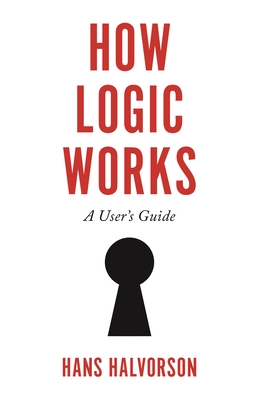
A concise introduction to logic that teaches you not only how reasoning works, but why it works
How Logic Works is an introductory logic textbook that is different by design. Rather than teaching elementary symbolic logic as an abstract or rote mathematical exercise divorced from ordinary thinking, Hans Halvorson presents it as the skill of clear and rigorous reasoning, which is essential in all fields and walks of life, from the sciences to the humanities―anywhere that making good arguments, and spotting bad ones, is critical to success.
Instead of teaching how to apply algorithms using “truth trees,” as in the vast majority of logic textbooks, How Logic Works builds on and reinforces the innate human skills of making and evaluating arguments. It does this by introducing the methods of natural deduction, an approach that teaches students not only how to carry out a proof and solve a problem but also what the principles of valid reasoning are and how they can be applied to any subject. The book also allows students to transition smoothly to more advanced topics in logic by teaching them general techniques that apply to more complicated scenarios, such as how to formulate theories about specific subject matter.
How Logic Works shows that formal logic―far from being only for mathematicians or a diversion from the really deep questions of philosophy and human life―is the best account we have of what it means to be rational. By teaching logic in a way that makes students aware of how they already use it, the book will help them to become even better thinkers.
The Stuart Professor of Philosophy at Princeton University, Dr. Halvorson's research interests include category theory, logic, philosophy of science, philosophy of physics, and the interplay of science and religion.
In 2001, he received a PhD in Philosophy from the University of Pittsburgh, where he also earned an MA in Mathematics (1998) and an MA in Philosophy (1997). He graduated from Calvin College in 1995 with a BA in Philosophy.
Academic appointments: 2016- Stuart Professor of Philosophy, Princeton 2010-16 full professor: Princeton philosophy 2012 associated faculty: Princeton mathematics 2005-10 associate professor: Princeton philosophy 2001-05 assistant professor: Princeton philosophy
PROS: Couple of the advantages of this book in the sea of introductory textbooks about propositional logic is its compactness and use of Lemmon-style natural deduction. It's a bit harder than Fitch or tree method but it really compels you to think about how inferences are made, which makes it very easy to understand other styles of proofs. I should also mention that some concepts are thoroughly investigated and expressed in a very comprehensive way.
CONS: I felt like sometimes there's a lack of examples before exercises. I understand one learns logic through exercise and thinking for themselves but considering this is an entry-level book, I think more worked examples for some chapters would've been very helpful, especially when dealing with Quantification and relationship of existential and universal claims.This book also lacks overall philosophical context for some concepts, especially in the chapters following QL. I suppose this book isn't really designed for self-study but still...
Overall, going through this book alongside the famous one by Peter Smith allowed me to greatly better my understanding of Propositional logic. I would highly recommend "How Logic Works" to anyone interested in the subject matter, however I'd strongly advise supplementing it with other material(s).
Hans Halvorson legt mit diesem Buch eine erfrischende und zugleich tiefgründige Einführung in die formale Logik vor, die sich bewusst von herkömmlichen, rein mechanischen Lehrbüchern absetzt. Im Zentrum steht die Überzeugung, dass Logik keine bloße Ansammlung von Fakten oder Dogmen ist, sondern eine praktische Fähigkeit („skill“), mit der sich gute von schlechten Argumenten unterscheiden lassen. Logik erscheint bei Halvorson nicht als abstraktes Regelwerk, sondern als eine „Lebensform“, die menschliche Rationalität schärft. Ein besonderes Merkmal des Buches ist die methodische Entscheidung des Autors: Er verzichtet auf vereinfachende Beweisbäume („trees“), da diese seiner Ansicht nach den Denkprozess eher verdecken als fördern und Lernende zu „logischen Automaten“ degradieren. Stattdessen setzt er auf das anspruchsvollere Lemmon-Beweissystem. Dieses mag eine steilere Lernkurve aufweisen als das verbreitete Fitch-System, erweist sich jedoch als „reflexionsdurchsichtig“ (transparent to reflection): Es macht sichtbar, warum Regeln gelten, und fördert so ein eigenständiges, kreatives logisches Denken. Der Aufbau des Buches folgt einer klaren didaktischen Dramaturgie: Es beginnt mit der Aussagenlogik, führt über die Prädikatenlogik und mündet schließlich in die logische Metatheorie. Dabei gelingt es Halvorson, zentrale metallogische Konzepte wie Korrektheit (Soundness) und Vollständigkeit (Completeness) präzise und zugänglich darzustellen, ohne in Simplifizierung zu verfallen. Die Mengenlehre dient ihm dabei als tragfähiges Fundament, um Begriffe wie Wahrheit und Interpretation (Modelle) systematisch zu klären. Besonders hervorzuheben ist der konsequente Anwendungsbezug: Logik wird als Instrument verstanden, mit dem sich die „Kosten“ eigener Überzeugungen kalkulieren lassen. Das Buch zeigt nicht nur, wie man Beweise führt, sondern auch, wie sich Unbeweisbarkeit durch Gegenmodelle demonstrieren lässt. Darüber hinaus werden anspruchsvollere Themen wie Entscheidbarkeit (Decidability), Gödels Unvollständigkeitssatz und das Kompaktheitstheorem eingeführt, wodurch das Werk weit über eine bloße Einführung hinausgeht. Zusammengefasst ist Halvorsons Leitfaden eine intellektuelle „Muskelübung“, die dazu befähigt, klarer, präziser und unabhängiger zu denken. Wer Logik nicht nur anwenden, sondern wirklich verstehen will, findet hier ein Werkzeug, das den eigenen Blick auf Argumente – und damit auf die Wirklichkeit selbst – nachhaltig schärft.
Nice to have an intro-level textbook that covers more advanced topics like metalogic and applications of first-order logic to axiomatized theories of groups, sets, arithmetic, etc. Teaching intro logic and I wanted to give students a glimpse of the more fun stuff and this book was super helpful in prepping lecture notes on those topics.