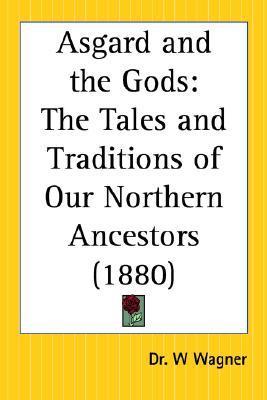
This scarce antiquarian book is a facsimile reprint of the original. Due to its age, it may contain imperfections such as marks, notations, marginalia and flawed pages. Because we believe this work is culturally important, we have made it available as part of our commitment for protecting, preserving, and promoting the world's literature in affordable, high quality, modern editions that are true to the original work.
If you don't have a vampire-meets-garlic reaction to Wilhelm Wagner's writing (Christian-oriented mindset), then it's not too bad. Corny humor aside, books on European heathenry like these have a special importance to me, being half-Norwegian and half-Jewish (with a preference for men). I can't speak for everyone, but I'm noticing more and more young Jewish people with European ancestry are looking into the pre-Christian mythologies, and I hope this continues. Generally speaking, (modern) European heathens and Jews (see Gittin 56 & 57 of the Talmud) share a rejection of, and disdain for, Christianity.
After reading this book and others like it, I see that there are similarities with the Jewish Talmud & Kabbala (esoteric Jewish mysticism for you goyim), and European heathenry. This review is long enough, so I won't get into that here. I was surprised to learn of the progressiveness of these ancient worldviews. There are examples of heathen dieties who challenged Christian-oriented gender roles and sexual morality, while the Talmud notes that there are more than two sexes. Esotericism and witchcraft are more similarities between heathenry and Talmudism & Kabbala. In my experience, Jewish and heathen circles have accepted and allied with LGBT people, united against the Christian bigots. Did I mention my favorite YouTuber is Rainbow Pagan?
I bought this book after having read the glorious A.S. Byatt's Ragnarok - where Asgard and the Gods is the keystone, the guide that takes the thin child in wartime through the myths. It is an informative book, not chronological (as the myths themselves are transmitted through various different voices) but quite engaging nonetheless.
Actually, the author's constant referencing of Christian mythology during the text was EXTREMELY distracting. In fact, Wagner seemed (he is LONG deceased) incapable of staying 'on task' with his retellings, often digressing into the mythologies of other peoples. I WILL grant, that in the stories he managed to cover, that he DID do a decent job of telling the stories for as long as he managed to stay with each one.
Great book on Norse Mythology and it's translation to northern culture. I read the 1917 8th Edition. that shows a 1st edition publish date from the 1800s.
The mythology included for lesser known Norse characters is very detailed and includes stories not often included with the more common stories.
Would definitely recommend. If you want the older 1917 edition, it can be checked out from the California State Library in Sacramento.