At the dawn of the twentieth century, when human flight was still considered an impossibility, Germany's Count von Zeppelin vied with the Wright Brothers to build the world's first successful flying machine. As the Wrights labored to invent the airplane, Zeppelin fathered the wondrous airship, sparking a bitter rivalry between the two types of aircraft and their innovators that would last for decades in the quest to control one of humanity's most inspiring achievements.
And it was the airship -- not the airplane -- that would lead the way. In the glittery 1920s, the count's brilliant protégé, Hugo Eckener, achieved undreamt-of feats of daring and skill, including the extraordinary Round-the-World Voyage of the Graf Zeppelin.
At a time when America's airplanes -- rickety deathtraps held together by glue, screws, and luck -- could barely make it from New York to Washington, Eckener's airships serenely traversed oceans without a single crash, fatality, or injury. What Charles Lindbergh almost died doing -- crossing the Atlantic in 1927 -- Eckener effortlessly accomplished three years before the Spirit of St. Louis even took off.
Even as the Nazis sought to exploit Zeppelins for their own nefarious purposes, Eckener built his masterwork, the behemoth Hindenburg -- a marvel of design and engineering. Determined to forge an airline empire under the new flagship, Eckener met his match in Juan Trippe, the ruthlessly ambitious king of Pan American Airways, who believed his fleet of next-generation planes would vanquish Eckener's coming airship armada.
It was a fight only one man -- and one technology -- could win. Countering each other's moves on the global chessboard, each seeking to wrest the advantage from his rival, the two men's struggle for mastery of the air was not only the clash of technologies, but of business, diplomacy, politics, personalities, and their vastly different dreams of the future.
Empires of the Sky is the sweeping, untold tale of the duel that transfixed the world and helped create our modern age.
A little about myself. I was born in the United States, grew up in Australia, educated (to the best of my modest abilities) in Britain, and have now circumnavigated back to the U.S. I served as a writer and producer on the AMC show, "Turn: Washington's Spies," which was adapted from my book, "Washington's Spies."
You can find me on Facebook, Twitter, or BlueSky (or just go to my website). If you're interested in historical espionage, please do subscribe (free) to my Substack newsletter, "Spionage," at https://alexanderrose.substack.com/
“From a passenger standpoint, the Hindenburg is wondrous. It typically makes the transatlantic run between Germany and New York in just over two days, whereas the world’s fastest cruise ships need five, and the slower ones up to ten. The Hindenburg is so light that it can be docked with two ropes, so nimble that it can revolve on its own axis, and so stable that the passengers can entertain one another with little party tricks involving pencils, water, and cards. Unlike on aircraft, where stomach-churning yaws and pitches are commonplace, no one ever feels nauseous aboard the Hindenburg. During liftoff, there is simply no sense of acceleration, motion, or vibration…The sheer immensity of the Hindenburg astounds. At 805 feet, it is significantly longer than the Golden Gate Bridge’s towers are tall, and one could stand a thirteen story building within its cathedral of elvish latticework delicately lacing together fourteen miles of girders with eighty of steel wire…” - Alexander Rose, Empires of the Sky: Zeppelins, Airplanes, and Two Men’s Epic Duel to Rule the World
This is a book that is filled with sharp-edged business practices, cutthroat corporate activities, and the extreme growing pains of emergent technologies. There is a world war, some Nazis, and a bunch of spectacular air disasters, including that of the Hindenburg, which exploded over Lakehurst, New Jersey in 1937, killing thirty-six and giving the world the immortal phrase: “Oh, the humanity!”
For all that, Alexander Rose’s Empires of the Sky is entertaining. It is fun to read, an old fashioned nonfiction epic that is packed to overflowing with memorable characters, momentous incidents, and fascinating trivia. Within these pages, you not only learn about the properties of hydrogen and helium, the Wright Brothers at Kitty Hawk, and the importance of the wing-loading ratio, but also that Countess Rosie Waldeck, a passenger on one of the Hindenburg’s less-calamitous flights, was “briefly married” to “high-society gynecologist” Ernst Gräfenberg, the man for whom the G-spot is named.
This is a throwback of sorts, to the days when good history was its own justification. Empires of the Sky is hugely ambitious in scope, but refreshingly lacks any sense of self-importance. Instead of molding his narrative to fit some overarching thesis, Rose simply spins a very large tale that somehow – despite its prodigious length – never flags or becomes wearisome.
***
Size is worth mentioning, because Empires of the Sky is nearly 500-pages of text, not including nearly 70-pages of oft-annotated endnotes. The amazing thing about this heft, though, is that it is entirely in service of the story Rose is telling. In Empires of the Sky, there are biographies of the major participants, the progression of both lighter-than-air and fixed-winged aviation, and detailed set-pieces that describe important moments, whether that is a successful flight or one that ends in flames, shrieking metal, and panicked screams. As noted above, there are a lot of factoids – the first person to go up in a balloon; the first person to ever serve as a flight attendant; the interior design of Pan Am’s Clippers – but rather than tossed-in filler, this minutiae adds texture and depth.
Every angle is covered, including the technological one, which is often glossed over or entirely ignored in popular histories. Obviously, Empires of the Sky is not a physics textbook, and you do not need a degree from MIT’s aerospace engineering department to understand it. Still, Rose provides enough of the science to give you a real appreciation of the arc of progress, from a balloon going up on a tether, to a jetliner capable of carrying hundreds of passengers thousands of miles.
***
Though Empires of the Sky is far-ranging in its sweep, it is smartly built around an easily-embraceable central conflict: the battle for supremacy of the skies waged between dirigibles and airplanes. The figureheads of this contest were Hugo Eckener, who ran Germany’s Luftschiffbau Zeppelin, and Juan Terry Trippe, who turned Pan American Airlines from a shell company with a mail contract to Cuba into a massively successful – and for a time, iconic – enterprise.
Of course, Eckener versus Trippe did not really heat up until after World War I, so to cover the eventful preceding years, Rose initially runs the storyline through the German Count Ferdinand von Zeppelin, who first saw a lighter-than-air craft while serving as an observer in the American Civil War. It seems like a simple thing, but by using the very different personalities of von Zeppelin, Eckener, and Trippe as his story’s spine, Rose is able to simultaneously maintain a coherent focus while also expanding his coverage. Empires of the Sky is both vast and intimate, which is a difficult balance that Rose achieves effortlessly.
***
On the whole, Rose probably spends a bit more time on balloons than he does on planes. This is likely for several reasons, including the fact that balloons are an older technology, but also less written about. There is also something breathtakingly majestic about airships, and Rose is clearly taken with them. I can fully understand the impulse. My family lives beneath the general route of a hot-air balloon race that is held each summer, and watching these huge, colorful teardrops float overhead with barely a sound is mesmerizing. I can only imagine what it would have been like to stare up at the Hindenburg, and to see something roughly the size of the Titanic making its way through the clouds.
Despite the romance of airships, they had a dark side as well. Rose delivers a harrowing segment on how dirigibles ushered in the era of area bombing during World War I, a campaign that seemed equally as terrifying for the bombers as for the bombed (the aircrews flew at enormous heights, in tremendous cold, and without any safety harnesses, meaning that one moment of vertigo could mean a ninety-second freefall).
Even though the dirigibles get center stage, Rose lets the planes have their moments. Some of the most interesting side-paths taken by Empires of the Sky recount the early days of barnstorming, ad hoc mail routes, and the first tentative steps into commercial passenger service, when paying customers were crammed in with the luggage (just like today, meaning we have come full circle).
***
For all the mistakes, failures, and tragedies, Empires of the Sky is ultimately about human achievement. It is about people of vision, who looked up to the sky and recognized possibilities; who saw birds and said: we can do that too; who worked to overcome challenges, rather than surrender to them.
The world – you might have noticed – is pretty awful right now. The prevailing themes are negativity and cynicism, with an outlook centered on doom.
For all their other faults, figures like von Zeppelin, Eckener, and Trippe were driven by a strain of positivity. To them, problems were meant to be solved, mistakes to be learned from, the drawing board something to be returned to time and again, as often as it took. They – and others like them – were confronted by an endless line of smirking, smallminded, shortsighted bastards ready to write their obituary after every setback, who laughed every time they tried. The forces of no and can’t are often very loud, and often very numerous, because the easiest thing in the world is to quit and say it can’t be done. But if the forces of no had won, we would still be wandering around with our feet firmly planted in the dirt, craning our necks skyward, vaguely wondering if we couldn’t be better.
I am fascinated by Zeppelins, perhaps in part because of the recent steampunk craze.
The time frame of the book extends mainly from the early 1890s to the 1950s.
The first quarter or so of the book outlined the massive technical and engineering challenges of designing and building a Zeppelin. You have to be a geek to really appreciate this part of the book. If you're not a techie or nerd, your eyes might glaze over at the wealth of specialized detail given pertaining to Zeppelin design.
There is some later discussion of the engineering challenges of airplane flight, but those sections are much less detailed. That’s likely because, since airplanes currently fly, much info on airplane design is readily available. But there’s a lot less information about the now obsolete Zeppelins.
The rest of the book is devoted to the politics and history of the two main rivals for control of the air: the German Zeppelin (promoted at first by Count von Zeppelin, its inventor, and later by Hugo Eckener) and the airplane (as personified by the American Juan Trippe, the founder of the now defunct Pan American Airlines).
The rise of Hitler, along with the Hindenburg disaster, eventually dealt the final blow to the Zeppelin, although its death throes were long and drawn out. For many years, it seemed as if the Zeppelin would dominate the skies, not the scrappy airplane. But the plane eventually won. One reason for the victory of the airplane was economics: Zeppelins were prohibitively expensive to build and to run.
This is a well researched and well written book. Alexander Rose, a former journalist, has written this history like a novel.
I still prefer to read fiction, but this was an interesting side trip into a fascinating subject.
3.5
4 for the quality of the book 3 for how much I enjoyed it
Whatever your preferred moniker-- blimps, Zeppelins, dirigibles--they have always fascinated me. It may have started on the chance viewing of one floating through the sky, or perhaps in the iconic Disney Silly Symphony cartoon when the small Zeppelin flies around the Christmas tree. Naturally, I was drawn to this new history, which puts blimps into a general aviation context; the author has done extensive research into the history of aviation, with references to such pioneers as Tripp, Lindbergh, and Sikorsky. It's very readable book that anyone with an interest in aviation, not just blimp-o-philes, would undoubtedly find quite interesting. Thanks to the publisher and to Netgalley for this ARC.
The airplane is so omnipresent in our lives that most of us have no idea that for decades airships were the main mode of air travel. While aviation pioneers like the wright brothers, Amelia Earhart and Charles Lindbergh are fondly remembered we’ve forgotten Count VonZeppelin and Hugo Eckener who were world famous heroes and celebrities. It seems like if certain key things had gone differently the airship may have gone on for some time before being overshadowed by the airplane. It’s at least food for thought that the race between airplane and airship was a closer thing than is popularly remembered.
There were parts of this book that were straight out of a steampunk fantasy novel, these guys had some amazing adventures and achievements.
History of Technology non-fiction. History of the rivalry between Rigid Airships (Zeppelins) and Airplanes, up until World War II, to be the worldwide technology aerial transportation.
German Zeppelin, Hindenburg disaster, 1937, Lakehurst, NJ, USA.
My dead tree copy was a moderate 599 pages. It had a US 2020 copyright. This book includes: Notes, Photographs, Bibliography, and an Index.
Alexander Rose is an author and British historian. He is the author of five books of non-fiction. This is the first book I have read by the author.
This was an Intermediate work. A familiarity with: Aircraft technology (not exclusively “Airplanes”), World Geography, Transportation studies, and early 20th Century Western History and Business Practices would be helpful.
TL;DR
“Aircraft” technology was the “high-tech” at the beginning of the 20th Century. The model for air transportation was undeveloped. Would it be the static lift of the balloon with its stately cloud-like movement, or the dynamic lift of fixed-wing vehicles with their agile bird-like movement? The technologies for developing either took about 10-years to develop them into potentially usable vehicles.
The balloon developed into the rigid airship, of which the German Zeppelin was the most successful example. It was capable of lifting 1000’s of kg, long (1000’s of km) to medium (100’s of km) distances, up to high altitude (1000 m/3000 ft), at for what for the time was high speed (100 km/h /60 mph). However, they were very large and expensive to build and operate.
Airplane tech developed in parallel in several western nations. France, Britain, and Germany producing the most successful examples. The United States was an early starter, but fell behind. Airplanes were capable of lifting several 100’s of kg, short (10’s of km) distances, up to low altitude (500m/1500 ft), at high speed (120 km/h /75 mph). Airplanes were small, and relatively inexpensive to build and operate.
The beginning of this book describes the pioneers of both modes of flight.
WWI (1914-1918) saw rapid aircraft technological development, with advances in aerodynamics , materials science, and engine technology. Airplane technology advanced further and faster than airships. They extended their range, maximum altitude and lift capacity. Airships were almost exclusively a German technology. Their development suffered the fate of the defeated. Post-war, the adoption of Zeppelin transportation was hampered by Germany’s post-war political and economic problems.
After The War there was a boom in air transportation. First it was in mail delivery, then priority cargo, and finally passengers. The prize of this boom, were the service rights for the transatlantic (Europe to North American) route(s). Pan American Airwaysflying boats (Pan Am Clippers), British Overseas Airways Corporation (BOAC)flying boats and the Zeppelins of Hindenburg disaster in 1937. Finally, in 1939 Pan Am’s Clippers started flying the transatlantic route.
Rose’s historiography was chronological, and very much in the The Great Man school. Numerous early aviation pioneers share the narrative: Ferdinand von Zeppelin, the Wright brothers, through to Charles Lindbergh. In addition, the early tycoons of aviation Hugo Eckener of Luftschiffbau Zeppelin and Juan Trippe of Pan Am feature largely. He also did the same for the more numerous US and European politicians, including the Nazis, along with the military officers affecting the adoption of the two aviation technologies development and deployment. Many of the portraits of these folks was unflatteringly true. Finally, the underlying technology of airships and transport airplanes was well covered.
This book concentrates on the aviation pioneers, and the business principals, organization and operation of the firms through almost 40-years of: world, aviation technology, and corporate history. Aviation was the High Tech of the early 20th Century. Pioneers were originally tinkerers, and later engineers. Companies were pre-modern, technology companies with strong-ties to their governments. They were both attempting to develop air transportation using the bleeding-edge of the two different available aircraft technologies first in a pre-technological, horse ‘n buggy world, and later in the very fraught period between the World Wars with its numerous obstacles.
In terms of: people, organizations, and technology, Rose did a very good job.
The Review
I have a keen interest in both the history-of-technology, and military-history. I also recently completed Stranded in the Sky: The Untold Story of Pan Am Luxury Airliners Trapped on the Day of Infamy (my review). Its a book about PanAm’s Pacific operations at the beginning of WWII. Finally, I also have a Steampunk inspired interest in airships. I came across this book during an Indie bookstore crawl, bought it, and placed it right at the top of my TBR.
Rose’s prose was good. It was in the narrative-style, rather than an academic history. The book was well groomed. I only found a small amount of repetition. The military, aviation, diplomatic and technical vocabulary was very correct, as were the German-language references and translations. If I was going to quibble, I’d complain about the author’s fondness for his high-brow vocabulary. For example, oleaginous was not until now part of my working vocabulary. Although, pulchritudinous was.
As with Rick Atkinson's histories, there were a significant number of anecdotes. These described “how folks lived and felt” about 100-years ago. They added context, which I’m sure most folks will appreciate. The larger number of these anecdotes were American, although German followed closely behind. The result was a somewhat balanced portrayal of airship vs. airplane, but I felt Rose was likely a partisan of the airship?
Notes were brief. There was notation embedded in the prose to indicate a Note appeared in that section in the rear of the book. The greatest majority of the notes were literature citations.
There were no Maps. This was unfortunate, considering that time and distance were integral to the narrative. I was forced to use satellite maps for locations mentioned.
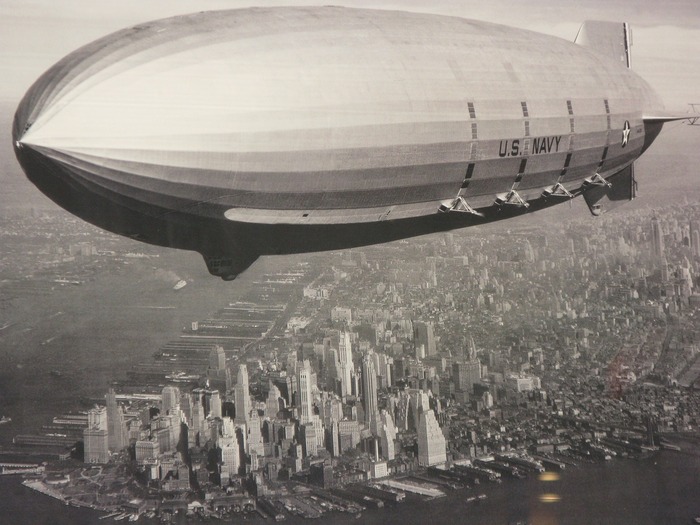
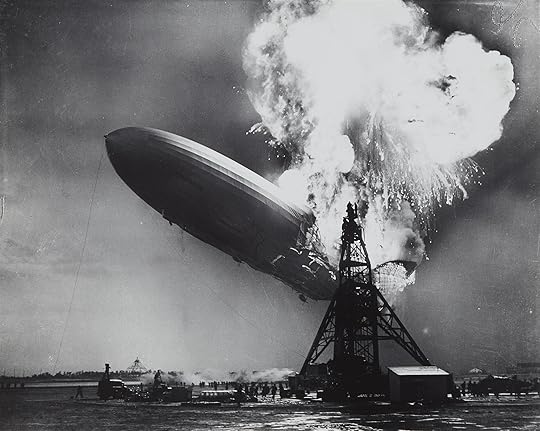
Photographs were good. They were oddly all found in a section 50-pages from the end. (Typically they’re found mid-way in histories.) It was the typical mix of: headshots, ¾ profile “glamor” shots of airships and airplanes, and historical events captured in the narrative, including the one shown above.
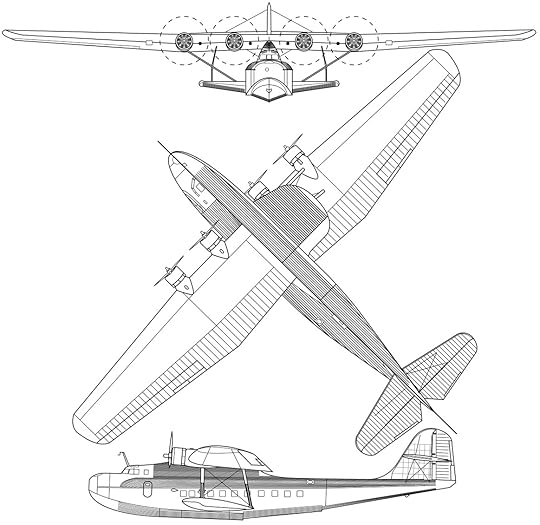
There were no diagrams. A “Figures” section would have been greatly appreciated. In proper aviation histories “Line Diagrams” are a staple of aircraft technology descriptions. They’re a lot more valuable than pictures, and narrative because they provide views of all sides and include a scale. A line diagram of a Martin M-130 would have been a valuable addition. Pan Am, Martin M-130 Flying Boat Aircraft Figure (Example)
The Index appeared accurate.
The Bibliography was peculiar. It contained a list of period newspapers and periodicals without version citations. Book references ranged from was 2015, to the earliest in 1881. They were mostly histories and aviation technical books. The greatest majority were in English, with very few in German. There were very few military and diplomatic histories referenced.
Rose, provided a particularly good physical description of the aircraft, both airships and airplanes. The aircraft infrastructure needed to support the vehicles was uneven. Whilst most folks are familiar with airport/airfield layouts, airship facilities, with the exception of the gigantic hangers received only cursory descriptions. Weather is an important aspect of air transportation scheduling and safety. He was remarkably good on meteorology and weathers effect on airship and primitive airplane travel. For example, the unpressurized aircraft in the late 1930’s flew at 3000m/10,000ft. There is a lot of “weather” at 10,000 ft and below.
Long distance navigation, especially over open water at that time was problematic. Overland, Rose riffed on the amateur pilots “IFR” technicque (“I follow roads.”) axiom, with mention of early German airships using IFRR (“I follow Railroads.”). PanAm’s use of radio direction finding for over-water navigation was mentioned, but zeppelin navigation was ill described.
There was a remarkably large aircraft technical discussion, and discussion of its dependencies. Most of it was centered on the airships, they likely be less familiar to most folks. However, I found the compares and contrasts between the two different vehicles to be intensely interesting. I also don’t recall finding any technical errors within the scope of my previous readings.
Companies build aircraft. Luftschiffbau Zeppelin which built the most successful airships was the product of two men, Count Ferdinand von Zeppelin and Hugo Eckener.
Zeppelin as a 19th Century aristocrat, cashiered Imperial German General and an aviation enthusiast. In order to rehabilitate his reputation, he gathered technically astute folks around him and iterated through the available balloon technology to enable directed flight. The result was the rigid airship, AKA Zeppelin in his name. In the intensely competitive atmosphere of the Belle Époque, he created a uniquely, German and successful aircraft that brought recognition and honors to the German Empire. Unfortunately, Luftschiffbau Zeppelin and its technology fell victim to Allied retribution after WWI for their wartime contribution. Zeppelin retired a venerable German figure after the War.
Hugo Eckener was one of the men Zeppelin drew to him to develop his airship. He was initially Zeppelin’s a publicist. Eventually through opportunity and personal ability, he became one of Luftschiffbau Zeppelin’s most capable airship captains. He succeeded von Zeppelin after the War, after a bruising internal battle for control of the company. He rebuilt the company and developed the airship technology through the difficult: Great Depression, Weimar Republic, and Nazi regime periods. Eckener’s strategy was to leverage the Zepelin’s range and heavy lift capability through a transatlantic airline carrying: mail, cargo and passengers. (He founded the DELAG airline to so he could build more zeppelins.) However, post WWI, Luftschiffbau Zeppelin was more constrained: financially, politically, and diplomatically, than under the Imperial German years. Superior German engineering could only be somewhat successful under those headwinds. Eckener was an anti-Nazi. Luftschiffbau Zeppelin was nationalized under the Nazi regime, its war re-purposed industrial infrastructure was destroyed in the War, and never rebuilt. Eckener retired on his West German government pension, another venerable German figure after another War.
The Hindenburg Disaster. The Hindenberg was the largest, fastest, luxurious, most expensive airship ever built. Eckener started it with support from the liberal Wiemar government and in partnership with the American Goodyear Corporation to avoid diplomatic restrictions. DELAG with an American partner would be an American airship airline. The airship was completed with complete funding by the Nazi regime after the Weimar Republic collapsed.
Airships originally used inexpensive and more buoyant hydrogen gas for decades for lift. However, hydrogen is highly flammable. After the War, element helium was discovered. Helium was less buoyant than hydrogen and much more expensive. However, being an inert gas, it was also inflammable. The sole source of helium at the time was in the United States, a byproduct of natural gas extraction. Due to the poor international safety record with hydrogen provisioned airships, Goodyear mandated a helium provisioned airship. Helium was considered a “dual use” (Civilian/Military) material. The Nazi regime was potentially unfriendly. A helium export license was refused for Luftschiffbau Zeppelin. The Goodyear partnership fell apart, and the airship was built with a Nazi subsidy and provisioned with the available hydrogen.
On the first flight of the 1937 season (airships didn’t fly transatlantic in the winter) the Hindenberg caught fire in Lakehurst, New Jersey when landing. The disaster had three contributing causes: a too hard and fast landing, a failed structural element, and an impending electrical storm causing an electrical discharge. Any one or even two of these was survivable. The hard landing caused a structural cable to snap, the cable tore the fabric of a hydrogen gas cell, the cell’s gas leaked into a void beneath the airship’s skin, the airship was electrically grounded by its wet mooring ropes with the Earth, the grounding caused a spark that ignited the leaked gas, the airship started to burn and then exploded. It was the first German airship loss since the War.
With the loss of the only operating airship, the transatlantic service was cancelled.
Airplane technology in the United States was driven by airlines. Pan Am grew rich delivering intercontinental mail and light cargo throughout the western hemisphere by airplane. They flew both seaplanes and conventional ground-based airplanes. Air mail and light cargo for years was more profitable than passengers. (Airplanes were small.) PanAm’s routes from The States to: the Caribbean, Central America, and South America were relatively short “hops” and well within the available, and quickly evolving, short range, airplane technology. Juan Trippe the majority shareholder and founder of PanAm was a ruthlessly competitive, businessman. He squashed all competition to his routes by any means possible. Due to: entrenched protective European and British regulation, geography, weather, and lack of aircraft range, North American to Europe routes were closed-off to him. Trippe founded a very risky and expensive trans-Pacific route ahead of a trans-Atlantic route. It was only on the cusp of WWII that PanAm flew trans-Atlantic, and then only for a short while. However, Trippe’s motivation was: money, power, and influence. (The airline was the vehicle for those opportunities.) Trippe retired as PanAm President and CEO after leading the firm for 540-years.
Rose alternated sections between airship and airplane, sometimes going a few chapters consecutively before switching. I came to feel there was more airship narrative than airplane narrative. With regard to the competition between PanAm and DELAG to be “The” transatlantic airline, I eventually came to feel that this “competition” was too forced. It was likely a literary artifice of the author’s, to make the book more interesting. I frankly would have liked to have seen two books, one on the founding and development of PanAn and its Clippers and the other exclusively on DELAG and zeppelins.
Summary
This book with the right background provides a lot of history on the development of early 20th Century aircraft technology, and the effects of politics and diplomacy on the business development of that technology.
Rose is an accomplished historian. His narrative most of the way through was engaging. The lack of maps, and figures to illustrate the narrative was a major editorial error in my mind. However, I felt more strongly that he reached too far in positioning Trippe’s PanAm and Eckener’s DELAG as competitors. That bit of historical analysis appeared to “make a better story”. Otherwise, I was less interested in PanAm and airplanes than in Luftschiffbau Zeppelin and airships. Two different businesses, two different sets of challenges. However, airships and their history were a “Could have been” technology. Their failure to develop was due to a multitude of factors beyond the engineering—like cost and politics. Airships were Betamaxed by airplanes almost a decade before airplanes had the same capabilities.
Recommended for folks interested in the history of aviation technology.
In his acknowledgments, Alexander Rose refers to Empires of the Sky as an "airship-sized book," and at 500 pages not including notes, bibliography, and index, it is certainly hefty. It doesn't drag though, and I finished the book thinking I wouldn't mind reading some more about the subject. For readers like me, Rose has included a lengthy bibliography with lots of ideas for further reading. The notes are also detailed and informative, full of extra information that didn't fit in the main text. The topic is one of my favorites, commercial aviation, and although I have read a lot of books on the subject, I had never read much about airships and how they seemed like the wave of the future at one time, especially compared to fixed wing airplanes, which tended to crash with alarming frequency in the early days. what made the book readable to those who are not necessarily propheads, is that Rose focused on the people and personalities involved. For the airships, Count von Zeppelin and then his protege Hugo Eckener, and on the side of the airplanes, Juan Trippe, were all driven to make their craft the choice of travelers of all kinds. Even though you already know the outcome, it's a dramatic story with tons of fascinating details. Five stars and thanks to Random House for a review copy.
This extremely well written and researched book about a long race to commercial flight across the Atlantic. Though it seems obvious now that we would get on a jet to cross the Atlantic, that wasn't the situation in the early periods of of aviation. When Lindberg crossed the Atlantic in 1927, it was one man in an airplane that had been stripped down to the lowest weight possible. By comparison, Zepplins, a rigid frame airship, had been capable of carrying over 50 crew members since about 1912.
The book looks at the origins of the Zepplin, first envisioned by a German, Count Zepplin. The company was later helmed by Hugo Eckener. It also examines the origins of airplane flight. The book looks at technical innovation, political and social topics.
In the later part of the book, there is a focus on Hugo Eckner (of Zepplin) and Juan Trippe, founder of Pan Am. Both are determined, even stubborn, men with a vision of air travel based in their technology. Both are fighting battles both of technical issues but also political and legal issues.
Fascinating read if you like the history of technology, and how technology change almost always gets tangled up in political agendas. Eckner was a German traditionalist, but his company was taken over by the Nazis, who used the Zepplins for propaganda purposes. Trippe was running planes in to many Caribbean and South American countries, and found himself in constant turmoil as various political agendas changed.
BTW - The answer to why we take airplanes not because Zepplins burst into flames. There was a solution for that. But, the manufacturing costs of airplanes got much cheaper than the manufacturing costs of Zepplins.
Nothing is accomplished by our society today. That little which seems like accomplishment is merely the sating of useless consumerist desires and the serving up of mental frippery and degradation. Apple is valued at trillions of dollars; that fact says all you need to know. Even something that could be thought an accomplishment, such as the rapid creation of vaccines to help counter the modest damage directly inflicted by the Wuhan Plague, is of dubious real value, and is moreover lost in wholly justified suspicion of our rulers. We have collectively marched, or been marched, into the dead end of a box canyon, and we hear the water rushing toward us. Not so long ago, however, as this book shows, the West was a civilization on the arc to glory. Maybe we can be again.
"Empires of the Sky" is the long, but compelling, story of the parallel development and adoption of rigid-frame airships, colloquially Zeppelins, and fixed-wing airplanes. The author, Alexander Rose (whose earlier book Washington’s Spies, about the Revolutionary War, was the basis for the very good AMC series Turn), writes with verve and grace, changing what might be simply a catalog of technical wizardry into a human-scale narrative. This is the story of men driven by an internal fire, who designed these machines and forced their development forward, taking insane risks. Why? Not so much for the possible material benefits to themselves, but for progress and glory, that of themselves and their people, and of all mankind.
Ferdinand von Zeppelin, father of airships, was born in 1838 in Mecklenburg, and took service with the Duke of Württemberg, as had his father. He rose in the military, but his primary focus was engineering, and among other assignments he was posted as an official Prussian military observer to Union forces in the Civil War, where he studied the early use of balloons for military observation. From his youth, Zeppelin did not suffer fools gladly, or anyone he thought of as a fool, which was most people. He also crashed into any obstacle head on; subtlety and politicking was not his forte. This sometimes helped him, as when in the Franco-Prussian war in 1870 he led a daring raid that got his name in the papers, but ultimately ended his military career, when in 1890 he was forced, humiliatingly, to retire, having offended the wrong people.
He needed something to do, he needed revenge, and he needed to prove he was a great man who could contribute to his society. Ever since his youth, he had been interested in balloons, pushing them during his military career. Balloons had advanced in fits and starts since the flight of the Montgolfier brothers in 1783, but their use for anything but tethered observation was obviated by an inability to control direction or to move against the wind. Steerable balloon-based craft with engines and rudders were proposed by various bright minds, but none had been successful, given the technical challenges, along with simple ignorance, such as of wind differences above the ground surface. Nonetheless, advances that would overcome the myriad difficulties were being made, primarily in Germany, including new aeronautical understandings and new technology, such as the ever-smaller and ever-more powerful internal combustion engines produced by Gottlieb Daimler. Zeppelin, like Steve Jobs and Elon Musk in the modern age, dismissed “experts” who said that what he desired, a fully-controllable airship, could not be done, and forged onward indefatigably.
As with many technological achievements, it was military demand and money that enabled Zeppelin to achieve his vision, although Prussian military interest waxed and waned with the international situation. Rose ably narrates the technical detail of Zeppelin’s work, interweaving it with descriptions of the world outside Zeppelin’s head. Part of that world was airplanes, slower to reach the air than balloons, and initially regarded as essentially unfeasible. So when Zeppelin flew his first machine, July 2, 1900, airplanes were not on his mind—his death was, given the flight was enormously risky, not that he was overly concerned. (Zeppelin was an unemotional man. He merely made basic plans for his death, consisting of a letter to his wife, and boarded his ship.) The first Zeppelin to fly, LZ-1 (for Luftschiffbau-Zeppelin), a rigid aluminum frame containing multiple hydrogen-filled internal balloons, was 420 feet long and flew, adequately though far from spectacularly. The rest of Zeppelin’s life was iterating this design.
As the century advanced and Zeppelin aged, his role as the public face and driving force of airships was taken over by Hugo Eckener, a sometime journalist who in 1906 had become captivated by Zeppelin and swept into his orbit. The other crucial man was Ludwig Dürr, a reclusive engineering genius responsible for much of the execution of Zeppelin’s vision. To be sure, as the Zeppelin team iterated their design, there were many accidents and problems, but in their methodical German way, Zeppelin’s team solved them all, and in general Zeppelins were regarded as very safe—even crashes almost never killed the passengers. Airplanes, on the other hand, which the Wright Brothers had first flown in 1903, were advancing at a slower rate, but killed people all the time. Moreover, they were far less comfortable for passengers; Zeppelins were much more stable, including from a passenger point of view, and could even fly through thunderstorms, though they avoided it.
Because of later events, the technical detail that we associate most with Zeppelins is their being filled with hydrogen. But this was not nearly as dangerous as it seems; the hydrogen was contained within balloons of pure hydrogen, which cannot directly ignite. (I once almost built a factory to manufacture hairspray aerosols, and so I know a great deal about flammable gases, including that they have a “lower explosive limit” and an “upper explosive limit,” meaning that above and below certain concentrations in ambient air they will not ignite even if directly exposed to flame.) Thus, lightning strikes, which were not infrequent, did not ignite the hydrogen—but smoking was still sharply restricted, just in case there was a leak somewhere.
Eckener wanted to start a commercial passenger line, and did, in 1909—DELAG, the Deutsche Luftschifffahrts-Aktiengesellschaft, or German Airship Travel Corporation. This was quite successful—until 1914, when as part of an earlier arrangement Zeppelin had made for funding, the Germany military requisitioned all of the several airships Zeppelin and DELAG were operating, putting a temporary end to DELAG. Yet Zeppelin’s airships proved essentially worthless in war, because the French quickly learned how to shoot them down, tearing open the gas balloons with bullets and then igniting the released gas, and their construction cost was far greater than the miniscule bombing damage they were able to inflict on the enemy—even if, in time-honored fashion, propaganda lies about their great success were spread widely. Rose draws a compelling picture of the demise of L-48, shot down by French incendiary rounds in 1917. One officer survived (only four men survived a burning Zeppelin during the entire war). “The fire rolled forward from the stern as the men fled along the walkway to the control car, and the flames folded over it like a ‘purple canopy’ as black smoke enveloped everyone within. One man, lighting up his last cigarette, joked ‘No smoking allowed!’ ”
On the other hand, Dürr continued to continuously improve the design and materials for the airships. And Eckener, a showman, managed to send an airship to the Sudan and back, putatively for a military rescue, but mostly to show the great distances of which Zeppelins were safely capable, in preparation for postwar transatlantic flights. Still, after their victory the Allies confiscated the two remaining ships and forbade any more construction, so it appeared that Zeppelins were dead. As was Zeppelin himself, dying in 1917, before the end of the war.
Airplanes, by contrast, had been quite successful in the war and were getting better all the time, led by a wide range of men in the United States. This was the era of experimentation and barnstorming—pilots died every month. The men of Air Mail in the United States called themselves the “Suicide Club,” and twenty-nine of the original forty pilots died, while two hundred Air Mail planes were lost in accidents. These men were the type of men we could use now, but whom we don’t have now, or if we do, they are not allowed to take risks and to excel, ground down and suppressed by a combination of government smothering and mass feminization. We never even study such men of the past, such as the Wright Brothers (well, my children do); our children in most schools today only study Bessie Coleman, a wholly unimportant black woman novelty act flyer of the late 1920s, who soon enough died falling out of an airplane after she failed to secure her seatbelt. You get more of what you praise to the young, so don’t hold your breath expecting the current generation to fix our problems.
In parallel with his narrative of Zeppelins, Rose traces the rise of airplanes as airliners, and their eventual total replacement of Zeppelins. His frame is the rise to the top of the airline business of Juan Trippe, a protean, suave, driven member of the American upper crust. Or so he pretended; his background wasn’t as pedigreed as he claimed, and his first name, odd in this context and strongly disliked by Trippe himself, came from his grandfather, a Venezuelan Irishman. Whatever his personal demons, Trippe knew what he wanted, which was to be rich and powerful, and to do it through dominating air travel. He was the first to comprehensively study and plan air travel in light of other modes of transport throughout the ages.
By the point Trippe got started, in the mid-1920s, DELAG was back in operation, the Allies having relented, but the received wisdom was that Zeppelins would be the long-range flyers of the future, safe but slow and inflexible, and airplanes the short-range flyers, more dangerous but faster and flexible. Airships were better understood and it was known that making them somewhat bigger rapidly increased their capacity; this simplicity made them attractive. Airplanes were believed to have strict physical limits to their capabilities, requiring impossible wingspans to achieve anything near the passenger capacity of airships. Advocates for both existed, but airplanes had scores, if not hundreds, of different companies working on them, which led to fast innovation. Airships had only the Zeppelin Company and the United States Army, and the latter abandoned airships after a series of disasters. Thus, in the 1920s airplanes developed with startling rapidity, while airships, already closer to technological maturity, didn’t, though various technical advances were made.
The technical development of airplanes was also made possible by a massive American turn to aeronautical engineering. Thousands of students flowed into engineering programs; numerous companies sprang up to commercialize every aspect of airplane design and manufacture, since the entrepreneurial environment was wide open for airplanes. And as airplanes improved exponentially, Trippe was always there, working tirelessly to build an airline. Others also started passenger lines, but the supple Trippe was ruthless in dealing with both competitors and politicians, domestic and foreign. He went into business with Charles Lindbergh, too, whose unparalleled fame was invaluable to his efforts.
As with Zeppelins, money was a limiting factor in running a successful airplane company, whether making airplanes or running an airline. Trippe had an advantage here—he was able to raise money from his upper-crust friends, and with some greasing of palms, he obtained the exclusive landing rights in Cuba, giving him an important route that nobody else was allowed to fly. But even with his advantages, Trippe had many close calls and lucky breaks, and as every successful entrepreneur must, he turned to creative, high-risk solutions to existential problems. For example, he had to meet a crucial Post Office contract hurdle, which rigorously specified that to keep the contract he must take off from Key West and land in Cuba by a date certain. But then there was no airport in Key West. So the day before the contract expired he scoured the country for a seaplane to fly to, then land, in Key West and had it take off with minutes to spare; the contract said nothing about taking off from the Key West airport. The name Trippe gave his new airline? Pan American, something that means little to younger Americans, but is instantly recognizable to anyone over forty.
Pan Am expanded with great speed, and was soon flying all over America and into South America. It did not fly the Atlantic, and this was the Holy Grail of air travel—to replace transatlantic boats with a faster alternative. Trippe wanted to start transatlantic travel, but needed to stop in Newfoundland—and the British government wouldn’t cooperate unless their state-sponsored company, Imperial, operated part of the route. Imperial, however, trailed Pan Am on every front. (It’d be as if Elon Musk had to coordinate his every act for SpaceX with NASA.) So Trippe turned to the unexpected—flying across the Pacific first, using island-hopping, including finding obscure islands on which to land and refuel (not dissimilar to how Musk flew his first rockets off a speck of an island in the Pacific). He figured he’d get back to transatlantic travel. The Pacific flights lost massive amounts of money, however, giving even greater spur to Trippe’s efforts to construct a more lucrative Atlantic route.
Eckener, on the other hand, was already running transatlantic flights, and the Zeppelin Company, back in the airship business, had forged links with the United States, establishing a US-based affiliate. In 1929, Eckener flew a Zeppelin airship around the world, which in his mind proved that airships were a viable solution for global long-range travel (even if it turned out that transcontinental trips in America were uniquely hazardous due to weather patterns, something Eckener kept to himself). Zeppelins, in the public mind, seemed still very much in the running for dominance.
The Depression dented the business travel that paid the bills . . . [Review completes as first comment.]
Empires of the Sky is chock full of little gems — fascinating facts and historical nuggets — but I can't say it delivered on the overarching compelling narrative about "two men's epic duel to rule the world." The author tries to pit Hugo Eckener, the brilliant and complex mastermind behind Germany's dirigibles, against Juan Trippe, the brilliant and complex mastermind behind Pan American World Airways. But hindsight is a bitch, and it undercut the competition for me before it even started.
The book does a thorough job — at times too thorough — detailing the birth of the airline industry in the United States, particularly PanAm. For me, though, the story of Zeppelin was more interesting, mainly because Eckener, no fascist himself, also had to navigate the aftermath of World War I and the rise of Nazi Germany.
The sections about the Hindenburg disaster and fallout are very well done, and I loved learning more about the famous "Oh, the humanity!" radio broadcast.
The audiobook is very good, too, but I wish the narrator hadn't attempted the various German and British accents.
Quite fascinating. From the development of the Zeppelin technology to its use in war and its competition with airplanes for mail and passenger service, so much here was completely new to me.
> They had recently found that wind speeds at ground level differ significantly from those at higher altitudes. Records taken for a 101-day period between June and October 1889 at the top of the Eiffel Tower (984 feet) found that the average daily velocity was 15.75 mph, whereas on the ground in the same location, it averaged a mere 4.9 mph. Until this discovery, any number of aeronauts had unwittingly made the error of building their craft to cope with ground-level winds.
> In May 1892, Zeppelin welcomed Kober aboard, saying that “I hope to God that by our joint efforts we will succeed in doing something useful for our German Vaterland.” Kober proved an admirable fit: He was young, mild-mannered, pliable, not so skilled as to question Zeppelin’s decisions with any great authority, and easily overawed by the count’s gale-force personality. Kober willingly, for instance, signed a contract stipulating that, like the slaves entombed in the pyramids with their pharaohs to serve them in the afterlife, he must “dedicate his whole energy to the execution and testing of the airships planned by me [Zeppelin], and…bring this task to its end in case of my death.”
> Asked by one to consent to an interview, the count had, with inimitable aristocratic hauteur, brusquely replied, “I am not a circus rider performing for the public; I am completing a serious task in service of the Vaterland,” and turned his back to him.
> As he had once been by the Russians, Zeppelin this time was saved by the French, who were beginning to develop a type of small dirigible known as a Lebaudy for army reconnaissance. Though these ships had nowhere near the same scale, power, or ambition of Zeppelin’s machines, their sinister implications seemed clear to the paranoid Wilhelm II. They were intended, or so he believed, as an aerial navy that would bomb his fortresses and ships. The kaiser was frightened into keeping Zeppelin solvent—just in case he too needed an aerial navy in the future
> Some local farmers helped anchor the ship fore and aft with cables weighted down at the ends with boulders. As the crew congratulated one another and thanked the Lord for their preservation, “we considered ourselves very clever, not realizing that we were sealing the fate of our airship,” Preiss recalled. An airship that is anchored at both ends is vulnerable to crosswinds—later Zeppelins would be secured at the nose alone to turn with the prevailing wind
> Considering how far and how quickly Zeppelin had advanced in the same period, the fact that the Wrights had, it seemed to the count, wasted nearly three years building a crash-prone toy only confirmed his suspicion that the airplane was not the future; the airship was
> The wonder of Zeppelins was not just their sheer size. It was that owing to their immensity it required only small changes to make them exponentially larger.
> The Wrights, for their part, thought exactly the same about the Zeppelin, with Wilbur writing that the airship “must soon become a thing of the past.” All the money the count was spending on developing them, he predicted, would “be practically wasted” once the airplane came into its own.
> The Wrights may have made a small fortune in 1908 thanks to their successes in America and France, but they were now competing against dozens of rivals as the airplane business exploded. Within three years, in the United States alone, there would be 146 airplane companies and 114 different engines on the market. Monoplanes, biplanes, triplanes—all these ate away at the Wrights’ once-commanding lead amid a host of meritless lawsuits and wasteful patent-infringement accusations. Orville and Wilbur sensed that their time at the top was running out. Following a spectacular series of flights in 1910 to show the world they were still the greatest aviators of them all, they essentially retired. Wilbur would die two years later of typhoid, and Orville, who lived until 1948, ceased flying in 1918.
> Rehabilitation in the eyes of his emperor, the satisfying defeat of Major Gross and other critics, a weakness for believing his own adulatory press, an aging man’s reactionary crustiness, a growing dislike of Colsman’s capitalist vulgarity, and the military’s purchase of LZ-3 and LZ-5—all these contributed to his [Zeppelin's] curdling into a militarist rabidly eager to wade through blood to raise Germany to paramountcy among the Great Powers. In his mind, airships were now suited exclusively for martial purposes and would, he boasted, “assure [Germany] world military domination.” … it would be the culmination of his life’s work if the kaiser permitted him “to lead the best one of my available airships into battle” since “all Germany expects me to make the first flight over London.”
> At a time when a (single) passenger on an airplane had to don goggles and overalls to prevent motor oil from the engine from spattering all over him or occasionally her, the Deutschland provided a lounge equipped with wicker chairs set next to large, sliding windows that allowed optimal viewing of the countryside passing by below. The walls and ceiling were veneered in dark mahogany, with the pillars and roof beams of the same material but richly inlaid with mother-of-pearl. Every sharp corner was swaddled in soft leather, and the floor was thickly carpeted to absorb the engine noise. A tiny galley provided sandwiches and drinks. All the cutlery, plates, and cups were made of aluminum to reduce weight. Even the lavatory—itself a revelation—had aluminum fittings
> Unfortunately, Kahlenberg, through lack of experience, had omitted to check the weather reports and now a fierce storm was unexpectedly approaching. When it hit, the three-hour pleasure jaunt turned into a nine-hour nightmare ride as Deutschland fought the unrelenting, turbulent wind. At one point, the airship was actually traveling backward.
> On September 2, 1916, Strasser sent sixteen airships—the largest raid of the war—to deliver a grand knockout blow, only to be frustrated by Lieutenant William Leefe Robinson’s shooting one down in an incendiary-armed B.E.2c fighter. The gigantic fireball that erupted so discouraged the other commanders that they turned tail and left. A single man in a single airplane had defeated an airship armada. Between that night and the end of 1916, seven more airships were shot down by airplanes.
> By 1917, Zeppelins could operate between 16,000 and 18,000 feet, but the newest British fighter, the Sopwith Camel, could reach 17,300 feet. In response, Dürr and his colleagues designed new classes of “height-climbers” that raised the ceiling by stripping Zeppelins of every ounce of extra weight. Hull girders were shaved to their thinnest feasible width, the control car was made even smaller, the crew’s quarters were eliminated, and most of the machine guns were removed—saving about seven thousand pounds and allowing a maximum height of 20,700 feet.
> The crews, from 12,000 feet and up for prolonged periods, relied on oxygen masks to avoid hypoxia, or altitude sickness. Impurities in the gas caused intense nausea and vertigo, but anyone who removed the mask, as many did, would feel at first a throbbing in the teeth and blurred vision, followed by an expansion of abdominal gases—the symphony of farting aboard a Zeppelin was something to behold—before exhibiting symptoms similar to those of carbon monoxide poisoning or a severe hangover. Whereas fighter pilots stayed up so high only for short periods, continued exposure by airship crews could fatally result in fluid in the lungs and brain swelling (leading to bladder and bowel dysfunction, loss of coordination, paralysis, and confusion).
> Worse, in the spring of 1918, the British devised a rudimentary aircraft carrier that allowed their long-range planes to hit Zeppelin bases. In July of that year, the Tondern sheds were bombed by seven sea-launched Sopwith Camels.
> Of the ninety-one Zeppelins built and operated during the war there were just sixteen left (including an unfinished experimental model, some training ships, and a few obsolete ones) at the Armistice in November 1918. The list of the fates that the others experienced makes for depressing reading: “shot down in flames,” “forced down,” “dismantled,” “destroyed in explosion,” “wrecked in landing,” “burned accidentally,” “bombed in shed,” “rammed a mountain,” “crashed,” “lost in North Sea,” and so forth
> when in May 1915 the submarine U-20 sank the Lusitania, its captain, Walther Schwieger, inflicted more than twice as many fatalities with a single torpedo as did three years of Zeppelin raiding (1,198 to 557). Indeed, deaths among the Zeppelin crews came close to equaling the number of their victims.
> A perennial problem of airship flying was that as the engines burned relatively heavy fuel during a trip, Zeppelins became lighter and so naturally tended to lift. In practice, the captain would valve out hydrogen to bring his ship back down into static equilibrium. … Blau gas resembled propane in that it could be transported as a liquid but released in a gaseous state only slightly heavier than air. In the latter form, it could replace liquid gasoline as a fuel. So as it was consumed the airship would experience almost no lift because the overall weight remained virtually the same
> Thanks to his timing, Eckener avoided the midwestern storms in the fall, but between those and the southwestern desert in the summer, he was realizing that much of the continental United States was close to being a no-go area for Zeppelins
Empires of the Sky is an unusual book. Foremost it is about Zeppelin airships, the history of their design and construction, how they once ferried passengers and cargo majestically over the Atlantic, and how many once thought that they would become the future of air travel across the globe rather than the airplane. But to understand why many thought airships the future of air travel, this book also contrasts the development of the airship with that of the airplane, and the powerful personalities involved whose chose to take sides: Count Ferdinand von Zeppelin himself who took on the Wright brothers to develop the technology to actually take to the air; and later, Zeppelin’s protégé Hugo Eckener and Pan American’s Juan Trippe, who had competing visions for the future of air travel.
This is a long book. And I found it a very slow read. Neither should be seen as a negative, as Alexander Rose has a very long and very detailed story to tell. But for those expecting a fast-paced and exciting narrative this may not be the book for you. If, however, you do have an interest in the history of aviation, and want to learn about Zeppelins especially, then this is a remarkable and rewarding book. I have been reading aviation history since I was a boy, and yet almost on every page I found myself muttering to myself, “Wow! I did not know this! How did I not know this?”
For instance – and this is nothing to do with Zeppelins – anyone who knows anything about WW2 in the Pacific will know about the valiant defence of Wake Island by the U.S Marines in December 1941. But what I didn’t know was that the island was nothing but an uninhabited atoll until Juan Trippe of Pan Am decided in 1935 it would be a great layover location for his flying boats en route from the United States to the Far East and decided it needed developing – with the acquiescence of the U.S. Navy, of course, which was already pondering a future war with Japan.
This little anecdote, though nothing to do with Zeppelins, also sums up the underlying narrative in this book: this is a story of men who possessed both iron will and vision, who, even when the whole world seemed stacked against them, refused to give up on achieving their dreams. Though the Wright brothers and to a greater extent Juan Trippe are part of the story, this book is really about the crusty old army officer Count Ferdinand von Zeppelin who never shied from touting the military advantages of his creation, and Hugo Eckener, as humane a man as one might wish to meet, for whom the Zeppelin was to be nothing more than a peaceful bridge between countries.
So, though there is a great deal of technological discussion in this book – I never knew airships were so complicated! – for me the narrative became all about the people. The story of Hugo Eckener’s struggles with the Nazi Regime in Germany through the 1930s and the tragic destruction of the Hindenburg at Naval Air Station Lakehurst, N. J. in 1937 were especially moving, and left me wishing that I had had the chance to meet Hugo Eckener in person, and to have made a flight in the Hindenburg, before both were gone forever.
I would have preferred there had been more discussion in the book on the use of Zeppelins in the First World War and the rapid development of aircraft during the same period, but I realise that would have required a much longer book and would have detracted somewhat from the main thrust of the narrative. And there are other books out there that do exactly that. Still, personally, I would have preferred a little more on the Zeppelin at war. But this is a minor, and almost certainly unjust, criticism.
Despite its subtitle this is really a book about Zeppelins, tracing the company's history and its two guiding lights, the eponymous founder and its wartime leader Hugo Eckener. Those looking for a more comprehensive history of aviation, or a more in-depth treatment of Juan Trippe, Pan Am's founder, will be disappointed.
Having said that, the book is excellent. It begins, as so many stories of corporate success and invention do, in America. A young Count von Zeppelin visits during the American Civil War, ostensibly for military observations. An ambassador gets him into the White House for a personal visit with Abraham Lincoln.
But Zeppelin is really there to explore, and he soon finds himself in Minnesota where a German immigrant sells tickets to take people up on a Union observation balloon. The flying bug bites Zeppelin hard, and he goes home dreaming of ways to capitalize on the technology.
It takes a few more decades before the internal combustion engine is capable enough for the Maybach company to provide Zeppelin with sufficient engines to power the giant dirigibles he dreams up. Rose does an excellent job describing the corporate and technological woes Zeppelin faces and overcomes.
Eventually World War I arrives, and the Kaiser uses Zeppelins to bomb London. Unfortunately for the Germans, the Brits soon discover that simple incendiary rounds can quickly down the hydrogen-filled airships.
Meanwhile, airplane development progresses exponentially. The Wright brothers are mostly glossed over, and little attention is paid to the industry until Lindbergh flies nonstop across the Atlantic to Paris. Suddenly, airplane passenger service appears obvious to everyone. At this point, Juan Trippe appears. With some Yale buddies he starts up what becomes Pan American Airways.
Trippe is given more attention than others in airplane lore, but doesn't show up until about a third of the way into the book. His efforts to establish South American routes are interesting, as well as certain anecdotes like the time he stood up his future wife on a date for a chance to meet Lindbergh and pitch the aviation legend on the idea of joining Pan Am. Lindbergh agreed and Trippe's future wife forgave him.
In due course we hurdle toward the Hindenburg and its date with disaster. After that moment dirigibles are finished. They had very limited military value and without the far more expensive helium instead of flammable hydrogen, they were seen as too dangerous for civilian use. Airplanes progressed in development, making the slow dirigibles steadily more obsolete. We do learn in the process of Goodyear's relationship to the Zeppelin company, leading to the famous blimp that flies above football games.
Rose has written another excellent book, and those looking for a thorough history of Zeppelins will enjoy this effort. It is very well done.
This book works on four levels; it is a an in-depth study of the parallel development of competing technologies, it is a case-history of economic competition for domination of a new market, it is a compendium of biographies of interesting men who share a particular drive to excel in those two subjects, and it is a history of Germany and the United States in the era between the Civil War and World War II that allowed such a dramatic competition to take place. The fact that we all know how it ends but can still maintain interest is a tribute to the author’s skill to interweave these related but different topics to craft a compelling narrative. I’ve long been an airship enthusiast, although I’ve never had the opportunity to ride one, and I still think there should be a place in the marketplace for such graceful and majestic transportation, but now I understand the limitations in terms of technology, safety and cost-basis. I greatly admire authors who can take an obscure historical occurrence and explain all the elements that come into play to shape the outcome. If you do too, you will probably like Empires Of The Sky.
This is a history of the rise and fall of the Zeppelin, told in parallel with the rise of Pan Am and commercial long-distance travel by airplane. The title suggests a symmetry that isn't there -- this is really a book about Zeppelins, with the Pan-Am stuff for comparison. It is not an overall history of early aviation. Assuming Zeppelins are your topic, this book is a marvel. It does a magnificent job balancing the human story, the technical story, and the economic story. After reading it, I understood a great deal that I didn't previously.
One running theme is that both airplanes and zeppelins had major technical drawbacks at first, and horrendous safety records, but the airplanes got much better faster. An assembly line can make a useful airplane in a few hours. It was economical to make a plane, crash it, and iterate. In contrast, a Zeppelin is more like the cost of a warship, and this makes iteration far more costly.
Rose has a lengthy discussion of German military use of Zeppelins in WW1. "Military use" was one of the original motives for the development of the airship, and Count Zeppelin was a confirmed militarist who had great ambitions for his machine. These military uses were almost totally illusory. There were assorted air raids on Britain during the war. These caused great consternation and considerable outrage, but did almost no real damage. The Germans consoled themselves, both during and after the war, with the idea that they had forced the British to commit very large resources to air defense. This was a complete fantasy, and by any realistic analysis the bombing campaign cost the Germans more than the British.
Rose didn't set out to write a book about aviation engineering, but there are some obvious lessons from his narrative of Zeppelin accidents.
There's a narrative I heard growing up that what made Zeppelins dangerous was the hydrogen, and it'd have been okay if only they used helium. This turns out to be wrong and there is an interesting history behind why people believe it.
The fundamental problem with dirigibles is that they had a very light structure and a huge cross section, so there were large dynamic wind loadings and that means varying structural stresses and metal fatigue. It also means that they were very vulnerable to weather. A lot of Zeppelin crashes were due to wind, notably the losses of Akron, Macon, and Shenandoah. Helium has twice the molecular weight of hydrogen, and therefore somewhat less lifting power -- meaning more sail area for a given payload, and less ability to lift engines. Also, helium was hugely expensive. Gas leaks, and venting gas was a standard way to control buoyancy -- so this cost becomes an operational cost not just part of the capital cost. Most Zeppelins had an operational life less than a year, regardless of the lift gas. Hindenburg was unusual in being destroyed by fire.
When the Hindenburg was being designed, the Germans felt, probably correctly, that they had a good handle on the fire risks, and that hydrogen was the way to go. Even so, they had an intention to use helium to appease American passenger sentiment. However, the only source for the stuff in the early 1930s was the United States and Interior Secretary Ickes refused primarily due to anti-Hitler sentiment, plus some residual concerns about its military use. So the Germans were happy to go forward with hydrogen. But when the Hindenburg burned up, emphasizing that hydrogen was a second-best was a way to pass blame to the Americans.
There are a few moments where Rose wobbles -- his explanation of the square-cube law I think is mangled -- but on the whole he does a deft job explaining the technical tradeoffs between airplanes and zeppelins. , but he explains enough
This work explains not only the history of the airship/zeppelin, but also the contest between the airship/zeppelin and the airplane for which form of air-borne transportation would end up ruling the sky for passenger service. The strength of this work is its analysis of the history of the airship/zeppelin. Starting from the work of a once-disgraced German general (von Zeppelin), the work follows how the airship evolved, and what role in played in WWI and in the interwar period as both the airship and the airplane sought to conquer the air as the medium for personal transport. The airship had so many flaws (from the flammability of the hydrogen gas that filled the German airships, to its susceptibility to the variances of wind and weather), but for awhile, it had better press and political protection as opposed to the airplane. However, the political fortunes of Germany, the tragedy of the Hindenburg, and the evolution of the airplane would eventually overcome the airship/zeppelin, and become the primary airborne medium of personal transport.
The work is strong in its analysis of the airship/zeppelin and the key personalities competing in the inter-war years for mastery of the sky. It does avoid the trap of describe all of human airborne travel in the timeframe discussed, and the reader will gain a lot of technical and anecdotal knowledge from this work. Perhaps if the airship could make a comeback, this would be an even stronger work, but as it stands, if you are a fan of air travel/airplanes/air-anything, this work is worth at least a read once in your life.
My neurodivergent mind couldn’t have been any more captivated by this fascinating slice of history. It’s incredible, once airships were the prevailing expectation for world travel by air. Airplanes were dangerous amusements for carnivals and traveling fairs.
It was an incredible story which I adored in every way.
An epic, well-written, very well-researched book that describes the emergence of both airships and airplanes, their competition and the key people behind them.
Well written non-fiction about the beginnings of airships and the competition with airplanes. I liked how Rose included the political situations in Germany and the US that affected airship development. Would like to see more photos or diagrams of airship construction and design.
Empires of the Sky, Zeppelins, Airplanes and Two Men’s Duel to Rule the World, Alexander Rose, 2020 It is October 9,1936. You are in a beautiful Art-Deco dining room, burnished with polished aluminum fixtures, graceful curved walls, and vibrant colors. You are dining with the elites and mega-millionaires of the day including Nelson Rockefeller, chairman of Chase Bank, Eddie Rickenbacker, head of Eastern Airlines, Juan Trippe, head of Pan American airlines, Admiral William Stanley, chief of Naval Operations among others. You dine on “swallow nest soup, cold Rhine salmon and potato salad, the main course of tenderloin Steak in goose liver sauce with chateau potatoes and beans a la princess, with a 1934 Riesling followed by a Carmen salad, iced California melon washed down with a 1928 Feist Brut, Turkish coffee and Austrian pastries”. You notice a slight ripple in your wine glass. Where are you? You are aboard the Hindenburg Zeppelin cruising over New York City. The luxury and the 10,000-mile nonstop capabilities of these mega-airships of that era could not be matched by fixed wing aircraft. Zeppelins had been carrying passengers across the Atlantic at that time for over ten years, way before planes could achieve such feats. The latest incarnation, the Hindenburg was truly awe inspiring, roughly the length of three football fields and the height of a 13 story building, featuring private cabins, smoking and dining salons, music room with a piano, hot water baths among other luxuries. This is the story of two driven, visionary men, one Hugo Eckener, head of the German Zeppelin company and Juan Trippe head of Pan American Airways. Both the airship and the airplane have military origins. The original Count Von Zeppelin was a general in the Prussian Army circa early 1900’s and was intrigued with the military utility of an airship both as a reconnaissance aid but also a long-range aerial bombardment vehicle. He enlisted a newspaper publicist, Hugo Eckener to publicize the airship concept. He was able, before WWI, to establish an airline that transported people on Zeppelins throughout Germany. Financed by the German government during the war Zeppelin got his chance to demonstrate the military capabilities of his airships by bombing London. Thinking he could evade British aircraft by cruising at 20,000 feet, his concept came to grief when the Sopwirth Camel aircraft was developed, matched his altitude capability and proceeded to shoot down tens of airships. After the war Eckener took control of the company and led it to develop long-range ocean spanning Airships. The concept was quite successful at least from a publicity standpoint if not a financial success. Until the Final Denouement in 1937 at Lakehurst NJ when the lasting image of a fiery horror was cemented in the public mind, the airship had safely carried tens of thousands of passengers across the Atlantic to North and South America for years without fatality or accident Juan Trippe, a man of very mild demeanor, was actually a fierce, ruthless competitor with a strategic vision for commercial aviation that was not widely shared. In the 1920’s planes, holdovers from the war, were wood, doped fabric covered contraptions that could only carry a few people for a few hundred miles. Most people assumed that the commercial future of fixed wing aviation was carrying mail. That was where the money was. Trippe understood that temporarily he had to play that game and he secured Cuban government approval to deliver mail to Havana, but he didn’t have the contract with the USPO. He happened to find 2 guys in Key West that had secured the USPO rights but had no plane or Cuban approval. He bought them out but had only 2 weeks before the contract was to expire. Trippe’ s first plane delivery had just arrived, but he had no serviceable airfield in Key West to land. One day before the contract was to expire, he found a guy with a seaplane in Key West and paid him the exorbitant sum of $250 to make the delivery. The name of the firm in Key West that Trippe had bought? Pan American Airways, and so an icon was born from very inauspicious beginnings. Trippe, from Cuba service expanded his network throughout Central and South America. Through the twenties and thirties he constantly pushed manufacturers Sikorsky, Boeing and Martin aircraft to develop bigger, faster planes with longer ranges. He was relentless in trying to find routes and ways to traverse the Atlantic and Pacific with the technologies he had at hand at the time. His establishment of US seaplane bases in the Pacific was a particularly intriguing feat. To span the Pacific he had to establish seaplane bases on tiny coral atolls in the mid-ocean to forge a hopscotch route to the Philippines and China. Whole prefab hotels, landing and navigation facilities were transported across thousands of miles to establish stopover and refueling points at the atolls of Midway, Guam, and Wake Island. I have to confess I do have a certain Nostalgia for the mystique of Pan Am, having worked there summers in the 1960’s when Pan Am was the dominant carrier in the world. That said, if you have an interest in early aviation then you will enjoy this readable and compelling account. History always looks inevitable in hindsight but at the time of the 1920’s and 1930’s the future was anything but clear. Zeppelin technology at that time was far more advanced than fixed wing. Advancement in evolution and technology only goes forward when the elements are in place to allow it. Fixed wing aircraft needed advancements in engine and metallurgy technologies to compete. Once those was available then the demise of the Zeppelins was inevitable. JACK
This was a great book. I love to read about subjects I have never studied before. This is the story of Count von Zeppelin and the Wright Bros. They were vying for who could make the best airship and airplane. It was a fight to see which technology would win. These events took place before I was born. The airship was not to prevail after the Hindenburg disaster. Juan Trippe was starting up Pan American Airways around that time. What made this book great is the story about the clash of these technologies, business, diplomacy, politics got involved, different personalities, and different dreams of the future. I learned a lot of things in this book I never knew before.
This book documents that duel, and though it does contain airplane history, it’s really more focused on Zeppelins and airships, which I enjoyed. Yet there’s enough airplane history to give you a sense of the battle. It focuses on two major figures from each side: Dr. Hugo Eckner, once the most famous person on the planet, and Juan Trippe, the founder of the first world-wide airline, Pan American. Rose is a fantastic writer, and this is a gripping history all the way through the 600+ pages.
Three years before the Wright Brother’s famous flight that went 120 feet into the air and lasted 12 seconds, Count von Zeppelin, on July 2, 1900, flew 3.5 miles reaching 1300 feet and lasting 18 minutes. Zeppelin actually met Orville Wright and took him on a 60 miles flight in his Zeppelin, L-Z6. The race between heavier-than-air and lighter-than-air (the birds vs. the clouds) was on. The Count continued to build and improve upon the airship, and though he lost some ships to wind and other misfortunes, up to World War I, he’d flown 48,778 passengers 1,193,501 miles for 20,877 hours, without one injury or fatality. It wasn’t until World War I that a death had occurred in a Zeppelin. Germans thought his obsession with the airship bordered on lunacy, dubbing him the Crazy Count, but as he achieved more success with flights, his public stature rose like his Zeppelins. In 1908, even after one of his airships was destroyed in the wind, as it was moored, the Count received over 6 million Marks from the general public to continue his Dream ($25-35 million today). Germany built and used many Zeppelins during the war, especially to bomb Britain. They could fly higher than airplanes, but eventually airplane technology improved and started to shoot them down. Rose points out that deaths among Zeppelin crews about equaled the deaths they were able to impose on their bomb’s victims. At the end of the War, Germany had 16 Zeppelins left, 7 of which were destroyed by crewman, while the others were distributed as part of the Treaty of Versailles, to France, Great Britain, Italy, Belgium, and Japan. To save the company, Eckner offered to build and deliver a Zeppelin to America, the LZ-126, which the Americans named Los Angeles. In a flight that could have bankrupted the company—Eckner couldn’t get insurance for the flight—he risked everything, successfully has it turned out. He received a New York ticker-tape parade and got to meet with president Coolidge. Airlines started to be formed, mostly due to air mail and being an air mail pilot was the most dangerous job, one-sixth of them dying in 1920 alone. Air mail routes were government granted, like the railroads received grants, and were in fact monopolies, which Trippe understood well. In the early days, airlines discouraged passengers because they weren’t as profitable per pound as mail. After Charles Lindbergh flew across the Atlantic to France in 1927, airplanes became quite popular. Eckner dismissed them, but it was a static analysis. He didn’t take into account the technological leaps that would be made in airplanes. The book documents the many achievements of the Zeppelins, including the Graf Zeppelin’s flight around the world in 1929, which earned Eckner another New York ticker-tape parade, and then the ill-fated LZ-129, Hindenburg. Rose also provides many little-known details, such as the fact that Eckner once met with Adolph Hitler (Eckner despised the Nazis; there was speculation he’d run for Chancellor and win; he forbid Hitler to use his hangar for a Nazi rally; he refused to name the ship Adolph Hitler, choosing Hindenburg instead; he hated the Swastika’s emblazoned on the tails of his airships; and said “Nazism brings to the surface all the evil qualities of human character.” Trippe flew on the Hindenburg as part of the “Millionaires flight” to raise money for future Zeppelin development, he also flew it to South America with his wife. Rose makes a good case that Hindenburg’s demise was caused by a confluence of failures, from attempting a high landing, too sharp turns being made during landing, the electrically charged ship from lightening over the airfield, and a bracing wire snapping on one of the sharp turns puncturing a gas cell, releasing flammable hydrogen. No bomb, no sabotage, though those were believed by some. Eckner believed it was human error and failure to follow well-tested safety procedures. The radio announcer Herbert Morrison’s famous line during the crash, “Oh, the humanity” was dubbed in decades later. Eckner failed to get helium from the USA for both Hindenburg, and its sister ship, LZ-130 Graf Zeppelin. That was death knell and the age of the Zeppelin was over. The Nazis dismantled both Graf Zeppelins in 1949, and dynamited the hangars. Ultimately the birds would conquer the clouds. Eckner would fly to the USA on an airplane, his first ever, in 1947 and he passed away at 86 in 1954. If you’re interested in aviation history, this is a gripping read. Highly recommended.
Empires of the Sky: Zeppelins, Airplanes, and Two Men's Epic Duel to Rule the Skies is a masterclass in how to write good history. Engaging from the outset, Alexander Rose has a unique ability to weave a broad and engrossing tale by combining a vibrant background with a compelling story. Empires of the Sky focusses on the German Zeppelin company and the lives of the founder Graf Ferdinand von Zeppelin and his successor Dr Hugo Eckener. The author provides a satisfying context by exploring the earliest days and subsequent development of flight as well as contrasting lighter-than-air with heavier-than-air flight. Rose delivers a multi-dimensional story of bold entrepreneurial and engineer exploits, as well as the political machinations and the military value of dirigibles and aeroplanes. Drawing in equally compelling, and wholly relevant, tangential biographies of Juan Trippe of Pan Am and the Wright Brothers, he takes us on a journey to another time full of promise, disappointment, disaster and triumph. The searing imprint of the image of the Hindenburg crashing in Lakehurst in 1937 is the enduring picture of the pinnacle of the Zeppelin experiment. Still, the author broadens this and indeed paints a series of images through evocative and engaging prose of the engineering majesty of the airship. He brilliantly recreates early short trips through Württemberg and into Switzerland, to the perilous journey to relieve German forces in Africa in the First World War, to the pioneering round the world flight of the Graf Zeppelin. Equal measures of engineering, science, politics, business and intrigue create a thoroughly enjoyable read. Empires is not a short book. If you are a Kindle reader, you may glance down and realise that a days reading - although engrossing - has merely moved you through a few more percent of the book. But this is hardly a criticism. Not once did I ever feel that the book was dragging, too long or spent too much time on a particular episode. Nor did it feel as though it was moving slower or faster at any point. The structure, pace, and prose are superbly balanced and methodically delivered. The research is extensive and well synthesised. The approach to the characters and the history itself lacks obvious bias. The fact that tangential episodes can be combined so well with the central story is another testament to the author's skill. Although inline images (on my Kindle they are appended to the end) wouldn't have detracted or necessarily enhanced the reading experience, the prose stood well on its own. This is one of the longer reads I have indulged in over the past few months. Although I was aware I was spending a lot of time with it, I am so delighted to have done so and truly savoured it throughout. So if you haven't sensed it yet, I enjoyed this book and heartily recommend it. Anyone fond of listening to (or reading) Dan Carlin's Hardcore History would especially find this an engaging read. The depth, and unique ability to present an extensive well-contextualised longer work of historical insight marks Empires of the Sky as exemplary work.
I've been fascinated by the history of aviation, and specifically how and in which ways the airship (dirigible, Zeppelin, etc) rose in significance to airplanes. I knew Count Zeppelin had visited American Civil War locations to observe the use of lighter-than-air balloons for military observation, critical during a time when warfare was largely won by capturing hills and gaining advantage over the enemy.
The author does an incredible job meticulously reporting on an incredible amount of resource material to provide us with the most thorough and comprehensive history I've read of the rise of airships and their competition with airplanes. Of course, there are many inventors not profiled as I would have liked, such as Alberto Santos Dumont, the Brazilian who in 1901 flew his small dirigible around the Eiffel Tower to capture the Deutsche Prize. But the premise of this historical accounting is really more focused on driving us toward the understanding the intense competition that unfolded in the 1920s and 30s between Dr. Hugo Eckener, who inherited the banner of master of the airship from Count Zeppelin, and Juan Trippe, the intrepid, dauntless head of PanAm airlines, who pushed the boundaries of aerial flight by expanding the horizons of air flight over the Pacific and Atlantic Oceans.
Naturally, the climax of the story is the May 1937 flaming destruction of the Hindenburg Airship over New Jersey, in front of throngs of spectators and the first live broadcast of a disaster. But the author does an outstanding job not just documenting that event, but going into the decisions, motivations, and political overtones of the epilogue which, as most modern readers know, involved the use of hydrogen vs. helium (an American-only resource), the rise of the Third Reich and the timing of its war machine.
Highly recommended reading for anyone wanting to have a fuller understanding of the underpinnings of a truly significant historical period that could have gone in a different manner - one that may have had peaceful, helium-filled airships still moving around the world carrying passengers in luxury.
I found this book fascinating and I learned so much from it. It is a very detailed and thorough book that helped me organize all the timeframes and the juggling character balls from history that were in the air at the same time.
Eddie Rickenbacher rode on the Hindenburg! Wow, who knew!
I find this period of time in history quite interesting and inspiring, mere mortals conquering the impossible with thought and determination. I enjoyed the battles of the mind between Count Ferdinand von Zeppelin and the Wright Brothers, as well as, the chess game between Hugo Eckener and Juan Trippe. If this wasn't actual history, most of those names would sound fake in a fictional movie version of the book. Count Ferdinand von Zeppelin met Abraham Lincoln, that little nugget blew my mind! I was also surprised by the role that stamp collecting played in aviation history.
Some of my favorite quotes:
"The students of the problem are divided into two camps or schools, each of which expects flight to be compassed by somewhat different apparatus. These are: 1: AERONAUTS, who believe that success is to come through some sort of balloon, and that the apparatus must be lighter than air which it displaces. 2: Aviators, who point to the birds, believe that the apparatus must be heavier than the air, and hope for success by purely mechanical means. Curiously enough, there seems to be very little concert of study between those two schools. Each believes the other so wrong as to have no chance of ultimate success. Octave Chanute, Aerial Navigation (1891)"
I finished this book on the birthday of Doug Wolfgang, just saying.
"Like a speeding cloud."
"He wasn't a man who purchased rather than shot what he wore."
"The old man's reach had exceeded his grasp."
"St. Elmo's Fire"
"Compared to airships, airplanes were nothing more surely than a nat is to a lion."
"But what was there to live for if the dream had no future."
"His religion, noted one observer, consisted of worshipping the airplane."
"The cloud or the bird?"
This entire review has been hidden because of spoilers.
I came to this book for the Zeppelins, I am a sucker for any history of the airship. We think of the Zeppelin as a symbol of a bygone era, whether of the fin-de-siècle or as an Art Deco icon of the interwar years. However, it is good to be reminded that it was almost the airplane that became history's footnote, or at the very least that we weren't too far from (a period of) air travel infrastructure mixing the two (more on that below and elsewhere). This book provided a comprehensive overview of Count von Zeppelin's invention and of Hugo Eckener's commercial empire, and thus was one of the few times that I was riveted by notes on mergers, stock transactions, and other business history. I have much less of a background on airplane development, so I thought at first that the selection of one airline out of many to juxtapose with the unique Zeppelin empire would be fairly arbitrary; but the connection and central thesis is that Pan Am competed with Zeppelin to run the first transatlantic airline. The airplane's technological history, from the barnstorming era to the first airliners, was very interesting as well, as there was enough direct interaction and competition between the two air services to make the comparison more than just spurious. I thought a lot of Dr. Eckener's Dream Machine: The Great Zeppelin and the Dawn of Air Travel when reading this. This book (which is very long and densely-packed) is a more thorough history; that book, which is also very good, focuses more closely on the Graf Zeppelin and it's round-the-world voyage. That book, however, quotes Hugo Eckener himself as thinking of the airplane as the future, and the Zeppelin as a mere stopgap. This book doesn't include that quote, but its portrayal of how long the Zeppelin company danced on the knife's edge before finally taking the plunge with the Hindenburg disaster renders it an accurate one. If anything, Zeppelins laster longer than they should have. The technological and business history of the Zeppelin is covered well; next someone needs to write a cultural history, a "Semiotics of the Zeppelin." That is touched upon in this book with notes on assorted racist speculative fiction novels of the era, but I am hungry to read even more about what the Zeppelin meant to people in the 1900s through '30s. We think of it as elegant history, but they thought of it as the future. That is, I think, the most romantic aspect, and why I keep coming back to books about a dead-end technology and, in this case, the hungry (and today mundane) upstarts that outmaneuvered it.
An engaging and accessible history of the early days of powered flight through to the establishment of international commercial air travel in the mid 20th Century. This book tears down the mask of victor’s history where we are taught the Wright Brothers were first in powered flight, and Lindbergh the first to fly solo across the Atlantic. These firsts apply to heavier than air travel and/or come with much fine print, for lighter than air beat them all to it.
Essentially heavier than air travel had a low cost of entry allowing many innovators to enter the arena. It was however clumsy, dangerous, with severely limited range and cargo/passenger capacity, and totally dependent on the weather and availability of runways. Consider the first transatlantic heavier than air flight made numerous stops and took about a week while the first lighter than air transatlantic trip made it in a single run, refueled turned around and came back.
Lighter than air travel had a high cost of entry due to the need for expensive new light metal alloys, gas bags made from the intestines of 10,000’s of cattle, and a huge size to produce sufficient useful lift. In true German fashion it became virtually the sole purview of German visionaries Count Zeppelin and Hugo Eckener, and their team of German engineers.
Despite all the challenges, a brief bygone era in the 1920’s and 1930’s saw luxurious international travel by airship, a global circumnavigation, and the establishment of the first scheduled passenger service from Europe to both Latin America and the USA.
Eventually however airplanes marched ahead being able to carry 100’s of passengers many times faster than airships, and while not matching their range, were still able to cross the Atlantic and Pacific in a single jump removing the need for airships.
This entire review has been hidden because of spoilers.
Finished this a while back and forgot to write a review. The topic (the moment in aviation history when zeppelin vs. airplane was a legit battle) is fascinating and something I knew little about, and the author has a knack for spinning it into an engrossing story. Airships really grip the imagination because when they fail, they fail spectacularly. It feels like such a precarious concept in the context of today's world.
This may be a quirk of the kindle edition, but I wish it had more photos, and that those photos were in-line with the text instead of all at the end. Ferdinand von Zeppelin was an extraordinarily colorful character, and early airship designs were borderline absurd (in retrospect) as people tried to grapple with aerodynamics, control, and propulsion. More generally it was a fascinating time for science at large as western culture shifted from the victorian era to industrialization. The people behind airship technology in Germany went on to grapple with the rise of Nazism as well. I would like to have seen more photos or design sketches of what was going on, particularly in those early years.
Also, the book is very long! The best niche history books always are, but you better be ready to read about airships, airplanes, and Pan Am's efforts to dominate global travel for long time when you sit down with this. It could have been multiple books. My favorite part was basically von Zeppelin's lifetime and biography as he worked to develop his dream (both the good and bad aspects; it is a fascinating story).
This book provides a panoramic history of aviation history, reaching all the way back to the Montgolfiers’ balloon flights in Paris during the 1700s, up to the eve of World War II. It focuses specifically on the competition between airships and airplanes, which grew into a great contest between Germany’s Count von Zeppelin’s airships and the airplanes operated by Juan Tripe’s Pan American airline.
This book is long, but I never found it plodding. It held my interest throughout the entire narrative, bringing in key aviators such as the Montgolfiers, Count von Zeppelin, Orville and Wilbur Wright, Charles Lindbergh, and others. It also helped fill in some gaps in my knowledge of aviation history, connecting many key event in the early decades of aviation, including the Zeppelin raids of World War I, the barnstormers of the 1920s, the advent of Postal air service in the United States, and the beginnings of commercial and passenger aviation in America.
This book does not go into details of military aviation (for example, it does not cover the development of dogfighting in World War I), so those wishing to learn more about those facets of aviation history should look elsewhere. By what is included in this book is well worth your time and money. I heartily recommend this book for those who wish to learn more about the early decades of aviation history.