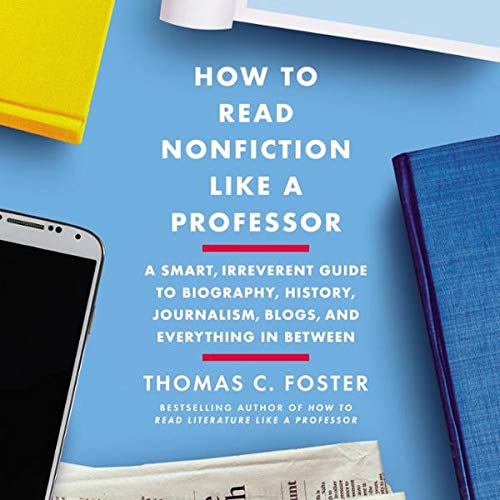
Where do I begin with this book? The first issue is of false advertising. If you're going to market your book as a "How to read" book, at some point you should probably teach people, you know, how to read different forms of nonfiction, preferably somewhere in the beginning. There is very little of that in the book. The main meat of the book, which goes through different forms of nonfiction writing simply describes the books and doesn't really teach you how to read them. I had to get to page 230 to get anything really useful (interrogating the books) which really should have been the first chapter.
The second problem is the overtly and weirdly placed political content, which I don't mind generally but the author should have just written a book about Trump and how horrible he is because he spends a good third of the book doing just that. The entire chapter on political writing, which is about 30 pages, is devoted to Trump. He mashes all this in with his equal hatred of Russia and their "interference" in the American election, taking the line that nothing was wrong in the US, and that Clinton was some sort of shoe in candidate with no horrible baggage (Iraq War, Libya, corruption, super predators) and if it hadn't been for Russia, she would be sitting in the Oval Office. This of course completely ignores the major issues currently racking the United States (expensive foreign wars, corporate takeover of every level of government, expanding gap between rich and poor, the opioid epidemic, environmental crises, etc), that it is an empire in decline and the fact that most people find Clinton to be repulsive and insincere. He really shows his age when he blames the internet for creating the spread of misinformation (p. 68). Ok boomer. It's your generation that got us Thatcher, Blair, Reagan, Clinton and Bush that led the world into a neoliberal dystopia that we are currently living in. Also there was plenty of disinformation campaigns before the internet, many of which were perpetrated by your intelligence communities which he seems to trust so much. The most hilarious part of this Russian interference, if it did indeed take place and had the effect of changing the results of an election, is that maybe the Americans are getting a little taste of their own medicine. Pretty hard to complain about something that you have done to literally every other country on the planet, including Russia. I would recommend that the author read Killing Hope by William Blum to see the path of despair and destruction that their country has brought to the earth since its rise to a superpower after the Second World War.
The other issue the author has is with sources of information. One line blew me away. He states on page 155 that "for all the abuse that mainstream media take from those on the loonier fringes, our major news sources are pretty trustworthy." The statement is simply laughable. He then goes on to state in his next point is that we should look at the source of the information and whether it is reliable and cites the tobacco industry and that we shouldn't be taking medical advice from them. This completely undercuts his previous point because all mainstream media in the United States is funded by Big Insurance, Big Pharma, the military industrial complex and Wall Street. His strange obsession with "experts" ignores the fact that during the leadup to the Iraq War all the experts were brought on the mainstream media and parroted the lies of the Bush administration and led the United States into a disastrous war. The experts also told us that there would be no crash in 2008 and that the housing market was rock solid. The author completely ignores the fact that experts can lie and that they can be paid off and pressured into doing what the powerful want.
This book doesn't know what it wants to be. Am I a "how to" book or a political commentary? Should I talk about how to read nonfiction, or should I yammer on about how Trump is so bad and that the internet ruined everything? Want a good book on how to read? Read "How to Read a Book" by Mortimer Adler and file this book in the disjointed, strange, falsely advertised section of your library.