Choć Zakon Świątyni, czyli Templariusze, został unicestwiony przez Filipa Pięknego w roku 1307, jego domniemany skarb-nie tylko złoto i kosztowności, ale także genealogie Dawida i Jezusa oraz zdobyte podczas krucjat dokumenty łączące ich rody z francuską dynastią Merowingów-został ukryty na wyspie Dębów na kontynencie amerykańskim. Na rozsławioną z czasem Money Pit, miejsce jego ukrycia, natrafiła w 1795 grupa chłopców. Ponad dwustuletnie poszukiwania bogactw zakonu to fascynujące dzieje licznych prób, podejmowanych przez pojedyncze osoby i profesjonalne ekipy-do dziś bezskutecznych. Kto jednak i w jakim celu wykonał niezwykle skomplikowany system szybów i tuneli? Komu i czemu służą
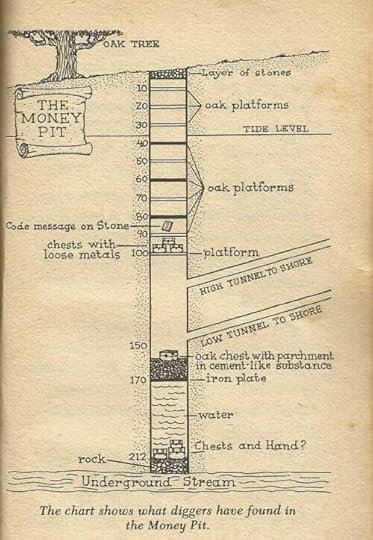
This was a neat book overall. The author was extremely informative of various subjects to include the indigenous people/European interactions Pre-Columbian North America, Knights Templar, history during the European Dark Ages, the religious and sociopolitical climate during the time of Christ, Biblical history during the time of David, and lots of other stuff. Unfortunately I wished the author talked more about the Oak Island mystery. The first two chapters gave a timeline of the money pit's discovery in 1795, structure and design, booby traps and flood tunnels, and the various digs/excavations up until the 1990s. There are many explanations as to who built the money pit and why to include the Vikings, pirate treasure, North American peoples, the Knights Templar, the Spaniards and Inca gold, and other alibis. Then in the end the author made connections from historical points of the Freemasons and Knights Templar—but in the end, it's all speculation.
Overall this was a very knowledgeable book on many connected topics. However the information went off on tangents at times and didn't relate to the Oak Island mystery. Not bad/not great. Thanks!
The subtitle is "solving the Oak Island mystery," but it should have been hypothesizing about Oak Island. There is some very good information in the book, but it certainly doesn't solve, or conclusively prove, that Oak Island is the resting place of the Templar treasure
I read this book as part of research for my archaeological novel "The Bones in the Pit", about the Oak Island Money Pit mystery in Nova Scotia. Of two dozen reference books (some purporting to be non-fiction, some blatantly fiction, some a mix) this was the standout. I thoroughly enjoyed the author's take on the Money Pit and why it might have been created. No spoilers here but the title gives some of it away - however you'll find a lot of intriguing stuff in this book if you like trying to figure out this two hundred year old mystery!
Pretty disappointed overall. Awkward writing - bad sentence structure - lots of author indulgences such as frequent rhetorical questions to the reader and postulating things as being "maybe so" in one chapter but in later chapters referring to them as fact. General confusion of fact, fantasy, theory, possibility and likelihood. Lots of cool content and details I mean to find out more about, so perhaps it could be said to have achieved its purpose, but generally a much goofier book than I originally thought. A big problem with it is that its scope is too wide - covering everything from the incorporation of Pagan ideas into Christianity (some factual errors in that I noticed) to the relationship of Freemasonry to every other known secret society in history. A jumble of elements - Francis Bacon is Shakespeare, the Norse and Irish and Basques discovered America, and the Black Madonna is Isis. I agree with the last two, but there are just too many theories and too few facts in this book and there is almost no distinguishing between the two on the part of the author. A better book on this subject in my opinion, would state what is known, what is suspected, and what is sheer speculation as separate topics - and let people decide for themselves what to believe.
Well this has little to do with Oak Island. This book connects Norse families to the Templars and connects David and Solomon and Jesus to the Templar lineage also. Sora references Holy Blood, Holy Grail so much that I felt that I should have read that instead. The book seemed well researched but was not put together well. Most of the writing was chronologically but then would just back and forth and seemed a little scattered.
Excellent! Some dry parts but only as setting historical acts need to be set up properly. Sora provides a wealth of incendiary information that was refreshing and enlightening. I will read again.
I picked this book up years and years ago, because of my fascination of Oak Island. I started reading it last year in a research effort for the novel that I'm writing. I have to say that I'm severely disappointed in it. Don't get me wrong, Mr. Sora did extensive research, and obviously has a huge interest in, and background of, etymology and epistemology. The background of why he thought the treasure of the Knights Templar and its route to Oak Island was an interesting course, however this was just not enough. Sora's thesis is based upon the previously mentioned studies and that is not only second hand evidence at best, but it is also a little dangerous and far fetched to make those kind of assumptions and state them as fact. On the surface (without revelaing spoilers) his theory seems plausible, but the deeper you dig into it, it becomes tenuous at best. It seems as though he relies heavily on others research (which is fine, dont get me wrong, but when you base about a quarter of your own theory on a single book of Gnostic belief, it degrades your own theory and makes it more about the previous authors discovery). This book was not really about Oak Island. If you are looking into it, this should only be read after digging into other resources. This is more about how The Knights Templar came to be exiled and the mystery behind thier organizations downfall. Where this is interesting, it wasn't what I signed on for. To add to that, there are countless grammar errors that are embarrassingly evident. I gave it two stars because of the research obviously put into it, and the few intriguing theories.
I'm now 1/4 through this book and now possess a wealth of information about pre-Columbian Scots and Norse settlers/explorers in North America, and nothing yet about the Templars. That said, it's still a fascinating book, esp. insofar as the linguistic links that have been established b/t the Native Americans and these Scots & Norse peoples.
***
The note above still stands -- this was a very interesting book. However, it was not a book about Solving the Oak Island Mystery. The author went into a great deal of detail about the history of the Templars, and added to the general Templars=Masons, etc. hypothesis.
He had an interesting overview of the Crusades. He went into a great deal of detail about early Europe and church history. He talked a bit about Christ's bloodline (building on the Holy Blood, Holey Grail hypothesis that was later picked up in Da Vinci Code regarding Mary Magdeline, Joseph of Aramathea and France). There was a nice bit about Roslin Chapel.
Know what's missing -- any substantive editing to tie this all together, and ESPECIALLY tying it all back to Oak Island.
The author seemed to think he'd inundate the reader with information and we'd immediately jump to the same conclusion as he, and as interesting as this all was, it was lacking in linkages and conclusions.
Not an awesome book. In fact, the whole book pulls together a wide ranging history that is supposedly meant to convince you that the templars ended up on Oak Island but for me it did the opposite. The author quoted non-factual things as if they were the gospel truth but a lot of his premise hung on those fairly far fetched ideas. His main premise seemed to be that the geneaology of Jesus (Da Vinci code anyone?) would and did make certain people wealthy throughout history because of black mail and that this was most likely part of the treasure that was buried at oak island. Basically only one chapter in the entire book was actually on Oak Island and it was the most flimsy part of a book that was pulled together in a fairly dry and non-convincing way. I do not recommend this book other than if you want some history of the knights templar (and for that I think you should go to more factual books). The only thing of interest to me in this book was that there were some burials of very important people done with interesting similarities to what Oak Island is known to have. Since bones were found in the oak island excavation, this may be a possibility but does not explain all the mysteries of Oak Island.
A LETDOWN! Speculative! More of a "Conspiracy Theory"...,
This book is a bit of a stretch if you are looking for FACTS. It is more of a hodge-podge of fact and fiction leaving the reader with a convoluted mess that is hard to pick through. Speculation abounds and creative license is plentiful in this work. Although an entertaining read, it presents many very interesting opinions, there are not supportive texts, archeological finds or historical proofs. Please do enjoy if you are looking for fantasy, historical fiction or could-have-been storylines, but this book is NOT FACT as it is advertised. If taken as a work of FICTION, this is a fairly good read, but as advertised, it is a poor excuse for history. So, It would be an average read as fiction, but must be marked down a little due to the fact that it is purported to be fact. This is how I arrive at a 2 out of 5.
V překladu Růženy Loulové vyšlo v nakladatelství BB/art s.r.o. v roce 2004. Kniha, která mi pěkně zamotala hlavu. Být napsaná o pár set let dříve, tak na hranici skončil nejen autor, ale i všichni kteří ji četli. Podává zcela nový pohled na počátky křesťanství, na možné pokračování Ježíšova rodu v jižní Francii, zpochybňuje autorství W.Shakespeara v celém jeho díle, ukazuje templáře ve zcela nové pozici při ochraně poutníků do Svatého města. V závěru autor konstatuje, že téměř všichni američtí prezidenti byli zednáři (pokračovatelé templářů) a že i v současnosti existují tajné struktury (ilumináti?), které manipulují světovým děním.
The book didn't solve any mysteries for me, in Oak Island or anywhere else. When King Phillip of France busted the Templars, on Friday 13th October 1307, was it their supposed amassed riches he was for getting his hands on? If so, he didn't get it. If not, where did it go? Mr Sora reckons it went down a mine shaft on Oak Island. Now that's what I call a credit crunch.
The most important thing in this book is the chapters about the Vikings in Northern America before Colombus,and the wars between the Scottish clans against the King of England,and the uprises between the Scots... The rest about the treasure,have no evidence at all In conclusion, it's a Worth book to read and nothing more... There is no treasure to find
What a hard book to read. The author is all over the place, quotes every book in existence and still doesn’t prove anything new. The speculation is probably correct but definitely not a theory he came up with.