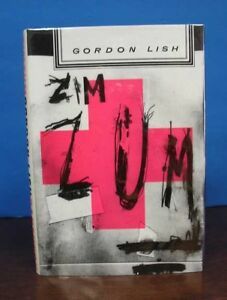
Call it zimzum: how we manage the scandal of our progress from desire to the void, through contraction and distractedness. In this perilously original work, composed of six rigorously crafted parts—and informed by a desperately libidinous, grotesquely comic rage—one of the most controversial figures in contemporary American letters brilliantly captures our humanity and Zeitgeist. Central to the novel is the ravishing shriek of a man who seeks to preserve what little there is left to him. It is as if his head were in an ever-tightening vise as he frantically seeks connection with others, knowing all the while the futility of the enterprise. He yearns for some carnal knowledge. He is obsessed with the successful operation of a sexual device. His lover is insensitive, self-absorbed. What is he—a former insane asylum inmate, whose motto used to be "share and share alike," but is now "fair is fair"—supposed to do? Exuberant in the music of its ordinary utterances, anguished and poignant in its declaration of the facts of life, Zimzum is Lish's most compelling novel.
Gordon Jay Lish is an American writer. As a literary editor, he championed many American authors, particularly Raymond Carver, Barry Hannah, Amy Hempel, and Richard Ford.
I'm here today with Michael Harris, book reviewr par excellence for the Los Angeles Times to talk about Gordon Lish's novel "Zimzum."
Glenn Russell – Hi, Michael. Thanks for your time. Let me start off by asking you about Gordon Lish's approach to writing "Zimzum."
Michael Harris - By now, we know we have to take Gordon Lish as he is. We know he isn’t going to wriggle out of the pupa of his established personality and suddenly flap his wings as a writer of taste, moderation, balance and moral acuity—someone like E.M. Forster, say.
GR – The Gordon we have in "Zimzum" isn't going to surprise us with a more conventional story, is he?
MH - No, the Lish we’ve encountered before, as a bad-boy editor at Esquire and Knopf, as a controversial teacher of writing and as the author of provocative fictions (“Dear Mr. Capote,” “Peru,” “My Romance”), is the same Lish we get here.
GR – What do you make of "Zimzum" as a title?
MH - “Zimzum"--no telling what the title means--is a typical Lish novel: short and crowded. The crowding isn’t due to the number of characters and incidents. There is only one real character, the narrator, who is more or less Lish himself. It’s due to the number of inflections, or layers, that Lish is able to pile onto the narrator’s voice.
GR – So with "Zimzum" we're given different phases, different level of Gordon?
MH - At the most basic level--call him Lish One--the narrator is an ordinary guy beset by life’s problems. His wife is “burning up” with an undiagnosed ailment; he must live in freezing cold and in the roar of multiple air conditioners. His lover is emotionally just as chilly. A “Mr. Fix-It Man” refuses to return a sex toy the narrator took in for repairs. His parents are threatened with eviction from a nursing home for “acting up.” Fairness, decency, the simplest human contact seem unobtainable.
GR – Goodness. Sounds like readers will encounter anything but a warm and fuzzy Gordon but, still, he's a Gordon we can root for.
MH - Before long, though, we feel uneasy about Lish One. His troubles are ludicrous as well as poignant. He lacks--another Forster word--perspective. He bends our ear with the obsessive sense of grievance, the numbing monotony, of the drunk on the next bar stool. We begin to see him in a different way: as Lish Two. We blame him rather than the state of the world--and blame the neurotic author for losing control of the story.
GR – I can picture a reader shaking their head and asking Gordon, as author, to resume control.
MH - The author is ready for us. You want control? he asks. I’ll give you more control than you ever thought possible. And, indeed, we come to see that what we took for mere rant and diatribe is actually rhetoric polished to a very high gloss, crafted for us by--let’s call him Lish Three.
GR – Wow! Could you share an example?
MH - Take this sentence from the opening chapter, a reminiscence of childhood: “I saw the men who were the drivers who had on sunglasses on who were sitting up on the seat.” When we read that sentence on the page, we want to grab an editor’s blue pencil and cross out the second on. But when we read it aloud, in the context of similar sentences, we find that the joke is on us: This really is how people talk.
GR – Fantastic. How about another example.
MH - Or take the second chapter, in which the narrator longs for sex and replays his whole erotic past--the names of the women, the things they did, the cities they did them in. Far from arousing desire, as pornography is supposed to do, it beats the language of desire to death. It’s a leaden parody of porn that first depresses us and then--especially when read aloud--makes us giggle. You see? Lish Three asks. Isn’t humor a sign of perspective? There isn’t a criticism you can make of me that I haven’t anticipated. Believe me, I’m covered.
GR – Sounds like Gordon beckons a reader to become an active participate in the game of literary fiction. But what else is happening here?
MH - What happens when we finally grow tired of all this game-playing, skillful as it is, and demand more substance from the story? Enter Lish Four, who is like Lish One, only more sophisticated, encompassing as he does all the Lishes in between. Lish Four asserts that he is in pain--that the game-playing wouldn’t have been necessary if he hadn’t had to overcome what he has assumed all along would be our contempt for him. His appeals to the reader become more personal and pointed: “Is this what you think, that I am just sitting here making a spectacle of myself from telling you this? Nobody has (anyone else’s) welfare at heart. . . . I do not know why I am bothering trying to communicate to you.”
GR – And there's all that sex.
MH - And in the sex chapter, after the depression and the mockery, Lish Four leads us into another, more elusive emotion. The crazy catalogue of past couplings reminds us that, indeed, nothing is more evanescent and irrecoverable than sexual experience, no matter how vivid it seemed at the time. We feel a different kind of sadness, and then, unexpectedly, a bit of desire after all.
GR – So you're saying Gordon is doing a kind of end run of what it means to write a novel. But does Gordon cover himself?
MH - Is Lish covered? Not completely. He still lacks some of the novelist’s most basic equipment: an interest in the world outside himself. He’s a solipsist, and knows it, and knows we know it. All his elaborate fictional strategies are a compensation for that lack, like a blind man’s sharpened hearing. It’s entertaining to see him walk down the sidewalk as sure-footedly as he does, tapping with the cane of that remarkable voice; but we can’t ever expect him to run.
GR - Now that's unique! Can I share your reflections as part of a Goodreads review, Michael?
MH - Absolutely, Glenn. Hope what I've said here prompts more readers to discover the magic that's Gordon Lish.
*Note - I transcribed Michael Harris' review of Gordon's novel that appeared in the Los Angeles Times for my imagined interview.
It is difficult to criticize Gordon Lish's work, because each sentence presents itself as the survivor of an intensive lengthy painful interrogation. A sentence or two might be found about which someone might say, I could improve that, but such a person would only be thinking such a thing on account of his own reading of Gordon Lish's work, and on account of the reduction of his customary patterns of thinking into the very harsh and patterns of the person, Gordon Lish, whom he had been reading. This problem, of the difficulty of criticizing Gordon Lish, comes also from the very wide acceptance and indeed adulation of his famous interrigations of other people's writing, and his well known and indeed famous and infamous, both famous and infamous, razorwire attention to individual sentences, resulting, in well known cases, of his utter and surprisingly quick rejection of entire manuscripts, indeed probably also of entire novels, on the basis of his quickly delivered verdict regarding the very opening sentences of the manuscripts, without his even reading the entirety of the manuscripts, or even actually more than their opening sentences.
Lish is remembered with affection and awe by students, and his novels aren't usually criticized or, perhaps, widely read. It may seem his legacy is his exemplary impatience with fustian and ill-formed sentences. But it isn't true that Lish was a teacher and that's the "beginning and end of it," as one person wrote on Twitter in response to this review, because his teaching points to, and limits, a kind of practice, which the novels exhibit. His wasn't simply good teaching or exemplary editing: it was a particular sort of editing, which has specifiable consequences for writing. In other words: if you value Lish's example as a teacher, it's worth worrying about what kinds of writing it enables and entails.
In this book by Gordon Lish, a man named Lish rants and raves for chapters on end about his desire to fuck a large number of women, and his exasperation at one woman, and his shredded life and its many injustices and wounds. The person Lish in the novel is described, immodestly by the author Gordon Lish himself, very clearly the author of the endorsement and description on the dust jacket, as a "ravishing shriek of a man," "desperately libidinous" and"grotesquely comic," which are true, but also marred by the reader's uncomfortable awareness that only one person could possibly have written those lines, and that is the author of the book, Gordon Lish, eventhough the result is queasy making. But I digress.
The book, Zimzum, opens with an epigraph by Thomas Bernhard, and I think that was a mistake. Calling Bernhard's rants to mind sheds an unhappy light on Lish's, because Lish's character Lish rants in a very precise way: his thoughts are unravelled and artfully scrambled, which is proper to a rant, but the sentences that convey his scrambled thoughts have clearly been subjected to a sharp sober patient scrutiny that is entirely of a different order than the unsettling and trackless rants in Bernhard's books. Lish has nearly perfect control over me, that is what each one of his sentences says, and when it says that, it entirely and permanently forecloses the possibility that the "shreik of a man" might actually be dangerous or clinically damaged or ruined or frozen or broken, and those are all metaphors form Bernhard's books, where people are not saved by the omniscient clarity of their narrator.
In Gordon Lish's Zimzum sentences get pushed and pulled and eaten up and chewed and spat back out and turned over and rearranged and blown to bits and reconstructed all in service of what can best be described as a brilliant rant. Lish plays with words and sentences like the best of em, maybe better than the best of em. It's hard not to think of Gertrude Stein or Samuel Beckett while reading, but by the end I realized that more than those obvious influences I felt that the way Lish's language moves reminded me of Fred Astaire. Like Astaire, his movements are executed with such ease that you almost forget the difficulty in pulling something like this off. Dance on, Lish, dance on...
This book is an editing, of nothing--not a novel. He can make sentences more elegant than Nabokov's. And he makes this. This book is horrible.
He is the most famous living American editor. He writes with the root obsessions of an editor. And, like later Leonard Cohen, his audience seems to be nothing more than his own legend. At one page, it is pure charisma. At the length of ZimZum, the neurotic striaghtjacket of his style is absolutely terrifying, unreadable, crazy-making. He never breaks through it. He never makes real human blood out of the forms. He doesn't allow himself to violate the forms enough, won't allow them any real damage, wont smash them together. His style is like pop-punk. It is the perfected evocation of incompetence, informality, neurosis, and disarray. As with punk in general, this is meant to indicate authenticity. But like pop-punk, it is too perfectly destroyed and always fails after a few minutes.
This slim investment was a solipsistic circumnavigation around a neurotic’s head. It rephrases and repeats. It repeats and rephrases, much like some of Gertrude Stein. And I can appreciate its method, I felt the percolating frustration and alienation of the head and what was outside of it, but it’s form didn’t elevate its story, in my opinion. I’ll try it again, eventually, Lish deserves a studious and determined reader. He so clearly is willing to squeeze all the air out of every idea, view each clause from every angle until a new meaning arrives. It is a claustrophobic tale about someone wondering where their wits end. Read it one sitting, it should be read in one sitting, this book should be read in one sitting. That was my karaoke cover; Lish is ambitious and doesn’t budge an inch, I’ll try it again soon.
You begin wondering why a man of this extreme talent and understanding of great literature would write and have published this disgusting stuff. Perhaps because Henry Miller did. Miller himself wrote some pretty hair-raising and harrowing pornography. And I know firsthand that Gordon Lish loved watching pornography as well as the Discovery channel. It was where he got his news. Of course, there's more, and plenty of good reasons to read on about it all here: https://rogueliterarysociety.com/f/zi...
What a wild, fun and fantastic rant this book is. The blurb says his most compelling novel and I believe it (having now read five including Peru, Dear Mr. Capote and Arcade).
Gordon Lish's Zimzum dropped quietly from the presses, and despite the author's notoriety in literary circles, there was precious little talk about it. As it turns out, there was little to talk about—no discernible plot or structure, no characters that last more than a few nondescript paragraphs, nothing remarkable or even interesting about the language. What we have is, as a back-cover blurb calls it, "a tireless rant." A voice goes on for 98 drawn-out pages in the most cloying, monotonous way imaginable about one inane thing after another. Case in point: "The nursing home started phoning me and phoning me to say that Father and Mom were not behaving. The nursing home kept badgering me about what I would do about Father and Mom misbehaving. But I could think of nothing to do. You think I could think of something to do about it? Who was I to think of something to do? I expected those two to be dead already! Can I tell you something? They weren't dead, they weren't dead at all. You know what else? I was not prepared for something like misbehaving." This faceless, disembodied voice takes up the entire novel with faceless people or absurd events—an Oster appliance of dubious household significance, for example, cannot be fixed for something like 30 pages. There are no paragraphs to break up the textureless writing, no dialogue, description or imagery. You are much better off reading the phonebook for curious names, alphabetizing the books on your shelves, writing long-overdue letters to friends you haven't seen in years. Even the section Lish might have made into something appealing in a pornographic way is so empty, reads so much like the list of who begat whom in the Genesis chapter of the Bible, it’s merely vulgar. Add to that the fact that it’s written in a lions-and-tigers-and-bears rhythm and it becomes all the more absurd. Keep Dorothy and Toto in mind as you read: "What about the blond girls in Aleut? What about the two of them in Aleut? What about Nina and Mina in Aleut? Good God—Nina and Mina in Aleut! Jesus, Mina and Nina in Aleut!" Oh my! Lish, who had previously written two novels and a collection of short stories seems to have nothing to convey. Zimzum is simply a void between hard covers into which your money will disappear. This is not writing, as Truman Capote once said (about a much better writer), this is typing. Lish should have let his secretary do it for him.
The book as a whole does interesting things when it comes to the sentences and style used and: That’s kind of it The stories feel to much of a cop out as they feel too easy for Lish to spin these out given the autobiographical and mundane nature of the stories. This leads to everything having a been there done that feeling such as the 12 page sentence about the narrator’s desire to fuck a lot of women. Whilst the structure makes it interesting to me that’s the only thing compelling to them.
Ok, it wasn’t what I was looking for when a friend recommended this book, or was it? Still I can’t make my mind, but I got a wonderful laugh out of it… As he writes “Ha Ha Ha” It is hilarious, with a sense of human absurdity, in an eternal rant with a physicality that many erotic works would want for them. I enjoyed, in the most literal way as a reader, and as a writer, I must say Wow! The way is written is absolutely exhilarating, I couldn’t put it down!
kinda annoying to discover that this pompous man deserves some of the credit he gets. but i still think that if you’re gonna be this brutally incisive with your prose you should maybe go ahead and write poetry but i get it, he’s doing a whole THING here 🙄
This book is unlike anything I have ever read. I first discovered it as a teen in highschool, and didn't know what to think of it then. I still probably don't, at times I love it, at times I hate it, but I keep coming back to it, reading and re-reading. When I need my head to be filled with a different sort of noise, or language, there is ZimZum.