"Gut Botany charts my body / language living on indigenous land as a white settler and traveler," Petra Kuppers writes in the notes of her new poetry collection. Using a perfect cocktail of surrealist and situationist techniques, Kuppers submits to the work and to the land, moving through ancient fish, wounded bodies, and the space around her. The book invites the reader to navigate their own body through the peaks and pitfalls of pain, survival, sensual joy, and healing.
Gut Botany is divided into eight sections. In "Court Theatre," Kuppers revisits courtroom performances following her sexual assault while drawing from the works of Perel and Bhanu Kapil. "Asylum" grew out of the Asylum Project performance experiments that Kuppers co-directed with dancer/poet Stephanie Heit. "Moon Botany" began as a collaboration with visual artist Sharon Siskin and offers a wheelchair user's view of insects, mushrooms, and horsetail ferns. Amber DiPetra notes that "this book is beautiful when it needs to be beautiful and it is edgy when it needs to be edgy and that is the sign of writing that matters."
Readers looking for experimental poetry that takes up space in their brains and bodies will dive deep and fast into this queer ecosomatic investigation.
One of my first impulse book purchases of the pandemic — I bought this through the #AWPvirtualbookfair. I've enjoyed books from Wayne State University Press's Made in Michigan series before, and I couldn't resist the description of this book as "my gorgeous queer disabled eco poetic freaky sturgeon dinosaur survivor."
The sections of this collection that fit this description well I LOVED. Gut Body and Contours are visceral and tactile, embodied in nature. Court Theatre examines a sexual assault and its aftermath — the police report, the courtroom testimony, perceptions of her body by authorities and herself. These first three sections I loved so much that later poems fell a bit flat in comparison. Picking the book up later and thumbing through the later sections out of sequence with the first, they pulsed with new resonance.
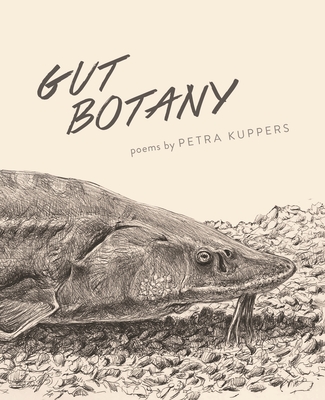
Also, I just have to say, the entire book design for this is SO GORGEOUS. Each section has an opening page with a full-page monochromatic rendition of the cover image (a sturgeon) and isolated flashes of color appear in titles and headings throughout the book. The press did a lovely job making this a beautiful object in addition to the quality of the poetry.
In work by Petra Kuppers there are always revelations and revolutions, and this is certainly true of the poems included in Gut Botany. Kuppers is interested in the ways the unstable language of “poetry provides a site to explore crip experience” (see Kuppers’s 2007 article “Performing determinism: Disability culture poetry), and also how the unstable language of poetry reveals the human role in ecological violence as well as potential environmental renewal. As has been the case in so much of Kuppers’s work, the poems in Gut Botany beg questions about culturally enforced binaries of all kinds. Kuppers moves beyond the limits of what separates the human body from the fish’s or the lake’s or the dinosaur’s, the female body from the male, the “disabled” body from the “able” body, a settler’s body from an Indigenous one, and more and more. Kuppers’s writing is additive, even multiplicative, rather than subtractive or divisive. The book explores myriad forms violence, but also makes room for bodies touching other bodies in wonder and in love.