Thank you so much, NetGalley, Soho Press and Soho Teen, for the chance to read and review this book in exchange of an honest review,
TW: child abuse, violence, alcoholism, self-harm, suicide ideation, homophobia, sexism, PTSD, xenophobia
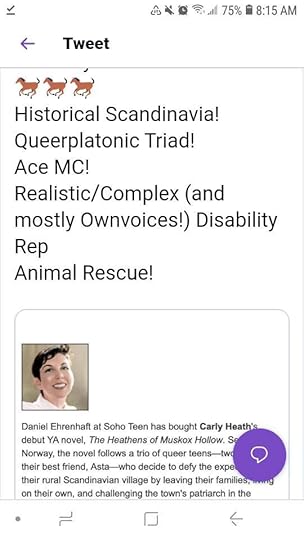
Asta Hedstrom has an unconventional appareance and she is deaf from one ear. Her mother believes she’s only suited for a domestic future, disregarding her ideas and feelings, but Asta doesn’t want to marry her odious betrothed, Nils. She wants to perform in the town’s theater with her best friend Gunnar Fuglestad and his secret boyfriend Erlend Fournier. When Gunnar is almost killed by a jealous Nils, Asta decides to shunning her marriage and starts to live with Gunnar and Erlend in a cabin above town. The only way to survive, have their own life, and save the Fuglestad’s deep into debt farm, is to win the village’s annual horse race. Even though they have the whole town against. Or so they think.
I LOVED reading The reckless kind. Set in a small rural town, in Norway 1904, The reckless kind is a wonderful, intense and brilliant story, with complex and well written characters, determined to do anything in their power to live their own lives and protect their loved ones. Told by two POVs, Asta’s and Erlend the story follows how Asta, Erlend and Gunnar defy the restrictions imposed upon them by the society, against family’s expectations, village’s rules, deciding and wainting a different life for them.
It’s a book with outsiders, outcasts, as main characters, people that don’t fit in and the strong bonds they forge. Asta is a queer and disabled young woman, Erlend is the rich son of the theater’s owner and fights everyday with his anxiety disorder and he’s deeply in love with Gunnar, who lost his arm in an accident and can’t walk after a violent aggression. Each of them defy what the town and the sociey expects from them and they are stubborn, brave and brilliant to follow their own paths, choosing themselves and their loved ones again and again, even though it’s not always easy.
Asta is one of the main characters, she lives in a heteropatriarcal society and she fights to be herself, to navigate her sexuality, her asexuality and desire of a platonic relationships. In a society and town where women were expected to act in a certain way, to marry, to have children, to choose a domestic life, mostly if poor, Asta refuses to marry, to be owned, to be without her freedom and fights to help the boys who became her family, to learn a profession, to be free.
Erlend, the other POV, is very different from Asta, but he’s an outcast like her and Gunnar and he struggles against his family’s expectations, to marry a good girl, to have a “proper” life and career. His love for Gunnar is indomitable, able to survive fights, misunderstadings, family’s rage and disappointment. Erlend chooses to leave everything behind, the life he was used to, refusing to lose his love.
Gunnar, the third main character, doesn’t have a POV, but the reader is able to know him and his struggles and pains through Asta and Erlend and with care and sensitivity the author addresses his struggles, his pains, his guilt and doubts, after the spinal injury. Gunnar struggles both with his physical symptoms, being in pain and being forced to adapt himself to a new life and with his guilt because Erlend left everything behind for him.
Carly Heath did an outstanding job with these characters. They are relatable, fierce, human, in their thoughts, struggles, ideas, hopes and dreams. It’s a book about all types of love and their strengths. The reader faces Gunnar’s love for Asta and Erlend, familial and romantic, his depression and dark thoughts, his fighting using sarcasm and irony, Erlend’s fierce love and stubborness to protect his newborn family, Asta’s love for the boys, and her devotion to animal companions. I love their strong bonds, how much they love and would do anything for each other. It’s also really beautiful how the author talked about different kinds of love and how each of them is important.
It was also really interesting reading the historical and medical notes, about Asta’s syndrome and how she, in that time, didn’t have the language to define parts of her identity, like her asexuality, about Gunnar’s spinal injury, the language’s limitations and so on. It was very intriguing and I loved it.
With care and sensitivity the author addresses traumas, violence and young love in a beautiful historical queer tale about love and all his types, like romance, friendship, devotion, about fighting to be themselves, to love who you want and against ignorance and violence.