

What do you think?

Black Wave: Saudi Arabia, Iran and the Rivalry That Unravelled the Middle East
'Brilliant ... Essential ... Riveting' Peter Frankopan
'Revelatory and original' Lindsey Hilsum
'Fascinating and important' Jeremy Bowen
A timely and unprecedented examination of how the modern Middle East unravelled, and why it started with the pivotal year of 1979
'What happened to us?'
For decades, the question has haunted the Arab and Muslim world, heard across Iran and Syria, Saudi Arabia and Pakistan, and in the author's home country of Lebanon. Was it always so? When did the extremism, intolerance and bloodletting of today displace the region's cultural promise and diversity?
In Black Wave, award-winning journalist and author Kim Ghattas argues that the turning point in the modern history of the Middle East can be located in the toxic confluence of three major events in 1979: the Iranian revolution; the siege of the Holy Mosque in Mecca; and the Soviet invasion of Afghanistan. Before this year, Saudi Arabia and Iran had been working allies and twin pillars of US strategy in the region - but the radical legacy of these events made them mortal enemies, unleashing a process that transformed culture, society, religion and geopolitics across the region for decades to come.
Drawing on a sweeping cast of characters across seven countries over forty years, Ghattas demonstrates how this rivalry for religious and cultural supremacy has fed intolerance, suppressed cultural expression, encouraged sectarian violence, birthed groups like Hezbollah and ISIS and, ultimately, upended the lives of millions. At once bold and intimate, Black Wave is a remarkable and engrossing story of the Middle East as it has never been told before.
401 pages, Kindle Edition
First published January 1, 2020
About the author
Kim Ghattas
4 books309 followersKim Ghattas covers international affairs for the BBC as well as Hillary Clinton's presidential campaign. She was the BBC's State Department correspondent from 2008 to 2013 and traveled regularly with the secretary of state. She was previously a Middle East correspondent for the BBC and the Financial Times, based in Beirut. Ghattas was part of an Emmy Award-winning BBC team covering the Lebanon-Israel conflict of 2006. Her work has also been published in Time magazine, the Boston Globe, and the Washington Post and she appears regularly on MSNBC and NPR as a commentator.
Ratings & Reviews
Friends & Following
Create a free account to discover what your friends think of this book!
Community Reviews
Displaying 1 - 30 of 812 reviews

February 12, 2020
Black Wave is an insightful history of Middle Eastern conflict and why the Middle East is in a state of turmoil today. Award-winning journalist and author Kim Ghattas argues that the turning point in the modern history of the Middle East can be located in three major events in 1979: The Iranian revolution; the siege of the Holy Mosque in Mecca; and the Soviet invasion of Afghanistan. Before this year, Saudi Arabia and Iran had been working allies and twin pillars of US strategy in the region - but the radical legacy of these events made them mortal enemies, unleashing a process that transformed culture, society, religion, and geopolitics across the region for decades to come.
Kim Ghattas unpacks layers of history and politics to understand the transformation of the region as a whole. With vivid storytelling, extensive historical research and on-the-ground reporting, Ghattas explore how Sunni Saudi Arabia and Shia Iran, once allies and twin pillars of US strategy in the region, became mortal enemies after 1979. She shows how the competition that went well beyond geopolitics and how this rivalry for religious and cultural supremacy has fed intolerance, encouraged violence, the creation of groups like Hezbollah and ISIS and, ultimately, destroyed the lives of millions.
Black Wave deals not only with rivals Iran and Saudi Arabia, but also Iraq, Pakistan, Afghanistan, Lebanon, and Egypt. The Israel-Palestine conflict plays only a supporting role. US foreign policy, often crucial to the region’s geopolitics also gets only a passing mention. The geopolitical rivalry between Iran and Saudi Arabia, two countries takes the center stage. It’s like Iran & Saudi Arabia are battling for control in a never-ending game of chess. Indeed, Black Wave is crafted like a thriller but with countries as characters in the story.
What makes the book special is that Ghattas narrates the story through the stories of a riveting cast of characters whose lives were changed completely by the geopolitical drama over four decades. These are not fictional characters but real people; from the Pakistani television anchor who defied her country’s dictator, to the Egyptian novelist thrown in jail for his writings all the way to the murder of journalist Jamal Khashoggi in 2018. Black Wave is both an intimate account of real-life experiences and sweeping history of the region narrated through the lives of people.
Ghattas has a distinct and free-flowing style of writing and the book does an excellent job in demystifying the complex history and geopolitics of the region. Meticulously researched and extremely readable, the book attempts to make sense of the region’s many troubles. The story keeps shifting from country to country without getting confusing. The western media has often reduced matters of extraordinary depth and complexity to a snapshot but this book attempts to decipher the complex events from several viewpoints. If you are interested in history and world events, this book is a must-read.
Many thanks to the publishers Henry Holt and Co and Macmillans and Edelweiss for the ARC.

January 26, 2020
***Top book of 2020 for me.***
The cultural and political changes in the Middle East were brought to life and breathed into each page beginning with the 1979 Iranian Revolution. The claim for the book is that the pivotal year of 1979 generated much of the conflict that is seen currently; so, we must understand 1979 at every angle in order to comprehend the Middle East of today. Because 1979 is the foundation for shaping the premise of the book, Part 1 which is 4 chapters (or 23 % on a Kindle) heavily centers around the 1979 Revolution.
The thesis is extremely well supported with exceptional research throughout each chapter reaching up to the year 2019. The reader sees the geopolitics in each region surrounding events that eventually lead to world developments such as the Iran hostage crisis, the emergence of Hezbollah in Lebanon, the 9/11 attacks in the U.S., and the growth of ISIS. We often always ask, "Why?" and this book attempts to explain the why.
*This is an intense book because it is eclipsed with several assassinations, insurmountable deaths, and extreme suffering.* (There was not a lot about the Kurds. There was not much about Yemen until the end.)
There were quite a few names in the beginning that I was unfamiliar with. All of those involved and mentioned were important, but it took some adjusting on my part to remember who was who. Because of that, I would recommend reading this on a Kindle.
Key figures (not limited to) : Abu Bakr al-Baghdadi, Musa al-Sadr, Juhayman al-Otaybi, Ruhollah Khomeini, Zia-ul-Haq, Saddam Hussein, Bin Baz, Osama Bin Laden, George H.W. Bush, Sadegh Khalkhali, Jamal Khashoggi, Qassem Suleimani, Mohammed Morsi, Nuri al-Maliki, Rafiq Hariri, Hafez al-Assad, Hassan Nasrallah, Crown Prince Abdallah, Abu Musab al-Zarqawi, Moqtada al-Sadr, Mansour al-Mansour, Nasr Abu Zeid, Salman al-Audah, King Fahd, Safar al-Hawali, Benazir Bhutto, Nawaz Sharif
Thank you to the publisher and NetGalley for an advanced copy. Opinions are my own.
"I started this project with the full awareness that the extremist partisans on either side of the Saudi-Iran divide would find fault with everything I wrote- or perhaps they would pick apart the sections that depict them and applaud passages about their nemeses. I did not write this book for them. I wrote it for peers and colleagues and a wider audience of readers who want to understand why events in the Middle East continue to reverberate around the world. I wrote it for those who believe the Arab and Muslim words are more than the unceasing headlines about terrorism, ISIS, or the IRGC. Perhaps above all I wrote it for those of my generation and younger in the region who are still asking, "What happened to us?" and who wonder why their parents didn't, or couldn't, do anything to stop the unraveling."
-Kim Ghattas, Black Wave
More on this:
Watch author Kim Ghattas talk about Iran-Saudi relations here on the Trevor Noah show
Watch author Kim Ghattas on CNBC discussing Qasem Soleimani's death
Follow Kim Ghattas onTwitter or Facebook.
Read The Guardian's review for Black Wave.
Take a look at Kim Ghattas book tour dates
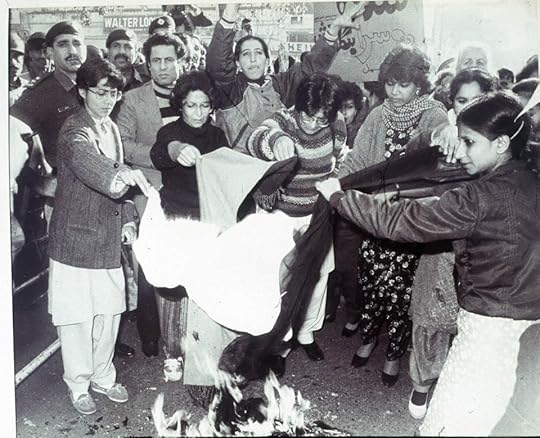
Above is the iconic dupatta burning protest in Pakistan against Zia. Click here to read more.
The cultural and political changes in the Middle East were brought to life and breathed into each page beginning with the 1979 Iranian Revolution. The claim for the book is that the pivotal year of 1979 generated much of the conflict that is seen currently; so, we must understand 1979 at every angle in order to comprehend the Middle East of today. Because 1979 is the foundation for shaping the premise of the book, Part 1 which is 4 chapters (or 23 % on a Kindle) heavily centers around the 1979 Revolution.
The thesis is extremely well supported with exceptional research throughout each chapter reaching up to the year 2019. The reader sees the geopolitics in each region surrounding events that eventually lead to world developments such as the Iran hostage crisis, the emergence of Hezbollah in Lebanon, the 9/11 attacks in the U.S., and the growth of ISIS. We often always ask, "Why?" and this book attempts to explain the why.
*This is an intense book because it is eclipsed with several assassinations, insurmountable deaths, and extreme suffering.* (There was not a lot about the Kurds. There was not much about Yemen until the end.)
There were quite a few names in the beginning that I was unfamiliar with. All of those involved and mentioned were important, but it took some adjusting on my part to remember who was who. Because of that, I would recommend reading this on a Kindle.
Key figures (not limited to) : Abu Bakr al-Baghdadi, Musa al-Sadr, Juhayman al-Otaybi, Ruhollah Khomeini, Zia-ul-Haq, Saddam Hussein, Bin Baz, Osama Bin Laden, George H.W. Bush, Sadegh Khalkhali, Jamal Khashoggi, Qassem Suleimani, Mohammed Morsi, Nuri al-Maliki, Rafiq Hariri, Hafez al-Assad, Hassan Nasrallah, Crown Prince Abdallah, Abu Musab al-Zarqawi, Moqtada al-Sadr, Mansour al-Mansour, Nasr Abu Zeid, Salman al-Audah, King Fahd, Safar al-Hawali, Benazir Bhutto, Nawaz Sharif
Thank you to the publisher and NetGalley for an advanced copy. Opinions are my own.
"I started this project with the full awareness that the extremist partisans on either side of the Saudi-Iran divide would find fault with everything I wrote- or perhaps they would pick apart the sections that depict them and applaud passages about their nemeses. I did not write this book for them. I wrote it for peers and colleagues and a wider audience of readers who want to understand why events in the Middle East continue to reverberate around the world. I wrote it for those who believe the Arab and Muslim words are more than the unceasing headlines about terrorism, ISIS, or the IRGC. Perhaps above all I wrote it for those of my generation and younger in the region who are still asking, "What happened to us?" and who wonder why their parents didn't, or couldn't, do anything to stop the unraveling."
-Kim Ghattas, Black Wave
Watch author Kim Ghattas talk about Iran-Saudi relations here on the Trevor Noah show
Watch author Kim Ghattas on CNBC discussing Qasem Soleimani's death
Follow Kim Ghattas onTwitter or Facebook.
Read The Guardian's review for Black Wave.
Take a look at Kim Ghattas book tour dates
Above is the iconic dupatta burning protest in Pakistan against Zia. Click here to read more.

February 11, 2021
Ghattas points to 1979 as a watershed, the year when the Middle East gave way to fundamentalist Islam. She uses the terms Salafist, Wahhabi, and Islamist to refer to strict interpretations of Islam that call for religious rule and impose strict moral codes and severe punishments particularly on women. Ghattas takes us through the recent rise of Salafism in Iran, Saudi Arabia, Egypt, Lebanon and Pakistan. She shows this led to widespread sectarian conflict throughout the region, pitting Shia against Sunni and Iran against Saudi Arabia as Islamists on both sides condemned all competing interpretations of religion. An accomplished liberal secular minded woman born and raised in Lebanon, Ghattas is appalled at what has become of Arab culture and the Middle East in the last forty years. She uses personal stories to illustrate her points profiling key figures including activists and dissidents who stood up to oppressive regimes adding human interest to the book. These personal vignettes are missing in my sketchy notes that follow which just outline the main events that underlie her argument.
Ghattas begins with the Iranian Revolution of 1978-79. She profiles important figures leading up to the revolution focusing on Ayatollah Khomeini. She covers a lot of ground in a short space. A few points caught my attention. First, in 1978 just months before the revolution began, Saddam Hussein called the Shah telling him they should get rid of Khomeini, who had been in Iraq for years, since he was trouble for both of them. The Shah declined. Second, Khomeini achieved power for his oppressive Islamic government by co-opting a revolution organized by leftist secularists who ended up horrified at the way the revolution turned out. Third, the takeover of the American Embassy and ensuing hostage crisis was orchestrated and carried out by leftists who were stridently anti-American. Khomeini had not been paying particular attention to America, but he embraced anti-Americanism as a way to cement his power once the embassy was overrun.
In Saudi Arabia in 1979, the Holy Mosque in Mecca was seized by local religious zealots. The Saudi government had been allowing Western culture to creep in, much to the angst of Salafists. It took government forces months to get them out of the Mosque. The Saudi King decided he needed to make some accommodations to the Islamists to preserve order. Adding to Saudi concern was an uprising of Shia oil workers. Saudi rulers turned to their relationships with clerics that preached an extreme form of Islam known as Wahhabism. So Saudi Arabia backtracked, particularly on laws regarding women, which were the ones that upset Wahhabis the most. Women would no longer be seen on TV or in other public occupations. Many women would lose their jobs. The government began to heavily fund “the Committee for the Promotion of Virtue and Prevention of Vice.” Prayer times were now strictly enforced.
Meanwhile, in Iran a ten year campaign of terror began. The Shah had forced secularization on Iran. The elites had exposed Iran to much more modernity than that experienced in Saudi Arabia and Khomeini demanded fast and dramatic change back. Thousands would be tortured, imprisoned and executed including many who had helped lead the revolution. Universities were closed for years while they were recast as Islamist institutions, at least in the liberal arts. Science was left alone. Women were forced to dress to Salafist standards and were excluded from numerous activities. Khomeini hated the equally repressive Wahhabism which considered Shia Islam heretical. In 1945 he had written that the Saudis were “the camel grazers of Riyadh, the barbarians of Najd [Saudi desert], the most infamous and the wildest members of the human family.” Saudi Arabia’s leadership began positioning themselves as the leader of all Muslims. This set off Khomeini. He intended to be the leader of the Islamic world.
In Egypt Anwar Sadat had assumed power in 1970. He went right where Nasser had gone left. He empowered the religious authorities in order to break Nasser’s bureaucracy. He broke with the Soviet Union, made friends with America and peace with Israel to get back the Sinai. The clerics turned against Sadat as he brought alien Western influences and more blatant inequality to Egypt. The marginalized, particularly rural people who had migrated to the cities, turned to Salafist organizations that gave them a sense of purpose and identity. Khomeini demanded that the Egyptian people overthrow Sadat comparing him to the Shah. In 1981 Sadat began mass imprisoning of dissidents, many inspired by the Iranian Revolution. Soon after, he was assassinated.
In Pakistan General Zia-ul-Haq staged a coup in 1977 doing away with free elections. He was a dictator and self-described “soldier of Islam.” Pakistan had been founded thirty years earlier by Muhammad Ali Jinnah, a Shia who believed in separation of church and state. But over time Islamist politics gained strength culminating in Zia who set about to enforce Sharia law. In 1979 he promulgated an Islamic “system” of government. Laws were changed to enforce Salafist standards of dress and behavior: the wearing of vails for women, enforcement of prayer times, severe punishment for intoxication, fornication and adultery. Women were especially targeted and severely limited in public activities. For example, women were not allowed to play sports in public.
In Syria Hafez Assad, who had come to power in 1970, tortured and executed dissidents just as his son would continue to do. In 1979 the terror in cities like Aleppo and Hamas was profound. Ghattas quotes a student who told her “You don’t know. The people die like rain.” Syria caught in the middle between the Saudis and Iranians chose to side with Iran. More chaos erupted. Christmas Eve 1979 the Soviet Union invaded Afghanistan. The Saudi’s vowed to help the resistance. 1979 was a seminal year across the Islamic world. Then in 1980 Saddam Hussein invaded Iran starting a war that lasted eight brutal years ending in a stalemate.
In the 1980s Lebanon also became a battleground. The Palestinians had established a presence in the southern part of the country where they could harass the Israelis. The Israelis invaded in 1982 and Iran seized an opportunity quickly sending Revolutionary Guards to aid and train the Palestinians as well as recruit and propagandize the Lebanese Shia giving birth to Hezbollah. Hezbollah, Party of God, was formed to replicate the Salafist values of its namesake in Iran. It was designed to export the Iranian Revolution to Lebanon. In response Saudi Arabia put forward a peace plan to settle the Palestinian – Israeli conflict. For this Iran condemned the Saudi Crown Prince calling him the enemy of Islam.
Hezbollah employed a tactic new to the Middle East, suicide bombers. In 1982 an Israeli command post was blown up by a truck bomb killing 75, then in 1983 another truck was driven into the U.S. embassy killing 63 followed by a truck driven into the U.S. Marine barracks in Beirut killing 241 Americans and French paratroopers, over 300 people in total. The Americans and French were part of a peace keeping force. In 1985 Israel withdrew to a much smaller buffer zone along the border. Hezbollah gained strength winning over Shia communities and enforcing strict Islamist laws. Lebanon became deeply divided along religious lines.
Pakistan in the 1980s evolved into a Shia-Sunni battleground. Khomeini claimed to be the protector of Shias everywhere. Pakistan had a large Shia minority. Soon Khomeini proselytizers were in Pakistan converting Shias to Khomeini’s fiery brand of Islam including condemnation of the Saudis. In response Saudi Wahhabi loyalists and jihadists like Egyptian Ayman Zawahiri, future al-Qaeda number two, came to Pakistan inflaming the Sunni’s. Up to this time, Islamist revolutionaries targeted their own countries, now they were organizing transnationally. Saudi contingents distributed aid in Pakistan including setting up many schools that taught Wahhabi Islam heavily influencing Sunni communities. These began in Peshawar close to Afghanistan where “Arab Afghans” flowed from the Middle East to fight the Russians. Anti-Shia rhetoric raged. Militias formed, assassinations took place, and in 1987 Sunnis attacked Shia villages, Shias retaliated, hundreds died, a war between sects not countries had erupted.
Egypt in the 1980s turned to Salafist Islam, a U-turn for a country that still revered the iconic secular President Nasser. Some of it was a reaction to Khomeini and much was due to Saudi influence. Saudi Arabia was booming and importing workers in the 1980s. By 1985 1.2 million Egyptians worked there. They brought back Saudi religious values along with the money. Saudi money was also financing fundamentalist religious leaders who were driving cultural change. In 1985 6% of books published in Egypt were religious; in 1994 it was 25%. In the mid-1980s there was a mosque for every 6,031 Egyptians, by the 2000s there was a mosque for every 745 Egyptians. Many women adopted the veil and Islamist dress. Religious edicts increasingly dictated acceptable behavior.
In Saudi Arabia in 1995 a bomb exploded killing six Americans who were training the Saudi National Guard. This was the first attack against foreigners on Saudi soil. The government rounded up hundreds of extremists but still didn’t link its support for Wahhabi clerics to the violence. In 1996 a tanker truck filled with explosives killed nineteen Americans and injured 400 at a U.S. Air force building in Saudi Arabia. The culprit was the ever more organized and powerful Hezbollah, sponsored by Iran. However the Saudis were seeking rapprochement with Iran and downplayed the linkage. Then came the 9-11 attack on the U.S. with fifteen Saudis participating. Saudi leadership still refused to connect the Islamist culture to the people that carried out the attack. Then in 2003 two bombings targeted foreign Muslims in Saudi Arabia killing over fifty and wounding four hundred including children. Al-Qaeda carried out the attacks. The Saudi leaders started to realize they had a terrorism problem.
The U.S. invasion of Iraq in 2003 emboldened terrorists and ignited Sunni-Shia sectarian violence. Saddam’s ruthless dictatorship had kept a lid on Sunni-Shia conflict. Now hothead leaders and jihadists turned followers into armies. In 2006 in Samarra, home of future ISIS leader Abu Bakr al-Baghdadi, two ten century old mosques were bombed. This was the beginning of all out Sunni-Shia war not only in Iraq, but in Lebanon and Pakistan as well. America had eliminated two of Iran’s enemies: Saddam and the Taliban. Iran made headway in Lebanon through Hezbollah under Syrian control. Syria had 40,000 troops in Lebanon, one for every 100 Lebanese. Hezbollah assassinated the Sunni Prime Minister Hariri, a close ally of the Saudi King and Crown Prince, with Syria’s blessing.
In Pakistan in 2011, a governor was assassinated for defending a Christian accused of blasphemy. The assailant proudly surrendered confident heaven awaited him. He was executed, but tens of thousands protested believing he was justified. A mosque was constructed in the murderer's honor. The impact of years of Saudi money promoting Wahhabi doctrine was widespread. Salafist Sunni culture was becoming the norm. Christians, Hindus and Shias were targeted. Half of all Pakistanis did not believe Shias were Muslims.
In Egypt in the 1990s satellite television stations proliferated. Many were funded by rich Saudis and spread Salafist ideology which incited violence against those not adhering to its strict code of dress and behavior. While most people believed or just fell in line, others particularly the young wanted a freer life. Both groups burst out in the Arab Spring of 2011 which brought down President Hosni Mubarak after thirty years in power. Mohammad Morsi, a member of the Muslim Brotherhood became president. The Saudi leadership was fearful that the revolution would spread to their country. They blamed the Brotherhood and Shias influenced by Iran for Egypt’s revolution. They ignored the divisiveness generated by Saudi Wahhabi culture exported to Egypt. In 2013 Morsi was driven out by throngs of protestors strongly backed by the Saudis and Emiratis.
Then came ISIS. Facing revolt and the Free Syrian Army in 2011 Assad emptied his jails of prisoners including many Islamists. They joined Salafist groups that fought Assad and the Free Syrian Army dramatically weakening it. These groups were ultimately subsumed by ISIS. In 2013 Baghdadi moved to Syria ready to establish his caliphate. Also in 2013 Hezbollah and Iranian Quds force fighters spread out over Syria in support of Assad. Sectarian Islamist warfare between Sunni and Shia consumed the region.
Ghattas goes on to describe dissidents and protests in Saudi Arabia and Iran against the strictures of their respective repressive governments. Despite being mortal enemies that denounced the other’s religion, the two countries treated their citizens, particularly women, with the same authoritarian grip. Both countries enforced draconian dress and behavior codes on women allowing them little if any freedom. Ghattas ends with a profile of Crown Prince Mohammad bin Salman, a millennial who relaxes the religious restrictions on women, but who with his father King Salman rules Saudi Arabia with a heavy hand. He doesn’t tolerate critics and Ghattas details the murder of Jamal Khashoggi. Bin Salman uses Saudi nationalism to replace religious zeal going to war in Yemen to counter Iran and Hezbollah.
Ghattas asks “What happened to us?” Born and raised in Lebanon she laments the fate of Arab culture and especially Arab women over the last forty years. Her book is essentially a document of “What happened". It lays out from a liberal Middle Eastern point of view the deterioration of Arab society at the hands of religious fundamentalists and political opportunists. She distinguishes the forces at play in each country and shows how domestic politics lead to regional sectarian conflict. At heart she sees Arabs and Persians desiring democracy and the same freedoms as everyone else. But charismatic leaders lied to them, misguided them and led them to chaos and repression. Ghattas’ book made me consider what could have become of us in the U.S. if Trump had won a second term and established autocratic power. Is there any doubt about how he would have treated dissidents and the forces he would have unleashed?
Ghattas begins with the Iranian Revolution of 1978-79. She profiles important figures leading up to the revolution focusing on Ayatollah Khomeini. She covers a lot of ground in a short space. A few points caught my attention. First, in 1978 just months before the revolution began, Saddam Hussein called the Shah telling him they should get rid of Khomeini, who had been in Iraq for years, since he was trouble for both of them. The Shah declined. Second, Khomeini achieved power for his oppressive Islamic government by co-opting a revolution organized by leftist secularists who ended up horrified at the way the revolution turned out. Third, the takeover of the American Embassy and ensuing hostage crisis was orchestrated and carried out by leftists who were stridently anti-American. Khomeini had not been paying particular attention to America, but he embraced anti-Americanism as a way to cement his power once the embassy was overrun.
In Saudi Arabia in 1979, the Holy Mosque in Mecca was seized by local religious zealots. The Saudi government had been allowing Western culture to creep in, much to the angst of Salafists. It took government forces months to get them out of the Mosque. The Saudi King decided he needed to make some accommodations to the Islamists to preserve order. Adding to Saudi concern was an uprising of Shia oil workers. Saudi rulers turned to their relationships with clerics that preached an extreme form of Islam known as Wahhabism. So Saudi Arabia backtracked, particularly on laws regarding women, which were the ones that upset Wahhabis the most. Women would no longer be seen on TV or in other public occupations. Many women would lose their jobs. The government began to heavily fund “the Committee for the Promotion of Virtue and Prevention of Vice.” Prayer times were now strictly enforced.
Meanwhile, in Iran a ten year campaign of terror began. The Shah had forced secularization on Iran. The elites had exposed Iran to much more modernity than that experienced in Saudi Arabia and Khomeini demanded fast and dramatic change back. Thousands would be tortured, imprisoned and executed including many who had helped lead the revolution. Universities were closed for years while they were recast as Islamist institutions, at least in the liberal arts. Science was left alone. Women were forced to dress to Salafist standards and were excluded from numerous activities. Khomeini hated the equally repressive Wahhabism which considered Shia Islam heretical. In 1945 he had written that the Saudis were “the camel grazers of Riyadh, the barbarians of Najd [Saudi desert], the most infamous and the wildest members of the human family.” Saudi Arabia’s leadership began positioning themselves as the leader of all Muslims. This set off Khomeini. He intended to be the leader of the Islamic world.
In Egypt Anwar Sadat had assumed power in 1970. He went right where Nasser had gone left. He empowered the religious authorities in order to break Nasser’s bureaucracy. He broke with the Soviet Union, made friends with America and peace with Israel to get back the Sinai. The clerics turned against Sadat as he brought alien Western influences and more blatant inequality to Egypt. The marginalized, particularly rural people who had migrated to the cities, turned to Salafist organizations that gave them a sense of purpose and identity. Khomeini demanded that the Egyptian people overthrow Sadat comparing him to the Shah. In 1981 Sadat began mass imprisoning of dissidents, many inspired by the Iranian Revolution. Soon after, he was assassinated.
In Pakistan General Zia-ul-Haq staged a coup in 1977 doing away with free elections. He was a dictator and self-described “soldier of Islam.” Pakistan had been founded thirty years earlier by Muhammad Ali Jinnah, a Shia who believed in separation of church and state. But over time Islamist politics gained strength culminating in Zia who set about to enforce Sharia law. In 1979 he promulgated an Islamic “system” of government. Laws were changed to enforce Salafist standards of dress and behavior: the wearing of vails for women, enforcement of prayer times, severe punishment for intoxication, fornication and adultery. Women were especially targeted and severely limited in public activities. For example, women were not allowed to play sports in public.
In Syria Hafez Assad, who had come to power in 1970, tortured and executed dissidents just as his son would continue to do. In 1979 the terror in cities like Aleppo and Hamas was profound. Ghattas quotes a student who told her “You don’t know. The people die like rain.” Syria caught in the middle between the Saudis and Iranians chose to side with Iran. More chaos erupted. Christmas Eve 1979 the Soviet Union invaded Afghanistan. The Saudi’s vowed to help the resistance. 1979 was a seminal year across the Islamic world. Then in 1980 Saddam Hussein invaded Iran starting a war that lasted eight brutal years ending in a stalemate.
In the 1980s Lebanon also became a battleground. The Palestinians had established a presence in the southern part of the country where they could harass the Israelis. The Israelis invaded in 1982 and Iran seized an opportunity quickly sending Revolutionary Guards to aid and train the Palestinians as well as recruit and propagandize the Lebanese Shia giving birth to Hezbollah. Hezbollah, Party of God, was formed to replicate the Salafist values of its namesake in Iran. It was designed to export the Iranian Revolution to Lebanon. In response Saudi Arabia put forward a peace plan to settle the Palestinian – Israeli conflict. For this Iran condemned the Saudi Crown Prince calling him the enemy of Islam.
Hezbollah employed a tactic new to the Middle East, suicide bombers. In 1982 an Israeli command post was blown up by a truck bomb killing 75, then in 1983 another truck was driven into the U.S. embassy killing 63 followed by a truck driven into the U.S. Marine barracks in Beirut killing 241 Americans and French paratroopers, over 300 people in total. The Americans and French were part of a peace keeping force. In 1985 Israel withdrew to a much smaller buffer zone along the border. Hezbollah gained strength winning over Shia communities and enforcing strict Islamist laws. Lebanon became deeply divided along religious lines.
Pakistan in the 1980s evolved into a Shia-Sunni battleground. Khomeini claimed to be the protector of Shias everywhere. Pakistan had a large Shia minority. Soon Khomeini proselytizers were in Pakistan converting Shias to Khomeini’s fiery brand of Islam including condemnation of the Saudis. In response Saudi Wahhabi loyalists and jihadists like Egyptian Ayman Zawahiri, future al-Qaeda number two, came to Pakistan inflaming the Sunni’s. Up to this time, Islamist revolutionaries targeted their own countries, now they were organizing transnationally. Saudi contingents distributed aid in Pakistan including setting up many schools that taught Wahhabi Islam heavily influencing Sunni communities. These began in Peshawar close to Afghanistan where “Arab Afghans” flowed from the Middle East to fight the Russians. Anti-Shia rhetoric raged. Militias formed, assassinations took place, and in 1987 Sunnis attacked Shia villages, Shias retaliated, hundreds died, a war between sects not countries had erupted.
Egypt in the 1980s turned to Salafist Islam, a U-turn for a country that still revered the iconic secular President Nasser. Some of it was a reaction to Khomeini and much was due to Saudi influence. Saudi Arabia was booming and importing workers in the 1980s. By 1985 1.2 million Egyptians worked there. They brought back Saudi religious values along with the money. Saudi money was also financing fundamentalist religious leaders who were driving cultural change. In 1985 6% of books published in Egypt were religious; in 1994 it was 25%. In the mid-1980s there was a mosque for every 6,031 Egyptians, by the 2000s there was a mosque for every 745 Egyptians. Many women adopted the veil and Islamist dress. Religious edicts increasingly dictated acceptable behavior.
In Saudi Arabia in 1995 a bomb exploded killing six Americans who were training the Saudi National Guard. This was the first attack against foreigners on Saudi soil. The government rounded up hundreds of extremists but still didn’t link its support for Wahhabi clerics to the violence. In 1996 a tanker truck filled with explosives killed nineteen Americans and injured 400 at a U.S. Air force building in Saudi Arabia. The culprit was the ever more organized and powerful Hezbollah, sponsored by Iran. However the Saudis were seeking rapprochement with Iran and downplayed the linkage. Then came the 9-11 attack on the U.S. with fifteen Saudis participating. Saudi leadership still refused to connect the Islamist culture to the people that carried out the attack. Then in 2003 two bombings targeted foreign Muslims in Saudi Arabia killing over fifty and wounding four hundred including children. Al-Qaeda carried out the attacks. The Saudi leaders started to realize they had a terrorism problem.
The U.S. invasion of Iraq in 2003 emboldened terrorists and ignited Sunni-Shia sectarian violence. Saddam’s ruthless dictatorship had kept a lid on Sunni-Shia conflict. Now hothead leaders and jihadists turned followers into armies. In 2006 in Samarra, home of future ISIS leader Abu Bakr al-Baghdadi, two ten century old mosques were bombed. This was the beginning of all out Sunni-Shia war not only in Iraq, but in Lebanon and Pakistan as well. America had eliminated two of Iran’s enemies: Saddam and the Taliban. Iran made headway in Lebanon through Hezbollah under Syrian control. Syria had 40,000 troops in Lebanon, one for every 100 Lebanese. Hezbollah assassinated the Sunni Prime Minister Hariri, a close ally of the Saudi King and Crown Prince, with Syria’s blessing.
In Pakistan in 2011, a governor was assassinated for defending a Christian accused of blasphemy. The assailant proudly surrendered confident heaven awaited him. He was executed, but tens of thousands protested believing he was justified. A mosque was constructed in the murderer's honor. The impact of years of Saudi money promoting Wahhabi doctrine was widespread. Salafist Sunni culture was becoming the norm. Christians, Hindus and Shias were targeted. Half of all Pakistanis did not believe Shias were Muslims.
In Egypt in the 1990s satellite television stations proliferated. Many were funded by rich Saudis and spread Salafist ideology which incited violence against those not adhering to its strict code of dress and behavior. While most people believed or just fell in line, others particularly the young wanted a freer life. Both groups burst out in the Arab Spring of 2011 which brought down President Hosni Mubarak after thirty years in power. Mohammad Morsi, a member of the Muslim Brotherhood became president. The Saudi leadership was fearful that the revolution would spread to their country. They blamed the Brotherhood and Shias influenced by Iran for Egypt’s revolution. They ignored the divisiveness generated by Saudi Wahhabi culture exported to Egypt. In 2013 Morsi was driven out by throngs of protestors strongly backed by the Saudis and Emiratis.
Then came ISIS. Facing revolt and the Free Syrian Army in 2011 Assad emptied his jails of prisoners including many Islamists. They joined Salafist groups that fought Assad and the Free Syrian Army dramatically weakening it. These groups were ultimately subsumed by ISIS. In 2013 Baghdadi moved to Syria ready to establish his caliphate. Also in 2013 Hezbollah and Iranian Quds force fighters spread out over Syria in support of Assad. Sectarian Islamist warfare between Sunni and Shia consumed the region.
Ghattas goes on to describe dissidents and protests in Saudi Arabia and Iran against the strictures of their respective repressive governments. Despite being mortal enemies that denounced the other’s religion, the two countries treated their citizens, particularly women, with the same authoritarian grip. Both countries enforced draconian dress and behavior codes on women allowing them little if any freedom. Ghattas ends with a profile of Crown Prince Mohammad bin Salman, a millennial who relaxes the religious restrictions on women, but who with his father King Salman rules Saudi Arabia with a heavy hand. He doesn’t tolerate critics and Ghattas details the murder of Jamal Khashoggi. Bin Salman uses Saudi nationalism to replace religious zeal going to war in Yemen to counter Iran and Hezbollah.
Ghattas asks “What happened to us?” Born and raised in Lebanon she laments the fate of Arab culture and especially Arab women over the last forty years. Her book is essentially a document of “What happened". It lays out from a liberal Middle Eastern point of view the deterioration of Arab society at the hands of religious fundamentalists and political opportunists. She distinguishes the forces at play in each country and shows how domestic politics lead to regional sectarian conflict. At heart she sees Arabs and Persians desiring democracy and the same freedoms as everyone else. But charismatic leaders lied to them, misguided them and led them to chaos and repression. Ghattas’ book made me consider what could have become of us in the U.S. if Trump had won a second term and established autocratic power. Is there any doubt about how he would have treated dissidents and the forces he would have unleashed?

March 26, 2020
The emotional sentiment underlying this book should be very recognizable to many people. The Muslim world is a gigantic mess, a site for every global problem. But within memory it was seemingly as normal and well-adjusted as any other part of the world. If you are a Muslim from a country like Egypt, Pakistan, Iran or Somalia your grandparents could likely describe to you a life in their country that is unimaginable today. This book is an attempt to explain what happened, charting the transformation from the annus horribilis of 1979, the year of the Soviet invasion of Afghanistan, the Iranian revolution and the seizure by militants of the Grand Mosque in Mecca. This whole story is so familiar to me that I've considered writing a book about it myself.
The book focuses on the Arab countries, Iran and Pakistan, but the themes that it charts is more broadly generalizable. There were once open and dynamic societies where today there is apparently gloom and darkness. I appreciate a book about such a subject including Pakistan, which is deeply affected by trends in the Middle East. Of course, some things have to be simplified to fit such a massive history into a mere 300 pages. Some of the liberals of the past and present were not so great, and an equivalence between ISIS and the IRGC is inapt even though it makes for a good chapter title. The issue of the mass rural-to-urban migration of the past few generations was also not recognized. In addition to geopolitical shifts, I'd argue that these countries changed in part simply because more of the population was starting to get a say in their cultures and politics.
Having said all that I'm broadly sympathetic to the argument of the book. I feel that it represented me and my own worldview, a worldview shared by the majority of non-Islamist Muslims. As such I found it to be a cathartic read. It also happens to be compellingly written by a great journalist rather an academic slog. If you want to give someone a crash course in the history of the contemporary Muslim world, this book is a great place to start.
The book focuses on the Arab countries, Iran and Pakistan, but the themes that it charts is more broadly generalizable. There were once open and dynamic societies where today there is apparently gloom and darkness. I appreciate a book about such a subject including Pakistan, which is deeply affected by trends in the Middle East. Of course, some things have to be simplified to fit such a massive history into a mere 300 pages. Some of the liberals of the past and present were not so great, and an equivalence between ISIS and the IRGC is inapt even though it makes for a good chapter title. The issue of the mass rural-to-urban migration of the past few generations was also not recognized. In addition to geopolitical shifts, I'd argue that these countries changed in part simply because more of the population was starting to get a say in their cultures and politics.
Having said all that I'm broadly sympathetic to the argument of the book. I feel that it represented me and my own worldview, a worldview shared by the majority of non-Islamist Muslims. As such I found it to be a cathartic read. It also happens to be compellingly written by a great journalist rather an academic slog. If you want to give someone a crash course in the history of the contemporary Muslim world, this book is a great place to start.

February 8, 2020
The author poses the question “What happened to us?” – meaning what happened to the people of the Middle East, the Muslim world from Egypt to Pakistan. Many of these areas had wonderful pockets of free thought, with entertainment where women and men were able to mix freely together (obviously this has never been the case for Saudi Arabia). This is no longer the case.
Page 231 (my book) Iraq
The land of biblical Eden and cradle of civilization that had given the world one of its seven wonders, the Hanging Gardens of Babylon; the Arab country with the first women cabinet minister in 1959 and where women were given equal rights in the constitution of 1970; the birthplace of the renowned architect Dame Zaha Hadid; the nation where artists at the Fine Arts Academy painted nudes and masterpieces – that Iraq was no more.
Kim Ghattas (the author) gives the year 1979 as the starting point where everything just got worse.
Three events happened that year”
1) The Ayatollah Khomeini set up his theocracy in Iran after the Shah left.
2) The attack on Islam’s holiest site the Holy Mosque in Mecca by a group of Islamic zealots led by Juhayman al-Otaibi who felt that the Kingdom was abandoning the purity of Islam. This siege lasted for several days and hundreds died.
3) The Soviet invasion of Afghanistan.
When Iran became a theocracy (The Islamic Republic of Iran) there were several left-wing militants in the entourage of the Ayatollah who thought they could control the old man. Unfortunately for them it was the other way around. Many perished, others spent their lives in prison and women came to have far less rights than they had had under the Shah.
Page 77 (my book) Iran
Now there was only one stance, one narrative allowed… Foreign influence had to be ripped out of books and minds. The purge was everywhere, a reign of terror that would last ten years…. The brutality of the SAVAK [under the Shah] paled in comparison to what was meted out in the new Islamic Republic dreamed up by Khomeini.
As the author points out the return to puritanical Islam in Iran, Egypt, Lebanon, Pakistan and Afghanistan was against women – where their roles in society became more and more restricted – where they had to cover their hair and even their faces for fear of punishment, humiliation and imprisonment. Some of the funding for this was provide by Saudi petro-dollars.
Page 192 on the migrant workers in Saudi Arabia
Immersed in the Saudi lifestyle and worldview, many kept the habits they picked up there – the flowing white robe, the niqab or face veil for the women, the more assiduous praying, and the denunciation of Sufism, intercession of saints, and Shias. In Pakistani villages, the Syrian countryside, or rural Egypt, migrant workers who had struck it rich in the Arabian Peninsula built mosques to show off their new wealth and piety, installing preachers trained in Saudi Arabia. This submergence in the Saudi way of life covered everything, including women.
Aside from the rise of suicide bombers there was a growth in the concept of blasphemy and apostasy against non-Muslims and Muslims. The barriers around who was a good Muslim became narrower. The Sunni-Shia divide became violent, particularly after the American invasion of Iraq in 2003.
Page 183
Salman Rushdie… survived the death threats. But the Japanese and Turkish translators of his book, and the publisher of the Norwegian one, were all assassinated for their association with Rushdie. Others with no connection to Rushdie would soon be felled or have their lives wrecked by accusations of blasphemy. Death by blasphemy has now been introduced to the Muslim world by a strange twist in the competition between Iran and Saudi Arabia to position themselves as the standard bearer of global Islam.
The Islamist revolution in Iran inspired many other Islamist groups like the Wahabis in Saudi Arabia to install similar puritanical theocracies. They saw opportunities in Pakistan and funnelled money and men into Afghanistan and the millions of Afghan refugees in Pakistan. Saudi Arabia was using its vast petro-money to spread its ideology to mosques and madrassas across the globe. It was also a way to get rid of its self-created fanatics with the will to become martyrs, by sending them out to Afghanistan, then Iraq, and ISIS.
Page 214 Mansour al-Nogaidan
“I cannot but wonder at our officials and pundits who continue to claim that Saudi society loves other nations and wishes them peace, when state-sponsored preachers in some of our largest mosques continue to curse and call for the destruction of all non-Muslims.”
The Americans only added to the Sunni-Shia divide. After the first Gulf War in 1991 Saddam took extreme vengeance on the Shia’s who had briefly rebelled thinking that the U.N. forces under U.S. command were coming to liberate them. It was all to get much worse after the second Gulf War of 2003.
There are many personal examples in this book of those who have been persecuted by the religious police in their countries – of how both men and women tried to overcome the religious restraints imposed on them. One is of Masih Alinejad of Iran who wrote the book “The Wind in My Hair’. The author knew personally Jamal Khashoggi who was brutally assassinated in the Saudi Arabian embassy in Turkey.
She points out the many rivalries between Iran and Saudi Arabia over the years, with each trying to outdo the other in puritanism and influence. Saudi Arabia has money and stronger ties to Washington. Iran has Hezbollah and Lebanon. Each is competing for dominance in Iraq and Syria. The Saudi’s helped orchestrate the downfall of Morsi in Egypt because he was getting too close to Iran.
Page 289-90
ISIS was a Saudi progeny, the by-product of decades of Saudi-driven proselytizing and funding of a specific school of thought that crushed all others, but it was also a rebel child, a reaction to Saudi Arabia’s own hypocrisy, as it claimed to be an Islamic state while being an ally of the West.
This is an intense book. There are only a few signs of hope, most of them coming from those who have been forced to flee.
Page 231 (my book) Iraq
The land of biblical Eden and cradle of civilization that had given the world one of its seven wonders, the Hanging Gardens of Babylon; the Arab country with the first women cabinet minister in 1959 and where women were given equal rights in the constitution of 1970; the birthplace of the renowned architect Dame Zaha Hadid; the nation where artists at the Fine Arts Academy painted nudes and masterpieces – that Iraq was no more.
Kim Ghattas (the author) gives the year 1979 as the starting point where everything just got worse.
Three events happened that year”
1) The Ayatollah Khomeini set up his theocracy in Iran after the Shah left.
2) The attack on Islam’s holiest site the Holy Mosque in Mecca by a group of Islamic zealots led by Juhayman al-Otaibi who felt that the Kingdom was abandoning the purity of Islam. This siege lasted for several days and hundreds died.
3) The Soviet invasion of Afghanistan.
When Iran became a theocracy (The Islamic Republic of Iran) there were several left-wing militants in the entourage of the Ayatollah who thought they could control the old man. Unfortunately for them it was the other way around. Many perished, others spent their lives in prison and women came to have far less rights than they had had under the Shah.
Page 77 (my book) Iran
Now there was only one stance, one narrative allowed… Foreign influence had to be ripped out of books and minds. The purge was everywhere, a reign of terror that would last ten years…. The brutality of the SAVAK [under the Shah] paled in comparison to what was meted out in the new Islamic Republic dreamed up by Khomeini.
As the author points out the return to puritanical Islam in Iran, Egypt, Lebanon, Pakistan and Afghanistan was against women – where their roles in society became more and more restricted – where they had to cover their hair and even their faces for fear of punishment, humiliation and imprisonment. Some of the funding for this was provide by Saudi petro-dollars.
Page 192 on the migrant workers in Saudi Arabia
Immersed in the Saudi lifestyle and worldview, many kept the habits they picked up there – the flowing white robe, the niqab or face veil for the women, the more assiduous praying, and the denunciation of Sufism, intercession of saints, and Shias. In Pakistani villages, the Syrian countryside, or rural Egypt, migrant workers who had struck it rich in the Arabian Peninsula built mosques to show off their new wealth and piety, installing preachers trained in Saudi Arabia. This submergence in the Saudi way of life covered everything, including women.
Aside from the rise of suicide bombers there was a growth in the concept of blasphemy and apostasy against non-Muslims and Muslims. The barriers around who was a good Muslim became narrower. The Sunni-Shia divide became violent, particularly after the American invasion of Iraq in 2003.
Page 183
Salman Rushdie… survived the death threats. But the Japanese and Turkish translators of his book, and the publisher of the Norwegian one, were all assassinated for their association with Rushdie. Others with no connection to Rushdie would soon be felled or have their lives wrecked by accusations of blasphemy. Death by blasphemy has now been introduced to the Muslim world by a strange twist in the competition between Iran and Saudi Arabia to position themselves as the standard bearer of global Islam.
The Islamist revolution in Iran inspired many other Islamist groups like the Wahabis in Saudi Arabia to install similar puritanical theocracies. They saw opportunities in Pakistan and funnelled money and men into Afghanistan and the millions of Afghan refugees in Pakistan. Saudi Arabia was using its vast petro-money to spread its ideology to mosques and madrassas across the globe. It was also a way to get rid of its self-created fanatics with the will to become martyrs, by sending them out to Afghanistan, then Iraq, and ISIS.
Page 214 Mansour al-Nogaidan
“I cannot but wonder at our officials and pundits who continue to claim that Saudi society loves other nations and wishes them peace, when state-sponsored preachers in some of our largest mosques continue to curse and call for the destruction of all non-Muslims.”
The Americans only added to the Sunni-Shia divide. After the first Gulf War in 1991 Saddam took extreme vengeance on the Shia’s who had briefly rebelled thinking that the U.N. forces under U.S. command were coming to liberate them. It was all to get much worse after the second Gulf War of 2003.
There are many personal examples in this book of those who have been persecuted by the religious police in their countries – of how both men and women tried to overcome the religious restraints imposed on them. One is of Masih Alinejad of Iran who wrote the book “The Wind in My Hair’. The author knew personally Jamal Khashoggi who was brutally assassinated in the Saudi Arabian embassy in Turkey.
She points out the many rivalries between Iran and Saudi Arabia over the years, with each trying to outdo the other in puritanism and influence. Saudi Arabia has money and stronger ties to Washington. Iran has Hezbollah and Lebanon. Each is competing for dominance in Iraq and Syria. The Saudi’s helped orchestrate the downfall of Morsi in Egypt because he was getting too close to Iran.
Page 289-90
ISIS was a Saudi progeny, the by-product of decades of Saudi-driven proselytizing and funding of a specific school of thought that crushed all others, but it was also a rebel child, a reaction to Saudi Arabia’s own hypocrisy, as it claimed to be an Islamic state while being an ally of the West.
This is an intense book. There are only a few signs of hope, most of them coming from those who have been forced to flee.

January 15, 2020
Without doubt this is an important, informative, well-researched and essential read, for anyone who is interested in the Middle East. It takes the reader from 1979 to the recent murder of Saudi journalist, Jamam Khashoggi, and endeavours to explain the quest that author, and journalist, Kim Ghattas poses, “What happened to us?” For Kim Ghattas has covered Middle Eastern politics for over twenty years, for the BBC and the Financial Times and was born, and raised, in Lebanon.
It seems that the Middle East is constantly exploding into violence, but Ghattas argues that the rivalry between Saudi Arabia and Iran, which she puts as central to the region’s history, has remained largely unexplored, despite its importance in the regions history. In this book she takes us back to 1979, looking at the major events of that period – the Iranian revolution and the Siege of the Holy Mosque in Mecca by Soviet zealots, along with the Soviet invasion of Afghanistan.
This volume takes the reader through the history of not only Saudi Arabia and Iran, but also looks at Iraq, Lebanon, Egypt, Pakistan and Syria. It is a disturbing, but fascinating read, which makes you understand, far better, the shifting alliances, the reason for the rise of religious fundamentalism, the tensions between the ancient schism of Shia and Sunni, the desire to control religious shrines and the hunger for power.
Although this is, obviously, well-researched, it is never dry, or difficult to understand. Indeed, I was immediately pulled into the narrative and it has made me interested in reading much more about the history, and politics, of this volatile and misunderstood region. Ghattas weaves the history of each country together, explaining the links between different groups and factions, of the changes within those countries and states some truly revealing statistics. Just as an example, in 1985, 6% of books published in Egypt were religious. By1995, 85% of books had a religious theme. In the 1970’s, 30% of Egyptian women wore a headscarf – by the mid 1990’s, 65% of women covered their hair. Modesty, as she says, has seeped into the mainstream.
Certainly, the Middle East is still extremely volatile, but this book explains the effects on the people who live there – those who looked on as their country changed around them and of how, so often, their world narrowed, became dangerous or unstable. It also shows that the reasons why religious fundamentalism suddenly became so widespread are not simply explained. Neither can the situation in the region simply be blamed on outside influences, but much stems from the pivotal year of 1979 and of the events that unfolded, with the ripples of that time still being widely felt.
It seems that the Middle East is constantly exploding into violence, but Ghattas argues that the rivalry between Saudi Arabia and Iran, which she puts as central to the region’s history, has remained largely unexplored, despite its importance in the regions history. In this book she takes us back to 1979, looking at the major events of that period – the Iranian revolution and the Siege of the Holy Mosque in Mecca by Soviet zealots, along with the Soviet invasion of Afghanistan.
This volume takes the reader through the history of not only Saudi Arabia and Iran, but also looks at Iraq, Lebanon, Egypt, Pakistan and Syria. It is a disturbing, but fascinating read, which makes you understand, far better, the shifting alliances, the reason for the rise of religious fundamentalism, the tensions between the ancient schism of Shia and Sunni, the desire to control religious shrines and the hunger for power.
Although this is, obviously, well-researched, it is never dry, or difficult to understand. Indeed, I was immediately pulled into the narrative and it has made me interested in reading much more about the history, and politics, of this volatile and misunderstood region. Ghattas weaves the history of each country together, explaining the links between different groups and factions, of the changes within those countries and states some truly revealing statistics. Just as an example, in 1985, 6% of books published in Egypt were religious. By1995, 85% of books had a religious theme. In the 1970’s, 30% of Egyptian women wore a headscarf – by the mid 1990’s, 65% of women covered their hair. Modesty, as she says, has seeped into the mainstream.
Certainly, the Middle East is still extremely volatile, but this book explains the effects on the people who live there – those who looked on as their country changed around them and of how, so often, their world narrowed, became dangerous or unstable. It also shows that the reasons why religious fundamentalism suddenly became so widespread are not simply explained. Neither can the situation in the region simply be blamed on outside influences, but much stems from the pivotal year of 1979 and of the events that unfolded, with the ripples of that time still being widely felt.

May 6, 2020
The book wants to explain or narrates the reasons behind the proliferation of fundamentalist Islamic movements in the Middle East since 1979, and explains this phenomenon as the result of a regional competition between Saudi Arabia and the Islamic regime in Iran.
The most fundamental problem of this book is that it provides a very simplistic narrative in this regard that puts the burden of the blame mostly on Saudi Arabia. Nevertheless, in my opinion, Saudi Arabia has been just a facilitator and not the initiator of this phenomenon. I think that Kim Ghattas's book is in line with the current attitude within some power cycles that want to make a Bogeyman out of Saudi Arabia that is responsible for all bad things that have happened in the Middle East since the 1980s. Although Saudi Arabia has financed Islamic movements in the last 70 years throughout the world, by itself, it never had the might and the resources to influence the region to this extent.
Curious readers can, for example, refer to a book by Rober Dreyfus, entitled as "The Devil's Game" which is published in 2005, and which also analyses this phenomenon but gives an alternative narrative and explanation for it that considers the influence of global players in addition to regional ones.
The most fundamental problem of this book is that it provides a very simplistic narrative in this regard that puts the burden of the blame mostly on Saudi Arabia. Nevertheless, in my opinion, Saudi Arabia has been just a facilitator and not the initiator of this phenomenon. I think that Kim Ghattas's book is in line with the current attitude within some power cycles that want to make a Bogeyman out of Saudi Arabia that is responsible for all bad things that have happened in the Middle East since the 1980s. Although Saudi Arabia has financed Islamic movements in the last 70 years throughout the world, by itself, it never had the might and the resources to influence the region to this extent.
Curious readers can, for example, refer to a book by Rober Dreyfus, entitled as "The Devil's Game" which is published in 2005, and which also analyses this phenomenon but gives an alternative narrative and explanation for it that considers the influence of global players in addition to regional ones.

October 30, 2022
Ghattas explores the social repercussions of 1979—the year of the Iranian revolution, the siege of the holy mosque in Mecca, and the Russian invasion of Afghanistan. She talks to hundreds of people between Egypt and Pakistan, gathering stories on the “black wave” of sectarian rivalry unleashed by those events over the past 40 years. For the first few pages her writing seems clunky, as she sets the stage with brief event-after-event accounts of several people’s lives in the lead-up to 1979. Then her prose takes off in a flowing stream of passionate, deeply researched, highly empathetic reporting. She captures the best and the worst of humanity in Lebanon, Syria, Iraq, Iran, Pakistan, Egypt, Saudi Arabia, and in Islam generally. It’s a powerful drama that casts light on all our other culture wars unfolding around the world.

December 5, 2024
There were two Islamic revolutions in 1979 - one that made world headlines and was scrutinized down to its smallest details, and one that unfurled almost unnoticed. Both were misunderstood. One was a sudden, dramatic reversal of progress and rejection of centuries of history, the other was a slow but forceful expansion of Salafist puritanism. Both of them would transform their country of origin and then ripple across the Arab and Muslim world for decades to come, bringing with them darkness and oppression.
There is an unfortunate tendency in studies of the modern-day Middle East to include the West as a major player which, fundamentally, it is not. This habitual misread of our influence colors the accounting of events in this region and lays the groundwork for the sort of misperception that is both inexpedient and unproductive. The West, through the lens of the Arabic eye, operates primarily as a unifier during periods of profound internal unrest. It is safe to hate and serves as an excellent distraction from the intrinsic, subterranean forces that threaten to rip the Middle East apart. It is this internal unrest that Kim Ghattas explores; the animosity seething between the two magnetic poles of the Shia and the Sunni, and their political masters: Saudi Arabia and Iran.
Ghattas is a journalist and writer who worked for several decades at the BBC and the Financial Times. Born and raised in Lebanon, she brings a uniquely native understanding to her history of the turmoil - which she takes from 1979 all the way through to journalist Jamal Kashoggi's murder inside a Saudi Arabian consulate. Her style is provocative, yet entirely objective; there are two equal sides to the story here - both dismal, both dangerous - that drive us through passages whose writing rivals the best of political thrillers.
This is a page-turner...but more than that, a necessary view to accommodate in any study of this conflicted region of the world.
There is an unfortunate tendency in studies of the modern-day Middle East to include the West as a major player which, fundamentally, it is not. This habitual misread of our influence colors the accounting of events in this region and lays the groundwork for the sort of misperception that is both inexpedient and unproductive. The West, through the lens of the Arabic eye, operates primarily as a unifier during periods of profound internal unrest. It is safe to hate and serves as an excellent distraction from the intrinsic, subterranean forces that threaten to rip the Middle East apart. It is this internal unrest that Kim Ghattas explores; the animosity seething between the two magnetic poles of the Shia and the Sunni, and their political masters: Saudi Arabia and Iran.
Ghattas is a journalist and writer who worked for several decades at the BBC and the Financial Times. Born and raised in Lebanon, she brings a uniquely native understanding to her history of the turmoil - which she takes from 1979 all the way through to journalist Jamal Kashoggi's murder inside a Saudi Arabian consulate. Her style is provocative, yet entirely objective; there are two equal sides to the story here - both dismal, both dangerous - that drive us through passages whose writing rivals the best of political thrillers.
This is a page-turner...but more than that, a necessary view to accommodate in any study of this conflicted region of the world.

February 25, 2020
This is a timely and critically important book on the deepening tragedy that is the Middle East. Lebanese journalist Kim Ghattas explains the region through the prism of the Iran-Saudi Arabia rivalry. She brings these two rich civilizations (and their neighbors) to life by showing them through the eyes of colorful individuals challenging the status quo. Her focal point is 1979. The year opened with the Iran’s Islamic Revolution and closed with the Soviet invasion of Afghanistan. In between, the House of Saud survived a fundamentalist coup attempt. These three events would unleash what Ghattas calls a “Black Wave” of Islamic fundamentalism and war.
Three lessons I took from “Black Wave”:
1.) Muslim reformers are fighting a losing battle with extremists.
2.) The Middle East is its own worst enemy (not Israel and/or the United States).
3.) U.S. involvement in the Middle East almost always makes things worse.
The three most interesting people Ghattas profiles:
1.) Quassem Suleimani, Iranian military leader assassinated by Trump last month
2.) Masih Alinejad, Iranian exile in the U.S. fighting forced veiling
3.) Jamal Khashoggi, Saudi journalist butchered by his government in 2018
Middle Eastern Leader Most Like Trump: Saddam Hussein -- Flamboyance + False Piety
Biggest Omission: No discussion of the Iranian Hostage Crisis. This was very much tied to the 1979 Revolution and defined Iran for me as a kid.
I visited Egypt and Palestine in the early 1990s, so I have been following the region for almost 30 years, but this was my first book. Consequently, there were a few chapters where I found myself swimming in a sea of names and unfamiliar Arabic/Persian terms. Fortunately, Ghattas rewards us neophytes with wonderful writing, characters, and insights.
I wish I could share the optimism Ghattas expresses in her Conclusion, but almost all of her heroes are either dead or in exile. Unfortunately, I cannot discern a pathway out of the darkness. I will be peppering my Iranian-American hiking buddies with questions on our next hike!
Three lessons I took from “Black Wave”:
1.) Muslim reformers are fighting a losing battle with extremists.
2.) The Middle East is its own worst enemy (not Israel and/or the United States).
3.) U.S. involvement in the Middle East almost always makes things worse.
The three most interesting people Ghattas profiles:
1.) Quassem Suleimani, Iranian military leader assassinated by Trump last month
2.) Masih Alinejad, Iranian exile in the U.S. fighting forced veiling
3.) Jamal Khashoggi, Saudi journalist butchered by his government in 2018
Middle Eastern Leader Most Like Trump: Saddam Hussein -- Flamboyance + False Piety
Biggest Omission: No discussion of the Iranian Hostage Crisis. This was very much tied to the 1979 Revolution and defined Iran for me as a kid.
I visited Egypt and Palestine in the early 1990s, so I have been following the region for almost 30 years, but this was my first book. Consequently, there were a few chapters where I found myself swimming in a sea of names and unfamiliar Arabic/Persian terms. Fortunately, Ghattas rewards us neophytes with wonderful writing, characters, and insights.
I wish I could share the optimism Ghattas expresses in her Conclusion, but almost all of her heroes are either dead or in exile. Unfortunately, I cannot discern a pathway out of the darkness. I will be peppering my Iranian-American hiking buddies with questions on our next hike!

July 12, 2025
This is a very interesting and well written book by Lebanese journalist Kim Ghattas. She begins the book with a discussion of the rise and ultimate takeover of her country by fundamentalist Shi'a clerics following Ayatollah Khomeini and his rise to power in Iran in 1979. She also delves deep in the rise of fundamentalist Sunni sects in Saudi Arabia. In a chronology year after year, country after country, she describes how Saudi Arabian Wahhabis (Sunnis) and Iranian backed Shi'as destroyed their own religions in an attempt to enforce puritanical and repressive theocracies throughout the Middle East. The author paints the 40-year time period between 1979 and 2019 as a time of destruction of Muslim culture within their own countries and through proxy wars with their neighbors. It reminded me of the wars between Protestants and Catholics from the Reformation to the early 1800s.
I watched a lot of this unfold on the news over the years. Western news rarely reports the details of what goes on behind the scenes. We hear about a bombing or an assassination by "those nuts over in the dessert" then it is on to something else. Ghattas sews this all up in a nice package and puts a bow on it for the West to read.
I am highly impressed. If you want an understanding of how things got to where they are today from the standpoint of someone who was a close observer, this is a great book.
I watched a lot of this unfold on the news over the years. Western news rarely reports the details of what goes on behind the scenes. We hear about a bombing or an assassination by "those nuts over in the dessert" then it is on to something else. Ghattas sews this all up in a nice package and puts a bow on it for the West to read.
I am highly impressed. If you want an understanding of how things got to where they are today from the standpoint of someone who was a close observer, this is a great book.

September 5, 2020
Black Wave might be the best book on the dynamics of the Middle East in years. In this historical and social analysis of how the Middle East ended up in the situation it is in now, Kim Ghattas focuses on the struggle between the Saudi royal family and the Iranian regime to become the hegemon of the Muslim world.
What makes the book so excellent is the combination of flawless, objective analysis and the personal background stories of people who played key roles in the social changes the Middle East went through with a significant on the year 1979. Due to this being the year in which both Iran and Saudi Arabia started their transitions towards their current state.
Furthermore, Ghattas provides the reader with a treasure of detailed knowledge while at the same writing in a clear and very vivid style which draws the reader into the pages of the book.
Black Wave is simply unputdownable.
What makes the book so excellent is the combination of flawless, objective analysis and the personal background stories of people who played key roles in the social changes the Middle East went through with a significant on the year 1979. Due to this being the year in which both Iran and Saudi Arabia started their transitions towards their current state.
Furthermore, Ghattas provides the reader with a treasure of detailed knowledge while at the same writing in a clear and very vivid style which draws the reader into the pages of the book.
Black Wave is simply unputdownable.

September 10, 2024
Iranul și Arabia Saudită se află într-un război rece de aproape patruzeci de ani .
Cum a început totul?
Cele două țări au trecut de la o simplă rivalitate regională la dușmănie de moarte în decurs de câțiva ani. Mai întâi a avut loc Revoluția Islamică din Iran. Apoi s-au desfășurat în Arabia Saudită două evenimente care vor schimba destinul țării. Marea Moschee din Mecca a fost ocupată de un grup islamist înarmat, iar pe coasta Golfului Persic, locuită majoritar de șiiți și bogată în petrol, s-a declanșat o revoltă. Sauditii au recăpătat controlul cu mari pierderi de vieți omenești. Simțindu-se vulnerabili au încheiat o înțelegere cu clericii radicali. Țara a impus o interpretare a islamului și mai radicală și, foarte important, au exportat-o. Prima țară în care au sosit consilierii și banii sauditi a fost Pakistanul generalului islamist Zia.
Concomitent, în cealaltă parte a regiunii, Iranul a înființat în Liban gruparea Hezbollah.
Așa a început lupta pentru putere și influență în Orientul Mijlociu, ținut transformat într-o tablă de șah de către beligeranți.
Cartea se citește ca un roman.
Recomand
Cum a început totul?
Cele două țări au trecut de la o simplă rivalitate regională la dușmănie de moarte în decurs de câțiva ani. Mai întâi a avut loc Revoluția Islamică din Iran. Apoi s-au desfășurat în Arabia Saudită două evenimente care vor schimba destinul țării. Marea Moschee din Mecca a fost ocupată de un grup islamist înarmat, iar pe coasta Golfului Persic, locuită majoritar de șiiți și bogată în petrol, s-a declanșat o revoltă. Sauditii au recăpătat controlul cu mari pierderi de vieți omenești. Simțindu-se vulnerabili au încheiat o înțelegere cu clericii radicali. Țara a impus o interpretare a islamului și mai radicală și, foarte important, au exportat-o. Prima țară în care au sosit consilierii și banii sauditi a fost Pakistanul generalului islamist Zia.
Concomitent, în cealaltă parte a regiunii, Iranul a înființat în Liban gruparea Hezbollah.
Așa a început lupta pentru putere și influență în Orientul Mijlociu, ținut transformat într-o tablă de șah de către beligeranți.
Cartea se citește ca un roman.
Recomand

June 13, 2020
What starts as contemporary history drifts into opinionated liberal journalism chapter by chapter but this is a worthy effort to explain something that most Westerners do not fully understand - how the Middle East has been shaped by Saudi-Iranian rivalry since the events of 1979.
The initial account of the Iranian Revolution is, as one reviewer has already put it, 'riveting'. The case is well made that Khomeini was a monster in a world of monsters although what is really useful is to see just how far the Arab Left had collapsed into utter ineptitude by the late 1970s.
The naivete of liberals in general and the secular Left in particular is what strikes this reader. Ghattas seems not to have quite understood just how much cosmopolitan liberal intellectuals must bear a lot of the responsibility for the situation today as much as then.
After all, blaming America for the death toll in Syria is displacement and misdirection, arising from the fact that too many exiled intellectuals think that their preoccupations should dictate 'moral solutions' that will cost American lives.
The death toll is just as much down to inept oppositional figures and naive liberal rebels (as the account in the book of the Raqqa story shows) as it is to opportunistic involvements from Saudis who hate Iranians and Iranians who wanted to secure their hold over Lebanon.
What, honestly, was Assad going to do once it was demonstrated that oppositions in power treat dictators like dogs to be shot and that Sunni Islamists would most likely repeat (as far as the Alawites and Sunni 'collaborators' were concerned) the horrors of 1979.
That does not make Assad good or right (far from it) but it makes him understandable and the consequent assertion of liberal revolt in an illiberal country could not but end in tragedy for the majority of the population. The situation in Libya and Iraq has been scarcely better.
But this is journalism and not the cold hard and detached analysis required to write true history. As an idealistic and privileged middle class writer of Lebanese origin but domiciled as much in Washington as Beirut, she cannot but write as a member of her class.
Nevertheless, her core thesis is well argued and persuasive - that the Iranian Revolution, Islamist assault on Mecca and Soviet Invasion of Afgahanistan were instrumental in creating the competitive Islamisms of Riyadh and Tehran that have since torn the region apart.
Liberals have been crushed like flour between the two millstones of Shia and Sunni radicalism and the determination of two regimes to extend their influence and face off the other. From this perspective, her story is cogent and well worth reading for those unfamiliar with the territory.
Unfortunately, I have two complaints - one substantive and one aesthetic which are reflections of a more general liberal internationalist blindness to their own contributions to the mess the region is in.
Pointing the finger at previous generations is not enough if the current generation has little understanding of what is wrong with upper middle class cosmopolitan and 'educated' solutions to regional problems. Quoting soulful poetry achieves little in itself.
The substantive criticism is that the author gives little time to the tensions and pressures that led to acceptance of Islamism. Shia Islam in Lebanon in particular has devoted enormous energy to providing valuable services to deprived communities.
Political Islam would often fill a gap in the provision of services left by 'big men', ostensibly nationalist and liberal but increasingly corrupt. Where it did not, it provided 'meaning' to a generation of educated technologists offended by that same corruption.
Some of this was little different from the insidious way that Christianity intruded into the Roman Empire by exploiting Rome's inability to create any form of sustainable welfare for the general population so that allegiance to the Church allowed martyrdom to become a price worth paying.
That is how hyperstitional movements catch hold and grow. They are not abstract theory but deliverers of welfare and meaning to classes who feel disrespected and whose conditions of life remain poor. An Islamist literacy is still literacy if none existed before.
A hyperstitional movement appears to be a matter of ideas (and the liberal intellectual is entranced by ideas) but the ideas emerge out of a much more complex 'lack' - something is missing and the movement provides it, whether it is bread or meaning or something else.
Above all, it becomes coherent and in becoming coherent it draws into itself believers and those who want some sort of security. Liberal capitalism itself is a hyperstitional movement of this type - rational only to insiders but where nearly everyone is an insider.
Liberalism in the Middle East, on the other hand, by the late 1970s was fragmented and its hegemony dysfunctional, like the Roman Empire before Constantine. It was as doomed as a fragmented paganism.
Of course, Islam is also enormously fragmented but its two state-sponsored political movements reproduced the Roman-Christian model - ideological and organisational coherence and networks backed by state authority and funding (this is where Ghattas is very good in her presentation).
Sunni Political Islam may not quite have had the same communitarian impulse as Shia Islam but Saudi funds and Muslim Brotherhood activism undoubtedly improved the lives of many ordinary people disregarded by urban intellectuals except as subjects of theory.
While Leftists poets sat in Beirut cafes and expatiated on freedom and intellectuals across the region strove to emulate the Western Enlightenment and demand liberal or social democracy, millions of people were living at close to subsistence with no education and few prospects.
Nasserism was probably the high point of a genuinely enlightened attempt to do something for the masses based on propaganda and organisation but the incursion of Israel constantly distracted all secular leaderships until the ones left standing were forced into brutality to survive.
While left-liberals became obsessed with Israel and democracy, what was really necessary (the betterment of the masses) was falling by the way-side until 'liberal' Muslims actually found themselves the handmaidens of a revolution by one monster against another, the Shah.
The left-liberal obsession with Israel became its own undoing not only because it achieved nothing but because, in making it a paramount issue instead of betterment of the masses, it created the perfect tool for Shia Islam to exploit. The Shia became more Catholic than the Left Pope.
Like all liberal upper middle class women, Ghattas tends to excuse people like the Shah or Bhutto whose management of power often permitted the sorts of freedom that the middle class crave but who, equally, fail to see that liberal freedoms do not bake bread.
I am not making an argument for the monsters (far from it) but I am making an argument against the lazy and corrupt liberal elite and suggesting that this elite not only dug its own grave but created the conditions for the monsters of all types - national secularist or Islamist
A class perspective runs through the book like a vein - not enough to devalue it but enough to realise that the international liberal middle class has learned nothing very much in half a century. It still thinks that rhetoric is a substitute for organisation, morality for practice.
The Arab Spring debacles in Egypt and Syria are turned into morality tales instead of what they should be seen as - abject political failures that failed to understand what was possible under local conditions.
The implicit demand that America come to save the revolution in Syria says it all. Organisationally Arab liberalism could not stand on its own two feet in the 1970s and nothing has changed since. The squabbling Syrian and Iraqi Oppositions want Daddy Washington to hand them their toys.
The aesthetic failure arises out of the substantive weakness - the sentimentalisation and sanctification of particular liberal intellectuals and their testimonies, leading ineluctably, of course, to that martyr of regional liberal journalism, Adnan Khashoggi.
I have nothing at all against Khashoggi and deplore his murder and that of anyone else but the man was a 'fixer' and player in a dangerous game who had been party to some of the developments that led to our current impasse. He was Islamist when it suited, radical liberal when it suited.
I understand why journalists fixate on one of their own being murdered but I would be more impressed if they took an equal interest in the dead of Yemen. There is an expectation that we should be more horrified by a dead liberal intellectual than a worker or a peasant.
That presumption of superiority amongst poets, intellectuals and journalists runs through the book and is perfectly normal in the liberal elite but it does rather suggest a special interest talking to its own.
I may be a little unfair here because Ghattas' stories are interesting and worthwhile. My point is not that they should not be told (the stories of women are most enlightening) but that there should be more awareness of the mind-set of the conservative 'other' and less 'sanctification'.
I certainly do not want to be over-critical. The soft feminist perspective is very valuable. The stories provide valuable insights into the crumbling world of the intelligentsia in the Arab, Persian and Pakistani worlds. The experience of women under masculine political egoism is often neglected.
Unfortunately, Ghattas writes these stories with a journalistic determination to move us emotionally and ends up with giving us a series of 'contes moraux' that start to sound after a while as if they were written for publication by Mills & Boon and eyes start to roll.
The individuals come across as romantic, tortured and poetic figures (which is not to say that they have not suffered), generally acquaintances from her class, whose experiences are supposed to evoke empathy. Fine but, after a while, it clashes with the detached understanding we really need.
The irony is that Ghattas is creating 'sotto voce' saints and martyrs for liberalism in a manner no different from the Shia as they create their saints and martyrs - as propagandistic story-telling. One even gets the standard trope at the end of hope and despair and choosing hope. Yes, well, maybe.
This is a shame because there are two books here competing for space. One is a very well argued case for the political origins of the current Shia-Sunni conflict. The other is an emotional liberal plea for the world to be other than it is with no practical solutions being offered.
On the one hand, we are offered a fashionable exercise in liberal empathy without much empathy for the condition of peoples who would enslave themselves to obscurantism because they felt they had nowhere else to go after the failure of Leftism, Arab nationalism and liberalism.
On the other hand, we have the basis here for further analysis of what might be required to change things - and that does not include bombing 'bad' Syrians in the hope that utterly inept 'good' Syrians can get their act together to form a viable opposition able to seize power.
Secularists strike me as needing more Lenin and Machiavelli and less Thomas Paine and Mary Wollstonecraft at this point in history. This book often struck me as an angry comfort blanket for the despairing than a step in the direction of organisation and action.
The unresolved issue is the relationship of freedom to Islam. The great hope is, of course, some form of moderate Islamism that respects freedom but, bluntly, any form of Political Islam is, by its nature, going to be fundamentally obscurantist.
Moderate 'secularist' Muslims were 'useful idiots' to the revolutionarists around Khomeini. Liberals tend to be 'useful idiots' in every narrative from Tehran to Raqqa. The question is how do those who love freedom become successful revolutionists instead of 'useful idiots' to obscurantists.
My view, having worked with and alongside Arabs over many years, is that the only solution lies in Arab radicals eschewing sentimentalism and the romantic and learning the tough and pragmatic art of collective revolutionary discipline in support of the nation.
But it is not for me or any Westerner or, frankly, any liberal internationalist living in two worlds, to say what is right and wrong for the region. We Westerners have managed to screw up the region on our own account so many times that we are best walking away in case we do more damage.
Westerners who love the region should be fighting a very different war - one inside the West that has nothing to do with the region and yet everything to do with it. That is, an inner war to ensure that Arab democracy and liberalism is privileged in its relations with the West.
All in all, worth reading but decide which book you are reading - the one that will confirm your emotional state as a beleagured and depressed liberal or the one that will give you a sound narrative that explains at least part of why the region is a cockpit of war and misery.

April 11, 2025
“Trying to answer the question “What happened to us?” led me to the fateful year of 1979. Three major events took place in that same year, almost independent of one another: the Iranian Revolution; the siege of the Holy Mosque in Mecca by Saudi zealots; and the Soviet invasion of Afghanistan, the first battleground for jihad in modern times, an effort supported by the United States. The combination of all three was toxic, and nothing was ever the same again.”
Black Wave reads like a parade of tyrants and terrorists either with their black turbans/flags or black chadors/abayas or actually the black oil/money used to fund these extremists on both sides of the Sunni and Shia sects, and eventually the black smokes of never-ending explosions and wars. Kim Ghattas takes on an ambitious goal of analyzing the black wave in the greater Middle East (from Egypt to Iran and Afghanistan and Pakistan, of course Saudis right in the middle) for the past four/five decades. Despite all the complex alliances and allegiances or sectarianisms, Ghattas manages to give a very accessible read without falling into simplistic frames such as east vs west, conservative vs liberal, modernist vs fundamentalist showing the continuously shifting fault lines. Experts of the field may find some of the generalizations crude or some other factors ignored, but considering the complexity of covered era and area, I find this a very insightful and engaging read.
Black Wave reads like a parade of tyrants and terrorists either with their black turbans/flags or black chadors/abayas or actually the black oil/money used to fund these extremists on both sides of the Sunni and Shia sects, and eventually the black smokes of never-ending explosions and wars. Kim Ghattas takes on an ambitious goal of analyzing the black wave in the greater Middle East (from Egypt to Iran and Afghanistan and Pakistan, of course Saudis right in the middle) for the past four/five decades. Despite all the complex alliances and allegiances or sectarianisms, Ghattas manages to give a very accessible read without falling into simplistic frames such as east vs west, conservative vs liberal, modernist vs fundamentalist showing the continuously shifting fault lines. Experts of the field may find some of the generalizations crude or some other factors ignored, but considering the complexity of covered era and area, I find this a very insightful and engaging read.

February 24, 2021
Bagi sebahagian, apa yang berlaku di Asia Barat atau Timur Tengah, dilihat dengan kerangka pertembungan Sunni dengan Syiah atau Islam(ist) dengan sekular/liberal. Kerangka ini apabila dipacu dengan semangat yang lebih emosional, bukan sahaja akan mendorong salah faham terhadap realiti yang berlaku, bahkan menjadi sebahagian masalah yang menyebabkan krisis, permusuhan dan perang tidak berkesudahan.
Namun bagi pengarang buku ini, Kim Ghattas, apa yang berlaku perlu dilihat daripada dua peristiwa penting yang berlaku pada akhir dekad 1970-an yang kelak memberi kesan dan pengaruh terhadap hegemoni politik yang cuba dikenakan dua kuasa di Asia Barat, iaitu Iran dan Arab Saudi dengan menggunakan percikan emosional daripada kefahaman agama yang cuba dilagakan.
Peristiwa pertama ialah Revolusi Iran (yang awalnya sering dilabelkan sebagai Revolusi Islam termasuk oleh pemimpin politik Islamis di Malaysia yang sangat terpengaruh dengan ‘kejayaan’ Khomeini walaupun sejarah sejarahnya ia turut dibentuk dan diacu oleh golongan sosialis dan Marxist) dan peristiwa kedua adalah rampasan Masjidil Haram di Makkah di tangan golongan ekstremis, Juhayman al-Otaibi yang kelak membentuk kerangka tindakan kedua-dua negara itu, Iran dan Arab Saudi dalam bentuk tersendiri tetapi membawa falsafah sama - faham agama yang dibentukkan secara keras, terkeluar daripada aliran utama Ahli Sunnah Wal Jamaah (ASWJ) dan Syiah itu sendiri tetapi menggunakan nama dengan cara salah.
Di sinilah kesilapan utama sebahagian daripada kita apabila menyentuh peristiwa susulan seperti hubungan antara Islamist dengan regim Anwar Sadat di Mesir, pencerobohan Israel di Lubnan, kebangkitan kelompok Hizbullah di negara itu, Taliban di Afghanistan, Zia-ul-Haq di Pakistan, revolusi terbaru di rantau itu, penindasan regim Assad dan penentangan rakyat Syria, krisis di Yaman dan gelombang ekstremis paling dahsyat, ISIS.
Melihat apa yang berlaku hanya dengan neraca Sunni-Syiah atau Islamis-sekular/liberal hanya menambahkan kekeliruan. Ini kerana hubungan Arab Saudi-Iran sendiri sangat unik sejak akhir 1970-an itu yang tidak hanya berseteru semata-mata, sebaliknya seperti permainan tarik tali yang berbahaya.
Begitu juga sokongan dan campur tangan kedua-dua negara terhadap negara serantau seperti Lubnan, Syria dan Yaman tidak hanya dalam kerangka semata-mata memperluaskan atau memperkukuhkan fahaman ASWJ atau Syiah.
ASWJ dan Syiah bukan baru tiba-tiba ada di rantau itu. Di Arab Saudi sendiri, penganut Syiah sudah wujud di negara itu terutama di bahagian timur yang memiliki simpanan minyak yang besar. Di Yaman, umat Islam sudah hidup bersama walaupun pastinya akan ada pergeseran dan perselisihan tetapi ia bukan dalam skala seperti sekarang. Di Syria, adalah salah untuk melihat ia semata-mata pertembungan antara penganut ASWJ dengan Syiah.
Barangkali inilah kesilapan apabila kedua-dua negara ‘diizinkan’ untuk memegang label penaung ASWJ dan Syiah. Wahabi pada awal kewujudannya di tangan Muhammad Ibnu Abdul Wahab dianggap menyeleweng dan terkeluar daripada fahaman ASWJ hingga ia ditentang oleh bapa dan saudara kandungnya sendiri serta dibantah termasuk secara penulisan oleh ulama termasuk Mufti Mazhab Shafie di Makkah, Sheikh Zaini Dahlan serta ulama daripada keturunan Rasulullah SAW. Wilayatul Faqih di tangan Khomeini pula adalah fahaman yang dianggap tidak mungkin boleh dikeluarkan daripada makna kewalian kepada ibu tunggal dan anak yatim tetapi digunakan oleh Khomeini bukan sahaja sebagai satu turning point, bahkan sebagai satu platform untuk mengambil dan memperkukuhkan ‘kuasa ayatollah’ dalam politik dan negara.
Buku ini mendedahkan hubungan dan perkaitan antara setiap insiden serta peristiwa yang berlaku di rantau Asia Barat dengan naratif yang menarik. Penceritaannya akan berpusat pada satu tokoh yang melihat apa yang berlaku dan natijah daripada kedua-dua peristiwa asal pada dekad 1970-an itu terhadap apa disaksikannya.
Di sinilah menjadikan buku ini sukar dilepaskan meskipun saya dapat mengesan beberapa konsep diterima secara blanket oleh pengarang meskipun ia tidak tepat seperti hakikat ASWJ dan Syiah dalam konteks sejarah awal pada zaman sahabat dulu. Bagaimanapun, ia tidak menjejaskan keseluruhan kandungannya.
Pada masa sama, tentangan terhadap hegemoni Arab Saudi dan Iran ini hanya dilihat dari sudut aktivis hak asasi dan liberalisme. Fahaman kaku yang cuba dijadikan hegemoni sebenarnya bukanlah menjadi pegangan majoriti umat Islam. Barangkali ada terpengaruh tetapi bukan atas kefahaman yang jelas terhadap bahaya aliran-aliran ini, sebaliknya hanya melihat sebahagian daripada kepelbagaian dalam agama.
Justeru, wajar sekali untuk melihat dari sudut majoriti umat Islam khususnya aliran sufi dan tariqat serta ilmuwan Islam yang berpegang teguh dengan faham ASWJ berasaskan Asyairah dan Maturidiyah (seperti Sheikh Ben Bayyah dan Dr Ali Jumaah) serta dalam sesetengah kes, Athari (seperti Dr Yasir Qadhi) yang sudah tentu cara ‘penentangan’ terhadap hegemoni kuasa kedua-dua negara itu berlainan dengan apa yang dilakukan aktivis hak asasi/liberalisme tanpa menafikan ada sisi perbezaan antara kedua-dua golongan terbabit.
Secara keseluruhannya, buku ini wajar dibaca sebagai antara bacaan yang boleh meletakkan kedudukan sebenar geopolitik di Asia Barat/Timur Tengah dalam perluasan dan pengukuhan hegemoni Arab Saudi serta Iran dengan menggunakan agama yang difahami secara keras dan salah. Sudah tentu satu judul saja tidak cukup kerana pengarang melihatnya dari perspektif aktivis hak asasi dan liberalis, sedangkan wacana terhadap hegemoni itu turut membabitkan golongan sufi dan tariqat serta ilmuwan ASWJ sebenar.
Namun bagi pengarang buku ini, Kim Ghattas, apa yang berlaku perlu dilihat daripada dua peristiwa penting yang berlaku pada akhir dekad 1970-an yang kelak memberi kesan dan pengaruh terhadap hegemoni politik yang cuba dikenakan dua kuasa di Asia Barat, iaitu Iran dan Arab Saudi dengan menggunakan percikan emosional daripada kefahaman agama yang cuba dilagakan.
Peristiwa pertama ialah Revolusi Iran (yang awalnya sering dilabelkan sebagai Revolusi Islam termasuk oleh pemimpin politik Islamis di Malaysia yang sangat terpengaruh dengan ‘kejayaan’ Khomeini walaupun sejarah sejarahnya ia turut dibentuk dan diacu oleh golongan sosialis dan Marxist) dan peristiwa kedua adalah rampasan Masjidil Haram di Makkah di tangan golongan ekstremis, Juhayman al-Otaibi yang kelak membentuk kerangka tindakan kedua-dua negara itu, Iran dan Arab Saudi dalam bentuk tersendiri tetapi membawa falsafah sama - faham agama yang dibentukkan secara keras, terkeluar daripada aliran utama Ahli Sunnah Wal Jamaah (ASWJ) dan Syiah itu sendiri tetapi menggunakan nama dengan cara salah.
Di sinilah kesilapan utama sebahagian daripada kita apabila menyentuh peristiwa susulan seperti hubungan antara Islamist dengan regim Anwar Sadat di Mesir, pencerobohan Israel di Lubnan, kebangkitan kelompok Hizbullah di negara itu, Taliban di Afghanistan, Zia-ul-Haq di Pakistan, revolusi terbaru di rantau itu, penindasan regim Assad dan penentangan rakyat Syria, krisis di Yaman dan gelombang ekstremis paling dahsyat, ISIS.
Melihat apa yang berlaku hanya dengan neraca Sunni-Syiah atau Islamis-sekular/liberal hanya menambahkan kekeliruan. Ini kerana hubungan Arab Saudi-Iran sendiri sangat unik sejak akhir 1970-an itu yang tidak hanya berseteru semata-mata, sebaliknya seperti permainan tarik tali yang berbahaya.
Begitu juga sokongan dan campur tangan kedua-dua negara terhadap negara serantau seperti Lubnan, Syria dan Yaman tidak hanya dalam kerangka semata-mata memperluaskan atau memperkukuhkan fahaman ASWJ atau Syiah.
ASWJ dan Syiah bukan baru tiba-tiba ada di rantau itu. Di Arab Saudi sendiri, penganut Syiah sudah wujud di negara itu terutama di bahagian timur yang memiliki simpanan minyak yang besar. Di Yaman, umat Islam sudah hidup bersama walaupun pastinya akan ada pergeseran dan perselisihan tetapi ia bukan dalam skala seperti sekarang. Di Syria, adalah salah untuk melihat ia semata-mata pertembungan antara penganut ASWJ dengan Syiah.
Barangkali inilah kesilapan apabila kedua-dua negara ‘diizinkan’ untuk memegang label penaung ASWJ dan Syiah. Wahabi pada awal kewujudannya di tangan Muhammad Ibnu Abdul Wahab dianggap menyeleweng dan terkeluar daripada fahaman ASWJ hingga ia ditentang oleh bapa dan saudara kandungnya sendiri serta dibantah termasuk secara penulisan oleh ulama termasuk Mufti Mazhab Shafie di Makkah, Sheikh Zaini Dahlan serta ulama daripada keturunan Rasulullah SAW. Wilayatul Faqih di tangan Khomeini pula adalah fahaman yang dianggap tidak mungkin boleh dikeluarkan daripada makna kewalian kepada ibu tunggal dan anak yatim tetapi digunakan oleh Khomeini bukan sahaja sebagai satu turning point, bahkan sebagai satu platform untuk mengambil dan memperkukuhkan ‘kuasa ayatollah’ dalam politik dan negara.
Buku ini mendedahkan hubungan dan perkaitan antara setiap insiden serta peristiwa yang berlaku di rantau Asia Barat dengan naratif yang menarik. Penceritaannya akan berpusat pada satu tokoh yang melihat apa yang berlaku dan natijah daripada kedua-dua peristiwa asal pada dekad 1970-an itu terhadap apa disaksikannya.
Di sinilah menjadikan buku ini sukar dilepaskan meskipun saya dapat mengesan beberapa konsep diterima secara blanket oleh pengarang meskipun ia tidak tepat seperti hakikat ASWJ dan Syiah dalam konteks sejarah awal pada zaman sahabat dulu. Bagaimanapun, ia tidak menjejaskan keseluruhan kandungannya.
Pada masa sama, tentangan terhadap hegemoni Arab Saudi dan Iran ini hanya dilihat dari sudut aktivis hak asasi dan liberalisme. Fahaman kaku yang cuba dijadikan hegemoni sebenarnya bukanlah menjadi pegangan majoriti umat Islam. Barangkali ada terpengaruh tetapi bukan atas kefahaman yang jelas terhadap bahaya aliran-aliran ini, sebaliknya hanya melihat sebahagian daripada kepelbagaian dalam agama.
Justeru, wajar sekali untuk melihat dari sudut majoriti umat Islam khususnya aliran sufi dan tariqat serta ilmuwan Islam yang berpegang teguh dengan faham ASWJ berasaskan Asyairah dan Maturidiyah (seperti Sheikh Ben Bayyah dan Dr Ali Jumaah) serta dalam sesetengah kes, Athari (seperti Dr Yasir Qadhi) yang sudah tentu cara ‘penentangan’ terhadap hegemoni kuasa kedua-dua negara itu berlainan dengan apa yang dilakukan aktivis hak asasi/liberalisme tanpa menafikan ada sisi perbezaan antara kedua-dua golongan terbabit.
Secara keseluruhannya, buku ini wajar dibaca sebagai antara bacaan yang boleh meletakkan kedudukan sebenar geopolitik di Asia Barat/Timur Tengah dalam perluasan dan pengukuhan hegemoni Arab Saudi serta Iran dengan menggunakan agama yang difahami secara keras dan salah. Sudah tentu satu judul saja tidak cukup kerana pengarang melihatnya dari perspektif aktivis hak asasi dan liberalis, sedangkan wacana terhadap hegemoni itu turut membabitkan golongan sufi dan tariqat serta ilmuwan ASWJ sebenar.
March 29, 2020
Yet another journalist trying to write an overarching narrative of the last decades of the Middle East.
The author has clearly put some effort and the pacing is very good. Most of the crucial events are present in the book. However her bias is baffling. As a reader of all-things-Iran, her account of certain events is simplistic at best and the omissions are jarring. For example she reads the 8th March 1979 march as a rejection of the veil without taking into account the long history of Women's Day in the country or the political nuances. Or how she implies without any backing other than "convenience" that certain deaths (Ayatollah Teleghani, Iman Sadr, and many others) are the secretive, evil doing of Ayatollah Khomeini. The list of inconsistencies is too large to mention but are present all over the book.
Don't waste your time.
The author has clearly put some effort and the pacing is very good. Most of the crucial events are present in the book. However her bias is baffling. As a reader of all-things-Iran, her account of certain events is simplistic at best and the omissions are jarring. For example she reads the 8th March 1979 march as a rejection of the veil without taking into account the long history of Women's Day in the country or the political nuances. Or how she implies without any backing other than "convenience" that certain deaths (Ayatollah Teleghani, Iman Sadr, and many others) are the secretive, evil doing of Ayatollah Khomeini. The list of inconsistencies is too large to mention but are present all over the book.
Don't waste your time.

March 27, 2023
"Ce s-a întâmplat cu noi" este întrebarea cu care începe studiul despre problematica Orientului Mijlociu. Cum s-a ajuns la situația dezastruoasă din Siria și Yemen-ul mileniului 3. Ce este Islamul și cum au pornit războaiele sectare. Ce aînsemnat anul revoluției iraniene 1979 pentru evoluția (?) popoarelor din zonă. Kim Ghattas, într-un stil propice unui scriitor de thriller, face o analiză amplă a ultimilor 40 de ani (și nu numai) de istorie a zonei. Fără patimă doar foarte bine documentat și extrem de bine povestit. Este ceea ce se cheamă un "page turner" sau mai neaoș n-o s-o poți lăsa din mână.

July 24, 2025
الكتاب رائع، وجهد سنيين من السفر، ومقابلة أشخاص مختلفة كانوا ليهم دور في المشهد السياسي، وعلى رأسهم الحريري الأب، وجمال خاشقجي.
استفدت منه غاية الاستفادة، وخصوصًا بعد الحرب.
المؤلفة قسّمت الأبواب، بالدول، كل فصل بيحكي عن وقائع حدثت في فترة زمنية معينة وفي بلد معين، فسافرت مع المؤلفة، باكستان، وإيران، والسعودية، والعراق، ولبنان، وسوريا، وتركيا، ومصر طبعاً.
من كتب العام 2025 بجدارة
استفدت منه غاية الاستفادة، وخصوصًا بعد الحرب.
المؤلفة قسّمت الأبواب، بالدول، كل فصل بيحكي عن وقائع حدثت في فترة زمنية معينة وفي بلد معين، فسافرت مع المؤلفة، باكستان، وإيران، والسعودية، والعراق، ولبنان، وسوريا، وتركيا، ومصر طبعاً.
من كتب العام 2025 بجدارة

February 4, 2020
Four years ago, I read Kim Ghattas’ account of Secretary of State Hillary Clinton’s tenure at Foggy Bottom. The book was personal, clear, concise and analytical. Her latest book, BLACK WAVE: SAUDI ARABIA, IRAN, AND THE FORTY-YEAR RIVALRY THAT UNRAVELED CULTURE, RELIGION, AND COLLECTIVE MEMORY piqued my interest in light of recent events. Iran’s attack on Saudi oil fields, the proxy war in Yemen between Iran and Saudi Arabia, Iran’s machinations dealing with shipping in the Persian Gulf, and President Trump’s recent order resulting in the assassination of Qassim Suleimani, the commander of the Iranian Revolutionary Guards, and the head of its Quds force makes the book extremely timely, but also very important as we seek to understand events in the most explosive region in the world trying to discern how the competition between the world’s leading Sunni and Shi’a countries will unfold.
Ghattas’ task is a difficult one, but she has met the challenge by presenting the relevant facts, personalities, theological ideologies, and major power interests in the area. She is able to break down the apparent and hidden complexities involved in the Saudi-Iran relationship and provides numerous insights.
In 2001, David W. Lesch wrote a short volume, 1979: THE YEAR THAT SHAPED THE MIDDLE EAST arguing that events that year; the rise to power of Ayatollah Khomeini in Iran; the seizure of American hostages; the occupation of the Holy Mosque in Mecca by radical students and Islamists; and the Soviet invasion of Afghanistan all created a watershed for the Middle East and the world balance of power. Ghattas builds upon Lesch’s hypothesis and argues that 1979 began a process that transformed societies and altered cultural and religious currents in the region fostering an evolution that bears little resemblance to what existed before. For Ghattas, the year 1979 and the forty years that followed witnessed “the Saudi-Iran rivalry that went beyond geopolitics, descending into an ever-greater competition for Islamic legitimacy through religious and cultural domination, changing societies from within – not only in Saudi Arabia and Iran, but throughout the region.” The influence of this rivalry spread to Pakistan, Lebanon, Syria, and Afghanistan and unleashed sectarian identities and killings that had never defined these countries in the past.
Ghattas’ approach is to present her material in a clear and concise manner that is easily understood by the laymen as well as scholars. She begins in 1974 focusing on events in Iran under the Shah and the plight of the Palestinians and the emergence of Ayatollah Khomeini and his vision for an Islamic state. She explains the developing opposition to the Shah and the revolution that seemed to begin in 1977 with the death of Ali Shariati, a leftist Muslim revolutionary. The blame for the death fell on SAVAK, the Shah’s internal security service exacerbating the public outcry. In exile in Paris, Khomeini prepared cassette tapes of his ideas and promises which were smuggled into Iran provided a vehicle to chip away at the Shah’s popularity and reach the masses to foster revolution.
Once Khomeini replaced the Shah, Ghattas details how his movement consolidated power; founded the Islamic Revolutionary Guards Corporation; dealt with foreign movements like the Moslem Brotherhood, the creation of Hezbollah or “Party of Guard;” Khomeini’s uncompromising approach to government and gaining the approval of the Iranian people; and of course the many important personalities involved. In creating the Islamic Republic, a tightly organized authoritarian regime, more repressive and murderous than the Shah’s emerges. Mass shootings resulted, students and clerics disappeared, newspapers shut down, and emissaries were sent throughout the Middle East to foster a regional movement led by the Shi’a.
Ghattas does a wonderful job unearthing information that was not generally known before as well as refocus on concepts and arguments that now appear acceptable with hindsight. First, the role of Yasir Arafat and how he developed a relationship with Khomeini from the outset hoping to gain support for his war against Israel. Khomeini would use Arafat for his own ends and never really earned the support he craved as only weapons and training were provided. Another example involves Saddam Hussein who wanted to kill Khomeini but would not act without agreement of the Shah. The Shah would refuse, and one could only imagine how history would have unfolded had he agreed. Ghattas also argues that though Khomeini did not order the seizure of the American Embassy in Teheran, feeling pressure from nationalists, Marxist students, and others who hated the United States dating to the assassination of Mohamad Mosaddeq in 1953 he would manipulate the situation for his benefit by publicizing his radical credentials.
Ghattas employs a number of individuals to create her narrative about important events. The seizure and occupation of the Holy Mosque in Mecca is told through the eyes of Sami Angawi, an architect and lover of history who describes the changes in Saudi Arabia after the 1973 Oil embargo and the massive wealth that flowed to the Saudi royal family. The zealots who took the mosque wanted the country to cut ties to the west, expel all foreigners, redistribute the oil wealth to the poor, and remove the House of Saud and their clerics who failed to uphold the purity of Islam. For the Saudi royal family this reflected weakness and they needed to counter the move to place the holy sites in Medina and Mecca under the trusteeship of the Moslem world.
The author does a nice job comparing the cultural changes in Saudi Arabia and Iran. In the case of Saudi Arabia, it was a case of arrested development, in Iran it felt like whiplash as a violent and dramatic undoing of decades of social, political, and cultural advancement that took place under the Shah was gutted. Khomeini created a cultural revolution accompanied by a reign of terror. Ghattas correctly points out that “these revolutions were amplified by the bitter rivalry that emerged that same year between two countries that had once been allies, a rivalry born out of Khomeini’s desire to upstage the Saudis as the leaders of the Moslem world.
All the events of 1979 seemed to be linked. After the Soviet invasion of Afghanistan in December 1979 the Saudi government fresh from the embarrassment of the Holy Mosque seizure, its recapture and its high death toll saw an opportunity to recoup its lost image by supporting and championing a move against “godless communists,” in addition it provided a vehicle to send radicals outside the country to fight against the infidels.
Ghattas describes the relationship between Hafez al-Assad, the Syrian strongman and Khomeini which portends a great deal for the future destruction of Syria that we are witnessing today. In 1982 when Assad crushed the Moslem Brotherhood and killed over 15,000 people in Hama, Khomeini just stood by. Though Khomeini was an Islamist, he was also a pragmatist and with Assad, an Alawite (a sect of Islam that made up about 15% of the Syrian population) an alliance with Shi’a Iran was formed that continues to this day.
Saddam Hussein witnessed the instability in Iran and began to expel Iraqi Shi’a, placed clerics under house arrest, brutalized the Kurds, leftists, and anyone who opposed his regime. After Saddam executed Ayatollah Mohammad Bager al-Sadr, the “Iraqi Khomeini,” Khomeini called for Saddam’s overthrow. On September 22, 1980, Saddam declared war on Iran as the Iraqi military deemed Iran weak, isolated and unable to defend itself. Saddam believed he could win a quick war cutting Khomeini’s ambitions down to size. As we know the war would continue for most of the decade causing hundreds of thousands of deaths.
Events in Egypt also would come to a head in 1979 as President Anwar Sadat took the gamble of recognizing Israel and agreeing to the Camp David Accords as a means of gaining US aid with his economy disintegrating and the poor ready to take to the streets. Ghattas describes her narrative through Nageh Ibrahim, a medieval studies student who helped create Gama ‘a, a radical Moslem organization that was gaining strength believed that Sadat’s negotiations went too far, particularly as it left out the Palestinians. By 1981 opposition to Sadat had increased especially with the purge of 3000 Islamists, leftists, and socialists including journalists, feminists and others. Sadat had managed to unite disparate groups to assassinate him. The killing was carried out by Gama’a who believed conservative Egyptian society was ready for a revolution. It was not as the military under Hosni Mubarak would retain power. Interestingly Ghattas argues the killing of Sadat had less to do with religion because he was a pious Moslem, he called himself the “believer president,” and more to do with the attempt to seize power by radical Islamists. What is increasingly clear as one digests Ghattas’ narrative, if 1979 was a turning point, 1980 was the point of no return.
Ghattas offers clear explanations as she discusses the disparate relationships among the leading characters she explores; in addition to their policies, beliefs, actions, governments they led and movements they represented. Whether analyzing the strategies of Khomeini, Saddam, Assad, Arafat, or Saudi princes she is able to link their narrative to each other reflecting the powder keg the Iranian Revolution sparked in the Middle East. Events in Lebanon and Pakistan in the 1980s and 1990s fit well into her narrative. Israel’s invasion of Lebanon, “Operation Peace for Galilee” would contribute to the fracturing of Lebanese society. Iran would take a major role as they ensconced themselves in the Beqaa Valley with the Syrian army and Hezbollah would ramp up its participation in Lebanese society into the poor areas of Beirut. In Pakistan the 1980s witnessed a proxy war between followers of Iran and Saudi Arabia which would result in Shi’a-Sunni sectarian violence as the ideological war spread. Ghattas tells the story of their differences through the eyes of Allama Ehson Elahu Zaheer who attended an Islamic University in Medina and Allama Arif Hussaini who studied in Najaf and was a follower of Khomeini.
Saudi Arabia had a great deal of influence in Pakistan with longstanding ties to Pakistani clerics like Maarout Dawalibi who became a pseudo advisor to the Saudi leaderships well as Jamatt-eIslami a radical Pakistani Moslem organization. In February 1979, General Zia-ul-Haq, who overthrew Prime Minister Zulfikar ali Bhutto imposed Shari’a law on Pakistan and Daealibi wrote the new legal code. Pakistan experienced a cultural revolution similar to what occurred in Saudi Arabia and Iran, but Zia would become an ally of the US against the Soviets in Afghanistan as he needed American and Saudi support for his survival. Pakistan had a tradition of using religion as a balm to soften defeat, i.e.; the loss of East Pakistan in 1971, the overthrow of Bhutto in July 1977, and its overall relationship with India. Pakistan’s radicalization is linked to Peshawar, a city near the Afghanistan border which became a center for radical mujahedeen fighting the Soviet Union. It was also the location for Ayman Zawahiri, an Egyptian doctor who was implicated and jailed for his role in Sadat’s assassination who later would become number two to Osama Bin-Laden in the al-Qaeda hierarchy who would move his family to Peshawar in the mid-1980s. Peshawar would become the nerve center for Arab jihad. As Ghattas astutely remarks, if Beirut was the supermarket of the left in the 1970s for Palestinians, Iraqis, Egyptians and Marxists, then Peshawar was the supermarket of the Islamists in the 1980s where “Islamic law, fatwas, the war of the believers, the unity of the Muslim nation, and the humanitarian needs of Afghan refugees” was discussed and acted upon.
As Saudi money poured into Peshawar, Zia allowed Saudi charities to build hundreds of madrassas, religious seminaries along the border with Afghanistan that taught the exclusionary teachings of fundamentalist schools of Saudi puritanism. Many of the graduates of these schools became the core of the Taliban in the 1990s. Ghattas writes that “the Saudis were helping to create an environment in which ideas and actions could be taken to the extreme, and they were blinded to the consequences of their creation because they could not recognize the intolerance of their own ideology,” a problem that haunts us in 2020.
Ghattas comes to a number of important conclusions with the Soviet defeat in Afghanistan which the Saudis took a great deal of credit. Teheran wanted a say in the post war period but when they were not able to impose their will Khomeini unleashed a culture war by calling for the death of Salman Rushdie for his depiction of Mohammad in his book SATANIC VERSES. Another major point was the removal of Saddam’s forces from Kuwait. President Bush made a grave error by allowing the Syrians to dominate the Beqaa Valley in Lebanon along with their Hezbollah ally in return for Damascus’ support against Saddam. The American presence in Saudi Arabia because of the war was part of the impetus for Osama Bin-Laden and the creation of al-Qaeda as “the infidels” seemed all over the kingdom. The Saudis had their own culture war with women and radical clerics continued to rail against the royal family. Ghattas is dead pointing out that “until 1979, the kings had bent that product and the clerics to their will, keeping them in check. After 1979, the Wahhabi religious establishment had become king.”
It is fascinating to explore the rapprochement that was reached between the Saudis and Iran following the death of Khomeini. They did share a common interest that trumped their ideological differences as Teheran wanted to lessen the Sunni-Shi’a rift to allow greater access to the holy places in Mecca. Even the Al-Khobar Towers bombing by Hezbollah elements did not cause a renewed rift. But dark forces existed on both sides that hampered a continuation of any honeymoon. For Iran supporters of Khomeini’s revolution remained in power – the Revolutionary Guards, Hezbollah, and radical clerics. On the Saudi side money was used to pursue an anti-western ideology in the madrassas and they continued to fund radical clerics throughout the region as well as the remaining mujahedeen from the Afghan War.
This review continues at www.docs-book.com for another page. I apologize for its length, but the subject matter is vast and important.
Ghattas’ task is a difficult one, but she has met the challenge by presenting the relevant facts, personalities, theological ideologies, and major power interests in the area. She is able to break down the apparent and hidden complexities involved in the Saudi-Iran relationship and provides numerous insights.
In 2001, David W. Lesch wrote a short volume, 1979: THE YEAR THAT SHAPED THE MIDDLE EAST arguing that events that year; the rise to power of Ayatollah Khomeini in Iran; the seizure of American hostages; the occupation of the Holy Mosque in Mecca by radical students and Islamists; and the Soviet invasion of Afghanistan all created a watershed for the Middle East and the world balance of power. Ghattas builds upon Lesch’s hypothesis and argues that 1979 began a process that transformed societies and altered cultural and religious currents in the region fostering an evolution that bears little resemblance to what existed before. For Ghattas, the year 1979 and the forty years that followed witnessed “the Saudi-Iran rivalry that went beyond geopolitics, descending into an ever-greater competition for Islamic legitimacy through religious and cultural domination, changing societies from within – not only in Saudi Arabia and Iran, but throughout the region.” The influence of this rivalry spread to Pakistan, Lebanon, Syria, and Afghanistan and unleashed sectarian identities and killings that had never defined these countries in the past.
Ghattas’ approach is to present her material in a clear and concise manner that is easily understood by the laymen as well as scholars. She begins in 1974 focusing on events in Iran under the Shah and the plight of the Palestinians and the emergence of Ayatollah Khomeini and his vision for an Islamic state. She explains the developing opposition to the Shah and the revolution that seemed to begin in 1977 with the death of Ali Shariati, a leftist Muslim revolutionary. The blame for the death fell on SAVAK, the Shah’s internal security service exacerbating the public outcry. In exile in Paris, Khomeini prepared cassette tapes of his ideas and promises which were smuggled into Iran provided a vehicle to chip away at the Shah’s popularity and reach the masses to foster revolution.
Once Khomeini replaced the Shah, Ghattas details how his movement consolidated power; founded the Islamic Revolutionary Guards Corporation; dealt with foreign movements like the Moslem Brotherhood, the creation of Hezbollah or “Party of Guard;” Khomeini’s uncompromising approach to government and gaining the approval of the Iranian people; and of course the many important personalities involved. In creating the Islamic Republic, a tightly organized authoritarian regime, more repressive and murderous than the Shah’s emerges. Mass shootings resulted, students and clerics disappeared, newspapers shut down, and emissaries were sent throughout the Middle East to foster a regional movement led by the Shi’a.
Ghattas does a wonderful job unearthing information that was not generally known before as well as refocus on concepts and arguments that now appear acceptable with hindsight. First, the role of Yasir Arafat and how he developed a relationship with Khomeini from the outset hoping to gain support for his war against Israel. Khomeini would use Arafat for his own ends and never really earned the support he craved as only weapons and training were provided. Another example involves Saddam Hussein who wanted to kill Khomeini but would not act without agreement of the Shah. The Shah would refuse, and one could only imagine how history would have unfolded had he agreed. Ghattas also argues that though Khomeini did not order the seizure of the American Embassy in Teheran, feeling pressure from nationalists, Marxist students, and others who hated the United States dating to the assassination of Mohamad Mosaddeq in 1953 he would manipulate the situation for his benefit by publicizing his radical credentials.
Ghattas employs a number of individuals to create her narrative about important events. The seizure and occupation of the Holy Mosque in Mecca is told through the eyes of Sami Angawi, an architect and lover of history who describes the changes in Saudi Arabia after the 1973 Oil embargo and the massive wealth that flowed to the Saudi royal family. The zealots who took the mosque wanted the country to cut ties to the west, expel all foreigners, redistribute the oil wealth to the poor, and remove the House of Saud and their clerics who failed to uphold the purity of Islam. For the Saudi royal family this reflected weakness and they needed to counter the move to place the holy sites in Medina and Mecca under the trusteeship of the Moslem world.
The author does a nice job comparing the cultural changes in Saudi Arabia and Iran. In the case of Saudi Arabia, it was a case of arrested development, in Iran it felt like whiplash as a violent and dramatic undoing of decades of social, political, and cultural advancement that took place under the Shah was gutted. Khomeini created a cultural revolution accompanied by a reign of terror. Ghattas correctly points out that “these revolutions were amplified by the bitter rivalry that emerged that same year between two countries that had once been allies, a rivalry born out of Khomeini’s desire to upstage the Saudis as the leaders of the Moslem world.
All the events of 1979 seemed to be linked. After the Soviet invasion of Afghanistan in December 1979 the Saudi government fresh from the embarrassment of the Holy Mosque seizure, its recapture and its high death toll saw an opportunity to recoup its lost image by supporting and championing a move against “godless communists,” in addition it provided a vehicle to send radicals outside the country to fight against the infidels.
Ghattas describes the relationship between Hafez al-Assad, the Syrian strongman and Khomeini which portends a great deal for the future destruction of Syria that we are witnessing today. In 1982 when Assad crushed the Moslem Brotherhood and killed over 15,000 people in Hama, Khomeini just stood by. Though Khomeini was an Islamist, he was also a pragmatist and with Assad, an Alawite (a sect of Islam that made up about 15% of the Syrian population) an alliance with Shi’a Iran was formed that continues to this day.
Saddam Hussein witnessed the instability in Iran and began to expel Iraqi Shi’a, placed clerics under house arrest, brutalized the Kurds, leftists, and anyone who opposed his regime. After Saddam executed Ayatollah Mohammad Bager al-Sadr, the “Iraqi Khomeini,” Khomeini called for Saddam’s overthrow. On September 22, 1980, Saddam declared war on Iran as the Iraqi military deemed Iran weak, isolated and unable to defend itself. Saddam believed he could win a quick war cutting Khomeini’s ambitions down to size. As we know the war would continue for most of the decade causing hundreds of thousands of deaths.
Events in Egypt also would come to a head in 1979 as President Anwar Sadat took the gamble of recognizing Israel and agreeing to the Camp David Accords as a means of gaining US aid with his economy disintegrating and the poor ready to take to the streets. Ghattas describes her narrative through Nageh Ibrahim, a medieval studies student who helped create Gama ‘a, a radical Moslem organization that was gaining strength believed that Sadat’s negotiations went too far, particularly as it left out the Palestinians. By 1981 opposition to Sadat had increased especially with the purge of 3000 Islamists, leftists, and socialists including journalists, feminists and others. Sadat had managed to unite disparate groups to assassinate him. The killing was carried out by Gama’a who believed conservative Egyptian society was ready for a revolution. It was not as the military under Hosni Mubarak would retain power. Interestingly Ghattas argues the killing of Sadat had less to do with religion because he was a pious Moslem, he called himself the “believer president,” and more to do with the attempt to seize power by radical Islamists. What is increasingly clear as one digests Ghattas’ narrative, if 1979 was a turning point, 1980 was the point of no return.
Ghattas offers clear explanations as she discusses the disparate relationships among the leading characters she explores; in addition to their policies, beliefs, actions, governments they led and movements they represented. Whether analyzing the strategies of Khomeini, Saddam, Assad, Arafat, or Saudi princes she is able to link their narrative to each other reflecting the powder keg the Iranian Revolution sparked in the Middle East. Events in Lebanon and Pakistan in the 1980s and 1990s fit well into her narrative. Israel’s invasion of Lebanon, “Operation Peace for Galilee” would contribute to the fracturing of Lebanese society. Iran would take a major role as they ensconced themselves in the Beqaa Valley with the Syrian army and Hezbollah would ramp up its participation in Lebanese society into the poor areas of Beirut. In Pakistan the 1980s witnessed a proxy war between followers of Iran and Saudi Arabia which would result in Shi’a-Sunni sectarian violence as the ideological war spread. Ghattas tells the story of their differences through the eyes of Allama Ehson Elahu Zaheer who attended an Islamic University in Medina and Allama Arif Hussaini who studied in Najaf and was a follower of Khomeini.
Saudi Arabia had a great deal of influence in Pakistan with longstanding ties to Pakistani clerics like Maarout Dawalibi who became a pseudo advisor to the Saudi leaderships well as Jamatt-eIslami a radical Pakistani Moslem organization. In February 1979, General Zia-ul-Haq, who overthrew Prime Minister Zulfikar ali Bhutto imposed Shari’a law on Pakistan and Daealibi wrote the new legal code. Pakistan experienced a cultural revolution similar to what occurred in Saudi Arabia and Iran, but Zia would become an ally of the US against the Soviets in Afghanistan as he needed American and Saudi support for his survival. Pakistan had a tradition of using religion as a balm to soften defeat, i.e.; the loss of East Pakistan in 1971, the overthrow of Bhutto in July 1977, and its overall relationship with India. Pakistan’s radicalization is linked to Peshawar, a city near the Afghanistan border which became a center for radical mujahedeen fighting the Soviet Union. It was also the location for Ayman Zawahiri, an Egyptian doctor who was implicated and jailed for his role in Sadat’s assassination who later would become number two to Osama Bin-Laden in the al-Qaeda hierarchy who would move his family to Peshawar in the mid-1980s. Peshawar would become the nerve center for Arab jihad. As Ghattas astutely remarks, if Beirut was the supermarket of the left in the 1970s for Palestinians, Iraqis, Egyptians and Marxists, then Peshawar was the supermarket of the Islamists in the 1980s where “Islamic law, fatwas, the war of the believers, the unity of the Muslim nation, and the humanitarian needs of Afghan refugees” was discussed and acted upon.
As Saudi money poured into Peshawar, Zia allowed Saudi charities to build hundreds of madrassas, religious seminaries along the border with Afghanistan that taught the exclusionary teachings of fundamentalist schools of Saudi puritanism. Many of the graduates of these schools became the core of the Taliban in the 1990s. Ghattas writes that “the Saudis were helping to create an environment in which ideas and actions could be taken to the extreme, and they were blinded to the consequences of their creation because they could not recognize the intolerance of their own ideology,” a problem that haunts us in 2020.
Ghattas comes to a number of important conclusions with the Soviet defeat in Afghanistan which the Saudis took a great deal of credit. Teheran wanted a say in the post war period but when they were not able to impose their will Khomeini unleashed a culture war by calling for the death of Salman Rushdie for his depiction of Mohammad in his book SATANIC VERSES. Another major point was the removal of Saddam’s forces from Kuwait. President Bush made a grave error by allowing the Syrians to dominate the Beqaa Valley in Lebanon along with their Hezbollah ally in return for Damascus’ support against Saddam. The American presence in Saudi Arabia because of the war was part of the impetus for Osama Bin-Laden and the creation of al-Qaeda as “the infidels” seemed all over the kingdom. The Saudis had their own culture war with women and radical clerics continued to rail against the royal family. Ghattas is dead pointing out that “until 1979, the kings had bent that product and the clerics to their will, keeping them in check. After 1979, the Wahhabi religious establishment had become king.”
It is fascinating to explore the rapprochement that was reached between the Saudis and Iran following the death of Khomeini. They did share a common interest that trumped their ideological differences as Teheran wanted to lessen the Sunni-Shi’a rift to allow greater access to the holy places in Mecca. Even the Al-Khobar Towers bombing by Hezbollah elements did not cause a renewed rift. But dark forces existed on both sides that hampered a continuation of any honeymoon. For Iran supporters of Khomeini’s revolution remained in power – the Revolutionary Guards, Hezbollah, and radical clerics. On the Saudi side money was used to pursue an anti-western ideology in the madrassas and they continued to fund radical clerics throughout the region as well as the remaining mujahedeen from the Afghan War.
This review continues at www.docs-book.com for another page. I apologize for its length, but the subject matter is vast and important.

March 14, 2024
Foarte interesantă cartea lui Kim Ghattas. Începe cu anul fatidic 1979 pentru a ne explica evoluțiile din Orientul Mijlociu. Nu se oprește la o singură țară, ci trece treptat prin (aproape) toate țările din regiune, de mai multe ori, pentru a explica evenimentele care au avut loc și cum s-au influențat reciproc, neținând cont de granițe, ci mai degrabă de delimitările sectare ale islamului.
Ghattas încearcă să-și răspundă sieși la întrebarea: ce s-a întâmplat cu noi? Pentru a înțelege ce se întâmplă acum în Orientul Mijlociu trebuie să ne întoarcem în timp, la anul 1979, spune ea. Atunci au avut loc trei evenimente majore care au dat totul tuturor conflictelor și fenomenelor ulterioare. În primul rând a avut loc revoluția lui Khomeini din Iran, care l-a înlăturat pe shah și a instaurat un regim teocratic în locul unuia mai moderat. Chiar dacă mulți au văzut în Khomeini o doză de speranță, la vremea respectivă, acesta rapid a transformat Iranul într-o tiranie a religiei, eliminând libertățile de care se bucurau iranienii, în special femeile, și devenind un regim care, pe lângă represiunea propriei populații, își dorea să-și exporte revoluția.
În același an, la Mecca, inima islamului, a avut loc un atac terorist, care a speriat familia regală și a făcut-o să caute o alianță cu liderii religioși mai radicali. Acolo, schimbările au fost mai subtile, dar s-au perpetuat, iar scopul casei Saud nu a fost neapărat să-și exporte versiunea sunnită (în speță wahhabismului) a islamului, ci să contracareze șiiții și influența Iranului.
Al treilea eveniment a fost invazia sovietică din Afganistan, care a transformat Pakistanul vecin într-un loc prielnic pentru extremiștii/teroriștii de tot felul.
Din rivalitatea asta s-au născut monștri precum Hezbollah, Al-Qaeda, ISIS. S-au schimbat – spre foarte rău – regimuri în Egipt, Pakistan, Liban. Milioane de oameni au murit, au fost închiși, torturați sau nevoiți să se exileze. S-au pierdut drepturi, libertăți, cărți, monumente istorice, familii. De la conviețuire pașnică între adepții diferitor ramuri ale islamului, s-a ajuns la ură și conflicte. Din ruinele acestor conflicte s-au născut generații noi, și mai radicale, și mai pline de ură. Unele povești sunt absolut îngrozitoare.
În mod normal, retorica dinspre Orientul Mijlociu este că de toate relele se face vinovată America. Autoarea însă nu se apleacă prea mult asupra acestui lucru. Argumentul ei este că Arabia Saudită și Iran sunt principalele vinovate, chiar dacă uneori, voluntar sau involuntar, prin acțiune sau inacțiune, au contribuit și alții. Regimurile din cele două state s-au influențat reciproc, devenind mai asemănătoare decât le-ar plăcea. Arabia Saudită a ajuns să-l asasineze pe Jamal Khashoggi în propriul consulat din Turcia, dezmembrându-l și făcându-l să dispară, demonstrând, încă o dată, că nu e cu nimic mai bună decât alte dictaturi. (Așa că atunci când mai vedeți încercările de regime whitewashing pe care îl încearcă saudiții prin sport – organizare de competiții, cumpărare de echipe și jucători, reclame pe tricouri în Europa –, prin cultură sau investiții strategice care sună frumos, gândiți-vă de două ori la scopul din spate.)
Valul negru reușește să-ți deschidă ochii asupra unor lucruri și să te facă să înțelegi niște conexiuni care nu sunt mereu vizibile. Haosul din Orientul Mijlociu devine, datorită lui Kim Ghattas, mai clar și mai ordonat. Scrie frumos și spune povești captivante, care are drept protagoniști oameni cu care ne putem identifica, chiar dacă avem puține în comun.
4,5/5
Ghattas încearcă să-și răspundă sieși la întrebarea: ce s-a întâmplat cu noi? Pentru a înțelege ce se întâmplă acum în Orientul Mijlociu trebuie să ne întoarcem în timp, la anul 1979, spune ea. Atunci au avut loc trei evenimente majore care au dat totul tuturor conflictelor și fenomenelor ulterioare. În primul rând a avut loc revoluția lui Khomeini din Iran, care l-a înlăturat pe shah și a instaurat un regim teocratic în locul unuia mai moderat. Chiar dacă mulți au văzut în Khomeini o doză de speranță, la vremea respectivă, acesta rapid a transformat Iranul într-o tiranie a religiei, eliminând libertățile de care se bucurau iranienii, în special femeile, și devenind un regim care, pe lângă represiunea propriei populații, își dorea să-și exporte revoluția.
În același an, la Mecca, inima islamului, a avut loc un atac terorist, care a speriat familia regală și a făcut-o să caute o alianță cu liderii religioși mai radicali. Acolo, schimbările au fost mai subtile, dar s-au perpetuat, iar scopul casei Saud nu a fost neapărat să-și exporte versiunea sunnită (în speță wahhabismului) a islamului, ci să contracareze șiiții și influența Iranului.
Al treilea eveniment a fost invazia sovietică din Afganistan, care a transformat Pakistanul vecin într-un loc prielnic pentru extremiștii/teroriștii de tot felul.
„1979 a fost un punct de cotitură, 1980 a fost punctul fără întoarcere.”Cele trei evenimente au stat la baza conflictului dintre Arabia Saudită și Iran, care dăinuie și astăzi. Iranul a încercat să-și exporte revoluția, iar saudiții au pompat bani pentru a opri acest lucru. Când Saddam a invadat Iranul, saudiții i-au oferit ajutor de zeci de miliarde de dolari. Au sponsorizat luptători în Afganistan, Irak, Siria. Au atac militar în Yemen. Iranul a pus bazele conflictului sectar dintre șiiți și sunniți, iar saudiții au pus cotul la acest conflict.
Din rivalitatea asta s-au născut monștri precum Hezbollah, Al-Qaeda, ISIS. S-au schimbat – spre foarte rău – regimuri în Egipt, Pakistan, Liban. Milioane de oameni au murit, au fost închiși, torturați sau nevoiți să se exileze. S-au pierdut drepturi, libertăți, cărți, monumente istorice, familii. De la conviețuire pașnică între adepții diferitor ramuri ale islamului, s-a ajuns la ură și conflicte. Din ruinele acestor conflicte s-au născut generații noi, și mai radicale, și mai pline de ură. Unele povești sunt absolut îngrozitoare.
În mod normal, retorica dinspre Orientul Mijlociu este că de toate relele se face vinovată America. Autoarea însă nu se apleacă prea mult asupra acestui lucru. Argumentul ei este că Arabia Saudită și Iran sunt principalele vinovate, chiar dacă uneori, voluntar sau involuntar, prin acțiune sau inacțiune, au contribuit și alții. Regimurile din cele două state s-au influențat reciproc, devenind mai asemănătoare decât le-ar plăcea. Arabia Saudită a ajuns să-l asasineze pe Jamal Khashoggi în propriul consulat din Turcia, dezmembrându-l și făcându-l să dispară, demonstrând, încă o dată, că nu e cu nimic mai bună decât alte dictaturi. (Așa că atunci când mai vedeți încercările de regime whitewashing pe care îl încearcă saudiții prin sport – organizare de competiții, cumpărare de echipe și jucători, reclame pe tricouri în Europa –, prin cultură sau investiții strategice care sună frumos, gândiți-vă de două ori la scopul din spate.)
Valul negru reușește să-ți deschidă ochii asupra unor lucruri și să te facă să înțelegi niște conexiuni care nu sunt mereu vizibile. Haosul din Orientul Mijlociu devine, datorită lui Kim Ghattas, mai clar și mai ordonat. Scrie frumos și spune povești captivante, care are drept protagoniști oameni cu care ne putem identifica, chiar dacă avem puține în comun.
4,5/5
October 18, 2021
Terrible. Avoid.
It is a profound irony that this section concludes Black Wave, a book which recycled Washington's vocabulary without examining it, that reinstated the narratives of western establishments without questioning them, that played to every eyeroll-inducing turn of phrase or bias you'd find in the average "European or American talks to taxi driver" piece on Beirut or Tehran. It even uses "Islamist" without questioning it.
Entire swathes of history are swept under the rug, like resentment against British and American involvement in 1953 in Iran, like feelings around the war of 1967. Other instances give too much credit for Iran's 1979 revolution (a story never properly examined). The storytelling is loopy, even for someone who knows the history, like myself. Every answer given is simplistic.
I knew the book would never improve when I came across this insane, reductionist passage on Pakistan, which I will highlight sections of that I'd have taken a hammer to:
Assumptions of cultural superiority and misreading of indicators, starring a protagonist so loopy she realises that maybbbbeeee her country's changed after a coup when a professor dresses in traditional clothing, the sociopolitical reasoning of which Ghattas never spares a thought.
Like many, I picked up Black Wave because of Ghattas, who is half-Lebanese. My friend Omar, more in-tune with academia than I am, warned me that reading Kim Ghattas was essentially reading a housebroken Arab, playing lip service. I have to agree. You can get the gist of the book faster, cheaper, and with the same basic narrative-building, but less model minority flavouring, if you watch PBS Frontline's Bitter Rivals, which is on YouTube, including some extraordinary admissions from Prince Turki bin Faisal Al Saud (former intelligence head). And hey, Ghattas is in there. Me, I'm never trusting the NYT's top books of the year lists again.
“What happened to us?” That question propelled my research. It was the North Star that guided me from one country to the next, unpacking layers of history and politics with the help of many people who in their own ways were also trying to understand the transformation of their lives and their countries. Each person offered clues to the larger puzzle; each brought me closer to understanding the question that loomed so large.
[...]
In trying to answer the question at the heart of the book, I attempted to render this region in all its diversity and cultural vibrancy, to remind those who look in from the outside that the headlines of today’s insanity are not a reflection of who we are—they never have been. Although our countries have been changed by the hegemonizing influences of both Iran and Saudi Arabia, the headlines in the Western media have always reduced matters of extraordinary depth and complexity to a mere snapshot, which more often than not has catered to an orientalist audience that regards Arab or Muslim cultures as backward and to security-focused policymakers. Over time, those two groups have worked to reinforce each other, merging to such an extent that everything was viewed through the prism of the security of the West, especially after 9/11.
It is a profound irony that this section concludes Black Wave, a book which recycled Washington's vocabulary without examining it, that reinstated the narratives of western establishments without questioning them, that played to every eyeroll-inducing turn of phrase or bias you'd find in the average "European or American talks to taxi driver" piece on Beirut or Tehran. It even uses "Islamist" without questioning it.
Entire swathes of history are swept under the rug, like resentment against British and American involvement in 1953 in Iran, like feelings around the war of 1967. Other instances give too much credit for Iran's 1979 revolution (a story never properly examined). The storytelling is loopy, even for someone who knows the history, like myself. Every answer given is simplistic.
I knew the book would never improve when I came across this insane, reductionist passage on Pakistan, which I will highlight sections of that I'd have taken a hammer to:
Before her studies of International Relations in the United States, Mehtab had been a radio and television presenter and had taught at Sindh University, her alma mater. Petite and pretty with a determined look, she was the youngest child in a lower-middle-class family. Her father was a teacher and wanted all his children, his son and five daughters, to get an education. There was no high school for girls in their small village of Naudero, near Larkana, in the southern Sindh province, so he moved the family to the city of Hyderabad and then pushed all his children to go to university. And Mehtab had somehow made it all the way to America: big, fabulous, full-of-promise America. Single, practically a spinster at that age in a conservative society, and living alone in a faraway country, she had the support of her family. She had felt free growing up, empowered by her progressive father. She didn’t feel she stood out; she felt she was swimming with the times. In the mid-1970s, more than 50 percent of university students in this developing nation were women. Purdah, the traditional separation of women from the world of men, was never really an option for working-class women, too busy in the fields or in servitude in urban homes. But it was now also receding in the cities. Mehtab’s grandmother had never worn a veil or a burqa, the all-in-one face veil and body cloak with a mesh in front of the eyes. Her mother put on the burqa only to visit the village. Her eldest sister wore and then discarded it as she rose to become a teacher and eventually a school principal. The sisters rode bikes, their colorful traditional dupatta scarves draped around their necks blowing behind them. Their father let them be, proud of the places they were going.
When Zia took over, he described himself as a “soldier of Islam.” Few paused to think about what this meant in a Muslim country. Mehtab began to wonder about it when she went to visit the beloved vice chancellor of Sindh University, Shaikh Ayaz. She knew instantly that something was wrong. Shaikh Ayaz was a renowned poet, both a revolutionary and a romantic whose verses spoke to the soul of Sindh, a province with a long tradition of Sufism and home to Pakistan’s first capital and seaport city, Karachi. That day, Ayaz looked sheepish, almost embarrassed. He was not wearing pants and a shirt, but the traditional kurta and salwar, a long tunic over baggy trousers. Ayaz had written fiery verses against the colonial powers of his youth in British India and infused his poetry with Sindhi nationalism under the rulers of newborn Pakistan, but he had never worn the salwar at university, nor had it ever been brandished as an act of cultural resistance or a symbol of Islam. But Zia had imposed the salwar as national dress for government officials, students, and schoolchildren. Kids across Pakistan threw fits every morning before putting on their new uncool, baggy uniform.
Assumptions of cultural superiority and misreading of indicators, starring a protagonist so loopy she realises that maybbbbeeee her country's changed after a coup when a professor dresses in traditional clothing, the sociopolitical reasoning of which Ghattas never spares a thought.
Like many, I picked up Black Wave because of Ghattas, who is half-Lebanese. My friend Omar, more in-tune with academia than I am, warned me that reading Kim Ghattas was essentially reading a housebroken Arab, playing lip service. I have to agree. You can get the gist of the book faster, cheaper, and with the same basic narrative-building, but less model minority flavouring, if you watch PBS Frontline's Bitter Rivals, which is on YouTube, including some extraordinary admissions from Prince Turki bin Faisal Al Saud (former intelligence head). And hey, Ghattas is in there. Me, I'm never trusting the NYT's top books of the year lists again.

July 12, 2020
A powerful piece of journalistic writing, and definitely among my top three books of the year, so far. Ghattas, born and raised in Lebanon, has covered the Middle East for the past twenty years as a correspondent for the BBC and the Financial Times, and reported for many other internationally acclaimed newspapers and publications.
In this masterfully written narrative, she examines the politics over the past forty years in the wider Middle East, as well as Egypt and Pakistan. In relatively chronological order, she tracks how the events that began in 1979 – the Islamic revolution in Iran, the seizure of the Holy Mosques in Mecca and the Soviet invasion of Afghanistan – set in motion a process that slowly but surely dismantled the vibrant, pluralistic societies that characterised the region before the 80’s.
Ghattas writes with such clarity about these extremely complex events and dynamics –unflinchingly appropriating blame where it is due. While she does not shy away from the negative and often devastating influence of the west, and in particular the US, this book, in contrast to most other narratives of the region, sets the gaze primarily on the two key players in the region itself – Saudi Arabia and Iran.
The book examines how the rivalry between the two countries – and the aggressive policies they pursued in their quest for regional hegemony – played out in different countries and directly contributed to creating religious zealotry, war, sectarian violence and mass oppression of women on a scale never witnessed before. The price is paid by the millions of people in the region.
Woven through this narrative are powerfully humane portrayals of the courageous and sustained acts of resistance, by both by women and men. These stories are incredibly moving and give a glimmer of hope in this very bleak tale.
I would highly recommend this book to anyone interested in international politics, and especially to those working or otherwise involved in the affairs of the Middle East.
In this masterfully written narrative, she examines the politics over the past forty years in the wider Middle East, as well as Egypt and Pakistan. In relatively chronological order, she tracks how the events that began in 1979 – the Islamic revolution in Iran, the seizure of the Holy Mosques in Mecca and the Soviet invasion of Afghanistan – set in motion a process that slowly but surely dismantled the vibrant, pluralistic societies that characterised the region before the 80’s.
Ghattas writes with such clarity about these extremely complex events and dynamics –unflinchingly appropriating blame where it is due. While she does not shy away from the negative and often devastating influence of the west, and in particular the US, this book, in contrast to most other narratives of the region, sets the gaze primarily on the two key players in the region itself – Saudi Arabia and Iran.
The book examines how the rivalry between the two countries – and the aggressive policies they pursued in their quest for regional hegemony – played out in different countries and directly contributed to creating religious zealotry, war, sectarian violence and mass oppression of women on a scale never witnessed before. The price is paid by the millions of people in the region.
Woven through this narrative are powerfully humane portrayals of the courageous and sustained acts of resistance, by both by women and men. These stories are incredibly moving and give a glimmer of hope in this very bleak tale.
I would highly recommend this book to anyone interested in international politics, and especially to those working or otherwise involved in the affairs of the Middle East.

October 14, 2019
(Note: I received an ARC of this book courtesy of NetGalley)
For a while now I merely “knew” that a Saudi Arabia-Iran rivalry was one of the factors shaping the present-day Middle East. Now that I’ve completed “Black Wave,” I can see just how little I was actually grasping. Thanks to the intense research and work she has poured into her newest work, Kim Ghattas has made it incredibly clear that the Saudi-Iranian struggle isn’t just one factor behind current events - it has been the major molding force in the center of the Muslim world the past forty years. And not only does she provide badly needed education for readers the likes of myself, but Ghattas upends many a common assumption by plainly demonstrating how so much of the intense sectarian violence and religious extremism that has come to be so associated with the Middle East are far from old trends, and actually are relatively recent phenomenons that were birthed by the rivalry between Iran and Saudi Arabia. On top of all that, Ghattas deserves particular praise for putting a spotlight upon the Muslim world that has been lost as a result of the rivalry - a world that allowed for far greater freedom of expression, religious diversity, and until just a few decades ago was the norm until the hardliners at opposite ends of the fringes pushed for a narrative change and haven’t ever let up.
Don’t let this book’s five hundred-odd pages intimidate. While this is indeed a detail-rich work, “Black Wave” is also a strongly cohesive (and not to mention riveting) narrative that is focused intimately through the lens of a range of key women and men who have been a part of the seismic changes that have been rocking their nations, faith and culture since 1979. The time and effort needed for “Black Wave” will very much be worth it, as this is definitely one of the most clarifying and eye-opening historical reads you’ll have the good fortune to encounter this year.
For a while now I merely “knew” that a Saudi Arabia-Iran rivalry was one of the factors shaping the present-day Middle East. Now that I’ve completed “Black Wave,” I can see just how little I was actually grasping. Thanks to the intense research and work she has poured into her newest work, Kim Ghattas has made it incredibly clear that the Saudi-Iranian struggle isn’t just one factor behind current events - it has been the major molding force in the center of the Muslim world the past forty years. And not only does she provide badly needed education for readers the likes of myself, but Ghattas upends many a common assumption by plainly demonstrating how so much of the intense sectarian violence and religious extremism that has come to be so associated with the Middle East are far from old trends, and actually are relatively recent phenomenons that were birthed by the rivalry between Iran and Saudi Arabia. On top of all that, Ghattas deserves particular praise for putting a spotlight upon the Muslim world that has been lost as a result of the rivalry - a world that allowed for far greater freedom of expression, religious diversity, and until just a few decades ago was the norm until the hardliners at opposite ends of the fringes pushed for a narrative change and haven’t ever let up.
Don’t let this book’s five hundred-odd pages intimidate. While this is indeed a detail-rich work, “Black Wave” is also a strongly cohesive (and not to mention riveting) narrative that is focused intimately through the lens of a range of key women and men who have been a part of the seismic changes that have been rocking their nations, faith and culture since 1979. The time and effort needed for “Black Wave” will very much be worth it, as this is definitely one of the most clarifying and eye-opening historical reads you’ll have the good fortune to encounter this year.

November 6, 2025
Kim Ghattas’s Black Wave is not simply a chronicle of Middle Eastern politics; it is a haunting anatomy of how ideology, rivalry, and religion intertwined to reshape the region’s soul. Across its pages, the book traces the decades-long confrontation between Saudi Arabia and Iran — two nations that turned faith into a weapon and dragged the Arab and Muslim worlds into a vortex of sectarianism, fear, and loss.
The story begins in 1979, the year that split the modern Middle East in two. The Iranian Revolution overthrew the Shah and proclaimed a new theocratic state under Ayatollah Khomeini, while in Saudi Arabia, extremists seized the Grand Mosque in Mecca. Both events ignited an arms race for religious legitimacy: Iran exported its revolutionary zeal, and Saudi Arabia responded with an avalanche of Wahhabi proselytization, funding clerics and schools from Pakistan to Egypt. What followed was an ideological cold war fought with sermons, satellite channels, and petrodollars — one that reshaped Islam itself.
In the first part of the book, Ghattas exposes how this rivalry poisoned societies, turning pluralism into heresy and difference into treason. The murder of Egyptian writer Farag Foda, the silencing of thinkers like Nasr Abu Zayd, and the Saudi crackdown on reformists all serve as symptoms of the same disease: the death of intellectual courage in a climate of fear and orthodoxy. From Beirut to Cairo, Baghdad to Islamabad, the Middle East became a landscape of suspicion and moral exhaustion.
The second part turns toward the 1990s and early 2000s, as the consequences of that ideological war begin to explode. Ghattas shows how Saudi Arabia’s own creation — the militant movements once blessed and financed to counter communism — mutated into uncontrollable monsters. The Afghan jihad gave birth to al-Qaeda; Pakistani Deobandi schools fed the Taliban. Money from Saudi charities flowed, often unknowingly, into networks of terror. The kingdom’s clerical establishment preached purity, while its young men sought redemption through violence.
The book’s most human moments come through the stories of individuals who tried to resist this tide. Mansour al-Nogaidan, once a zealous preacher, evolves into a liberal voice questioning the same system that had shaped him — only to be shunned and jailed for his words. Journalist Jamal Khashoggi appears as another tragic figure: a man torn between faith and freedom, loyalty and conscience, whose journey mirrors that of his country. Architect Sami Angawi, meanwhile, fights a quieter war — against the physical erasure of Islamic heritage in Mecca and Medina — and draws a haunting connection between the destruction of buildings and the destruction of meaning.
By the time the narrative reaches 9/11, the reader can see the full circle of the tragedy. The men who brought down the Twin Towers were not outsiders to Saudi society — they were its sons, products of a culture that had taught them certainty without compassion. Ghattas refuses to offer simple villains; instead, she shows a system of complicity, denial, and self-delusion — in both Riyadh and Tehran — that allowed extremism to grow unchecked.
In the later chapters, the focus shifts to Iraq after 2003, where the American invasion becomes a new battlefield for the same sectarian struggle. Old wounds reopen: Sunni versus Shia, Arab versus Persian, ideology versus humanity. Freedom arrives, then turns instantly to chaos and blood. The story of Sayyed Abdulmajid al-Khoei’s murder in Najaf captures that contradiction perfectly — liberation that tastes like loss.
What makes Black Wave so powerful is Ghattas’s refusal to surrender to despair. Her prose is steady, compassionate, and deeply informed by decades of journalistic witnessing. She does not sensationalize the horror; she dissects it. She reveals how both Iran and Saudi Arabia, blinded by pride and sanctified power, unleashed forces that devoured not only their rivals but their own people.
Ultimately, Black Wave is a requiem — for the thinkers silenced, the faiths fractured, and the generations born into a world where religion became a battlefield. Yet it is also a plea: to remember that faith, when stripped of politics, can still be a bridge rather than a sword.
The story begins in 1979, the year that split the modern Middle East in two. The Iranian Revolution overthrew the Shah and proclaimed a new theocratic state under Ayatollah Khomeini, while in Saudi Arabia, extremists seized the Grand Mosque in Mecca. Both events ignited an arms race for religious legitimacy: Iran exported its revolutionary zeal, and Saudi Arabia responded with an avalanche of Wahhabi proselytization, funding clerics and schools from Pakistan to Egypt. What followed was an ideological cold war fought with sermons, satellite channels, and petrodollars — one that reshaped Islam itself.
In the first part of the book, Ghattas exposes how this rivalry poisoned societies, turning pluralism into heresy and difference into treason. The murder of Egyptian writer Farag Foda, the silencing of thinkers like Nasr Abu Zayd, and the Saudi crackdown on reformists all serve as symptoms of the same disease: the death of intellectual courage in a climate of fear and orthodoxy. From Beirut to Cairo, Baghdad to Islamabad, the Middle East became a landscape of suspicion and moral exhaustion.
The second part turns toward the 1990s and early 2000s, as the consequences of that ideological war begin to explode. Ghattas shows how Saudi Arabia’s own creation — the militant movements once blessed and financed to counter communism — mutated into uncontrollable monsters. The Afghan jihad gave birth to al-Qaeda; Pakistani Deobandi schools fed the Taliban. Money from Saudi charities flowed, often unknowingly, into networks of terror. The kingdom’s clerical establishment preached purity, while its young men sought redemption through violence.
The book’s most human moments come through the stories of individuals who tried to resist this tide. Mansour al-Nogaidan, once a zealous preacher, evolves into a liberal voice questioning the same system that had shaped him — only to be shunned and jailed for his words. Journalist Jamal Khashoggi appears as another tragic figure: a man torn between faith and freedom, loyalty and conscience, whose journey mirrors that of his country. Architect Sami Angawi, meanwhile, fights a quieter war — against the physical erasure of Islamic heritage in Mecca and Medina — and draws a haunting connection between the destruction of buildings and the destruction of meaning.
By the time the narrative reaches 9/11, the reader can see the full circle of the tragedy. The men who brought down the Twin Towers were not outsiders to Saudi society — they were its sons, products of a culture that had taught them certainty without compassion. Ghattas refuses to offer simple villains; instead, she shows a system of complicity, denial, and self-delusion — in both Riyadh and Tehran — that allowed extremism to grow unchecked.
In the later chapters, the focus shifts to Iraq after 2003, where the American invasion becomes a new battlefield for the same sectarian struggle. Old wounds reopen: Sunni versus Shia, Arab versus Persian, ideology versus humanity. Freedom arrives, then turns instantly to chaos and blood. The story of Sayyed Abdulmajid al-Khoei’s murder in Najaf captures that contradiction perfectly — liberation that tastes like loss.
What makes Black Wave so powerful is Ghattas’s refusal to surrender to despair. Her prose is steady, compassionate, and deeply informed by decades of journalistic witnessing. She does not sensationalize the horror; she dissects it. She reveals how both Iran and Saudi Arabia, blinded by pride and sanctified power, unleashed forces that devoured not only their rivals but their own people.
Ultimately, Black Wave is a requiem — for the thinkers silenced, the faiths fractured, and the generations born into a world where religion became a battlefield. Yet it is also a plea: to remember that faith, when stripped of politics, can still be a bridge rather than a sword.

March 26, 2021
Wow, maybe they should rename the Middle East Tyrantland. Ms. Ghattas states in her introduction, “… this is not a book about terrorism or al-Qaeda or even ISIS, nor is it about the Sunni-Shia split or the dangers that violent fundamentalists pose for the West. This has been the almost obsessive focus of the headlines in the West.” Instead ‘Black Wave,’ which was published in 2020, attempts to focus on the progressive thinkers who fought against their countries’ decent into anti-intellectualism and “cultural darkness.” While Ms. Ghattas does cite examples of people pushing back against religious zealotry and intolerance, most of the ‘Black Wave’ recounts the events that caused the respective countries to descend into backward societies. The author posits that the combination of three major events during 1979 became the tipping point. Her story begins a few years prior with progressives and conservatives looking for ways to disrupt the barbaric nationalism by Middle East tyrants and usher in a more egalitarian system. Boy oh boy, did their good intentions seriously have unintended consequences.
I thought all the Arabic names might make it difficult for me to follow along but that was not the case. Ms. Ghattas included a three-page list of key players as well as a helpful map that I frequently referenced. Her writing is clear, engaging, and chock-full of interesting facts. The religious zealotry and frequent Middle East wars did not just pop out of nowhere. The tension between Saudi Arabia’s royalty and Iran’s Ayatollah Khomeini is caused by leaders with delusions of Middle East grandeur. The House of Saud monarchy and long alliance with the fundamentalist Wahhabi sect was in competition with the unscrupulous and ruthless Khomeini’s vision of being the region’s Islamic leader. It’s a world of violent oppression towards critics, rivals, and any person who deviates from their atavistic strict religious protocols. Women and civil rights took an especially big hit by being relegated to inferior or nonexistent roles. Public beheadings, assassinations, counterassassinations, whippings, stoning people to death, firing squads, and other jaw-dropping forms of barbaric punishment are frequently administered. Christ, these Middle East zealots and politicians are not foolin’ around. Ms. Ghattas explains how their tools of oppression and political actions kept evolving into more radical ways such as suicide bombings, embracing death in martyrdom and death due to perceived blasphemy. I bet ya cheery ole Epcot’s World Showcase won’t be simulating THAT Hell on Earth anytime soon. There should be no surprise that the intolerant Islamic zealots did not stay focused on their own backyard but started violently exporting their nutty dogma abroad. While many of the Middle East countries inflict horrible deeds upon its citizens, Saudi Arabia and Iran are especially held accountable in ‘Black Wave.’ The book also describes the evolution of warring religious factions within the Arab countries. The book clearly shows that the Middle East is nowhere near being an Islamic monolithic philosophy. The sects interpret the Quran differently and some of the more reactionary followers have zero qualms about murdering people they deem heretics. Most Middle East Muslims who believe in science and reason hide in the shadows or go abroad to voice their views. The events in ‘Black Wave’ cover events from 1979-2019.
The Middle East used to be a more tolerant and progressive environment. Now it’s just a bloody cruel misogynistic power-struggling mess. ‘Black Wave’ certainly highlighted to me the dangers of allowing religious zealots into positions of political power. We Americans should read the book and take heed. Even here in the United States we have an unhealthy segment of Christian fundamentalists who would love nothing more than our country to become a quasi-theocracy and follow the Bible. Ms. Ghattas has written an excellent history of what happens when governments embrace religious zealotry as either a helpful way to manipulate the masses or as unquestionable truths. Peaceful civic engagement about a multitude of issues, including religion, and treating women as equals are very much not the case in the current Middle East. The author is a brave person for writing ‘Black Wave’ and I very much admire her for it. Goodness knows, we Americans have our own cornucopia of horrible problems, but when compared to the Middle East, well…if you’ll excuse me, I’m going to go outside, kneel down, and kiss the ground, happy for my family and this old bald agnostic to be living on U.S. soil.
I thought all the Arabic names might make it difficult for me to follow along but that was not the case. Ms. Ghattas included a three-page list of key players as well as a helpful map that I frequently referenced. Her writing is clear, engaging, and chock-full of interesting facts. The religious zealotry and frequent Middle East wars did not just pop out of nowhere. The tension between Saudi Arabia’s royalty and Iran’s Ayatollah Khomeini is caused by leaders with delusions of Middle East grandeur. The House of Saud monarchy and long alliance with the fundamentalist Wahhabi sect was in competition with the unscrupulous and ruthless Khomeini’s vision of being the region’s Islamic leader. It’s a world of violent oppression towards critics, rivals, and any person who deviates from their atavistic strict religious protocols. Women and civil rights took an especially big hit by being relegated to inferior or nonexistent roles. Public beheadings, assassinations, counterassassinations, whippings, stoning people to death, firing squads, and other jaw-dropping forms of barbaric punishment are frequently administered. Christ, these Middle East zealots and politicians are not foolin’ around. Ms. Ghattas explains how their tools of oppression and political actions kept evolving into more radical ways such as suicide bombings, embracing death in martyrdom and death due to perceived blasphemy. I bet ya cheery ole Epcot’s World Showcase won’t be simulating THAT Hell on Earth anytime soon. There should be no surprise that the intolerant Islamic zealots did not stay focused on their own backyard but started violently exporting their nutty dogma abroad. While many of the Middle East countries inflict horrible deeds upon its citizens, Saudi Arabia and Iran are especially held accountable in ‘Black Wave.’ The book also describes the evolution of warring religious factions within the Arab countries. The book clearly shows that the Middle East is nowhere near being an Islamic monolithic philosophy. The sects interpret the Quran differently and some of the more reactionary followers have zero qualms about murdering people they deem heretics. Most Middle East Muslims who believe in science and reason hide in the shadows or go abroad to voice their views. The events in ‘Black Wave’ cover events from 1979-2019.
The Middle East used to be a more tolerant and progressive environment. Now it’s just a bloody cruel misogynistic power-struggling mess. ‘Black Wave’ certainly highlighted to me the dangers of allowing religious zealots into positions of political power. We Americans should read the book and take heed. Even here in the United States we have an unhealthy segment of Christian fundamentalists who would love nothing more than our country to become a quasi-theocracy and follow the Bible. Ms. Ghattas has written an excellent history of what happens when governments embrace religious zealotry as either a helpful way to manipulate the masses or as unquestionable truths. Peaceful civic engagement about a multitude of issues, including religion, and treating women as equals are very much not the case in the current Middle East. The author is a brave person for writing ‘Black Wave’ and I very much admire her for it. Goodness knows, we Americans have our own cornucopia of horrible problems, but when compared to the Middle East, well…if you’ll excuse me, I’m going to go outside, kneel down, and kiss the ground, happy for my family and this old bald agnostic to be living on U.S. soil.

September 29, 2024
Ik had niet verwacht dat in de week dat ik dit boek las, Hezbollah leider Hassan Nasrallah (1960-2024) zou worden vermoord in Zuid-Libanon. Hij komt al voor op de eerste bladzijde van dit boek en dat is alleen al een reden om het te lezen. De auteur woont op een steenworp afstand van de plek waar de Israëlische raketten insloegen. Dat toont aan hoeveel moed zij heeft om op de plek te blijven wonen waar zij geboren is. Beiroet is haar stad, Libanon is haar land en het Midden-Oosten is haar regio.
Een analyse van de laatste 40 jaar in verhoudingen in het Midden-Oosten in 400 bladzijden? Een regio met veel revoluties, politieke moorden, diverse coups en sektarisch geweld? Kim Ghattas (1977) maakt het in haar boek Black Wave (2020) verteerbaar door het te doorspekken met verwijzingen naar zangers (Marcel Khalifa!) en schrijvers (de net overleden Elias Khouri), journalisten (ze was bevriend met de in 2018 vermoorde Jamal Khashoggi) en dichters (de Iraanse Hafez uit 1320). De Christelijk Libanese auteur weet het complexe verhoudingen eenvoudig weer te geven en schrijft daarvoor vaak vanuit een perspectief van iemand die de tijd heeft meegemaakt. Dat maakt dit informatie dichte boek toch goed heel goed leesbaar en dat is een buitengewone prestatie.
Daarbij stelt ze niet de rol van de VS centraal, of die van Israël, maar probeert zij de verhoudingen te begrijpen vanuit de interne verhoudingen in het Midden-Oosten. Dat doet ze vooral aan de hand van een reeks historische gebeurtenissen, waarvoor ze veel interviews heeft gehouden. Omdat ze zelf is opgegroeid in Libanon geeft dit een uniek intern perspectief op het Midden-Oosten. Ze neemt de regio zoals die is, for better and for worse (en vooral dat laatste vaak, helaas). Het geeft haar ook aanleiding om wat geschiedenis op te diepen, rond het uiteenvallen van het Ottomaanse rijk bijvoorbeeld, of de dekolonisatie van de Franse en Engelse "mandaatgebieden, maar die teksten zijn nooit leidend. Ook gebruikt ze haar eigen ervaringen en observaties vanuit Beiroet waar ze al jaren woont. Een verslag van zo'n insider is heerlijk om te lezen.
Invalshoek van het boek: Veel ontwikkelingen vanaf 1979 zijn terug te voeren op de rivaliteit tussen de twee regionale grootmachten: Saudi-Arabië en Iran. Het steenrijke soennitische olierijke koninkrijk met zijn miljoenen hadj-gangers, tegenover het theocratische en shiitisch Iran, mijn zijn eigen heilige plaatsen en ook met olie maar veel minder. Beide leggen claims op de waarheid: Theologisch, ideologisch en misschien zelfs wel spiritueel. Saudi probeert van Pakistan tot Egypte (het boek gaat niet over de Maghreb landen, maar daar gebeurt hetzelfde) haar doctrine te "pluggen" door een het verspreiden van de Saoedische versie van de koran en andere strikte geschriften. Daarnaast heeft het land een enorm aantal migranten uit de regio, die deze "Wahabistische" invloed bij terugkeer gratis en voor niets blijken mee te nemen naar hun landen van herkomst Daar verwijst de "black wave" dan ook naar: De zwarte kleding, sluiers, abayas en hijabs die vooral de vrouwen moeten dragen. Deze klederdracht wordt een statussymbool bij terugkeer. Familiefoto's worden vervangen door koranteksten, televisietoestellen worden alleen opgesteld op religieuze kanalen, muziek wordt ingeruild voor koran recitaties. De zwarte golf overspoelt alles.
Iran pakt het militanter aan en stuurt troepen naar gebieden waarvan het denkt dat de shiitische minderheid wordt geschaad: Jemen, Syrië (alawitisch wordt gezien als een shiitische stroming), Irak en natuurlijk Libanon (via Hezbollah). Het probeert daarmee in een soort proxy oorlog strategie deze landen te ondermijnen en dat doet denken aan de tactiek die Rusland gebruikt in bijvoorbeeld Moldavië. Daarmee nemen ze het leven in grote mate over: Zorg, onderwijs (shiitisch, uiteraard), voedsel, en militaire training, het komt allemaal uiteindelijk voor rekening van Iran. Een beetje zoals in de oude Philips dorpen in Nederland, maar dan met wapens (deze parallel gaat mank maar ik vond geen betere).
Ghattas laat zien dat beide landen vergelijkbare doelen hebben die ze met andere middelen nastreven. Daardoor komt Iran vaak in de media als het land van het ultieme kwaad en Saudi-Arabië wellicht minder. De Iraanse revolutie in 1979 is bekend, maar minder bekend, want bewust buiten de media gehouden, is dat ook in Saudi-Arabië veel interne oppositie bestaat, die zich eind 1979 uitte in de bezetting van de Al-Masjid al-Haram moskee in Mekka. Het handelen van de Al-Saud dynastie is er vooral in gelegen om hun eigen heerschappij te bestendigen. Die is vooral gestoeld op "het zwaard en de zwarte sluier", of militaire macht en een rondje met de geestelijkheid. Die laatste peiler kwam ook in het koninkrijk in 1979 sterk onder druk te staan en het huis Al-Saud sloeg meedogenloos terug. Ze beschouwt het land ook als haar eigendom. Welk ander land in de wereld voert immers de naam van haar heerser in haar titel?
Ghattas sluit haar tekst af in 2020 maar haar analyse is nog even actueel. Haar invalshoek is niet economisch en de kritiek in De Reactor (https://www.dereactor.org/teksten/kim...) was dan ook dat die invalshoek de onrusten in het Midden-Oosten deels kunnen verklaren. Dat zou echter een heel ander boek vereisen dat ik graag zou willen lezen maar dat nog geschreven moet worden. De beste recensie vond ik die van The Guardian (https://www.theguardian.com/books/202...), de Nederlandse recensie in de Volkskrant was zo tenenkrommend dat ik me afvraag of de auteur het boek echt gelezen heeft.
Fairuz (1934-) zong al in 1989 over Beiroet:
For Beirut,
A glory of ashes, for Beirut;
Of blood, of a child held in its palm...
My city has extinguished its lantern,
closed its door, became at night
alone, alone with the night...
You are mine... You are mine!
(...)
Beiroet is inderdaad van Kim Ghattas, met of zonder zwarte golf.
Een analyse van de laatste 40 jaar in verhoudingen in het Midden-Oosten in 400 bladzijden? Een regio met veel revoluties, politieke moorden, diverse coups en sektarisch geweld? Kim Ghattas (1977) maakt het in haar boek Black Wave (2020) verteerbaar door het te doorspekken met verwijzingen naar zangers (Marcel Khalifa!) en schrijvers (de net overleden Elias Khouri), journalisten (ze was bevriend met de in 2018 vermoorde Jamal Khashoggi) en dichters (de Iraanse Hafez uit 1320). De Christelijk Libanese auteur weet het complexe verhoudingen eenvoudig weer te geven en schrijft daarvoor vaak vanuit een perspectief van iemand die de tijd heeft meegemaakt. Dat maakt dit informatie dichte boek toch goed heel goed leesbaar en dat is een buitengewone prestatie.
Daarbij stelt ze niet de rol van de VS centraal, of die van Israël, maar probeert zij de verhoudingen te begrijpen vanuit de interne verhoudingen in het Midden-Oosten. Dat doet ze vooral aan de hand van een reeks historische gebeurtenissen, waarvoor ze veel interviews heeft gehouden. Omdat ze zelf is opgegroeid in Libanon geeft dit een uniek intern perspectief op het Midden-Oosten. Ze neemt de regio zoals die is, for better and for worse (en vooral dat laatste vaak, helaas). Het geeft haar ook aanleiding om wat geschiedenis op te diepen, rond het uiteenvallen van het Ottomaanse rijk bijvoorbeeld, of de dekolonisatie van de Franse en Engelse "mandaatgebieden, maar die teksten zijn nooit leidend. Ook gebruikt ze haar eigen ervaringen en observaties vanuit Beiroet waar ze al jaren woont. Een verslag van zo'n insider is heerlijk om te lezen.
Invalshoek van het boek: Veel ontwikkelingen vanaf 1979 zijn terug te voeren op de rivaliteit tussen de twee regionale grootmachten: Saudi-Arabië en Iran. Het steenrijke soennitische olierijke koninkrijk met zijn miljoenen hadj-gangers, tegenover het theocratische en shiitisch Iran, mijn zijn eigen heilige plaatsen en ook met olie maar veel minder. Beide leggen claims op de waarheid: Theologisch, ideologisch en misschien zelfs wel spiritueel. Saudi probeert van Pakistan tot Egypte (het boek gaat niet over de Maghreb landen, maar daar gebeurt hetzelfde) haar doctrine te "pluggen" door een het verspreiden van de Saoedische versie van de koran en andere strikte geschriften. Daarnaast heeft het land een enorm aantal migranten uit de regio, die deze "Wahabistische" invloed bij terugkeer gratis en voor niets blijken mee te nemen naar hun landen van herkomst Daar verwijst de "black wave" dan ook naar: De zwarte kleding, sluiers, abayas en hijabs die vooral de vrouwen moeten dragen. Deze klederdracht wordt een statussymbool bij terugkeer. Familiefoto's worden vervangen door koranteksten, televisietoestellen worden alleen opgesteld op religieuze kanalen, muziek wordt ingeruild voor koran recitaties. De zwarte golf overspoelt alles.
Iran pakt het militanter aan en stuurt troepen naar gebieden waarvan het denkt dat de shiitische minderheid wordt geschaad: Jemen, Syrië (alawitisch wordt gezien als een shiitische stroming), Irak en natuurlijk Libanon (via Hezbollah). Het probeert daarmee in een soort proxy oorlog strategie deze landen te ondermijnen en dat doet denken aan de tactiek die Rusland gebruikt in bijvoorbeeld Moldavië. Daarmee nemen ze het leven in grote mate over: Zorg, onderwijs (shiitisch, uiteraard), voedsel, en militaire training, het komt allemaal uiteindelijk voor rekening van Iran. Een beetje zoals in de oude Philips dorpen in Nederland, maar dan met wapens (deze parallel gaat mank maar ik vond geen betere).
Ghattas laat zien dat beide landen vergelijkbare doelen hebben die ze met andere middelen nastreven. Daardoor komt Iran vaak in de media als het land van het ultieme kwaad en Saudi-Arabië wellicht minder. De Iraanse revolutie in 1979 is bekend, maar minder bekend, want bewust buiten de media gehouden, is dat ook in Saudi-Arabië veel interne oppositie bestaat, die zich eind 1979 uitte in de bezetting van de Al-Masjid al-Haram moskee in Mekka. Het handelen van de Al-Saud dynastie is er vooral in gelegen om hun eigen heerschappij te bestendigen. Die is vooral gestoeld op "het zwaard en de zwarte sluier", of militaire macht en een rondje met de geestelijkheid. Die laatste peiler kwam ook in het koninkrijk in 1979 sterk onder druk te staan en het huis Al-Saud sloeg meedogenloos terug. Ze beschouwt het land ook als haar eigendom. Welk ander land in de wereld voert immers de naam van haar heerser in haar titel?
Ghattas sluit haar tekst af in 2020 maar haar analyse is nog even actueel. Haar invalshoek is niet economisch en de kritiek in De Reactor (https://www.dereactor.org/teksten/kim...) was dan ook dat die invalshoek de onrusten in het Midden-Oosten deels kunnen verklaren. Dat zou echter een heel ander boek vereisen dat ik graag zou willen lezen maar dat nog geschreven moet worden. De beste recensie vond ik die van The Guardian (https://www.theguardian.com/books/202...), de Nederlandse recensie in de Volkskrant was zo tenenkrommend dat ik me afvraag of de auteur het boek echt gelezen heeft.
Fairuz (1934-) zong al in 1989 over Beiroet:
For Beirut,
A glory of ashes, for Beirut;
Of blood, of a child held in its palm...
My city has extinguished its lantern,
closed its door, became at night
alone, alone with the night...
You are mine... You are mine!
(...)
Beiroet is inderdaad van Kim Ghattas, met of zonder zwarte golf.

August 7, 2020
As an introduction to one of the worlds most debilitating rivalries for someone unfamiliar with the recent history of the Middle East this would be a 4 star book. As it is, I think read in near conjunction with Andrew Bacevich's 'America's Greater War for the Middle East', it would be a great complimentary part to the overall whole.
The parts of the narrative focused on personal anecdote are moving. Interestingly, the sections on countries that are not Saudi Arabia or Iran but are more their 'victims' (often with miscalculated agency of their own though) are probably the best. How this rivalry played out in Pakistan and Egypt is often overlooked by mainstream commentary and so those are the most valuable chapters.
Sadly, the general quality of the narrative decreased as we leave its origin point and move closer to the present day. This is when you become reminded that the author is from journalist circles and will reflect that. Losing the outside perspective that helped the earlier chapters, we move more and more into the schitzoid nature of present day social media commentary where any coherent world view or even rejection of one gets thrown out for often contradictory hot takes. The direction of this thrust becomes obvious when you look up the author's ties to a certain war-hungry political dynasty in American politics. America unleashing sectarian chaos in Pakistan and Iraq is bad (yes), therefore America should do more to do the same in Syria? (no). Though Libya is not mentioned in the narrative, the slave markets and civil war there today show just how useful NATO interventionism is for the region...and that is in a country without significant sectarian hostilities. The author also reports on chemical weapon attacks in Syria with a straight party line, despite the fact that the perpetrator has never been conclusively proven and all sensible motives for those events sit on the opposite side of the war than the one usually fingered in western media narratives.
Still, its hard to find a book on this topic in English that is normie-accessible. If you want that than this one is probably your best bet.
The parts of the narrative focused on personal anecdote are moving. Interestingly, the sections on countries that are not Saudi Arabia or Iran but are more their 'victims' (often with miscalculated agency of their own though) are probably the best. How this rivalry played out in Pakistan and Egypt is often overlooked by mainstream commentary and so those are the most valuable chapters.
Sadly, the general quality of the narrative decreased as we leave its origin point and move closer to the present day. This is when you become reminded that the author is from journalist circles and will reflect that. Losing the outside perspective that helped the earlier chapters, we move more and more into the schitzoid nature of present day social media commentary where any coherent world view or even rejection of one gets thrown out for often contradictory hot takes. The direction of this thrust becomes obvious when you look up the author's ties to a certain war-hungry political dynasty in American politics. America unleashing sectarian chaos in Pakistan and Iraq is bad (yes), therefore America should do more to do the same in Syria? (no). Though Libya is not mentioned in the narrative, the slave markets and civil war there today show just how useful NATO interventionism is for the region...and that is in a country without significant sectarian hostilities. The author also reports on chemical weapon attacks in Syria with a straight party line, despite the fact that the perpetrator has never been conclusively proven and all sensible motives for those events sit on the opposite side of the war than the one usually fingered in western media narratives.
Still, its hard to find a book on this topic in English that is normie-accessible. If you want that than this one is probably your best bet.

November 24, 2021
In 1979 vonden er in het Midden-Oosten drie gebeurtenissen plaats die een blijvende invloed op de regio zouden hebben. De Iraanse revolutie, de bezetting van Mekka in Saoedi-Arabië en de moord op Sadat; alle drie gebeurtenissen hebben de Arabische wereld zo diep en fundamenteel veranderd.
Het gevolg was een gevecht om islamitische legitimeit, waarbij de strijd tussen sjiieten (Iran) enerzijds en soennieten (Saoedi-Arabië) anderzijds de regio verdeeld houdt.
De basis van het boek wordt gevormd door persoonlijke verhalen en Kim Ghattas schetsts hiermee een indringend en beklemmend beeld van de zwijgende meerderheid die vooruitgang wil en vecht tegen de maatschappelijke duisternis sinds 1979.
Meer dan de helft van de Arabische bevolking bestaat uit jongeren. Jongeren die, onder invloed van social media zich steeds meer afzetten tegen de onderdrukking. Tegelijkertijd zien we in Saoedi-Arabië een koning die er niet voor schuwt om zijn critici lafhartig te vermoorden en in Iran een regime die er alles aan doet om aan de macht te blijven.
Wellicht was de Arabische Lente van 2011 slechts een voorproefje en is het wachten op de tijdbom die eens tot uitbarsting zal komen.
Het gevolg was een gevecht om islamitische legitimeit, waarbij de strijd tussen sjiieten (Iran) enerzijds en soennieten (Saoedi-Arabië) anderzijds de regio verdeeld houdt.
De basis van het boek wordt gevormd door persoonlijke verhalen en Kim Ghattas schetsts hiermee een indringend en beklemmend beeld van de zwijgende meerderheid die vooruitgang wil en vecht tegen de maatschappelijke duisternis sinds 1979.
Meer dan de helft van de Arabische bevolking bestaat uit jongeren. Jongeren die, onder invloed van social media zich steeds meer afzetten tegen de onderdrukking. Tegelijkertijd zien we in Saoedi-Arabië een koning die er niet voor schuwt om zijn critici lafhartig te vermoorden en in Iran een regime die er alles aan doet om aan de macht te blijven.
Wellicht was de Arabische Lente van 2011 slechts een voorproefje en is het wachten op de tijdbom die eens tot uitbarsting zal komen.

June 1, 2020
“What happened to the Middle East?”
The writer Kim Ghattas, an exceptional journalist-scholar-author from Lebanon, has provided one of the best explanations to the familiar question (above mentioned). She argues that 1979 was a pivotal year for the region, that saw three major events – the Iranian revolution, occupation of Mecca by Juhayman and Soviet invasion of Afghanistan. These events led to the two major Gulf States – Saudi Arabia and Iran, to compete against each other and export their own extreme versions of Islam throughout the Muslim world and in doing so, corrupt the culture and politics of the Middle East toward intolerance and sectarian violence.
Kim Ghattas shares her extensive historical research about not just Saudi Arabia and Iran but also of Iraq, Pakistan, Afghanistan, Lebanon and Egypt through the stories of a set of common people whose own lives were completely changed for the worse because of the chain of events triggered after 1979. The radical elements not only consumed the lives of the commoners but also that of the moderate public figures, like Rafiq Hariri (Lebanon Prime Minister), Salman Taseer (Governor of Punjab-Pakistan) and most recently Jamal Khashoggi (Washington Post Journalist). But despite the prevalent darkness people have started resisting, and things are only going to get better. When you reach the rock bottom, there is only one way to go - up. Masih Alinejad’s “My Stealthy Freedom” and Nasr Abu Zeid’s writings symbolizes the desire of progress. People are protesting corruption, mismanagement and a lack of freedom. They want a different future with hope dignity, justice and democracy. Jamal Khashoggi himself wrote "We will never have freedong in the Arab world without true democracy".
The book itself is a must read for anyone who is interested in the geopolitics of Middle East or the World in general. Being born in the Middle East Kim Grattas brings in the perspective of a local along with the intelligence and rigor of an intellectual. She does a great job in breaking the complex relations between different countries and agencies into a simple connected story. The huge number of personalities involved could be a little overwhelming, but for the sake of accuracy it must be dealt with. Overall I thoroughly enjoyed my reading of the book, found myself much more knowledgeable about the dynamics of the region and would strongly recommend to peers to definitely pick up the same.
The writer Kim Ghattas, an exceptional journalist-scholar-author from Lebanon, has provided one of the best explanations to the familiar question (above mentioned). She argues that 1979 was a pivotal year for the region, that saw three major events – the Iranian revolution, occupation of Mecca by Juhayman and Soviet invasion of Afghanistan. These events led to the two major Gulf States – Saudi Arabia and Iran, to compete against each other and export their own extreme versions of Islam throughout the Muslim world and in doing so, corrupt the culture and politics of the Middle East toward intolerance and sectarian violence.
Kim Ghattas shares her extensive historical research about not just Saudi Arabia and Iran but also of Iraq, Pakistan, Afghanistan, Lebanon and Egypt through the stories of a set of common people whose own lives were completely changed for the worse because of the chain of events triggered after 1979. The radical elements not only consumed the lives of the commoners but also that of the moderate public figures, like Rafiq Hariri (Lebanon Prime Minister), Salman Taseer (Governor of Punjab-Pakistan) and most recently Jamal Khashoggi (Washington Post Journalist). But despite the prevalent darkness people have started resisting, and things are only going to get better. When you reach the rock bottom, there is only one way to go - up. Masih Alinejad’s “My Stealthy Freedom” and Nasr Abu Zeid’s writings symbolizes the desire of progress. People are protesting corruption, mismanagement and a lack of freedom. They want a different future with hope dignity, justice and democracy. Jamal Khashoggi himself wrote "We will never have freedong in the Arab world without true democracy".
The book itself is a must read for anyone who is interested in the geopolitics of Middle East or the World in general. Being born in the Middle East Kim Grattas brings in the perspective of a local along with the intelligence and rigor of an intellectual. She does a great job in breaking the complex relations between different countries and agencies into a simple connected story. The huge number of personalities involved could be a little overwhelming, but for the sake of accuracy it must be dealt with. Overall I thoroughly enjoyed my reading of the book, found myself much more knowledgeable about the dynamics of the region and would strongly recommend to peers to definitely pick up the same.
Displaying 1 - 30 of 812 reviews