Lifelode is the Mythopoeic Award Winning novel from Hugo, Nebula and World Fantasy Award winning author Jo Walton. It was published in hardcover in 2009 by NESFA Press and is now available for the first time as an ebook.
At its heart, Lifelode is the story of a comfortable manor house family. The four adults of the household are happily polygamous, each fulfilling their ‘lifelode’ or life’s purpose: Ferrand is the lord of the manor, his sweetmate Taveth runs the household, his wife Chayra makes ceramics, and Taveth’s husband Ranal works the farm. Their children are a joyful bunch, running around in the sunshine days of the harvest and wondering what their own lifelodes will be.
Their lives changed with the arrival of two visitors to Applekirk: Jankin the scholar and Hanethe, Ferrand’s great grandmother and the former lord of the manor, who has been living for many generations in the East, a place where the gods walk and yeya (magic) is so powerful that those who wield it are not quite human.
Jo Walton writes science fiction and fantasy novels and reads a lot and eats great food. It worries her slightly that this is so exactly what she always wanted to do when she grew up. She comes from Wales, but lives in Montreal.
This was an incredibly hard book to write, and I never feel sure of whether I made it work or not. I mostly think not, but some people I respect love it, and I've decided to make it available as an ebook in this time of isolation so it can be more widely available finally. When I wrote it, I was getting tired of adventure plots, but I didn't know how to write a book without one. It took me five or six books to figure it out. There's absolutely no reason why a book that's SF or fantasy needs an adventure plot, but it's what we're used to as readers and it's hard to learn how a plot works without that. In T&C I stole a plot from Trollope. In this, which I started writing immediately next, I flailed about and it develops an adventure plot part way through because I didn't know how to tell a story otherwise. I was really trying to do too many things in this book, and they were hard things, and I didn't make all of them work. But trying to do hard things is how I learn as a writer, and I did learn a lot from writing this book -- and from stopping and writing Farthing in the middle, which is a sharp little needle of a book, while this is like a big messy pile of knitting.
A domestic, pastoral fantasy, this novel is set in the village of Applekirk whose inhabitants live out their lives in accordance with their traditions and with the seasons. However, ordinary lives for these villagers involve such things as nuclear families comprised of four adults and their assorted children, the practice of "yeya" - a form of magic - and a commitment to honouring their "lifelode", that is, their skill, their passion, their role in life.
Into the village come two people, Rankin, a scholar from the rationalist and scientific Western part of the world in which Applekirk exists and Hanethe, former lord of Applekirk, who left to go to the spiritual Eastern region and who returns because she has displeased a god. The presence of Rankin and Hanethe sets off a chain of events which leads to the climax of the novel.
Time is the most important element of the narrative. Taveth, a central character in the novel, is able to see people at different stages of their lives at once - as they are, as the child or the teenager they once were and as the elderly person they will become. Past, present and future happen simultaneously. In addition, Applekirk exists on a continuum where space and time expand as one travels from East to West. Days or weeks of time in the East may be decades in Applekirk and centuries in the West. The sense that time is not fixed and that what happens in life can happen all at once pervades the work.
The novel is not just about time, though. Amongst other things, it's about religion, politics, sexual mores and family life. Applekirk's conventions, practices and beliefs raise questions about our own conventions, practices and beliefs, which I guess is part of the role of good literature.
It took a couple of chapters for me to begin to understand the world of Applekirk and the web of relationships which exists between the main characters. I particularly like that Walton doesn't spoonfeed her readers. She makes them work to become immersed in the world she creates. I also love Walton's beautiful prose, her inventiveness, her humour, her playfulness, her ability to create memoreable characters and her willingness to write a fantasy which celebrates the ordinary things in life.
Thank you to my friend BunWat, for introducing me to Jo Walton by suggesting that I might like to read Farthing and also for entrusting her signed copy of this novel to the vagaries of the international postal system. The book will head home having won another fan.
This book has a bunch of made-up words in it, one of which is "raensome"...which describes the feeling you get when you see someone you're fond of, doing something that is very "them". And this book made me feel very raensome about Jo Walton.
What an extraordinary book that I stayed up far too late finishing. A domestic fantasy of a type, ostensibly about a polyamorous marriage shifting its internal axes over time, but also containing wildly original magic, gods that walk the earth, sieges and harvests and trials by ordeal, scholars and priests and magicians and a sort-of time travel. It's also about how ordinary people's lives matter: how difficult and important it is to run a household and look after children, and don't get less so in dramatic times. As well all of that, the plot and structure are technically perfect. I think this may end up one of my favourite books of all time.
Jo Walton is an author who can be trusted to come up with fresh ideas and stories, a rare bird in the fantasy genre. Here we have “time zones” in which time passes at different rates, gods with hive minds, and, most unusual of all, nontraditional family structures. Lifelode centers on a nuclear family consisting of two husbands, two wives, and five kids with every possible combination of parents, in a world where monogamy is a curiosity. The central plotline--involving a woman fleeing a wrathful goddess--isn’t so different, but the way it’s told is, both the fact that the entire story (even flashbacks) is told in present tense as if everything is happening at once, and the focus of the narrative. The character with the largest chunk of pages is the housekeeping wife, and the book focuses on the family and their daily life rather than the large-scale conflict or the transient characters.
Although I’ve rounded my star rating down, I liked this book: the characters are believable, the writing solid, and the small details bring the world to life. Walton manages the focus on daily life in a quasi-medieval setting without its becoming either dull or saccharine (though it is in some ways a warm and fuzzy sort of book), though I’m sure it helps that the book is quite short. I also enjoyed the characters’ attempts to settle the goddess situation through negotiation and lawsuits rather than resorting only to violence.
There are a few issues, though. One is the beginning: the first 30 pages or so are unnecessarily confusing, bombarding the reader with names with little to no context, and causing me to spend a lot of time flipping back and forth to figure out who these people were. (I’m including a character list at the end of this review for that reason.) This despite the fact that the invented words fit very well into the story, their meanings immediately recognizable from context. Second, toward the end my favorite character is killed off in what feels like a cheap shot; it contributes little to the plot, and the reactions of characters who should be devastated come across as obligatory. Between this book and Among Others, I get the sense that Walton either isn’t comfortable writing about grief or isn’t interested in it, so, why?
Overall, though, a solid fantasy story that didn’t blow my mind, but that is worth reading, especially if you want a break from typical fantasy fare. It was apparently published as a limited edition, and is therefore expensive, but do grab a copy if you can find one.
CHARACTER LIST:
Taveth: Cook/housekeeper of Applekirk Ranal: Husband of Taveth, runs the farm at Applekirk Ferrand: Lord of Applekirk, lover of Taveth Chayra: Wife of Ferrand and lover of Ranal; a potter
Perry: Adult daughter of Taveth and Ranal; a weaver Kevan: 14-year-old son of Taveth and Ranal; becomes a lawyer and judge Melly: 8-year-old daughter of Taveth and Ferrand; powerful at magic Hodge: 6-year-old son of Ferrand and Chayra; heir to Applekirk Tydsey: baby daughter of Ranal and Chayra
Hanethe: Wizard and former lord of Applekirk; great-grandmother of Ferrand
Jankin: Visiting scholar from Marakanda
Gislain: Priestess and lover of Chayra Hilden: Lover of Kevan (gender unspecified)
I have wanted to read this book since at least 2015. It seemed like exactly that sort of small-scale book I might be into. Unfortunately, it was completely impossible to get – available either from a small press that did not ship to my country, or used for insane prices – until very recently when an ebook finally became available.
Worth the wait? Absolutely.
Lifelode is the story of what happens after two strangers come to the tiny village of Applekirk and of course, throw their usually stagnant life into all sorts of upheaval. Though things get a little more exciting near the end, the story remains extremely small-scale all the way through, remains focused on one (large) family, and never moves out of the village.
It’s all set in a very strange world where magic exists on a sliding scale from East to West – a lot of it on one end and none on the other, with Applekirk being somewhere in the middle. Combined with a few other unusual touches like polyamory being the norm (makes love triangles interesting!) and priests going around naked and what might look like normal medieval fantasy on the surface…isn’t.
In addition, time really doesn’t matter much. Especially the beginning moves between the present and different events in the past constantly, and even though it does eventually level out and become mostly linear, there remain some quirks. The use of past tense is also rare to nonexistent – for example “when [character] was a child” would always be “when [character] is a child” even though it’s obviously referring to the past. This makes for an odd sense of timelessness, quite fitting for the themes of the story and the abilities of some characters who can see through past and future.
But really, all the weirdness and the content warning aside, it’s a very chill, slice of life, family- and character-focused book.
(This does not affect my rating or anything, but I have to note that the ebook is extremely poorly formatted. Worse than most ARCs, with no proper chapter breaks, _ instead of italics, and random line breaks in the last chapter. Hopefully this will get fixed eventually.)
Enjoyment: 4/5 Execution: 4/5
Recommended to: fellow slice of life fans, those who like weird books, anyone looking for a book with normalised poly relationships (plus, a lot of the characters are bi, some are gay, and there is an aroace side character too!) Not recommended to: parents (see: content warning), those easily confused by weird timelines
Applekirk is a small rural community, where time is strange; months may pass elsewhere while years pass in Applekirk. Here, people go about their business, in the farms and in the manor house, leading their lives as they're bid to by each one's own lifelode, that part of their self which tells them what their talent and work should be in life. Taveth is the quiet heart of the manor house, keeping it in order as she keeps its extended family in order, according to her lifelode. She also has a strange talent: she sees multiple times at once, and multiple selves of the people she interacts, their past, present, and future selves. When two new people come to Applekirk, they disrupt the quiet orderliness of its routine and its people's lives.
I was struck with delight about fifteen pages into Lifelode when I suddenly realized that Walton was using Rumer Godden's trick of narrating as though everything is happening at once, moving backward and forward in time. I found that fascinating in Godden's China Court and Take Three Tenses, and I've never encountered it anywhere else. Taveth describes it this way: "Time, she knows, is an illusion. Things seem to happen one after another, but when you look back they all happened at once and what seemed at the time to be part of one story was part of another...."
In her introduction, Sharyn November calls Lifelode a domestic fantasy, which I think is an apt description. I found it very much a celebration of love and family and home, although it also involves politics on a small scale and religion on a much larger scale. I think it may well develop into my favorite of Walton's books (which is saying something, given how much I love the Small Change series and Tooth and Claw). Lifelode is available only in a limited edition from NESFA Press. Go snap up a copy quickly, because it's a wonderful book and deserves a wide readership.
I've loved everything I've read by Jo Walton, but it's so hard to rate them in relation to each other, because they're each so different. I enjoyed Lifelode more than Tooth and Claw, but perhaps less than Farthing -- yet I rated both four stars. I loved Among Others most of all her work so far, and I'm not sure Lifelode matches up... Maybe I should be rating all her work that I've read so far five stars, except Tooth and Claw.
Her range of work is fascinating. Her books are not like each other, and yet all of them are well-written and ambitious, and succeed very well with their ambitions. The narration of Lifelode, for example, is done in both past and present tense, because for one of the main characters, time is like that: all things happening at once. I expected to see more of the more distant past, through Taveth, but it was very much about that generation, the people she knew. It's a very warm book, full of family bonds and love.
It's also interesting in that polyamory seems to be the default, and Jo Walton treats that sensitively. There's a sense of great strength in the relationships, but also an acknowledgement of the problems they'll succeed. There's also LGBT people, and one who seems pretty much asexual. She always writes about all kinds of people, and that's another thing I really appreciate about her writing.
It's also nice that the gendering of roles isn't a really big thing here. Taveth is a housewife, but she chooses that, and her role is central to the functioning of her home. But even a female priest is still just called a priest, not a priestess.
I've managed to say all that and say nothing about the plot. It's a domestic fantasy, although there is also a level on which it is about gods. I think the homelife is as important to the story as the bursts of fighting, and the magic -- the bonds between people are, I think, more important, as they are what is under threat. Don't go into it expecting a big showdown at the end, or something like that.
If you have enjoyed other books by Jo Walton but haven’t heard of this one, it’s probably because it was published by a small press. It’s one of those books which is so odd and quirky that only a relatively small fraction of the total possible readers will like it. But the nice thing about those sorts of books is that the people who like them at all tend to like them a lot.
Lifelode is a quiet, pastoral book, and not much happens in the first half other than people going about their daily lives in a closely observed domestic setting. I love that kind of thing when it’s done well, and it’s done very well. In fact, I preferred the first half, in which the big events concern meals and childcare and discussions of etymology, to the second half, which has battles and relationships falling apart and magical duels. However, the book does work as a whole, and the battles and so forth don’t come out of the blue, but arise from what was set up in the beginning.
Like Pamela Dean’s marvelously strange The Dubious Hills, it’s a book in which most of the action consists of the daily lives of people in a fantasy world whose extremely weird attributes are worked out with the sort of rigor fans like to see in hard sf. In Dean’s world, knowledge is divided among different people, so you have to go ask the person whose sphere is the knowledge of emotions if you want to know what it is that you’re feeling.
In Walton’s world, time and free will and magic, among other forces, vary depending on where you are. The farther you travel west, the less free will and magic you have, and while years may pass for you, only weeks will have gone by for the people in the village you left. The farther east, the more magic and the more free will you have… to a certain cool and also spoilery point which I won’t reveal. But also, time passes much more quickly for the people you left than for you.
And so Hanethe returns from the east to the placid village of Applekirk, over a hundred years after she left, and shakes up the quiet lives of the inhabitants. Because one of the main characters, Taveth, can see people at all stages of their lives at once, past and present and future, the book is told in present tense but we see the events much as Taveth does, as all happening at once. This is skillfully done and I didn’t find it confusing.
Many of the characters are members of a large, complicated polyamorous family. (This is completely normal in Applekirk.) Walton tried to avoid the usual pitfall of presenting the particular family arrangement she’s writing about as practically perfect in every way, and succeeded to some extent: even open relationships are not necessarily free from jealousy, even the most carefully set rules of operation can’t prevent people from breaking them, and not even a person who has dedicated her life to the pursuit of serenity can avoid pettiness and pain.
That being said, the family and characters may not have been practically perfect, but many of them skirted close to that mark. I would have liked a little more rawness and sharp edges, and children being immature. (The children are wise in the way that real children sometimes are; I have no quarrel with that. It’s that all of them are usually wise and mature, and even when they’re not, none of them are ever whiny or hyper or having inexplicable emotional meltdowns.)
There are a number of invented words, most of which work. Raensome (people being characteristically themselves) is lovely and fits with the setting, though frubbled (the opposite of jealousy) sounds cutesy-modern. On a similar nitpick, I was startled by the mention of edamame in a book which has no other Asian words or referents, unless I missed something. I expect it was supposed to indicate that the characters are descended from many different cultures of our world (I don’t think they’re all what we would consider phenotypically Caucasian, though it was hard to tell because the characters don’t make those kinds of distinctions) but for the sake of consistency and not jerking readers out of the story, either there should have been more non-western references, or there should have been none.
But those are, as I said, nitpicks. The prose is lovely, the descriptions are vivid, and it’s a type of novel not merely not often done well, but not often done at all. If you like books like Rumer Godden’s In This House of Brede, an evocative and intimate portrait of daily life in a nunnery, or Ursula K. Le Guin’s anthropological sf about life in an unfamiliar culture, you will probably like this book, and you may well like it a lot. Even with war and death and so forth, this is a very cozy book. I read it in bed during a cold night, and the only way the experience could have been better would have been if I’d had a fireplace instead of a space heater.
Je pense que si la fin avait été un peu moins longue et tonitruante, cela aurai pu être un cinq étoiles.
Jo Walton décide de donner à ce roman de fantasy un angle très doux et plutôt calme dès le début : exit les grandes quêtes initiatiques, pas de magie à corps et à cri, pas d'élus. Une famille dans un petit village qui s'occupe à la moisson. Chaque membre suit sa pierre-de-vie, ce pour quoi sa vie a un sens : la famille, la moisson, la poterie, diriger, etc.
L'autrice n'est pas généreuse avec son lecteur, avare en détails et en explications, elle nous laisse naviguer à vue. Pas simple de se repérer dans ce monde assez flou, où la magie/yeya est capricieuse et fluctuante en fonction des régions. Cette magie n'est jamais claire ou définie, mais elle est là partout.
L'autrice arrive à partir de ce roman champêtre / pastoral à nous faire réfléchir sur divers codes de notre société : la place du mariage et des enfants, la notion de couple et d'amour(s) multiples, la religion.
Excellente découverte, je pense que le roman détonne dans le paysage littéraire imaginaire actuel et cela fait du bien.
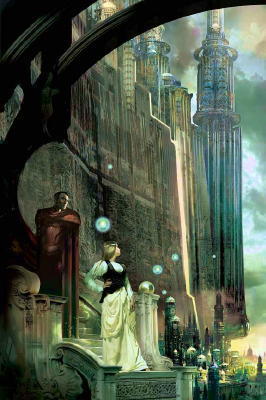
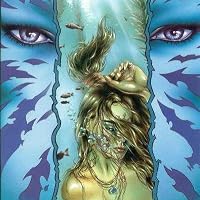
I haven't read this book but I wanted to ask a question about it because I do want to read it but is there a reason the cover is a piece from the cover of Elantris by Brandon Sanderson?
From the introduction by Sharyn November: "Lifelode is what one might call domestic fantasy, set in a quiet farming community—but it's also about politics, God and religion, sexual mores, the make-up of a family, and how people change over time. There is magic, humor, and lots of good food."
Jo Walton herself describes this book as "like a big messy pile of knitting."
It's about a small pastoral village called Applekirk, domestic life, and family relationships. It's about lovers and raising children and running a household and cooking food. There are also gods and magic and trial by fire.
Ultimately it's a strange beast, and one that I will need to sit on and think about for a while. I wasn't sure I liked it at first, but having read it, I am thinking about it more and more. It's starting to grow on me, like yeast rises.
I bought this book on sale for my Kindle about a year ago. My only other experience with Walton was her Hugo and Nebula winning book Among Others, which was one of my favorite reads of 2018 (It was published in 2012). I had wanted to read more of Walton because she is different, very different than a lot of the big names of fantasy.
This book is quite different than Among Others. It takes place in an unknown world, which has some very unique qualities. In the East, magic is very strong and time is very slow. In the West, magic is very weak and time moves quickly. This story takes place in a village in the middle called Applekirk. Magic in this world is mysterious and never fully explained. The story focuses on an extended family consisting of 4 adults and 5 children. Sexual and marriage mores are very different than in our world. The technology is reminiscent of the early Enlightenment era.
The title is this world's term for one's purpose in life.
This book is quite short. The Kindle version I read was only 173 pages, but it's amazing how much depth and plot and characterization Walton fits into such a small space. I grew to know and care for many of the characters, and was sad when the book ended.
This book is primarily about family. What does it mean to be family? What ties bind us to one another? What is the nature of love when our lover is married to someone else? Or a beloved child was birthed by someone else?
This book is also about time, and the gods (which are physical people in this world), and about responsibility for actions we take. The theme of time is reflected in the way this book is told. Everything is told in present tense, even memories of past events. There is a framing story of three characters fishing, which confused me at first, but once I got a handle on it, the writing became much clearer. I would not call this a difficult read, but it did challenge me at times.
If I had to compare Walton to a more famous writer, it would be NK Jemisin. There is a similar headiness and a similar way of phrasing. But ultimately, this is a poor comparison. Walton is a creature all of her own.
If you are looking for a different kind of fantasy, I highly recommend this.
Having finished this book, it remains a curiosity to me because it contains several elements I normally can't tolerate, and yet the book had me hooked start to finish. First of all, the perspective and tense of the story are unusual. The main character, Taveth, looks upon people and sees shadows of them from the past and future, and the book follows that same flow in time and between character perspectives. It's something that normally would leave me very confused, but Walton made it work.
My other big turn-off in fiction is love triangles. I just don't like that kind of drama. Here, that entanglement is even more complicated due to the poly relationships... but it also comes about largely because of the manipulation of a cruel goddess. I think it was all more tolerable to me because I increasingly looked at the goings-on in Applekirk as a kind of anthropological study, like something by Ursula K. le Guin. This is not a standard high fantasy world--in fact, Walton points at the back that she really writes science fiction, as a singularity plays a big role here. Poly families are common, but women have far more rights and say than in our world. Fashion is different, as breasts are often bared and priests typically are naked. Then there's that singularity--time and magic (yeya) flow different in this world, depending on how far east or west a person is.
Really, this isn't a book about high stakes or action, though there is drama and fighting as the end nears. Most of all, it's about a unique culture and people. If you love nitty-gritty world-building, this book might be perfect for you. I think Walton is one of the few writers I know who could have pulled off the complicated nature of this book.
I'd wanted to read this novel for so long. It sounded just up my alley but there was no ebook, and it was obviously out of print. So I jumped at the chance once it finally had its e-release, and spent a week savouring the experience.
This is a cozy fantasy and a polyamorous story about negotiating boundaries and relationships, and also a story about grief, loss and parenthood. It does a nifty thing with tenses that took me a few chapters to get used to, and there is this thing in it that a central character sees future and past shadows of people and I found that haunting and poignant in the extreme, and it almost made me cry when I was reading in bed late at night.
Walton is both consistent in her themes and reflections and always, always surprising. I find it difficult to put into words what it is about her writing that I dig so much - an interest in the inner life that's as intense as (or more than) the plot? The way she writes love of work, love of place, love of life, passion? I'm not sure, but there's just something about it. Her characters often feel real in a way that few other writers' creations do. I feel empathy for them much more than in most literary works I read.
Lifelode, with its history of publication, feels like a labour of love, and that's great, though it also feels a little unfinished - like it could have been continued, or like the frame doesn't get as much space as it might have needed.
This was such a fascinating book. It is very different from the other books I have read by Jo Walton and I greatly admire her versatility. I enjoyed the structure and narration of this book and how it moved back and forth to weave its story. It is hard to say much about this book without spoiling the story, but I will say that I loved the family it was portraying and the focus on the different relationships and how they change over time. That Walton managed to effortlessly include queer–and especially polyam and asexual–representation in this was an additional delight. I will be thinking about this book - and especially about Taveth, who was the most interesting character in my opinion - for a while and I already look forward to eventually re-reading it.
Lifelode is a hard book to review. It would also be hard to give a synopsis that is not complete nonsense as well, based on the way it is written. I suppose regaling you with how it is written is the best way to begin, given the fact that this will most likely be a "make it or break it" sort of technique for any given reader. I will use an analogy...bear with me.
Picture a wall of pictures. The pictures tell a complete story, and if they were fashioned in linear order, you would be able to see this comprehensive story unfold just as any child "reads" a book made entirely of pictures. Now imagine that some creative genius(?) has scrambled all of the pictures up. The complete story is still there, but everything is happening all at once.
This is sort of what is being attempted with Lifelode.
*Let me stop here to say I am not just making this crap up; in the FAQ at the end of the novel, Walton owns up to writing this with the idea that everything is happening at the same time.*
At any rate, this type of artistic sensibility, while being appreciated, would work better in another medium - such as the picture wall envisioned above. What hinders the performance of this type of everything-happens-at-the-same-time sort of book is that a book is not an everything-happens-at-the-same-time sort of medium. A reader picks it up and expects some sort of plot running left to right (or right to left, depending on which country you live in).
Walton ran into this problem as the story went on - the reader gets the sense of what she is trying to accomplish, but the complete effect would require having the book uploaded directly to the brain. She used tenses throughout that attempted to convey everything was happening at the same time. Even further, Taveth,the main character, is a woman who can see the selves of others throughout time - i.e., she will look at a 14 year-old and see both the baby he was and the man he will become. This adds to the idea that everything is happening at once, but in the end there is still a story, and it still moves in a mostly linear fashion. The novel is sort of a slave to linear time, just one that jumps around quite a bit more than the usual.
Actually, it is only after you finish the book that it accomplishes its goal - you can remember in retrospect the entire story as fluid pictures in your mind.
But that is enough of examining the structure of the book. If you find novels that flit about to be exasperating, you can pretty much stop reading this review now and move on to another book.
If you are still reading at this point, congratulations!
The actual plot in Lifelode is really quite good. It is based in a world where the gods live in the East with a concentration of yeya (magic), and where time moves faster and yeya depletes as you move west. In the center of this land is Applekirk, the ideal pastoral farm town. The novel has much of the daily life of Applekirk, including some wonderful descriptions of mouth-watering foods. Enter Jankin, scholar from the west and Hanethe, who left Applekirk as a teen to go east and who now returns as a great-grandmother years later with a secret.
That is actually all I can tell you about the actual plot without giving anything away...If I have to leave you with one sentence to describe this book it is this:
A giddy pastoral with lots of good food and odd descriptions of time.
The farther you go east, the more magic and freedom you have, until at last you are not even yourself. The farther you go west, the less magic and freedom you have, until you are practically a statue going through motions. Between these extremes lie the Marches, where folk can live much as we do in our world, and within the Marches is Applekirk, a sleepy little town. This is the story of one summer in the lives of the family that lives in Applekirk Manor.
It's a homey story, told mostly through the housekeeper. From her perspective, the details of a magical trial by ordeal are obscured by the necessity of comforting a baby, and a siege is mostly about making sure there are enough beds and food for everyone. By which I mean, a lot of exciting things happen, and I as a reader was certainly engrossed in them, but we see them through very distinct eyes in a way that never lets us forget the way epic moments are not so epic for everyone, and that there is mundane work underpinning every great deed.
I really liked the details of this book. They tell us so much about how the world works, without ever actually stopping the story to explain. Just knowing that the housekeeper husbands her pepper wisely, and that visitors from the east find her food overspiced and from the west, bland, is so informative. Or the way time has passed for Hanethe, who has traveled, is an excellent way of explaining the time dilation that occurs with magic. This time dilation effect is one of the coolest and weirdest parts of the story, for me. The other is how the gods work, . Perhaps because of this weirdness of time, perhaps because certain magical folk can see multiple time points simultaneously, or perhaps to mirror other stories about family houses, the tale is told in the present tense, even things that happened in the past or the future, which gives the feeling that everything is happening at the same time. It took getting used to--the first 20 to 30 pages were quite strange to me--but after that I liked it.
I liked the way we see a little different view of each character depending upon who's seeing them: stolid Taveth and her family see Gislain as soppy, romantic Chayra sees her as equally romantic, and academic Jankin sees her ecstatic piety. And she's just a minor character who only gets a few lines! Walton describes the feudal ties that bind up society in a wonderful way; it's so rare to read fantasy that feels like it gets that system of shared obligations and tradition right. And I love her family set up, where marriage is a contract but not one that requires or precludes love. The family living in Applekirk Manor is made up of four adults in love with each other and their children. The events in Lifelode test their relationships in very natural ways; I liked that their arrangement was so ordinary and relatable. Characters are asexual, bisexual, poly, monogamous, all very casually and matter of factly. It's equally casually absent a lot of -isms, to the extent that even I was surprised. Here's an example of what I mean:
I'm used to female warriors in fantasy novels, but they are pretty much always presented as special, an exception. It kinda shocked me to read an unnamed soldier being a woman as though that was just as unexceptional as anything. Characters are a variety of colors and shapes, but it has no more import than someone having long fingers and another short--it's just aesthetic preferences. I loved it! This kind of thoughtful reimagining of how societies can work is exactly the kind of worldbuilding I like best, far more than someone explaining to me how the FTL drives work.
So, in all: I am so impressed and pleased that this book tries to tell a small scale story (even though big scale things happen), I thought the style was pleasingly unconventional, and I liked the way it was all woven together.
This is a book from one of my very favourite authors, that I NEVER thought I'd get to read. And then boom: ebook edition in the UK! A present for me!
And it is just as good as I was hoping. This is a very timely story (even though it was written a while ago now!) about making a place in the world, what counts as "important", balancing feelings and politics even when those are not easily separable, how our natural fears and anxieties can turn poisonous, and the meaning of family and love. It does a lot of things: it's fundamentally domestic in one way, universe-spanning in another.
There are a whole lot of very cool world-building things (I maybe shrieked "VERNOR VINGE!" at one reveal, in a good way) but they work because the people in the story live in this world. I love that. I also love that Jo Walton is committed to making sure her stories include women, kids, disabled people, queer people, and people who aren't Really Really Really Ridiculously Good Looking, all of them solidly real and believable. If I was going to summarise it, I might mangle a line from Lord of the Rings and say "where there's life there's hope... and need of vittles". These are people who need to sleep, and eat. It's a story that knows how important those things are.
It also does some things with tenses that I MASSIVELY nerded out about: you definitely don't need to care about this to love the story, but I do feel the need to report that I AM that person, and it made me very happy. The use of tense is both plot relevant and character relevant in a way I've never seen done by anyone! It's SO GOOD! While also being basically invisible if you aren't into that sort of thing! I properly had to have a little run around my house for a moment when I realised what Jo Walton had done.
I was already very much on board the "buy what Jo Walton writes, immediately" train, here, but if I hadn't been, this book would have done it.
What an odd, interesting book. Time is such a fluid, unpredictable thing in this story, cutting and turning at all angles. I don't mind that sort of thing; the odder the better is my style. However I can see that turning into a decent sized barrier to many. Oh the whole, the characters, the whole family focused, slice of life angle of the story was just what I was after. I especially loved the focus on food.
Before I comment further, I have to note that I've known Jo for years, and am always delighted when I get to spend time with her. That said, what I love about her work is very much what I love about her: a willingness to go wholeheartedly into exploring a particular facet of story and the world, in a way that provides new understanding and awareness of our own.
_LifeLode_ is a fantasy novel, set in a world where geography has a strong effect not only on time, but on how the world works. As you move East, the possibility of yeya (magic) becomes stronger and stronger, until you are become a god (the process is a little more complicated than that, as the book discusses). As you move west, yeya becomes less and less possible, and people also have less and less free will. Likewise, time flow changes as you travel: a day in Applekirk might be weeks further west. This makes travel particularly interesting.
_Lifelode_ is set in a village, Applekirk, which is far enough east that yeya is a part of daily practical life - small charms to keep away danger, to keep food fresh, to make it easy to carry hot dishes - are all commonplace. But it is not so far East that one generally has to worry overmuch about the Gods being active and present. (Though of course, one has their priests around, as any good community does.)
What I love about Jo's work is her ability to create a clearly functioning and real society, and yet demonstrate how it works in quiet ways. (She's the one who coined the term incluing, the art of dropping this kind of information in so that it feels natural and obvious.) This book is a particularly good example of the art: what we learn about family structures, how people interact with the Gods, how they approach yeya, are all tucked into little phrases and moments, without ever dumping it on your head.
The term lifelode itself is a good example: a lifelode is someone's true work in the world, the thing that they can do really well, that also in some way, fills a need in the world. One of the main characters, Taveth, has the lifelode of housekeeping: while a middle-aged, mother of young-adult children is not the conventional fantasy heroine by a long-shot, this works brillantly in this context.
There is a plot, and exciting things do happen, and the world is changed as a result, but those, I leave to the reader.
I was a history major in college, and my favorite classes were always those that dealt with social history: how people lived, rather than wars and borders and treaties. This book seems as if it comes directly from those classes. It's a novel that inhabits a place and time fully, taking note of the disruptions that become what we commonly term history.
I loved the author's comprehensive and confident vision of her creation, from the culture to the religion to the food. I loved the domestic quality of the book and the earthy comforts of Applekirk: food and sex and work and family. I loved Taveth and her self-awareness and her comfort in her own skin and in her place in life.
While I wasn't entirely comfortable with the shifty present tense and perspective, both did make sense. I also resented the gradual shift in focus from Taveth to Hanethe, though it was probably necessary). Those seem like petty complaints against an overall lovely book.
There's something about Walton's books that just doesn't--quite--work for me. Her characters are human, her ideas are interesting, her prose enjoyable . . . and yet. We have a different notion, I think, about what the shape of a satisfying story is, and so at the end I'm always left with an uncomfortable sense that I've been jerked off the trail I'm following into an uncharted bit of wilderness with no clear idea of how I got there.
So: there's a lot to like here, as a quiet pastoral description of country manor life, and then the climax happens and I headtilt in confusion. The notes at the end talk about how Walton wanted to write a truly domestic fantasy and only reluctantly got sidetracked into a tale of gods and great doings. I wish she'd stuck with the original plan.
I was wondering what one of my favourite authors was up to – so got a bit of a shock when I saw this offering had appeared when I wasn’t looking… Researching this one a bit more, it appears that this book won the Mythopoeic Fantasy Award for Adult Literature (2010) when it was published by a small press. And earlier this year, Walton self-published it so her fans could have the ebook available – yay! It’s an interesting premise. This is a flat-world where the further East you travel, the more magic there is, while the further West you go, the less there is. Applekirk appears to be situated about midway between the two extremes, so some of the family members who live in the manor are reasonably well endowed with yeya. Others, not so much. And reading this one, if I had the choice, I wouldn’t want to be one of those who were overly talented.
The manor is generally reasonably peaceful, where an agrarian lifestyle revolves around the harvests. Initially the main protagonist is Taveth, who is married to Ranal, but mistress to Ferrand, the current lord of the manor. Taveth sees people at various stages of their lives whenever she looks at them and is in charge of running the house, while the official Mistress of the Manor is a potter. Their contentment is abruptly shattered when two visitors appear – one is a travelling scholar, Jankin, a beautiful young man with an eye for the ladies and the other one is a long-lost relative – Ferrand’s great-grandmother who reappears from the East very suddenly and rather mysteriously…
Walton’s storytelling, as ever, packs a punch. Events take a much darker turn, as it turns out that spiky, sneering Hanethe hasn’t returned to Applekirk simply to make everyone’s life a misery – she’s on the run from a very, very powerful enemy. This one gripped me and held me far too late into the night, as Walton’s writing always does. And as usual with Walton’s writing, now it’s finished, I can’t get it out of my head. The nature of belief… how people can do a lot of damage by simply being careless… and being thoroughly obnoxious to those around you doesn’t necessarily make you a bad person… And that nothing hurts quite so much as lost love…
Once more – a tour de force. Walton is a towering talent, whose books make me glad I can read and provide me with lots of mental fodder, before I get the pleasure of reading her next offering. I don’t know what it will be – but I can guarantee that it will be nothing like this particular book. Needless to say – very highly recommended. 10/10
Another strong book by Jo Walton, probably 4 1/2 stars. The book is written entirely in present tense, but is bookended by two scenes of the characters far after the main action of the book, talking about how to write all the happenings down and where to begin. Where to begin is indeed a good question when everything is present tense. One of the main characters has the ability to see other people's "ghosts" at different points in their lives, which gives her an insight into how people are feeling, but also cuts her loose in time a bit.
I think it's kind of impossible to explain everything about the book, so I won't really try. Plot-wise, it's about what happens when a powerful mage comes home to a lower-magic medieval setting. She is fleeing from her community, but it's not going to be that easy- they want her back.
We also get a lot of interpersonal dynamics. There are two main couples in the book, each of which are married to one person but the "sweetmate" of a different person's spouse. It's sort of a four way marriage, and no one thinks too much of it. Faithfulness is defined as being polite enough to tell your loved ones that you're interested in someone else. It's generally pretty laid back, but there are still some issues with jealousy and exclusion. And it's interesting to read about and think about.
It's an interesting world, with characters described with empathy. It made me feel cozy to read it.
The thing about this book is, it's very good company; the people in it are properly knotty and I care about them very much. And I care about the central family, especially, and then I like the way all the other people in the narrative come in and mess about with their really very solid and steady center. There is also a more conventional plot which holds my interest, and subplots which hold my interest, and the world building is really excellent in a lot of ways.
And I just got to listen to the audiobook for the first time, and I love it, and I will listen to it more, and in talking about that I realized this is my *fourth time* reading this book and I still want to reread it, possibly every third year or something, and well. Clearly I hadn't updated this review in ages and it needed to be redone, in order to properly communicate just how very fond of this book I am.
CN: war-like violence (a siege, there are deaths), coercive control and resisting it
Roman de fantasy mais aussi roman de vie, Jo Walton nous propose ici une jolie fresque familiale dans laquelle la magie du coeur a tout autant d’importance, si ce n’est plus, que celle des Dieux. Entre les bouleversements liés à deux personnages qui font le pont entre présent et passé, le quotidien d’une famille ordinaire aux liens extraordinaires, et un monde original qui remet en question notre conception du temps, de l’amour et de la famille, ce roman vous promet un très beau et intense moment de lecture.
Great book. Most people I know would HATE it because of the non-linear time and such, but it was great.
One of the only times I've noted an author commenting on the great cover art -- though if you look st Stefan Martiniere's full painting, it does not fit AT ALL.
When you have to wait such a long time to read a book you REALLY want to read, you run the risk of getting disappointed after all. This wasn't the case. A fantastic reading. Jo Walton mixes time, magic and feelings like the masterful juggler she is. And her characters are interesting and lovable as ever. I'd like to thank the author for making the e-book available. A great present to all her readers in these difficult times.
If you’re a Twitter friend, you may remember when I started Lifelode, because I got all excited over the fact that it’s basically China Court by Rumer Godden in a magical world. And since China Court is one of my heart books and Jo Walton perfectly caught the weird loveliness of her present tense everything happening at once style, I expected to adore this one.
And I liked it a lot. Like I said, Walton really caught the style perfectly, and the sense of both the home-liness and the turn of wider events that China Court has. I love domestic books, and I loved Taveth almost instantly. And I liked the sense of family dynamic and the complicated way it unfolds in the world of the book.
Where I got hung up is actually something surprising for me: pacing. For the first three quarters of the book, we have this lovely slow paced story, with lots of attention to details of everyday life and if that’s your thing, ignore what I’m about to say and go read it, because while I was reading I was living in Applekirk. But then at the end larger events come into the picture and lots of Things, Spoilerish Things, happen all at once, and then the story ends.
We’ve gotten hints of what’s happened since then throughout the book, thanks to the structure, and there is a bit at the end that helps to wind everything up. But I’m not quite talking about that, more about the fact that there didn’t seem to be any space in the moment for me to react what was happening, to feel anything. (Versus the big finale of Among Others where I will get choked up if I see one paragraph out of context.)
Again, that’s a personal thing, and yet I think there is something there that’s a little less finished than the rest of the book. As I said, though, if lovely descriptions of everyday life in a world not our own makes you go, “Ooooo,” read this one.