

What do you think?
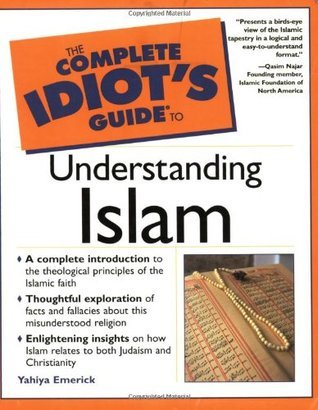
The Complete Idiot's Guide to Understanding Islam
Islam may be the most misunderstood faith in history. Most of us learn little or nothing about Islam in school; in fact, our knowledge of Muslims may be restricted to news reports on the Middle East and Louis Farrakhan. Surprise--the vast majority of Muslims aren't Arabs, the Muslim Allah is very much the "one God" Christians and Jews believe in, many of the scientific and medical innovations we take for granted were passed on by Muslims, and the popular myths about Muslims often have little to do with the real beliefs of Islam. The Complete Idiot's Guide(R) to Understanding Islam reveals fascinating facts about Islam; they accept both the Old and New Testaments as holy books and accept Moses and Jesus as prophets. The book offers tips on Muslim culture, actual quotes from the Qur'an, the Prophet Muhammad, and prominent scholars, and answers to questions regarding everyday life from the Muslim perspective.
416 pages, Paperback
First published October 1, 2001
About the author
Yahiya Emerick
94 books45 followersYahiya Emerick has been a prolific author and has written many articles that have been published in local as well as national magazines, both in North America and abroad. Amirah Publishing was founded by Yahiya Emerick in 1992 in order to further his ideal of publishing American-oriented literature on Islam. Much to his chagrin, Brother Yahiya found that many traditional Muslims were quite content with the old, outdated books imported from overseas and could not conceive of the need for literature specifically designed for the North American environment.
After having written two books, which received wide acclaim in local Muslim circles, Brother Yahiya looked in vain for a publisher willing to work with him in this vision. After many promises and vague arrangements, he decided to form his own company and work for Allah as best he knew how. Today, with the addition of Reshma Baig, Qasim Najar and Samina Baig to the team, Amirah Publishing is enjoying rapid growth and recognition among Muslims as a source for original, as well as improved literature, for use in a strictly American environment.
(courtesy islamfortiday.com)
After having written two books, which received wide acclaim in local Muslim circles, Brother Yahiya looked in vain for a publisher willing to work with him in this vision. After many promises and vague arrangements, he decided to form his own company and work for Allah as best he knew how. Today, with the addition of Reshma Baig, Qasim Najar and Samina Baig to the team, Amirah Publishing is enjoying rapid growth and recognition among Muslims as a source for original, as well as improved literature, for use in a strictly American environment.
(courtesy islamfortiday.com)
Ratings & Reviews
Friends & Following
Create a free account to discover what your friends think of this book!
Community Reviews
Displaying 1 - 30 of 43 reviews

February 16, 2011
I found this in a box of books that my wife's friend gave her during a recent visit to San Antonio. Though obviously biased and simplistic, it's a pretty decent overview of Islam that I can use with my children to dispel misconceptions they pick up from the media and school.

March 30, 2015
Hmmm...where to start? This book was recommended to me when I requested a very fact-based, objective look at Islam. In some ways, this is a good overview of Islam--historical information, basic tenets of the faith, etc. However, the book is bogged down with generalizations, some misinformation and a lot of very disturbing apologies for some of the very disturbing things done in the name of Islam.
I don't necessarily think Islam is worse than other religions (some aspects yes, others no) but Emerick's attempts at Islamic apologetics are worse than a lot of others'. He asserts that crime is nearly non existent in societies that have implemented Islamic law. This is somewhat undermined by the fact that Saudi Arabia keeps executing people. He explains how he totally doesn't agree with the Taliban but here's how the Taliban has been misunderstood and those statues they blew up were totally not even important because there haven't been any Buddhists in Afghanistan for like EVER so it's still totally in keeping with the great respect that Islam has for other religions to get rid of them because no one was really using them.
Using that logic, we should all be cool with it if someone blows up the Acropolis--it's not like anyone still worships Athena!
I was frequently annoyed with the author for putting in "facts" that are more like opinion--sometimes he actually put these under the "Just the Facts" sidebars so that's extra baffling. He'll assert something as fact with no citation (or with a sly "some scholars say..." Who?!) or insert a quote under "just the facts" when it is simply a quote that expresses an opinion. He will list false facts like "Mohammed sent letters to all the heads of state of his day and museums retain those copies" (not actually something historical scholars believe) or that evolution can't account for human traits like compassion (actually, it can and does. There are actual articles about this using science!)
Other times he takes what I assume is his own experience and declares it to be universal. I was very confused when he explained how western history classes depict the heroic capture of Palestine by medieval crusaders. Really? Because I went to Catholic school and was taught that the crusades were misguided and a complete failure.
It's not just on controversial issues he assumes an incorrect universal experience. He tells us that the two feasts/holidays in Islam are fast breaking post-Ramadan and the feast following he annual pilgrimage, with the post-Ramadan feast being the much bigger deal. I assume this is the case where he lives and practices. But guess what? In Morocco, the post Ramadan feast is called "small feast" and the post pilgrimage one is called "big feast." Guess which is a bigger deal? It's not a huge mistake but I wonder how many others there were that I didn't catch. Makes me distrust the author and assume he's been sloppy with his research.
But it's his comments about women that really made me wince.
Did you know that "most Muslim women live oppression free lives"? Our author asserts nothing less. Where can I sign up to live this oppression free life?
But perhaps I can't expect too much from a man whose knowledge of women's issues doesn't extend to knowing that it's Elizabeth Cady Stanton, not "Cady Stanton" (did this book have an editor? I decided "no" when I then read about something "hearkening back" to earlier times).
While I'm nitpicking with "Cady Stanton," the author's dismal view of women's issues within Islam is a larger problem. This is perhaps best expressed when he kindly explains that while it didn't turn out great and most everyone Muslim condemned them, the Taliban's policies around women were just an honest attempt to deal with a high unemployment rate!
Sexist practices are mansplained away with explanations avoiding any real reflection. Women HAVE to stand behind men in the mosque. Otherwise their lovely lady lumps could distract men from prayer (but women are incapable of being distracted by looking at men's bootyliciousness). Banning women when they are menstruating isn't because they are unclean--they are just ritually unclean! See? Totally different!
And Islamic women cover their hair because it is required by Islam to protect them from men's lustful gaze. It's for their protection, DUH! Yet I know there are lots of Muslims and even Islamic scholars who will argue that covering one's hair is NOT required. But the author presents it as a completely non-controversial fact. IT's just "What Islam Says." Same with abortion--it's against Islam. End of story, right? Well, it's a bit more complicated than that. In fact (an actual fact, not a "fact" like those presented this book), the King of Morocco recently tasked religious scholars with finding some ways for Morocco to liberalize their abortion laws while staying within the confines of Islam. So Islam and women--maybe not the author's strong suit.
Finally, I find it completely bizarre that though the edition I read was published in 2002, the only mention of Osama bin Laden is as the mastermind of attacks on some U.S. embassies. Why would you publish an American book, for American audiences, in 2002 that failed to acknowledge the 2001 occurrence of the most significant crime ever committed against Americans in the name of Islam?
Most of the problems I've listed above aren't a problem for those reading this book with a critical eye. But the book is, by its own admission, targeted towards complete idiots. So for an objective, fact based overview of Islam, keep looking.
I don't necessarily think Islam is worse than other religions (some aspects yes, others no) but Emerick's attempts at Islamic apologetics are worse than a lot of others'. He asserts that crime is nearly non existent in societies that have implemented Islamic law. This is somewhat undermined by the fact that Saudi Arabia keeps executing people. He explains how he totally doesn't agree with the Taliban but here's how the Taliban has been misunderstood and those statues they blew up were totally not even important because there haven't been any Buddhists in Afghanistan for like EVER so it's still totally in keeping with the great respect that Islam has for other religions to get rid of them because no one was really using them.
Using that logic, we should all be cool with it if someone blows up the Acropolis--it's not like anyone still worships Athena!
I was frequently annoyed with the author for putting in "facts" that are more like opinion--sometimes he actually put these under the "Just the Facts" sidebars so that's extra baffling. He'll assert something as fact with no citation (or with a sly "some scholars say..." Who?!) or insert a quote under "just the facts" when it is simply a quote that expresses an opinion. He will list false facts like "Mohammed sent letters to all the heads of state of his day and museums retain those copies" (not actually something historical scholars believe) or that evolution can't account for human traits like compassion (actually, it can and does. There are actual articles about this using science!)
Other times he takes what I assume is his own experience and declares it to be universal. I was very confused when he explained how western history classes depict the heroic capture of Palestine by medieval crusaders. Really? Because I went to Catholic school and was taught that the crusades were misguided and a complete failure.
It's not just on controversial issues he assumes an incorrect universal experience. He tells us that the two feasts/holidays in Islam are fast breaking post-Ramadan and the feast following he annual pilgrimage, with the post-Ramadan feast being the much bigger deal. I assume this is the case where he lives and practices. But guess what? In Morocco, the post Ramadan feast is called "small feast" and the post pilgrimage one is called "big feast." Guess which is a bigger deal? It's not a huge mistake but I wonder how many others there were that I didn't catch. Makes me distrust the author and assume he's been sloppy with his research.
But it's his comments about women that really made me wince.
Did you know that "most Muslim women live oppression free lives"? Our author asserts nothing less. Where can I sign up to live this oppression free life?
But perhaps I can't expect too much from a man whose knowledge of women's issues doesn't extend to knowing that it's Elizabeth Cady Stanton, not "Cady Stanton" (did this book have an editor? I decided "no" when I then read about something "hearkening back" to earlier times).
While I'm nitpicking with "Cady Stanton," the author's dismal view of women's issues within Islam is a larger problem. This is perhaps best expressed when he kindly explains that while it didn't turn out great and most everyone Muslim condemned them, the Taliban's policies around women were just an honest attempt to deal with a high unemployment rate!
Sexist practices are mansplained away with explanations avoiding any real reflection. Women HAVE to stand behind men in the mosque. Otherwise their lovely lady lumps could distract men from prayer (but women are incapable of being distracted by looking at men's bootyliciousness). Banning women when they are menstruating isn't because they are unclean--they are just ritually unclean! See? Totally different!
And Islamic women cover their hair because it is required by Islam to protect them from men's lustful gaze. It's for their protection, DUH! Yet I know there are lots of Muslims and even Islamic scholars who will argue that covering one's hair is NOT required. But the author presents it as a completely non-controversial fact. IT's just "What Islam Says." Same with abortion--it's against Islam. End of story, right? Well, it's a bit more complicated than that. In fact (an actual fact, not a "fact" like those presented this book), the King of Morocco recently tasked religious scholars with finding some ways for Morocco to liberalize their abortion laws while staying within the confines of Islam. So Islam and women--maybe not the author's strong suit.
Finally, I find it completely bizarre that though the edition I read was published in 2002, the only mention of Osama bin Laden is as the mastermind of attacks on some U.S. embassies. Why would you publish an American book, for American audiences, in 2002 that failed to acknowledge the 2001 occurrence of the most significant crime ever committed against Americans in the name of Islam?
Most of the problems I've listed above aren't a problem for those reading this book with a critical eye. But the book is, by its own admission, targeted towards complete idiots. So for an objective, fact based overview of Islam, keep looking.
May 6, 2009
I understand more about Islam than before. But I had trouble with the author. He seemed to be always defending Islam. For example he says the Taliban had a religious right for demolishing the ancient Buddha statues in Afghanistan because there are no Buddhists in Afghanistan anymore, and the Quran teaches to destroy idols. Also Westerners have attacked Islamic culture through imperialism and have destroyed many Islamic things. Also women are honored by all the rules. They have to wear veils and Burquas to protect themselves from male lusts. Reminds me of the Victorian notion that women are "angels" and men are "animals"--Both do harm to either gender.
The rabbi in the Judaism book had more fun explaining his religion.
The rabbi in the Judaism book had more fun explaining his religion.

December 28, 2012
Very educational read on the fundamental (not fundamentalist) beliefs of Islam.

January 7, 2013
I have a weakness for the Complete Idiot's Guides. This one was a great starting point. It especially helps with knowing what to read about next. If you know nothing about Islam, start here.
April 9, 2011
Very good book to learn the basics of Islam. I have given it to several people.
January 21, 2017
I'm actually reading this book right now. I'd reached a place in my life as a Christian that I started questioning Christianity a lot and even started doubting if God existed. Then I started researching Islam and I came across this book. There's a free pdf version in Google search. I admit, i was just like some of the people in the comments, didn't really know anything about Islam except stereotypes and things I'd been told by Christians. This book really opened my third eye. A lot of questions I'd already started asking myself were answered in this book, such as why in Christianity if God is omnipotent do Christians assign God a gender? That's just one example. The book is supposed to be easy to read and comprehend and it is. Like someone stated, the reason the author defends Islam in the book is to drive home a point about common misconceptions of Islam, not to say that people of Islam are perfect, no one is, but that to say that due to misinterpretation of the Qu'ran, just like the Bible, people have done outlandish things in the name of Islam. Before I started reading this book, I had to desire to learn further about Islam, Judaism, OR Christianity, and I considered myself a Christian. That's one of the great things this book has taught me about Islam, is that unlike Christianity, Muslims are tolerant of other people's beliefs, Muslims believe people of all races and creeds can be Muslims, and Islam is a religion of peace. I love this book and it is helping me tremendously on my journey of conversion to Islam. As salaam alaikum!
March 23, 2016
This is a very good book for a basic introduction to Islam. Although it has some minor aqeedah related issues, I would still recommend this to any Muslim or non-Muslim. It covers a wide range of topics including the Prophet's life, sciences of the Quran, prophets of the past, Islam's relation with the other Abrahamic faiths, predestination, heaven/hell, God, history of the Islamic civilization and how it shaped the modern world etc.

July 11, 2008
A good basic overview, but the book is badly contaminated with what is the author's position and beliefs. I felt that I had to take everything he said with a grain of salt. I wouldn't really recommend the book, there has to be a better one out there.

October 8, 2014
With the possible exception of practicing Muslims, everyone in America should read this book about the Islamic faith. As with all the Idiot Guides, the author assumes that you seriously considering practicing the faith either because you are about to marry into it or because previous generations in your family were practicing members of the religion.
The guides tell you what to expect when you go the Mosque and how the religion is practiced in America. The books are updated every five or six years in order to stay current. This book will tell you how to pray, what the five pillars of Islam are, what is in the Koran, what is a sura, what is the difference between Shia and Sunni Islam is, and the party line is on issues of public controversy.
This book is in no way theological. It is a "how to" guide. Hence it is of great value to anyone who has Muslim friends. It explains what they believe in and how they practice their faith.
Be a good neighbour and read this book. You will understand the family across the street, your dentist, your plumber and your son's girlfriend much better if you do.
The guides tell you what to expect when you go the Mosque and how the religion is practiced in America. The books are updated every five or six years in order to stay current. This book will tell you how to pray, what the five pillars of Islam are, what is in the Koran, what is a sura, what is the difference between Shia and Sunni Islam is, and the party line is on issues of public controversy.
This book is in no way theological. It is a "how to" guide. Hence it is of great value to anyone who has Muslim friends. It explains what they believe in and how they practice their faith.
Be a good neighbour and read this book. You will understand the family across the street, your dentist, your plumber and your son's girlfriend much better if you do.

September 8, 2015
These series books are hit and miss, depending on the author's ability, focus, etc. This one was beautifully written and done (whereas the Christianity one was almost unreadable). Only quibbles - some historical inaccuracy (as to be expected when using religious texts for history), and definitely slanted toward the experience of Islam in Western countries, where it is not necessarily woven into the culture, and sometimes lacking cultural context.
That said, great read that covered a lot of the info that one would be looking for in this kind of a book. Nicely done.
That said, great read that covered a lot of the info that one would be looking for in this kind of a book. Nicely done.
July 15, 2014
Excellent book.. Debunks allot of the misconceptions and lies about Islam .
Judging by some of the comments, many people did not want to learn about Islam but would rather stick they own belief of what Islam is , thats why the author had to defend the religion so much while explaining it, because people don't like the fact that Islam is the truth, so many people attack Islam and lie about it intentionally whilst being ignorant or not .
Judging by some of the comments, many people did not want to learn about Islam but would rather stick they own belief of what Islam is , thats why the author had to defend the religion so much while explaining it, because people don't like the fact that Islam is the truth, so many people attack Islam and lie about it intentionally whilst being ignorant or not .
May 12, 2015
In response to other reviewers: Of course it's supposed to be simple. That's the point of this series. At the same time, the author was not patronizing. The defense of Islam was appropriately placed, given all of the horrible misconceptions provided in American media. The comparisons among the Abrahamic faiths we clarifying, not critical. Thanks to the author for a job well done!
May 25, 2010
This is a great book for those who are interested in the beliefs and expectations in Islam. This is the book I read to learn more about Islam. I loved it.

March 16, 2012
Too "rah, rah" for Islam, I'll re-read sometime in the future, maybe.
August 23, 2014
Informative to see the islamic viewpoint, but a bit myopic and surprisingly uncompromising. Too many simplifications to make it a serious book on a very complex topic.
January 25, 2015
Good place to start for an absolute novice I guess. But too biased for my tastes
February 14, 2020
This was an excellent and though-provoking read. The overall presentation is professional and the content is comprehensive.
This book is geared towards those unfamiliar to Islam, hence the title so some content was repetitive but not to worry, a refresher never hurts.
But a quirk I have is at the beginning, the author establishes the scene and status quo that the rest of the book will reference. It's written as if the rise of Islam is like some worldwide takeover. Now some paraphrasing here but it is still indicative of the text in the book:
Maybe someone in your class is one, or your neighbour is one, or your co-worker is one. Well, it appears that Muslims are everywhere". See what I mean. Well, the book is addressed to a secular American audience who have grown up without Islam, So I felt out of place. However, the writer uses the ubiquity of Islam to galvanise people to educate themselves about 1.7 billion Muslims who continue to impose a larger sphere of influence of global politics and stuff, so it all is behind good intentions
Also, the content arrangement was quite odd. In the beginning as mentioned the author addresses the controversial racial and political climate in the modern age which is fine but it is only on the 111th page that the author begins talking about the five pillars of faith. Other topics such as the story of creation, Judgement Day and views of God are preceded. Just felt a bit confused when I turned the page to see the five pillars, after a quarter of the book passed by. Also also, the different sects are introduced at the end, again odd.
But I digress, these are all nitpicks. This book was amazingly crafted with polish and respect. Don't expect to find any discussion on Islamic Law or anything but it is a solid foundation for gaining knowledge, such that I have myself have gained. I applaud the way he ... whats the word not " beats around the bush " but disregards the controversy and difference of opinions that some topics conspire because it is frivolous at times. The priority here is awareness and educating the masses. 5
5/5
This book is geared towards those unfamiliar to Islam, hence the title so some content was repetitive but not to worry, a refresher never hurts.
But a quirk I have is at the beginning, the author establishes the scene and status quo that the rest of the book will reference. It's written as if the rise of Islam is like some worldwide takeover. Now some paraphrasing here but it is still indicative of the text in the book:
Maybe someone in your class is one, or your neighbour is one, or your co-worker is one. Well, it appears that Muslims are everywhere". See what I mean. Well, the book is addressed to a secular American audience who have grown up without Islam, So I felt out of place. However, the writer uses the ubiquity of Islam to galvanise people to educate themselves about 1.7 billion Muslims who continue to impose a larger sphere of influence of global politics and stuff, so it all is behind good intentions
Also, the content arrangement was quite odd. In the beginning as mentioned the author addresses the controversial racial and political climate in the modern age which is fine but it is only on the 111th page that the author begins talking about the five pillars of faith. Other topics such as the story of creation, Judgement Day and views of God are preceded. Just felt a bit confused when I turned the page to see the five pillars, after a quarter of the book passed by. Also also, the different sects are introduced at the end, again odd.
But I digress, these are all nitpicks. This book was amazingly crafted with polish and respect. Don't expect to find any discussion on Islamic Law or anything but it is a solid foundation for gaining knowledge, such that I have myself have gained. I applaud the way he ... whats the word not " beats around the bush " but disregards the controversy and difference of opinions that some topics conspire because it is frivolous at times. The priority here is awareness and educating the masses. 5
5/5

July 22, 2024
This is a review of the second edition, which has a cover different to what is shown on Goodreads. My cover is the same as for the ebook version of this edition.
It's called The Complete Idiot's Guide to Understanding Islam. Well, I must not be a complete idiot, because I STILL don't understand Islam.
(Rimshot.)
I don't blame the author or publisher for this. They certainly tried their best, processing a massive amount of information into bite-sized chunks. There's a good glossary, plenty of white space so you don't feel intimidated, and little boxes of knowledge paired with goofy doodles and the occasional photograph.
But, as Commander Riker put it, "A chef is only as good as his ingredients."
Islam is like any other religion -- just another flavor of bullshit. I've no idea why anyone would believe this junk, especially women.
This is also basically a 400 page slick advertisement for Islam. Even at that length, it only scratches the surface. For example, if you're looking for Muslim views on animals, forget it. The whole Satanic Verses bugaboo is glossed over in half a page.
I just looked up "Salman Rushdie" in the index. He's listed in two places. However, he is not mentioned on the first page, 229. So, the index is unreliable.
My copy got water damaged. I was not trying to damage this, since it was expensive reference book. But, there was a leak in the basement and about 20 - 30 books got soaked. A couple were total losses. This one has been drying out for about 10 years. It's readable, but not saleable. I might throw it in the recycling bin, but I don't want my neighbors to think I'm Muslim.
It's called The Complete Idiot's Guide to Understanding Islam. Well, I must not be a complete idiot, because I STILL don't understand Islam.
(Rimshot.)
I don't blame the author or publisher for this. They certainly tried their best, processing a massive amount of information into bite-sized chunks. There's a good glossary, plenty of white space so you don't feel intimidated, and little boxes of knowledge paired with goofy doodles and the occasional photograph.
But, as Commander Riker put it, "A chef is only as good as his ingredients."
Islam is like any other religion -- just another flavor of bullshit. I've no idea why anyone would believe this junk, especially women.
This is also basically a 400 page slick advertisement for Islam. Even at that length, it only scratches the surface. For example, if you're looking for Muslim views on animals, forget it. The whole Satanic Verses bugaboo is glossed over in half a page.
I just looked up "Salman Rushdie" in the index. He's listed in two places. However, he is not mentioned on the first page, 229. So, the index is unreliable.
My copy got water damaged. I was not trying to damage this, since it was expensive reference book. But, there was a leak in the basement and about 20 - 30 books got soaked. A couple were total losses. This one has been drying out for about 10 years. It's readable, but not saleable. I might throw it in the recycling bin, but I don't want my neighbors to think I'm Muslim.

January 31, 2021
I picked up this book for an objective overview of Islam. It was a good overview but it was not objective. The author even disparages how different Muslim countries implement Islamic law. He often quotes Islam in relation to Christianity - but seems defensive. He claims Islam's Adam and Eve story as an improvement, since in Islam, it's not clear who ate the apple (not blaming woman), and he claims that Islam's definition of seven "days" is more flexible, thus more realistic than Christianity's creation in "seven days". He claims that Sharia law has been misconstrue in the media, and clarifies that cutting off hands is only for *multiple* thefts (and thus it's acceptable). He also claims that countries with actual Sharia law have less crime - does he not consider that it's simply less reported since the punishments are severe? Also, he claims all Muslim women must cover their heads. Obviously, there are millions of Muslim women all over the world who disagree with this, and he did not call often acknowledge this diversity in thought. Overall, I was looking for a book that I can give to Christians to better understand Islam. This author's tone is unnecessarily disrespectful toward any other religion and to Muslims using less-extreme interpretations of Muslim writings.

February 10, 2022
Convincing
As a Christian, I was surprised how much i was intrigued by all the knowledge I gathered from reading this, and I crave to know more. The only downside I would say is that there are no footnotes, endnotes, works cited, or bibliography. There is only a list of recommended readings. My assumption from this is that it is written by someone who has lived it for a while and speaks from experience, not research.
As a Christian, I was surprised how much i was intrigued by all the knowledge I gathered from reading this, and I crave to know more. The only downside I would say is that there are no footnotes, endnotes, works cited, or bibliography. There is only a list of recommended readings. My assumption from this is that it is written by someone who has lived it for a while and speaks from experience, not research.
July 10, 2018
It's a good overview/introduction. I liked the "from the source" and "ask the Imam" bits spread around the book. I wish it would have talked more about the contents of the Qur'an and details about the beliefs, but I think it did a good job of giving a broad overview. The author wrote in an obviously biased way, but that is understandable.

January 7, 2020
I really enjoyed this book. The author included a little bit of everything and it was informative as well as fun to read (which is sometimes a difficult combination to pull off). There were a couple of confusing bits of information but overall it offered a good insight into the religion of Islam.

February 26, 2020
very interesting book
December 22, 2021
Good basic understanding, but almost a bit childish. The author is also a bit biased and colors the narrative with his political views, all favoring Muslims, of course

March 6, 2022
So informative, so much I didn't know!
November 9, 2025
Educational and informative for someone wanting to learn about other religions. Easy to understand.

December 22, 2015
Informative, but hopelessly dismissive and excusing of all possible criticism of the Muslim world. According to the author, it seems that Islam, the Islamic Empire, and "true" Islamic government are blameless (but Christianity, Western Civilizations, and the concept of dating have always been questionable). The author even excuses the crimes of the Taliban (specifically, the active repression of women's rights and the destruction of the Buddha statues) as merely misunderstood:
"Their idea for reform was that first husbands and fathers had to become stable with steady work and then women could take their place in society as well. Unfortunately, their logic backfired... Islam does not condone their miscalculations or methods. They simply implemented policies as they saw fit. In their devastated land probably nothing they could have done would have worked." (pg. 257)
"...why did the Taliban destroy the Buddha statues? Quite simply because there are no Buddhists in Afghanistan, nor have there been for over a thousand of years. The Taliban concluded that since no one was there worshipping the statues, they could be rightly destroyed as false idols without reneging on the rights of religious minorities.... one fact remains: They sincerely believed in what they did." (pg. 118-119)
Also disappointing is the author's insistence that modern Muslims are persecuted for their beliefs in Muslim countries because their governments aren't authentically Muslim enough (Turkey is his primary example), and, he writes, the absence of "true" Muslim authorities is why terrorism grows.
"The worldwide Muslim community is in somewhat of an awkward position because there is currently no Islamic government functioning today. No, not even Afghanistan or Iran is considered to be adhering to Islamic Law by most of the world's Muslims. So there is no official agency to police the activities of would be vigilantes." (pg. 172)
I read this book to learn about Islam, and I have certainly learned more, but it has been an incredibly frustrating read for the author's bias. The book was published in 2002, so the author's unabashed wish for a new caliphate rings eerily.
"Their idea for reform was that first husbands and fathers had to become stable with steady work and then women could take their place in society as well. Unfortunately, their logic backfired... Islam does not condone their miscalculations or methods. They simply implemented policies as they saw fit. In their devastated land probably nothing they could have done would have worked." (pg. 257)
"...why did the Taliban destroy the Buddha statues? Quite simply because there are no Buddhists in Afghanistan, nor have there been for over a thousand of years. The Taliban concluded that since no one was there worshipping the statues, they could be rightly destroyed as false idols without reneging on the rights of religious minorities.... one fact remains: They sincerely believed in what they did." (pg. 118-119)
Also disappointing is the author's insistence that modern Muslims are persecuted for their beliefs in Muslim countries because their governments aren't authentically Muslim enough (Turkey is his primary example), and, he writes, the absence of "true" Muslim authorities is why terrorism grows.
"The worldwide Muslim community is in somewhat of an awkward position because there is currently no Islamic government functioning today. No, not even Afghanistan or Iran is considered to be adhering to Islamic Law by most of the world's Muslims. So there is no official agency to police the activities of would be vigilantes." (pg. 172)
I read this book to learn about Islam, and I have certainly learned more, but it has been an incredibly frustrating read for the author's bias. The book was published in 2002, so the author's unabashed wish for a new caliphate rings eerily.
July 2, 2011
I must admit I didn't read this cover to cover but chose to read different selections throughout that interested me. It is a great guide, easy to understand and fascinating to read. I am leading a discussion this week for my Book Club on being Muslim in America using To Kill A Mockingbird and Major Pettigrew's Last Stand as the literary foundation. I wanted to add some depth to my understanding of the religion of Islam and what it's like to be Muslim. This book did exactly what I wanted it to do.

October 17, 2016
A very good read if you want to at a high level what is Islam about. There are few factual gaps but that won't be noticed easily unless you have some advanced/academic knowledge on Islam. But mostly this brings out all the facets of Islam in short but explanatory way. I read the first edition but 2 more editions came out of it and I wonder if I should check the latest edition as well, specially for the contemporary trends of Islam in the West.
Displaying 1 - 30 of 43 reviews