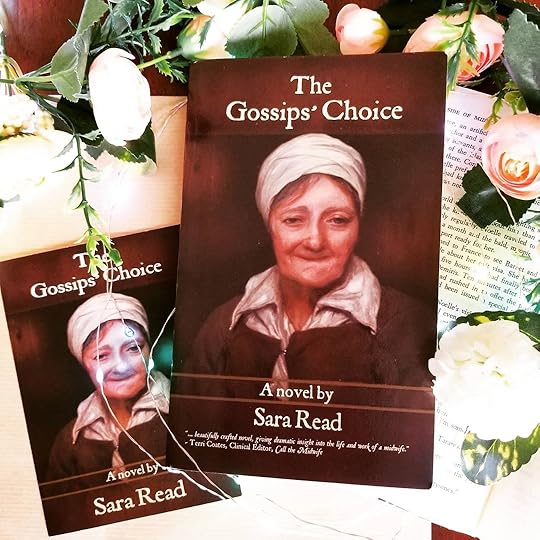
Respected midwife Lucie Smith is married to Jasper, the town apothecary. They've lived happily together at the shop with the sign of the three doves for almost three decades. But 1665 is proving a troublesome year. Lucie is called to a birth at the local Manor, and Jasper is uneasy at her involvement with their former opponents in the English Civil War. Their only surviving son Simon flees plague-ridden London for his country hometown, only to argue with his father. Lucie is shaken to learn their loyal maid has been keeping a secret, and knows when Jasper finds out he will be furious. How could she have missed the signs?
As the year draws to a close, Lucie is accused of serious negligence in her care of one of her mothers which could see her not only lose her licence but face excommunication.
Wavering between 3.5 and 4 stars, this is an exhaustively researched tale of an English midwife just after the Civil War. Touches on the plague and grief.
I wouldn't normally choose historical fiction as my go to read but when I was offered the chance to be part of the tour by Kelly of @lovebookstours I knew from first read of the synposis that I was going to enjoy reading this, and my initial reaction was spot-on.
It's a wonderful read, picture "Call the Midwife" but in 1665. The story follows Lucie Smith, a community midwife of her time, as she attends, supports and delivers babies to all manner of women. A Gossip was the name given to women who attended other women during childbirth. This was often a neighbour. Men weren't allowed anywhere near during this time!
I found it a fascinating read, learning about the differences in birthing practices compared to practices today. I was drawn into this book and the characters, and how they went about their daily lives.
In all, a well written, factual and informative read, woven into a fascinating step back in time story. I thoroughly enjoyed it.
The Gossips’ Choice is a wonderful story that surprised me. I am not even a fan of medical themed stories, but I was glued to the story-line and Lucie’s work.
Firstly, I loved the level of details the author put into the story. I have never read a historical fiction novel where I felt I learnt so much. The author has done thorough research and beautifully incorporated her findings into the story. To be honest, I feel like a lot of these herbal treatments would be more effective than what the hospital prescribes today.
Moreover, Lucie is wonderful as the main character. I was completed engrossed in the first half of the story. I loved reading of the various ailments she uses to treat her patients. The author mentions a variety of cases, from miscarriage, having twins, false labor and much more. It is so interesting to see the different procedures that were practiced during that time.
However, I felt like the focus shifted halfway into the book. In the first half, I loved the medical aspect of Lucie’s treatments with her patients. Yet, in the second half, the story became a family drama between Lucie, Simon and Jasper. Even though I enjoyed the second half of the book, I wish the author had blended both these elements in an organic way. At times, I also felt like the author was trying to cover a lot of issues, like abortion, suicide and being gay. While this was interesting, I didn’t feel it was necessary.
Overall, this is a wonderful book of the insights of a midwife’s life in the 1600s. I really enjoyed reading it, and hope the author writes more stories in this genre.
This is a beautifully written story about the life of a 17th century midwife. It details the established practices and remedies that were used by midwives in that era. It was very interesting to see how far medicine had developed in 1665 in regards to pregnancy. The technical and medicinal aspects may have changed exceedingly but the process and personal interaction of mother and midwife has largely stayed the same.
Lucie is getting older and feeling the stress and painful limbs that comes with living a busy and strenuous life after diligently serving the village women for nearly 30 years. The story goes through Lucie's daily routine of expertly delivering babies and advising on fertility issues to nobility and peasants alike. The book is a wondrous throve of detail of life during the Restoration, the trials and tribulations of the people and the constant treat from the Plague. Lucie's life is hard but for her it's fulfilling.
However, everything goes wrong when she deals with a difficult delivery which ends tragically for both mother and child. The grief stricken father decides to sue and Lucie is left devastated by the reactions of many of the women she has helped deliver over the years. As the drama unfolds, her relationship with her husband becomes strained and the tension continuously builds to the last page.
I give it 🌟🌟🌟 🌟🌟for its realistic view into the life and work of women in the 17th century, how they were treated and the consequences when society deems them wrong. Lucie is a strong person, full of good morals and decency. She is also surrounded by other great female characters. Her live in maid, Martha, whose husband died in the war and is childless whose grief and longing for a child has shaped her personality. Lucie's apprentice, Mary is a shy but determined young women, ready to learn all she can while also willing to stand up for Lucie when others attack her abilities. This is historical fiction at its finest, it delivers an educational and emotive story paired with interesting and compelling characters.
I actually enjoyed this a lot more than I was expecting too once I had adjusted to the writing style. It’s a really good bit of historical fiction that occasionally can feel quite informative.
It has VERY graphic scenes of labour and birth so if you’re even emotive squeamish, don’t do it. But for those with a hardy stomach and have an interest in midwifery (especially historical midwifery) - I highly recommend this one for you.
Set in 1665, it really brings home how lucky we are to have different medications etc available to us - I couldn’t cope with birth in 1665!
The only reason this didn’t get more stars from myself is purely because the ‘plot’ of the book as described in the synopsis doesn’t really happen for the last 75/100 pages and the rest is mainly recounts of childbirth.
Thoroughly enjoyed this book. I’d describe it as “call the midwife set in the 1600s”. When I read it I was able to imagine myself watching the story play out from behind the scenes. It was so well written that even though some of the historical terms were not familiar to me it was obvious what the modern day equivalent is. The book had the right amount of gore without being macabre or overhyped. Looking forward to the sequel!
I have loved this book! This novel about midwifery in 1665 was so interesting, medically and socially speaking. Many details are revealed about actual births and the joys, griefs they might entail. However, the reader learns about how fragile a midwife's reputation can become. This brings suspense in this novel which I could not put down until the outcome was revealed!
This is a very well researched book, as would be expected from a historian author, and its depiction of 17th midwifery is very interesting. The characters are also interesting, but the writing style and plotting are awkward and a bit clichéd. I saw the ending coming a mile away. If the author can find her feet as an author, her next and any ensuing books should be a delight to read.
An evocative story that is feels authentic and given the nature of Lucie’s job, unflinching. I thoroughly enjoyed reading this well-crafted and engaging story. I know there is a sequel!
This was a fascinating read. An incredible insight into the ways and beliefs of not only people in general, but the medicine mixed with folklore and superstition, and yet the church backing there for all to see. I don’t read masses of historical fiction, as I’m a lover of history so it really has to catch my imagination as some books are too fantastical to read. Not in this case!
You are invested in the lives of Lucie, Jasper and their family and workers before you know it. The births have you equally squirming in horror, but reading on in transfixed revulsion, or holding your breath and laughing or whooping when things go better. Highly recommended reading for historical fiction lovers and general fiction lovers alike.
I did not anticipate how involved I would become in this book. Not only was I drawn in by the characters individual stories but also engrossed in the history which was fascinating to read. I've not only completed an excellent novel, it has taught me so much about early midwifery, I particularly enjoyed the remedies given. A definite challenger to Call the Midwife, this would make a brilliant mini series.