Ken Wells’s highly acclaimed picaresque Catahoula Bayou novels introduced “one of the most compelling voices in fiction of the last decade” ( Los Angeles Times ). Now Wells is back, writing about his favorite subject–the exotic, beleaguered Louisiana wetlands–in a sharp, rollicking tale of corporate corruption and political shenanigans. The fight over one man’s tract of sacred marsh fronts a deeper story of our place in the environment and our obligations to it.
Justin Pitre’s marsh island, a legacy of his trapper grandfather, is a scenic rival to anything in the Everglades, and he has promised to protect it from all harm. But he hasn’t counted on oil bigwig Tom Huff’s plans to wreck his bayou paradise by ramming a pipeline through it. When cajolery doesn’t sway Justin to sign the land over, Huff turns to darker methods. But Justin and his spirited wife, Grace, prove to be formidable adversaries–and the game is on.
Into the fray comes the charismatic Cajun governor Joe T. Evangeline, who seems more interested in chasing skirts than saving Louisiana’s eroding coast. The Guv, though, is a man on the edge, upended by a midlife crisis and torn between a secret political obligation to Big Oil and the persuasive powers of Julie Galjour, a feisty environmentalist. Julie is clearly out to reform more than the Guv’s ecopolitics, but will his tragicomic Big Oil deals wreck both his career and his chances with the brash and beautiful activist?
As Justin and Grace battle to stop this Big Oil assault, the plot thickens–and the Guv becomes snared in the web. Featuring a gumbo of eccentrics and lowlifes, a kidnapping, a sexy snitch, a toxic-waste-dumping scheme, a boat chase, and a fishing trip gone horribly awry, Crawfish Mountain , spiced with Ken Wells’s keen eye for locale, showcases his adventurous storytelling.
Ken Wells, journalist and novelist, grew up second of six sons on the banks of Bayou Black deep in South Louisiana's Cajun country. His father was a part-time alligator hunter and snake collector and his Cajun-French-speaking mother a gumbo chef extraordinaire. Wells began his journalism career covering car wrecks and gator sightings for the weekly Houma, La., Courier newspaper. He has gone on to an adventurous career: a Pulitzer Prize finalist for the Miami Herald; editor of two Pulitzer-Prize-winning projects for Page One of The Wall Street Journal where, over a 24-year period, he also roamed the U.S. and the globe covering among other stories the Exxon Valdez oil spill, the first Persian Gulf War and South Africa's transition to a multiracial democracy. He later served as a senior editor for Conde Nast Portfolio magazine and spent six years at Bloomberg News/Businessweek as both a senior writer and editor before leaving in 2015 to pursue book writing full-time. He is the author of six well-received novels of the Cajun bayous: Meely LaBauve (a 2000 Barnes & Noble Discover Great New Writers book); Junior's Leg (2001); Logan's Storm (2002); and Crawfish Mountain (2007). Tom Wolfe said of Crawfish Mountain, "Ken Wells is the Cajun Carl Hiaasen." In 2010, Knopf Young Adult published his YA novel, Rascal, a Dog and His Boy. His sixth novel, Swamped! is a fast-paced YA survival story set in Louisiana's exotic and forbidding Atchafalaya Swamp. It was co-authored with his niece Hillary Wells and published in January of 2023. Wells has penned four works of narrative non-fiction: Travels with Barley: A Quest for the Perfect Beer Joint, a travelogue through America's $75 billion beer industry; The Good Pirates of the Forgotten Bayous, a story of blue-collar heroism in the wake of Hurricane Katrina; Gumbo Life: Tales from the Roux Bayou, published by W.W. Norton in 2019 and republished as a paperback by Blair Publisher in 2024; and Boudin, a lively travelogue through the mania surrounding Louisiana's most popular sausage, that was published by LSU Press on April 14 as part of its Louisiana True series. The Pirates, published in September 2008 by Yale University Press, won the Harry Chapin book award in September 2009. A paperback version was published by YUP in 2015. Gumbo Life, meanwhile, was chosen by the Louisiana Center for the Book to represent the state at the National Book Festival in Washington, D.C., last fall. While serving as an editor on Page One of The Wall Street Journal, Ken was also chosen to edit two anthologies of "A-heds," the beloved middle-column feature that has appeared on the front page of the paper since the early 1940s. Floating Off the Page was published in 2003 and Herd on the Street: Animal Stories from The Wall Street Journal was published in 2007. Ken more recently is the author the whimsical Christmas novella, A Christmas Tree Without a House: The Tale of Sam and the Mysterious Joseph E.W. Pine (A Very Possibly True Story) available on Amazon and which is now an audiobook on Audible. Kirkus Reviews called it "enchanting." Ken's journalistic and literary accomplishments were honored in 2009 when he was awarded an honorary doctorate from his undergraduate alma mater, Nicholls State University, and was inducted as a Louisiana Legend by Louisiana Public Broadcasting that same year. Ken divides his time these days between Chicago and a lovely little summer log cabin in the wilds of Maine. He's an avid photographer, hiker and fisherman and dabbles in blues and jazz guitar and songwriting. He cooks a mean Cajun gumbo and visits Louisiana every chance he gets.
This tale of wetlands preservationists and Big Oil duking it out in the Louisiana bayous was very well written. The message was clear, but not preachy, and the story was very entertaining.
The 'Guv' , and Julie were my favorite love story in the book , though there were several - and the warm ties of friendship and family shone through.
There's even a reference to Junior from one of the author's other books, Junior's Leg, in passing- so if you read very carefully you'll learn what he's been up to since the end of that tale.
Though I really enjoyed Crawfish Mountain, I didn't enjoy it quite as much as the Mealy LaBaueve series. I would recommend this book or that series to anyone who isn't familiar with Ken Wells though - because they're all well worth the read.
The political struggle between the oil company and the environmental impacts of planned work was very interesting to me. I also enjoyed the descriptions of the bayous and marshes, and the information about how their degradation impacts farther inland. The characters were very believable, and Wells did a good job writing.
There were two things I didn't particularly care for: The amount of graphic information about one of the character's sex life, and the fact that the story just ended. There was quite a build up to the climax, but in the next chapter, there was a meeting and one of the characters had orchestrated a solution that seemed to satisfy all the characters in the situation. It seemed like a quick ending when it would have been more fun to go through the process of how the character came up with the solution.
Out in the yard, well away from the ears of Juke Charpentier, Justin said exactly what Grace had been thinking. "That's the craziest thing I've ever heard of. Can you imagine what that trench will do? Besides being a scar on our property, it'll ruin all those meanders between the salt marsh and the island and open up the north side to saltwater tides. And if we get salt water up in front of the chenier , our freshwater prairie and the whole swamp is in trouble." Grace nodded. "In trouble? Doomed, cher. Look at what's happenin' all around us. No, we have to tell this guy in no uncertain terms that we just aren't interested."
"That illustrates two related weaknesses in much environmental policymaking: an assumption that future politicians will take a longer-term view than current ones, and an excessive willingness to discount the future costs of solving environmental problems caused today." ~~ The Economist (See full article under Further Reading links).
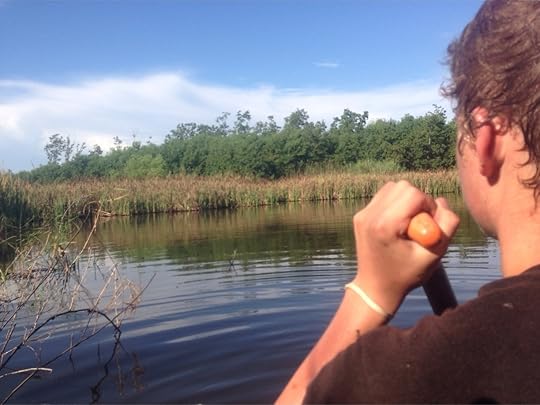
~~Fishing by boat around a chenier in the Louisiana bayou.
Meet Justin and Grace Pitre. Their families have lived in the Louisiana delta for generations. Justin has inherited over 500 acres of marshland from his Grandfather, including a substantial chenier dubbed Crawfish Mountain where their fishing camp sits. Grace has strong roots in her Cajun ancestry.
Unfortunately for the Pitres, a giant oil company wants to purchase a right of way for their pipeline directly through their land...and the company's executive in Louisiana, Tom Huff, has sent his pit bull, Juke, to start negotiations. When the Pitres don't immediately jump at the proffered cash deal, Huff digs for dirt in their families past in order to force a deal.
Meanwhile, Julie Galjour, another Cajun and general council for the Department of Environmental Conservation, is fighting a canal planned by the Army Corp of Engineers (and backed by Big Oil) that would have far reaching implications in the health of the coastal wetlands. She is concerned about the real threats of salt water intrusion...worries that are mirrored on a smaller scale by the Pitres. She is hoping to bring Louisiana governor Joe T. Evangeline over to her side, but he has complex and troubling connections with the oil companies.
Bottom line: Wells does an excellent job of using a fictional tale to shine a spotlight on the very real dangers to Louisiana's wetlands and estuaries. The rate of coastal erosion and land loss there is staggering. Despite the compelling premise, I felt the character development was lacking--instead players in the political drama dug into their long-held beliefs until almost unbelievable changes in the last few chapters wrapped up the conflict. The actual debates happening in Louisiana currently are much more complex than Crawfish Mountain portrays, and I doubt any of them are wrapped up so cleanly with a big red bow, and no feelings hurt. Despite my critique, I do recommend this offering as a library checkout for anyone who wants to begin reading about Cajun culture and the threats to their way of life by the rapidly declining Mississippi delta/wetlands. Given 3 stars or a rating of "Good".
Further reading: Here is an excellent article describing the current state of coastal erosion, the causes (both natural and man-made), economic and social consequences, and the bi-partisan efforts to combat land loss. https://www.economist.com/united-stat... ~~And here's an interesting exploration of Cajun culture and history--https://www.encyclopedia.com/history/...
A lighter book than I remember Wells' first three novels (I read them ten years ago). The Catahoula Bayou setting is the star, overshadowing the numerous characters. I would have liked more tension. The ending is tied up as neat as a Shakespearean comedy. A pleasant enough read, with some humor.
364 pages Wonderful story of Louisiana, its politics and issues. The bayou itself is a character, which I love. The author can be proud of the authenticity of this book. I love the tagline, "Ken Wells is the Cajun Carl Hiasson!" from Tom Wolfe
Loved this author's previous work but this one seemed like his fresh ideas were running low. It's a decent novel, but it lacked the spark of his other books.
After finishing this book I did a little research on Ken Wells and just as I thought, the fictional "Black Bayou" community is patterned on my home town of Houma. The French names such at Petrie were, of course, familiar as they are all over the Cajun Bayou, but when the author mentioned "Ellinder" I knew. I was born in Ellinder Hospital in Houma!
I also discovered that Ken Wells worked as a journalist in Florida which explains the tone and genre of the book. Remember how I said "This book reminds me of all those Floridian comic environmental tomes?" There you go.
I actually listened to this book and although the reader at times was excellent, his reading of female voices grated on my nerves. Some male readers pull this off very well, but others...and you through in a Cajun accent. No, no, cher.
But it was a fun story with an extremely important message and I highly recommend it along with Mike Tidwell's Bayou Farewell,. See my review here: http://www.goodreads.com/book/show/14...
I had a great time reading this book, as I was vey familiar with the locale and culture in which it takes place; I'm not sure what my reaction would have been if I were not. It was, in any case, a fun story with a vey important message. I hope that this book helps to achieve broader recognition of the serious problem of the loss of the La. wetlands.
I think that the portrayal of the cajun culture was accurate, but it was laid on a little thick; e.g. every meal eaten in So. La. is not seafood or gumbo. Please--how about an occasional hambuger or pizza? The similies and methophors were overdone, as well; can we be expected to believe that EVERY character is the book speaks in such poetic language as "troubles bigger than a sumo wrester's ass?"
I like the 3 previous novels better, but I like the message in this one, and I look forward to more from Ken Wells.
The story of the little guy vs. the big guy is told here, with details about the bayou country, money movement between deep pockets, big oil, lying, cheating, stealing, fishing, and surprisingly tender romances. It's a classic story, told with just enough outrage to let the reader know that, while the book is fictional, it's also true.
Wells draws a great cast of characters (who doesn't love to hate a guy with a Napoleonic complex?) and descriptions of the bayou that make you ache to stand on a boat and listen to the birds.
I had read Meely LaBauve by Ken Wells and liked the style, so I thought I'd read another of his books. This was not nearly up to the standard. It could have been written by a high school student who knew Louisana well. What a disappointment. I stuck with it and read the whole thing, but I can't understand why I did. Characters were shallow, dialog was silly and predictable. The ending was the worst! Everything fit so neatly it made me sick!
I'm not sure what attracted me to the book but I enjoyed it somewhat, mostly for the exploration of Louisiana culture. It's an entertaining book that is suspenseful but it's over the top with the message it's trying to get across: protection of LA's wetlands. I totally agree with that but I like authors to be more subtle with their agendas.
A sweet story that takes place in Louisiana. It has a satisfying and hopelessly romantic ending. Written in the style of Carl Hiaasen's book of Florida corruption amidst heartwarming stories, Wells pulls off the same tone and feel. It almost made me interested in taking an up close look at the swamps. Almost.
I enjoy Ken Wells a lot and this book was a fun read, but not as wacky and wild as his LeBauve trilogy which includes one of my all time favorites--Junior's Leg. Crawfish Mountain was a very environmentally conscious book in the style of Hiassen.
Very charming tale of a small city in Bayou country. Big-city politics mix with backwoods heros. Ken Wells is very familiar with his characters and can paint an excellent portrait.
The author had a good story line with the oil companies versus the marsh. But, he over-did the Louisiana politics and the characters. The story was too far-fetched.
Another to add to my list of books that I've read recently with a little too much going on for one story. The characters were a little to stereotypical Cajun, but it was still an interesting read.
A political, satirical pageturner about a serious subject - read for Bill's reading group at the time of the oil spill in the Gulf - totally unplanned timing but very appropriate.
The ending was a bit contrived but overall a good read. Great description of the bayous of Louisiana as well as of the Cajun people. Very entertaining as well as informative.
I LOVED Ken Wells' Meely LeBauve trilogy, and was hoping this one showed the same excellent storytelling skill. The storyline wasn't my cup of tea (or Community coffee, for that matter).