

What do you think?

Glass and Gardens: Solarpunk Winters
This anthology envisions winters of the future, with stories of scientists working together to protect narwhals from an oil spill, to bring snow back to the mountains of Maine, to preserve ecosystems--even if they have to be under glass domes. They're stories of regular people rising to extraordinary circumstances to survive extreme winter weather, to fix a threat to their community's energy source, to save a living city from a deep-rooted sickness. Some take place after an environmental catastrophe, with luxury resorts and military bases and mafia strongholds transformed into sustainable communes; others rethink the way we could organize cities, using skybridges and seascrapers and constructed islands to adapt to the changes of the Anthropocene. Even when the nights are long, the future is bright in these seventeen diverse tales.
274 pages, Kindle Edition
First published January 7, 2020
About the author
Sarena Ulibarri
38 books105 followersSarena Ulibarri is a writer and editor from the American Southwest. Her short stories have appeared in Lightspeed, DreamForge, Baubles From Bones, and elsewhere, and non-fiction essays have appeared in Grist and Strange Horizons. Two novellas were published in 2023: Another Life (from Stelliform Press) and Steel Tree (from Android Press). As an anthologist, she edited Glass and Gardens: Solarpunk Summers and Glass and Gardens: Solarpunk Winters, and co-edited Multispecies Cities. She also serves as a story reviewer for the Imagine 2200 climate fiction contest.
Ratings & Reviews
Friends & Following
Create a free account to discover what your friends think of this book!
Community Reviews
Displaying 1 - 30 of 37 reviews

February 6, 2020
Glass and Gardens: Solarpunk Summers was such an excellent collection, which left a lot for this to live up to. It was a slightly slower start this time - more similarities to the stories, mostly in theme, but once it got going there were some truly excellent stories here.
A buddy read with the folks over at the Solarpunk group; thanks guys!
More detail to come.
A buddy read with the folks over at the Solarpunk group; thanks guys!
More detail to come.

January 17, 2020
I always look forward to new releases from World Weaver Press, as the compilations I’ve purchased in the past have never disappointed me. Perhaps I have built a higher standard for this publisher as I found most of the stories in “Glass and Gardens: Solarpunk Winters” to be okay, though nothing special. There are also some stories Solarpunk Winters (anthologized by Sarena Ulibarri) that are very good.
Wendy Nikel started the book with “Wings of glass,” a whimsical tale of inventiveness and survival. The quirky heroine in the next story, “Halps’ Promise” by Holly Schofield, helped make this offbeat story one of my favorites. Also memorable was “The Fugue of Winter” by Steve Toase, a story that examines a choice between something beautiful versus life itself. As I entered the last third of the book I found Brian Burt’s “Snow Globe,” impressive for the world-building contained in a short story. This was followed by Jerri Jerreat’s “Rules for a Civilization,” an interesting look at the role of a teacher during day-to-day and crisis situations. While there were some other stories that came close, these were the stories that I enjoyed the most, the ones that blossomed with fresh plot ideas and tech inventiveness. If you like stories about Earth’s near future, this book is worth a read. Five stars to these stories, three-and-a-half for the compilation.
Wendy Nikel started the book with “Wings of glass,” a whimsical tale of inventiveness and survival. The quirky heroine in the next story, “Halps’ Promise” by Holly Schofield, helped make this offbeat story one of my favorites. Also memorable was “The Fugue of Winter” by Steve Toase, a story that examines a choice between something beautiful versus life itself. As I entered the last third of the book I found Brian Burt’s “Snow Globe,” impressive for the world-building contained in a short story. This was followed by Jerri Jerreat’s “Rules for a Civilization,” an interesting look at the role of a teacher during day-to-day and crisis situations. While there were some other stories that came close, these were the stories that I enjoyed the most, the ones that blossomed with fresh plot ideas and tech inventiveness. If you like stories about Earth’s near future, this book is worth a read. Five stars to these stories, three-and-a-half for the compilation.

February 8, 2020

Black Ice City by Andrew Dana Hudson ★★★★½
Every winter sailors gather pieces of ice on the pole to recreate the Arctic. They create habitats for themselves and the whole thing is a frosty version of Burning Man. Loved this world, this freedom, sign me up!

Rules for a Civilization by Jerri Jerreat ★★★★½
I adored this story of a future Canadian teacher dealing with problem children and natural disasters with the same patient, understanding, equanimity.

Wings of Glass by Wendy Nikel ★★★★☆
There was some gorgeous future primitive world building here as well as a firm call for community and understanding.

The Healing by Sarah Van Goethem ★★★★☆
My favorite Solarpunk trope is the living city. Creatis lives in harmony with its humans, they prosper together, and they die together.

Orchidaceae by Thomas Badlan ★★★★☆
Rather gorgeous imagery of biodomes in Svalbard after the new ice age. I felt the characters frustration at the difference between planned greening and real life biodiversity. The ending felt right while being optimistic.
On the Contrary, Yes by Catherine F. King ★★★★☆
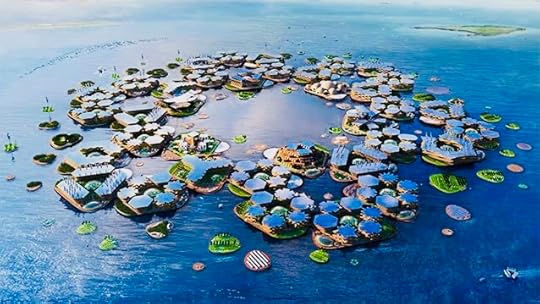
Floating fashion and friends! In a gorgeous world of autonomous man made islands people have not forgotten the importance of art. This is the story of friends new, and old, coming together for a winter fashion show on the isle of Ys.

Glâcehouse by R. Jean Mathieu ★★★★☆
I enjoyed these fiery characters, especially Marie-Pier Corriveau, future black female French speaking president of Canada! It also had a good lesson on ecological engineering - always consider the whole.
The Things That Make It Worth It by Lex T. Lindsay ★★★½☆
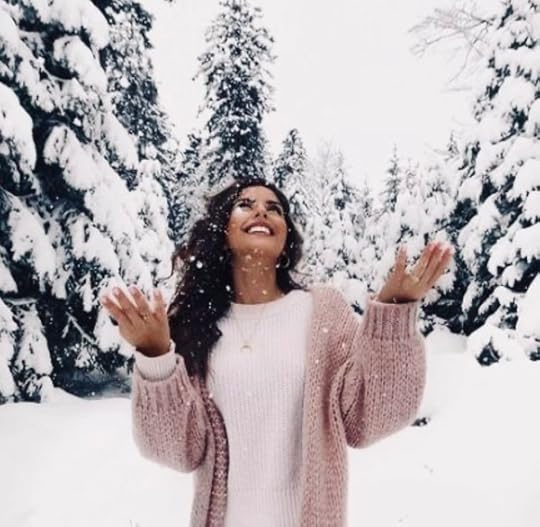
One hundred years after the end of winter restoration scientists get a little back.
Set the Ice Free by Shel Graves ★★★½☆
“They stood with raised palms for a few moments looking over each others shoulders into the future, the People’s Way.”
This was a beautiful example of a Future Primitive story. Long after collapse, and most of humanity going to forever wander the stars, those remaining rebuilt a simpler society in harmony with nature and each other.

Halps’ Promise by Holly Schofield ★★★☆☆
Starting every single day with a community Gabfest that discusses ever single issue sounds like both a great idea and a personal horror.
The Roots of Everything by Heather Kitzman ★★★☆☆
This was ok, it was a little Hallmark love story. The Solarpunk part was the repurposing of an abandoned military base into... well, they were not clear on that but I imagine it as a town/live-work space.
Recovering The Lost Art of Cuddling by Tessa Fisher ★★★☆☆
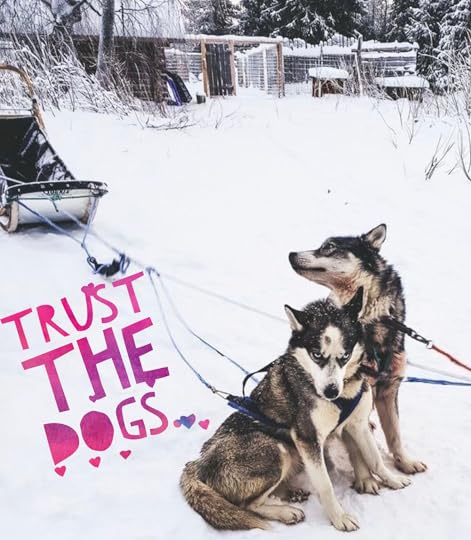
That was cute snapshot story of people and animals working together. I liked the energy, barter, favor economy.
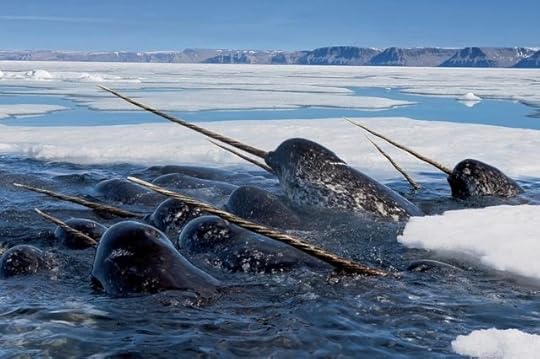
Oil and Ivory by Jennifer Lee Rossman ★★½☆☆
A story of a future Inuit family dealing with an endangered narwhal migration and an oil spill. It was an aggressive angry story and I don’t believe the oil worker would have risked his job for them. That character development did not happen.

A Shawl for Janice by Sandra Ulbrich Almazan ★★½☆☆
“As the population collapsed during the Change, people moved into bigger cities and EcoTowers to conserve energy, leaving entire towns free to be returned to native ecosystems.”
And that was the good part of the story. It began with a lunatic old lady insisting on going on a birding expedition with malicious intent. Her motivation tiptoe awkwardly forward, never regaining much sympathy.
Snow Globe by Brian Burt ★★½☆☆
I enjoyed some of the world building but found it hard to picture. Floating islands, pirates, submarines, all on a lake. It is a big lake but I drew the line at trained bull moose. I don’t believe it.

The Fugue of Winter by Steve Toase ★★☆☆☆
I take exception this! If you can figure out fancy algae, growing keratin, and making automated feather insulation, you can figure out a sound booth!
Viam Inveniemus Aut Faciemus by Commando Jugendstil and Tales from the EV Studio ★★☆☆☆
The zie/zir beginning is a derailing distraction to the story. I am an advocate for a singular gender neutral pronoun but zhat iz nozt itz. We need a him/her/h—. The rest of the story is of a semi eco-transitioned Italy of semi independent villages. It also felt like a checklist of inclusiveness rather than a free flowing tale, but that might have been from the bumpy beginning.
Average Rating 3.3 Stars

January 6, 2020
I have a story in this collection, "Set the Ice Free, " and also a story in Glass and Gardens: Solarpunk Summers, "Watch Out, Red Crusher!". Editor Sarena Ulibarri, solarpunk champion, was fabulous to work with.
I'm a swooning fan of optimistic science fiction and of those writers who undertake the difficult task of imagining positive futures and making engaging stories about them.
Overall, it's fun be a part of this anthology and enjoying the stories as a reader makes it even better — dare I say, thrilling!
I love that Publishers Weekly noted Solarpunk Winters', "emphasis on LGBTQ representation and female empowerment" and I love that this is a book filled with the best of humanity including love of beauty, art, and a lot, lot, of fun parties.
By now, you are certainly not expecting any kind of unbiased review. Me=muppet flailing about books I love. So, I'm just going to tell you just a bit about what I loved about each story and go ahead and gush about those I especially connected with. I have two overall critiques for the collection, which I'll save for the end.
“Wings of Glass” by Wendy Nikel — Snow bees!
“Halps’ Promise” by Holly Schofield — Loved the structure and premise.
“A Shawl for Janice” by Sandra Ulbrich Almazan — "We belonged here as much as the birds did, no matter what feathers we clothed ourselves in." — Loved the premise and trans protagonist.
“The Healing” by Sarah Van Goethem — Living cities!
“The Fugue of Winter” by Steve Toase — Extreme survival — and music!
“Recovering the Lost Art of Cuddling” by Tessa Fisher — Doggos to the rescue! Loved this ending.
“Orchidaceae” by Thomas Badlan — Rainforests in the winter — the Amazon!
“The Things That Make It Worth It” by Lex T. Lindsay — Felt beauty and peace.
“Glâcehouse” by R. Jean Mathieu — Beautiful ending, evokes Les Misérables.
“Snow Globe” by Brian Burt — Love Owki Bearheart, the park ranger protagonist.
“Rules for a Civilization” by Jerri Jerreat — A teacher hero protagonist who saves her students. Appreciated the childhood bullying theme and plot points.
“On the Contrary, Yes” by Catherine F. King — "A renewable resource. Art—love—winter—" "Friendship!"
“Set the Ice Free” by Shel Graves — I wrote this, so...
“Black Ice City” by Andrew Dana Hudson — Ooh, this style — beautiful lyrical, evocative, wistful. Great story to end on.
Three stories I especially connected with:
I'm also from Washington State and Heather Kitzman's “The Roots of Everything” set at Fort Lewis following the Cascadia earthquake got my attention. I loved the description of community coming together after disaster (which reminded me Rebecca Solnit's A Paradise Built in Hell), bioluminescent mushrooms, emotionally intelligent lover (which reminded me of Nathaniel in Mary Robinette Kowal's Lady Astronaut series) and the themes: imagination creates reality and science as art.
Ooh! I'm a volunteer editor at Luna Station Quarterly, which publishes speculative stories by women-identified authors. I've had the pleasure of reading Rossman's submission and being able to say, "Oooh, this one!" See her stories in LSQ: "One Last Ride on the Horse with Purple Roses" and "Pocketful of Souls." In Solarpunk Winters, "Oil and Ivory" had me in tears and cheering. A pregnant protagonist! Narwhals! Hmm, I haven't checked out her novel ""Jack Jetstark's Intergallactic Freakshow" also published by World Weaver Press. Maybe I should.
Fist raised! A "Midsummer Night's Heist" by Commando Jungendsil and Tales from the EV Studio was one of my favorites in Glass and Gardens: Solarpunk Summers. So, I was really looking forward to their “Viam Inveniemus Aut Faciemus" — and rightly so! It was great to see Stabby and Loopy return and meet some new characters, too. These stories really put the punk in solarpunk. I love that they are written by a collective of creators and activists about the adventures of a collective of activists. Love these characters — and the romance sub-plot. Love the use of gender neutral pronouns. Love these descriptions: "Loopy might like heights, but Stabby'd rather take zir chances with fascists than with gravity."; "If Bilbo Baggins' cottage and the lair of a mad scientist had an architectural lovechild..."
Two critiques:
More animals, please. I faulted my own story in Solarpunk Summers for not having any animals in it. Seriously Shel, a positive future set on earth without mention of nonhuman animals? I fixed this in Solarpunk Winters and was pleased to see relations with other animals here: some sled dogs, conversations with whales, and one cat (Thank goodness for Jerri Jerreat's inclusion of Apple in "Rules for a Civilization" — Do you really want to live in a future without cats?). Still there are 8.7 million species on Earth. Solarpunk futures feature a lot of interesting and nurtured plant life, but could have way more animals. I'm really excited about World Weaver Press' call for stories for a new anthology Multispecies Cities.
We could get weirder. I'd love to see us speculate even harder about what the future holds --weirder tech, weirder worlds, stranger cities, more unusual cultural changes, and even less status quo. I love what we're doing, and I'd love to challenge us to be even more fearless and fantastic. Happy writing!
I'm a swooning fan of optimistic science fiction and of those writers who undertake the difficult task of imagining positive futures and making engaging stories about them.
Overall, it's fun be a part of this anthology and enjoying the stories as a reader makes it even better — dare I say, thrilling!
I love that Publishers Weekly noted Solarpunk Winters', "emphasis on LGBTQ representation and female empowerment" and I love that this is a book filled with the best of humanity including love of beauty, art, and a lot, lot, of fun parties.
By now, you are certainly not expecting any kind of unbiased review. Me=muppet flailing about books I love. So, I'm just going to tell you just a bit about what I loved about each story and go ahead and gush about those I especially connected with. I have two overall critiques for the collection, which I'll save for the end.
“Wings of Glass” by Wendy Nikel — Snow bees!
“Halps’ Promise” by Holly Schofield — Loved the structure and premise.
“A Shawl for Janice” by Sandra Ulbrich Almazan — "We belonged here as much as the birds did, no matter what feathers we clothed ourselves in." — Loved the premise and trans protagonist.
“The Healing” by Sarah Van Goethem — Living cities!
“The Fugue of Winter” by Steve Toase — Extreme survival — and music!
“Recovering the Lost Art of Cuddling” by Tessa Fisher — Doggos to the rescue! Loved this ending.
“Orchidaceae” by Thomas Badlan — Rainforests in the winter — the Amazon!
“The Things That Make It Worth It” by Lex T. Lindsay — Felt beauty and peace.
“Glâcehouse” by R. Jean Mathieu — Beautiful ending, evokes Les Misérables.
“Snow Globe” by Brian Burt — Love Owki Bearheart, the park ranger protagonist.
“Rules for a Civilization” by Jerri Jerreat — A teacher hero protagonist who saves her students. Appreciated the childhood bullying theme and plot points.
“On the Contrary, Yes” by Catherine F. King — "A renewable resource. Art—love—winter—" "Friendship!"
“Set the Ice Free” by Shel Graves — I wrote this, so...
“Black Ice City” by Andrew Dana Hudson — Ooh, this style — beautiful lyrical, evocative, wistful. Great story to end on.
Three stories I especially connected with:
I'm also from Washington State and Heather Kitzman's “The Roots of Everything” set at Fort Lewis following the Cascadia earthquake got my attention. I loved the description of community coming together after disaster (which reminded me Rebecca Solnit's A Paradise Built in Hell), bioluminescent mushrooms, emotionally intelligent lover (which reminded me of Nathaniel in Mary Robinette Kowal's Lady Astronaut series) and the themes: imagination creates reality and science as art.
Ooh! I'm a volunteer editor at Luna Station Quarterly, which publishes speculative stories by women-identified authors. I've had the pleasure of reading Rossman's submission and being able to say, "Oooh, this one!" See her stories in LSQ: "One Last Ride on the Horse with Purple Roses" and "Pocketful of Souls." In Solarpunk Winters, "Oil and Ivory" had me in tears and cheering. A pregnant protagonist! Narwhals! Hmm, I haven't checked out her novel ""Jack Jetstark's Intergallactic Freakshow" also published by World Weaver Press. Maybe I should.
Fist raised! A "Midsummer Night's Heist" by Commando Jungendsil and Tales from the EV Studio was one of my favorites in Glass and Gardens: Solarpunk Summers. So, I was really looking forward to their “Viam Inveniemus Aut Faciemus" — and rightly so! It was great to see Stabby and Loopy return and meet some new characters, too. These stories really put the punk in solarpunk. I love that they are written by a collective of creators and activists about the adventures of a collective of activists. Love these characters — and the romance sub-plot. Love the use of gender neutral pronouns. Love these descriptions: "Loopy might like heights, but Stabby'd rather take zir chances with fascists than with gravity."; "If Bilbo Baggins' cottage and the lair of a mad scientist had an architectural lovechild..."
Two critiques:
More animals, please. I faulted my own story in Solarpunk Summers for not having any animals in it. Seriously Shel, a positive future set on earth without mention of nonhuman animals? I fixed this in Solarpunk Winters and was pleased to see relations with other animals here: some sled dogs, conversations with whales, and one cat (Thank goodness for Jerri Jerreat's inclusion of Apple in "Rules for a Civilization" — Do you really want to live in a future without cats?). Still there are 8.7 million species on Earth. Solarpunk futures feature a lot of interesting and nurtured plant life, but could have way more animals. I'm really excited about World Weaver Press' call for stories for a new anthology Multispecies Cities.
We could get weirder. I'd love to see us speculate even harder about what the future holds --weirder tech, weirder worlds, stranger cities, more unusual cultural changes, and even less status quo. I love what we're doing, and I'd love to challenge us to be even more fearless and fantastic. Happy writing!

Read
August 18, 2021An impressive collection of Solarpunk short stories which all worked out really well for me.

October 12, 2024
I occasionally pick up solarpunk anthologies with the hope that I'll bond with the genre. This one intrigued me because it deals with winter (and in particular, winter in Canada), which is an interesting technological challenge. There's a lot of good stuff in here and the stories are well-written, with a few standouts.
It's altogether too cozy for my tastes, which is why I have failed to bond with solarpunk as a genre. I love the aesthetic, but I want more conflict. If you like coziness though, you'll enjoy this.
It's altogether too cozy for my tastes, which is why I have failed to bond with solarpunk as a genre. I love the aesthetic, but I want more conflict. If you like coziness though, you'll enjoy this.
January 5, 2026
As with any anthologies, some stories are better than others. I really enjoyed to be reading so many different stories from a solarpunk perspective, but found some to still be a bit too hightech oriented and some urban design to still be about subjecting the environment to our human needs and highly impractical (floating cities need a lot of material and transportation, earthscrapers are very iffy in terms of getting daylight). I loved how (gender)queer inclusive the stories were! I started reading this anthology when it was just cold outside, but once the snow set in, I started reading more and feel more immersed :). I greatly appreciated all the different perspectives on solarpunk.

April 27, 2023
Après Glass and Gardens : Solarpunk Summers, Serena Ulibarri a dirigé une autre anthologie de nouvelles solarpunk : comme son titre l’indique, Glass and Gardens : Solarpunk Winters est cette fois consacré à la saison hivernale.
This anthology envisions winters of the future, with stories of scientists working together to protect narwhals from an oil spill, to bring snow back to the mountains of Maine, to preserve ecosystems—even if they have to be under glass domes. They're stories of regular people rising to extraordinary circumstances to survive extreme winter weather, to fix a threat to their community's energy source, to save a living city from a deep-rooted sickness. Some stories take place after an environmental catastrophe, with luxury resorts and military bases and mafia strongholds transformed into sustainable communes; others rethink the way we could organize cities, using skybridges and seascrapers and constructed islands to adapt to the changes of the Anthropocene. Even when the nights are long, the future is bright in these seventeen diverse tales.
Je vous propose un bref aperçu des dix-sept nouvelles qui composent cette anthologie :
1. Wings of Glass de Wendy Nikel : dans une ancienne station de ski reconvertie en refuge pour les survivants de la crise climatique, une jeune ingénieure part à la recherche de son meilleur ami qui a disparu après avoir suivi des abeilles mécaniques qu'il a aperçu quelques jours plus tôt
2. Halps' Promise de Holly Shofield : une adolescente inventive mais impulsive a du mal à s'intégrer dans la communauté autonome au sein de laquelle elle vit, ce qui pourrait bien provoquer un drame lorsqu'elle part en expédition avec sa soeur ainée et sa mentor pour réparer une conduite d'eau, vitale pour la survie de la communauté
3. A Shawl for Janice de Sandra Ulbrich Almazan : une jolie histoire autour du harcèlement scolaire et de la transition de genre, à l'occasion d'une expédition ornithologique
4. The Healing de Sarah Van Goethem : une jeune historienne et son petit ami ingénieur quittent la ville-vivante où ils ont grandi pour rendre visite à une médecin, la seule peut-être capable de soigner la jeune femme
5. The Fugue of Winter de Steve Toase : dans un refuge antarctique, la découverte d'un violon engendre la nostalgie pour celles et ceux ayant connu la musique d'avant le long hiver ; sont-ils prêts à mettre en danger tout le monde pour réentendre cette musique ?
6. The Roots of Everything de Heather Kitzman : dans une ancienne base militaire reconvertie en communauté artistique, un jeune couple est confronté à la question du désir (ou non) d'avoir des enfants dans un monde difficile
7. Viam Inveniemus Aut Faciemus de Commando Jugendstil et Tales from EV Studio : une partie du Commando Jugendstil, un groupe de jeunes artistes-activistes milanais, reprend du service pour aider un village en difficulté avec son système de chauffage, vital pour traverser l'hiver
8. Recovering the Lost Art of Cuddling de Tessa Fisher : une biologiste part pour un dangereux trajet en plein hiver, avec son traîneau à chiens
9. Oil and Ivory de Jennifer Lee Rossman : une communauté inuite au Groenland accueille un ouvrier blessé lors de l'explosion d'un puit de pétrole qui menace la vie des poissons des environ
10. Orchidaceae de Thomas Badlan : dans un dôme géant en Norvège chargé de conserver et cultiver la flore mondiale pendant la crise climatique, une botaniste s'inquiète de voir revenir les vieilles mauvaises habitudes productivistes
11. The Things That Make It Worth It de Lex T. Lindsay : à l'occasion du centenaire de la Révolution Verte, une scientifique dans le doute cherche une idée pour relancer les efforts de l'humanité
12. Glâcehouse de R. Jean Mathieu : dans une république du Québec désormais indépendante, une femme accompagnée d'une amie rêve de voir la neige pour la première fois
13. Snow Globe de Brian Hurt : il m'est totalement impossible de résumer cette nouvelle, tellement je suis passé à côté ...
14. Rules For a Civilizations de Jerri Jerreat : une enseignante propose à ses élèves pré-adolescents un exercice consistant à imaginer qu'ils sont le premier village de l'histoire de l'humanité et à définir leurs règles de vie, alors qu'une élève en particulier lui donne du fil à retordre
15. On the Contrary, Yes de Catherine F. King : une américaine et son amie traversent l'Atlantique jusqu'à Ys, la première ville flottante française
16. Set the Ice Free de Shel Graves : une jeune femme qui rêve de voyager dans l'espace accueille une jeune ambassadrice des Voyageurs, une descendante des humains qui ont quitté la Terre il y a longtemps, en quête d'une autre planète habitable
17. Black Ice City de Andrew Dana Hudson : une autre nouvelle que je suis bien en peine de résumer, ce qui est d’autant plus dommage qu’elle conclut le recueil et ne m’a donc pas laissé sur une bonne impression
L’ensemble est globalement très hétérogène : il y a quelques nouvelles très réussies, d'autres sympathiques sans être vraiment mémorables, et quelques unes - heureusement rares - qui m'ont laissé totalement indifférent et dans lesquelles je n’ai pas réussi à plonger.
Il y a peut-être de ma part un peu de lassitude avec cette succession de recueils de nouvelles solarpunk. C’est finalement un genre récent et qui se cherche encore, à la fois dans ses thématiques, dans ses marges et ses frontières, et dans son style. Je vais peut-être alterner avec d'autres genres avant de revenir vers les deux dernières anthologies solarpunk qui m'attendent.
This anthology envisions winters of the future, with stories of scientists working together to protect narwhals from an oil spill, to bring snow back to the mountains of Maine, to preserve ecosystems—even if they have to be under glass domes. They're stories of regular people rising to extraordinary circumstances to survive extreme winter weather, to fix a threat to their community's energy source, to save a living city from a deep-rooted sickness. Some stories take place after an environmental catastrophe, with luxury resorts and military bases and mafia strongholds transformed into sustainable communes; others rethink the way we could organize cities, using skybridges and seascrapers and constructed islands to adapt to the changes of the Anthropocene. Even when the nights are long, the future is bright in these seventeen diverse tales.
Je vous propose un bref aperçu des dix-sept nouvelles qui composent cette anthologie :
1. Wings of Glass de Wendy Nikel : dans une ancienne station de ski reconvertie en refuge pour les survivants de la crise climatique, une jeune ingénieure part à la recherche de son meilleur ami qui a disparu après avoir suivi des abeilles mécaniques qu'il a aperçu quelques jours plus tôt
2. Halps' Promise de Holly Shofield : une adolescente inventive mais impulsive a du mal à s'intégrer dans la communauté autonome au sein de laquelle elle vit, ce qui pourrait bien provoquer un drame lorsqu'elle part en expédition avec sa soeur ainée et sa mentor pour réparer une conduite d'eau, vitale pour la survie de la communauté
3. A Shawl for Janice de Sandra Ulbrich Almazan : une jolie histoire autour du harcèlement scolaire et de la transition de genre, à l'occasion d'une expédition ornithologique
4. The Healing de Sarah Van Goethem : une jeune historienne et son petit ami ingénieur quittent la ville-vivante où ils ont grandi pour rendre visite à une médecin, la seule peut-être capable de soigner la jeune femme
5. The Fugue of Winter de Steve Toase : dans un refuge antarctique, la découverte d'un violon engendre la nostalgie pour celles et ceux ayant connu la musique d'avant le long hiver ; sont-ils prêts à mettre en danger tout le monde pour réentendre cette musique ?
6. The Roots of Everything de Heather Kitzman : dans une ancienne base militaire reconvertie en communauté artistique, un jeune couple est confronté à la question du désir (ou non) d'avoir des enfants dans un monde difficile
7. Viam Inveniemus Aut Faciemus de Commando Jugendstil et Tales from EV Studio : une partie du Commando Jugendstil, un groupe de jeunes artistes-activistes milanais, reprend du service pour aider un village en difficulté avec son système de chauffage, vital pour traverser l'hiver
8. Recovering the Lost Art of Cuddling de Tessa Fisher : une biologiste part pour un dangereux trajet en plein hiver, avec son traîneau à chiens
9. Oil and Ivory de Jennifer Lee Rossman : une communauté inuite au Groenland accueille un ouvrier blessé lors de l'explosion d'un puit de pétrole qui menace la vie des poissons des environ
10. Orchidaceae de Thomas Badlan : dans un dôme géant en Norvège chargé de conserver et cultiver la flore mondiale pendant la crise climatique, une botaniste s'inquiète de voir revenir les vieilles mauvaises habitudes productivistes
11. The Things That Make It Worth It de Lex T. Lindsay : à l'occasion du centenaire de la Révolution Verte, une scientifique dans le doute cherche une idée pour relancer les efforts de l'humanité
12. Glâcehouse de R. Jean Mathieu : dans une république du Québec désormais indépendante, une femme accompagnée d'une amie rêve de voir la neige pour la première fois
13. Snow Globe de Brian Hurt : il m'est totalement impossible de résumer cette nouvelle, tellement je suis passé à côté ...
14. Rules For a Civilizations de Jerri Jerreat : une enseignante propose à ses élèves pré-adolescents un exercice consistant à imaginer qu'ils sont le premier village de l'histoire de l'humanité et à définir leurs règles de vie, alors qu'une élève en particulier lui donne du fil à retordre
15. On the Contrary, Yes de Catherine F. King : une américaine et son amie traversent l'Atlantique jusqu'à Ys, la première ville flottante française
16. Set the Ice Free de Shel Graves : une jeune femme qui rêve de voyager dans l'espace accueille une jeune ambassadrice des Voyageurs, une descendante des humains qui ont quitté la Terre il y a longtemps, en quête d'une autre planète habitable
17. Black Ice City de Andrew Dana Hudson : une autre nouvelle que je suis bien en peine de résumer, ce qui est d’autant plus dommage qu’elle conclut le recueil et ne m’a donc pas laissé sur une bonne impression
L’ensemble est globalement très hétérogène : il y a quelques nouvelles très réussies, d'autres sympathiques sans être vraiment mémorables, et quelques unes - heureusement rares - qui m'ont laissé totalement indifférent et dans lesquelles je n’ai pas réussi à plonger.
Il y a peut-être de ma part un peu de lassitude avec cette succession de recueils de nouvelles solarpunk. C’est finalement un genre récent et qui se cherche encore, à la fois dans ses thématiques, dans ses marges et ses frontières, et dans son style. Je vais peut-être alterner avec d'autres genres avant de revenir vers les deux dernières anthologies solarpunk qui m'attendent.

May 22, 2024
There was a lot of variety in the stories, in every way: quality, focus, theme, mood. If that's something you like, great news. I thought it felt kind of disjointed-- some stories are about futuristic settings, and the plots are secondary, but some are about people and events with the futuristic details being a minor point.
Some of the short stories felt crowded. Sci-fi is hard to do in a short stories, because there's such a limited space to set up the world. It was refreshing that each story featured (pretty exclusively, even to minor characters) other-abled, non cis-het-white characters, but it made it even harder to set the scene. Not only do you have very limited space to tell a story, but it's futuristic, so set up how the world ended; oh, and also explain how the main character was raised by her lesbian biracial grandmothers and then go into the local culture. Too compressed to do justice to characters who deserve to be full people.
Recommended primarily for readers who want hopeful sci-fi, or who want more gender-diverse short stories. Not a must-read.
Some of the short stories felt crowded. Sci-fi is hard to do in a short stories, because there's such a limited space to set up the world. It was refreshing that each story featured (pretty exclusively, even to minor characters) other-abled, non cis-het-white characters, but it made it even harder to set the scene. Not only do you have very limited space to tell a story, but it's futuristic, so set up how the world ended; oh, and also explain how the main character was raised by her lesbian biracial grandmothers and then go into the local culture. Too compressed to do justice to characters who deserve to be full people.
Recommended primarily for readers who want hopeful sci-fi, or who want more gender-diverse short stories. Not a must-read.

January 4, 2023
I have to admit, when I think of solarpunk I tend to think of warmer climates - there's a companion volume to this, on solarpunk summers, that I also own and will be reading soon. The winter volume, by comparison, seemed appealingly unlikely, so I plumped to read that one first. And you know, it's not a silly idea. Climate change doesn't mean warming everywhere, and anyway, some of these stories are more concerned with preserving winter and the related cold-adapted ecologies.
I don't think there's a single dud story here. I liked all of them, and all of them took different and interesting approaches to the topic. Most, if not all, of the stories relate to North America, and it would have been nice to have a little more geographic variety, but that diversity of approach made up for a lot. Of the 17 stories collected here, I think my favourites were "Wings of Glass" by Wendy Nikel, "Rules for a Civilization" by Jerri Jerreat, and "On the Contrary, Yes" by Catherine F. King. I'd be happy to read everything here again, however, so I'm glad I have my own copy.
I don't think there's a single dud story here. I liked all of them, and all of them took different and interesting approaches to the topic. Most, if not all, of the stories relate to North America, and it would have been nice to have a little more geographic variety, but that diversity of approach made up for a lot. Of the 17 stories collected here, I think my favourites were "Wings of Glass" by Wendy Nikel, "Rules for a Civilization" by Jerri Jerreat, and "On the Contrary, Yes" by Catherine F. King. I'd be happy to read everything here again, however, so I'm glad I have my own copy.

October 6, 2023
As an introduction to solarpunk, I think this anthology works quite well. I have a much better idea of what solarpunk fiction looks like. I saw there’s a companion anthology with a summer theme - though I quite enjoyed the winter theme - and maybe I‘ll pick it up for next year.
As always with anthologies, some stories really resonated with me personally, others not so much. YMMV
As always with anthologies, some stories really resonated with me personally, others not so much. YMMV

February 7, 2024
I read this collection slowly, and it was always the infusion of hope that I needed.

September 23, 2026
One summer I spent on Svalbard, I attended a course for master’s and doctoral students. The course focused on ecological conditions related to elevation, and people from all over the world had flown in to participate. During one of the first few days—before I decided the course wasn’t for me—a fellow student asked: "So, which latitude are you from?" After reading the anthology *Glass and Gardens: Solarpunk Winters* (2020), I realize that fellow student could easily have been a character from this book.
The people speak about the Earth differently and are more conscious of their surrounding environment—and nationalities, with the exception of Indigenous nations, are a thing of the past. What does *not* flow through the anthology, however, are the Earth’s jet streams; consequently, the winters in several of the short stories are described as Arctic and extreme. For instance, the story "Wings of Glass" by Wendy Nikel notes: "[T]he jet streams had shifted, and cold Arctic air had whipped its way into their mountains, bringing colder winds and more snow than any of them had seen, even before the days of the Drought." In contrast to the depiction of summers as difficult in the predecessor *Glass and Gardens: Solarpunk Summers* (2018), it is striking how often the winters in *G&G: Solarpunk Winters* are described in negative terms: winter is something terrible that humanity has inflicted upon itself and must endure. A common thread in several of the stories is that the environmental catastrophe has already occurred, and humanity is now living in its aftermath. In "The Fugue of Winter" by Steve Toase—one of the anthology’s stronger stories—winter is unequivocally a dystopia. Here, we see the temperature plummeting dangerously to minus eighty-six after the building’s heating system is switched off—because someone wants to record violin music without background noise. After all, what is the point of living if we do not cherish art—that which serves no practical purpose? Furthermore, two engineers in *Wings of Glass* are portrayed as almost heroic as they venture out of the former ski hotel to repair a glass dome covering a greenhouse: “She was eager for the hot cocoa that’d be waiting for them today—a small indulgence for those willing to brave the cold for the good of the whole community.” In other short stories—such as *Viam Inveniemus Aut Faciemus* by the writing collective Commando Jugendstil and *Recovering the Lost Art of Cuddling* by Tessa Fisher—the protagonist(s) must brave a snowstorm. By the time I reach one of the final stories, *Snow Globe* by Brian Burt, I am encountering yet another snowstorm and yet another dome. Domes are popular, though little is said about how they operate. What are their energy sources? I wonder—without necessarily wanting a detailed explanation. When Rosita, in *The Things That Makes It Worth It* by Lex T. Lindsay, takes reusable lunchboxes out of a cloth bag, followed by the explanation that “[t]he bag is a Bureau product from the Consumer Division. The kinetic energy of every jostle and zip gets collected, stored, and output as heat which allows any food inside to be kept hot for an extended period of time,” it comes across as contrived. The same applies to the conversation that follows on the next page:
“Someone should have overridden her. You came up with the ice seeding method that’s slowly bringing the caps back to the poles, and what was that grass thing you did last year?”
“Genetically cross-engineering native grasses with more drought-tolerant species to slow soil erosion,” Tessa says.
“Which was brilliant. You’re the best mind in Major Restoration, and they know it,” Rosita says. “Not having you on the team was a waste.”
The short story deserves praise, however, for being one of the few that portrays winter as something good and positive: winter is something people want—and fortunately still have—thanks to the fact that, in true solarpunk fashion, they cooperate to ensure it doesn’t disappear: “They had called themselves the Winter Legion, a loosely formed union of individuals and small businesses whose livelihoods relied on cold weather and the snow it brought. At first, they’d gone to Congress and asked them what they planned to do to fix what had been broken. When that hadn’t worked, their union had become a movement.” Cooperation is key to the solarpunk ethos, yet sometimes it is laid on too thick—as in the aforementioned *Wings of Glass*: “This man was like the robber in the woods; they wouldn’t win him over by appealing to any sense of community, for obviously, at some point, the community had failed him. But maybe if they could help him—and in the process, demonstrate that they understood the value of his ideas—he might return the favor…” Can’t the reader be allowed to arrive at this point on their own? This same tendency toward over-explicitness appears elsewhere; for instance, in *Glâcehouse* by R. Jean Mathieu—another story that views winter positively—Dr. Corriveau says the following to her dark-skinned daughter: “When I said you take after your mother, I never meant your melanin.” Who on earth says something like that to their child? No one, I think, and thus read the sentence as the author’s overzealous attempt to show us that the main character is a person of color—something we already know from earlier descriptions in the story. Yet *Glâcehouse* isn't the worst offender in this regard; in both *A Shawl for Janice* by Sandra Ulbrich Almazan and *Oil and Ivory* by Jennifer Lee Rossman—latter which is set in Greenland—constant emphasis is placed on people's sexuality and unconventional relationship structures. In the latter, we learn that the protagonist is the daughter of a gay male couple; then we learn she is married to a woman herself; and shortly after, we are served the following paragraph: “Our family is big and confusing and polyamorous. Qai and I are married, Nan is the biological father of our two children that Qai birthed, and I used to date Nan’s girlfriend, whose boyfriend is Malina’s biological father. People come in and out of our inner circle, but we’re all connected as a close community, and it’s generally accepted that children will be raised by as many parents as possible.” Okay, got it—but it doesn't stop there; a little later, we learn that the protagonist is asexual: “Being asexual, I’ve never totally understood the concept of ‘hot,’ but I guess he could be considered handsome, if you’re into skinny guys.” Ffs. They’re trying to tick every single box here.
The extremely macho protagonist of *Black Ice City* by Andrew Dana Hudson has to travel through everything, too—or at least, he has to travel across the entire Arctic continent. The title is the name of a town on Svalbard where he finds his peers: “To join the winter party, one must bring ice, and to wrangle ice of any consequence one needs more than a single boat. So I hobnob in Barentsburg hostels, buying drinks and trading planktonspice until I win the favor of seven rough men out of Yuzhny. They’re Irish and Icelandic, Spanish, Dutch and Saharan, all drawn north to seek their fortunes in one unlikely way or another.” One of them is named Mateo and becomes his lover. Mateo explains that he is on Svalbard because his imaginary muse has mysteriously lured him there—something I can somewhat relate to. What is it that makes Svalbard so appealing? Rationally speaking, nothing. One day, Mateo suddenly disappears—an event the narrator attributes to the muse. Another welcome reminder of my time on Svalbard is the red saxifrage described in Holly Schofield’s *Halp’s Promise*, even though the short story actually takes place in the Rocky Mountains. The plant’s sweet petals are gathered for consumption, just as I have read that the Inuit people of the Arctic do. That said, the story tends to over-explain; the narrator knows far too much about a past she did not experience firsthand for it to feel realistic. Furthermore, I am not convinced by the premise that the text is the narrator’s university application essay—partly due to the excessive use of the colloquialism "duh." Red saxifrage aside, my favorite of the stories is something else entirely: *Rules for a Civilization* by Jerri Jerreat, who also contributed a memorable story to *G&G: Solarpunk Summers*. This story is also told from a first-person perspective, in a style that suggests the narrator is keeping a sort of logbook. Things are explained, but in a way that feels everyday and seamless. The narrator is a schoolteacher who asks her students to imagine they are creating a society. What does it take to establish such a society? The students offer a wide range of answers, yet the author refrains from telling me which are right and which are wrong. A small detail I appreciate is the inclusion of subjects like "Indigenous Language" and "Nature Nurture Class," where students—among other activities—cultivate and care for bonsai trees.
Also worth mentioning are the evocative terms "earth-scraper" and "igloo-hick"—appearing in Sarah Van Goethem’s *The Healing*, where people outside the metropolis live in igloos—as well as Heather Kitzman’s short story *The Roots of Everything*, which portrays a love affair that is both complex and poignant. There is also a welcome change in the weather in Catherine F. King’s *On the Contrary, Yes*, where toxic jellyfish rain down instead of snow; this story is one of two in the collection that plays with the myth of the city of Ys (the other being *Glâcehouse*). Since I mentioned Svalbard at the start, I must also mention Thomas Badlan’s *Orchidacea*, which deals with the Svalbard seed vault. Fittingly, Svalbard is described there as hermetically sealed—a description I would not apply to *G&G: Solarpunk Winters*, despite there being plenty to criticize.
The people speak about the Earth differently and are more conscious of their surrounding environment—and nationalities, with the exception of Indigenous nations, are a thing of the past. What does *not* flow through the anthology, however, are the Earth’s jet streams; consequently, the winters in several of the short stories are described as Arctic and extreme. For instance, the story "Wings of Glass" by Wendy Nikel notes: "[T]he jet streams had shifted, and cold Arctic air had whipped its way into their mountains, bringing colder winds and more snow than any of them had seen, even before the days of the Drought." In contrast to the depiction of summers as difficult in the predecessor *Glass and Gardens: Solarpunk Summers* (2018), it is striking how often the winters in *G&G: Solarpunk Winters* are described in negative terms: winter is something terrible that humanity has inflicted upon itself and must endure. A common thread in several of the stories is that the environmental catastrophe has already occurred, and humanity is now living in its aftermath. In "The Fugue of Winter" by Steve Toase—one of the anthology’s stronger stories—winter is unequivocally a dystopia. Here, we see the temperature plummeting dangerously to minus eighty-six after the building’s heating system is switched off—because someone wants to record violin music without background noise. After all, what is the point of living if we do not cherish art—that which serves no practical purpose? Furthermore, two engineers in *Wings of Glass* are portrayed as almost heroic as they venture out of the former ski hotel to repair a glass dome covering a greenhouse: “She was eager for the hot cocoa that’d be waiting for them today—a small indulgence for those willing to brave the cold for the good of the whole community.” In other short stories—such as *Viam Inveniemus Aut Faciemus* by the writing collective Commando Jugendstil and *Recovering the Lost Art of Cuddling* by Tessa Fisher—the protagonist(s) must brave a snowstorm. By the time I reach one of the final stories, *Snow Globe* by Brian Burt, I am encountering yet another snowstorm and yet another dome. Domes are popular, though little is said about how they operate. What are their energy sources? I wonder—without necessarily wanting a detailed explanation. When Rosita, in *The Things That Makes It Worth It* by Lex T. Lindsay, takes reusable lunchboxes out of a cloth bag, followed by the explanation that “[t]he bag is a Bureau product from the Consumer Division. The kinetic energy of every jostle and zip gets collected, stored, and output as heat which allows any food inside to be kept hot for an extended period of time,” it comes across as contrived. The same applies to the conversation that follows on the next page:
“Someone should have overridden her. You came up with the ice seeding method that’s slowly bringing the caps back to the poles, and what was that grass thing you did last year?”
“Genetically cross-engineering native grasses with more drought-tolerant species to slow soil erosion,” Tessa says.
“Which was brilliant. You’re the best mind in Major Restoration, and they know it,” Rosita says. “Not having you on the team was a waste.”
The short story deserves praise, however, for being one of the few that portrays winter as something good and positive: winter is something people want—and fortunately still have—thanks to the fact that, in true solarpunk fashion, they cooperate to ensure it doesn’t disappear: “They had called themselves the Winter Legion, a loosely formed union of individuals and small businesses whose livelihoods relied on cold weather and the snow it brought. At first, they’d gone to Congress and asked them what they planned to do to fix what had been broken. When that hadn’t worked, their union had become a movement.” Cooperation is key to the solarpunk ethos, yet sometimes it is laid on too thick—as in the aforementioned *Wings of Glass*: “This man was like the robber in the woods; they wouldn’t win him over by appealing to any sense of community, for obviously, at some point, the community had failed him. But maybe if they could help him—and in the process, demonstrate that they understood the value of his ideas—he might return the favor…” Can’t the reader be allowed to arrive at this point on their own? This same tendency toward over-explicitness appears elsewhere; for instance, in *Glâcehouse* by R. Jean Mathieu—another story that views winter positively—Dr. Corriveau says the following to her dark-skinned daughter: “When I said you take after your mother, I never meant your melanin.” Who on earth says something like that to their child? No one, I think, and thus read the sentence as the author’s overzealous attempt to show us that the main character is a person of color—something we already know from earlier descriptions in the story. Yet *Glâcehouse* isn't the worst offender in this regard; in both *A Shawl for Janice* by Sandra Ulbrich Almazan and *Oil and Ivory* by Jennifer Lee Rossman—latter which is set in Greenland—constant emphasis is placed on people's sexuality and unconventional relationship structures. In the latter, we learn that the protagonist is the daughter of a gay male couple; then we learn she is married to a woman herself; and shortly after, we are served the following paragraph: “Our family is big and confusing and polyamorous. Qai and I are married, Nan is the biological father of our two children that Qai birthed, and I used to date Nan’s girlfriend, whose boyfriend is Malina’s biological father. People come in and out of our inner circle, but we’re all connected as a close community, and it’s generally accepted that children will be raised by as many parents as possible.” Okay, got it—but it doesn't stop there; a little later, we learn that the protagonist is asexual: “Being asexual, I’ve never totally understood the concept of ‘hot,’ but I guess he could be considered handsome, if you’re into skinny guys.” Ffs. They’re trying to tick every single box here.
The extremely macho protagonist of *Black Ice City* by Andrew Dana Hudson has to travel through everything, too—or at least, he has to travel across the entire Arctic continent. The title is the name of a town on Svalbard where he finds his peers: “To join the winter party, one must bring ice, and to wrangle ice of any consequence one needs more than a single boat. So I hobnob in Barentsburg hostels, buying drinks and trading planktonspice until I win the favor of seven rough men out of Yuzhny. They’re Irish and Icelandic, Spanish, Dutch and Saharan, all drawn north to seek their fortunes in one unlikely way or another.” One of them is named Mateo and becomes his lover. Mateo explains that he is on Svalbard because his imaginary muse has mysteriously lured him there—something I can somewhat relate to. What is it that makes Svalbard so appealing? Rationally speaking, nothing. One day, Mateo suddenly disappears—an event the narrator attributes to the muse. Another welcome reminder of my time on Svalbard is the red saxifrage described in Holly Schofield’s *Halp’s Promise*, even though the short story actually takes place in the Rocky Mountains. The plant’s sweet petals are gathered for consumption, just as I have read that the Inuit people of the Arctic do. That said, the story tends to over-explain; the narrator knows far too much about a past she did not experience firsthand for it to feel realistic. Furthermore, I am not convinced by the premise that the text is the narrator’s university application essay—partly due to the excessive use of the colloquialism "duh." Red saxifrage aside, my favorite of the stories is something else entirely: *Rules for a Civilization* by Jerri Jerreat, who also contributed a memorable story to *G&G: Solarpunk Summers*. This story is also told from a first-person perspective, in a style that suggests the narrator is keeping a sort of logbook. Things are explained, but in a way that feels everyday and seamless. The narrator is a schoolteacher who asks her students to imagine they are creating a society. What does it take to establish such a society? The students offer a wide range of answers, yet the author refrains from telling me which are right and which are wrong. A small detail I appreciate is the inclusion of subjects like "Indigenous Language" and "Nature Nurture Class," where students—among other activities—cultivate and care for bonsai trees.
Also worth mentioning are the evocative terms "earth-scraper" and "igloo-hick"—appearing in Sarah Van Goethem’s *The Healing*, where people outside the metropolis live in igloos—as well as Heather Kitzman’s short story *The Roots of Everything*, which portrays a love affair that is both complex and poignant. There is also a welcome change in the weather in Catherine F. King’s *On the Contrary, Yes*, where toxic jellyfish rain down instead of snow; this story is one of two in the collection that plays with the myth of the city of Ys (the other being *Glâcehouse*). Since I mentioned Svalbard at the start, I must also mention Thomas Badlan’s *Orchidacea*, which deals with the Svalbard seed vault. Fittingly, Svalbard is described there as hermetically sealed—a description I would not apply to *G&G: Solarpunk Winters*, despite there being plenty to criticize.

December 22, 2019
**Disclaimer: I received a free eARC of this anthology from Netgalley in exchange for my honest review.
When I saw this title available for download on Netgalley I was ecstatic! I have been interested in and part of the Solarpunk community since around 2015, but I haven’t always managed to get my hands on the short story anthologies, so I was really excited to read this one. Of course, with any short story collection, it becomes challenging to review, since there are so many different voices and stories, but I chose to rate this book by rating each story individually, and then averaging all of them together, which came out to 3.7 stars, which I will round up to 4 stars, especially since I think the editing and order of the stories was spot on. I won’t go into every story individually, but I’ve listed each story’s rating at the end of this review.
I would like to highlight a few of my favorite stories, in order of appearance. First was The Fugue of Winter by Steve Toase. I really enjoyed the premise of this story, since it took into account things that other stories did not, like what would happen to extremely fragile wooden instruments as temperatures dropped. Within the limited word count, Toase managed to give us a strong sense of place, high stakes, and a meaningful message.
Next, Glâcehouse by R. Jean Mathieu. This is another one where the sense of place was really strong for me, and being fluent in French I also enjoyed it and thought the bilingual parts were done pretty well. In particular, I liked how this story flipped the script of many of the other stories—instead of it being set in a world in which climate change had veered toward another ice age, it explored people who tried to preserve the winters of the past in a warming future (Black Ice City also did this, but I think it was not as effective). I also liked how Mathieu left some details out, details which would have made an appearance if it were a full length novel, but which would have been extraneous in a short story (for example, why Corriveau is an ass and why he’s famous. It’s intriguing, but ultimately not as important).
The bilingual/French aspects in several of these stories really appealed to me, which leads me to my next 5-star story—On the Contrary, Yes by Catherine F. King. In this story, the Solarpunk aspects didn’t jump out at me as much as in other stories, but I really loved the characters and the situation in which they found themselves. I liked how this story featured the arts instead of the sciences, or politics, and I liked how the characters found meaning in each other’s works at the end.
The last story I’d like to highlight is Set the Ice Free by Shel Graves. This story, I’d like to see more of. I would love to see it turn into a full novel. I just think the concept is so cool—the people who choose to stay behind on Earth while others search the galaxy for another home. There were essentially two storylines in this short story, which is of course challenging with such limited space, but Graves did it really well. I loved the characters, I loved the setting, I loved the plot. This is definitely my favorite story in the book.
All in all, I had a wonderful time with Glass and Gardens and would highly recommend. I’d be happy to talk about any of the stories more in depth, and if you’ve just finished this anthology and would like to become more active in the Solarpunk movement and would like to be a part of our Discord, let me know and I can contact a mod for you!
Wings of Glass by Wendy Nikel - 4 stars
Halps’ Promise by Holly Schofield - 3 stars
A Shawl for Janice by Sandra Ulbrich Almazan - 4 stars
The Healing by Sarah Van Goethem - 3 stars
The Fugue of Winter by Steve Toase - 5 stars
The Roots of Everything by Heather Kitzman - 4 stars
VIAM INVENIEMUS AUT FACIEMUS by Commando Jugendstil and Tales from the EV Studio - 2 stars
Recovering the Lost Art of Cuddling by Tessa Fisher - 3 stars
Oil and Ivory by Jennifer Lee Rossman - 4 stars
Orchidaceae by Thomas Badlan - 3 stars
The Things That Make It Worth It by Lex T. Lindsay - 3 stars
Glâcehouse by R. Jean Mathieu - 5 stars
Snow Globe by Brian Burt - 3 stars
Rules For a Civilization by Jerri Jerreat - 4 stars
On the Contrary, Yes by Catherine F. King - 5 stars
Set the Ice Free by Shel Graves - 5 stars
Black Ice City by Andrew Dana Hudson - 3 stars
When I saw this title available for download on Netgalley I was ecstatic! I have been interested in and part of the Solarpunk community since around 2015, but I haven’t always managed to get my hands on the short story anthologies, so I was really excited to read this one. Of course, with any short story collection, it becomes challenging to review, since there are so many different voices and stories, but I chose to rate this book by rating each story individually, and then averaging all of them together, which came out to 3.7 stars, which I will round up to 4 stars, especially since I think the editing and order of the stories was spot on. I won’t go into every story individually, but I’ve listed each story’s rating at the end of this review.
I would like to highlight a few of my favorite stories, in order of appearance. First was The Fugue of Winter by Steve Toase. I really enjoyed the premise of this story, since it took into account things that other stories did not, like what would happen to extremely fragile wooden instruments as temperatures dropped. Within the limited word count, Toase managed to give us a strong sense of place, high stakes, and a meaningful message.
Next, Glâcehouse by R. Jean Mathieu. This is another one where the sense of place was really strong for me, and being fluent in French I also enjoyed it and thought the bilingual parts were done pretty well. In particular, I liked how this story flipped the script of many of the other stories—instead of it being set in a world in which climate change had veered toward another ice age, it explored people who tried to preserve the winters of the past in a warming future (Black Ice City also did this, but I think it was not as effective). I also liked how Mathieu left some details out, details which would have made an appearance if it were a full length novel, but which would have been extraneous in a short story (for example, why Corriveau is an ass and why he’s famous. It’s intriguing, but ultimately not as important).
The bilingual/French aspects in several of these stories really appealed to me, which leads me to my next 5-star story—On the Contrary, Yes by Catherine F. King. In this story, the Solarpunk aspects didn’t jump out at me as much as in other stories, but I really loved the characters and the situation in which they found themselves. I liked how this story featured the arts instead of the sciences, or politics, and I liked how the characters found meaning in each other’s works at the end.
The last story I’d like to highlight is Set the Ice Free by Shel Graves. This story, I’d like to see more of. I would love to see it turn into a full novel. I just think the concept is so cool—the people who choose to stay behind on Earth while others search the galaxy for another home. There were essentially two storylines in this short story, which is of course challenging with such limited space, but Graves did it really well. I loved the characters, I loved the setting, I loved the plot. This is definitely my favorite story in the book.
All in all, I had a wonderful time with Glass and Gardens and would highly recommend. I’d be happy to talk about any of the stories more in depth, and if you’ve just finished this anthology and would like to become more active in the Solarpunk movement and would like to be a part of our Discord, let me know and I can contact a mod for you!
Wings of Glass by Wendy Nikel - 4 stars
Halps’ Promise by Holly Schofield - 3 stars
A Shawl for Janice by Sandra Ulbrich Almazan - 4 stars
The Healing by Sarah Van Goethem - 3 stars
The Fugue of Winter by Steve Toase - 5 stars
The Roots of Everything by Heather Kitzman - 4 stars
VIAM INVENIEMUS AUT FACIEMUS by Commando Jugendstil and Tales from the EV Studio - 2 stars
Recovering the Lost Art of Cuddling by Tessa Fisher - 3 stars
Oil and Ivory by Jennifer Lee Rossman - 4 stars
Orchidaceae by Thomas Badlan - 3 stars
The Things That Make It Worth It by Lex T. Lindsay - 3 stars
Glâcehouse by R. Jean Mathieu - 5 stars
Snow Globe by Brian Burt - 3 stars
Rules For a Civilization by Jerri Jerreat - 4 stars
On the Contrary, Yes by Catherine F. King - 5 stars
Set the Ice Free by Shel Graves - 5 stars
Black Ice City by Andrew Dana Hudson - 3 stars

Read
December 9, 2019In this anthology, seventeen authors present their visions of how the world might look in a future longstanding winter. I enjoyed seeing the variety of innovations depicted, from the bioengineered moss of "Oil and Ivory" (Jennifer Lee Rossman) to a city insulated with giant feathers in "The Fugue of Winter" (Steve Toase) to umbrellas that capture kinetic energy from rain in "Set the Ice Free" (Shel Graves).
I suppose it was unavoidable that the stories were exposition-heavy, with characters thinking about backstory and technological developments, or telling each other about them. The amount of actual "plot" was pretty light, and very few of the characters made much impression on me, other than perhaps Mackenzie in "Glâcehouse" (R. Jean Mathieu). Several of the stories seemed to be vehicles for the authors explaining how their imagined future worlds came to be, rather than the characters being tested and/or changed by new challenges.
The innovations were interesting enough to read about, but many of the stories depicted an idealised society where people were kind, tolerant, unified, understanding and generally bland. This is no doubt nice to live in, but perhaps not great story fodder. I think some stories might have been strengthened if they'd dug deeper into implications of the new technology and what new conflicts might arise.
In summary, some interesting ideas and a pleasant read, but with a flavour more of thought experiments than stories.
The publisher kindly provided me with a free review copy. This is my unbiased review.
I suppose it was unavoidable that the stories were exposition-heavy, with characters thinking about backstory and technological developments, or telling each other about them. The amount of actual "plot" was pretty light, and very few of the characters made much impression on me, other than perhaps Mackenzie in "Glâcehouse" (R. Jean Mathieu). Several of the stories seemed to be vehicles for the authors explaining how their imagined future worlds came to be, rather than the characters being tested and/or changed by new challenges.
The innovations were interesting enough to read about, but many of the stories depicted an idealised society where people were kind, tolerant, unified, understanding and generally bland. This is no doubt nice to live in, but perhaps not great story fodder. I think some stories might have been strengthened if they'd dug deeper into implications of the new technology and what new conflicts might arise.
In summary, some interesting ideas and a pleasant read, but with a flavour more of thought experiments than stories.
The publisher kindly provided me with a free review copy. This is my unbiased review.

November 7, 2023
This anthology has some great stories which I really enjoyed. Only the last wasn't my taste at all.
Individual ratings:
Introduction by Sarena Ulibarri ****
Wings of Glass by Wendy Nikel ****
Halp's promise by Holly Schofield *** (the writing seemed flippant to me)
A shawl for Janice by Sandra Ullbrich Almazan *** (one extra star for the birds)
The healing by Sarah Van Gothem ***
The Fugus of Winter by Steve Toase **** ( extraordinary and music-themed)
The Roots of Everything by Heather Kitzman *** (I think the protagonist acts rather childish)
Viam inveniemus Aut Facimus by Tales from the EV Studio and Commando Jugendstil **** (romantic story, has personal pronouns zie, zer, zerself)
Recovering the lost art of cuddling by Tessa Fisher ***
Oil and Ivory by Jennifer Lee Rossman ***
Orchidaceae by Thomas Badlan ***** (very nice story and great writing)
Snow Globe by Brian Burt ****
Rules for Civilisation by Jerry Jerreat ***** (I love the development of the characters)
On the Contrary, Yes by Catherine F. King ****
Set the ice free by Shel Graves ****
Black Ice City by Andrew Dana Hudson ** (the story was okay but I didn't like the writing)
Individual ratings:
Introduction by Sarena Ulibarri ****
Wings of Glass by Wendy Nikel ****
Halp's promise by Holly Schofield *** (the writing seemed flippant to me)
A shawl for Janice by Sandra Ullbrich Almazan *** (one extra star for the birds)
The healing by Sarah Van Gothem ***
The Fugus of Winter by Steve Toase **** ( extraordinary and music-themed)
The Roots of Everything by Heather Kitzman *** (I think the protagonist acts rather childish)
Viam inveniemus Aut Facimus by Tales from the EV Studio and Commando Jugendstil **** (romantic story, has personal pronouns zie, zer, zerself)
Recovering the lost art of cuddling by Tessa Fisher ***
Oil and Ivory by Jennifer Lee Rossman ***
Orchidaceae by Thomas Badlan ***** (very nice story and great writing)
Snow Globe by Brian Burt ****
Rules for Civilisation by Jerry Jerreat ***** (I love the development of the characters)
On the Contrary, Yes by Catherine F. King ****
Set the ice free by Shel Graves ****
Black Ice City by Andrew Dana Hudson ** (the story was okay but I didn't like the writing)

January 9, 2020
Such a creative and collective mix of narratives! Reading this book was such an adventure, and an inspiring window into how our society could adapt to changing climate. I love the marriage of fiction and serious environmental concerns in this book, and the first, “Solarpunk Summers.”

January 19, 2025
"Drifting polar vortexes, lake effect, winter hurricanes, these are all tied to climate change as much as wildfires and heatwaves are. Sustainable solutions have to serve our cities and communities year-round, not only when the sun is most abundant. What does a solarpunk society look like during the shortest days of the year?"
"Whereas Adair was always building the future, my calling was to preserve our past - to make sure we never made the same errors again. To do that, we had to remember, we had to remember when we'd almost lost Earth, the narrow window of opportunity we'd had in the 1980s. If humans had taken that path, we'd never have gone through The Reckoning. But we hadn't; we'd failed."
This is a decent anthology of shorts stories in the solarpunk genre, the science fiction genre that emerged to imagine a more hopeful and sustainable version of a post-climate change future, and a response to the dystopian worlds of cyberpunk. Most of the stories suffer from being too short to have any meaningful character depth, but still gives some interesting glimpses of ecological oriented technological and societal possibilities. A couple of the especially memorable ones were "Glâcehouse," by R. Jean Mathieu and "Rules for Civilization" by Jerri Jerreat. The former is an interesting take on the unintended consequences of trying to preserve a winter environment and what happens when humans fail to take into account environmental systems as a whole. The latter, meanwhile, is a charming story of survival for a teacher and her students during a devastating winter hurricane, which the author obviously draws on her own experiences as a teacher. "Black Ice City" by Andrew Dana Hudson was certainly an innovative and evocative one as well, perhaps the most radical in imagining a different type of society in the wake of ecological collapse.
The anthology works as a good introduction to the genre though, and illustrates also optimism for the season of winter, usually unduly associated with being a harsh season.
Solarpunk as a genre, though, still remains relatively obscure to the general public, mostly existing in these types of anthologies. The short nature of such stories really inhibits the creative nature of the genre as well, leading to it frequently being an mere aesthetic papered over stories that could have just as easily been set in the present reality. The genre needs a more lengthy and imaginative novel to move it more into the spotlight, similar to what William Gibson's Neuromancer did for the cyberpunk genre. Those sorts of dark dystopias have really captured the modern popular imagination, perhaps as a result of the appeal of such bleakness itself being in tune with the current state of events, but still it would interesting to see an ecologically-aware and hopeful of science fiction genre catch on.
"Whereas Adair was always building the future, my calling was to preserve our past - to make sure we never made the same errors again. To do that, we had to remember, we had to remember when we'd almost lost Earth, the narrow window of opportunity we'd had in the 1980s. If humans had taken that path, we'd never have gone through The Reckoning. But we hadn't; we'd failed."
This is a decent anthology of shorts stories in the solarpunk genre, the science fiction genre that emerged to imagine a more hopeful and sustainable version of a post-climate change future, and a response to the dystopian worlds of cyberpunk. Most of the stories suffer from being too short to have any meaningful character depth, but still gives some interesting glimpses of ecological oriented technological and societal possibilities. A couple of the especially memorable ones were "Glâcehouse," by R. Jean Mathieu and "Rules for Civilization" by Jerri Jerreat. The former is an interesting take on the unintended consequences of trying to preserve a winter environment and what happens when humans fail to take into account environmental systems as a whole. The latter, meanwhile, is a charming story of survival for a teacher and her students during a devastating winter hurricane, which the author obviously draws on her own experiences as a teacher. "Black Ice City" by Andrew Dana Hudson was certainly an innovative and evocative one as well, perhaps the most radical in imagining a different type of society in the wake of ecological collapse.
The anthology works as a good introduction to the genre though, and illustrates also optimism for the season of winter, usually unduly associated with being a harsh season.
Solarpunk as a genre, though, still remains relatively obscure to the general public, mostly existing in these types of anthologies. The short nature of such stories really inhibits the creative nature of the genre as well, leading to it frequently being an mere aesthetic papered over stories that could have just as easily been set in the present reality. The genre needs a more lengthy and imaginative novel to move it more into the spotlight, similar to what William Gibson's Neuromancer did for the cyberpunk genre. Those sorts of dark dystopias have really captured the modern popular imagination, perhaps as a result of the appeal of such bleakness itself being in tune with the current state of events, but still it would interesting to see an ecologically-aware and hopeful of science fiction genre catch on.

April 8, 2020
Combined score 55/85, averages to 3.24 stars. Read my updates for quick reviews and scores of the individual stories.
After reading Solarpunk Summers back in 2018 and liking quite a few of the stories and enjoying the scientific and societal concepts in nearly all of the stories (even the ones I didn’t quite like), I expected this to be more of the same, except in winter settings. While the concepts were as impressive in this short story collection, it felt like the stories overall lacked that extra punch and needed a bit more than novelty of the solarpunk concept to get the point across. In a way, I was slightly disappointed by the overall package.
One thing I did like in the stories was the settings, each unique and with a couple of exceptions, immersive. The idea was that we are seeing the concept of solarpunk in a winter setting, how we can use technology to work with nature and how humans can live in harmony with nature to maintain and restore it. Nature was front and center in most of these stories, and focused on how we relate to it, with many morals that we can carry in our everyday lives. While the science in most of these stories were clear, in other stories, they were a bit confusing, which made parts hard to follow. And with solarpunk not being as novel anymore, I feel like it can’t carry a mediocre story as much as it did in Solarpunk Summers, even though the concepts brought were unique and interesting.
The story quality and enjoyment level was all over the place, it was very hit or miss for me. Some of the morals were a bit too on the nose for me, and in others, the writing is choppy or I didn’t really care for the narrative. There were some good ones that sung to me with interesting twists and characters that I won’t forget anytime soon. My favorites were Halps’ Promise, The Healing and The Fugue of Winter for those reasons.
If you liked Solarpunk Summers, give this one a chance and find a new favorite short story and more ideas of a hopeful future living with nature.
After reading Solarpunk Summers back in 2018 and liking quite a few of the stories and enjoying the scientific and societal concepts in nearly all of the stories (even the ones I didn’t quite like), I expected this to be more of the same, except in winter settings. While the concepts were as impressive in this short story collection, it felt like the stories overall lacked that extra punch and needed a bit more than novelty of the solarpunk concept to get the point across. In a way, I was slightly disappointed by the overall package.
One thing I did like in the stories was the settings, each unique and with a couple of exceptions, immersive. The idea was that we are seeing the concept of solarpunk in a winter setting, how we can use technology to work with nature and how humans can live in harmony with nature to maintain and restore it. Nature was front and center in most of these stories, and focused on how we relate to it, with many morals that we can carry in our everyday lives. While the science in most of these stories were clear, in other stories, they were a bit confusing, which made parts hard to follow. And with solarpunk not being as novel anymore, I feel like it can’t carry a mediocre story as much as it did in Solarpunk Summers, even though the concepts brought were unique and interesting.
The story quality and enjoyment level was all over the place, it was very hit or miss for me. Some of the morals were a bit too on the nose for me, and in others, the writing is choppy or I didn’t really care for the narrative. There were some good ones that sung to me with interesting twists and characters that I won’t forget anytime soon. My favorites were Halps’ Promise, The Healing and The Fugue of Winter for those reasons.
If you liked Solarpunk Summers, give this one a chance and find a new favorite short story and more ideas of a hopeful future living with nature.

November 2, 2023
I've only recently come across the idea of 'solarpunk' - basically a hopeful take on humans living in a post-climate change world, as far as I can tell. I guess this is what 'hopepunk' also aims to be? maybe solarpunk is a bit more about the actual mechanics... I don't know, I'm not going to claim the ability to set genre boundaries. ANYWAY, World Weaver Press has done a bunch of solarpunk anthologies, and a couple of them were on special the other day so I got them.
The first one I read was this, Glass and Gardens. Turns out I was in the right zone for some hopeful SF. As with all anthologies, I didn't love every story - but also, there were no stories that left me wondering what the editor was thinking. They all fit the overall theme - how to be hopeful when winters have got more extreme or, in a couple of cases, the world has warmed so much that winter no longer happens, with equally disastrous consequences for the environment. It is heavily North American-focused, but honestly as an Australian this is just something I pretty much take for granted.
One thing I particularly liked was that while all of the stories were focused on humans, and what they are doing to live with/ mitigate/ work around climate change, there's also a focus on how the climatic changes have affected the rest of the species on the planet. It's s refreshing change and something that seems to be a trope within solarpunk from what I can tell - an acknowledgement that humans aren't alone on the planet. So there's Jennifer Lee Rossman's "Oil and Ivory", about narwhals and whether they'll be able to travel underneath pack ice in the Arctic; bears and several other animals in "Set the Ice Free," from Shel Graves; and several stories that have cities encouraging a lot more greenery and what could be called extreme eco-living compared to today.
An aspect that connects to the idea of hope is the prominence of art in these stories. Your dire post-apocalyptic world has no room for art and beauty. But Sandra Ulbrich Almazan has characters making clothes in a variety of ways in "A Shawl for Janice;" "On the Contrary, Yes" from Catherine F King is entirely focused on art and making art across multiple genres; Andrew Dana Hudson imagines ice-architecture as its own art form in "Black Ice City."
This is a great anthology, and I look forward to reading more solarpunk.
The first one I read was this, Glass and Gardens. Turns out I was in the right zone for some hopeful SF. As with all anthologies, I didn't love every story - but also, there were no stories that left me wondering what the editor was thinking. They all fit the overall theme - how to be hopeful when winters have got more extreme or, in a couple of cases, the world has warmed so much that winter no longer happens, with equally disastrous consequences for the environment. It is heavily North American-focused, but honestly as an Australian this is just something I pretty much take for granted.
One thing I particularly liked was that while all of the stories were focused on humans, and what they are doing to live with/ mitigate/ work around climate change, there's also a focus on how the climatic changes have affected the rest of the species on the planet. It's s refreshing change and something that seems to be a trope within solarpunk from what I can tell - an acknowledgement that humans aren't alone on the planet. So there's Jennifer Lee Rossman's "Oil and Ivory", about narwhals and whether they'll be able to travel underneath pack ice in the Arctic; bears and several other animals in "Set the Ice Free," from Shel Graves; and several stories that have cities encouraging a lot more greenery and what could be called extreme eco-living compared to today.
An aspect that connects to the idea of hope is the prominence of art in these stories. Your dire post-apocalyptic world has no room for art and beauty. But Sandra Ulbrich Almazan has characters making clothes in a variety of ways in "A Shawl for Janice;" "On the Contrary, Yes" from Catherine F King is entirely focused on art and making art across multiple genres; Andrew Dana Hudson imagines ice-architecture as its own art form in "Black Ice City."
This is a great anthology, and I look forward to reading more solarpunk.

May 16, 2025
⭐ 4.5/5 ⭐
I love more optimistic sci-fi and Solarpunk is probably my favourite subcategory for this reason. Solarpunk Winters does an amazing job of showing a less covered side to the genre and explores many different ideas of what Solarpunk can be outside of the sunny garden city.
- As indicated in the title, each story features winter in a different way, be it violent or severe winters brought on by climate change, winter confined to a bubble or just how technology would be used in the cold and dark as opposed to sunny and warm. I loved how each story had its own vibe and way of exploring this.
- Each story also had a different focus in terms of characters and plot. Some were focused on the character/s and their growth or wellbeing. Others showcased the technology and it's benefits and limitations. There were mysteries, adventures, romances. All were wonderful little snapshots of wider worlds.
- Of course the short story format has it's limitations and my only gripe with this book (and short story compilations in general) is that I would find myself immersed in a world or gelling with a character, to have to leave them far to soon for the next one. Lots of the stories work very well in the short format but several of them I found myself longing for a novel or novella to stay with them a little longer.
If you like your sci-fi on the more optimistic side and enjoy ideas on how people can adapt to a climate crisis through technology and a connection with the world around them, I would highly recommend this collection.
I love more optimistic sci-fi and Solarpunk is probably my favourite subcategory for this reason. Solarpunk Winters does an amazing job of showing a less covered side to the genre and explores many different ideas of what Solarpunk can be outside of the sunny garden city.
- As indicated in the title, each story features winter in a different way, be it violent or severe winters brought on by climate change, winter confined to a bubble or just how technology would be used in the cold and dark as opposed to sunny and warm. I loved how each story had its own vibe and way of exploring this.
- Each story also had a different focus in terms of characters and plot. Some were focused on the character/s and their growth or wellbeing. Others showcased the technology and it's benefits and limitations. There were mysteries, adventures, romances. All were wonderful little snapshots of wider worlds.
- Of course the short story format has it's limitations and my only gripe with this book (and short story compilations in general) is that I would find myself immersed in a world or gelling with a character, to have to leave them far to soon for the next one. Lots of the stories work very well in the short format but several of them I found myself longing for a novel or novella to stay with them a little longer.
If you like your sci-fi on the more optimistic side and enjoy ideas on how people can adapt to a climate crisis through technology and a connection with the world around them, I would highly recommend this collection.
March 25, 2020
** Full disclosure: I received this book in exchange for an honest review**
I really enjoyed this collection, I actually found myself reserving reading this book to my train rides home for work because it gave me something uplifting to look forward to every day.
It was so nice to read positive stories that weren't saccharine or felt forced, just people working together to make things better for everyone. And using Science!
This is one of the few short story collections I've read where I really enjoyed just about every story. There was only one story that I felt was weaker than the others, the last one, Black Ice City. There wasn't really anything wrong with the story, it just didn't feel like it fit in with all the others somehow.
This was my first real exposure to solar punk and I'm very glad I read it, especially in these troubling times. There needs to be more positive vibes out there, more examples of what we can be when we work together.
I will definitely be getting the Glass and Gardens: Solarpunk Summers and hope that they continue with a spring and fall one?
I really enjoyed this collection, I actually found myself reserving reading this book to my train rides home for work because it gave me something uplifting to look forward to every day.
It was so nice to read positive stories that weren't saccharine or felt forced, just people working together to make things better for everyone. And using Science!
This is one of the few short story collections I've read where I really enjoyed just about every story. There was only one story that I felt was weaker than the others, the last one, Black Ice City. There wasn't really anything wrong with the story, it just didn't feel like it fit in with all the others somehow.
This was my first real exposure to solar punk and I'm very glad I read it, especially in these troubling times. There needs to be more positive vibes out there, more examples of what we can be when we work together.
I will definitely be getting the Glass and Gardens: Solarpunk Summers and hope that they continue with a spring and fall one?

March 4, 2024
Overall, a fantastic anthology filled with sumptuous worldbuilding, fresh ideas surrounding a post-climate change (and in some cases post-capitalist) world where societies have come together to fashion existences where nature and technology work in balance.
The first short story, "Caught Root" drew me in immediately and, it's only around the middle that the spirit of Solarpunk seems to get a little lost. Hang in there and see it through and the anthology picks back up in its expansive exploration of daily life, adventure, travel, exploration, and - in some cases- finding love.
Glass and Gardens is a great way to get back into reading if you've been in a bit of a slump and my personal short story faves were:
Caught Root
The Spider and the Stars
Fyrewall
The Heavenly Dreams of Mechanical Trees
New Siberia
Cabletown Delivery
Women of White Water
Under the Northern Lights
The first short story, "Caught Root" drew me in immediately and, it's only around the middle that the spirit of Solarpunk seems to get a little lost. Hang in there and see it through and the anthology picks back up in its expansive exploration of daily life, adventure, travel, exploration, and - in some cases- finding love.
Glass and Gardens is a great way to get back into reading if you've been in a bit of a slump and my personal short story faves were:
Caught Root
The Spider and the Stars
Fyrewall
The Heavenly Dreams of Mechanical Trees
New Siberia
Cabletown Delivery
Women of White Water
Under the Northern Lights

October 31, 2021
This is an engaging example of solarpunk, the genre/art form which seeks to imagine climate crisis futures in a non-dystopian way. What's unusual about this collection is that it focuses on cold climates, rather than on a world heating up. In some stories climate crisis-era events cause icy climes as byproducts, while in others the cold areas are as they are today, just smaller and under more threats.
Many of the stories focus on repairing: fixing mechanical, natural, or human problems. Some take place after a major collapse, while some occur during a managed decline.
Altogether, a pleasing and inspiring work of imagination.
Many of the stories focus on repairing: fixing mechanical, natural, or human problems. Some take place after a major collapse, while some occur during a managed decline.
Altogether, a pleasing and inspiring work of imagination.

March 11, 2024
The idea of this anthology is better than its contents. I was eager to read stories of the future where humans were more or less successfully dealing with keeping the world going despite climate catastrophe - which, after all, is the subject of Volume 5 in my own Merlin Chronicles 'Rumbling Echoes of the Elusive Seeds of Time' - but sadly most of the stories were boring love stories or filled with boring technical details. A disappointment.

May 9, 2021
None of the stories really stood out to me this time, unfortunately. Except "Glâcehouse," but that was more because of the interplay/examination of French/English/Canadian as languages/cultures in a way that's just... relevant to my specific interests and didn't actually have anything to do with the solarpunk elements of the story.

December 20, 2022
Struggled to get through this, and had to push myself to finish. Something about the collection fell a little short, as if the attempt to set out positive, progressive techno-social solutions led to a bit too much technical detail, and not enough narrative structure.

March 13, 2023
DNF, I might pick it up again from the library later. I really like the concept behind these stories -- a post apocalyptic world with optimism and ecofriendly technology. But the stories are just okay and don't quite live up to what I dreamt.

August 22, 2023
This and it’s sister „Solarpunk Summers“ are the best in the genre for me. Fiction but so near, so hopeful, so calming for the soul and spirit. I don’t cry over books that often, but these stories always get me. Read this!!

December 7, 2023
Easy feel-good collection. My favorite stories were toward the end. The prompt is interesting and creates room for some cool experiments and visions to strive for, but also a lot of tropes quickly become apparent when bundled so closely together in similar writing styles.
Displaying 1 - 30 of 37 reviews