Jump to ratings and reviews
Rate this book

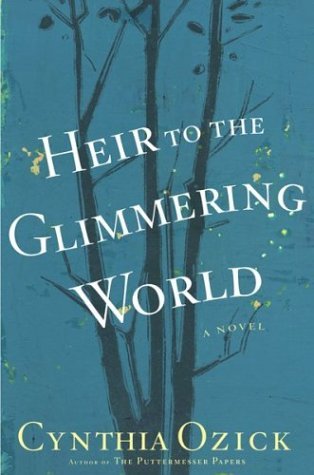
Heir to the Glimmering World

Rate this book
Rose Meadows unknowingly enters this world when she answers an ambiguous want ad for an "assistant" to a Herr Mitwisser, the patriarch of a large, chaotic household. Rosie, orphaned at eighteen, has been living with her distant relative Bertram, who sparks her first erotic desires. But just as he begins to return her affection, his lover, a radical socialist named Ninel (Lenin spelled backward), turns her out.

And so Rosie takes refuge from love among refugees of world upheaval. Cast out from Berlin's elite, the Mitwissers live at the whim of a mysterious benefactor, James A'Bair. Professor Mitwisser is a terrifying figure, obsessed with his arcane research. His distraught wife, Elsa, once a prominent physicist, is becoming unhinged. Their willful sixteen-year-old daughter runs the household: the exquisite, enigmatic Anneliese. Rosie's place here is uncertain, and she finds her fate hanging on the arrival of James. Inspired by the real Christopher Robin, James is the Bear Boy, the son of a famous children's author who recreated James as the fanciful subject of his books. Also a kind of refugee, James runs from his own fame, a boy adored by the world but grown into a bitter man. It is Anneliese's fierce longing that draws James back to this troubled house, and it is Rosie who must help them all resist James's reckless orbit.

310 pages, Hardcover

First published September 1, 2004

405 people are currently reading
2215 people want to read

About the author

Cynthia Ozick

108 books427 followers
Recipient of the first Rea Award for the Short Story (in 1976; other winners Rea honorees include Lorrie Moore, John Updike, Alice Munro), an American Academy of Arts and Letters Mildred and Harold Strauss Living Award, and the PEN/Malamud award in 2008.

Upon publication of her 1983 The Shawl, Edmund White wrote in the New York Times, "Miss Ozick strikes me as the best American writer to have emerged in recent years...Judaism has given to her what Catholicism gave to Flannery O'Connor."

Ratings & Reviews

What do you think?
Rate this book

Friends & Following

Create a free account to discover what your friends think of this book!

Community Reviews

5 stars
250 (11%)
4 stars
561 (26%)
3 stars
765 (35%)
2 stars
397 (18%)
1 star
154 (7%)
Displaying 1 - 30 of 286 reviews
Profile Image for William2.
855 reviews4,032 followers
March 6, 2020
Brilliant. A wonder and a joy! It's the mid-1930s and Herr Professor and Frau Mitwisser, being Jews, have fled Hitler's Germany with their big family. Thanks to the charitable Quakers, known for their tradition of religious tolerance, the Mitwisser Family is brought to New York, to Albany, where the professor begins to lecture at the Quaker college. Mrs. Mitwisser is deeply depressed, however, sometimes verging on the delusional, having had to abandon her high-profile scientific pursuits. (She'd worked closely with Erwin Schrödinger). She has now withdrawn from the rest of the family and lies inert in a remote sitting room. Our narrator, eighteen-year-old Rose, answers an ad in an Albany newspaper and comes to work for the Mitwissers. Actually, the ad is hilariously vague as to just what Rose's duties are going to be, but she answers it anyway because she has to get out of her cousin Bertrand's apartment since he's fallen in love with the loudmouthed Communist Ninel (Lenin spelled backwards), and Rose has fallen for Bertrand who, though very kind, just thinks of her as a "kid," which she resents.

The Mitwisser household also includes sixteen-year-old Annaliese, three younger boys (Heinz, Willi and Gert) and a toddler daughter (Waltraut). Soon they move to the Bronx because the professor, torn from Europe's great libraries due to the imminent war, has to continue his scholarly study of a heretical group of tenth-century Jews, the Karaites, at the New York Public Library. Interlarded with the story of the Mitwissers and Rose and the Karaites is the story of The Bear Boy. As a child, during the decade of The Great War, this fellow became the model for his father's dazzlingly successful series of children's books. Now in mid-life he's a lost soul who hates his immense wealth and lives a semi-debauched, drifter's existence. That's pretty much the setup, so I'll leave you hanging there.

Suffice it to say, the novel's language is rich without being daunting, its plot sprightly, and its structure awe inspiring. I really came to care for these vividly drawn characters, even the cynical Bear Boy, whose influence as patron of the Mitwisser household causes major friction between the professor and his wife. Cynthia Ozick is my new favorite writer. I plan to read everything she's written. Also exquisitely good are her The Messiah of Stockholm and The Puttermesser Papers, both of which I have reviewed.
Profile Image for Lisa (NY).
2,124 reviews820 followers
August 31, 2019
Listening to the audio of Heir to the Glimmering World, narrated by the amazing Julie Dretzin, was a wondrous and rich experience. Rose Meadows, exiled from Albany, arrives in the Bronx to serve as a caretaker/secretary for the Mitwisser family, refugees from Hitler's Germany. The plot meanders amongst the Mitwissers, Rose, her "cousin" Bertram and James A'Bair who brings tumult to their household. Ozick's use of language is stunning and her control of the narrative is brilliant.
I loved this novel!
Profile Image for Ian "Marvin" Graye.
946 reviews2,778 followers
February 20, 2022
CRITIQUE:

Better Than "Stoner"

As I approached the end of this masterful novel (set in the mid to late 1930's), it struck me more and more how richly detailed the characters were, and how Cynthia Ozick had drawn their differences and likenesses so precisely.

Because of its academic context, I was forced to compare it with "Stoner", in which there was only one character of any significance and focus, even though the prevailing emotion was one of self-pity. Here, there were multiple characters, none of whom was self-pitying, even if the prevailing emotion was one of melancholy, tempered with occasional humour.

In this case, there was ample basis for self-pity, yet nobody fell victim to it. They simply got on with their lives, as best they could, with a little help (and material support) from their friends (including, initially, the Friends).

Heretics and Exiles:

Although there are three families involved in the story in one way or another, the central focus of the novel is the Mitwisser family.

Professor Rudolf (Rudi) Mitwisser is a German Jewish academic, whose area of interest is a non-conformist sect or movement of Jews called the Karaites.

The Karaites derive the elements of their faith from the plain, contextual meaning of the Torah (peshat). They oppose Rabbinic Judaism which interposes Rabbis in the process of interpretation (derash). In effect, they believe it is up to individual Jews to interpret and determine the meaning of the Torah:

"In the ninth century [the Karaites] become the rabbis' foes. Scripture! they cry, Scripture alone! They will not tolerate rabbinic interpretation. They will not allow rabbinic commentary. They scorn metaphor and the poetry of inference. Only the utterance of Scripture itself is the heritage divine!"

The Professor explains his own area of interest in similar terms:

"...my work has to do precisely with opposition to the arrogance of received interpretation. Received interpretation is often enough simply error."

al-Kirkisani

Later, the Professor finds a passage in an Arabic translation of the Bhagavad-Gita by the Karaite, Jacob al-Kirkisani, that said, "Oh, immense, immense, immense! Inconceivable, amazing, immense! It opens before us a fathomless well of speculation, of unsuspected new leanings, of unknown marvels! And the mystery of it - consider that where Karaism contracts, Hinduism teems."

The Professor believes, "Here is a man, a mind comprehending vastness, a luminary, a majesty, and history obscures him, buries him, suffocates him! Ejects him! Erases him from the future, suppresses him, names him dissident, subversive, heterodox, transgressive...dissident from the normative, then dissident from the dissidents..."

"The Karaites also repudiate. They separate from the mainstream. They ridicule the mainstream..."

"They reject, they rebel. But al-Kirkisani reveals that he is apart from these things [against which they rebel]. Those who rebel do not regard themselves as heretics. Hardly so! They believe heresy lies in the very men they repudiate. For them, whatever is orthodox is heretical, so they depart from it."


Parasites and Refugees:

Professor Mitwisser and his family escape from Nazi Germany via Sweden in 1935, and take up the life of exiles in the United States. The once proud family is forced to think of themselves as parasites and refugees. The Professor seems to physically resemble Karl Marx, although this isn't expressly stated in the novel. Ozick does, however, call him "the huge Teuton who was no Teuton", which makes him sound like the Moor.

The Professor's wife, Elsa, was a senior fellow at the Kaiser Wilhelm Institute in Berlin, a talented physicist who assisted Erwin Schrödinger (the father of quantum mechanics) in the research for which he was awarded a Nobel Prize. While the Professor continues his academic research, Elsa retreats into herself, and becomes unable to care for their family. For much of the novel, she is broken, bedridden, and bordering on depression or insanity. But she never surrenders to despair, nor does her husband.

The Mitwissers have five children, the oldest of whom (she is a similar age to Rosie Meadows below) is Anneliese, who is tall, brown-haired, attractive, officious, "authoritative, but amazingly foreign...a refugee girl, an outlander...this foreign thing."

Rosie Meadows:

Rosie Meadows, a teenaged orphan, applies for employment with the Mitwissers. While her duties aren't specified, she becomes an amanuensis for the Professor, Elsa's servant, and caretaker of the younger children. She is also the first person narrator of the novel.

Her first impression of the Mitwissers was:

"These were refugees; everything about them was bound to be makeshift, provisional, resentful...

"My speech was stilted. I had at that time been reading 'Jane Eyre', and admired the gravity and independence of a sad orphanhood. My own try at gravity and independence was a way of escaping the wilderness of my father's imagination. My goal was utter straightforwardness: it made me prim and smug. I fought chaos and sought symmetry, routine, propriety."


Bertram and Ninel:

Rosie's mother's first cousin, Bertram (named after a character in Jane Austen's "Mansfield Park"), is tangentially involved, more so at the conclusion of the novel. He plays the role of a fantasy love interest for Rosie, at least until he forms a relationship with the Communist activist, Ninel (this is her Party name, which is a reversal of Lenin). This is how Rosie sees their interaction:

"I was seventeen and stabbed by jealousy...I wanted Bertram's kiss to land just once, even if unintentionally, on my lips..."

"I was reading [those old English novels] night after night, Dickens and Trollope and George Eliot, one after another."

"...[Ninel had intended] to remind me that the novels I loved were steeped in the pre-Marxist capitalist darkness of their wickedly imperialist times...

"Ninel was angry at Jane Austen not only on account of the British empire ['the whole thing's a plantation! The whole kit and caboodle!'] - she was angry at all novels. Novels, like movies, were pretend-shadows, they failed to diagnose the world as it was in reality. 'Crutches,' she said, 'distractions. And meanwhile the moneybags and the corporate dogs eat up the poor.' For Ninel, the only invention worse than novels and movies was religion...She railed against all varieties of worship."


19th Century Style

Structurally and stylistically, Cynthia Ozick modelled her novel on 19th century novels, such as those mentioned in the book itself (Austen, Dickens, Eliot, Trollope). There is a sense of realism, although it isn't strictly linear. The back story is filled in as the need arises, though nothing ever seems wanting or out of place. Ozick also has several epistolary chapters which contain detail that might have been difficult to dramatise.

In an interview published both online and at the back of the novel, Ozick says:

"It would be grandiose to call my novel a novel of ideas, but I hope I may venture that it is a novel of at least one idea: the idea of the necessity of interpretation, but also the danger of interpretation. What makes a human being? Language first, and then imaginative interpretation — the human mind cannot live without it. Like all literalists, the Karaites stood against imagination and interpretation, and they vanished out of history’s mainstream."

Gravity and Independence

This comment seems to be more dismissive of the literalism of the Karaites, than Ozick conveys it in the novel itself. I felt that the portrait of the Professor was overwhelmingly sympathetic. I have little knowledge or understanding of the history and context of these disputes about interpretation within Judaism. However, it seems that some Jews consider they have a legitimate right and reason to question the Rabbinical interpretation of the Torah, however imaginative or unimaginative it might be.

This doesn't mean that literalism should be considered a preferred or undesirable approach in other contexts, such as the meaning of the law, or the interpretation of the U.S. Constitution. Likewise, it doesn't mean that there is no place for the imagination in, say, a creative context. Language is approximate and imprecise, and requires some guesswork or invention around the edges.

Perhaps, in literature, at least, you could argue that we all have the right to make or find our own interpretation, to resist or ignore received interpretation or opinion, and to oppose orchestrated reception (whether orthodox or not).

description

The Bear Boy:

When first published in the U.K., this novel was called "The Bear Boy". This title reflects a focus on the character, James A'Bair, who was inspired by Christopher Milne, the son of A. A. Milne and the basis for Christopher Robin.

James was the basis of his father's stories about an imaginary, anthropomorphic bear, but like Christopher Milne (1), he resented the fact that he was turned into a fictional figure ("His father had created a parallel boy; his father had interpreted him for the world", and he could never experience real life from his own point of view, i.e., without outside influence, as if from the beginning. His life was already interpreted for him, by his father, the author, by way of analogy with a Rabbi: "The Bear Boy was never himself. He was his father's commentary on his body and brain." As a result, he suffered from "a dread of everything; a dread of living."

Nevertheless, James inherited a fortune when his father died. He regarded his wealth as symbolic of his oppression by his father and his fiction. "He liked getting rid of the money: trash money contaminated by the rouged knees and the lace collar" of the Bear Boy character. He seemed to be determined to get rid of his fortune as quickly as possible, mainly by way of philanthropy and supporting the Mitwisser family. He didn't seem to otherwise be a spendthrift.

Witness to Ecstasy

Towards the end of the novel, the Professor quotes an Arabic proverb to Rosie:

"The wise man speaks of ideas, the middling man of actions, the fool of persons."

Rosie feels that, bit by bit, she has become part of the Mitwisser family:

"[The] Mitwissers were an organism, and I was part of its flesh."

By working so close to the Professor, Rosie witnessed the influence of al-Kirkisani on his thinking:

"He had seen the Ganges, he had uncovered heresy in the Godhead itself. He had tunneled like a worm into Mitwisser's brain. His bones were Mesopotamian dust, yet they had permitted me to witness ecstasy."

What glimmered at the beginning of the novel glitters by the end. By achieving this transformation, Cynthia Ozick makes the reader feel that they, too, have been a witness to ecstasy.


FOOTNOTES:

(1) Christopher Milne: "It seemed to me almost that my father had got where he was by climbing on my infant shoulders, that he had filched from me my good name and left me nothing but empty fame..."
Profile Image for robin friedman.
1,942 reviews409 followers
November 17, 2025
The Bear Boy

Cynthia Ozick's 2004 novel "Heir to the Glimmering World" is known as "The Bear Boy" in the United Kingdom. It is fitting that this complex difficult novel will take two, or perhaps more, appropriate titles. "The Bear Boy" refers to one of the many principal characters in the book, James A'Bair. As a child, James had been the subject of a successful series of children's book written by his father. James inherits a fortune when his father dies. We wanders aimlessly over the world before ultimately becoming the benefactor of the Mitwisser family at the heart of the novel. The title "Heir to the Glimmering World" is both more poetic and more difficult to explain. The heir is the young woman narrator, Rose Meadows, 19, of the story. The "glimmering world" could be one of several lost worlds described in the story: the world of the Karaites, discussed below, or the world of Germany and scholarship before WW II.

The story is set primarily in depression-era New York in 1933 -- 1935. The book is told with great allusiveness in form and content to British novels, including "Sense and Sensibility", "Middlemarch", "Jane Eyre" and "Hard Times." The early stages of Ozick's novel take place in Albany and upstate New York while the larger portion of the book is set in a relatively remote section of the Bronx. The novel tells loosely interrelated stories of refuges, outcasts, and rebels.

The narrator, Rose, is a quiet, bookish girl whose mother died when she was 3 and whose father, a teacher and a gambler, dies when Rose is 18 after he has put the girl in the care of a distant relation, Bertram, 36. Bertram is divorced, a pharmacist, and involved with radical politics. He is in love with an even more radical woman, named Ninel, who is not committed to him. Ninel essentially forces Rose out of her home with Bertram, and at age 18 Rose drops out of a teacher's college which bores her to answer a strange ad placed by a Professor Mitwisser. Mitwisser is a student of religious history who has been forced to flee Germany. His wife, Elsa was a research physicist and the colleague of Erwin Schrodinger. The couple have five children. Elsa is despondent and appears mad. Their eldest daughter, Anneliese, runs much of the household. In Albany, Mitwisser has been teaching at a small college by the kndness of the Quakers. He is a renowned scholar of the heretical Jewish sect known as the Karaites. The governor's of the school mistake him as a student of Christian Charismatics. There is little interest in Mitwisser's passion for the Karaites in the United States. The family moves to New York City to allow Mitwisser to study and write. They are supported by the mysterious James, "The Bear Boy."

The Mitwissers have difficulty, to say the least, with their new home in America. In Germany the family was wealthy and respected for intellect and knowledge while in the United States they are spurned. There is a sense of high culture -- or "bildung" in German which the family, especially Elsa finds lacking in the United States. Professor Mitwisser wants his children and family to adopt and adjust, to learn and use English, and to drop German and German culture. The narrator Rose, too, is a refuge and an outcast of a different sort as is the wealthy, dissolute, wandering James who has somehow adopted the Mitwisser family and is their apparent benefactor.

Rose has an ambiguous role in the family as a companion to Elsa, a nanny to the children, and a scribe or "amanuensis" for Mitwisser. Although the Mitwisser family is not religious, Mitwisser is the greatest scholar of the Karaites. The Karaites are a Jewish sect originating in the early Middle Ages. The Karaites broke away from mainline traditional Judaism because they refused to accept the authority of the Jewish Oral Law --, the Mishnah and the Gemmorah which comprise the Talmud. Instead, the Karaites accepted the authority only of the 24 books of the Old Testament. Traditional Judaism rejected the Karaites as heretics and the sect became marginalized and obscure. Many of the leaders of the sect wrote voluminously and provocatively. Mitwisser, in this novel, is their scholar. As Rose comes to describe the Karaites as she learns about them from Mitwisser:

"They are dissidents; therefore they are haters. But they are also lovers, and what they love is purity, and what they hate is impurity. And what they consider to be impurity is the intellect's explorations; and yet they are themselves known for intellect." (p.73)

Professor Mitwisser loves the Karaites for their independence, their heresy, their obscurity, and their religious passion and feeling. His love, alas, is at the expense of much else in life, including his wife and children. Professor Mitwisser is pursuing threads regarding an earlier leader of the sect who, Mitwisser believes, travelled to India where he studied and became enamored of the Bhagavad-Gita. Ultimately Mitsisser's research program is dashed. Rose and Ozick in particular take a much more distanced position from the Karaites than does Mitwisser.

Elsa has a madness that derives from the wife in Jane Eyre. But she also sees certain things clearly. A physicist, she was also the lover of Schroedinger. She undergoes significant changes during the course of the book.

The book has the feel of a difficult coming of age story as Rose, who narrates the story from a distance, ultimately uses what she has learned from living with the Mitwissers to begin her own independent life.

Ozick has written a cerebral, thoughtful story of refugees, outcasts, and the life of the mind and its limitations. There is a skeptical tone towards political messianism and radicalism, in the person of Ninel and in Bertram's early life, and towards religious freethought and heresy, as exemplified by the Karaites. The author also turns a skeptical eye towards what she sees as the thoughtless, materialist character of American life. Some of the threads of the story do not come together well, and there is a sense of coolness and detachment towards the characters. This a challenging but rewarding novel.

Robin Friedman
Profile Image for Edith.
494 reviews
July 2, 2010
This book was NOT the thrill I anticipated after listening to Ann Patchett recommend it on NBC’s Book Club. She RAVED about this story effusively, calling it “all books for all people”. The story line sounded interesting…a displaced immigrant Jewish family in 1930’s New York state needing to hire a young girl for unspecified help….and had me running to the library to find this book.

I just do not get it. I found myself having to doggedly PLOW through this story (Julia’s words of “never not finishing a book” ringing in my ears). I had to work at it; I just found the writing frequently awkward and odd. The flow felt erratic, the descriptions often had a weirdness to them, there was needless repetition; it was difficult to identify with any of the characters. Yet this author is touted as brilliant. This book left me shaking my head quizzically.

I should say that one of the characters in the story is based on the real Christopher Robin of A. A. Milne fame. The grown-up Christopher Robin was an unhappy man who was alienated from his father who had used him as story fodder. I found that to be very sad.

I finished this book with a sigh of relief. (less)
Profile Image for Emilio Berra.
304 reviews281 followers
November 8, 2019
Una storia complessa
Un libro molto diverso dal piccolo capolavoro "Lo scialle" di C. Ozick, celebre scrittrice americana.

Rose, Io-narrante, giovane donna in cerca di lavoro, viene assunta presso una famiglia ebrea fuggita dalla Germania in America per sottrarsi al terribile progetto nazista. Siamo infatti nel '35.
Un nucleo familiare numeroso : un insigne studioso di un'antica setta eretica; la signora, una scienziata in forte depressione; cinque figli, la maggiore dei quali avrà un ruolo rilevante nel romanzo.
Le mansioni di Rose non sono ben chiare, ma presto s'accorge che sono innumerevoli.

In America sono degli esuli, stranieri/estranei, in condizione diversa rispetto al prestigio e all'agiatezza di cui godevano a Berlino : "ciò che un tempo là era apprezzato, oggi non è apprezzato qui. Qui non hanno la larghezza di vedute degli europei" .
"La famiglia Mitwissen celava un segreto: (...) che, secondo me, era proprio la signora". La sua presunta follia costituiva un enigma : "Era Amleto, per il quale la pazzia è stratagemma e difesa e tranello, o era Ofelia, sommersa dalla vera pazzia ? " . "Non dipendeva dal fatto che le mancavano le vecchie comodità ; le mancavano le vecchie dignità" .

La vicenda presenta sviluppi sorprendenti, anche per il lettore rimasto un po' frastornato nella parte iniziale del testo.

Profile Image for El.
1,355 reviews491 followers
May 23, 2010
The Mitwisser family are exiled Germans living in upstate New York during the Depression, and Rose Meadows, the narrator, answers an ad in the paper looking for rather vague household help. Her duties wind up being different things for different members of the family, depending on their needs. The Mitwissers's benefactor is James A'Bair, a malcontent who is popular because of his father's children's story books about the Bear Boy, ie James. James is loosely based on Christopher Milne, the son of A.A. Milne, who is immortalized as Christopher Robin in Winnie-the-Pooh, something Christopher was sadly never able to remove himself from.

I'm happy to be reading authors whose writings are better read personally than explained to someone else. Ozick's The Puttermesser Papers felt similarly to me - I enjoyed the entire reading process but didn't find myself analyzing or reviewing or editing it in my head as I read. To find an author like that, who can take me away completely, is exciting for me and I want to tell everyone to read her. But don't make me explain why. Ozick has a way with words and a style entirely her own, but as a strong female writer it's hard not to lump her (despite everything I believe in not lumping writers together based on gender or topic) with Angela Carter or Susan Sontag. Perhaps the fact that I'm reading more of these authors all around the same time has more to do with the categorization than anything else.
Profile Image for Sara.
140 reviews55 followers
May 22, 2007
This was a reasonably satisfying read -- good stuff for curling up in bed during a cold night -- but the story of a wildly disaffected, almost schizoid nanny in the house of a family of German immigrants coughs and sputters at its core. The narrator's complete lack of affect is supposed to do something, but exactly what is never clear. Equally unclear is what the poorly disguised retelling of A A Milnes' own alienated son is doing in this book. If you approach it as a sweet compendium of idiomatic behavior, you'll enjoy this just fine.
Profile Image for Jeanette.
4,079 reviews837 followers
September 3, 2014
Superb writing and enthralling family and character study of these refugees and the narrator who is hired as the father's "aide". It's a tremendous analysis of intellectualism, culture, hierarchy, economic power, language change and esteem alteration- you name it. All within desperate times of change. This is not the particular time period, place, or type of voice that I usually prefer- but the writing of this place and of these people is spot on to a masterful reveal of essence, emotion, and their reality of choices to chosen survivals. It doesn't much miss any of the Bronx locale nuance for that particular period either. Excellent read!

This author writes in a classic mode, sometimes you must tease the unsaid meanings out of her. What is unsaid, being sometimes understood in a much deeper way than if it was detailed. It can seem slow for that reason to some, but this one is in a class of literature with the big L. I especially liked her politico characterizations and her view into "sane" self-identification reactions of the Mother. She, in her own estimation, did not compromise her "place" of esteem deserved.

As a person who has heard English spoken by people who never heard a word of it until they were out of their teens, or by some whose 3rd language is English- I was flummoxed by this author's skill in German nuance and placements. EXCELLENT and so few can do it. I can understand how many readers would be turned off by this as a read because they find it is odd or awkward, not flowing prose. I understand the density for them and the plodding to get anywhere here. Yet that feels, to me, authentic- and worth the slowness of this period piece.
Profile Image for Josh Friedlander.
829 reviews135 followers
February 20, 2020
In the vein of this meeting should have been an email: this novel might have been a solid three-page story. Possibly? At least to me it felt immensely drawn-out, a never-ending landscape of melodramatic sturm und drang. There are some stuck-up, repressed German immigrants; the narrator who works for them, who has unprocessed feelings about her father; a Communist activist; the heir to a children's book fortune. I never cared about any of them and just wanted this to end. Maybe this is not the best Ozick, though?
Profile Image for Marne Wilson.
Author 2 books45 followers
August 26, 2016
This book began very promisingly and then just fizzled. Since there wasn't a lot holding my interest, I started paying attention to point of view. The beginning of the story is told in first person by Rose Meadows, then the point of view switches to third person limited omniscient for a while. Finally it switches back to first person, but with a very different-sounding Rose, who recounts things she couldn't possibly know and couldn't even have learned from talking to the other characters. This distracted me a lot, but I really don't think I would have fixated on these problems if the book was interesting. Ozick is a capable writer, and there were many beautiful passages, but not a whole lot happens in the middle section of the book, and the action just sags. The end, when it finally comes, is abrupt and not satisfying at all.

I think there probably was a good story here, but it didn't quite get told. In my opinion, this book could have stood a lot more editing and was released before its time. It's always so disappointing when that happens.
Profile Image for Lori.
266 reviews31 followers
May 21, 2012
I thoroughly enjoyed this book and am sorry to finish it. It’s one of those dreamy books that creates such a particular world. It’s very well-plotted, and the characters are unique and real, but it’s the richness of the created world that makes me love this one. Ozick has made me know just how those teacups, the china ones with yellow roses, feel in my hand; just how Waltraut’s dolls sound on the stairs; just how the Professor’s study feels when you enter it; just how Bertram fills up the kitchen, and creates a home from the awful house the Mitwissers inhabit. It’s like she gave me the memories and experiences of those people and that place, even the ones she didn’t include in the book. Somehow she gave them all to me.

Don't read it expecting to find a page-turner, a book you get all electrified by -- it's not that. Expect to soak in it, let it soak into you. It's one that leaves you tinted with its memories.
Profile Image for Lark Benobi.
Author 1 book3,786 followers
January 30, 2019
This novel was completely unpredictable and not like anything I had ever read before and that in itself makes it worth reading. But beyond that the prose is beautiful.
Profile Image for Lemunty.
6 reviews
Read
December 13, 2010
I picked up this book in Delhi, off a pavement seller peddling second-hand books for a pittance, primarily because it looked interesting and light, and I thought something cheerful would be nice. I would hesitate to call this either cheerful, or light, but it wins on the interesting scale. Heir to the Glimmering World is not, as the title might suggest, a book about fantasy or adventure, or even about inheritance (well, at least, not much).

It's about a girl, working as a governess to the Mitwisser clan, a strange and chaotic family patronised by the young, wealthy and mysterious James A'Bair. Does the governess end up happily married to the young millionaire? No, she doesn't, and that alone should pique your interest. Herr Doktor Professor Rudolf Mitwisser himself is a scholar of an ancient Jewish sect, a field of study of interest to no one but a small group of like-minded scholars and his patron. James A'Bair, heir to the fortune built by the sale of childrens' books written by his father, and based on him, is sulky, whimsical, and charming all at once, the sole reason that the entire family isn't on the streets, begging. The rapidly deteriorating mental state of Mrs. Mitwesser, the acting out of her younger children in a desperate bid for attention, her daughter's frantic desire to escape the familial trap of poverty, create a cast of characters that our protagonist, Rose, deftly picks her way through.

This is a book that contains neat touches of humour amidst the quietly understated misery of many of the characters. One is left with a feeling of despair, but not an overwhelming one - a sense that this too is something that be absorbed, tolerated, learned. The Mitwessers are refugees in the New York of 1935, escaping Nazi Germany. With their background and Rose's orphanhood, this is as much a novel about trying to fit in, as it is about love, and desperation. I very much liked it, and I'm not sorry at all for judging the book by its cover.
107 reviews3 followers
January 30, 2011
Finally an author with a masterful command of the beauty and intricacies of the English language. Half the book follows the narraror, hired as half scribe half caretaker. A fine portrait of the various stark disenchantments of childhood, the woundedness of exile of all kinds, and the inscrutability of the ones who are supposed to guide us. The author is unsentimental about children and describes the mind-numbing nature of the options left to girls of lower middle class upbringing, the obscure rules of servitude, and the lives of refugees among other topics. The discussion of the unusual sect of Jews was hard to penetrate in context but worth the intellectual challenge. The other half of the novel follows the itinerant child and muse of a popular children's book author and his shameless acts of spite.
38 reviews
December 14, 2008
Would have given four stars because Ozick's writing kept the pages turning. There were some interesting premises within the novel that could have been separate novels in and of themselves. But I gave three stars because the relationships among the characters never really went anywhere and the plot clumsily bumped along until the end just sort of arrived. Ultimately, I felt like all the great writing went to waste.
Profile Image for Sarah Beth.
1,369 reviews45 followers
December 15, 2014
This novel is narrated by Rose, who lost her mother as a three year old and her careless and reckless father when she was eighteen. A cousin, Bertram, takes pity on her and takes her in, but in time Rose discovers that "he was not a cousin by blood. Instead he was a cousin to my mother's first cousin; it was a tenuous in-law connection. Laughing, Bertram had worked it out for me - he was the son of my mother's aunt's husband's sister. He was not really a relation" (19). In time, Bertram's girlfriend boots Rose out, which is how she ultimately winds up in New York as a sort of secretary/nanny/servant/undefined assistant to the Mitwisser family. The Mitwisser family, father Rudolf, wife Elsa, daughter Annaliese, three sons, and a toddler daughter, have fled Berlin, penniless. In time, Rose understands that the family is supported by James A'Bair, the heir to a fortune his father made selling books called The Bear Boy, of which James was the star.

Although largely from Rose's perspective, the novel does have flashbacks to reveal James' childhood as a reluctant star of his father's bestselling books. In fact, Ozick based the character off of Christopher Milne, the son of the creator of Winnie-the-Pooh. James resents his childhood and seems hell-bent on blowing through his fortune.

In time, it becomes clear that the Mitwisser family is merely a living doll house for the heedless heir, James. As an idolized child star, James received dozens of presents in the mail, none of which captured his attention the way a doll house did: "Wherever he ordered them to go, they went - he had only to grip their yellow heads with his fingers. And sometimes he told them not to move at all, to stand very still in such and such a position. They always obliged him" (173). Seemingly randomly, James selected the poor Mitwisser family to install in a similar house. "This house! This whim! Narrow and tall, three stories high - it had the configuration of a doll house" (297). And like the dolls in his doll house, they oblige his every whim. Until he tires of this toy as well.

This novel had such a dreamlike, surreal quality to it. In additional, although set in the 1930s, it almost feels like a fantastical story that could have taken place at any point in time after the invention of cars and typewriters. There's little sense of the historical in the novel's setting.

Although I enjoyed aspects of this novel, particularly the complexity of the character of James, I found parts of this unbelievable. In addition, it felt like some aspects of the plot didn't quite connect to be brought full circle. But perhaps Ozick was striving for mixed connections between her largely dissatisfied cast of characters.

3.5 stars
Profile Image for Lisa H..
247 reviews14 followers
March 9, 2013
I don't remember whether I officially put Heir to the Glimmering World on my to-be-read list when I read a review from Powell's (if you're a big reader and you need new suggestions for reading material, get on the powells.com review-a-day email. They cull reviews from good periodical sources like Esquire, Vanity Fair, Atlantic Monthly, etc. and I probably end up with several new must-reads every month, and forward others to people I think would be interested), but I remembered the title when I saw it on the library bookstore's shelf, which indicates I was at least intrigued by the review.

Regardless of the absence of a compelling plotline, Cynthia Ozick's writing grabs you and pulls you into this tale of displaced people in 1930s New York - primarily the narrator, a young woman badly raised by a ne'er-do-well father and eventually fobbed off on a relative, who does right by her until his own choices squeeze her out, sending her off to a questionable and ill-defined position in the household of an immigrant family of scholars. They have been forced from their homeland by the Nazi regime and now depend on the largesse of an unseen (at least for the first third of the book) and erratic benefactor who as a little boy was the unwitting and eventually unwilling star of his father's series of children's books.

The book is about choices (often the lack of them), and obsessions, and denial, and the freedom money gives you, and caretakers, and ultimately I can't say I really *liked* it. Once the framework of the story had been laid down, I found too much repetition of particular themes: the benefactor's resentment of his twisted childhood; the mother's ebb and flow from function to dysfunction to function again, fed by different characters' willingness or ability to coddle her; the poorly fleshed-out, nearly interchangeable sons who dash through the scene and make inappropriate and pointless comments to the narrator. Ultimately, all are left in a sort of limbo, subject to the influence of next person who is injected into this motley group, and not really going anywhere.
Profile Image for E.
1,413 reviews7 followers
August 7, 2014
An odd, yet interesting read, my first delve into Ozick. I was disappointed that the narrative did not provide as much background as I expected about the pre-WWII "upheaval" in Germany that led to the Mitwissers' refugee status, which was part of what drew me to the book in the first place. Nonetheless, while I wouldn't say I found it compelling, I somehow felt I needed to see it through, with the strange Mitwisser family's twisted, yet loyal dysfunction; James's sad, yet generous meanderings; and Rose's slightly melancholy life and "outsider" observations. The middle section, particularly pages on pages about the Karaites, was a bit tedious and too forced--like Ozick was trying to squash a sprawling Richard Powers novel of ideas into the miniature frame of a Jane Austen domestic comedy. And part of me was far more interested in Rose's disheveled family history rather than the Mitwissers'. But I still found the book a worthwhile undertaking, rather like turning over a curious foreign object in one's hand while trying to analyze what its purpose is and how to make it work.
694 reviews32 followers
November 15, 2021
I have enjoyed other books by Cynthia Ozick but found this very disappointing and struggled to finish it. The characters were all very unsympathetic and the overall atmosphere of gloom was depressing. The story seemed aimless and the writing style jerky. I kept looking for some clue as to what it was really about - identity, perhaps? The characters did seem to be reinventing themselves - but ended up feeling as if I had totally missed the point.
Profile Image for Erwin Maack.
451 reviews17 followers
October 16, 2022
Nós somos herdeiros de um mundo de pirilampos e parasitas, sim é um fato. E essa história demonstra a iluminação de um judeu ultraortodoxo que encontra a solução de todos seus enigmas . E se dá por satisfeito, nada há mais nada a se fazer.
Ele será um vagalume que brilha intensamente e depois desaparece. No centro de uma balbúrdia de impressões, histórias da vida, da busca através do dinheiro de algo significativo, e do fracasso de todas elas e mesmo o professor que chegou à solução também desaparecerá inevitavelmente, assim como todos os demais.
É uma escritora indispensável como poucas. Creiam-me.
14 reviews
December 11, 2010
I have only read one other novel by Cynthia Ozick, the Puttermesser Papers, and this book has a very different feel. I preferred the Puttermesser book, which struck me as being very inventive and in the realm of magical realism with a dash of New York Jewish humor. This novel doesn't have that kind of fantasy aspect. In other words, everything that happens in the novel could actually happen in real life. Also, it's more serious, and kind of sad.

However, I did enjoy reading this book, which I read with a book group and the discussion about it was spirited. The plot is very unusual, and the main characters are well drawn and fascinating. There is a beautiful line from the book describing the house with its characters as "a house of bruises," as all of the main characters are all bruised from life. However, it is a gentle book, and takes the characters and their victimized lives and examines their pain, and Ozick's elegant writing helps us understand their pain and their motives.

The end, which I won't reveal, was a real surprise to me.
Profile Image for Bookmarks Magazine.
2,042 reviews809 followers
Read
February 5, 2009

Heir revisits many of Ozick's trademark themes, which stem from her own heritage: European versus American culture, scholarly pursuits, cultural and class conflict, and exile, both real and imagined. As befitting an author of great intellectual range, Ozick exhibits extraordinary knowledge about her subjects, from Victorian literature and religious mysticism to Depression-era New York. Heir, a captivating, polished story about three sets of lives, resembles in its compassionate questioning of life the Jewish debates she invokes. It also, in its Victorian leanings, explores how modern misfits deal with issues of family, employment, love, and wealth

Profile Image for John Pistelli.
Author 9 books361 followers
November 27, 2015
{Spoilers abound below. This is a novel as profound as those of its sources—Austen, Dickens, Eliot, James—it cannot be spoiled by a mere recitation of its events. It must be read.}

This 2004 novel has not received its due. It seems to have baffled most critics and reviewers, as its contents are at odds with its packaging. Because it takes the plot of the classic nineteenth-century English novel as its own—combining an Austenian satirical romance with a Brontean female bildungsroman—it was sold as a work of popular literary fiction, the kind of art-novel you could take to the beach. But it deploys this classic emplotment ironically and self-consciously, as a comment on all that it would have to exclude of intellectual and political life to make its readers happy. And it does so in a prose too complex and vivid to do anything so simple as deliver a merely exciting story.

Its story is this: in the mid-1930s, the novel’s narrator, Rose Meadows, the daughter of a ne’er-do-well schoolteacher and a dead mother, goes to seek her fortune upon reaching adulthood by answering an ad to serve the Mitwisser family in some unspecified capacity. The Mitwissers are Jewish refugees from Germany—the father, Rudolf, is an obsessive religious scholar, specialist in the Karaites, an obscure sect of eighth-century Jewish fundamentalists who rejected the Talmud and proposed only a literal reading of Torah; the mother, Elsa, is a scientist who was once the colleague, the lover, and the uncredited inspirer of Erwin Schrödinger. They have three sons (one of them possible Schrödinger’s—Ozick, unlike the tedious Tom McCarthy, has the good taste not to mention the physicist’s over-familiar feline, but the is-he-or-isn’t-he joke about Schrödinger’s paternity will please the reader seeking subtlety) and two daughters, one still a small child, and the other, Anneliese, is the eldest of the family and its de facto head, since the father is too obsessed with his studies for household cares and the mother too traumatized by what the family endured in being chased out of Germany by the Nazis to function in everyday life.

The family’s patron is one James A’Bair, who was the model for his father’s world-famous series of children’s books focused on “the Bear Boy.” James, inheritor of his father’s fortune, is a restless wanderer—Ozick’s pages in his wanderings around the world are superb—and seems drawn to the Mitwissers not only because he wishes to seduce Anneliese (though he does), but because he identifies with the heretical Karaites in rejecting all traditions and forms of order. He exemplifies Ozick’s career-long polemic against idolatry, having been converted from a person to an idol by his father and then by the reading public. This has left him empty and soulless, an ambulatory fetish, and Ozick’s evocation of his sorrow, even in the midst of the trouble he sows, is a superb act of novelistic sympathy.

The novel’s other central characters are Rose’s cousin Bertram, a well-off pharmacist, and his lover, Ninel (i.e., Lenin spelled backwards), an ardent communist. Bertram, who seems like a side character in the beginning, comes to dominate the novel’s conclusion; a character who initially appeared merely feckless comes to seem monstrous. For James eventually does seduce and abscond with Anneliese; he unwittingly gets her pregnant, but shortly after commits suicide. His vast fortune, then, goes not to Mitwisser—to whom he had designated it in his will—but to his unborn son. Bertram who has come on the scene following Ninel’s death in the Spanish Civil War and his own explosion from his profession due to his communist sympathies, marries Anneliese and becomes the legal guardian of James’s child and thus James’s de facto heir. Their sudden wealth revivifies Mrs. Mitwisser and defeats her husband, as his scholarship cannot thrive in the atmosphere of crass wealth Bertram has destined for the family. Rose, for her part, exits the family and ends the novel by moving to New York City to work as a secretary—and, it is implied, as a writer.

A happy ending? Why not?—the family is saved, the eldest daughter is married, the narrator “begins the world.” But, on reflection, there is little happy about it: the novel ends on the eve of war, with European Jewry about to be exterminated; American Jewry, meanwhile, is about to be dissolved in American capitalism, assimilated to the amnesiac and idolatrous cult of money, cut off from its tradition, even from the tradition of its own internal dissidents and anarchists. The novel comes to seem a demonic parody of Jane Austen: in America, the winners of a Jane Austen novel would be its unscrupulous seducers and naive, absconding daughters, rather than the wise heroine and her good man. Its unwieldy title, editorially imposed, is an ironic, even sarcastic one: the world the novel describes is various and occasionally beautiful, but it rarely glimmers.

The late John Leonard, with his characteristic enthusiasm, hymns the novel thusly, and catalogues even more of its profligate marvels than I have found the energy to mention, even as he censures a few of Ozick’s less nuanced judgments:
Never mind the Communist girlfriend, so negligently travestied that she might as well be the airhead mother in "Trust." Lefties in Ozick's fiction are as rudely caricatured as Palestinians in her essays, or Primo Levi before he killed himself, or Miami in "The Shawl."

Otherwise, "Heir to the Glimmering World" is both a chambered nautilus and a haunted house -- a fairy tale with locked rooms, mad songs, secret books and stolen babies. And a children's story, an Oedipal grief, about killing fathers and moving on. And a sendup of Victorian novels that solve their problems with fortuitous marriage, sudden death, miraculous inheritance, emigration to Australia or all of the above. But also a grim parable about "purifications" -- by fundamentalist ascetics like the Karaites, repudiators of the rabbis and Talmudic commentary; by Hindu skeptics like the Nastiks, who mocked the priests in the Upanishads by comparing them to white dogs in a procession, each holding in its mouth the tail of the next in line; by the sages of high German humanism, who conferred on credulous communicants like Rudi and Elsa a counterfeit comfort, a fraudulent dignity, and the illusion of a bildung whose possession meant you were "more than merely cultivated," you were "ideally purified by humanism, an aristocrat of sensibility and wisdom"; and, of course, by National Socialism, with its death-camp refinements.
Let me conclude with a sample of this novel’s exquisitely precise but paradoxically also pungently vital sentences. In this passage, Rose is describing Mrs. Mitwisser’s nearly supernatural sense of what is happening in her family, even as she keeps to her bedroom, prostrated by trauma:
She had reverted to nightmare; she had usurped my father’s nightmare. I saw, in the conflagration of her seeing, the critical logic of what hardly deserves the name of madness. Nothing was obscured, reality burned and burned. She knew and she knew. In the shadowed seclusions of our little house on a forgotten street in a nondescript cranny that turned its back on everything urban, hidden in cattails along the lip of a bay where the tide, going out, left behind the odors of seaweed and bird-lust—here in her nightgown, alert to the subterranean calamities of the world, sat the sibyl.
In this passage, which summons nature and gives credence to female vision, can be found one half of the novel’s worldview. But alas, madness is no salvation from the world’s dangers; and Ozick’s lament over sibylline magic’s opposite, religion and scholarship, forms the other half of the novel’s dialectic, even if this dryer subject matter is never evoked so beautifully.

Those seeking only a review can stop reading now. But in a subsequent blog post, which you can read here, I want to elucidate two of the novel’s subtexts—politics and religion—and to discuss Ozick’s quarrel with two prominent literary critics: Edward Said and Harold Bloom.
Profile Image for Mike.
856 reviews2 followers
February 16, 2024
This novel has a really interesting premise - in 1933, the Bronx, a young woman is hired by German-Jewish refugees to - be what, exactly? A secretary for the patriarch? A companion for the wife? A governess for the children? Our narrator, Rose Meadows, is great, and funny, and confused, and I was really enjoying Ozick's 20th century Jewish spins on Jane Eyre. But halfway through, the book introduces a new, less interesting character -- James, the child of a famous children's author, and as the narrative switches over to him, I lost interest. Ozick pulls out some neat narrative twists at the end, but I missed Rose.
Profile Image for Hannah Rosenthal.
290 reviews11 followers
June 30, 2020
I alternated between listening to the story ( amazing) and reading it. Love the writing-so poetic. Did not like an6 of the characters especially but was very engaged and enjoyed it.
115 reviews1 follower
February 9, 2021
Hard to get into initially and slow moving but then story accelerated and I found myself wanting to know what happens to the characters. I think 2 1/2 stars but since can't give that, I gave 3 stars.
Displaying 1 - 30 of 286 reviews

Can't find what you're looking for?

Get help and learn more about the design.