What do you think?
Rate this book


86 pages, Hardcover
First published January 1, 1986
The city crumples like a burning page. Run, without crown, without scepter; no one will realize that you are the king. There is no night darker than a night of fires. There is no man more alone than one running in the midst of a howling mob.The last story, The Name, the Nose, was brilliant as well, albeit more confusing and ambitious than the other two. Again, Calvino managed to encapsulate the sense of smelling with his words, which is a feat that I respect, not many writers can do that. My only criticism is the fact that the story should've been longer: its ending was way too rushed and over-the-top and the character of Monsieur de Sainte-Caliste, in particular, would've warranted further examination. I think the entire murder-subplot should've been omitted for more of his musings.
'The city holds the roar of an ocean as in the whorls of the shell, or of the ear: if you concentrate on listening to the waves, you no longer know what is palace and what is city, ear, shell.
Among the sounds of the city you recognize every now and then a chord, a sequence of notes, a tune: blasts of fanfare, chanting of processions, choruses of schoolchildren, funeral marches, revolutionary songs intoned by a parade of demonstrators, anthems in your honor sung by the troops who break up the demonstration, trying to drown out the voices of your opponents, dance tunes that the loudspeaker of a nightclub plays at top volume to convince everyone that the city continues its happy life, dirges of women mourning someone killed in the riots. This is the music you hear; but can it be called music? From every shard of sound you continue to gather signals, information, clues, as if in this city all those who play or sing or put on disks wanted only to transmit precise, unequivocal messages to you. Since you mounted the throne, it is not music you listen to, but only the confirmation of how music is used: in the rites of high society, or to entertain the populace, to safeguard traditions, culture, fashion. Now you ask yourself what listening used to mean to you, when you listened to music for the sole pleasure of penetrating the design of the notes.' (The King Listens)
'In this seesawing of the scale of odors, I was lost, I could no longer discern the direction of the memory I should follow: I knew only that at one point of the spectrum, there was a gap, a secret fold where there lurked that perfume which, for me, was a complete woman.' (The Name, the Nose)
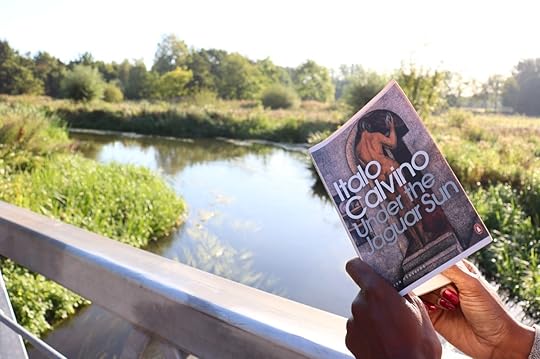
'But the memory was like a trompe-l'oeil, and when I examined it a little, it gave me a sense of multiplied distance, in space and in time.' (Under the Jaguar Sun)
‘The obstinacy on which power is based is never so fragile as in the moment of its triumph.’