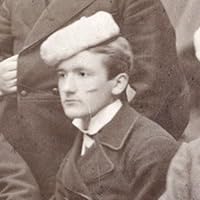
Born in Fuente Vaqueros, Granada, Spain, June 5 1898; died near Granada, August 19 1936, García Lorca is one of Spain's most deeply appreciated and highly revered poets and dramatists. His murder by the Nationalists at the start of the Spanish civil war brought sudden international fame, accompanied by an excess of political rhetoric which led a later generation to question his merits; after the inevitable slump, his reputation has recovered (largely with a shift in interest to the less obvious works). He must now be bracketed with Machado as one of the two greatest poets Spain has produced in the 20th century, and he is certainly Spain's greatest dramatist since the Golden Age.
Many years ago reading a book of the poems by Lorca was an eye-opening experience to me; from that time on I started learning to understand, appreciate and love poetry.
Schematic Nocturne (Nocturno esquemático)
The fennel, a serpent, and rushes. Aroma, a sign, and penumbra. Air, earth, and solitariness.
(The ladder lifts up to the moon.) ------------------------------------------------------------------------------ AND AFTER THAT
The labyrinths that time creates vanish.
(Only the desert remains.)
The heart, fountain of desire, vanishes.
(Only the desert remains.)
The illusion of dawn and kisses vanish.
Only the desert remains. A rolling desert. ------------------------------------------------------------------------------ IT'S TRUE
Ay, the pain it costs me to love you as I love you!
For love of you, the air, it hurts, and my heart, and my hat, they hurt me.
Who would buy it from me, this ribbon I am holding, and this sadness of cotton, white, for making hankerchiefs with?
Ay, the pain it costs me to love you as I love you!
For one reason or another, I felt pretty confident going in that I would like Lorca's poetry but I quickly realised it's very different from the kind of thing I'd been expecting. After reading through 'Book of Poems' and not really getting it, I skipped ahead to 'Gypsy Ballads', which I also didn't get. From there I read on to the end, then went back and read over the sections I'd missed in reverse order.
The first poem that made me stand up and take notice was 'Qasida VIII - Of The Golden Girl', probably because it was less surreal than many of the others and easier to get a hold on. There weren't anymore I really liked in this section, so I skipped back to the section 'Poem Of The Cante Jondo' where 'Dagger' caught my attention, soon followed by Surprise.
After liking those three poems, I realised there are at least 'some' Lorca poems I enjoy, and started to give him the benefit of the doubt a bit more as I examined his work a little more closely. As I write this, there are a dozen or so in this collection that I like, which is quite a big improvement considering that on days one and two of reading Lorca's poetry, I didn't really like any of it. Who knows? Maybe he'll go the way Rimbaud went for me and I'll gradually like him more and more, improving this review with each reading.
One thing I did notice, is that when I was browsing online I stumbled across translations of two of the poems listed below that I preferred to the translations in this book. That makes me wonder if the Sorrell translations contained within are maybe not the best ones to start with, focusing more on literal accuracy than the real sense of the poem. I might look into this at some point. For now though, I'll leave this lying around and pick it up now and then and see if Lorca can coax anything better than a 2 star review out of me, because as much as I liked the poems listed below, I didn't love them enough to make up for the dozens of others that did nothing for me whatsoever.
Anyway, these are the ones I liked:
Autumn Song The Guitar The Shout Dagger Surprise Nocturnes At The Window Horseman's Song Venus - I Saw You Thus The Moon Appears He Died At Dawn Another Way Song Of The Dry Orange Tree Qasida VIII - Of The Golden Girl
Strugged to get through this one. The Spanish, even for me a fluent reader and speaker, was very difficult. In english I was just not as inspired as I was with Neruda.
Reading Lorca was't a piece of cake. Some poems are too melancholic, some are way to profound. I would love to carry it around just to feel the warmth of it!
I have always been captivated by Lorca's poetry. My personal favorite poems of his are;
“ Neither you nor I are ready to find each other. You … you know why . And I loved her so much! Follow that narrow path. In my hands are holes from the nails. Don’t you see how I’m bleeding to death? Don’t look back, go slowly and pray as I do to San Cayetano, for neither you nor I are ready to find each other.”
“ Ay, the pain it costs me to love you as I love you!
For love of you, the air, it hurts, and my heart, and my hat, they hurt me.
Who would buy it from me, this ribbon I am holding, and this sadness of cotton, white, for making hankerchiefs with?
Ay, the pain it costs me to love you as I love you!”
“ The first time I didn't know you. The second time I did. Tell me if the air tells you so. One sharp morning I grew sad and was seized by the impulse to laugh. I didn't know you. But you knew me. Yes I knew you. You didn't know me. Now a month stretches between us two, no feeling, like a screen of grey days.”
'busco en mi carne las huellas de tus labios. el manantial besa al viento sin tocarlo.'
'i search my flesh for the mark of you lips. the fountain kisses the wind without touching it.'
.
i have been interested in garcía lorca's poems for the past few years but never found the chance to actually sit down and read them together. whilst those selected and translated here are incredibly beautiful (some more than others), i don't connect to their translation as much as i have with christopher maurer's. now i am by no means fluent in spanish (yet...), but i think the emotion of the words is slightly lost here :(
all this to say i will be tackling the 1000+ pages of his collected poems as soon as i can get my hands on it!
3 stars because Sorrell's translations are lifeless and often incorrect/misleading. much of lorca's young poetry is just an annoying young man brooding in his room by himself, his later works gets much more interesting & developed and you can see the growth towards the end of this book
The English versions of these Lorca poems have lost too much in translation. I recommend you either read in the original Spanish (if you are up to it) or find a different translation.
To check if someone is dead you can search for a pulse, a sign of breath, or a heartbeat. For lovers of poetry, waving some Federico Garcia Lorca will do. So, why has this "new" translation got such lifeless reviews? I wanted to find out.
The Mystery of the Lifeless Reviews
The start was intriguing. On the cover is a Dali-esque drawing of a guitar with an eye. Is it Lorca's eye? Or someone else's? A circle goes around it like a lock. The key must be inside.
Bilingual editions hand you the clues. A sharp eye is all it takes. An ear as well is useful. Provident, also, to note the words which end lines. The same as in death, last words deserve to be kept how they are said. Yet, Lorca's are not preserved in this translation. Let me illustrate with one short poem in which the words "Ciel azul./Campo amarillo." become this (with more even more changes):
Blue sky. Yellow field.
Blue mountain. Yellow field.
Across the scorched plain an olive tree drifts.
One lone olive tree. (poem ends)
Now, this is how I would write it:
Sky of blue. Field of yellow.
Mountain of blue. Field of yellow.
Across the scorched plain walks an olive tree.
One lone tree. (poem ends)
Returning to the Spanish original gave me all I needed to know. There I found an echoing set of sounds that "oohed" and "ohed" with words that came at the end of lines. By appearing there, the impact is greatest. Color like blood in a body gives this poem life. So, does the rhythm made with the word "of" in English. Now, it pulses. There is movement, too, in my translating "va caminando" as "walks." Wood that "drifts" is dead, broken from a ship that sunk. An olive tree with its gnarled trunk more closely resembles a man with years and experience and a face lined like Auden's, the poet whose age Lorca, sadly, never reached.
Interesting little poems in this very short book which you could probably finish in a couple of hours. Here are the best bits:
I will give everything to others. And weep my passion. Like the child abandoned. In a story crossed out.
My heart’s a butterfly Good children of the field Pinned by times grey spider.
The sea smiles from afar Teeth of foam, lips of Sky.
You and I— neither ready to meet. You. you know why. I loved her so much! Down this little path. Nail-holes in my hands. Don't you see my blood draining? Never look behind you, walk slowly away and like me pray To Saint Cayetano for you and I, neither's ready to meet.
How distant you and I together. How close when you depart.
And the wings of your stern soul. Have been gored by troubled words.