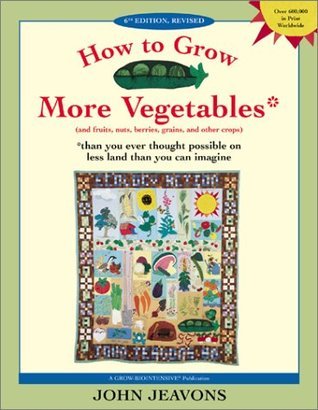
This book is for you if:
1) You are planning a trip to Mars and need a self-contained food-producing system.
2) You are prepping for the zombie apocalypse and need to grow every scrap of your own food and compost to maintain soil fertility.
3) You are a nerd who had read too many gardening books that reference Grow Biointensive, and want to know what it actually is (that's me!)
This book isn't for you if:
1) You want to grow more vegetables. Most of the book is about growing grain -- both for eating and because it produces a bunch of stuff you can compost to maintain soil fertility without external inputs.
2) You don't live on a ton of space. The book estimates you need 4000 square feet per person to sustainably grow their food. They suggested devoting only 10% of that to vegetables, or 400 square feet per person. There are six people in my family. We don't have anything like 24,000 square feet of growing space. We'd be doing amazing to hit their 10% estimate (2,400 square feet) and grow all our own veggies.
3) And on the heels of that last one, this book isn't for people with children. None of the charts estimate how much space you need to feed a child. And the claim that you can grow all your own food part-time is nice (IIRC, 14 hours/week), but when I multiply that out (84 hours/week) it's laughable for my family. Given that this is supposed to be a book for feeding generation after generation of people on limited space, it's still weird to me that there's no mention of kids, or how the higher-calorie demands of say, nursing or pregnancy fit into this scheme, either.
4) Following up on the time concerns, the authors talk a good deal about how easy it is to integrate growing all your own food into your daily life, but they don't actually do it: "We still take a neighborly ribbing for racing down to the farmers' markets to buy sweet corn, carrots, and other vegetables and fruits to feed an extended family of staff, apprentices, interns, and friends at our research site. Research priorities often interfere with growing all our vegetables and fruits. It is difficult to research, write, publish, teach, do outreach around the world -- and farm -- all at the same time!"
It seems that growing grains is significantly more time-consuming than the authors claim, especially, I'd think, if you follow their advice to start in flats and transplant the wheat.
5)You don't live in complete isolation. It's kind of a pity that the book talks so much about growing your own compost, but never talks about the free, local resources many people have that could be put to the same end and diverted from landfills (like neighbor's autumn leaves).
6) You like animals. This book is very against livestock of all kinds, citing that cows take up lots of acreage, and then ignores critters like chickens, who take up very little space and eat/compost kitchen scraps and garden pests.
7) You like simple. This...isn't simple. Remember that bit about transplanting wheat?
8) You like history. They mention the Maya a few times, with no citations -- largely to prove that Grow Biointensive is rooted in the past:
"The Mayan culture [sic] in Guatemala survived when other civilizations around them faded. They did this, in part, through neighborhood biologically intensive food-raising. No one knows why this very skilled and intelligent culture eventually disappeared. There are many possibilities, including disease, but one is that the food-raising practices may not have been used with full sustainability."
"Biologically intensive farming dates back to four thousand years ago in China, two thousand years in Greece, and one thousand years ago in Latin America. In fact, the Mayan culture [sic, again] grew food this way at their homes on a neighborhood basis. This is one of the reasons their culture survived when others around them were collapsing."
So...the Maya still exist. I hate that they're here, claiming they "disappeared" when there are still millions of Maya, speaking dozens of Mayan languages. And I have no idea where their claims of how they farmed comes from. Kitchen vegetable gardens are common in many civilizations around the world, but archaeologists are still trying to figure out how the Classic Maya fed their civilizations and even which crops predominated (corn or cassava). I'm not sure what neighboring, contemporary civilizations they're talking about collapsing, either. Given that there aren't any citations, I'm 95% sure they haven't researched it, but tossed in "The Maya used something like this" to try to boost their own credibility.
Okay. That made it sound like I hated the book. I did disagree with a lot of it, and I really don't like their off-handed, no-citations history. Despite that, this was still an interesting read for me because of other books I've read. I can now understand how other authors modified this method, or parts of it, to develop gardening techniques much better suited to their situations. I suppose I now know why everyone references this book, but so few authors advocate actually using it.