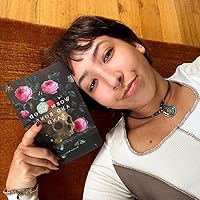
A troubled girl, a haunted book, a house of illusions and enchanted mirrors. Anna Carrow just wants to make things right between her and her mum, to please her stepdad, and keep out of the way of school bullies. But her efforts only seem to lead her further and further from reality, deeper and deeper into paranoia and delusion, until she finds herself tangled inside a twisted fairytale, face to face with the sinister cully king. Now Anna has to decide which version of reality to believe in. But how can you know who to trust, when your mind is playing tricks on you?
In “Honeybones” we have a haunted mansion, confined mad women, shapeshifters, vampires, monsters, creepy dolls and spells, but there is nothing derivative here. The novella is a truly original reworking of these gothic tropes, which are tightly woven. Georgina Bruce experiments with typography and self-referencing without that being a gimmick that obscures the emotional storytelling and clear narrative, which makes it a very satisfying read. It’s the age- old story of abuse but told with a fresh and nuanced voice. There are true chills here and pure glory.
Anna’s mother, Sarah, is Tom’s lover and they live in mansion haunted by monstrous his ex, Rose, the girls in the mirror and the Dreemy dolls. Sarah is in Tom’s thrall. He has sucked the life from her and the sweetness from her bones.
Anna has never asked her mother for anything. She has never received anything. Not love, not attention. Her mother doesn’t really see her. “My love for her had worn away to a stub of desperation. I sank down onto the floor outside her room, hating her because I needed her. Hating myself for needing her and being too stupid and ugly and worthless to get her love.”
This lost, bullied, girl, called fat and slag, is perfect prey for Tom, whom he keeps home from school “to protect her”.
Georgina Bruce does what is often done badly in fiction. She demonstrates exactly how one person can manipulative another, convincing them that they are loved and in love, gaslighting them, making them feel both special and worthless all at once. “I loved you and made you beautiful and now you say it's not what you want at all. You make me so sad, Anna,” Tom says to Anna. The book put me in mind of “First Love” by Joyce Carol Oates in this respect.
There are many layers for a novella. The complexity of women’s relationships with their own bodies and definitions of attractiveness. Dysfunctional mother-daughter relationships, which she does very well (I am thinking of The Queen of Knives from her collection This House of Wounds- a study in power).
The writing itself is as gorgeous e.g.
He was waiting for me to speak, and in the silence he was completely present. Like he was holding something open for me.
This disturbing but ultimately triumphant novella interweaves dark fairy tale, fantasy, folk horror and horror of an all-too-real nature. It’s a thorny, twisty compelling work, seeped in foreboding. With any justice, it should herald Bruce as a major new talent.
When I started this book I thought I was going to hate it. Something about the language. Yet it is the language that pulls you in. There is something almost poetic about the language. Something uncomfortable. You know the world you are in is wrong, but you can't quite put your finger on why. But it becomes clearer and clearer.
This is a book about dark subjects: abuse - mental and physical; the sexualisation of children; misogyny. There's is a piece of writing on p36 that begins: "I knew what men did because their doings were everywhere" which is one of the best and most effective pieces of writing I've read in anything this year.
I find myself reminded of Susanna Clarke's 'Pirenesi'. Like this is a darker, more personal echo of that story with a building as a metaphor.
There are times when I was utterly afraid for Anna and yet, ultimately, this is a story about redemption - or, at least, the beginning of redemption.
I found this a tough read. For all the best reasons. You should read it.
It is very difficult to accurately review Honeybones without spoiling its delicate nature. The writing is poetic and winding, the atmosphere eerie from the first page, and the layers of thematic weight to unwrap are infinite and incredible for such a short novella. Accurately delving into sensitive topics with an unafraid hand, a horror story in more ways than one.
I have to say I wanted to like this more than I did. I loved Bruce's story "White Rabbit" which was published in Black Static magazine and which deservedly won a British Fantasy Society award. I thought the tale of shifting reality worked perfectly well in that story about a man whose assimilation of the reality of his dying wife disintegrates his own 'self'. It was an almost cut-up life story, perfectly realised. Here, in "Honeybones", we also have a splintered life, in this case Anna who is subjected to abuse by her stepfather, and her reality is corrupted through a series of fantastical scenarios which act as a metaphor for her thoughts. The difficulty - with honesty being the best policy - is that unfortunately I didn't care (oh irony, because my disconnection is the typical male response to allegations of abuse and I appreciate I'm opening myself up for criticism, however - for me - there wasn't sufficient reality here for me to pin down a connection to Anna and I found the dreem-like repetition repetitive). I felt we were told the idea of the story rather than being told the story.
I did like "all I had to do was to turn my head and it was a different world" which I felt encapsulated an 'out' for someone being abused (although obviously not an easy 'out' - to be fair, Bruce renders this expertly in the final quarter of the book).
So ultimately, I had no connection. But others did. And others will find strengths here not only for the story but also for themselves.
My first novella from TTA Press. I've heard great things from this UK Publisher. "Honeybones" is a short 86 page read with beautiful artwork by Vince Haig. Finishing this excellent dark, dreamlike fiction left me searching for more by Georgina Bruce. The story follows a girl named Anna who seems to be desperate to impress her Step-Dad, Tom. Her yearning for love and attention pulling her by the hand into a deeper mental prison. When at every turn she seems to open her eyes for a breath of fresh air, the rabbit hole only wraps its enticing arms even tighter. The possibilities are endless when dealing with the psyche. I was entrapped by this tale of woe and impressed by how dark Anna's world became before being set free at such a surprising finale. A tale of jealousy, abuse, of loss. Also, of breaking the chains and self-love. I'll admit. I just ordered "This House of Wounds," by Georgina Bruce, from Undertow Publications. I need more!
A short read following an unreliable narrator whose POV causes us to question the unrealiability of our own minds and memories. There is body horror, psychological horror, explored through the theme of the oppression of women by men and the way women are made to believe there are things wrong with their minds and sanity, the way women are turned against one another, the way men prey on the insecurities of women, particularly those in their younger and more turbulent years through the abuse of authority. For these women, the body is often not an ally but a foe, and this self-loathing results from projections of a need for male acknowledgement, desire, and acceptance. Ultimately, this is a story about empowering the self, depowering external and internal oppressors, and overcoming difficult circumstances while battling against the unrelenting mind.
Honeybones is a kind of Gothic, locked room horror-mystery about the relationships in a fractured family; but as with many of this author's works, the physical setting takes second place, and we see the story unfold much more in the psyche - within the dreams, nightmares and insecurities of the protagonist.
There's a relentless rhythm to the sequence of scenes, during which we have to unfold Anna's story - there's a nightmarish groundhog day feel to it, a disorienting, David Lynch kind of unease. This is complimented and contrasted, often spectacularly, by the author's unique turn of phrase. If you've never read Georgina Bruce before, and you dare try something very different and ambitious, and written with a real love of the word, I can highly recommend it.
…all factored into our increasing poetic knowledge of Anna’s bullied backstory as her current self perceives it: through the filter of drug or dream, or both?
The detailed review of this book posted elsewhere under my name is too long or impractical to post here. Above is one of its observations at the time of the review.
This is powerful stuff and beautifully written. As with most of Bruce’s work, I feel as if I’ve landed in one of her dreams. There’s shades of Anna Kavan and Janet Frame here in terms of its strangeness. Highly recommended.