Jump to ratings and reviews
Rate this book

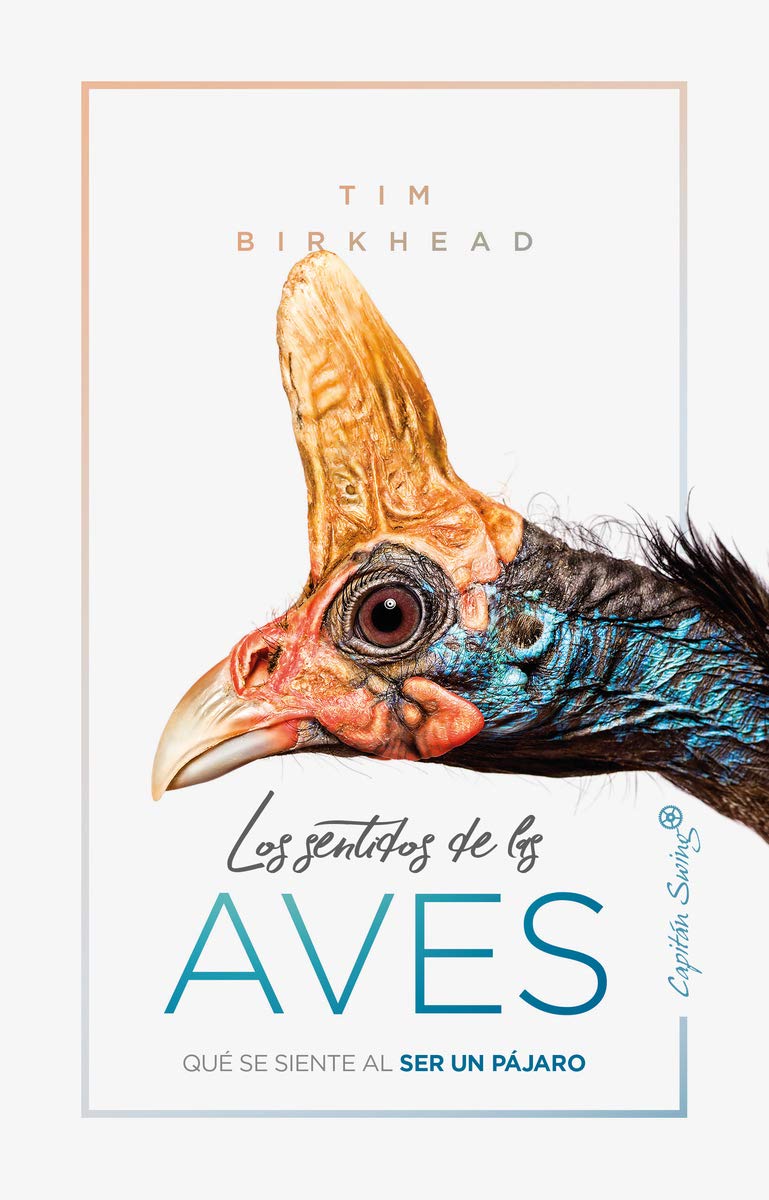
Los sentidos de las aves: qué se siente al ser un pájaro

Rate this book
“Los sentidos de las aves” se basa en la convicción de que siempre hemos subestimado lo que sucede en la cabeza de un pájaro. Nuestra comprensión del comportamiento de las aves está simultáneamente atravesada y restringida por la forma en que los observamos y estudiamos. Al llamar la atención sobre la forma en que estos marcos facilitan y a la vez inhiben el descubrimiento, identifica formas de escapar de ellos para buscar nuevos horizontes en el comportamiento de las aves. Toda una vida dedicada al estudio de las aves le ha proporcionado a Tim Birkhead una gran cantidad de observaciones y una comprensión de las aves y su comportamiento que está firmemente fundamentado en la ciencia.

288 pages, Paperback

First published April 24, 2012

170 people are currently reading
3298 people want to read

About the author

Tim Birkhead

17 books98 followers
Tim Birkhead is an award-winning author and one of the world’s leading bird biologists. He is the coauthor of Ten Thousand Birds: Ornithology since Darwin (Princeton) and the author of The Wonderful Mr. Willughby: The First True Ornithologist, The Most Perfect Thing: The Inside (and Outside) of a Bird’s Egg, and Bird Sense: What It’s Like to Be a Bird, among other books. He is a Fellow of the Royal Society and professor emeritus of zoology at the University of Sheffield.

Ratings & Reviews

What do you think?
Rate this book

Friends & Following

Create a free account to discover what your friends think of this book!

Community Reviews

5 stars
571 (34%)
4 stars
699 (42%)
3 stars
306 (18%)
2 stars
43 (2%)
1 star
20 (1%)
Displaying 1 - 30 of 210 reviews
Profile Image for RKanimalkingdom.
526 reviews73 followers
June 20, 2017
3.49

This was a great book that really goes into the science of birds.

We touch on various sense such as: touch, smell, taste, emotion, magnetic sense, and more

In each section, Birkhead goes through the history of the sense in relation to birds, experiments conducted on the birds to prove/disprove this theory, and the science behind how the bird uses this sense.

It was a fun and very informative book that stuck to the scientific facts.

My only problem is that on certain topics Birkhead tended to be on the fence. He gave evidence but then refused to state this as fact because "proper" scientific investigation had not been conducted. It rubbed me the wrong way and I took off a point for that because he would go into so much detail on the subject and then suddenly back off saying that this is only speculation.

What's funny though is that there is a picture of a flamingo on the cover but we never talk about them!

If you want a more scientific introduction to how birds use their body, you should definitly give this a go!

Profile Image for robin friedman.
1,946 reviews414 followers
November 8, 2022
What Is It Like To Be A Bird"

It has been years since I have read a book devoted to science. Tim Birkhead's new book "Bird Science: What It's Like to Be a Bird" appealed to me as something outside the scope of my usual readings. Also, I have a 17-some year old pet cockatiel to whom I am devoted, but I tend to avoid such things in my reading and reviews.

The book is unusual and, forgive me, a true rara avis. Tim Birkhead is a fellow of the Royal Society of London and a professor at the University of Sheffield. He has traveled throughout the world studying birds, which is both his work and his passion, and written extensively. Part of the appeal of this book was learning about Birkhead. He was fascinated by birds from the age of five when he kept a pair of zebra finches as pets. I found it intriguing that an early childhood interest should develop throughout a lifetime. Birkhead has studied the zebra finch throughout his career.

The subject of the book is "bird sense" or how birds use their senses to get along, how they may be like human senses and how they may differ. The subtitle of the book derives from an essay by the philosopher Thomas Nagel: "What is it Like to be a Bat"; but Birkhead, unlike Nagel is optimistic that science can provide at least a partial answer to the question. In his Preface, Birkhead explains the goal of his book:

"Bird Sense is about how birds perceive the world. It is based lifetime of ornithological research and a conviction that we have consistently underestimated what goes on in a bird's head. We already know quite a lot, and we are poised to make more discoveries. This is the story of how we got to where we are, and what the future holds."

The subject matter might suggest to some a sort of speculative, odd-ball approach, but nothing could be further from the truth. Birkhead points out that people simply like birds and identify with them closer than with any other animals with the exception of dogs and chimpanzees. He also notes that the question about bird "sense" is too broadly drawn as there are thousands of species of birds and each has its own characteristics.

The book shows a mastery of biology and ornithology and their histories. Birkhead draws freely on studies of birds beginning in ancient times through the renaissance, the 18th and 19th century, and contemporary science. The learning is awesome. He also discusses the research on birds and their sensory behavior that takes place among scholars all over the world. It was good to be reminded of and to see strong evidence of a community of scholars engaged in interesting research.

Birkhead has a gift for taking scientific research and, in some respects, technical anatomical and physiological information and presenting it lucidly in a manner that the lay reader can understand. His joy in the subject is apparent everywhere and adds much to the book. What could be a summary of difficult scholarly articles in obscure scientific journals comes to life. I found the book informative and entertaining.

In a series of chapters, Birkhead offers a bird's eye view (sorry) of what scientists have learned and what they don't understand about seeing, hearing, touch taste, and smell in various types of birds. He considers anatomy, in particular, as well as bird behavior. He offers an extended treatment of sexuality in birds, which appears to be a particular interest. After considering the five senses birds share with people, Birkhead offers a chapter considering the "magnetic sense" which some birds apparently possess to guide them in their long migrations over land and the ocean. A final chapter considers difficult questions of emotions and consciousness. As Birkhead points out, it is notoriously difficult to define these concepts when applied to people; Birkhead considers whether birds can be said to have "emotion" or "consciousness" and suggests cautiously that they might do so.

This book was refreshing to read not the least because I have grown away from thinking in the way that a scientist thinks. I learned something about birds and even more, in broad terms, about science. But I most enjoyed sharing Birkhead's enthusiasm and joy in his life work.

Robin Friedman
Profile Image for Troy Blackford.
Author 24 books2,477 followers
June 11, 2014
This was one of the most interesting biology books I have ever read! Tackling the unique senses of avian creatures in a chapter by chapter way, starting with vision, then progressing through smell, taste, magnetic navigation, emotion, and more, this book is packed to the brim with fascinating facts. For example, dogs are widely reputed to 'see in black and white' because they have only two kinds of rods and cones in their eyes. We humans have three types. Birds, on the other hand, have FOUR, along with variants of these with a colored drop of oil. Birds not only detect more colors than we do, but they can see ultraviolet as well. This is the kind of fascinating information that you will be learning as you read this book. Strange tidbits like the fact that you can see the back of an owl's eyeballs through its ears (if you can get close enough to look!) round out each chapter, but there is some seriously interesting information throughout this book. It's author, a foremost avian expert, writes with great knowledge and passion. He loves these animals, has dedicated his life to studying them, and he has taken the time to share that information and passion with us all. If you're at all interested in birds, you're going to want to take him up on it.
Profile Image for pattrice.
Author 7 books87 followers
Read
December 27, 2015
This is book about sensation by someone who seems to have no feelings. What's even more odd is that this is a book about "what it's like to be a bird" by someone who seems to have zero interest in that question.

"In the late 1960s, I dissected my way through much of the animal kingdom.... I loved it.... the dogfish was a delightful dissection" (pp 134-135).

In addition to demonstrating Birkhead's callousness, that quote gives you a tip on where Birkhead's true interests lie: In determining the structures and mechanics of vision, taste, touch, hearing and other sensations in birds. How that adds up... what it might feel like to be a bird... that question seems to fall so far outside of the ambit of Birkhead's curiosity that he has never once troubled himself to even try to imagine it.

And so he is able, without flinching, to describe the most horrific experiments on birds (and on other animals, such as mice) as if these were unremarkable and self-evidently justifiable activities. He also describes his own interventions into the lives of both captive and free-living birds without once feeling the need to justify them. One can only imagine that he, like so many scientists, is operating under the unspoken maxim of might makes right, as follows: (1) I am curious about something; (2) I have the power to do something that might satisfy my desire for an answer; thus (3) I have the right to do that thing, with reckless disregard for who it might hurt.

I imagine that his publishers came up with the subtitle of the book and that the subtitle --which speaks to the curiosity that so many people other than Birkhead have about birds-- is responsible for its sales, regardless of the fact that the book itself does not delve very far into the question of what it's like to be a bird.

Birkhead does devote a few pages toward the end to the question of bird emotion, ever so generously allowing that the animals who share all of the biological infrastructure responsible for emotion probably do experience emotion. Having acknowledged the hurtful effects of stress in particular, he does not refer back to the stressful experiments (such as pulling parents away from their nestlings) to in any way justify having caused such distress. Might makes right, I guess.

Read this book only if knowing something more about the mechanics of sensation in birds will help you to be helpful to birds (e.g., if you are a wildlife rehabilitator or, like me, care for birds at a sanctuary). If possible, check it out from the library rather than buying it, in order to avoid further rewarding Birkhead for his callous mistreatment of birds.

Profile Image for Cheryl.
12.9k reviews483 followers
July 25, 2017
Too much anatomy for me. Not enough anecdotes, though there are some and they are fascinating. The title itself is accurate, but the subtitle is misleading and led me to feel more frustration than I would have if not led on to expect more. Mostly the book is a plea for more research... there are still far more questions than answers on the topic of birds' senses. Rigorous science (which I know you know that I appreciate) but this time I thought I was getting something a bit more speculative, more like Sy Montgomery.
Profile Image for Chris Leuchtenburg.
1,227 reviews8 followers
November 16, 2012
Unfortunately, this book is written from the scientists’ point of view rather than that of the bird. It is a narrative of the experiments and observations over the last 400 years that have given us some clues about the workings of bird senses: sight, touch, smells, etc. A better title would have been ‘what it is like to be an ornithologist.’ Such an intriguing title, I wish that I could recommend this book.
Profile Image for Prince Mendax.
525 reviews31 followers
September 15, 2019
den fångade mig inte som jag hade hoppats. alldeles för lite om fåglars magnetiska hjärna t ex, men spännande om lukt och känslor. även stor behållning av slutordet där han helt plötsligt började prata om echolocation som var mkt spännande som jag GÄRNA läst mer om.
Profile Image for Prashanth Nuggehalli Srinivas.
98 reviews18 followers
September 6, 2015
Can we ever know what it is like to be a bird? As poetic as the question may appear to be, it’s fascinating how the question has fascinated a bunch of  cientists and artists ranging from neurosurgeons, ecologists, physiologists to bird illustrators and medieval travellers. The fascination with bird flight is possibly as old as language itself. Birds are among the early cave paintings, be it in the subterranean caves discovered by teenage boys at Lascaux, or the paintings of Genyornis in cave paintings in Northern Australia that could be 40,000 years old, dating to the time when man set foot on that continent. In Bird Sense, Tim Birkhead who has written fascinating stuff on history of science, birds and birdwatching and has edited the Cambridge Encyclopaedia of Ornithology, makes a narrative synthesis of the historical and contemporary knowledge on what it is like to be a bird. An extremely intriguing question throwing up questions such as “Is this know-able?”. Such philosophical meanderings have clearly not deterred several scientists from designing simple and elegent experiments to try and understand this.

The book begins with a set of questions that Birkhead claims the book will answer. Just seeing the list captivated me to start reading the book (see video intro by Tim Birkhead below, where he outlines some of the questions he attempts to answer in the book). The chapters, organised according to the five senses that we know - seeing, listening, smell, taste and touch - and two of which we don’t know fully understand (at least among birds!), magnetism and emotions - are a treasure of stories of early anecdotes and discoveries.

The chapter on seeing begins with the attempts of early falconers in Europe attempting to perform experiments with shrikes to understand the range of falcon’s vision. Among these early experiments, the falconers of Valkenswaard in Netherlands stand out. Falconry, with its possible origins in Central Asia matured in the middle-east, eventually tracing northwards to Europe. In the book, the experience of English naturalist and falconer, James E. Harting, who was supposedly very often seen in London with a hawk on his fist, and known for his experiments in a falcon hunt in 1877, where traditionally migratory falcons used to be trapped, are described. Later studies on the structure of the eye particularly the cellular structure of the retina and the fovea, the high-density receptor pit on the retina, are described in a beautiful story. The story of Casey Albert Wood, an ophthalmologist who was also interested in the eye of birds (among other animals) is described, how he pored into early literature on avian sight by falconers [As an aside, Wood has no article (yet) on the English Wikipedia (the Dutch one has an article though) and the scarce material on him on the Internet I went through include an inventory of his items handed over to the Osler Library of the History of Medicine at McGill University, Canada. This interesting inventory includes some of his contributions to the New York based Charaka club - see the proceedings on Archive.org]. The structure of the eye has been an object of great fascination from historical times, the debate spilling over to the contemporary creationism-evolution debates, with creationists often drawing from William Paley’s flawed teleological arguments in favour of a creation or being inspired by the intricate structure of the human eye to infer irreducible complexity and hence an intelligent designer. The fact that we see with our brains rather than our eyes is illustrated by recalling an extreme experiment of getting used to image-reversing glasses while riding a bike, an unreal experiment actually carried out by Irwin Moon in 1961 [turns out though that the good Dr. Moon was a man of God though]. Later on beautiful stories of bird gifts to one of those Louis kings and expeditions to understand lekking behaviour of a curiously named South American bird, the cock-of-the-rock and the Bowerbird’s decorative nests are used to convincingly tell us the story of sight in birds. Darwin’s ideas regarding how female preference for colourful birds (as a proxy of reproductive success) could have driven run-away evolutionary processes culminating in peacocks train of colourful feathers and such are described. Pierre Broca and his work find mention. He was known for his discovery of the hemispheric nature of control over our speech through dissection of the brain of a man with a speech defect who succumbed to Syphilis.This led him to conclude that the disease-mediated damage to particular hemispheres of the brain could have led to the speech defect; wonderful stories that are missed out in textbooks of medicine, for example. Quite recently, this aphasic brain of the man who couldn’t speak too much was identified to belong to Louis Victor Leborgne, possibly one of the most famous patients of the last century, in an article in the Journal of the History of the Neurosciences. The consequence is the amazing phenomenon of lateralisation or “sidedness” in birds [see lateralisation in bird song as well as in flight path], which for a century was supposed to have been thought to be unique for humans. Apparently, such sidedness among birds could be both at the level of individuals, wherein some individual parrots’ bill use or leg preference for tool use by those extremely intelligent New Caledonian crows. Similarly, entire species could exhibit a sidedness too; the Peregrine Falcon which swoops down upon its prey along a wide arc mainly use their right eye!

On hearing in birds, Birkhead begins with an illustration of hearing among Barn Owls, which can hunt in near darkness. The chapter progresses to describe arly explorations as to how particularly loud birds (listen to the extremely loud corncrake or the capercaillie) protect their own hears from damage of their nearly 150db calls. Later on, he touches upon the recent work on songs which blur the black-and-white nature-nurture debates and divides prevalent in the last century. The story of birds songs beautifully shows us how learning and genes are intricately involved with each other in manifesting what we see, this perhaps being a phenomenon across taxa, including humans. Later on, while describing the historical work done on the inner ear, the story of the Swedish physician and anatomist, Gustav Retzius, whose pioneering work on illustrating inner ears of several species including birds led to great insights into hearing in general (and among birds too). In spite of his geographical proximity (he was a Swede!) and a 12-time nomination, apparently he didn’t get a single one, possibly the Ivan Lendl among the Nobels! (Retzius did some work on botany, embryology, histology and craniometry, talk the modern specialisation fad within medicine let alone in science!). The ability of avian hair cells to regenerate and the asymmetrically placed ears in owls and how this helps 3-d localisation of prey is beautifully described. In fact, hearing is quite sophisticated among birds; nightingales in Berlin supposedly sing a good 14db louder to make up for the noise, while Birkhead in a subsequent section wonders if the introduced Dunnocks and Blackbirds in New Zealand’s relatively silent forests sing softer. The early hypothesis of Hamilton Hartridge on whether bats could be using high frequency sounds to echo-locate and the subsequent experiments conducted by the (then) Harvard undergraduate, Don Griffin on oilbirds which also navigate in total darkness [see and hear Oilbird echolocation in the dark] and finding that they also use echolocation are beautifully woven into a story.

Touch in birds is the most under-recognised function. Using examples of the false-penis among red-billed buffalo weavers (which by the way could also be “experiencing” an orgasm; see Birkhead’s article!) and the bristles of the nightjar the way birds touch is explored. Early work by German anatomists on the receptors in duck’s bill seems to have been key to our appreciation of how much touch is important in many birds and how precise it could be. Corpuscles for touch of two types arranged “beautifully” are described; one named after the Belgian biologist Grandry (for whom I neither found a Wikipedia entry nor a first name yet!) and the other named after the German histologist Emil Herbst [see article on anatomy of bill tip co-authored by Tim Birkhead again]. The behaviour of allo-preening wherein birds preen each other and the one study among ravens in 2008 by Stowe and colleagues, that shows stress reduction (measured by blood cortisol levels, a hormone situations of high stress) in response to allo-preening illustrate the degree of touch sensation among birds.

The chapter on hearing begins with John Weir’s early experiments with offering possibly unpleasant tasting bright caterpillars instead of the cryptic ones that birds were eating and how the birds found these “distasteful”, an experiment he is supposed to have performed at the behest of Alfred Russel Wallace and Charles Darwin, following up on their own fascination with colouration in animals. Apparently, taste in birds was a hotly debated topic in Darwin’s day and age, although clearly Darwin and his ilk were quite convinced of it and the role it has played in the evolution of mimicry seems to have been clear to them. Among all the relatively older historical anecdotes, the more contemporary one that happened to Bruce Beehler (known locally for his work on Indian birds and biogeography with Salim Ali and Dillon Ripley), whose PhD student Jack Dumbacher found in late 80s and early 90s, the first-ever distasteful bird, the New Guinean hooded pitohui (pit-oh-wheez), because of its toxic feathers. On hearing this, Beehler is supposed to have exclaimed that this could be the cover of Science magazine, which it seems it did with a cover photo of Science in October 1992! Like in many such instances, this piece of information was quite well known to the local people who had in fact named the bird wohob, bird whose bitter skin puckers the mouth! Turns out from Dumbacher’s future work that the toxin in the birds feathers comes from its diet of melyrid beetles and is a kind of batrachotoxin, now known to be stronger than strychnine. Other birds in New Guinea are now known to be similarly toxic. Their experiments, of course being much more sophisticated than Audubon’s “experiment” of feeding ten boiled carcasses of Carolina Parakeets to cats to see if they are unpleasant or toxic!

The chapter on smell explores the amazing capacity of the Kiwi to smell earthworms inside the soil. Experiments seem to have focused on whether the Kiwis hear the worms or smell them when they dig into the soil. The chapter also explores sense in birds through the early life of the “larger-than-life” bird illustrator, John James Audubon, who was, as the book describes “a dynamic, erratic and charming illegitimate son of a French sea captain and a servant girl” born in Haiti. Audubon’s initial article “exploding” the then held belief that American Turkey-buzzard smelt carrion, and instead declarign though his experiments that they actually saw carrion sparked a lot of interest on the ability to smell among birds. It turns out that Audubon’s experiments were actually flawed and indeed, the buzzards do indeed have a sense of smell, one of the explanations being that Audubon might have mis-identified (or mis-reported?) Turkey-vultures, a similar looking species as Turkey-buzzards. It seems the former does have a poor sense of smell….talk of bad identification by the veterans! Like in many cases with birds (and biology!), it was somebody in the “medical” community to the rescue. Birkhead attributes a lot of progress in the study of avian olfaction to an medical illustrator in Johns Hopkins, aptly named, Betsy Bang, with her article in Nature in 1960 focusing on avian olfaction. Later on in the chapter, the unexpectedly good ability of sea birds such as albatrosses in smelling is also described though long stories and experiments that showed this.

The last two chapters, one on magnetism and the other on emotions are relatively less “developed” than the above five, possibly showing the dearth of work on these two. That said, the chapter on magnetic sense in birds begins with a fascinating of work done by the famous British ecologist, David Lack, then a school teacher and Ronald Lockley on islands and their experiments with taking away birds and releasing them far away and how long it took for the birds to return to the island. With better technology, the sense of direction in birds and how they possibly “sense” earth’s magnetic fields has improved but it is one of these those things that we will never fully appreciate, because of our own sense of not being able to know what it is like to sense this. The last chapter on emotions gives some insights into social behaviours among birds.

All in all a great read both for a lay reader and possibly for the sciency ones. A great introduction to several hundreds of years of experiments and stories about birds and their senses.
Profile Image for Tilly.
1,722 reviews242 followers
March 13, 2022
4.5 Stars

This book was brilliant and just what I wanted it to be! After most recent nature books being mainly about anecdotes and stories the author has related to wildlife, I really wanted a book about the science of birds. This book was definitely scientific and looked into all of the senses that birds have, the biology behind them and the scientific research that has gone into findong out about this knowledge. It was a very well researched and interesting book and one I will definitely reread in the future. Highly recommend it to any birders or nature lovers.
Profile Image for Noel Ward.
169 reviews20 followers
July 7, 2023
This is everything I want in a non fiction book. The science is exactly at the right level for a non expert, it’s well written, concise, and engaging. IMO the most important element for a book like this is how you look at things afterwards. Every time I go out in the yard I see the birds around me differently than I did before reading this book.
Profile Image for Mike.
Author 29 books90 followers
April 13, 2013
I hate giving this book a poor review. I really wanted to like it. (I just upped it to 3; really was too harsh)

It's a discussion of birds' senses: vision, hearing, touch, etc. The chapter on vision is great; birds see well into the ultra-violet, and species are optimized for one of two different kinds of visual acuity. Night birds, like owls, don't see high resolution, but can see in extremely low light. Soaring birds, like hawks, have amazing resolution, but can't see well in low light at all; they basically shut down.

But the chapter on hearing was filled with errors on human hearing. Just one example: in one place, the author states that humans can't frequencies much below 2 KHz. What? Middle C is about 260 Hz. The bottom A on a piano is about 25 Hz. There were enough mistakes of this nature to make me distrust almost everything it said about bird hearing. I am very interested in whether bird hearing extends significantly above 20 KHz, roughly the upper limit of human hearing. The author's conclusion is that birds hear high frequencies better than humans, but the top end of their hearing range is roughly the same; but given the off-by-10-or-100 errors that characterized the author's discussion of human hearing, I have no idea whether this is correct.

Takeaway: if you're writing a science book, even one without math, get your numbers right.
Profile Image for Divya Pal.
601 reviews3 followers
March 5, 2022
Authoritative and informative about vision, smell, taste, hearing and magnetic navigation but a bit iffy on emotions like love, jealousy etc
Profile Image for Laura Gaelx.
606 reviews105 followers
July 24, 2020
Me lo he leído con calma (quizá no fue muy buena idea lo de leer divulgación ornitológica en inglés; creo que en castellano también me faltaría el vocabulario específico) pero lo he disfrutado mucho. Tanto las partes sobre los sentidos de los pájaros como sobre el método científico y los experimentos sobre fisiología y comportamiento pajarero. <3
Profile Image for Jorge Zuluaga.
430 reviews384 followers
June 23, 2025
Cada vez me gustan más los libros sobre animales que abordan temáticas originales como este libro.

En este libro, el experto en aves Tim Birkhead hace un recorrido por los sentidos de los pájaros describiendo no solamente sus increíbles e inesperadas capacidades, sino también la manera como la investigación etnológica y zoológica ha logrado descubrir esas capacidades.

El libro está lleno de datos curiosos.

Me impresionaron poderosamente los capítulos dedicados a los sentidos de la vista y del oído. Las adaptaciones peculiares e increíbles que aves rapaces como las águilas y los halcones tienen para ver con una resolución sin parangón en el reino animal son simplemente increíbles. Por el lado del oído, nunca imagine las extrañas estructura anatómicas de aves como los buhos y las lechuzas con sus cráneos tremendamente asimétricos escondidos en medio de tantas plumas que no te das cuenta.

Buena decisión la del autor la de dedicar un capítulo a las emociones de las aves y a la discusión sobre su consciencia o su experiencia del dolor. No creería uno que sea algo para incluir en un texto sobre los sentidos, pero le da un cierre definitivamente poderoso a todo el libro.

Una nota negativa es la desapasionada descripción de cómo se descubrieron las capacidades de algunos animales, aves incluídas por supuesto, para usar algunos de sus sentidos, experimentos en los que se las ha mutilado, enceguecido, ensordecido, limitada su capacidad olfativa por el "bien mayor", acceder al conocimiento sobre sus sentidos. Creo que el autor pudo haber dedicado unos párrafos para comentar con algo de empatía la crueldad de estos experimentos.

¡A por más libros sobre animales!
Profile Image for Savi Johnson.
17 reviews
June 10, 2025
this was super interesting and it definitely explained the understanding of sensory capabilities of birds at the time, which was 2012. i was a little frustrated by the lack of caution to anthropomorphize until it came to emotions. i’d really like an update on what is known today. however, it does seem a bit suspicious to generalize the sensory capabilities of an entire class, especially since birds are the second most diverse group of land verts. i think the author did the best he could have, he made it clear that there’s lots of variation.
Profile Image for Mark Avery.
74 reviews95 followers
December 21, 2012
Seeing, hearing, touch, taste, smell, magnetic sense and emotions are the chapters under which Prof Tim Birkhead FRS discusses what it’s like to be a bird.

It’s a good read and I learned a lot about how we people sense the world around us as well as how birds sense it differently.

How do birds sense distant rain? How do oilbirds and owls navigate in the dark? Which eye will let robins sense the Earth’s magnetic field? How do dunnocks feel when they copulate for a tenth of a second but hundreds of times a day? What is it like to be an emperor penguin diving down to 400m in the Antarctic seas? These are the types of question that Tim Birkhead addresses in this book and although he doesn’t completely answer all of them (ask a dunnock is my only suggestion) he takes the reader either to the answer or as close to it as science has so far achieved.

All this is wrapped up with stories of Tim in the field – hooking guillemots off their ledges, grabbing kiwis or catching corncrakes. Serious and distinguished scientist though he is, Tim Birkhead knows birds from watching and noticing as well as studying and experimenting.

One of the reasons that we are so keen on birds (you are too, aren’t you?) is probably that we are strange mammals. We share the birds’ world of hearing and sight rather than the typical mammal’s world of touch and smell. This book gets you into the head of a bird so that we can understand better quite how well an eagle sees and how keenly an owl hears.

Read this book – it will delight your senses.
Profile Image for Wouter.
Author 2 books30 followers
October 15, 2013
I have always admired birds but I never really wondered how they manage to survive or behave in this world. I picked up this book out of curiosity at my local library, eager to learn at least "something" about bird sense in general, and I was not disappointed. I did not know anything about birds (except that I like them!) and this book is a great start, it's not too heavy for newbies like me and it's not too bland for the more experienced birdwatcher.

Tim Birkhead essentially captures all the recent research data into one book, explaining how birds can see, how they can smell, feel, and have a sense of direction. Each chapter also contains bits and pieces of his personal journey, which I would like to have seen more, it's really short and is only used as an introduction to the summary of papers of other researchers. Luckily, the writing is not complicated at all and it's a joy to read. Don't expect to have a deep knowledge of bird power at your disposal after reading this, it's just a great start.
Profile Image for Ryan.
109 reviews2 followers
August 21, 2018
I am totally nerding out on birds right now, so this book hit the spot. It's created hundreds of dazzling opportunities to bore the shit out of my poor wife. The writing has inconsistent quality, sometimes it's really packed wìth content, and at other times, there's kind of an informal rambling to it that kind of made me impatient. Overall though, I loved it.

Teaser:

This book contains a story where the friend of the author gives the equivalent of a half-hour handjob to a Buffalo Weaver, you'll have to read it yourself to find out the results. Spoiler Alert: it's the fairy tale ending you've always dreamed of.
Profile Image for T.R..
Author 3 books109 followers
May 20, 2016
I walked into this with greater expectations, I think. It is an easy read, enlightening and entertaining in parts. Still, I thought it could have been far better: written with greater attention to detail, making the excitement of discovery the reader's rather than the scientists' -- and that too scientists described in sparse detail or simply named. The final chapters, on magnetic sense and emotions, peter out, and the book ends with a brief postscript that makes a passable attempt at tying up the book together and make a case for the many exciting discoveries that are yet to come.
Profile Image for Vira.
350 reviews60 followers
November 27, 2018
A very interesting reading! I got this book from an ornithologist I know, that's why I had no doubts that it's worth reading.
The book goes on about different senses in birds, chapter after chapter, starting from sight and on to less studied senses like taste. The narrative is simple for understanding, the author gives historic background of the studies and his own experience, providing some adventurous scenes of bird ringing. I got to know lots of interesting details about birds and, since I'm not a native speaker of English, learned new words and species names :)
Profile Image for Jessica.
463 reviews14 followers
May 7, 2013
This book was fascinating. I have read a great deal about birds since the age of 8, and I learned something new on every page of "Bird Sense." Several things I shared with my husband, who is not particularly interested in ornithology, and they caught his attention too.
Profile Image for Cassandra Kay Silva.
716 reviews337 followers
May 25, 2013
I loved this book! It was a wonderful look into the mind/experiances of a bird. I had no idea that birds had chosen sides of vision or that that some owls can close one ear to sound. I loved this! Now I want to be a bird!
Profile Image for Marie Ode.
128 reviews
March 14, 2022
Skvělá kniha o ptactvu a o tom, jak zřejmě vnímají svět a jak každý druh vnímá ten svět trochu jinak. Pro milovníky ptáků skvělá kniha, naplněna mnoha informacemi a zajímavostmi. Škoda jen, že má hlava není schopna je všechny pobrat. :)
Profile Image for 987643467881.
66 reviews8 followers
November 6, 2018
I've learned a valuable lesson here: when there's “skinny dipping” in the preface of a science book (even if it's popular science for the lay reader), no matter how great the rest of the preface may be, it definitely says something about the rest of the book.
“Our path takes us back down towards the shore and we are suddenly aware of the sea: phosphorescence! […] ‘You should swim,’ Isabel says, and with no further encouragement we are all skinny-dipping, and ignited by bioluminescence we jump around like human fireworks. ”
So great was my curiosity of the the sensory perceptions of birds that, against my better judgment, I let this soft-core-porn intro slide and continued on with this train wreck of book until it was already too late to put it down: every little detail that horrified me spurred me on with curiosity to see how much worse the book could get. So despite the impressively large bibliography and the author's obvious expertise in the topic, I had to give this book 1 star - here's why:

An incoherent mix of genres:
The book is a bizarre, incoherent mix of personal stories, historical literature and science - with the three often intertwining. It was clearly intended for the lay reader (the author makes this obvious in the preface), but if other reviews are anything to go by, readers who are more interested in the personal experiences of the author will probably find the book too dry and filled with “overly scientific things”, while those looking for a purely scientific book on bird senses written in an accessible language (without excessive scientific jargon and assumptions of prior knowledge) will likely be horrified by the intermingling of scientific research with autobiographical stories. A good example of this is:
“Wood’s The Fundus Oculi of Birds [1917…] grew out of his belief that a better understanding of the exceptional eyesight of birds would throw light on the biology and pathology of human vision. […] My first opportunity to look at Wood’s Fundus Oculi occurred during a visit to the ornithological Blacker-Wood Library at McGill University, Montreal, which I visited while searching for material for my book The Wisdom of Birds (2009). […] I went with my colleague Bob Montgomerie, specifically to look at the Pepys’ Ornithology, and while I was there Eleanor MacLean, the librarian, asked if I’d also like to look at the Fundus Oculi. Stupidly, I declined, befuddled by its title and distracted by too many other more interesting old books.”
In the above example the author even manages to fit in a plug for one of his other books. Does the reader really need all this background information?

Atmospheric recollections, personal anecdotes and pointless fillers:
I would say about a third of the book is filled with these. I'll give an example of each:
Atmospheric recollection:
“I am in the swamps in a little-known part of northern Florida, on the Choctawhatchee River. This is red-neck country – similar to that of the 1970s film Deliverance. Resting quietly in my kayak, I watch spellbound as four pileated woodpeckers chase each other noisily through the trees. The late afternoon light filtering through the olive-green leaves of the buttress-rooted cypresses is perfect and the birds seem to be enjoying themselves.”
Personal anecdote:
“For several years while my children were growing up, we had a pet zebra finch named Billie. Born blind, Billie thrived on human company and was particularly fond of my daughter, Laurie, who had reared him from a chick. He knew her voice, but more impressively he recognised her footstep, although how he did this was a mystery, for Laurie is an identical twin and Billie never became excited at the sound of her sister’s footfall.”
Pointless fillers:
“He told me: ‘At that moment I realised that I [had] found taste buds. It gave me quite a dose of adrenalin!’ This was new.”
And:
“It appears that it is the robin’s ability to see contours and edges in the landscape that provides the appropriate signal to trigger the magnetic sense. Extraordinary! As one of my colleagues said: ‘You couldn’t make this stuff up.’”
A word count for “told me” revealed that it's used 13 times in what is a relatively short book, and that's not counting the variants like “in her/his own words:” or “he/she said:” which are also frequently used. On its own, this wouldn't have been a bad thing, but considering the fact that the words following “told me” were more often than not pointless additions that didn't add anything to the readers understanding (and considering all the other faults with the book), I thought it was a ridiculous ploy to make the reader feel like they were getting some kind of exclusive statement, or to make the reader aware of the author's vast networking connections and, indirectly, his standing within his field.

Authorial and editorial errors:
I know almost every book has a few typos and errors, but this one was just an insult to the reader. The sloppiness was so extensive that it left me questioning whether some research was either purposefully or accidentally misrepresented, and doubting certain facts that I felt I had to double check before actually taking seriously.

Editorial errors like typos and inconsistencies include things like writing “mm” in some places and then switching to writing “millimeter” in full in the next few lines, writing BC and AD in lower case letters, and missing out words in sentences (for example: “As did so, he noticed something unusual.”). There were also a few places where the author makes clumsy repetitions such as writing “aposematic (warningly coloured)” and then in the very next paragraph: “Warning colouration (also known as ‘aposematic’ colouration)”.

I wasn't even sure whether to classify this particular example as an editorial or authorial error. I was alerted to this mistake by another reviewer, and admittedly, would probably never have noticed the it on my own.
“Most people can hear sounds with frequencies as low as 2 or 3 kHz, and as high as 20 kHz.”
The frequency range for human hearing is generally accepted as 20 Hz to 20 kHz.

One of the more bizarre instances in the book is when the author actually ends Chapter 1 two times, with two different topics. Saying:
“We’ll end this chapter by looking at how and why some birds are apparently able to sleep while still looking at the world through one eye.”
And then, after about 3 pages:
“Rather than end this chapter on a sleepy note, I want to finish on something a bit more dynamic – the extraordinarily rapid flight of certain birds. […] The closest we can come to imagining what it is like to process information as rapidly as a hummingbird or a hawk is the sensation of time slowing down that occurs during a near-death experience. Over the years I have had a few near-death experiences while doing fieldwork, and I imagine many readers will have had, like me, the same sensation during traffic accidents. ”
And that's how the author felt it appropriate to end a chapter that was supposed to be on the sense of sight in birds.

There were also a few sections of the book that I personally thought were poorly explained or written in a misleading way. The back-and-forths between personal stories, historical literature and science was often so distracting that the actual point of some of the research got blurred and was left vulnerable to misinterpretation. A good example of this is at the end of Chapter 2 on Hearing, the author says: “the bird that best captures the extreme sophistication of avian hearing is the great grey owl. Its ability to pinpoint a mouse, invisible under the snow, by means of asymmetric ears, leaves me speechless.” I read this and found myself struggling to remember what the actual research behind that theory was. I had to go back to that section of the chapter, only to find that this was never actually explained. All the author says is:
“Jerry Pumphrey pointed out that asymmetric ears would make it much easier for the owl to pinpoint the source of sound. In the 1960s, Roger Payne […] conducted an ingenious experiment on a captive barn owl in a completely dark room, to demonstrate this. When the light was reduced over several successive days, the owl – which was observed by infra-red light (invisible to owls) – was able to catch mice in total darkness simply by homing in on the sound of the mice rustling leaves that covered the floor. As a test of what the owl was homing in on, Payne conducted an experiment in a room whose floor was covered with foam rubber, tying a dry, rustling leaf to the tail of a mouse. The owl swooped on the leaf (the source of the sound) rather than the mouse itself, dispelling the idea proposed earlier than owls might have infra-red vision or some other sense, confirming that sound alone was the cue.”
At first glance this seems like a great explanation of the research and experiments. The clever language, authoritative tone and historical literature make you think you've actually got it – but taking a moment to think about it, you realise that while the research proved that owls use their hearing to pinpoint their prey, how exactly did it actually prove that the asymmetry of their ears is responsible for accuracy of their hearing? Either the research conclusion was flawed, or the author either misrepresented it or simply didn't bother to explain it properly.

Unfortunately this was a common thread throughout the whole book – you think you're taking away something useful from it, but in actuality it's just little fun facts that you can't even properly explain if anyone was to ask you any intelligent questions. Even though the research presented was often really interesting, I was always left with a sense of never quite knowing the full picture (not that I needed every single little thing to be covered in a crazy amount of detail, but a simple, accurate, well thought out explanation would have sufficed).

Excessive eroticism:
The skinny dipping in the preface was but a prelude to a whole host of cringe-worthy word choices and anecdotes. For example:
“The human mouth is a remarkable structure; soft and moist, with a large, fleshy tongue acutely sensitive to gustatory, thermal and tactile sensations, both while eating and during erotic kissing.”
So presumably not during non-erotic kissing then? :)

Chapter 3 took a bizarre twist when Mark Winterbottom, a research student, “discovered” that a male buffalo weaver “experienced ecstasy in a similar way to ourselves”. And what, you may wonder, did he deduce this from? The answer is: from the bird's “dramatic response” to having its sexual organs physically stimulated by Winterbottom's own hand (“the wingbeats slowed to a quiver, the entire body shuddered, the feet clenched tightly on to Mark’s hand and the male ejaculated”). Why/how exactly this counts as “proof” of the bird experiencing an orgasm as humans do was left unclear, as was the necessity for this sort of “experiment”, especially considering the fact that the phalloid organs were subsequently examined by another specialist under different microscopes, which showed that there was in fact nervous tissue “comprising free nerve endings and touch-sensitive Herbst corpuscles” but that they were “much smaller than he had encountered on other parts of the body in other species”. I suppose the reader is expected to take Winterbottom and the author's word for it. Since the organs presumably had to be microscopically examined anyway in order to form any kind of real scientific theory, what was the point of Winterbottom's “experiment”?

Patronising attitudes towards natives/locals:
The author appeared to have a rather flippant attitude towards the completely unnecessary gouging out of bat eyes with scissors by Lazzaro Spallanzani (an 18th century Jesuit Priest and professor) and casually talked about “John James Audubon, who boiled up the carcasses of ten Carolina parakeets he had shot (the bird is now extinct) for his cat, specifically to see if they were poisonous” without even a word of disapproval. (Perhaps this is because the author, by his own admission, has a bit of a fascination with the gory; describing himself as being “hooked” on dissection, and detailing how dogfish made for “delightful dissection” because cutting through their skulls was “like slicing beans”, etc.) Considering his apparent nonchalant attitude to unnecessary/pointless/unscientific invasive animal experiments, I was surprised at the hypocrisy of the following recollection of a trip to the Arctic:
“Far from fulfilling my romantic notion of the far north, I’m disappointed by the desolate, muddy landscape, by the all-pervading smell of aviation fuel and, most of all, by the casual way the local Inuit use birds for target practice.[...] on that first day I notice a pair of brent geese by a frozen pool […] The next day I drive past the frozen pool again, but am saddened to see that one of the geese has been shot.”
So this, as opposed to the above two examples of unnecessary animal cruelty, is suddenly disappointing? By making this distinction (between what he does or doesn't find “disappointing”), the author appears to be suggesting that the Inuit people kill brent geese (a non-extinct bird) and leave their corpses lying around just for the fun of it, and that this is somehow worse than killing a group of birds and actually contributing to the species' extinction, as long as this is done in the name of “science”. There are two problems with this. First, the reader is left with the assumption that anything under the “science” label is excusable, so any experiment does not have to prove itself to be necessary and/or ethical, which is far from the truth and leaves the door wide open for the misuse of science and unnecessary animal cruelty. Second, I don't know what the author's point was with the implication that it's common practice for Inuit people to kill birds just for the sake of it, especially since it's not like he was referencing a study that provided some sort of statistics on what percentage of local Inuit people engage in the practice, the frequency with which they do so, or the impact that this practice has on the local bird populations (with actual numbers) – without this sort of information, which would actually be relevant in a book about birds (perhaps less so in a book that's supposed to be about bird senses), it just comes across as the perpetuation of a patronising stereotype of the locals.

I found this section equally as ridiculous: the author describes his surprise at the persistence of local Namibian folklore regarding the “false penis” of the male buffalo weaver:
“The local black farm workers told us we were wasting our time for they knew why the males possessed this structure: it was a device, they said, by which the male carried thorny acacia twigs during nest construction. Our extensive observations, however, provided no evidence whatsoever for this. The local people must have known this, too, so it is curious that that particular bit of avian folklore persisted.”
I wonder what the local Namibians would have to say about the persistence of Western folkloric ideas about Santa Clause, the Easter Bunny, the Tooth Fairy, etc., for which their extensive observations would provide “no evidence whatsoever” either! :)

Patronising comments and unprofessional inconsistencies:
I read a review with the complaint that the author referred to female professors/researchers by their first names - I can confirm that that does in fact happen, but not anywhere near consistently enough to form any kind of “sexist” interpretation. Because a few of their male counterparts are also given the same treatment (and considering all the other inconsistencies in the book) this lead me to believe this was more of a case of unprofessional and clumsy, inconsistent editing. If we assume that this inconsistency was in fact intended, perhaps the reason behind it was to show the author's different relationships with the other researchers (first names used for friends, last names for colleagues). Or perhaps it could have been done to differentiate formal and informal settings (first names for informal settings and last names for formal ones). Either way the inconsistency is really unprofessional since it gives the reader different (and often misleading) impressions of the researchers, specifically regarding their credentials, level of expertise, seriousness, etc., and because of this, it affects how much weight the reader gives to the different researchers' claims and work.

Interestingly, while some professors/researchers are consistently referred to by either their first or last names, others have their names randomly alternated (sometimes the first name, sometimes the last name, sometimes both). Even more bizarrely still, these particular researchers are not even given the privilege of being named at all: “The researchers who conducted this work are keen to emphasise its preliminary nature”. Out of curiosity I checked the footnote to see who these researchers were. I was expecting a long list which the author would have been justified in not including in the text, but lo and behold, this is the reference in the bibliography: Young, L. J., and Wang, Z., 2004, ‘The neurobiology of pair bonding’, Nature Neuroscience, 7, 1048–54. Why would the author not include these two names? Especially considering that the reader even knows the name of the librarian who suggested a book to him over a decade ago?

This brings me to another patronising, unprofessional, backhanded compliment that the author made to his PhD student Jonathan Ekstrom, essentially implying that because he was too busy doing more important things, he handed Ekstrom his PhD project: “I decided this would make an interesting research project for an intrepid and enterprising student. Jonathan fitted the bill, and it was indeed a tough project.” And yet again, I ask the same question I asked at almost every page in this book: what was the point of this? Even if it really is the case that the author was responsible for Ekstrom's choice of PhD topic, why make such a passive aggressive remark that obviously has negative connotations and could even theoretically make a dent in the reputation of his PhD student, and even potentially affect his career prospects?

“Clickbate”, or in this case “coverbate”:
This last point may be a bit petty, but why have a flamingo on the cover of a book that only ever mentions the birds in the preface and postscript? The preface teases us with the question:
“What is it like to be a flamingo sensing invisible rain falling hundreds of kilometres away that will provide the ephemeral wetlands essential for breeding?”
Only to never actually answer it in the postscript:
“Thousands of greater and lesser flamingos suddenly appear within hours of rain falling at Etosha Pan, Namibia or the Makgadikgadi Pans in Botswana. […] Are the flamingos responding to the vibration of distant thunder? […] Are they responding to the sight of towering cumulus rain clouds, visible from considerable distances on the ground and further still from the air? Are they responding to changes in barometric pressure? So far, no one knows what senses flamingos and other birds use to detect distant rain.”

This clickbate/coverbate just about sums up the whole book – superficially interesting, but ultimately lacking in substance.
Profile Image for Catie Markesich.
333 reviews2 followers
July 3, 2025
A-MAZ-ING. Birkhead has collected fascinating information about birds’ senses and anatomy, and this book is just WILD. It definitely reads scientific-ish (it’s not like reading a novel). It’s kind of like reading something by David Attenborough. I loved loved it. I did a mix of the physical book and the audiobook and both were excellent.

An example of the wonders in this book:

“Birds are different in that their [ear] hair cells are replaced. Birds also seem to be more tolerant of damage created by loud sounds than we are. This is currently an area of intense research, for if we can establish the mechanisms by which birds replace their hair cells, the cure for human deafness might be found.”

Birds’ organ sizes fluctuate during the year!!!!! Energy saving tactics
Profile Image for Juliet Wilson.
Author 7 books45 followers
March 4, 2022
Bird Sense by Tim Birkhead is a fascinating investigation into what it's like being a bird, focussing on the senses. A chapter is devoted to each of: Sight; Hearing; Touch; Taste; Smell; Magnetic Sense and Emotions. Each chapter gives an overview of historical and current research into bird biology, highlighting important insights into birds lives, including mating, nesting, eating, singing and navigating a migration route. Many different bird species are included, but the kiwi and the guillemot feature more than any other species, given the author's specific interest in these species.

Birkhead does an excellent job of writing about sometimes complex science in an accessible way, making this a great read for anyone who's interested in birds.
1,317 reviews4 followers
June 27, 2018
Covering all the senses plus magnetic sense and emotions, Bird Sense explains what we know about how birds see/hear/taste/etc. The author is extremely passionate about birds and that comes through in the writing. I was pleasantly surprised just how much I enjoyed it. I don’t know a whole lot about birds and this book was still easy to understand. I learned a ton. I highly recommend it to anyone with any interest in birds.
Profile Image for Merl Fluin.
Author 6 books59 followers
September 4, 2022
Fun, informative, accessible and engaging. This book combines bang-up-to-date (for 2012) scientific knowledge with historical accounts of how that knowledge was discovered.

Be warned, though: some of the descriptions of animal experiments are horrific. Birkhead keeps those descriptions dry and deadpan, but he also closes the book with an equally deadpan discussion of animals' capacity for pain.
Profile Image for Nijntje.
18 reviews1 follower
February 27, 2022
我觉得这本书的副标题 what it’s like to be a bird 非常不准确,全书更多地是在讲科学家们是如何研究鸟的感官的,如何从人类的盲目偏见,到提出质疑,到做实验得出结论,到发现实验的纰漏,再到做更严密的实验得到更靠谱的结论的过程。其中还谈了很多做科研的感想,包括做科研的态度,靠谱的研究方法和开展田野工作的困难。很少很少的笔墨才真正在描述现在科学界普遍接受的一些关于鸟的感官的结论,甚至还写了很多当时的开放性问题,以及作者本人对某些问题的观点。
如果想把它当关于鸟类的科普书看的话信息密度还是太低了,但如果对科学家研究鸟类的过程感兴趣的话,倒算是一本挺有意思的故事书。作者真的很爱研究鸟类,看书的时候会被他的态度感染。
Profile Image for Carancho.
6 reviews
March 20, 2025
Ideal para aquellos que buscan profundizar en su conocimiento sobre como funcionan las aves, es decir en como sienten, ven y escuchan el mundo
Displaying 1 - 30 of 210 reviews

Can't find what you're looking for?

Get help and learn more about the design.