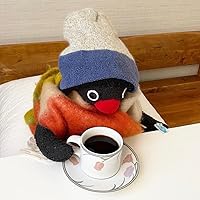
Ao Omae (Japanese name: 大前粟生) was born in 1992 in Hyogo Prefecture. Hailed in Japan as a rising star of gender-conscious literature since the 2020 publication of Nuigurumi to Shaberu Hito wa Yasashii (“People Who Talk to Stuffed Animals are Nice”), he debuted in 2016 with a short story that was eventually included in the 2018 collection Kaitengusa (Tumbleweed). In 2019, he released a collection of flash fiction called Watashi to Wani to Imōto no Heya (“A Room for a Crocodile, My Sister, and Me”), and his 2017 digital-only collection is Nokemonodomono.
this book is truly nothing more than its title: extremely simple, almost annoying and cloying writing about very preschool-level topics, like imaginary friends and hitting and stuffed animals.
i read this book because of its title, and its title is the explanation for everything i hated about it.
life is so cruel in its ironies.
bottom line: i can't believe i'm giving this one star, and i can't think of any reason to give it more than that.
In essence, this novel felt like it is trying to examine what “kindness” actually means when you strip away the usual simple definitions. Across all of these short stories, there is a consistent focus on people who are sensitive to the point where normal human interaction feels risky. The idea that “if I say something, I might hurt someone” shows up repeatedly, and the stuffed animals become a kind of safe middle ground where emotions can exist without consequences.
If you take that logic seriously, then yes, it does feel like a kind of kindness. But at the same time, the book also makes you question whether avoiding people is really kindness, or just fear dressed up as consideration.
What I found interesting is how the story naturally expands from something small and strange into heavier themes like gender, masculinity, emotional repression, even social issues like abuse. Each character’s way of thinking carries real weight, and none of their feelings feel easy to simplify. As a whole, I appreciate the standpoint because it reflects how messy real emotions actually are.
However, the feeling after finishing this is hard to describe. Recently, novels that explore women’s struggles in a very candid way have become widely read. These are struggles that men often contest or sometimes completely fail to understand. This book? feels like a male counterpart to that trend.
To a considerable extent, this novel made me think we should try to see people as individuals rather than reducing them to labels like “because they are men” or “because they are women.” This applies not only to gender but to many other contexts as well. We often stop at categories like “because they are x” and mistakenly assume we understand someone. At the same time, this book challenge that a world made up only of kind people (like Nanamori or Mugito) might not function in practice, so perhaps even systems of categorization or “discrimination,” in a broader sense, are to some extent necessary for society to operate.
Still, I struggled to fully connect with the writing style. It often felt like a stream of thoughts being explained too directly, almost like everything is being laid out in an analytical way rather than letting the emotions breathe. Because of that, even when the themes were interesting, I found it hard to stay emotionally invested in the characters. And interesting is not always enough.
There were also moments where I couldn’t tell whether I was meant to take certain ideas seriously or question them, especially around the protagonist’s relationships and the way his worldview develops. I understand what he is trying to convey, but at times, including how he ends up dating and other aspects of his behavior, I found myself thinking he is no different from ordinary men in society after all. In that sense, the book title felt like a cotton-soft phrase he uses to protect himself.
Ultimately, the execution felt distant to me, and it is the kind of story I can respect more than I can feel. And I honestly don't know if that's because of what the author was trying to express or the way it was translated. Overall, I would say it is a quietly unsettling book disguised as something soft and gentle. In the end, it still did not move me. Oh well...
People Who Talk to Stuffed Animals Are Nice: Stories by Ao Omae (translated by Emily Balistrieri) comprises an interesting collection of short stories that touch upon themes of friendship, gender politics and stereotypes, feminism, isolation and loneliness and mental and emotional well-being.
In the first story “Realizing the Fun Things Through Water”(3.5/5) we meet Hatsuoka who receives a case of “hyper-organization water” from her soon to be mother–in–law who tells her to talk to it, sharing happy thoughts to increase its potency. Hatsuoka is conflicted over her impending marriage, unsure of what she wants while also dealing with the pain of the loss of her sister who had been missing for almost two years. As she waits for her sister to return to the house they shared, she anxiously contemplates the upcoming changes in her life. The second in this collection is the novella “People Who Talk to Stuffed Animals Are Nice” (3.5/5) revolves around university students Nanamori, Mugito, Shiraki and others who are members of a Plushie Club whose purpose is to give its member the space to talk to stuffed animals for emotional support. The author tackles sensitive issues such as gender identity stereotypes, misogyny and mental health with sensitivity and compassion in this story. But the narrative seems a tad long and could have been more compact. In “Bath Towel Footage” (2.5/5) a woman sees an unpleasant side to her boyfriend while attending a comedy show, making her question her compatibility with him. The final story, “Hello, Thank You, I’m Okay” (3/5) revolves around Marumi and her family and how they each interact with her shut-in brother and how they cope with his decision to have a birthday party with his invisible friends and the aftermath.
Needless to say, the title of this book and that cover grabbed my attention. The tone of these thought-provoking stories is predominantly melancholic and emotionally charged. At times I found it difficult to connect with the characters and found the narrative in a few of the stories a tad disjoint, lacking in cohesiveness, though that might have been deliberate in keeping with the character’s state of mind. (Given that I read a translation of the original, I feel that perhaps fine-tuning the translation and/or the editing might have made a difference.) I did have a problem with the length of these stories. While the novella could have been more compact, the final two stories did not allow us to explore the characters well enough. Overall, while I did appreciate the concept and themes that are explored in these stories, the execution left a bit to be desired.
Many thanks to author Ao Omae, publisher HarperVia and NetGalley for the digital review copy. All opinions expressed in this review are my own. This book is due to be released on June 06, 2023.
An unsettling, compelling collection from award-winning Japanese author Ao Omae, featuring the novella “People who talk to stuffed animals are nice” which was recently made into a movie. Omae’s fiction deals with aspects of the isolation and alienation underlying contemporary Japanese society with a focus on individuals in their late teens and early twenties. Each story’s told from a single character’s perspective, all caught up in personal dilemmas and finding inanimate objects offer the only possibility of retreat from an increasingly hostile environment.
The title piece has a gloriously messy immediacy. It’s a stream-of-consciousness narrative centred on university student Namamori who’s grappling with questions around gender and masculinity. He’s striving to find a way to construct an identity unconstrained by conventional masculinity and Japan’s overwhelmingly patriarchal culture. Namamori’s story also forms a fascinating commentary on kawaii culture as he seeks refuge in his university’s plushie club. A supposedly safe space where members confide their deepest, previously unspoken, feelings and fears to stuffed animals. Namamori, like the diffident Hatsuoka in “Realising Fun Things Through Water”, makes abundant use of messaging apps but, on-and offline, any impression of authentic communication eludes them - meanwhile the wider world is almost routinely menacing with news of mass shootings and evidence of the aftermath of natural disasters commonplace. The surreal final piece is a departure from the earlier, naturalistic entries, as schoolgirl Marumi’s suddenly confronted with her shut-in brother’s bizarre solution to loneliness.
Although Omae’s charting familiar territory in Japanese fiction here, there’s something intensely felt about his portrayals of fragile people adrift in a sea of conformity and convention that makes his work feel unexpectedly vivid and fresh. Translated by Emily Balistrieri.
El autor es muy ansioso o convive con muchas personas ansiosas o es psicólogo porque mi ansiedad se sintió demasiado reflejada en ciertos aspectos, incluso me tomó por sorpresa a momentos. Jajajaja. Me sentí un poco menos sola.
Quitando eso, me gusta la manera en que está escrito. Mis favoritos son los primeros dos relatos aunque los otros dos no me parecen malos, solo un poco confuso y un cuanto más inconclusos en comparación a los primeros. Sin duda alguna mi favorito fue el segundo, logré entender por completo la razón por la cuál decidieron nombrar el libro a la par.
Nunca soy buena para hablar sobre este tipo de antologías... Como que me fallan las palabras, no me alcanzan incluso cuando tengo un montón de pensamientos al respecto. Soy incapaz de resumir tantas cosas en una sola así que solo puedo decirles que vayan a leerlos y después me cuenten que les pareció.
Si ustedes no sobrepiensan hasta el más mínimo detalle probablemente les resulte un libro un poco raro... creo que los sobrepensadores realmente podemos identificarnos con este tipo de personajes porque entendemos tal cual lo que se siente pensar en el más mínimo detalle y que este afecte tu vida a un nivel que no eres capaz de comprender. (Al menos yo que ya he pasado mucho por eso logré verme reflejada en algunas de las palabras descritas aquí.)
Me gusta cuando las personas se atreven a escribir sobre las complejidades y desordenes mentales. Es interesante saber las distintas interpretaciones que se tienen de las mismas y como es que los autores logran expresarlas en sus palabras. (Siempre y cuando tengan el respeto e información necesaria para hablar al respecto, ojo que también soy quisquillosa. Jajaja.)
A funny, self aware collection on gender dynamics and coming of age in contemporary society. Relatable and told with the direct, sometimes dramatic voices of our young narrators, this collection highlights the impacts of gender perception in young people, and the influence that interacting with others has on creativity, relationships, and emotion. This collection also highlights the negative effects of misogyny specifically to young minds, as it crushes aspirations and friendships into the tightly packed boxes of the past. These stories, though effectively challenging outdated ideals, are also fun to read; they are colorful, simple, recognizable; who doesn’t have an emotional support stuffie or two?
I got this book because of the title, because how can you look at a book titled PEOPLE WHO TALK TO STUFFED ANIMALS ARE NICE and not want to read it immediately? I went into this expecting something cozy or fantastical, and instead I was treated to about five (five?) melancholic stories about toxic masculinity, the isolation that comes from social media, and the increased difficulty in forming meaningful, intimate relationships when everything you do is policed.
This short story doesn't have great ratings and I can kind of see why. A lot of these stories don't really have a linear "this is the beginning and this is the conclusion" sort of format. They meander, do weird things with their timelines, and gaze hopelessly inwards. If I were in a certain mood, I could see myself losing patience with this story, but now, depressed, and longing for a time when it seemed easier to form connections and like each other, I found myself resonating with these weird, lonely characters and their desperate need for intimacy.
Mellow yet meaningful, People Who Talk to Stuffed Animals Are Nice is a sensitively written and delightfully earnest collection of short stories. Consisting of three short stories (“Realizing Fun Things Through Water”, “Bath Towel Visuals”, “Hello, Thank You I’m Okay”) and the title novella, “People Who Talk to Stuffed Animals Are Nice”, this collection struck me for its empathy, and for its focus on characters who are (for whatever reasons) made to feel different. Throughout these stories, Ao Omae explores the experiences of characters who feel constrained by patriarchal norms of gender and sexuality. Omae is in particular critical of strict gender roles, heteronormative notions of dating and marriage, and traditional ideas of masculinity. In “People Who Talk to Stuffed Animals Are Nice” we follow Nanamori, a college student who is disenchanted by other men’s braggadocio attitudes towards women, from their crass banter to the way they objectify women and belittle men who are to whatever degree ‘atypical’. Nanamori longs for a more genderless society, and he finds solace in one of his college clubs, a judgment-free place where students talk to plushies for emotional support. Nanamori continues to feel guilty by association when it comes to his peer’s sexist and/or homophobic behavior, and he struggles with his own desire to ‘fit’ in. Throughout the novella, the narrative also explores his confusion when it comes to separating friendship from romance. In “Hello, Thank You I’m Okay” a shut-in young man delights his family when he announces that he is planning to invite his new friends over to his birthday party. When the time comes, his mother and sister realize that his friends are not exactly part of the ‘material’ world. Yet, not wanting to hurt his feelings, they play along and soon find themselves believing in their existence. The other two stories in this collection are more forgettable, not quite as funny or touching as the titular novella or “Hello, Thank You I’m Okay”. Still, it was an insightful collection that gives readers a glimpse into contemporary Japan and the different perspectives of young(ish) people questioning and pushing back against tradition. The translation was good, but some scenes/descriptions could have benefited from some added clarity. For instance, we have this scene where a character comes up with a fake name, “Kotori”, after seeing a bird outside the window, but unless you know that bird is “tori” in Japanese her name seems very random. Nevertheless, the unadorned writing style is very easy to read. I liked this collection well enough. The stories, while slightly humorous, are grounded in everyday reality. The characters are not particularly fleshed out but we gain an understanding of their perspectives. The narratives are focused on exploring certain issues and they succeed in doing that. I appreciated the author’s sensitivity and that he allows characters to change their mind and/or question their own opinions and beliefs. I would definitely check out more of his work. If you are looking for an easy yet thoughtful read, look no further.
I’m trying to think of a reason to give this 2 stars but I really can’t. The stories did really not work out for me. The translator’s note mentions Omae’s writing is very simple and, I agree, but it also felt inconsequential and disjointed.
The stories are trying to be quirky but also meandering as we focus on the main character’s thoughts, but they would jump around topics and then, suddenly, add something about feminism, men/women, love, or gender. Like the author suddenly recalled ‘ah, I was trying to appeal the feminists.’ But the occasional burst of feminism was just very just there. It wasn’t really chewed on, it wasn’t properly explained, nor did it have a defined context. And so, the point didn’t come across.
I also struggled with a few bits. I read a fair amount of Japanese literature and after four years of East Asian Studies (with sociology, literature, and culture courses) I think I never really struggle reading or comprehending characters. Here… I don’t know, I think it just blew things out of proportion to be more literary? Maybe? Example: “Even if he didn’t look threatening, he was a man. Nanamori realized that by asking a girl out, he became the opposite sex to her. If a man takes the romantic, lustful action of “confessing” his feelings to a woman, it could frighten or hurt her.” Me is confused. This is… what is this.
I won’t go into the stories. The first one was probably a 2 stars because it was quirky enough, but the rest were just… bad. They really didn’t work for me and, as a short story collection, I don’t think they worked together.
I’ll just finish with this portion that just exemplifies the writing of the book. If this is something you don’t mind reading, go for it. I only read this collection because I love the title, but in hindsight, I wish I hadn’t.
“Their bit was about, like, ‘compliance’ and ‘fuck political correctness,’” I said. “Like, ‘I’m a feminist, so I hit girls same as guys’—” “Hya-heh-heh!” “Huh?” “Ha-hya-heh-heh!” So you think that’s funny? I thought. I wanted you to yikes with me.
“No one asked her where she had been. Because they were nice. It was very similar to indifference.”
Being vulnerable is hard. Here are four short stories centered around telling bottled water about your day and sending unread texts to your missing sister because you don’t want to move in with your fiancé. Talking to stuffed animals or praying to the shrine of your dead dog because you don’t want to burden your friends with your anxieties about mass shootings. Draping a towel over your head whenever your sexist boyfriend talks at you so you can feel like a ghost for a few minutes instead of a human being. Pretending to be your brother’s imaginary friend and eating enough for two at his birthday party so he finally feels Seen. Also romantic love isn’t real, you JUST found out sexism exists (oh my god are you ONE OF THE OPPRESSORS???), and anime is a social crutch for people who aren’t able to make very good small talk. Bleach your hair blonde so you don’t have to make conversation with your old friends from high school about anything deeper than your superficial aesthetic choices.
“The fact that it’s impossible to tell the difference between people talking to themselves because they’re struggling and people talking to someone on the phone……couldn’t it be that there’s no good way to tell the difference between someone who pretends they’re answering a stuffed animal, someone who’s having a hard time and actually talking to themselves, and someone who really can hear stuffed animals’ voices?”
This felt like SUCH a modern book, and a very specific snapshot of contemporary Japanese culture. I think the translator Emily Balistrieri did a really amazing job, even if I don’t have any actual expertise or know how on the subject. The vibes are just there. I’m still not a huge fan of heavy-handed speeches about sexism, and the self-reflection is pretty direct, but there’s a lot of beautiful nuance in between the lines, and also like. We’re different cultures. It’s allowed.
side note, but do u think japanese millennials insist that the Showa era only ended ten years ago, like americans do with the 90’s. To me a character wanting to take one last purikura photo of the Heisei era with her girlfriend somehow felt like when teens call the 90’s “the 1900’s”
Each of the young adults in People Who Talk (…) grapples with their identities, while trying to make sense of the world around them, one that is marred by hatred of women and pressure to conform. Some of them prefer to comply with the norms, but others seek to escape them by talking to stuffed animals or purified water, or hiding under a bath towel. One of them even went so far as to befriend four imaginary friends and introduce them to his family. But as much as they try to resist the society, they also have a tendency to placate others and put on a happy front which ultimately costs them mentally and emotionally.
The collection may sound depressing, yet there is a simplicity and tenderness in the author’s writing that inspires hope for a kinder and gentler society in the future.
I struggled with this one. Four short stories, the first longer than the rest and represented in the title and cover of the book. The writing was easy to read. My translator friend had recommended it to me … or, well, asked me for my take on it as a “new masculinities” novel from Japan. The lead in the first story might be aro or ace or ambivalent … but, to me, felt like a rather stereotypical take on a teenaged Japanese guy: inconsiderate, expecting others to be interested in him, playing with people’s feelings for his own sake, ignorant of sexism, bemoaning his gender … the privilege and self-centredness … my eyes were rolling so much they nearly moseyed on out of my head by the end of it. The other stories were a bit hard to follow, especially the last one. Were they crazy? Bored? Stifled? Abused? Haunted? And what was the point? I dunno, I felt like there was a perturbing cast of unlikeable or zany characters but no deeper meaning to make up for it.
A title novella and 3 short stories in a spine; so quirky and cute yet quite distressful on how each plot brought me to observe on the idiosyncrasy of a character; of emotional fragility and disillusionment that was intricately crafted in a gender dynamic, coming-of-age and human relationship backdrops. Its tender almost gloomy narration was addictive much and I like how the author managed to explore the theme with a gripping variation in his neat characterization and absorbing plot dynamics.
I enjoyed reading all the 4 stories especially the title novella, People Who Talk To Stuffed Animals Are Nice as it centered on how people find solace and attachment by talking to stuffed animals. Of self-concern, social expectations, desire and morality that making Nanamori to question on his kindness and consideration towards others. Realizing Fun Things Through Water following Hatsuoka’s perspective on her mother-in-law who believes in the miracle of a cancer-preventing water and sister who writes fake news for a living but now went missing. Love the execution and tension in this story as well the affecting ending. A slightly dreamy plot for Bath Towel Visuals with its love conflict narrative , siblings drama and misogyny issue. Hello, Thank You, Everything’s Fine the most surreal out of all; Marumi who needs to deal with her brother’s shut-in behaviour and his imaginary friends who he invited over— bit haunting but I love how bizarrely psychological it goes.
A thought-provoking collection overall; unique with nothing exceptional yet intriguing much for how each expressing alienation, anxiety and fear in its own emotional arc— a grim reality that often go hopeless or misjudged. Will go with 4 stars to this!
TLDR: I'm not sure this translator knows what they're doing. Either that, or this author has gone insane and someone is publishing their incoherent ramblings and milquetoast feminism.
[Update 4 months post-read: destashed. No regrets. Goodbye, incoherent nonsense book!] I grabbed this on a whim one day at Barnes & Noble—a cute pink hardcover? 50% off? A translated work from a rising voice in Japanese literature? As a gullible consumer wanting to read more translated books in 2024, I was all in.
And, I mean, it does what it says on the tin. The stories were thematically interesting (sort of) and simply told, with an entertaining perspective on the world. I like the perspective on the comfort of things that seem childish. But it still wasn’t what I thought it was going to be, and I really don’t think I fully got a lot of what the author had to say; though I couldn’t actually tell if this was because of what Ao Omae was trying to convey or the way it was translated.
I don’t speak Japanese—just English, and Polish so amateur that it’s almost embarrassing to bring it up at all. I say this because this bad boy makes me wish I had the sort of time and dedication required to learn Japanese so I could read the source material myself. Unfortunately, I’m a slow learner determined to be fluently bilingual, and I already plan to spend the next fifteen years or so on remembering how to conjugate my Polish verbs without simultaneously crying, so that’s probably out. Kinda already picked my poison and sunk a few years into it. Mądry Polak po szkodzie or whatever (/s).
Anyway. My understanding is that the author is known for their simplistic style, but I still feel like something is getting lost between the lines here, especially because Japanese can be a lot more nuanced with its words and their meanings than English tends to be. You know, sort of like how there’s a standalone German word for everything, including feelings you never knew you’d experienced until German offers you a word for it, like schadenfreude or weltschmerz or torschlusspanik? The kind of stuff that usually takes multiple words to convey in English; a very specific sort of depth and a lot more room for error.
Accordingly, I have to wonder about the potential differences between a translator whose first language is Japanese vs. Emily Balistrieri whose first language is English, especially because when the titular story in the collection was adapted by Yurina Kaneko as a Japanese language film, the international translation of the title was different: People Who Talk to Plushies Are Kind.
Maybe it’s just me, but immediately, that title strikes in me something completely different than “People Who Talk to Stuffed Animals Are Nice.” It’s not the stuffed animals part, it’s the “nice” part. Nice has this connotation of possible superficiality, and it’s something we’re all expected to be day to day because it’s polite. Kindness is something else entirely, a deeper and more genuine type of niceness that not everyone will possess. It’s something more pure that makes sense in the context of ‘talking to stuffed animals.’ So right away, just from the title, there’s the vibe of a translation that needed fine-tuning.
But, again, I have no idea if this can be attributed to the author or the translator. Aside from the above, the reason I'm leaning translator is because of how fucking weird and unnatural the prose sounds (in a way that doesn't feel stylistic/just grammatically does not seem like something anyone would ever do on purpose, plus it's inconsistent and a lot of the time seems normal, just subpar) when compared to other translated Japanese works I've read. I don’t even know how to fully explain what reading this was like, but my best attempt would be that there were times when the prose sounded natural, then suddenly started reading like an anime script someone ran back and forth through Google Translate until it was completely broken, usually when trying to articulate some complex feeling the characters had or moments of action. It doesn't feel simplistic or interesting, it feels like someone jacked it up.
All that being said, I have absolutely no idea what I’m talking about when it comes to translating between Japanese and English, I have no idea what happened in the process of translating this book or making the adaptation, and nobody should take any of my thoughts as fact OR credible criticism of the translation. Literally just thoughts. I’m just some lady who happens to be very confused about what happened here. If people took me seriously all the time there would be a lot more cats and dogs in mayoral offices because I think it’s hilarious when animals have jobs. I think we can all agree that would be an extremely adorable disaster, and that it's entirely possible I just don't like Ao Omae.
Overall, 2 stars. My honest rating would probably be lower, but I don't know who to blame for it, so. There's that.
Thank you to Netgalley, Goodreads, and the publisher for a copy of this book in exchange for an honest review.
My Selling Pitch: Do you want to read a collection of translated short stories that deals with mental illness and has some gender commentary? Do you like stories that are a bit of a musey bummer, but don’t really have any takeaway messaging?
Pre-reading: This title is bonkers. I read such a wide range, guys.
Thick of it: It’s giving MLM. It’s giving essential oils.
This translation is rough.
You wouldn’t live with the person you married? That’s odd to me.
osmanthus
2/5? Girlypop, grow up. Don’t settle for men. Go after what you actually want. Go to therapy. Stop people pleasing. ———————-
Go to therapy y'all. This is insane people-pleasing and social anxiety.
Doria
Zelkovas
Happi
I do not care about this story.
That’s called depression.
purikura
I want to read more about Japanese love hotels. Cultural differences surrounding sex are so wild to me.
See, this is very interesting commentary on toxic masculinity. Because men shouldn’t feel bad just for existing. But I do think it’s interesting how he’s going out of his way to make her hurt about himself. And it’s an interesting concept that people who consume trauma porn essentially are going out of their way to prove that they have empathy to prove that they’re a good person thereby proving that they’re not actually a good person, but that message is sort of hidden and buried within this clunky story because of the translation.
izakaya
You can definitely get by in the world without drinking. What the fuck kind of thought is that?
I don’t think you need to reject your gender identity to not be a threat.
3/5 I’m glad I read it. It’s an interesting think piece. But I don’t think it reached any sort of moral verdict. I think it’s just saying that sensitive people are overwhelmed by the world, and if you’re not overwhelmed, you’re missing a bit of empathy. But also, if you’re overwhelmed, you can’t function in society. And society needs people to function, so you can’t be pure empathy.
I don’t know, I feel like there’s a bit of a cultural disconnect. I would be curious to see this sort of concept Americanized and then see what I think of it. ——————-
2/5 Again, not really sure what to do with it. Sexist jokes succeed in a sexist society-fucking duh? It’s hard to go against the norms, but you can definitely find people that will go against them with you. ——————-
Girlypop this is not fine.
2/5 What a weird story. I feel like it was about mental illness and suicide and trying to be horror, but it was just so disjointed that I got nothing from it.
Post-reading: This was an interesting collection of short stories. I think the translation might be limiting its impact a bit, but I obviously can’t read the original to verify that. All the stories seem to deal with some facet of mental illness and anxiety, but it’s hard to connect and engage with the characters. Again, that may be due to a bit of a cultural mismatch. I think if you like translated works and thought-provoking gender commentary, the collection is worth a read, but I’m not sure how much you’ll get out of it other than this general sense of huh, that’s something to think more about. All the stories just feel incomplete. They don’t have any simple takeaway messages which tend to be a vital backbone for memorable and impactful short stories. These are just musings that basically amount to the state of the world is pretty shit, and you should feel sad about it, but whoopsies, you also have to function in society and you can’t do that if you’re too sad. Like we done been knew.
Who should read this: People who like translated works Gender commentary fans
Do I want to reread this: No
Similar books: * There Is No Death in Fonding Nemo by Jeffrey M. Feingold-modernized fairytales and morbid short stories * The Merry Spinster by Daniel M. Lavery-purposefully difficult to interpret set of dark fairytale retellings * Nineteen Claws and a Black Bird by Agustina Bazterrica-dark and edgy short stories that think they’re edgier than they are * Amor and Psycho by Carolyn Cooke-edgy short stories * How High We Go In the Dark by Sequoia Nagamatsu-interconnected sci-fi short stories, social commentary * Her Body and Other Parties by Carmen Maria Machado-feminist short stories * Our Wives Under the Sea by Julia Armfield-dementia horror, musey, all vibes very little plot * Tell Me I’m Worthless by Alison Rumfitt-gender commentary horror * Tender is the Flesh by Agustina Bazterrica-dystopian, societal commentary, cannibal horror
a collection of short stories about gender and relationships, to me this was severely hindered by the translator. the translator emphasized the ending vowels of words by writing them like “yayyyyyy” which really took away from the narrative of certain stories.
while the main story, and namesake, “people who talk to stuffed animals” was wonderful and made me cuddle my own stuffed animals, i didn’t think the other stories held up against it. they were much, much shorter. i didn’t feel that this was an accurate representation of a sexuality either, and the theme of gender is lacking in the sense that there are no explicitly lgbtqia+ titles nor words. it’s up to speculation.
thank you to netgalley and the publisher for an arc copy in exchange for an honest review!
What a weird, quirky, slightly disturbing collection of stories. Comprised of one novella of the book title and 3 other short stories, Ao Omae spin the wildly imaginative stories brimmed with tension and questions on gender roles, identity, sexuality, the toxic masculinity, the feminist ideas and one's own diversion from real life.
The titular novella of the book title talked about the deteriorating mental health condition of the youngsters as we are attacked left and right with horrible news such as the arson occured near, the sexual assault perpetrated to helpless women, the inability to act due to fear, the hatred of one's own gender while facing the insulting comments on masculinity. For me, the novella really talked thru about these issues from our main male lead with his stream of consciousness of his inner struggles with his feminine appearance, of wanting to love but have no understanding of the concept, of hating his own sex as a man for how vile some of the actions are.
The Plushie Club he joined alongside his best friend became a place of solace. In this club, the members talk to stuffed animals of stuff they will never talk to others for fear of burdening others or the judgement given. Stuffed animals dont talk back, they listen without being judgemental. In this we can also see how loneliness was potrayed where humans lose connections with people and seek for companion in this non living objects .
1. Realizing fun things through water - 3.8✨️ The female lead doesnt seems to have romantic feelings towards her fiancee, commenting in sexuality topics of what love meant to them. She was more concerned on her sister's disappearance than her upcoming wedding. 2. People who talk to stuffed animals are nice - 4.5✨️ 3. Bath towel visuals - 2.5✨️ story is too short, barely convey the desired message. This one was weird and I dont understand much but the bigger theme will be the misogynistic treatment shown by the rude jokes men make in expense of women and how the female lead despise this, wishing she is invisible covered by the bath towel like a ghost 4. Hello, thank you, everything's fine - 4✨️ Odd, surreal and slightly horrific. Talking about the way her brother become a shut in and stop going to school. For what reason, we dont know and then he came with a bunch of imaginary friends. This slowly becoming weirder as we go thru the story as the line of imagination and reality become blurry.
Though, the translation can be clunky sometimes and doesnt feel like it convey the story well. Not entirely sure if its the original was written this way or there is something lost in translation Thank you to Edelweiss & HarperVia for the e-arc in exchange for an honest review
los dos primeros cuentos son hermosos pero la narrativa decae en los últimos dos; algunas partes se sienten muy forzadas al hablar de las problemáticas sociales y algunas funcionan muy bien.
en general creo que son muy digeribles y que cualquier sociedad puede encontrarse en algunos fragmentos de los cuentos.
“People Who Talk to Stuffed Animals Are Nice” sounds like an aggressively adorable premise. Sure, there are imaginary friends and bath towels and plushies catching emotional shrapnel, but what Ao Omae is really doing here is softly dismantling the idea of “normal.” Each story follows someone who feels slightly out of sync with the world, especially when it comes to gender roles, relationships, and the suffocating performance art of being “okay.” On the surface, the coping mechanisms are quirky. Charming. The longing behind them is not.
What I loved most is how sincere this collection feels. It flirts with melancholy and whimsy but never lets either one take over completely. The characters are painfully self-aware, sometimes frustratingly so, but watching them inch toward something resembling self-acceptance is deeply satisfying. It’s soft spoken. It’s odd. At times it felt like a non-binary empath’s fever dream, but it’s uncomfortably accurate about the roles we’re expected to play. I see a lot of myself in these characters. In my youth, I was also crippled by my own sensitivity. Maybe that’s why this hit me so hard. Maybe we all just need somewhere soft to put the feelings we don’t know what to do with.
Quattro short stories in cui i protagonisti utilizzano degli esseri inanimati come ascoltatori per una sorta di "terapia". Il primo e più lungo, Le persone che parlano con i peluche sono gentili, è un racconto in cui il protagonista, Nanamori, è una persona molto sensibile, che soffre perché sente di non avere un'autentica identità sessule, sia a causa dell'aspetto fisico (è bassino e magrolino e visto da dietro potrebbe sembrare una ragazza), sia perché non riesce a identificarsi con i suoi "colleghi" uomini, tutti più materiali e insensibili di lui. Ma, allo stesso tempo, non si sente neanche omosessuale, perché a lui piacciono le donne, anche se non prova verso di loro alcun impulso sessuale, solo tanto affetto e tenerezza. Sussurrando all’acqua e L’asciugamano sono meno incisivi degli altri racconti, a mio avviso, il primo narrato dalla sorella di una donna scomparsa nel nulla e il secondo da una donna che non riesce a ridere delle battute del fratello, un comico dilettante, che invece tutti gli altri trovano divertentissime. Andrà tutto bene!, l'ultimo racconto, è narrato dal punto di vista della sorella di un hikikomori, un ragazzo pieno di amici immaginari, che cominciano a diventare reali anche per lei. Si tratta di una famiglia particolare, che vive in una casa sull'orlo di un burrone, con alcune stanze sospese proprio sopra il burrone. Un racconto strano, un po' horror, in effetti, che avrebbe potuto far parte di una raccolta di Yoko Ogawa.
The first story is the longest one and also the one that gives the book its title. It left me rather indifferent, mainly because I was never able to get into the shoes of the characters. Not that it was easier in the other two stories, but the female characters in my opinion are better written. To summarize I would talk about people talking to stuffed animals, water, and invisible friends.
Il primo racconto é quello piú lungo e anche quello che da il titolo al libro. Mi ha lasciato piuttosto indifferente, soprattutto perché non sono mai riuscita a calarmi nei panni dei personaggi. Non che nelle altre due storie sia stato piú semplice, ma i personaggi femminili secondo me sono scritti meglio. Per riassumere parlerei di gente che parla con i peluche, con l'acqua e con gli amici invisibili.
First book of 2024 is read and I am very pleased with this short story collection; the style was very simple, but the stories were a mix of cuteness and of hard reality. It's quick to read/listen to, and the characters are very relatable I think. The one I felt the most connected to is "People Who Talk to Stuffed Animals are Nice". I thought this one was very clever and beautiful in some ways. This is definitely a story for quiet people, who are easily terrified to do the easiest things in life--like me, I suppose. This story truly made me feel less alone. I'm writing this review under the scrutinized gaze of my bunny plushy, Poppy. Should I start talking to her, too?
am having such a rubbish year that I’m just gonna 5 star anything I enjoyed from now on. this was THE no plot, just vibes short story collection, with themes of gender, sexuality, and relationships, looking at them through a sort of cloudy lens. the collection as a whole feels a little disjointed, with an uneven tempo. (what is the eyeball version of tempo?) the title story is the winner here, the rest I will likely forget but what’s new I forget everything. the overall 3 star rating is not surprising but whatever man I liked it 🤷♀️
.. Four weird quirky collections of short stories - if you're a fan of Sayaka Murata
▫️ Realizing Fun Things Through Water - loved it
▫️ People Who Talk To Stuffed Animals Are Nice- my favorite and most memorable
▫️ Bath Towel Tissues - wished it was longer, although it annoyed me
▫️ Hello, Thank You, Everything's Fine - the weirdest and also a favorite
As usual with short stories, there's always a connection of theme messages with deeper meanings and imaginations to reflect on. So I'd say this worked.
Topics of relationships, asexuality, family & sisterhood, gender dysphoria & stereotypes, friendships, loneliness, mental illness, preferred effective forms of communication, and imagination. As with translated lit, it gets lost sometimes and can be confusing... But for the most part, you get an idea of what's being conveyed with the bits you can retain. So although the representation of sexuality isn't concrete in its translation, one can interpret it as it is.
damn harpervia sent this arc to every damn bookseller they could huh? 😂 strange; dispassionate; dare i say a little pathetic? (in the eileen myles way) confusing but i was moved at parts. i think there's a lot of good thoughts contained in some very strange and brief stories. i will read anything that includes engagement w the internet in a believable way:)
Surreal and moving, stories about outsiders, neurodivergents and just people who don't fit into society's expectations in a really peculiar way. Quite unusual, but so captivating.