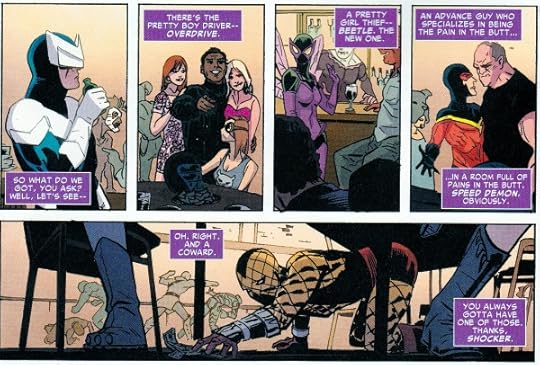
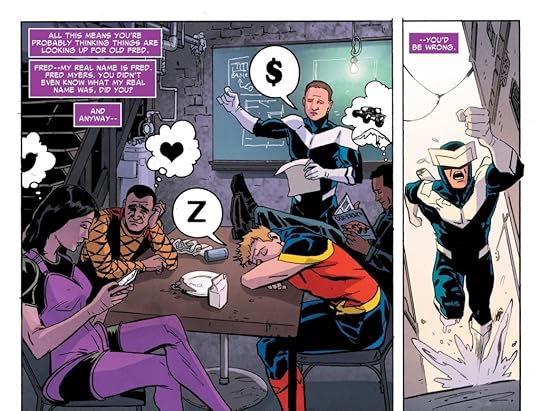
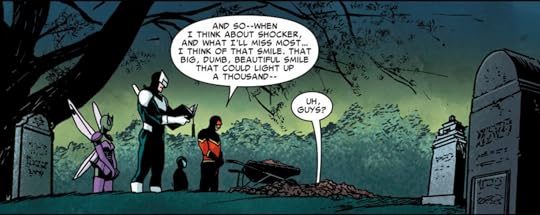
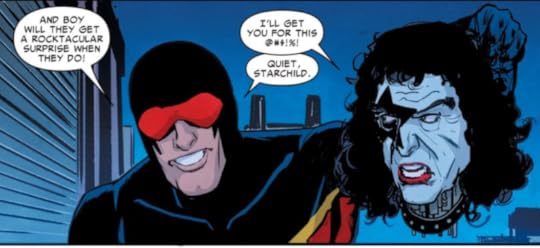
This comic, right ? I first read this almost four years ago, and it never left my mind since. Nick Spencer has been a talent that I've closely followed and admired, and I was constantly waiting to give one of his works a 5-star rating, and after the massive disappointment that was Hunted, I came back to where it began. Today, I finally recognize it for the masterpiece it is.
This comic shouldn't exist. Around 2014, superhero titles began exploring some other facets of their characters, a wave launched by Matt Fraction and David Aja's Hawkeye run, portraying heroes when they aren't saving the world (that's the series' tagline). Since then, there have been some excellent stories, like Tom King's and Gabriel Walta's Vision, as the genre both matured and self-parodied their heroes and concepts. But, even after those, Superior Foes still stands out as unique, by targeting the C and even D-list villains, and more generally the criminal landscape of the Marvel Universe (MU). With inspirations ranging from The Sopranos to Breaking Bad with the Coen Brothers and Arrested Development in between, this series finally shows how the random supervillain lives: how and why they started their careers, how they find their missions and their personal goals. The writing explores far beyond other books what their everyday life is, both as villains and people: they use their powers in the shops, help small businesses destroy each other, don't hide their identities in public, are targeted in their houses and in the street, and even go to a support group for others like them. It details and humanizes both the minimal roles of the small-time criminals, easily replaceable and disposable, and the mobs at the top, constantly fighting and robbing each other. In that aspect, Nick Spencer maps out the power dynamics and shifting in New York, putting each corner at the mercy of another mastermind. They keep piling up (Chameleon, The Owl, Tombstone, Mr. Negative, Hammerhead), and I actually met these villains for the first time while reading this comic. They even get distinctive personality traits, differentiating themselves from other random mobsters, and those details make fantastic recurring gags. It manages to be new-reader friendly, while rewarding avid Marvel readers for knowing each precise character (like Mirage). Nick Spencer captured what it's like being a criminal in the MU, and those days, it sucks, except if you actually know what you do, like Boomerang does, but I'll explore him more about later on.
Re-reading the series helped me understand the plot better. It starts with Boomerang already having debts, and establishes quickly the characters. Its approach is to keep stacking complications to the story, with more betrayals and back stabbings, so that abrupt start doesn't help to start well. But, from that point, it's a constant compilation of manipulations and steps to Boomerang's plan, having to adapt to the other parties and his own carelessness. In that part, it's quite well constructed by Nick Spencer, and keeps escalating, with more players involved and treason sabotaging them (that's ironically something the Hawkeye TV series couldn't do, to keep to date and place the personages of the story, so it's comprehensive). The characters are never safe and have to plan their next step, and with that in mind, the series still balances the action and ordinary moments well. Especially, Boomerang has a lot of personal time, so the rhythm isn't as tense and compressed. Moreover, it's thanks to that description of the crime structures that we can follow the particular power hierarchy. Each major participant in the story, most often going against the Sinister Six, is properly introduced at a certain point, where the situation gets messier, due to more people arriving to ruin the situation. However, I've always had some pacing issues with it, and this second reading didn't quite solve it. This train-wreck succession of events is put to pause for dramatic effect before that excellent conclusion, but this part drags too much. The series itself feels more like quite a long graphic novel than a series of chapters. Thankfully, I read it in an Omnibus, so I didn't have to pause the story at moments not meant for so, but it's clearly not meant for the Marvel publishing format. Though I appreciate how it exactly lasts 17 issues, so unusual for ongoings (not 12 or 18), it never overstays its welcome or becomes repetitive in the interactions (that's the point, of repetition for comedic purposes), but this peculiar sequences after the middle act drags the momentum too much. The story is incredibly well planned, but its structure isn't adapted to the events. The second heist happens earlier than I remember, but the next issues are too focused on laying the cards and showing that everything is planned for the ending, instead of advancing the characters. That would be the main, and only, solid criticism I have.
But, no matter what happens in the plot, a quality is consistent: the tone and humor. Like I said, the concept driving the series is peculiar enough to Superior Foes, but its writing also is. Comedy has been mainstreamed in superhero adventures, but Nick Spencer makes it the central tool, actually helping the plot. But first, the comic is hilarious. That never changes, no matter how many times I read it, and some quotes are implanted in my brain ("I want to become the Hilary Clinton but, you know, of drugs", "This will be a piece of cake", "This guy, right ?"). Having read more from the author, I clearly notice the Arrested Development influence of graduation and escalation through repetition. The running gags are excellent, as expected, and some flew over my head the first time, like Overdrive mentioning his debt to Mr. Negative or Fred having an obsession with Dormammu, and fits with how the characters don't evolve. But, the Arrested Development influence is present in two aspects. The most obvious one is how some characters repeat lines the reader knows from others, but that they haven't heard themselves, so each time it's stated, it gains a new meaning for how we piece each time it's used. That's funny enough, but it's in the ensemble writing that it earns its titles as spiritual successor to one of my favorite sitcoms ever. We follow a group of unstable, immature and selfish people, ready to do anything to come out on top, and their shenanigans build in their separate parts to collide in a bang. Their hubris and obsessions lead them to fail, in a collision course to others like them, and that is what truly anchors the comic in the crime satire.
Between the meta narration and unstoppable flow of quips, it doesn't stop adding more jokes, and they never tire. They aren't necessary quips, it's the general atmosphere of the criminal world. Nobody is serious, and that greatly improves the rest. Some plot points are absurd, come from nowhere and totally change the dynamics, but they work, because of the tone. When the comic already establishes that the characters aren't rational, then the plot doesn't have to be. From the moment the protagonist narrates the story with an ironic second look, it establishes itself as a satire. It embraces the comic-book zaniness (the protagonist wears a boomerang on his forehead), which provokes a contrast. The comic doesn't treat itself seriously and establishes each time more out-of-nowhere MacGuffins (Doctor Doom's painting is a wonder), but at the same time, the character writing is anything if not dedicated. Especially with the enemies, they can be scary and menacing to the Sinister Six, and the audience. The impactful moments, where decisions are taken, are integral and matter (unlike Thor: Ragnarok, which had to tell a joke every 30 seconds). The tone is perfectly balanced, between the unserious plot points and game-changing ones. What pains me is that the characters present here are so well integrated to that peculiar universe, that I consider some of them have been too marked by it, but we'll also come back to it.
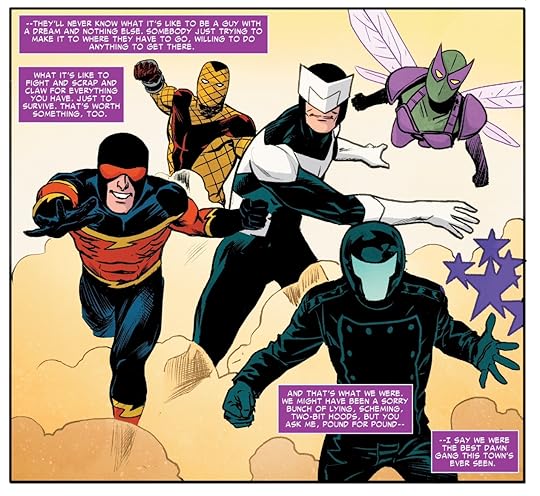
This goofy tone is greatly enhanced by Steve Lieber's art, who doesn't get the credit he deserves. I often say that the style fits with the story, but that's a prime example of how and why. Spider-Man comics never feature particularly "realistic" or detailed art, they tend more towards amplification through simplification, like how his giant, white eyes manage to be expressive. Steve Lieber is placed in the same vein of past, cult Spider-Man artists, and Superior Foes embraces its Silver Age roots (Shocker's eyes work exactly like Spider-Man's, and that's on purpose). The villains are colorful, have tight costumes and don't take themselves seriously. This contrasts with the dark nature of their acts of violence, and more generally the atmosphere of the criminal underworld. This allows the comic to be both impactful at moments (like The Owl eating a rat alive) and hilarious for the rest. And does it greatly improve the humorist tone. We should talk more about how Steve Lieber tackles visual humor in drawing form. There's the usual stuff of expressive and silly facial expressions or poses, that is common. But, he undertakes an exploration of the art form in multiple ways.
One is allowed by the excellent script. The book is told from Boomerang's perspective and narration, and the illustrations have to follow everything he states. But, due to the wandering nature of that narration, sometimes Boomerang gets off-topic, or goes too far in his justifications, which gives a lot of material to Steve Lieber to play with the panel composition, going from one scene to another, with utterly differing contexts without transition. This goes with the volatility of Boomerang's tales and imagination, saying and thinking about anything, always looking for a way out or solution. The other specific aspect, the one that differentiates this comic from others, is the spoken iconography. No matter the context, if other characters are speaking at the same time or not, people in the background or foreground speak in drawings. If you've read the comic, it's totally banal at one point and it's just an amusing detail, but it's definitely not appreciated enough. The creative team understood the power of images, expressing sentences, ideas and moods at the same time. Simplified iconography is a vessel for language, never out-of-place, and each time justified and welcome. Even the background replenishes visual jokes and details, fully embracing the visual medium, making the reading experience richer. Steve Lieber's artistic ideas convey more emotion and humor better than any line of dialogue or piece of acting. The atmosphere is even more unique, and helps us appreciate what the story tells even better.
This leads me to Boomerang, undoubtedly the greatest Marvel character ever. What Nick Spencer tried and succeeded is similar to James Gunn's work on Polka-Dot Man or Tom King's on Kite Man, taking a D-list villain, known for how unknown they are, and creating a fleshed-out, complex, immediately iconic person. Boomerang wasn't even that mocked (he isn't Big Wheel), but Nick Spencer gave him the revamp that comes only twice a decade. While Matt Fraction and David Aja developed a well-known, albeit unexplored Avenger, this is a full on character-study of freaking Boomerang. From the first ever page, the goal is clear: to show what's behind the little guy, the random enemy-of-the-week, the one that Spider-Man easily defeats every so and then. This is his story, his mission, his destiny. He first appears as the archetype of the failing criminal or loser on personal levels, one constantly present in Nick Spencer's work. Boomerang's never pulled any successful jobs, he doesn't have any credit as a serious bad guy, and keeps being thrown away by major crime mobs. He's a nobody, and that will be a starting point to build his empire his own way, because he knows what it's like to be a nobody in the MU. But for the moment, let's ask ourselves: how the hell does he manage to survive this world ? He isn't particularly smart, nor powerful, nor has resources or allies to back him up, or any form of leverage, nor is he a master manipulator. No, what he has is a dream, and a plan. While using his image of the immature henchman (which he is), he gets under the radar and grows in confidence. The irony is that it's that confidence that puts him in trouble afterwards, because he becomes reckless and uncareful. Other villains are constantly mad at him, he owes them, and his list of enemies is constantly piling up. But, somehow, he always finds the most random and incoherent excuse, promising to give something back, which comes back to a point: he finds the resources he needs. Whether it's finding the mythical head of a dead mobster or attacking another mobster's fortress, he's extremely versatile, and will in the face of each danger find a way out. It's because he knows he has nothing to lose, so he looks for another trick up his sleeve to pull. Another strength is that he totally gets how the MU works. Like his narration displays, doing his job so much time has procured him an insight of how others act. He sees behind the typical pattern of heroes and villains, repeating a cycle of violence and power envy, and he exploited it. His knowledge of everyone's secret and functioning way. That's the way of the underdog, to analyze and adapt to the threats he knows. And, even when he has a momentary success, he still wastes it, either because he isn't accustomed to keeping his victories, or because he still owes to other villains. So, he's himself stuck in a cycle of manipulations and treason, directly affecting his teammates.
I guess it's finally time to discuss the titular Superior Foes. They're probably another low point of the series. Don't get me wrong, their group dynamics is what carries the comic (thanks, in part, to Boomerang), but individually, they aren't that compelling. In comparison to Boomerang, any character is stale and pale, but even without him, some don't have anything to push them forward. Re-reading it made me appreciate Shocker even more, whose position is comical, tragic and meta. He's supposed to be a central foe for Spider-Man, but in hindsight, he isn't part of any major team or storyline. It reminded me of when Animal Man, during his 1986 run, was in comic-book limbo and found Mr. Freeze himself present there. The latter was shocked (no pun intended) to be present there, because he should be more important and present in comics. But, neither him nor Shocker marked spirits enough to stay in mind and comics enough. Nick Spencer also reinvented him, transforming another mindless Spider-Man villain into a complex man, suffering due to his lack of power and respect. The comic defined him so well that I hate when he's reduced to a random villain in other comics published since. He reached a point of no return (like Kraven did in his Last Hunt, and see where it led). Still, it's a bit of a shame how he spends half of the series moping in his apartment. The other member of the team I love is Beetle. She isn't so developed or nuanced, but her dynamic with the rest of the team is funny enough. She also wants to be respected and, growing with Tombstone as her father, isn't afraid of mobsters or talking back, so she also takes initiative. But, what differentiates her from Boomerang is her scope. While she wants the Sinister Six to do better, Boomerang is beyond that, and only looks for his benefit, while sacrificing the team. Still, Beetle brings some of the best comical exchanges, and the twist of her being Tombstone's daughter is purely brilliant. As for the last two members, they sadly don't have enough time to develop, and their additions are forgettable at most. That's particularly the case for Speed Demon, while Overdrive had an interesting backstory, also bringing an in-depth exploration of criminality in the Marvel Universe. But, while they're individually forgettable, they shine as a team, never competent or agreeing on their plan of action. Nick Spencer definitely knows how to write lesser known characters and further developing them on the long-term. That's why I'm glad that he continually finds a way to write them in other comics, and their running jokes still pile up (he even managed to do so in the underrated Secret Empire).
I want to come back to Fred and his end goal. For the entire series, he seems not to know what he actually wants. Each victory is marked afterwards by a slip in concentration, laying down for a moment, before forcibly going back to his ways and schemes. Boomerang is the ultimate narcissist, able to sacrifice anyone, truly everyone, for his personal success. It's a driving force that makes him untrustworthy and unpredictable, and the genius of the book is persistently putting him on a team or to ally with others. And whether he chose his teammates or not, he will betray them, or hide his true motive, and build towards his plan. That all leads to the finale, where the reader (his public) finally grasps the scope of his genius. What seemed like unfortunate setbacks for him were part of his plan, to come out as dumbfounded to be the one using others. He doesn't learn or want to learn, because he knows what he wants. No matter how hard he's pushed, he always finds a way to get back up, but not for the right reasons. He's just a man with a dream, and the ending is a celebration of that, and of his team. They aren't worth anything, and they know that.
More than anything, this book is a miracle. While it isn't such a typical masterpiece, it's the pure expression of a creative team, something far too rare in mainstream comics. How it was pitched, made, published, not cancelled after a couple of issues and critically successful is the most inspiring part of that, and the team behind it knows that. I think there's a personal part coming from Nick Spencer in what Boomerang says at the end. He was also just a man in the back, but he had a dream: to write this book. Like his protagonist, he pushed forward, planned his actions, tied every thread, won and ruled comics. That was until Marvel didn't understand his talents, forced him too much in more important titles, and he lost his momentum. That's a huge shame, because we need more comics like this one. While it's unique and shouldn't be plagiarized in any way, it offered something different, creative and hilarious. Comics that push what we know and think of heroes and villains, satirizing how those worlds and people work, and still telling a heartfelt tale: how anybody, even the stupid villain that Spider-Man once fought in two pages, can be the most fascinating person, and achieve their dreams.