

What do you think?

The Citizen's Guide to Climate Success: Overcoming Myths That Hinder Progress
Sometimes solving climate change seems impossibly complex, and it is hard to know what changes we all can and should make to help. This book offers hope. Drawing on the latest research, Mark Jaccard shows us how to recognize the absolutely essential actions (decarbonizing electricity and transport) and policies (regulations that phase out coal plants and gasoline vehicles, carbon tariffs). Rather than feeling paralyzed and pursuing ineffective efforts, we can all make a few key changes in our lifestyles to reduce emissions, to contribute to the urgently needed affordable energy transition in developed and developing countries. More importantly, Jaccard shows how to distinguish climate-sincere from insincere politicians and increase the chance of electing and sustaining these leaders in power. In combining the personal and the political, The Citizen's Guide to Climate Success offers a clear and simple strategic path to solving the greatest problem of our times. A PDF version of this title is also available as Open Access on Cambridge Core at doi.org/10.1017/9781108783453.
296 pages, Paperback
First published February 6, 2020
Ratings & Reviews
Friends & Following
Create a free account to discover what your friends think of this book!
Community Reviews
Displaying 1 - 30 of 31 reviews

March 21, 2020
There is certainly no lack of books on climate change. It is somewhat more difficult to find good books on the topic, especially when they target a non-specialized audience. Mark Jaccard's book fills an important gap: that of books focusing on climate policy (rather than of the possible consequences of climate change), from a non-ideological and rigorous perspective. AND THE E-BOOK IS FREE!
Each chapter in the book tackles an individual myth that "hinders progress" in implementing ambitious climate policies.
Professor Jaccard is well placed to write this book. As an energy economist with a career spanning over three decades, Jaccard has not shied away from getting his hands dirty and providing real advice on climate policy to public authorities. This book is thus also a sort of (partial) intellectual autobiography, in which Jaccard explains how his thinking on some topics has evolved as the result of working with real world policy makers - which explains why, on topics like carbon pricing, his thinking somewhat differs from that of most environmental economists (I will come back to that in a minute).
This book has been written in a very clear and accessible style, and should indeed be accessible to any concerned citizen. Economists working on climate change will find less really new material, except probably when Jaccard discusses some of his experiences in policy advice, some of which are really revealing (and sometimes darkly funny).
For instance, in the 1990s, prof Jaccard served in an expert panel for the Chinese government. Not surprisingly, whenever the panel made concrete policy proposals, the "government graciously thanked us and did nothing". This changed after the Kyoto protocol was signed, even though China did not face any commitments under Kyoto (which was of course one of the major reasons why the Americans never ratified it). Why? Because, by signing the Kyoto protocol, the rich countries sent out the signal that they took climate policy seriously, and the Chinese feared that they would soon face punitive tariffs unless they would also undertake efforts to reduce their greenhouse gas emissions. Not surprisingly, this motivation vanished into thin air as soon as it became clear
that the American Senate wouldn't ratify the protocol after all. As Prof Jaccard correctly points out, this was a major missed opportunity.
Anyway, Jaccard has more or less given up on the idea that it will ever be possible to reach a global and enforceable climate treaty with the level of ambition that is needed to keep climate change within the limits of the acceptable. As an alternative to global treaties, the recent idea of "climate clubs" (coalitions of the willing imposing carbon tariffs on climate laggards) is probably something that deserves more discussion and research.
The chapter on carbon emissions" is probably the best non-technical discussion I have ever seen about the political economy of carbon taxes.
In particular, the history of British Columbia's "revenue neutral carbon tax" is eerily similar to the history of the attempt to introduce a congestion charge in the Belgian region of Flanders (where I have participated in a group of policy consultants). So you have a government that, unexpectedly for some, has "finally" (from an economist's perspective) understood the power of price mechanisms. But the government also understands the risk of political opposition against the charge, so they invest a huge amount of work in preparing its introduction, including numerous studies on how to overcome resistance against the measure, evaluating the pros and the cons of different redistribution mechanisms (and in the case of Flanders: discussions with civil society to understand their concerns).
Did this help? Well, in the case of Flanders, one well orchestrated campaign was enough to unravel the years of careful work. It didn't go as far as in Canada (no one has ever followed my whereabouts to denounce I am a hypocrite because I drive a car myself - Jaccard's experience with people spying on his house to observe his energy consumption must have been horrifying).
But all the other elements were present: people don't understand how a revenue neutral levy could change behaviour; whatever redistribution mechanism you design, it will always be possible to find a group of people who will lose from the system. Etc.
Another important point: what counts is not how many people favour or oppose a given policy. What counts is how strongly people oppose a policy. This is what eventually kills policies that are in the public good.
As an alternative to carbon taxes, Jaccard now advocated "flex regs" - regulations that, for instance impose a CO2 target on certain products, but without specifying in detail how those targets need to be me, and while leaving a lot of flexibility to individual producers on how to achieve the targets (the EU targets for CO2 emissions of passenger cars are a typical example).
(This being said, given the rather positive recent experience with the European Trading System, I guess most EU based economists would be more positive about the potential of carbon pricing, if it would take the form of tradable permits rather than taxes).Mark Jaccard on climate change: "People can't tell you what behavioral change means. But they agree it must happen, whatever it is...The next time someone tells you we must change behavior to reduce GHG emissions, ask them how they changed behavior to reduce emissions that were causing acid rain, smog, dispersion of lead and destruction of the ozone layer" Personally, I would include "technology adoption" and "innovation" as "behavior", but that would be nitpicking. In the colloquial sense, the message is clear: climate mitigation is not about individual behavioral change, it is about a profound transformation of our energy system, and this will not happen because you start shopping locally.
I have also taken a mischievous pleasure from the way Jaccard tackles Naomi Klein and her likes, who propose we abolish capitalism to save the planet. As Jaccard note "humanity's failure thus far with the climate energy threat has provided an opportunity for people to attach their agendas to the solution, and in the process render it more complicated and difficult than necessary.... Klein ignores the main reasons why humanity is having so much trouble with the climate-energy challenge, reasons that exist irrespective of the economic system"
Jaccard's analysis of Klein's highly selective reading of the IPCC reports would be funny if she wouldn't have that many followers who buy into her reasoning.
One point I liked in particular was his discussion of individual behavioural change, which is sometimes advocated as a necessary and sufficient condition to save the planet: "
Each chapter in the book tackles an individual myth that "hinders progress" in implementing ambitious climate policies.
Professor Jaccard is well placed to write this book. As an energy economist with a career spanning over three decades, Jaccard has not shied away from getting his hands dirty and providing real advice on climate policy to public authorities. This book is thus also a sort of (partial) intellectual autobiography, in which Jaccard explains how his thinking on some topics has evolved as the result of working with real world policy makers - which explains why, on topics like carbon pricing, his thinking somewhat differs from that of most environmental economists (I will come back to that in a minute).
This book has been written in a very clear and accessible style, and should indeed be accessible to any concerned citizen. Economists working on climate change will find less really new material, except probably when Jaccard discusses some of his experiences in policy advice, some of which are really revealing (and sometimes darkly funny).
For instance, in the 1990s, prof Jaccard served in an expert panel for the Chinese government. Not surprisingly, whenever the panel made concrete policy proposals, the "government graciously thanked us and did nothing". This changed after the Kyoto protocol was signed, even though China did not face any commitments under Kyoto (which was of course one of the major reasons why the Americans never ratified it). Why? Because, by signing the Kyoto protocol, the rich countries sent out the signal that they took climate policy seriously, and the Chinese feared that they would soon face punitive tariffs unless they would also undertake efforts to reduce their greenhouse gas emissions. Not surprisingly, this motivation vanished into thin air as soon as it became clear
that the American Senate wouldn't ratify the protocol after all. As Prof Jaccard correctly points out, this was a major missed opportunity.
Anyway, Jaccard has more or less given up on the idea that it will ever be possible to reach a global and enforceable climate treaty with the level of ambition that is needed to keep climate change within the limits of the acceptable. As an alternative to global treaties, the recent idea of "climate clubs" (coalitions of the willing imposing carbon tariffs on climate laggards) is probably something that deserves more discussion and research.
The chapter on carbon emissions" is probably the best non-technical discussion I have ever seen about the political economy of carbon taxes.
In particular, the history of British Columbia's "revenue neutral carbon tax" is eerily similar to the history of the attempt to introduce a congestion charge in the Belgian region of Flanders (where I have participated in a group of policy consultants). So you have a government that, unexpectedly for some, has "finally" (from an economist's perspective) understood the power of price mechanisms. But the government also understands the risk of political opposition against the charge, so they invest a huge amount of work in preparing its introduction, including numerous studies on how to overcome resistance against the measure, evaluating the pros and the cons of different redistribution mechanisms (and in the case of Flanders: discussions with civil society to understand their concerns).
Did this help? Well, in the case of Flanders, one well orchestrated campaign was enough to unravel the years of careful work. It didn't go as far as in Canada (no one has ever followed my whereabouts to denounce I am a hypocrite because I drive a car myself - Jaccard's experience with people spying on his house to observe his energy consumption must have been horrifying).
But all the other elements were present: people don't understand how a revenue neutral levy could change behaviour; whatever redistribution mechanism you design, it will always be possible to find a group of people who will lose from the system. Etc.
Another important point: what counts is not how many people favour or oppose a given policy. What counts is how strongly people oppose a policy. This is what eventually kills policies that are in the public good.
As an alternative to carbon taxes, Jaccard now advocated "flex regs" - regulations that, for instance impose a CO2 target on certain products, but without specifying in detail how those targets need to be me, and while leaving a lot of flexibility to individual producers on how to achieve the targets (the EU targets for CO2 emissions of passenger cars are a typical example).
(This being said, given the rather positive recent experience with the European Trading System, I guess most EU based economists would be more positive about the potential of carbon pricing, if it would take the form of tradable permits rather than taxes).Mark Jaccard on climate change: "People can't tell you what behavioral change means. But they agree it must happen, whatever it is...The next time someone tells you we must change behavior to reduce GHG emissions, ask them how they changed behavior to reduce emissions that were causing acid rain, smog, dispersion of lead and destruction of the ozone layer" Personally, I would include "technology adoption" and "innovation" as "behavior", but that would be nitpicking. In the colloquial sense, the message is clear: climate mitigation is not about individual behavioral change, it is about a profound transformation of our energy system, and this will not happen because you start shopping locally.
I have also taken a mischievous pleasure from the way Jaccard tackles Naomi Klein and her likes, who propose we abolish capitalism to save the planet. As Jaccard note "humanity's failure thus far with the climate energy threat has provided an opportunity for people to attach their agendas to the solution, and in the process render it more complicated and difficult than necessary.... Klein ignores the main reasons why humanity is having so much trouble with the climate-energy challenge, reasons that exist irrespective of the economic system"
Jaccard's analysis of Klein's highly selective reading of the IPCC reports would be funny if she wouldn't have that many followers who buy into her reasoning.
One point I liked in particular was his discussion of individual behavioural change, which is sometimes advocated as a necessary and sufficient condition to save the planet: "

November 20, 2020
If the best exercise routine is the one you'll actually do, then the best climate plans are the ones that pass and are implemented. With that in mind, Mark Jaccard's The Citizen's Guide to Climate Success is an excellent policy overview for pragmatic greens.
Jaccard mostly prefers standards and regulation to a carbon tax because the latter, though a little more efficient, is so politically unpopular that it either fails to pass or removes "climate sincere" politicians from office. Any tax is too easily attacked by vested interests.
The subtitle is "Overcoming Myths that Hinder Progress." Here are some other positions I see him taking.
Behavior Change. Jaccard mostly distrusts behavior change as an effective solution. He points out that every major environmental initiative has succeeded through regulation, not behavior change. He asks people what behavior they did to stop acid rain or to save the ozone layer. It's convincing. At times, it's also comical: when one of his students talks to someone who is "getting into environmentalism" through hot yoga, another looks into how much energy these studios use. The electricity bills are neither calming nor flexible. The exception to behavior change is diet, see below.
Peak Oil: Jaccard convincingly argues that we are not likely to soon run out of fossil fuels. Further, as we increase renewable sources, the price of oil is likely to fall. (The major oil producers met earlier this year in response to coronavirus shutdowns and lowered production. I'm glad, though I note it's not a very competitive free market.) See Smil's Oil for more.
Messaging: Messaging is mostly overrated. People mostly believe what they want. If they want to believe that climate change isn't that big a deal, it's very hard to change their mind. Even if voters say they care, they mostly don't support climate sincere politicians, regardless. We should therefore focus on electing climate sincere politicians who will pass regulations that don't trigger motivated reasoning and misinformation campaigns from the fossil fuels industry. Jaccard defends Prime Minister Trudeau of Canada and President Obama as climate sincere politicians who, though not perfect, pursued many green initiatives that idealistic environmentalists take for granted in their quest for a perfect policy package.
Against Capitalism: Although I found much of value in Naomi Klein's This Changes Everything, Jaccard convincingly argues against piling climate legislation on top of other legislation--it's hard enough already to pass climate policy. He is, like many greens in this camp, skeptical of consumerism, but he is less skeptical of capitalism in all forms. And he remains a realist.
Nuclear Energy and geoengineering: Jaccard keeps an open mind on both of these issues. He's not a promethean, but he's not indignant at the thought of either idea. If you're looking for books that convincingly support these ideas, try Brand's Whole Earth Discipline and Morton's The Planet Remade.
What should policy target? Transportation and electricity. Although an argument can be made that each one of these sectors is not a majority emissions driver in every country, Jaccard sees them as largely overlapping. They can be addressed together and so their urgency rises. He doesn't love biofuels without qualification, but he sees a role for them and points to Brazil as a success story. He does address housing, though only briefly, and here again he points out that regulations lead to effective reductions in energy consumption.
Diet: Jaccard is happy to see people reduce meat intake. He curiously sees it as a technological change, citing Beyond Meat and Impossible Burger. I note that many people reduce meat intake by eating beans and tofu, which are fine by the way, but I'm not going to quibble.
Who are Jaccard's fellow travelers? I broadly see Jaccard as a policy realist rather than an idealist, perhaps because he is a professor of economics and sustainability at Simon Frasier University who has consulted governments and watched the victories, losses, and unintended consequences. Here, he mostly engages with other scholars like Naomi Oreskes and Vaclav Smil. Although he clearly values and contributes to the IPCC reports, neither Rockstrom nor Raworth's Doughnut Economics model is mentioned. Jaccard is not concerned with revolutions; he wants real policies that lead to real changes, even if they're incremental on the way to zero emissions by 2030 or 2050. There is room for activism, akin to what McKibben is doing, but mostly in terms of creating Overton windows that, you guessed it, make it easier to elect climate sincere politicians who will focus on regulations and standards. If I were to recommend The Citizen's Guide to Climate Success in a stack, the other works would be Paul Hawken's Drawdown and Hal Harvey's Designing Climate Solutions. They are all focused on how technology and policy, rather than the science (a different stack), work and then push for initiatives to advance both.
All in all, greens can learn a lot from Jaccard's approach on what we can do within the world we live in rather than what should be done within an ideal world. If I can return to my original analogy, that the best workout routine is the one you stick with, greens might learn a lot from fitness journeys and past climate policies. Very few people optimize their exercise routine 7 days a week 52 weeks a year, but just going for a run three times a week every week leads to many positive health outcomes. And it's easy to build one's routine from there.
Notes.
Jaccard mostly prefers standards and regulation to a carbon tax because the latter, though a little more efficient, is so politically unpopular that it either fails to pass or removes "climate sincere" politicians from office. Any tax is too easily attacked by vested interests.
The subtitle is "Overcoming Myths that Hinder Progress." Here are some other positions I see him taking.
Behavior Change. Jaccard mostly distrusts behavior change as an effective solution. He points out that every major environmental initiative has succeeded through regulation, not behavior change. He asks people what behavior they did to stop acid rain or to save the ozone layer. It's convincing. At times, it's also comical: when one of his students talks to someone who is "getting into environmentalism" through hot yoga, another looks into how much energy these studios use. The electricity bills are neither calming nor flexible. The exception to behavior change is diet, see below.
Peak Oil: Jaccard convincingly argues that we are not likely to soon run out of fossil fuels. Further, as we increase renewable sources, the price of oil is likely to fall. (The major oil producers met earlier this year in response to coronavirus shutdowns and lowered production. I'm glad, though I note it's not a very competitive free market.) See Smil's Oil for more.
Messaging: Messaging is mostly overrated. People mostly believe what they want. If they want to believe that climate change isn't that big a deal, it's very hard to change their mind. Even if voters say they care, they mostly don't support climate sincere politicians, regardless. We should therefore focus on electing climate sincere politicians who will pass regulations that don't trigger motivated reasoning and misinformation campaigns from the fossil fuels industry. Jaccard defends Prime Minister Trudeau of Canada and President Obama as climate sincere politicians who, though not perfect, pursued many green initiatives that idealistic environmentalists take for granted in their quest for a perfect policy package.
Against Capitalism: Although I found much of value in Naomi Klein's This Changes Everything, Jaccard convincingly argues against piling climate legislation on top of other legislation--it's hard enough already to pass climate policy. He is, like many greens in this camp, skeptical of consumerism, but he is less skeptical of capitalism in all forms. And he remains a realist.
Nuclear Energy and geoengineering: Jaccard keeps an open mind on both of these issues. He's not a promethean, but he's not indignant at the thought of either idea. If you're looking for books that convincingly support these ideas, try Brand's Whole Earth Discipline and Morton's The Planet Remade.
What should policy target? Transportation and electricity. Although an argument can be made that each one of these sectors is not a majority emissions driver in every country, Jaccard sees them as largely overlapping. They can be addressed together and so their urgency rises. He doesn't love biofuels without qualification, but he sees a role for them and points to Brazil as a success story. He does address housing, though only briefly, and here again he points out that regulations lead to effective reductions in energy consumption.
Diet: Jaccard is happy to see people reduce meat intake. He curiously sees it as a technological change, citing Beyond Meat and Impossible Burger. I note that many people reduce meat intake by eating beans and tofu, which are fine by the way, but I'm not going to quibble.
Who are Jaccard's fellow travelers? I broadly see Jaccard as a policy realist rather than an idealist, perhaps because he is a professor of economics and sustainability at Simon Frasier University who has consulted governments and watched the victories, losses, and unintended consequences. Here, he mostly engages with other scholars like Naomi Oreskes and Vaclav Smil. Although he clearly values and contributes to the IPCC reports, neither Rockstrom nor Raworth's Doughnut Economics model is mentioned. Jaccard is not concerned with revolutions; he wants real policies that lead to real changes, even if they're incremental on the way to zero emissions by 2030 or 2050. There is room for activism, akin to what McKibben is doing, but mostly in terms of creating Overton windows that, you guessed it, make it easier to elect climate sincere politicians who will focus on regulations and standards. If I were to recommend The Citizen's Guide to Climate Success in a stack, the other works would be Paul Hawken's Drawdown and Hal Harvey's Designing Climate Solutions. They are all focused on how technology and policy, rather than the science (a different stack), work and then push for initiatives to advance both.
All in all, greens can learn a lot from Jaccard's approach on what we can do within the world we live in rather than what should be done within an ideal world. If I can return to my original analogy, that the best workout routine is the one you stick with, greens might learn a lot from fitness journeys and past climate policies. Very few people optimize their exercise routine 7 days a week 52 weeks a year, but just going for a run three times a week every week leads to many positive health outcomes. And it's easy to build one's routine from there.
Notes.

February 14, 2020
**93rd Climate Book**
Disclosure: I read and summarized this book for a local climate event I helped to coordinate, as Dr. Jaccard was kind enough to come as our keynote speaker. So this review is unavoidably informed by that presentation as well as the conversations he had with attendees. (If you'd like to see a livestream of the talk and Q&A, I've put a link to it at the bottom of the review.)
Overall it's very helpful, in finding a clear and actionable path forward on a good chunk of a jurisdiction's carbon emissions: Do the emissions inventory and identify sectors with high emissions and low potential for relocation (in most countries, this will be the electrical grid and transportation); make compulsory policies for reductions in carbon emissions for those sectors through either carbon pricing and/or regulations; and impose tariffs on countries with no plans for emissions reductions to avoid penalizing local industries. He suggests largely giving up on the UN negotiation process (fair enough), and recommends each country use the tools it has complete control over to drive its own emissions down ASAP and encourage other countries to do likewise.
For regular citizens without the power to unilaterally impose mandatory regulations on either transportation systems or electrical grids, he says to determine which politicians are "climate sincere," do everything you can to help them get and stay elected, hold them accountable to the promises they make, and when this doesn't work out (either because the insincere ones get in or the sincere ones don't act), protest and/or engage in civil disobedience. Handy flow chart:
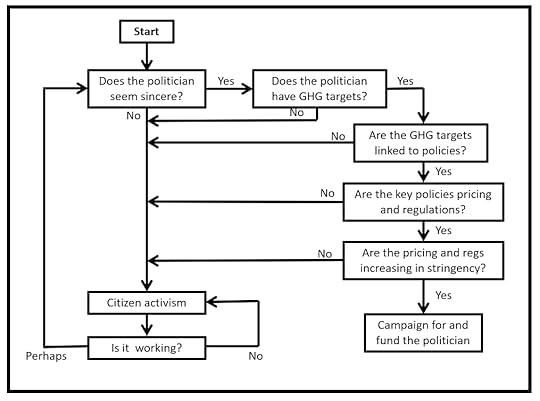
Produced by one of his students, not by me.
It's a very encouraging approach, as it lays out a simple path for most citizens to get engaged on a critical issue without having to become a technical expert in a dozen fields, and he spends a lot of his book laying out common myths that prevent or obscure this simplicity, and then taking them apart one by one. His technical credentials are impeccable and his arguments are concise and persuasive, and I was largely persuaded.
There are two where I wasn't; on one I'm reserving judgement, and on the other I think Jaccard is partially mistaken:
1. The electrical grid: Jaccard's argument is that we can switch fuels rather simply and eliminate emissions that way; however, I've seen arguments that this isn't possible on its own and requires substantial reduction of load to accomplish, which makes retrofitting buildings and other infrastructure projects a key part of the fuel switch. I am not a technical expert in either field, so I can't decisively say one way or the other; but I can say that as lower levels of government usually find buildings are within their control and electricity generation is not, a focus on load reduction from buildings seems very productive in the absence of regional/provincial/state/national policy, depending on who's in power.
Three recent examples much shared in my own circles last year: https://thetyee.ca/Analysis/2019/11/1...
https://thetyee.ca/Analysis/2019/11/1...
https://thetyee.ca/Analysis/2019/11/2...
2. The chapter on Naomi Klein.
Which isn't becuase I disagree with him on This Changes Everything: Capitalism vs. The Climate ; I panned it, and for largely the same reasons. But I think Jaccard overlooks what makes Klein's arguments so appealing, and the role that appealing arguments have played in building the size of the movement. I'd be surprised if most of Klein's readers actually want to destroy capitalism, or even have a very clear or concrete idea what "overthrowing capitalism" means. What they do understand is that "overthrowing capitalism" is a kind of shorthand for reducing inequality in a way that will materially improve the conditions of their own lives; it means not feeling broke all the time. And Klein's genius has been in connecting a mass interest in not feeling/being broke all the time to climate action, which has built a very large constituency pushing for climate action.
In the same way that activists connecting climate change to racism and sexism (justifiably! The links are there and well-documented) has created a large "climate justice" movement that is also demanding political action. And the "generational inequity" arguments of the youth strikers have built large climate action movements with huge impact.
Jaccard argues that we don't have time to overthrow capitalism while pursuing decarbonization, and he's right. But he also argues against "agenda-hitching" broadly, or the connection of climate action to other social goals such as equity, and here I think he's wrong; it's agenda-hitching that has pushed climate action to the top of the political agenda for the first time in decades. Without agenda-hitching, we will not be able to sustain a big enough movement to successfully oppose fossil fuel companies' very deep pockets and entrenched political power. Frankly, without some agenda-hitching, I doubt we'd be able to implement many climate policies in my own jurisdiction.
We are never going to have a climate protest of millions of people demanding flex-regs on clean energy standards, much as that might simplify things. That is for the policy wonks and the politicians. Mass movements are built on a need for justice.
I highly recommend the book for readers very concerned about climate change and looking for something to help cut through a lot of the noise. It's readable and engaging, in parts very funny, and anything that usefully and accurately simplifies climate action is much needed today.
Livestream link: https://www.mohawkcollege.ca/centre-f...
Disclosure: I read and summarized this book for a local climate event I helped to coordinate, as Dr. Jaccard was kind enough to come as our keynote speaker. So this review is unavoidably informed by that presentation as well as the conversations he had with attendees. (If you'd like to see a livestream of the talk and Q&A, I've put a link to it at the bottom of the review.)
Overall it's very helpful, in finding a clear and actionable path forward on a good chunk of a jurisdiction's carbon emissions: Do the emissions inventory and identify sectors with high emissions and low potential for relocation (in most countries, this will be the electrical grid and transportation); make compulsory policies for reductions in carbon emissions for those sectors through either carbon pricing and/or regulations; and impose tariffs on countries with no plans for emissions reductions to avoid penalizing local industries. He suggests largely giving up on the UN negotiation process (fair enough), and recommends each country use the tools it has complete control over to drive its own emissions down ASAP and encourage other countries to do likewise.
For regular citizens without the power to unilaterally impose mandatory regulations on either transportation systems or electrical grids, he says to determine which politicians are "climate sincere," do everything you can to help them get and stay elected, hold them accountable to the promises they make, and when this doesn't work out (either because the insincere ones get in or the sincere ones don't act), protest and/or engage in civil disobedience. Handy flow chart:
Produced by one of his students, not by me.
It's a very encouraging approach, as it lays out a simple path for most citizens to get engaged on a critical issue without having to become a technical expert in a dozen fields, and he spends a lot of his book laying out common myths that prevent or obscure this simplicity, and then taking them apart one by one. His technical credentials are impeccable and his arguments are concise and persuasive, and I was largely persuaded.
There are two where I wasn't; on one I'm reserving judgement, and on the other I think Jaccard is partially mistaken:
1. The electrical grid: Jaccard's argument is that we can switch fuels rather simply and eliminate emissions that way; however, I've seen arguments that this isn't possible on its own and requires substantial reduction of load to accomplish, which makes retrofitting buildings and other infrastructure projects a key part of the fuel switch. I am not a technical expert in either field, so I can't decisively say one way or the other; but I can say that as lower levels of government usually find buildings are within their control and electricity generation is not, a focus on load reduction from buildings seems very productive in the absence of regional/provincial/state/national policy, depending on who's in power.
Three recent examples much shared in my own circles last year: https://thetyee.ca/Analysis/2019/11/1...
https://thetyee.ca/Analysis/2019/11/1...
https://thetyee.ca/Analysis/2019/11/2...
2. The chapter on Naomi Klein.
Which isn't becuase I disagree with him on This Changes Everything: Capitalism vs. The Climate ; I panned it, and for largely the same reasons. But I think Jaccard overlooks what makes Klein's arguments so appealing, and the role that appealing arguments have played in building the size of the movement. I'd be surprised if most of Klein's readers actually want to destroy capitalism, or even have a very clear or concrete idea what "overthrowing capitalism" means. What they do understand is that "overthrowing capitalism" is a kind of shorthand for reducing inequality in a way that will materially improve the conditions of their own lives; it means not feeling broke all the time. And Klein's genius has been in connecting a mass interest in not feeling/being broke all the time to climate action, which has built a very large constituency pushing for climate action.
In the same way that activists connecting climate change to racism and sexism (justifiably! The links are there and well-documented) has created a large "climate justice" movement that is also demanding political action. And the "generational inequity" arguments of the youth strikers have built large climate action movements with huge impact.
Jaccard argues that we don't have time to overthrow capitalism while pursuing decarbonization, and he's right. But he also argues against "agenda-hitching" broadly, or the connection of climate action to other social goals such as equity, and here I think he's wrong; it's agenda-hitching that has pushed climate action to the top of the political agenda for the first time in decades. Without agenda-hitching, we will not be able to sustain a big enough movement to successfully oppose fossil fuel companies' very deep pockets and entrenched political power. Frankly, without some agenda-hitching, I doubt we'd be able to implement many climate policies in my own jurisdiction.
We are never going to have a climate protest of millions of people demanding flex-regs on clean energy standards, much as that might simplify things. That is for the policy wonks and the politicians. Mass movements are built on a need for justice.
I highly recommend the book for readers very concerned about climate change and looking for something to help cut through a lot of the noise. It's readable and engaging, in parts very funny, and anything that usefully and accurately simplifies climate action is much needed today.
Livestream link: https://www.mohawkcollege.ca/centre-f...

November 17, 2022
Why listen fact when easy not

July 9, 2020
Clear and accessible but deals with the issues in detail.

January 28, 2020
This is a very interesting book. The moment you open this book, you will be drawn into reading it in full. Honestly speaking, I found it really hard to put this book down after having started it. The tone is neither overly passionate nor dull. The writer maintains a balanced tempo throughout the book, and except for few scattered passionate outbursts, he does not leave it. He talks to you slowly, allowing you sufficient time to absorb the knowledge that he is trying to impart. He ensures not to feed you too much information with each morsel, while at the same time makes sure that every page contains something new to learn. This book was an eye opener for me, and even though I took about three months reading it, I would not mind reading it again. It is because the book contains so much stuff which would stay relevant for years to come. This book does not aim at entertainment as it is addressing a very serious issue. At the same time, nowhere does it create any impression of a boring treatise. At one place the writer acknowledges that scientists are poor communicators and this has been one of the reasons behind the knowledge gap between (climate) science and general public. This book will certainly fill that gap, and considering the scarcity of texts aimed at general audience, it will remain a valuable source to refer to.
First the writer explains how myths come into being, and why it becomes difficult for people to change their minds. Then with the first chapter, he goes on to describe how myths are created and fed by people and institutions having vested interests or those trying to avoid inconvenience. He discusses the various myths at length, so that by the end of the chapter you begin to realise how serious the issue is, and how you are being manipulated all the time. Then from the next chapter onwards he discusses how myths are created and sustained in the context of climate change. Next comes the timeline of events, i.e., when and how did people start taking interest in climate change discussion, and what are the challenges faced by people and politicians who want to take meaningful action. He keeps returning to enumerate the various actions and steps that could be taken in order to address climate change.
I belong to the generation which has grown up hearing about climate change, ozone layer, greenhouse effect and global warming. And as I march forward towards the end of my life, there doesn’t seem to be any solution in sight to most of these problems. That implies that the next generation will also study these concepts in their school curriculum! This is indeed unfortunate.
At the same time, I cannot deny that certainly a lot of progress has been made. I am not talking about ozone. I am talking about general social awareness. Today nobody needs to be told what is carbon dioxide or global warming or climate change. Everybody seems to have a fairly good idea about the problem. The reasons behind this increased social awareness could be several. First, as I mentioned earlier, climate change is part of school curriculum for nearly three decades. Second, print and electronic media have played crucial role in spreading awareness about several aspects of climate system mainly through popular science articles, social awareness advertisements and campaigns, and documentaries. Third and most importantly, and unfortunately, effects of climate change are right in front of us for all to see — whether in form of floods, or droughts, or severe weather. Add to this the increased confidence of scientific community as a result of long observations, simulations and data analysis. They no longer talk in terms of probabilities and uncertainties; instead, they have a better understanding of the various interactions between different components of the climate system as well as their individual roles. Now we do not doubt, we do not question. There is a problem. And it demands action. Urgent action.
Now this leads to the obvious question — Now what? At the same time, there is a sense of panic and general chaos. So certain questions still remain, to be precise three questions. Question 1: What exactly does it all mean? So much information is thrown at public, which is left on its own to make sense out of it. Unfortunately, people and agencies with vested interests will go to any length to create and sustain doubt in the minds of general public. In a way, this question is no longer very serious one since, as I mentioned in the previous paragraph, general audience has a fairly good sense of the climate change problem. It may not be familiar with all the scientific complexities of the issue, however, it need not be acquainted with them. This book gives a very basic outline of the climate change problem, which is necessary and sufficient for understanding the issues and concepts discussed in the book. Whenever any new idea or concept is introduced, all background information is also provided.
Question 2: OK, so there is a problem. But if it is such a big problem, why aren’t people doing something to solve it? I mean, the government, the various NGOs, the scientists — shouldn’t they be doing something? It is already 30 years that I have been listening about this noise, yet there is no resolution in sight. And it is here that the book begins its discussion, most of which I have already mentioned. It tells you the various obstacles that scientists, environmentalists and climate sincere politicians have to face in their efforts. The problem is much bigger and serious than it appears to us outsiders. Somewhere in the beginning of the book he mentions that several agencies would have to collaborate and work together to address this problem — scientists, politicians, environmentalists, psychologists, economists and so on. I didn’t give much thought to that sentence. But after going through 3/4 of the book, I was already appreciating the various bias and flaws in my own scientific reasoning, mainly because I tend to ignore the psychological (human behaviour) and economical factors. Let me give you one simple example. We assume that improving the efficiency of vehicles would reduce fuel consumption. Quite obvious. But do you account for the fact that with increased efficiency the users would be inclined to travel more often and to longer distances? With efficient production of light, price of electricity would come down, but at the same time, users would be inclined to use electricity more ‘generously’ for applications not thought of before — heating, decoration etc. Another example could be given of ‘go green’. It is a very noble thought, but do you consider the increased fuel consumption in transport by train or air during the shipment of these products from factories to consumers?
And finally, question 3: What can I do as an individual to make my contribution towards climate success. This is the core content of this book. From an economist point of view, the writer enumerates various methods and approaches one by one to deal with the climate change problem, along with their merits and drawbacks. As far as I could see it, the discussion is fairly unbiased and balanced. He does not hesitate in acknowledging the positive points, advantages and merits of various approaches, and points out their limitations only after he has first discussed their merits at length. Among the major ones are carbon tariffs, flexible regulations, offsets, and renewable energy. In his criticism, he focuses on specific aspects of those solutions. In final chapters, he enumerates various examples from different parts of the world e.g., Brazil, France, Canada, and California where different ways for decarbonization were employed with success. I must say that this discussion is exhaustive, and at one point you may feel overwhelmed with the information and discussion presented. However, the last chapter makes things easy for you by giving an overall summary of the various approaches for addressing the climate change problem. Note that this is not a summary of the whole book; for example, he does not go through the myths and their propagation all over again, nor does he debate all the possible solutions again. Instead, he gives only a summary of what the recommended approach towards climate success should look like. In fact, that is precisely what the reader wants to know at the end of the book.
There are only few typographical mistakes including punctuation marks but I would rather ignore them. The only drawback of the book is the digressions going too long. To drive home his point, the writer gives analogies from history, and explains how the case under discussion is similar to that analogy. This requires a digression while he explains all the aspects of the analogy. However, such narration becomes long to such an extent that after some time you get confused as to why you ended up discussing this topic and what has it to do with climate science. I do agree that the analogies were always very appropriate and the discussions were good. My concern is that the discussion and elaboration became much longer than were required. It is easy to sense that it was perfectly possible to cut down on the discussion without sacrificing the rigour. I am saying this regarding the analogy of smoking versus climate change risk, war in Middle East versus climate change myths, US presidential elections versus convincing people about the science of climate change.
Few cartoons are scattered throughout the book, some of them are very direct and apt. However, the captions to these cartoons were not required. For example, why to explicitly tell “Cartoon about carbon offsets by Jacob Fox” when it is obvious? Instead, just the artist’s signature or a label “copyright: Jacob Fox” would have been sufficient. Also, the book cover could have been made more catchy by including some graphics or figures.
Summary: You would not find very basic definitions and concepts of climate science here. Instead the writer prefers to answer the crucial questions that make the crux of the climate change debate. Yes, the content of the book is true to its title — it is indeed a guide for all concerned citizens to make their contribution to address climate change. The biggest positive point of the book is its focus. It aims at telling what can we as citizens do to help address climate change, and nowhere does it deviate from that focus.
First the writer explains how myths come into being, and why it becomes difficult for people to change their minds. Then with the first chapter, he goes on to describe how myths are created and fed by people and institutions having vested interests or those trying to avoid inconvenience. He discusses the various myths at length, so that by the end of the chapter you begin to realise how serious the issue is, and how you are being manipulated all the time. Then from the next chapter onwards he discusses how myths are created and sustained in the context of climate change. Next comes the timeline of events, i.e., when and how did people start taking interest in climate change discussion, and what are the challenges faced by people and politicians who want to take meaningful action. He keeps returning to enumerate the various actions and steps that could be taken in order to address climate change.
I belong to the generation which has grown up hearing about climate change, ozone layer, greenhouse effect and global warming. And as I march forward towards the end of my life, there doesn’t seem to be any solution in sight to most of these problems. That implies that the next generation will also study these concepts in their school curriculum! This is indeed unfortunate.
At the same time, I cannot deny that certainly a lot of progress has been made. I am not talking about ozone. I am talking about general social awareness. Today nobody needs to be told what is carbon dioxide or global warming or climate change. Everybody seems to have a fairly good idea about the problem. The reasons behind this increased social awareness could be several. First, as I mentioned earlier, climate change is part of school curriculum for nearly three decades. Second, print and electronic media have played crucial role in spreading awareness about several aspects of climate system mainly through popular science articles, social awareness advertisements and campaigns, and documentaries. Third and most importantly, and unfortunately, effects of climate change are right in front of us for all to see — whether in form of floods, or droughts, or severe weather. Add to this the increased confidence of scientific community as a result of long observations, simulations and data analysis. They no longer talk in terms of probabilities and uncertainties; instead, they have a better understanding of the various interactions between different components of the climate system as well as their individual roles. Now we do not doubt, we do not question. There is a problem. And it demands action. Urgent action.
Now this leads to the obvious question — Now what? At the same time, there is a sense of panic and general chaos. So certain questions still remain, to be precise three questions. Question 1: What exactly does it all mean? So much information is thrown at public, which is left on its own to make sense out of it. Unfortunately, people and agencies with vested interests will go to any length to create and sustain doubt in the minds of general public. In a way, this question is no longer very serious one since, as I mentioned in the previous paragraph, general audience has a fairly good sense of the climate change problem. It may not be familiar with all the scientific complexities of the issue, however, it need not be acquainted with them. This book gives a very basic outline of the climate change problem, which is necessary and sufficient for understanding the issues and concepts discussed in the book. Whenever any new idea or concept is introduced, all background information is also provided.
Question 2: OK, so there is a problem. But if it is such a big problem, why aren’t people doing something to solve it? I mean, the government, the various NGOs, the scientists — shouldn’t they be doing something? It is already 30 years that I have been listening about this noise, yet there is no resolution in sight. And it is here that the book begins its discussion, most of which I have already mentioned. It tells you the various obstacles that scientists, environmentalists and climate sincere politicians have to face in their efforts. The problem is much bigger and serious than it appears to us outsiders. Somewhere in the beginning of the book he mentions that several agencies would have to collaborate and work together to address this problem — scientists, politicians, environmentalists, psychologists, economists and so on. I didn’t give much thought to that sentence. But after going through 3/4 of the book, I was already appreciating the various bias and flaws in my own scientific reasoning, mainly because I tend to ignore the psychological (human behaviour) and economical factors. Let me give you one simple example. We assume that improving the efficiency of vehicles would reduce fuel consumption. Quite obvious. But do you account for the fact that with increased efficiency the users would be inclined to travel more often and to longer distances? With efficient production of light, price of electricity would come down, but at the same time, users would be inclined to use electricity more ‘generously’ for applications not thought of before — heating, decoration etc. Another example could be given of ‘go green’. It is a very noble thought, but do you consider the increased fuel consumption in transport by train or air during the shipment of these products from factories to consumers?
And finally, question 3: What can I do as an individual to make my contribution towards climate success. This is the core content of this book. From an economist point of view, the writer enumerates various methods and approaches one by one to deal with the climate change problem, along with their merits and drawbacks. As far as I could see it, the discussion is fairly unbiased and balanced. He does not hesitate in acknowledging the positive points, advantages and merits of various approaches, and points out their limitations only after he has first discussed their merits at length. Among the major ones are carbon tariffs, flexible regulations, offsets, and renewable energy. In his criticism, he focuses on specific aspects of those solutions. In final chapters, he enumerates various examples from different parts of the world e.g., Brazil, France, Canada, and California where different ways for decarbonization were employed with success. I must say that this discussion is exhaustive, and at one point you may feel overwhelmed with the information and discussion presented. However, the last chapter makes things easy for you by giving an overall summary of the various approaches for addressing the climate change problem. Note that this is not a summary of the whole book; for example, he does not go through the myths and their propagation all over again, nor does he debate all the possible solutions again. Instead, he gives only a summary of what the recommended approach towards climate success should look like. In fact, that is precisely what the reader wants to know at the end of the book.
There are only few typographical mistakes including punctuation marks but I would rather ignore them. The only drawback of the book is the digressions going too long. To drive home his point, the writer gives analogies from history, and explains how the case under discussion is similar to that analogy. This requires a digression while he explains all the aspects of the analogy. However, such narration becomes long to such an extent that after some time you get confused as to why you ended up discussing this topic and what has it to do with climate science. I do agree that the analogies were always very appropriate and the discussions were good. My concern is that the discussion and elaboration became much longer than were required. It is easy to sense that it was perfectly possible to cut down on the discussion without sacrificing the rigour. I am saying this regarding the analogy of smoking versus climate change risk, war in Middle East versus climate change myths, US presidential elections versus convincing people about the science of climate change.
Few cartoons are scattered throughout the book, some of them are very direct and apt. However, the captions to these cartoons were not required. For example, why to explicitly tell “Cartoon about carbon offsets by Jacob Fox” when it is obvious? Instead, just the artist’s signature or a label “copyright: Jacob Fox” would have been sufficient. Also, the book cover could have been made more catchy by including some graphics or figures.
Summary: You would not find very basic definitions and concepts of climate science here. Instead the writer prefers to answer the crucial questions that make the crux of the climate change debate. Yes, the content of the book is true to its title — it is indeed a guide for all concerned citizens to make their contribution to address climate change. The biggest positive point of the book is its focus. It aims at telling what can we as citizens do to help address climate change, and nowhere does it deviate from that focus.
June 8, 2020
Very good and essential reading for anyone interested in the impact of climate change - and what we can do about it.
The interesting and very revealing experiences of the author's long career at the intersection of economics, climate science and politics serve to provide us all with a clear list of things to do. And no... composting, or never flying, or going vegan don't make it to the list.
Mark outlines how there are only a few areas of attack which can get us to a solution given the urgency of the problem. He shows us why we need to avoid the temptation of the "perfect" and to go for practical, tested and good enough solutions. He also takes the time to tell us why we should avoid any solutions which don't focus on the crux of the matter - thus avoiding the trap of getting enmeshed in the priorities of non-climate advocates.
I only wish that some of the parts of the book were a bit less repetitive and lengthy. But that's probably just because I'm impatient.
The interesting and very revealing experiences of the author's long career at the intersection of economics, climate science and politics serve to provide us all with a clear list of things to do. And no... composting, or never flying, or going vegan don't make it to the list.
Mark outlines how there are only a few areas of attack which can get us to a solution given the urgency of the problem. He shows us why we need to avoid the temptation of the "perfect" and to go for practical, tested and good enough solutions. He also takes the time to tell us why we should avoid any solutions which don't focus on the crux of the matter - thus avoiding the trap of getting enmeshed in the priorities of non-climate advocates.
I only wish that some of the parts of the book were a bit less repetitive and lengthy. But that's probably just because I'm impatient.

June 24, 2022
This was an informative read for someone starting out reading about climate change. Covered a lot of different myths or grey areas related to climate change specifically relating to fossil fuels in simple terms and without a million statistics or jargon. Especially as a Canadian it was good to learn about what was happening in my own country.
October 16, 2024
I have read many books on climate and this is by far the best. Jaccard is pragmatic in sharing knowledge which most other climate writers don’t touch on and I feel more sophisticated after reading his book.

April 2, 2022
Mark Jaccard is the most influential Canadian academic on climate policy. Great read.

November 27, 2024
Interesting as a textbook for my sustainability transitions/climate change mitigation course!

December 7, 2022
We are undeniably beginning to feel the first impacts of client change, and discussions around its causes and solutions will dominate an increasing portion of public discourse in the years to come. Jaccard's Citizen's Guide provides a template not just for combatting climate change, but for engaging with the problem holistically. His decades-long career as an environmental researcher and policy advisor makes him the perfect advocate for effective, practical solutions, and the scars of past battles for more idealistic or absolute solutions are evident.
At this point in his career, Jaccard has seen accepted scienctific consensus overturned, once unheard-of opinions become mainstream, and several climate-sincere and fatally idealistic politicians' careers go up in flames. He understands the science, but admits that his ignorance of psychology and sociology have limited his impact. He is no longer interested in conversations on ideal scenarios, and scribes this book as an environmental policy and human psychology realist. That said, he is not yet so jaded as to be pessimistic or nihilistic and remains a teacher at heart. He encourages his readers to be skeptical of any sweeping generalities, and think of creative solutions that could co-exist to maximize impact over time.
The book is presented as a series of myths -- some promulgated by the left, others by the right -- that are harmful to climate progress, and Jaccard masterfully balances the razor's edge between "don't let good be the enemy of great", and "don't settle for gap solutions if it gives opponents an opportunity to drag their feet". The result is a comprehensive set of concrete recommendations that's mindful of political will and public perception.
At this point in his career, Jaccard has seen accepted scienctific consensus overturned, once unheard-of opinions become mainstream, and several climate-sincere and fatally idealistic politicians' careers go up in flames. He understands the science, but admits that his ignorance of psychology and sociology have limited his impact. He is no longer interested in conversations on ideal scenarios, and scribes this book as an environmental policy and human psychology realist. That said, he is not yet so jaded as to be pessimistic or nihilistic and remains a teacher at heart. He encourages his readers to be skeptical of any sweeping generalities, and think of creative solutions that could co-exist to maximize impact over time.
The book is presented as a series of myths -- some promulgated by the left, others by the right -- that are harmful to climate progress, and Jaccard masterfully balances the razor's edge between "don't let good be the enemy of great", and "don't settle for gap solutions if it gives opponents an opportunity to drag their feet". The result is a comprehensive set of concrete recommendations that's mindful of political will and public perception.
May 2, 2021
This is an important book in which the well known economist Mark Jaccard attempts to shatter the illusions both of climate change deniers and climate change purists. He argues for a focused strategy to decarbonize the electrical and transportation sectors which contribute greatly to CO2 and which can be fixed with technology at hand,not in some far distant future.The fossil fuel industry is powerful and there is no global governance mechanism so those worried about climate change need to be pragmatic and smart about policies that have a chance of winning support.Sector regulations, for example, raise less opposition than the mechanism of a carbon tax( likely because tax is not part of the description). Citizens should support politicians who are sincere about climate change( many are not) and we should equally keep our eye on the doable goal of decarbonization through focus on key domestic sectors and carbon tarrifs against those nations who free ride .The problem is so great, Jaccard writes,that we can not run the luxury of adding to the obstacles by taking on multiple desirable objectives.Do not let the perfect be the enemy of the good is one of the book's key messages and another is do not be fooled by politicians who spout myths while advocating delay.
July 15, 2020
This is a great thought provoking book.
I originally had four concerns.
1) there will be the usual long dull preamble giving us the history/science of climate change;
2) lots of why we are irreversibly screwed (like in Mark Lynas's 2020 book);
3) it's written by a long-standing academic, so it will be dull and/or difficult to digest
4) it's written by a North American and will assume that N.America is all that exists.
Well, scratch all those concerns, as it's a great book that (unlike others of the canon) avoids all these pitfalls. It's engaging to the general audience, well constructed and free for partisan bias and overwhelming focussed and practical on what we can do to avoid things getting much worse (without being all pollyanna).
The paperback is out fairly soon (early autumn/fall I think) and at a much more accessible price than the hardback (I read the free PDF ebook but will gladly buy the paperback and reread!)
Well done, Prof Jaccard.
I originally had four concerns.
1) there will be the usual long dull preamble giving us the history/science of climate change;
2) lots of why we are irreversibly screwed (like in Mark Lynas's 2020 book);
3) it's written by a long-standing academic, so it will be dull and/or difficult to digest
4) it's written by a North American and will assume that N.America is all that exists.
Well, scratch all those concerns, as it's a great book that (unlike others of the canon) avoids all these pitfalls. It's engaging to the general audience, well constructed and free for partisan bias and overwhelming focussed and practical on what we can do to avoid things getting much worse (without being all pollyanna).
The paperback is out fairly soon (early autumn/fall I think) and at a much more accessible price than the hardback (I read the free PDF ebook but will gladly buy the paperback and reread!)
Well done, Prof Jaccard.

March 5, 2021
My gosh, I just noticed that I have not written a review of this fantastic book. If you are concerned about climate change, this is for sure a must read book. Tons of great advice that help to bring focus on to the things that need to be done ASAP - and the coattail issues that should be avoided. Great book
In addition, I recommend that you have a look at Prof Jaccard's blog at http://markjaccard.blogspot.com/ .
If you like reading softcopy, then make sure to have a look at https://www.cambridge.org/core/books/...#
In addition, I recommend that you have a look at Prof Jaccard's blog at http://markjaccard.blogspot.com/ .
If you like reading softcopy, then make sure to have a look at https://www.cambridge.org/core/books/...#

June 17, 2021
This book by one of the prominent experts in the vast world of climate-energy field could easily be eclipsed by other figures, who boast themselves as real pundits. But seriously, how dare you keep yourselves blindfolded, if you have such a valuable treasure like this at your disposal?
I would say this is far more science-based than Klein’s or Gates’ popular manifesto, yet high-level enough to be reachable for mass audience. He knows what he’s talking about.
I would say this is far more science-based than Klein’s or Gates’ popular manifesto, yet high-level enough to be reachable for mass audience. He knows what he’s talking about.
April 13, 2020
I enjoyed reading the book and found it very interesting, insightful an inspirational. It had great educational value. Besides, I felt that learnt more about the current climate challenges, diverse approaches to address them and importance of getting on board both reach and poorer countries. Sometimes, information was repetitive though.

April 27, 2023
This book combines interesting anecdotes, historical/current examples, and key advice for busting myths and taking serious climate action. It was an easy and engaging read. I enjoyed the insights from psychology and anthropology - getting to the root of the human psyche and the way it can be maladaptive when confronted with modern global crises.
May 4, 2023
This book really challenged some of my own assumptions and is generally a good resource. My one problem with it is that Jaccard is so completely focused on the energy part of the puzzle (it's a big part so I get it) that he completely ignores methane, which is one of the easiest low hanging fruits in climate action.
January 17, 2024
It's a great book for people to understand more about the climate crisis happening now. This book had a soft approach on fossil fuels that even though a more climate-friendly usage is better, it is understandable to keep the current fossil fuel sources for backup plan until better technologies on renewable energy are developed.
December 1, 2020
A great overview of some major myths surrounding climate and responsive policies. Definitely one I'll be recommending to people without much exposure to space. A useful book that highlights practical pathways toward climate-effective policies.

November 27, 2021
There were a number of interesting thoughts in this book, that have shifted a bit my understanding of best actions, but it felt like sometimes too much details were provided, where fewer with some external links to other resources would have been better.
July 4, 2020
I now have a better awareness of GHG and how important to our future the reduction of them is. Also gained an understanding of the complexity of the task on a global level.
October 25, 2020
I thoroughly enjoyed this book. It offers a refreshing, realistic and practical review of myths and alternatives to dealing with climate change. Recommended.

February 17, 2021
Essential reading for everyone in this climate emergency.
June 27, 2021
Everyone who claims to care about the environment should read this book.

August 20, 2021
Very informative and well written!
December 8, 2019
These 5 stars are not for entertainment value or even for readability, but rather for educational value. I’ll be honest, it was hard to get through this book. I find it ironic that Jaccard spoke about how scientists need to learn how to communicate better with the average layman citizen; because, unfortunately, he did not live up to that sentiment with this book. It’s “too smart” for the average citizen. I constantly had to reread sections and look up words/concepts to even understand what he was saying; and even now, my head spins to try and recall many of his points (thank goodness for bookmarks). But the content was so invaluable that, despite the struggle, I believe this book still deserves 5 stars.
The title made me think this book would be full of action points about how I could change my home or lifestyle to help the environment. I realized quickly that I was mistaken in that expectation. He explains that, while individual lifestyle changes won’t necessarily hurt, they certainly won’t help in any meaningful way either. He gave this analogy:
“The next time someone tells you we must change behavior to reduce GHG emissions, ask them how they changed behavior to reduce emissions that were causing acid rain, smog, dispersion of lead, and destruction of the ozone layer. You will get a blank stare. No one changed behavior. Instead, we changed technologies, with considerable success. We did this with the compulsory policies, especially regulations, I described in Chapter 6.”
He’s not saying that you, average citizen, have nothing to do (in fact, the opposite is true). He’s just saying you need to make sure you spend your time, energy, and resources doing something productive, not futile. The goal of this book is to give you the tools to recognize good versus bad policy, and sincere versus insincere politicians. He does this primarily by picking apart harmful misconceptions, and by offering his suggestions for the most effective and feasible policy solutions. He does NOT give any one-size-fix-all solution (to my dismay). This issue is too complex, and every local municipality has its own unique circumstances. He repeatedly warns against making perfection the enemy of good. That’s why we need knowledge above all else, and why we need to suffer through reading “too smart” books like this one.
Thank you NetGalley and Cambridge University Press for providing me with this ARC for free.
The title made me think this book would be full of action points about how I could change my home or lifestyle to help the environment. I realized quickly that I was mistaken in that expectation. He explains that, while individual lifestyle changes won’t necessarily hurt, they certainly won’t help in any meaningful way either. He gave this analogy:
“The next time someone tells you we must change behavior to reduce GHG emissions, ask them how they changed behavior to reduce emissions that were causing acid rain, smog, dispersion of lead, and destruction of the ozone layer. You will get a blank stare. No one changed behavior. Instead, we changed technologies, with considerable success. We did this with the compulsory policies, especially regulations, I described in Chapter 6.”
He’s not saying that you, average citizen, have nothing to do (in fact, the opposite is true). He’s just saying you need to make sure you spend your time, energy, and resources doing something productive, not futile. The goal of this book is to give you the tools to recognize good versus bad policy, and sincere versus insincere politicians. He does this primarily by picking apart harmful misconceptions, and by offering his suggestions for the most effective and feasible policy solutions. He does NOT give any one-size-fix-all solution (to my dismay). This issue is too complex, and every local municipality has its own unique circumstances. He repeatedly warns against making perfection the enemy of good. That’s why we need knowledge above all else, and why we need to suffer through reading “too smart” books like this one.
Thank you NetGalley and Cambridge University Press for providing me with this ARC for free.

February 9, 2020
This is an in-depth review of the challenges and potential solutions facing our planet around the issues of climate change. I must admit that I had to read some of the sections twice, as I had never delved this deep into the subject of climate change. But Mark Jaccard lays out the various proposed climate policies and delineates which are most practical and critical. His focus is on decarbonizing electricity and transport, and electing politicians who will give more than lip service to climate issues. Note: I received a free copy of this book from the publisher. This book is worth reading twice! It is open access, and so you can obtain a PDF online.

June 24, 2022
This book is an antidote to the doomsaying and alarmism that has plagued the climate conversation in mainstream media. Per the title, it's written in a widely accessible manner and focuses on the solutions to climate change.
Displaying 1 - 30 of 31 reviews