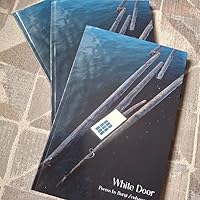
This is a book of ghost stories, and for the most part, ghosts are jealous monsters, intent upon our destruction. They never appear overtly here, yet we gradually become aware of their presence the way spirits in haunted houses trod over creaky floors, slam doors, and issue sudden gusts of wind. These poems are Koan-like―the fewer the words, the more charged they are. The engine driving the sense of haunting and loss is money, which Davis describes as “federal bone” boiling around us. Bison in Nebraska are reduced to bones, “seven/standing men/tall” fodder for the fertilizer used by farmers in the 1800s. There is, too, an equality to the hauntings―every instance has its moment, and persists, despite being in the past, present, or future. Index of Haunted Houses is spooky and sad―a stunning debut, one that will surprise, convince, and most of all, delight.
Adam O. Davis is the author of Pyrrhic Symphony (Nebraska Press, 2026), winner of the Raz/Shumaker Book Prize, and Index of Haunted Houses (Sarabande, 2020), winner of the Kathryn A. Morton Prize. His poems have appeared in many journals, including The Believer, Boston Review, Gulf Coast, The Paris Review, The Southern Review, and ZYZZYVA. The recipient of the 2022 Poetry International Prize and the 2016 George Bogin Award from the Poetry Society of America, Davis has received grants and fellowships from Columbia University, Western Michigan University, and Vermont Studio Center. A graduate of the University of California, Riverside and Columbia University, he lives in San Diego, California where he teaches English literature at The Bishop’s School. He was also once hit by lightning. It felt, more or less, like you'd expect.
The parts of life that are severed and left along the winding path of existence - almost saṃsāric in echo - the cycle of wanting in reflection of time individuated before eternity. We all have to face this 'existence cliff' that is in front of us. Will look for more books of poetry from this poet.
"I know there is always a ghost idling on the edge of what I hold dear." -Manifest Destiny
I love a good ghost story, and this book is full of them--most inspired by actual historical events and people. It also plays a lot with the naturally related themes of isolation, absence, and a sort of collective loneliness, creating an emotionally immersive reading experience. The language is fantastic, especially the alliteration. Definitely a collection to revisit. (Thank you to the publisher for the review copy!)
One more stanza, for the road: "Forgive us, history. We orphan everything we touch." -Pacific Americana
A travelogue of haunted houses. Ghost prose poems. Foggy, nostalgic fragments that feel like both erasure and haiku. This is one to read once the sun goes to sleep.
"Ghosts who write love letters / to ghosts, who linger light // as book-pressed / butterflies upon the lips / of the living." (from "Meteorology Index") I love the sound-kaleidoscope of these poems, how slight turns from line to line or stanza to stanza render new and shimmering patterns. The poems in this four-part collection are quite literally language-making in other ways as well. They may riff on rituals, such as the transubstantiation in the Christian mass ("Nebraskan Bribes") or on the ritualistic use of familiar metaphors, such as house, weather, star, ghost, etc. Welcome alienation! And aren't ghosts supposed to do just that, alienate and haunt?
I was lucky enough to have Mr David as an English teacher. When you’re a student, you get to pick someone’s brain, ask questions, listen to their thoughts and ideas, but it isn’t very often that you get to read a teacher’s writing. I so enjoyed getting a glance at work from a writer and mentor who I admire.
Hands down my favorite collection of 2023. The language is sparse, but precise and intricate. There is loneliness here, and abandon. A meditation on loss and the lives we inhabit as ghosts ourselves. This book is why I continue to write poetry.
I guess I was just expecting something different when reading the description, but nothing about this poetry felt haunting. I was honestly just a bit bored by almost all of the poems. I did like the addition of images to go along with certain poems, however it did not do enough to really impact the poetry itself.
(I received a free ARC in return for an honest review)
Adam O. Davis’s Index of Haunted Houses is absolutely beautiful. Through precise language and sound, he collects seemingly unrelated images into a coherent mosaic of haunting memories. The theme of ghosts is carried through each of the poems and related to themes such as losing and missing childhood, westward expansion, and the Covid 19 Pandemic. Davis describes common emotions in new ways. For example, in “The Bell System”, a poem which seemingly reminisces on growing-up years, Davis writes “what I feel / is not so much loss as a lessening, as if the self was nothing more / than a late-model sedan crossing / the city limit in search of a better / resale value.” Reading this collection of poems, I found the variety of poem structures intriguing and refreshing. Poems vary in length from a few pages to literally nine words– and yet each is as captivating as the last. I am completely in love with the poem “Spirit Arithmetic” because of its sound and use of numbers one through ten. The lines “Six spoons I swallow. / Seven scratches upon the sun.” had especially good consonance. Something else I find really cool about this book is the black and white photographs interspersed in its pages. Adam Davis took these pictures himself, and they really add to the overall haunted tone of the collection and help to show the stories of the poems. Overall, this book was a thrilling read that will forever live on my list of books to re-read. I got chills page after page of this beautifully crafted collection of poems.
These poems are about ghosts & haunted places, but also the unfailing reality that is America chugging along into the future no matter the consequences, so obviously I was going to love it. Something about these pieces echo Beat poetry? But beat poetry written by someone sitting in the 21st century, watching all the ghosts of modernity pile up.
At first opaque (to me, anyway) — the words not what they seem — the rocking, soothing voice calls you in. The house will not let you leave. Echoes of old arguments, held together by light, a string tempered by time. With photographs so the house can enter you.
Davis' language has such striking cadence and musicality. The way these poems sound is just stunning. There are also some truly excellent metaphors and masterful line breaks. The only thing that kept me from liking this more was that the emotional distance and sparseness were not quite to my taste.
Strong, sparse, and gritty poems about ghosts and haunted houses. For me it sounds like a new voice in poetry. Innovative and unusual. This is one I'll definitely have to read more than once.