Often when people think of Gaul, they tend to immediately think of Charalmange. That is understandable as is his close association with the Franks. Yet, Charlamagne was a scion of the Carolingian Dynasty, which had usurped the rule of Frankia by turning the offices of the mayor of the palace and dux et princeps Francorum, both offices combined to make Charles Martel's Carolingian line quite powerful and puissant. In 751 CE, Pepin the Short, Charel's son, with the contrivance of the Papacy, was crowned King of the Franks. Yet, who was the family they overthrew? Shelly Puhak, masterfully, introduces us to the Game of Thrones-like Merovingian dynasty.
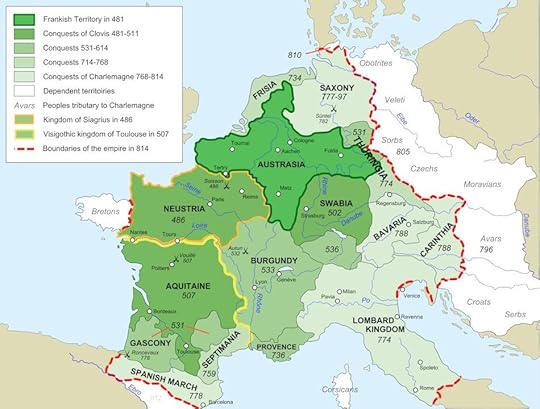
The crux of the conflict inherent to the Merovingians is best encapsulated in two fascinating, and utterly ruthless, women who rose to become powerful Queens and were each other's arch-nemesis. Frankia at this time was a grouping of provinces under their own King, each a son of King Clothar. In the Kingdom of Austrasia, in the capital Metz, ruled by Sigibert (Third son of King Clothar, Grandson of Clovis "The Famous Warrior" and King of the Franks), himself a most accomplished warrior called "Magnificent Victory", marries a Visigothic Princess from Spain named Brunhild, herself an accomplished shield maiden called "Battle Armor" (Second Daughter of King Athanagild and Queen Goiswintha of the Visigoths in Spain).
In the Kingdom of Neustria, ruling from Soissons appears the "other side" of the conflict manifested in the form of Chilperic, the "Valiant Defender" and his infamous third wife, the former servant to Queen Audovera (Chilperic's first wife), who usurped the position of Queen Galswintha (Chilperic's second wife) to become a brilliant Machiavellian Queen known with the sobriquet "Peace through War".
This multi-year conflict, primarily driven by these two women, would see inter-family conflict, treachery, betrayal, assassinations, and war to put any GOT fictional family to shame. All without dragons of any sort. In fact, this war to untie the four Kingdoms of Aquitane (Charibert, the "Bright Warrior", ruling from Paris and eldest son of King Clothar); Burgundy (Guntram, the "Battle Raven", second son ruling from Chalon-sur-Saône); Austrasia (Sigibert and Brunhild's Kingdom); and finally Neustria (King Chilperic and Queen Fredegund), will result in the eventual destruction of the Merovingian dynasty.
Prepare for an exciting, always interesting, and very well-written story about two Queens who were truly powerful and ruthless in a time and land where this should be viewed with far more respect and admiration. Yet, under the Carolingian Dynasty and given the dislike of powerful Queens endemic in Salic Law and the Papacy, these two queens would disappear from most commonly known history, only to be reborn in the form of myth.
Fredegund would go on to influence many stories of the evil stepmother motif, as well as the ever-nefarious image of the Queen's servant rising to the position of Queen. Shakespeare would resurrect Fredegund in "Macbeth" by using her battle strategy of the "walking forest". Though, two centuries before the Great Bard, poet Christine de Pizan wrote of Fredegund in her "Book of the City of Ladies" (1405) where she found manuscripts preserved in a convent in Soissons, that described the Battle of Droizy and Pizan's research reveals a "....valiant queen kept out in front, exhorting the others on to battle with promises and cajoling words...", but also with Pizan conceding that Ferdegund was "...was unnaturally cruel for a woman.." but praises the Queen's "...skillful handling of power.." and her successful regency where she ruled her Kingdom most wisely after Chilperic's death.
Brunhild would also become an object of fame and legend. There were many roads named after her ("Brunehaut" in French) all throughout France. There were legends comparing her to a witch who could "pave a road in a single night with the help of the devil.." BTW 13 of those Brunehaut roads still exist after all this time and many converge in the French town of Bavay, wherein the center of the intersection is a statue of Queen Brunhild.
The two Quuens would resurface in legend again in the nineteenth century during the Age of Romanticism where a re-interest in the Merovingians led to an interest in the two enemy Queens and many operas and plays were based on their conflict. But it would be the rediscovery, and subsequent deep national pride and interest, in Germany of the twelfth-century epic poem Nibelungenlied. This was the tale of the epic battle between these two Queens and how these sisters-in-law tore their nations apart. This Midevial text also served as the inspiration for Wagner's opera cycle - Der Ring des Nibelungen. That's also where the whole "wings and horns on Viking helmets" came from. Thus it is common to see statues of Queen Brunhild, and in the Opera, to have wings surmounting her helm.
This interfamily spat lasted over forty years! That is longer than the far better-known War of the Roses. Also, the author makes a superb argument as to why Queen Cersei from Game of Thrones is
who is often portrayed as an amalgam of Elizabeth Woodville, Margaret of Anjou, and Anne Boylen as well as the English War of the Roses, G.R.R. Martin could actually have been describing the real-life Queen Fredegund....WARNING GoT Spoilers ahead(kinda..sorta), so be warned and skip to the end of this quote...
"...Like Fredegund, Cersei is dogged by suspicions of infidelity, and when her adultery is discovered, she arranges for her king-husband to die while he is on a hunting trip, as isFredegund's husband. Cersei also arranges the deaths of her husband's other children as Fredegund is said to, and in her (Cersei) we see Brunhild's paranoia about being replaced by a younger queen. Like both queens, while ostensibly serving as regent for underage boys, Cersei assumes the throne herself...."
Pretty cool, as a GoT fan, I'd say. Obviously, I really enjoyed this book and would highly recommend it to any fan of history, Merovingians, or two really cool Queens who managed to rule ruthlessly during the Merovingian dynasty that would tear it apart.