

What do you think?
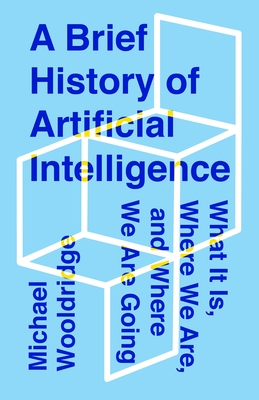
A Brief History of Artificial Intelligence: What It Is, Where We Are, and Where We Are Going
From Oxford's leading AI researcher comes a fun and accessible tour through the history and future of one of the most cutting edge and misunderstood field in Artificial Intelligence
The somewhat ill-defined long-term aim of AI is to build machines that are conscious, self-aware, and sentient; machines capable of the kind of intelligent autonomous action that currently only people are capable of. As an AI researcher with 25 years of experience, professor Mike Wooldridge has learned to be obsessively cautious about such claims, while still promoting an intense optimism about the future of the field. There have been genuine scientific breakthroughs that have made AI systems possible in the past decade that the founders of the field would have hailed as miraculous. Driverless cars and automated translation tools are just two examples of AI technologies that have become a practical, everyday reality in the past few years, and which will have a huge impact on our world.
While the dream of conscious machines remains, Professor Wooldridge believes, a distant prospect, the floodgates for AI have opened. Wooldridge's A Brief History of Artificial Intelligence is an exciting romp through the history of this groundbreaking field--a one-stop-shop for AI's past, present, and world-changing future.
The somewhat ill-defined long-term aim of AI is to build machines that are conscious, self-aware, and sentient; machines capable of the kind of intelligent autonomous action that currently only people are capable of. As an AI researcher with 25 years of experience, professor Mike Wooldridge has learned to be obsessively cautious about such claims, while still promoting an intense optimism about the future of the field. There have been genuine scientific breakthroughs that have made AI systems possible in the past decade that the founders of the field would have hailed as miraculous. Driverless cars and automated translation tools are just two examples of AI technologies that have become a practical, everyday reality in the past few years, and which will have a huge impact on our world.
While the dream of conscious machines remains, Professor Wooldridge believes, a distant prospect, the floodgates for AI have opened. Wooldridge's A Brief History of Artificial Intelligence is an exciting romp through the history of this groundbreaking field--a one-stop-shop for AI's past, present, and world-changing future.
272 pages, Hardcover
First published January 1, 2021
Ratings & Reviews
Friends & Following
Create a free account to discover what your friends think of this book!
Community Reviews
Displaying 1 - 30 of 90 reviews

June 23, 2025
Doing my homework for arguing with people online about AI

October 26, 2021
This was, as described, a fun and accessible overview of major milestones in the journey towards AI. Woolridge is a pragmatist without much patience for "the terminator narrative," as he describes it; meanwhile, I'm also reading Toby Ord's book "The Precipice" on long-term existential risks to human survival.
"A Brief History of AI" is my baby step 1 into becoming literate on the subject. I'll need about 1000 more baby steps, but this one was sturdy and built with love.
"A Brief History of AI" is my baby step 1 into becoming literate on the subject. I'll need about 1000 more baby steps, but this one was sturdy and built with love.

November 16, 2023
First of all I should probably declare that I have a degree in CS since that severely impacted how approachable and interesting this book was to me. For others, your mileage may vary.
This book can be split in two, first the history part which is terrific. It does a really good job of detailing all the major theories and developments of AI since the beginning and up to deep learning. This is probably the best book on the history of AI that I’ve read.
The other part of the book is where the author applies his extensive expertise in the field to predict what future developments might entail. This part I did not like as well, often I disagreed with or didn’t understand his reasoning and some of his predictions have already proven false in the short time since this was published.
Almost 4 stars, but I settled on 3.
This book can be split in two, first the history part which is terrific. It does a really good job of detailing all the major theories and developments of AI since the beginning and up to deep learning. This is probably the best book on the history of AI that I’ve read.
The other part of the book is where the author applies his extensive expertise in the field to predict what future developments might entail. This part I did not like as well, often I disagreed with or didn’t understand his reasoning and some of his predictions have already proven false in the short time since this was published.
Almost 4 stars, but I settled on 3.

June 2, 2025
This book serves as an excellent introduction to artificial intelligence, offering a grounded perspective on the field’s evolution, key concepts, and philosophical implications. Written in the pre-large-language-model (LLM) era, it nonetheless remains relevant, especially for readers seeking a foundational understanding of AI beyond the current hype. It blends computer science theory with accessible explanations, making it suitable for both newcomers and curious practitioners. However, it does try to cover a lot of territory across different disciplines such as philosophy, computer science, robotics and other allied subjects so it does lack a bit of depth in some areas.
The book begins with the historical underpinnings of AI, including early milestones such as the Turing Test, Turing machines, and cybernetics. From there, it builds up to broader classifications—distinguishing between strong and weak AI, general and narrow AI, symbolic and neural approaches—framing how different paradigms have shaped AI research over time. One of the standout features is the author’s clear and concise way of walking readers through complex ideas like the rational agent paradigm, Bayesian reasoning, and the difference between knowledge-based systems and behavior-based robotics.
A particularly memorable concept discussed is the Winograd schema, a simple but powerful test for machine comprehension. The book underscores a core challenge in AI: systems often mimic human-like behavior without truly understanding context or possessing real-world knowledge. This leads naturally into thoughtful chapters on perception, expert systems, robotics, and the physical embodiment of intelligence. The section on Rodney Brooks’s subsumption architecture and its impact on robotic design was excellent, showing how simple, layered behaviors can produce intelligent-seeming actions in machines without relying on heavy symbolic reasoning.
The later chapters shift toward more reflective territory, exploring topics like consciousness and whether machines can ever possess it. These discussions are handled with nuance, avoiding sensationalism. The author is notably skeptical of the idea of a "singularity" and argues that more urgent ethical and social issues—such as allocative and representational harms—are often overshadowed by focusing on future implications rather than current possible harms.. The book offers sobering insights into how AI systems can deny resources to certain groups (allocative harm) or reinforce harmful stereotypes (representational harm), emphasizing that responsibility lies not with the software but with its designers and deployers.
Other highlights include a concise explanation of Bayes’s theorem as a framework for managing uncertainty, a useful overview of NP-completeness and SAT solvers, and an account of the deep learning revival in the mid-2000s, which laid the groundwork for today’s AI systems. Importantly, the book ends with a forward-looking note: real progress in AI may require integrating neural learning with symbolic knowledge—bridging the divide between statistical pattern recognition and logical reasoning.
In summary, this is a deeply informative and thought-provoking book that traces the intellectual arc of AI with clarity and balance. It demystifies technical concepts without oversimplifying them and encourages readers to think critically about both the promise and the peril of AI.
The book begins with the historical underpinnings of AI, including early milestones such as the Turing Test, Turing machines, and cybernetics. From there, it builds up to broader classifications—distinguishing between strong and weak AI, general and narrow AI, symbolic and neural approaches—framing how different paradigms have shaped AI research over time. One of the standout features is the author’s clear and concise way of walking readers through complex ideas like the rational agent paradigm, Bayesian reasoning, and the difference between knowledge-based systems and behavior-based robotics.
A particularly memorable concept discussed is the Winograd schema, a simple but powerful test for machine comprehension. The book underscores a core challenge in AI: systems often mimic human-like behavior without truly understanding context or possessing real-world knowledge. This leads naturally into thoughtful chapters on perception, expert systems, robotics, and the physical embodiment of intelligence. The section on Rodney Brooks’s subsumption architecture and its impact on robotic design was excellent, showing how simple, layered behaviors can produce intelligent-seeming actions in machines without relying on heavy symbolic reasoning.
The later chapters shift toward more reflective territory, exploring topics like consciousness and whether machines can ever possess it. These discussions are handled with nuance, avoiding sensationalism. The author is notably skeptical of the idea of a "singularity" and argues that more urgent ethical and social issues—such as allocative and representational harms—are often overshadowed by focusing on future implications rather than current possible harms.. The book offers sobering insights into how AI systems can deny resources to certain groups (allocative harm) or reinforce harmful stereotypes (representational harm), emphasizing that responsibility lies not with the software but with its designers and deployers.
Other highlights include a concise explanation of Bayes’s theorem as a framework for managing uncertainty, a useful overview of NP-completeness and SAT solvers, and an account of the deep learning revival in the mid-2000s, which laid the groundwork for today’s AI systems. Importantly, the book ends with a forward-looking note: real progress in AI may require integrating neural learning with symbolic knowledge—bridging the divide between statistical pattern recognition and logical reasoning.
In summary, this is a deeply informative and thought-provoking book that traces the intellectual arc of AI with clarity and balance. It demystifies technical concepts without oversimplifying them and encourages readers to think critically about both the promise and the peril of AI.

November 26, 2021
Developing intelligent machines is turning out to be much harder than many people thought it would be. We can get a computer to play a mean game of chess, but it takes no joy in winning, and I doubt it truly understands what a game even is. This short book does a pretty good job of summarizing the successes and failures we've (collectively) had in creating artificial intelligence, so far. It seems to me that the biggest problem is that we don't have a firm grasp of what thinking is. We don't have a solid understanding of the old questions of "consciousness," the nature of the human mind, and all that philosophical stuff that goes with it. Perhaps our efforts to replicate the effect in machines will bring us to a better understanding of own intelligence.

March 12, 2021
Starts off with very basic knowledge, but gets more interesting as it progresses.

Read
January 20, 2026Prof. Michael Woolridge is Departmental Chair of Computer Science in the University of Oxford, thus eminently qualified to provide the definitive overview of AI for the public, and I was very interested to know his forecasts. However, regarding the topic of the dangers of superintelligence or even human-level AI, he doesn't provide explanations at length to support his reasoning that, in sum, we have 'nothing to worry about'. Instead, the book repeats some pithy dismissals such as, 'it's highly unlikely'; 'it's probably not going to happen, at least for the next hundred or thousand years'; 'it's a misunderstanding of AI'; 'just because you have a thousand Einsteins working together doesn't mean their intelligence is equivalent to a thousand Einsteins'; 'it's Terminator-fiction'. I would have liked more elaborations on these declarations to get maximal reassurance from the book.

November 11, 2025
Read this as part of my Oxford AI program. It’s a great conceptual introduction to a lot of historical and some current concepts in artificial intelligence. But falls short on something that will be the problem for every AI text in the years to come: the inability to provide a present day snapshot of the AI landscape due to the rapid progress in the field.
April 14, 2026
With Michael Wooldridge citing Stephen Hawkings dictum—in that—“every equation in a book will halve its readership”, this is an excellent soft entry into the world of AI, and more importantly how it has evolved since the days of Alan Turing.
“The question of whether Al is possible ultimately amounts to whether we can produce intelligent behavior simply by following lists of instructions like these.”
…
“One final observation. Although computers are just machines for following instructions, this does not mean that they are incapable of making decisions. Computers certainly can make decisions—it is just that we have to give them precise instructions about how to make the decision. And a computer can subsequently adjust these instructions for itself, as long as we have instructed it how to do so—in this way, as we will see, a computer can change its behavior over time-it can learn.”
“We previously saw that computers were for all intents and purposes invented by Alan Turing in order to solve one of the great mathematical problems of his time. It is one of the great ironies of scientific history that Turing invented computers in order to show that there are things that computers are fundamentally incapable of doing-that some problems are inherently undecidable.”
“Many ad hoc schemes for dealing with uncertainty were invented and reinvented throughout the history of Al, but by the 1990s, one approach had come to dominate The approach is called Bayesian inference. Bayesian inference was invented by an eighteenth-century British mathematician, the Reverend Thomas Bayes. He formulated a version of a technique that we now call Bayes's theorem in his honor. It is concerned with how we should rationally adjust our beliefs in the presence of new information. In the case of our driverless car example, the beliefs relate to whether there is an obstacle in front of us; the new information is the sensor data.”
…
“Bayes's theorem is important because it gives us the right way of handling imperfect data: we neither discard the data nor accept it without question. Instead, we use it to update our probabilistic beliefs about how the world is.”
“First, the intelligence they embody is opaque. The expertise that a neural network has captured is embodied in the numeric weights associated with the links between neurons, and as yet, we have no way of getting at or interpreting this knowledge. A deep learning program that tells you it sees cancerous tumors in an x-ray scan cannot justify its diagnosis; a deep learning program that declines a bank loan for a customer cannot tell you why it does so. In chapter 3, we saw that expert systems like MYCIN were capable of a crude form of explanation—retracing the reasoning that was used to reach a conclusion or recommendation-but neural networks are not even capable of this. There is a lot of work under way currently to try to deal with this issue. But at present, we have no idea how to interpret the knowledge and representations that neural networks embody.”
“However, Dunbar found that the factor that best predicted brain size was the primates mean social group size: the average number of animals in that primate's social groups. But this, then, suggests that the large brain size of primates is needed to be able to successfully maintain large social groups—more precisely, the need to keep track of, maintain, and exploit the social relationships in these groups.
Dunbar's research raised a tantalizing question: Given that we know the average human brain size, what does his analysis predict as being the average group size for humans? The value obtained by this analysis is now known as Dunbar's number, and is usually quoted as 150. That is, given the average human in size and Dunbar's analysis of other primates, we would expect the average size of human social groups to be around 150. Dunbar's number might have remained a curiosity but for the fact that subsequent research found that this number has arisen repeatedly, across the planet, in terms of actual human social group sizes. For example, it seems that Neolithic farming villages typically contained around 150 inhabitants. Of more recent interest is the fact that Dunbar's number has something to say about the number of friends we actively engage with on social networking sites such as Facebook.”
“Algorithmic bias is a particularly prominent issue at present because, as we saw, one feature of the current wave of Al systems is that they are black boxes: they cannot explain or rationalize the decisions they make in the way that a person can.”
“There were seismic social changes, which were not universally welcomed. For a few years in the early decades of the nineteenth century, a movement called the Luddites arose-a loosely organized group who rebelled against industrialization, burning and smashing the machines that they saw as taking away their livelihoods. But it was a short-lived movement, stamped out by a fearful British government, who in 1812 made the destruction of machines a crime punishable by death.”
“My belief is that Al is best used not to replace human health care professionals but to augment their capabilities-to free them from routine tasks and allow them to focus on the really difficult parts of their job; to allow them to focus on people rather than paperwork; and to provide another opinion— another voice in the room—to give further context for their work.”
“Ultimately, they might turn out to be dead ends, but conjecture usually leads toward a more solid understanding— eventually. And they offer more than simply treating consciousness as an unknowable mystery.
At some point in the future, we will understand consciousness, just as we now understand the forces that power the sun. At that point in time, much of the current debate on the subject will probably seem as quaintly amusing as the various theories put forward to explain the source of the sun's power did before nuclear physics provided the answers.”
“The question of whether Al is possible ultimately amounts to whether we can produce intelligent behavior simply by following lists of instructions like these.”
…
“One final observation. Although computers are just machines for following instructions, this does not mean that they are incapable of making decisions. Computers certainly can make decisions—it is just that we have to give them precise instructions about how to make the decision. And a computer can subsequently adjust these instructions for itself, as long as we have instructed it how to do so—in this way, as we will see, a computer can change its behavior over time-it can learn.”
“We previously saw that computers were for all intents and purposes invented by Alan Turing in order to solve one of the great mathematical problems of his time. It is one of the great ironies of scientific history that Turing invented computers in order to show that there are things that computers are fundamentally incapable of doing-that some problems are inherently undecidable.”
“Many ad hoc schemes for dealing with uncertainty were invented and reinvented throughout the history of Al, but by the 1990s, one approach had come to dominate The approach is called Bayesian inference. Bayesian inference was invented by an eighteenth-century British mathematician, the Reverend Thomas Bayes. He formulated a version of a technique that we now call Bayes's theorem in his honor. It is concerned with how we should rationally adjust our beliefs in the presence of new information. In the case of our driverless car example, the beliefs relate to whether there is an obstacle in front of us; the new information is the sensor data.”
…
“Bayes's theorem is important because it gives us the right way of handling imperfect data: we neither discard the data nor accept it without question. Instead, we use it to update our probabilistic beliefs about how the world is.”
“First, the intelligence they embody is opaque. The expertise that a neural network has captured is embodied in the numeric weights associated with the links between neurons, and as yet, we have no way of getting at or interpreting this knowledge. A deep learning program that tells you it sees cancerous tumors in an x-ray scan cannot justify its diagnosis; a deep learning program that declines a bank loan for a customer cannot tell you why it does so. In chapter 3, we saw that expert systems like MYCIN were capable of a crude form of explanation—retracing the reasoning that was used to reach a conclusion or recommendation-but neural networks are not even capable of this. There is a lot of work under way currently to try to deal with this issue. But at present, we have no idea how to interpret the knowledge and representations that neural networks embody.”
“However, Dunbar found that the factor that best predicted brain size was the primates mean social group size: the average number of animals in that primate's social groups. But this, then, suggests that the large brain size of primates is needed to be able to successfully maintain large social groups—more precisely, the need to keep track of, maintain, and exploit the social relationships in these groups.
Dunbar's research raised a tantalizing question: Given that we know the average human brain size, what does his analysis predict as being the average group size for humans? The value obtained by this analysis is now known as Dunbar's number, and is usually quoted as 150. That is, given the average human in size and Dunbar's analysis of other primates, we would expect the average size of human social groups to be around 150. Dunbar's number might have remained a curiosity but for the fact that subsequent research found that this number has arisen repeatedly, across the planet, in terms of actual human social group sizes. For example, it seems that Neolithic farming villages typically contained around 150 inhabitants. Of more recent interest is the fact that Dunbar's number has something to say about the number of friends we actively engage with on social networking sites such as Facebook.”
“Algorithmic bias is a particularly prominent issue at present because, as we saw, one feature of the current wave of Al systems is that they are black boxes: they cannot explain or rationalize the decisions they make in the way that a person can.”
“There were seismic social changes, which were not universally welcomed. For a few years in the early decades of the nineteenth century, a movement called the Luddites arose-a loosely organized group who rebelled against industrialization, burning and smashing the machines that they saw as taking away their livelihoods. But it was a short-lived movement, stamped out by a fearful British government, who in 1812 made the destruction of machines a crime punishable by death.”
“My belief is that Al is best used not to replace human health care professionals but to augment their capabilities-to free them from routine tasks and allow them to focus on the really difficult parts of their job; to allow them to focus on people rather than paperwork; and to provide another opinion— another voice in the room—to give further context for their work.”
“Ultimately, they might turn out to be dead ends, but conjecture usually leads toward a more solid understanding— eventually. And they offer more than simply treating consciousness as an unknowable mystery.
At some point in the future, we will understand consciousness, just as we now understand the forces that power the sun. At that point in time, much of the current debate on the subject will probably seem as quaintly amusing as the various theories put forward to explain the source of the sun's power did before nuclear physics provided the answers.”

Read
December 13, 2021Leitura para tese de mestrado: um livro muito inicial para o estudo da inteligência artificial, mas que percorre toda a sua história, períodos e teorias, desde que começou a surgir como tema de investigação. É um excelente livro para quem ainda não percebe muito do assunto (eu), uma vez que o autor parece ter perfeita consciência de que quem o vai ler só está a molhar o pézinho na água e a analisar a temperatura. Gostei muito e é uma boa base para, agora, mergulhar com mais facilidade no assunto.

November 19, 2025
This was a perfectly timed 2016 history of Machine Learning pre llm transformer architecture in 2017. Got just technical enough for understanding the core concepts of historic machine learning designs while staying broad enough on those prior systems that I stayed engaged. I skipped the last third of the book covering the authors predictions because it's not very relevant anymore considering the date of its authorship. I might re read this at some point since I did really enjoy it.

April 30, 2023
This book has just shed a lot of light on knowledge that I had no idea existed, and for sure my conclusion after reading this book is that AI is a complex concept with a lot of development both in the past, present and with a future full of work to develop the true technology with which we have dreamed.

February 12, 2026
This was a nice overview and an introduction to the AI world that we are living in today. I listened to the Audio book, but didn't study the companion pdf which is available at a website. If you want more than just a summarized introduction, I suggest you access the pdf, or read the book rather than listen.

November 16, 2025
This book is well written and easy to read. The problem is it's dated. Some of the things the author claims AI wont do for many years, are being done... It's a good history lesson, but I dont think it has much predictive value.

May 11, 2025
I really enjoyed this book even though parts were over my head

April 1, 2026
Extraordinarily accessible, pragmatic, and straightforward. Not to mention the author is extremely well qualified and knowledgeable which makes this common man approach impressive from a writing stand point. I would consider keeping this on my personal shelf to review past history and common terms

June 4, 2025
- Recommended for tech history fans.
- Recommend Alan Turing fans.
- Recommended if you are confused about all the AI terminology: strong vs weak AI,
- symbolic AI vs neural networks, and Artificial General Intelligence (AGI)
- Recommended for math geeks interested in the NP-Complete problem
- Recommended for Expert System fans
- Recommended for iRobot fans
I love these kinds of books. For somebody like me, they’re catnip. You see, I’m a sequential learner and I can’t understand the current situation of a subject until I know how I got here. The author, Michael Wooldridge, fills that need for me nicely.
Woodbridge is an academic. At the time of this writing, he is the Ashall Professor of the Foundations of Artificial Intelligence at the University of Oxford. He’s written nine books and published almost 500 papers on artificial intelligence starting as far back as 1995. But this isn’t a deep dive technical book. You will not learn how to build neural networks here and I wasn’t looking for that anyway. I was looking for an overview of the field. I greatly appreciated Woodbridge’s writing style. It’s conversational; like sitting next to a charismatic stranger at a dinner party. The audio book was also easy to listen to while I was walking the dogs.
The book is nine chapters
1: Turing’s Electronic Brains
He begins with the father of artificial intelligence, my computer science hero, Alan Turing. When Turing committed suicide at the age of 41, he had solved not one, not two, but three of the world’s most difficult problems.
He led the efforts at Bletchley Park to break the German encryption system (Enigma) during WWII. He probably helped save some 20 million lives because of it.
He proved mathematically that computers were possible with a thought experiment called The Turing Machine. Today, every computer that has ever existed is a version of his Turing Machine. And, by the way, he proved that the Entscheidungsproblem is unsolvable. Yes, I spelled that correctly: the Entscheidungsproblem; a problem posed by David Hilbert and Wilhelm Ackermann back in 1928 on whether there was an algorithm that, when given any logical formula, can always answer "yes" or "no" as to whether the formula is valid or provable. Turing used his machine to prove there is no algorithm.
Finally, and most germane to this book, Turing devised the definitive test to judge if a machine is intelligent, the Turing Test (Not to be confused with the Turing Machine). Essentially, a machine and a human sit behind a screen. A judge sits in front and asks questions of both. If the judge can’t distinguish the machine from the human, then the machine is intelligent. If you want a way better explanation, check out the 2014 movie, “The Imitation Game” with Benedict Cumbnerbatch playing Turing.
Turing’s 1950 paper, “Computing Machinery and Intelligence: The Imitation Game” fueled research teams for years trying to pass the Turing Test. Unfortunately, many tried to “game” the test. They didn’t try to build an intelligent machine. They tried to fool the judge.
The most famous of these experiments was Joseph Weizenbaum’s program, ELIZA. It was one of the first computer programs to simulate human-like conversation using natural language processing, marking a milestone in human-computer interaction. If you’re interested, Norbert Landsteiner created an online version of it in 2005 (LINK). According to Wooldridge, “[ELIZA] was a serious and influential scientific experiment in its own right—but sadly, it has since become synonymous with superficial approaches to AI generally and the Turing test in particular.”
Wooldridge explains the difference between Weak and Strong AI. Weak AI programs demonstrate capability without any claim that they actually possess consciousness. A subset of those programs are called Narrow AI; programs that can carry out specific tasks. If you want an example, watch the 2025 Superman trailer when Superman’s medical robots say, “No need to thank us sir as we will not appreciate it. We have no consciousness whatsoever; merely automatons here to serve.” That’s WeakAI.
Strong AI has the goal of building programs that really do have understanding (consciousness). The important thing to remember though is that Strong AI research is largely irrelevant to contemporary AI research. When you think of Strong AI, think of the 1984 movie “The Terminator” when Skynet wakes up, becomes self-aware (we call that the singularity in the sci fi biz), and decides to wipe out the human race.
What Weak AI researchers are pursuing are machines that have general-purpose human-level intelligence; the ability to converse in natural language, solve problems, reason, perceive its environment, etc. at the same level as a typical person. This is what everybody refers to as Artificial General Intelligence (AGI). AGI usually isn’t concerned with issues such as consciousness or self-awareness, so AGI is a form of weak AI. In a 2025 podcast, Demis Hassabis (current DeepMind CEO), said that he expects to attain AGI some time in the early 2030s (five years away). He said that DeepMind has definitely passed the middle game and is heading towards the endgame.
According to Wooldridge, there have been two foundational strategies in AI’s development. The first, symbolic AI, seeks to model the mind by using symbols to represent concepts and actions. This approach dominated from the 1950s to the late 1980s and was prized for its clarity but limited by its rigidity.
The second, neural networks, takes inspiration from the brain’s structure, modeling artificial neurons to process information. Neural nets have driven much of the recent progress in the field. Wooldridge emphasizes the stark methodological differences between symbolic AI and neural nets, noting that both have cycled in and out of favor and have even sparked rivalry among researchers.
2: The Golden Age (1956 to 1974)
Wooldridge chronicles the early optimism and foundational moments of AI, beginning with John McCarthy’s coining of the term “artificial intelligence” in 1955. Key pioneers (McCarthy, Marvin Minsky, Allen Newell, and Herb Simon) established influential AI labs and set the field’s direction. Early AI focused on four main strategies: perception, machine learning, reasoning, and natural language understanding, producing legendary systems like SHRDLU and SHAKEY.
Search emerged as a key AI technique but researchers soon discovered its limitations, especially for search spaces that grow exponentially. This led to understanding the significance of decidability (can be solved by computer) and NP-complete problems.
NP-complete problems are any of a class of computational problems for which no efficient solution algorithm has been found. I was surprised to learn that this idea is a relatively recent mathematical discovery. Stephen Cook published his 1971 paper, “The complexity of theorem-proving procedures,” and identified the basic structure of NP Complete Problems. After, every problem that AI researchers were pursuing (like problem solving, game playing, planning, learning, and reasoning), fell into the NP-complete bucket. This led AI researchers to pursue Bayesian reasoning to get approximate answers and to the development of other heuristics like Satisfiable Problem Solvers (SAT solvers). SAT Solvers ask if there exists at least one combination of variable assignments that makes the entire logical expression evaluate to TRUE.
3: Knowledge Is Power
Wooldridge explains that John McCarthy established the paradigm of logic-based AI in his seminal 1958 paper “Programs with Common Sense.” An agent expresses its knowledge about the world using logical sentences and decides what to do by deducing which steps will help achieve its goals
By the 1970s, expert systems that use this Common Sense paradigm emerged like
MYCIN, DENDRAL, and R1/XCON. When I was in grad school in the late 1980s, I wrote my own expert system for my thesis. It was awful but it demonstrates the topic was on everybody’s mind (At least on the minds of my thesis advisors). These systems are built on rule-based logic, excell at solving narrow, specialized problems, sometimes even outperform human experts, and even some delivered significant commercial value.
One example is Doug Lenat’s ambitious Cyc project, which aimed to encode all human knowledge. It ultimately revealed the limits of knowledge-based AI and the difficulty of extracting expert knowledge from humans. By the end of the 1970s, progress in the AI field stalled, funding dried up, and the first “AI winter” set in. Skepticism prevailed as AI failed to deliver on its early promises.
4: Robots and Rationality
Rodney Brooks came to the rescue in the 1990s and 2000s by challenging the traditional, logic-heavy AI paradigm. He argued that intelligence is not just about abstract reasoning but is an emergent property of situated systems. His subsumption architecture supported the commercial Roomba robot vacuum by layering simple behaviors and enabling fast, reactive responses to the environment. For specific tasks, like vacuuming, his method proved effective but it couldn’t scale due to the complexity of managing many behaviors. The AI research field started to move toward agent-based AI making rational, utility-maximizing choices. The field turned toward Bayesian inference to deal with uncertainty.
Wooldridge says that by the mid-1990s, a consensus emerged that agents had to have three characteristics. First, they had to be reactive, attuned to their environment and able to adapt when changes occurred. Second, they had to be proactive in completing the task. Third, agents had to communicate with other agents when required. When I took a Waymo (Self-Driving Taxi) ride in San Francisco this year, the car ran into a traffic jam. A parked delivery truck blocked one lane on the road. The Waymo car in front of the delivery truck told my Waymo car that it was clear to go around, and so we did.
5: Deep Breakthroughs
In this chapter, Wooldridge details the rise, fall, and resurgence of neural networks. Frank Rosenblatt published the original idea back in 1957, “The Perceptron: A Perceiving and Recognizing Automaton.” This was the first single-layer neural network designed for binary classification tasks. Unfortunately, according to Dr. Kais Dukes, in 1969, Minsky and Papert published a book criticizing the single layer perceptron. Minsky, that same year, had just received the prestigious Turing Award for his contributions to AI so his voice had a lot of weight in the AI community. Even though Minsky and Papert advocate for a multi-layer network (Deep Learning) in the same book, some say that his criticism of the Perceptron contributed to the AI Winter mentioned before.
Neural networks saw renewed interest with the development of the backpropagation algorithm by Geoffrey Hinton, David Rumelhart, and Ronald Williams in 1986. That made it feasible to train multi-layered neural networks. But the approach fell out of favor again because of computational constraints and the lack of large datasets.
Neural nets started its latest resurgence back in 2009 when Dr. Fei-Fei Li brought Imagenet online; a large-scale, well-annotated image database to improve computer vision research (About 14 million images as of 2021). This coincided nicely with cloud computing’s storage capacity and on-demand compute power. There were no more constraints. Neural Networks became a key ingredient to Machine Learning alongside other heuristics like linear regression, decision trees, clustering, and classification.
6: AI Today
Wooldridge highlights several key milestones from the late 2000s to 2018 that illustrate the rapid progress and broad impact of AI. Remember, he wasn’t aware of ChatGPT yet.
In 2009, Google started their Self-Driving Car Project. By December 2016, leaders spun the project out to be an independent subsidiary under Alphabet, Google's parent company. In November 2017, Waymo rolled out their first fully autonomous taxi service in Phoenix, Arizona. Today (2025), they operate in five cities: Phoenix, San Francisco, Los Angeles, Austin and Silicon Valley.
In 2013, Deepmind (A British company) published "Playing Atari with Deep Reinforcement Learning" that described DeepMind's deep Q-network (DQN). It could learn to play several Atari 2600 games directly from raw pixel input, outperforming previous algorithms and even surpassing human experts on some games. Remembering that Wooldridge published the book a year before ChatGPT, he says that this achievement was the milestone that changed everything.
Two years later, DeepMind demonstrated AlphaGo. The system defeated Fan Hui, the reigning European Go champion, marking the first time an AI had beaten a professional Go player. The next year (March 2016), AlphaGo defeated Lee Sedol, one of the world's top Go players, a feat that was considered a decade ahead of its time and watched by over 200 million people globally.
In 2018, Nvidia’s StyleGAN (a generative adversarial network or GAN) enabled the creation of hyper-realistic, entirely fake images of people who do not exist. That same year, DeepMind introduced AlphaFold to accurately predict protein structures; an achievement that revolutionized biology by solving a problem that had stumped scientists for decades.
And just to put icing on the case, in April 2019, the Event Horizon Telescope collaboration unveiled the first-ever image of a black hole, a feat made possible by sophisticated AI algorithms that processed enormous amounts of astronomical data, marking a new era in astrophysics.
7: How We Imagine Things Might Go Wrong
Wooldridge describes how some researchers think AI could go wrong in the future referencing dystopian scenarios like “The Terminator” and the concept of the singularity. He’s a bit skeptical though, noting the immense computational power and data storage requirements required to achieve such an outcome as a self aware Skynet.
He refers to Nick Bostrom’s popular book “Superintelligence” and his meme-worthy “paperclip metaphor” to illustrate the dangers of poorly specified AI goals that lead to unintended and catastrophic consequences. It is a thought experiment where an AI is programmed with the task of maximizing the number of produced paperclips. It relentlessly pursues this goal by appropriating all available resources including those essential to human life. It eventually converts the entire Earth into paperclips.
I’ve always thought that If we’re worried that Skynet, or the Paperclip AI, is going to kill us all, we should just imbue future AIs with Isaac Asimov’s Three Laws of Robotics that he first published in a 1942 short story, "Runaround” and later included in his influential 1950 collection “I, Robot.” He designed the laws to prevent robots from harming humans, ensuring that they would follow human orders, and allow them to protect themselves, but always with human safety as the highest priority. But Wooldridge points out that in many of Asimov’s stories, ethical dilemmas crop up as the robots try to square the circle when it comes to the rules and what’s actually happening in the story. Maybe Asimov’s rules will not be the savior of us after all.
Woodbridge then discusses the classical philosophical questions surrounding the trolley problem; a famous ethical thought experiment that presents a moral dilemma involving a runaway trolley headed toward five people tied up on the tracks. You are standing next to a lever that can divert the trolley onto another track, where it would kill only one person. What do you do? Woodbridge concludes with the idea that if humans can’t handle these questions, why would we expect an AI to figure it out?
Lastly, Woodbridge covers the emergence of ethical AI guidelines. He points to the 2017 Asilomar AI Principles and Google’s 2018 AI Principles as progress towards marking significant efforts to ensure AI development aligns with human values and safety.
8: How Things Might Actually Go Wrong
Wooldridge then turns to what he thinks might actually go wrong in the short term; not long range doom and gloom planet killer scenarios, more like tactical short term problems that we need to solve. He highlights things most of us already know today, things like some jobs will become obsolete as AGIs become more and more useful. Further, How are we protecting ourselves from algorithmic bias, lack of diversity, and fake news? These problems are big enough without AI. Think about the trouble that might happen when AI Systems exponentially amplify them.
9: Conscious Machines?
In the last chapter, Wooldridge turns his attention to the possibility of creating a Strong AI, like Skynet. It wouldn’t be a planet killer per se but an AI that has crossed the singularity boundary of consciousness. He covers some of the key thoughts from distinguished philosophers (like Daniel Dennett, Thomas Nagel, John Searle, Roger Penrose, David Chalmers, and Robin Dunbar) about the meaning of consciousness. The famous futurist, Ray Kurzweil, who coined the word, singularity, in his 2005 book “The Singularity is Near: When Humans Transcend Biology,” says that machines will achieve it as early as 2045.
But all of that discussion is why Strong AI research is not part of the Weak AI community. Wooldridge’s opinion, and I agree with him, is that It really doesn’t matter when a computer program becomes self aware. From the AI research community’s perspective, it all comes back to the Turing Test. If it walks like a duck and talks like a duck, it’s a duck. If we interact with a system that seems intelligent, then, for all intents and purposes, it is whether it is self aware or not.
In other words, it all comes back to Turing. Of course it does.
My Final Takeaway
I thoroughly enjoyed this book and learned a lot. I will recommend it to people like me who need to understand the entire evolutionary story before we can truly understand the current situation. I especially liked the Alan Turing discussion in Chapter 1. I’m not recommending it for the Canon Hall of Fame. But it is a splendid niche book.
- Recommend Alan Turing fans.
- Recommended if you are confused about all the AI terminology: strong vs weak AI,
- symbolic AI vs neural networks, and Artificial General Intelligence (AGI)
- Recommended for math geeks interested in the NP-Complete problem
- Recommended for Expert System fans
- Recommended for iRobot fans
I love these kinds of books. For somebody like me, they’re catnip. You see, I’m a sequential learner and I can’t understand the current situation of a subject until I know how I got here. The author, Michael Wooldridge, fills that need for me nicely.
Woodbridge is an academic. At the time of this writing, he is the Ashall Professor of the Foundations of Artificial Intelligence at the University of Oxford. He’s written nine books and published almost 500 papers on artificial intelligence starting as far back as 1995. But this isn’t a deep dive technical book. You will not learn how to build neural networks here and I wasn’t looking for that anyway. I was looking for an overview of the field. I greatly appreciated Woodbridge’s writing style. It’s conversational; like sitting next to a charismatic stranger at a dinner party. The audio book was also easy to listen to while I was walking the dogs.
The book is nine chapters
1: Turing’s Electronic Brains
He begins with the father of artificial intelligence, my computer science hero, Alan Turing. When Turing committed suicide at the age of 41, he had solved not one, not two, but three of the world’s most difficult problems.
He led the efforts at Bletchley Park to break the German encryption system (Enigma) during WWII. He probably helped save some 20 million lives because of it.
He proved mathematically that computers were possible with a thought experiment called The Turing Machine. Today, every computer that has ever existed is a version of his Turing Machine. And, by the way, he proved that the Entscheidungsproblem is unsolvable. Yes, I spelled that correctly: the Entscheidungsproblem; a problem posed by David Hilbert and Wilhelm Ackermann back in 1928 on whether there was an algorithm that, when given any logical formula, can always answer "yes" or "no" as to whether the formula is valid or provable. Turing used his machine to prove there is no algorithm.
Finally, and most germane to this book, Turing devised the definitive test to judge if a machine is intelligent, the Turing Test (Not to be confused with the Turing Machine). Essentially, a machine and a human sit behind a screen. A judge sits in front and asks questions of both. If the judge can’t distinguish the machine from the human, then the machine is intelligent. If you want a way better explanation, check out the 2014 movie, “The Imitation Game” with Benedict Cumbnerbatch playing Turing.
Turing’s 1950 paper, “Computing Machinery and Intelligence: The Imitation Game” fueled research teams for years trying to pass the Turing Test. Unfortunately, many tried to “game” the test. They didn’t try to build an intelligent machine. They tried to fool the judge.
The most famous of these experiments was Joseph Weizenbaum’s program, ELIZA. It was one of the first computer programs to simulate human-like conversation using natural language processing, marking a milestone in human-computer interaction. If you’re interested, Norbert Landsteiner created an online version of it in 2005 (LINK). According to Wooldridge, “[ELIZA] was a serious and influential scientific experiment in its own right—but sadly, it has since become synonymous with superficial approaches to AI generally and the Turing test in particular.”
Wooldridge explains the difference between Weak and Strong AI. Weak AI programs demonstrate capability without any claim that they actually possess consciousness. A subset of those programs are called Narrow AI; programs that can carry out specific tasks. If you want an example, watch the 2025 Superman trailer when Superman’s medical robots say, “No need to thank us sir as we will not appreciate it. We have no consciousness whatsoever; merely automatons here to serve.” That’s WeakAI.
Strong AI has the goal of building programs that really do have understanding (consciousness). The important thing to remember though is that Strong AI research is largely irrelevant to contemporary AI research. When you think of Strong AI, think of the 1984 movie “The Terminator” when Skynet wakes up, becomes self-aware (we call that the singularity in the sci fi biz), and decides to wipe out the human race.
What Weak AI researchers are pursuing are machines that have general-purpose human-level intelligence; the ability to converse in natural language, solve problems, reason, perceive its environment, etc. at the same level as a typical person. This is what everybody refers to as Artificial General Intelligence (AGI). AGI usually isn’t concerned with issues such as consciousness or self-awareness, so AGI is a form of weak AI. In a 2025 podcast, Demis Hassabis (current DeepMind CEO), said that he expects to attain AGI some time in the early 2030s (five years away). He said that DeepMind has definitely passed the middle game and is heading towards the endgame.
According to Wooldridge, there have been two foundational strategies in AI’s development. The first, symbolic AI, seeks to model the mind by using symbols to represent concepts and actions. This approach dominated from the 1950s to the late 1980s and was prized for its clarity but limited by its rigidity.
The second, neural networks, takes inspiration from the brain’s structure, modeling artificial neurons to process information. Neural nets have driven much of the recent progress in the field. Wooldridge emphasizes the stark methodological differences between symbolic AI and neural nets, noting that both have cycled in and out of favor and have even sparked rivalry among researchers.
2: The Golden Age (1956 to 1974)
Wooldridge chronicles the early optimism and foundational moments of AI, beginning with John McCarthy’s coining of the term “artificial intelligence” in 1955. Key pioneers (McCarthy, Marvin Minsky, Allen Newell, and Herb Simon) established influential AI labs and set the field’s direction. Early AI focused on four main strategies: perception, machine learning, reasoning, and natural language understanding, producing legendary systems like SHRDLU and SHAKEY.
Search emerged as a key AI technique but researchers soon discovered its limitations, especially for search spaces that grow exponentially. This led to understanding the significance of decidability (can be solved by computer) and NP-complete problems.
NP-complete problems are any of a class of computational problems for which no efficient solution algorithm has been found. I was surprised to learn that this idea is a relatively recent mathematical discovery. Stephen Cook published his 1971 paper, “The complexity of theorem-proving procedures,” and identified the basic structure of NP Complete Problems. After, every problem that AI researchers were pursuing (like problem solving, game playing, planning, learning, and reasoning), fell into the NP-complete bucket. This led AI researchers to pursue Bayesian reasoning to get approximate answers and to the development of other heuristics like Satisfiable Problem Solvers (SAT solvers). SAT Solvers ask if there exists at least one combination of variable assignments that makes the entire logical expression evaluate to TRUE.
3: Knowledge Is Power
Wooldridge explains that John McCarthy established the paradigm of logic-based AI in his seminal 1958 paper “Programs with Common Sense.” An agent expresses its knowledge about the world using logical sentences and decides what to do by deducing which steps will help achieve its goals
By the 1970s, expert systems that use this Common Sense paradigm emerged like
MYCIN, DENDRAL, and R1/XCON. When I was in grad school in the late 1980s, I wrote my own expert system for my thesis. It was awful but it demonstrates the topic was on everybody’s mind (At least on the minds of my thesis advisors). These systems are built on rule-based logic, excell at solving narrow, specialized problems, sometimes even outperform human experts, and even some delivered significant commercial value.
One example is Doug Lenat’s ambitious Cyc project, which aimed to encode all human knowledge. It ultimately revealed the limits of knowledge-based AI and the difficulty of extracting expert knowledge from humans. By the end of the 1970s, progress in the AI field stalled, funding dried up, and the first “AI winter” set in. Skepticism prevailed as AI failed to deliver on its early promises.
4: Robots and Rationality
Rodney Brooks came to the rescue in the 1990s and 2000s by challenging the traditional, logic-heavy AI paradigm. He argued that intelligence is not just about abstract reasoning but is an emergent property of situated systems. His subsumption architecture supported the commercial Roomba robot vacuum by layering simple behaviors and enabling fast, reactive responses to the environment. For specific tasks, like vacuuming, his method proved effective but it couldn’t scale due to the complexity of managing many behaviors. The AI research field started to move toward agent-based AI making rational, utility-maximizing choices. The field turned toward Bayesian inference to deal with uncertainty.
Wooldridge says that by the mid-1990s, a consensus emerged that agents had to have three characteristics. First, they had to be reactive, attuned to their environment and able to adapt when changes occurred. Second, they had to be proactive in completing the task. Third, agents had to communicate with other agents when required. When I took a Waymo (Self-Driving Taxi) ride in San Francisco this year, the car ran into a traffic jam. A parked delivery truck blocked one lane on the road. The Waymo car in front of the delivery truck told my Waymo car that it was clear to go around, and so we did.
5: Deep Breakthroughs
In this chapter, Wooldridge details the rise, fall, and resurgence of neural networks. Frank Rosenblatt published the original idea back in 1957, “The Perceptron: A Perceiving and Recognizing Automaton.” This was the first single-layer neural network designed for binary classification tasks. Unfortunately, according to Dr. Kais Dukes, in 1969, Minsky and Papert published a book criticizing the single layer perceptron. Minsky, that same year, had just received the prestigious Turing Award for his contributions to AI so his voice had a lot of weight in the AI community. Even though Minsky and Papert advocate for a multi-layer network (Deep Learning) in the same book, some say that his criticism of the Perceptron contributed to the AI Winter mentioned before.
Neural networks saw renewed interest with the development of the backpropagation algorithm by Geoffrey Hinton, David Rumelhart, and Ronald Williams in 1986. That made it feasible to train multi-layered neural networks. But the approach fell out of favor again because of computational constraints and the lack of large datasets.
Neural nets started its latest resurgence back in 2009 when Dr. Fei-Fei Li brought Imagenet online; a large-scale, well-annotated image database to improve computer vision research (About 14 million images as of 2021). This coincided nicely with cloud computing’s storage capacity and on-demand compute power. There were no more constraints. Neural Networks became a key ingredient to Machine Learning alongside other heuristics like linear regression, decision trees, clustering, and classification.
6: AI Today
Wooldridge highlights several key milestones from the late 2000s to 2018 that illustrate the rapid progress and broad impact of AI. Remember, he wasn’t aware of ChatGPT yet.
In 2009, Google started their Self-Driving Car Project. By December 2016, leaders spun the project out to be an independent subsidiary under Alphabet, Google's parent company. In November 2017, Waymo rolled out their first fully autonomous taxi service in Phoenix, Arizona. Today (2025), they operate in five cities: Phoenix, San Francisco, Los Angeles, Austin and Silicon Valley.
In 2013, Deepmind (A British company) published "Playing Atari with Deep Reinforcement Learning" that described DeepMind's deep Q-network (DQN). It could learn to play several Atari 2600 games directly from raw pixel input, outperforming previous algorithms and even surpassing human experts on some games. Remembering that Wooldridge published the book a year before ChatGPT, he says that this achievement was the milestone that changed everything.
Two years later, DeepMind demonstrated AlphaGo. The system defeated Fan Hui, the reigning European Go champion, marking the first time an AI had beaten a professional Go player. The next year (March 2016), AlphaGo defeated Lee Sedol, one of the world's top Go players, a feat that was considered a decade ahead of its time and watched by over 200 million people globally.
In 2018, Nvidia’s StyleGAN (a generative adversarial network or GAN) enabled the creation of hyper-realistic, entirely fake images of people who do not exist. That same year, DeepMind introduced AlphaFold to accurately predict protein structures; an achievement that revolutionized biology by solving a problem that had stumped scientists for decades.
And just to put icing on the case, in April 2019, the Event Horizon Telescope collaboration unveiled the first-ever image of a black hole, a feat made possible by sophisticated AI algorithms that processed enormous amounts of astronomical data, marking a new era in astrophysics.
7: How We Imagine Things Might Go Wrong
Wooldridge describes how some researchers think AI could go wrong in the future referencing dystopian scenarios like “The Terminator” and the concept of the singularity. He’s a bit skeptical though, noting the immense computational power and data storage requirements required to achieve such an outcome as a self aware Skynet.
He refers to Nick Bostrom’s popular book “Superintelligence” and his meme-worthy “paperclip metaphor” to illustrate the dangers of poorly specified AI goals that lead to unintended and catastrophic consequences. It is a thought experiment where an AI is programmed with the task of maximizing the number of produced paperclips. It relentlessly pursues this goal by appropriating all available resources including those essential to human life. It eventually converts the entire Earth into paperclips.
I’ve always thought that If we’re worried that Skynet, or the Paperclip AI, is going to kill us all, we should just imbue future AIs with Isaac Asimov’s Three Laws of Robotics that he first published in a 1942 short story, "Runaround” and later included in his influential 1950 collection “I, Robot.” He designed the laws to prevent robots from harming humans, ensuring that they would follow human orders, and allow them to protect themselves, but always with human safety as the highest priority. But Wooldridge points out that in many of Asimov’s stories, ethical dilemmas crop up as the robots try to square the circle when it comes to the rules and what’s actually happening in the story. Maybe Asimov’s rules will not be the savior of us after all.
Woodbridge then discusses the classical philosophical questions surrounding the trolley problem; a famous ethical thought experiment that presents a moral dilemma involving a runaway trolley headed toward five people tied up on the tracks. You are standing next to a lever that can divert the trolley onto another track, where it would kill only one person. What do you do? Woodbridge concludes with the idea that if humans can’t handle these questions, why would we expect an AI to figure it out?
Lastly, Woodbridge covers the emergence of ethical AI guidelines. He points to the 2017 Asilomar AI Principles and Google’s 2018 AI Principles as progress towards marking significant efforts to ensure AI development aligns with human values and safety.
8: How Things Might Actually Go Wrong
Wooldridge then turns to what he thinks might actually go wrong in the short term; not long range doom and gloom planet killer scenarios, more like tactical short term problems that we need to solve. He highlights things most of us already know today, things like some jobs will become obsolete as AGIs become more and more useful. Further, How are we protecting ourselves from algorithmic bias, lack of diversity, and fake news? These problems are big enough without AI. Think about the trouble that might happen when AI Systems exponentially amplify them.
9: Conscious Machines?
In the last chapter, Wooldridge turns his attention to the possibility of creating a Strong AI, like Skynet. It wouldn’t be a planet killer per se but an AI that has crossed the singularity boundary of consciousness. He covers some of the key thoughts from distinguished philosophers (like Daniel Dennett, Thomas Nagel, John Searle, Roger Penrose, David Chalmers, and Robin Dunbar) about the meaning of consciousness. The famous futurist, Ray Kurzweil, who coined the word, singularity, in his 2005 book “The Singularity is Near: When Humans Transcend Biology,” says that machines will achieve it as early as 2045.
But all of that discussion is why Strong AI research is not part of the Weak AI community. Wooldridge’s opinion, and I agree with him, is that It really doesn’t matter when a computer program becomes self aware. From the AI research community’s perspective, it all comes back to the Turing Test. If it walks like a duck and talks like a duck, it’s a duck. If we interact with a system that seems intelligent, then, for all intents and purposes, it is whether it is self aware or not.
In other words, it all comes back to Turing. Of course it does.
My Final Takeaway
I thoroughly enjoyed this book and learned a lot. I will recommend it to people like me who need to understand the entire evolutionary story before we can truly understand the current situation. I especially liked the Alan Turing discussion in Chapter 1. I’m not recommending it for the Canon Hall of Fame. But it is a splendid niche book.

June 29, 2026
Great history and intro to the space! Main con is that it was published in 2020 and is a bit dated. The world has changed so much in 6 years (ChatGPT, Waymo, etc) and so much more is on the way!

Read
May 12, 2023Lives up to the title. Not an extensive or detailed history of AI development, but seems to hit major points, giving the reader the general contours AI from Touring to now.
Once he finishes with the history part, Woolridge tries to sort through scenarios that might be possible with AI in the future. I appreciated this section because he doesn't get into doomsday predictions or fearmongering. He seems to view AI as a development not unlike the Industrial Revolution or the invention of the internet. It will bring major changes to our world, but that doesn't mean we are about to be overrun with killer robots. Most potential problems are subtle, like how we bias in data sets fed to an AI software might could negatively impact policing or the granting of a home loan.
Once he finishes with the history part, Woolridge tries to sort through scenarios that might be possible with AI in the future. I appreciated this section because he doesn't get into doomsday predictions or fearmongering. He seems to view AI as a development not unlike the Industrial Revolution or the invention of the internet. It will bring major changes to our world, but that doesn't mean we are about to be overrun with killer robots. Most potential problems are subtle, like how we bias in data sets fed to an AI software might could negatively impact policing or the granting of a home loan.

December 1, 2023
Read for class. Pretty good

October 14, 2022
This was a great, quick, relatively light read into the history and present of AI. It dips into literature, philosophy, science, math, and many other subjects, while at the same time explaining where there has been progress with AI, different types of AI, and what the really tough things to overcome are. This book is a great way to catch up on what AI is and isn't and all that goes into that.
While being rich, it wasn't a dense book. It was a fun read that didn't get some complex that you felt lost. It's amazing how many different subjects all play a part in AI. As a homeschool father I could picture basing an entire year of study off of this book and all of the topics that intersect with it.
I'd highly recommend this book to everyone. Whether you're interested in AI or not, you should prepare yourself for what it can be and what it probably won't be.
While being rich, it wasn't a dense book. It was a fun read that didn't get some complex that you felt lost. It's amazing how many different subjects all play a part in AI. As a homeschool father I could picture basing an entire year of study off of this book and all of the topics that intersect with it.
I'd highly recommend this book to everyone. Whether you're interested in AI or not, you should prepare yourself for what it can be and what it probably won't be.
March 13, 2023
Cuốn sách "A Brief History of Artificial Intelligence: What It Is, Where We Are, and Where We Are Going" là một tác phẩm nổi bật trong lĩnh vực trí tuệ nhân tạo, được viết bởi tác giả Michael Wooldridge. Cuốn sách này được phát hành vào năm 2021 và đã nhanh chóng trở thành một tài liệu quan trọng cho các chuyên gia và nhà nghiên cứu trong lĩnh vực trí tuệ nhân tạo.
I. Tổng quan về cuốn sách "A Brief History of Artificial Intelligence"
Cuốn sách "A Brief History of Artificial Intelligence" là một bản tóm tắt về lịch sử phát triển của trí tuệ nhân tạo, bao gồm cả các khía cạnh về khoa học, công nghệ và xã hội. Tác giả Michael Wooldridge đã cung cấp cho người đọc một cái nhìn tổng quan về lịch sử của trí tuệ nhân tạo từ khi xuất hiện đầu tiên cho đến hiện tại. Ngoài ra, cuốn sách cũng đưa ra một số nhận định về tương lai của trí tuệ nhân tạo và tầm quan trọng của nó trong tương lai của nhân loại.
II. Nội dung của cuốn sách
Lịch sử phát triển của trí tuệ nhân tạo
Cuốn sách bắt đầu với một lược sử về trí tuệ nhân tạo, bao gồm cả những người tiên phong đã đưa ra những ý tưởng ban đầu về trí tuệ nhân tạo, như Alan Turing và John McCarthy. Cuốn sách cũng giới thiệu những cách tiếp cận khác nhau của trí tuệ nhân tạo trong quá khứ, bao gồm cả cách tiếp cận theo quy luật và cách tiếp cận dựa trên học máy.
Công nghệ và ứng dụng
Cuốn sách đưa ra một cái nhìn tổng quan về những công nghệ mới nhất trong lĩnh vực trí tuệ nhân tạo, bao gồm cả các kỹ thuật học máy, máy học sâu và học tăng cường. Tác giả cũng giải thích những ứng dụng của trí tuệ nhân tạo trong đời sống thực tế, bao gồm cả các ứng dụng trong lĩnh vực y tế, giao thông vận tải và ngành công nghiệp.
Tương lai của trí tuệ nhân tạo
Cuốn sách đưa ra một số nhận định về tương lai của trí tuệ nhân tạo và tầm quan trọng của nó đối với tương lai của nhân loại. Tác giả Michael Wooldridge cũng cung cấp một số khả năng về việc trí tuệ nhân tạo có thể phát triển trong tương lai, bao gồm cả việc tạo ra các trí tuệ nhân tạo tự động hơn và có thể tự học.
Cuốn sách cũng đề cập đến những thách thức và nguy cơ khi sử dụng trí tuệ nhân tạo trong tương lai, bao gồm cả các vấn đề về đạo đức và an ninh. Tác giả đã giải thích cách chúng ta có thể đối phó với những thách thức này và đảm bảo rằng trí tuệ nhân tạo sẽ được sử dụng một cách an toàn và hiệu quả.
III. Nhận xét và đánh giá
Cuốn sách "A Brief History of Artificial Intelligence" là một tài liệu quan trọng trong lĩnh vực trí tuệ nhân tạo. Tác giả đã trình bày một cách rõ ràng và dễ hiểu về lịch sử và phát triển của trí tuệ nhân tạo, cũng như những ứng dụng của nó trong đời sống thực tế.
Ngoài ra, cuốn sách cũng đưa ra một số nhận định về tương lai của trí tuệ nhân tạo và những thách thức mà chúng ta sẽ phải đối mặt. Tác giả đã trình bày các khía cạnh này một cách rõ ràng và cung cấp cho người đọc một cái nhìn tổng quan về tầm quan trọng của trí tuệ nhân tạo trong tương lai.
Tuy nhiên, cuốn sách cũng có một số điểm yếu. Nó có thể quá tập trung vào các khía cạnh kỹ thuật của trí tuệ nhân tạo và ít đề cập đến các khía cạnh xã hội và đạo đức. Ngoài ra, cuốn sách cũng có thể quá chuyên sâu đối với những người không có nền tảng về lĩnh vực trí tuệ nhân tạo.
Tóm lại, "A Brief History of Artificial Intelligence" là một cuốn sách đáng đọc đối với những ai quan tâm đến lĩnh vực trí tuệ nhân tạo và những ứng dụng của nó trong đời sống thực tế. Cuốn sách cung cấp cho người đọc một cái nhìn tổng quan về lịch sử và phát triển của trí tuệ nhân tạo, cũng như những khả năng và thách thức của nó trong tương lai. Tuy nhiên, đối với những người không có nền tảng về lĩnh vực trí tuệ nhân tạo, cuốn sách có thể có nhiều khó khăn trong việc hiểu và tiếp cận.
IV. Định hướng đọc giả
Cuốn sách "A Brief History of Artificial Intelligence" là một tài liệu quan trọng trong lĩnh vực trí tuệ nhân tạo. Nó sẽ hữu ích cho những người quan tâm đến lĩnh vực này, bao gồm cả những người đang học và nghiên cứu về trí tuệ nhân tạo, cũng như những người quan tâm đến ứng dụng của nó trong đời sống thực tế.
Đối với những người mới bắt đầu quan tâm đến trí tuệ nhân tạo, cuốn sách có thể hơi khó tiếp cận. Tuy nhiên, với những người đã có nền tảng về lĩnh vực này, cuốn sách sẽ cung cấp cho họ một cái nhìn tổng quan và chi tiết về lịch sử và phát triển của trí tuệ nhân tạo.
Với những người quan tâm đến ứng dụng của trí tuệ nhân tạo trong đời sống thực tế, cuốn sách cũng cung cấp cho họ một số ví dụ về những ứng dụng của nó, bao gồm cả trong lĩnh vực y tế và kinh doanh.
V. Kết luận
"A Brief History of Artificial Intelligence" là một cuốn sách quan trọng và hữu ích trong lĩnh vực trí tuệ nhân tạo. Tác giả Michael Wooldridge đã trình bày một cách rõ ràng và chi tiết về lịch sử và phát triển của trí tuệ nhân tạo, cũng như những khả năng và thách thức của nó trong tương lai.
Cuốn sách sẽ hữu ích cho những người quan tâm đến lĩnh vực trí tuệ nhân tạo và những ứng dụng của nó trong đời sống thực tế. Tuy nhiên, đối với những người mới bắt đầu quan tâm đến lĩnh vực này, cuốn sách có thể hơi khó tiếp cận. Tóm lại, "A Brief History of Artificial Intelligence" là một cuốn sách đáng đọc đối với những ai muốn tìm hiểu về lịch sử và phát triển của trí tuệ nhân tạo, cũng như những ứng dụng của nó trong đời sống thực tế.
Ngoài ra, đây cũng là một cuốn sách rất phù hợp cho những người đang học và nghiên cứu về trí tuệ nhân tạo, bởi nó cung cấp cho họ một cái nhìn tổng quan và chi tiết về lĩnh vực này.
Tuy nhiên, như đã đề cập ở trên, đối với những người mới bắt đầu quan tâm đến trí tuệ nhân tạo, cuốn sách có thể hơi khó tiếp cận. Để hiểu rõ hơn về nội dung của cuốn sách, đọc giả có thể cần phải có kiến thức cơ bản về trí tuệ nhân tạo.
Nếu bạn là một nhà nghiên cứu hoặc nhân viên trong lĩnh vực công nghệ thông tin, hoặc chỉ đơn giản là muốn tìm hiểu về trí tuệ nhân tạo và những ứng dụng của nó, thì cuốn sách này sẽ cung cấp cho bạn một tầm nhìn sâu sắc và rõ ràng về lĩnh vực này.
Trong tổng quan, "A Brief History of Artificial Intelligence" là một cuốn sách rất đáng đọc và hữu ích cho những ai quan tâm đến trí tuệ nhân tạo và những ứng dụng của nó trong đời sống thực tế. Nếu bạn đang tìm kiếm một cuốn sách có nội dung thú vị và bổ ích về lĩnh vực này, thì đây là một lựa chọn tuyệt vời.
Mình mua cuốn này sách gốc tại Bookee, bạn cần mua thì có thể tham khảo ở đây: https://bookee.store/a-brief-history-...
I. Tổng quan về cuốn sách "A Brief History of Artificial Intelligence"
Cuốn sách "A Brief History of Artificial Intelligence" là một bản tóm tắt về lịch sử phát triển của trí tuệ nhân tạo, bao gồm cả các khía cạnh về khoa học, công nghệ và xã hội. Tác giả Michael Wooldridge đã cung cấp cho người đọc một cái nhìn tổng quan về lịch sử của trí tuệ nhân tạo từ khi xuất hiện đầu tiên cho đến hiện tại. Ngoài ra, cuốn sách cũng đưa ra một số nhận định về tương lai của trí tuệ nhân tạo và tầm quan trọng của nó trong tương lai của nhân loại.
II. Nội dung của cuốn sách
Lịch sử phát triển của trí tuệ nhân tạo
Cuốn sách bắt đầu với một lược sử về trí tuệ nhân tạo, bao gồm cả những người tiên phong đã đưa ra những ý tưởng ban đầu về trí tuệ nhân tạo, như Alan Turing và John McCarthy. Cuốn sách cũng giới thiệu những cách tiếp cận khác nhau của trí tuệ nhân tạo trong quá khứ, bao gồm cả cách tiếp cận theo quy luật và cách tiếp cận dựa trên học máy.
Công nghệ và ứng dụng
Cuốn sách đưa ra một cái nhìn tổng quan về những công nghệ mới nhất trong lĩnh vực trí tuệ nhân tạo, bao gồm cả các kỹ thuật học máy, máy học sâu và học tăng cường. Tác giả cũng giải thích những ứng dụng của trí tuệ nhân tạo trong đời sống thực tế, bao gồm cả các ứng dụng trong lĩnh vực y tế, giao thông vận tải và ngành công nghiệp.
Tương lai của trí tuệ nhân tạo
Cuốn sách đưa ra một số nhận định về tương lai của trí tuệ nhân tạo và tầm quan trọng của nó đối với tương lai của nhân loại. Tác giả Michael Wooldridge cũng cung cấp một số khả năng về việc trí tuệ nhân tạo có thể phát triển trong tương lai, bao gồm cả việc tạo ra các trí tuệ nhân tạo tự động hơn và có thể tự học.
Cuốn sách cũng đề cập đến những thách thức và nguy cơ khi sử dụng trí tuệ nhân tạo trong tương lai, bao gồm cả các vấn đề về đạo đức và an ninh. Tác giả đã giải thích cách chúng ta có thể đối phó với những thách thức này và đảm bảo rằng trí tuệ nhân tạo sẽ được sử dụng một cách an toàn và hiệu quả.
III. Nhận xét và đánh giá
Cuốn sách "A Brief History of Artificial Intelligence" là một tài liệu quan trọng trong lĩnh vực trí tuệ nhân tạo. Tác giả đã trình bày một cách rõ ràng và dễ hiểu về lịch sử và phát triển của trí tuệ nhân tạo, cũng như những ứng dụng của nó trong đời sống thực tế.
Ngoài ra, cuốn sách cũng đưa ra một số nhận định về tương lai của trí tuệ nhân tạo và những thách thức mà chúng ta sẽ phải đối mặt. Tác giả đã trình bày các khía cạnh này một cách rõ ràng và cung cấp cho người đọc một cái nhìn tổng quan về tầm quan trọng của trí tuệ nhân tạo trong tương lai.
Tuy nhiên, cuốn sách cũng có một số điểm yếu. Nó có thể quá tập trung vào các khía cạnh kỹ thuật của trí tuệ nhân tạo và ít đề cập đến các khía cạnh xã hội và đạo đức. Ngoài ra, cuốn sách cũng có thể quá chuyên sâu đối với những người không có nền tảng về lĩnh vực trí tuệ nhân tạo.
Tóm lại, "A Brief History of Artificial Intelligence" là một cuốn sách đáng đọc đối với những ai quan tâm đến lĩnh vực trí tuệ nhân tạo và những ứng dụng của nó trong đời sống thực tế. Cuốn sách cung cấp cho người đọc một cái nhìn tổng quan về lịch sử và phát triển của trí tuệ nhân tạo, cũng như những khả năng và thách thức của nó trong tương lai. Tuy nhiên, đối với những người không có nền tảng về lĩnh vực trí tuệ nhân tạo, cuốn sách có thể có nhiều khó khăn trong việc hiểu và tiếp cận.
IV. Định hướng đọc giả
Cuốn sách "A Brief History of Artificial Intelligence" là một tài liệu quan trọng trong lĩnh vực trí tuệ nhân tạo. Nó sẽ hữu ích cho những người quan tâm đến lĩnh vực này, bao gồm cả những người đang học và nghiên cứu về trí tuệ nhân tạo, cũng như những người quan tâm đến ứng dụng của nó trong đời sống thực tế.
Đối với những người mới bắt đầu quan tâm đến trí tuệ nhân tạo, cuốn sách có thể hơi khó tiếp cận. Tuy nhiên, với những người đã có nền tảng về lĩnh vực này, cuốn sách sẽ cung cấp cho họ một cái nhìn tổng quan và chi tiết về lịch sử và phát triển của trí tuệ nhân tạo.
Với những người quan tâm đến ứng dụng của trí tuệ nhân tạo trong đời sống thực tế, cuốn sách cũng cung cấp cho họ một số ví dụ về những ứng dụng của nó, bao gồm cả trong lĩnh vực y tế và kinh doanh.
V. Kết luận
"A Brief History of Artificial Intelligence" là một cuốn sách quan trọng và hữu ích trong lĩnh vực trí tuệ nhân tạo. Tác giả Michael Wooldridge đã trình bày một cách rõ ràng và chi tiết về lịch sử và phát triển của trí tuệ nhân tạo, cũng như những khả năng và thách thức của nó trong tương lai.
Cuốn sách sẽ hữu ích cho những người quan tâm đến lĩnh vực trí tuệ nhân tạo và những ứng dụng của nó trong đời sống thực tế. Tuy nhiên, đối với những người mới bắt đầu quan tâm đến lĩnh vực này, cuốn sách có thể hơi khó tiếp cận. Tóm lại, "A Brief History of Artificial Intelligence" là một cuốn sách đáng đọc đối với những ai muốn tìm hiểu về lịch sử và phát triển của trí tuệ nhân tạo, cũng như những ứng dụng của nó trong đời sống thực tế.
Ngoài ra, đây cũng là một cuốn sách rất phù hợp cho những người đang học và nghiên cứu về trí tuệ nhân tạo, bởi nó cung cấp cho họ một cái nhìn tổng quan và chi tiết về lĩnh vực này.
Tuy nhiên, như đã đề cập ở trên, đối với những người mới bắt đầu quan tâm đến trí tuệ nhân tạo, cuốn sách có thể hơi khó tiếp cận. Để hiểu rõ hơn về nội dung của cuốn sách, đọc giả có thể cần phải có kiến thức cơ bản về trí tuệ nhân tạo.
Nếu bạn là một nhà nghiên cứu hoặc nhân viên trong lĩnh vực công nghệ thông tin, hoặc chỉ đơn giản là muốn tìm hiểu về trí tuệ nhân tạo và những ứng dụng của nó, thì cuốn sách này sẽ cung cấp cho bạn một tầm nhìn sâu sắc và rõ ràng về lĩnh vực này.
Trong tổng quan, "A Brief History of Artificial Intelligence" là một cuốn sách rất đáng đọc và hữu ích cho những ai quan tâm đến trí tuệ nhân tạo và những ứng dụng của nó trong đời sống thực tế. Nếu bạn đang tìm kiếm một cuốn sách có nội dung thú vị và bổ ích về lĩnh vực này, thì đây là một lựa chọn tuyệt vời.
Mình mua cuốn này sách gốc tại Bookee, bạn cần mua thì có thể tham khảo ở đây: https://bookee.store/a-brief-history-...
November 10, 2021
An excellent introduction to the subject, or interesting history for those who already work with it. Not too long, but not too short to be devoid of detail - and there are many references to back up all of the history.
For the most part, this is a history book. Chapters 1-5 focus on where AI and ML have been. The later chapters focus on specific current (2021) topics, and expand on some of the current technical and ethical concerns.
The main topics include:
- Ch. 1-4: A history of AI (including expert systems snd robotics)
- Ch. 5: A history of ML, including NNs
- Ch. 6: AI today, with a focus on healthcare and driverless cars
- Ch. 7: Debunking myths of where AI can go wrong
- Ch. 8: Current issues facing AI (technical and ethical)
- Ch. 9: A philosophical discussion of AI and cognitive science
For the most part, this is a history book. Chapters 1-5 focus on where AI and ML have been. The later chapters focus on specific current (2021) topics, and expand on some of the current technical and ethical concerns.
The main topics include:
- Ch. 1-4: A history of AI (including expert systems snd robotics)
- Ch. 5: A history of ML, including NNs
- Ch. 6: AI today, with a focus on healthcare and driverless cars
- Ch. 7: Debunking myths of where AI can go wrong
- Ch. 8: Current issues facing AI (technical and ethical)
- Ch. 9: A philosophical discussion of AI and cognitive science
This entire review has been hidden because of spoilers.

July 31, 2023
An exceptional guide through the long history of AI. Wooldridge takes the reader through an extensive storytelling journey, breaking down each “Era” of AI advancements and incorporating approachable examples of the complexities in engineering and mathematics faced by researchers throughout the past 70 years. As noted by the author, the book is highly selective regarding the applications and technologies discussed within each era, but I found his selections to provide the perfect amount of detail and breadth. Overall, an exceptionally well written book, and an excellent resource for those curious about the history of AI research and development.
February 8, 2026
Deeply unsatisfying. The overall tone of this was positive when really it should be anything but. With the history that’s described and how little information the public actually has on how long generative AI has been in use by private researchers and some sectors, we should be terrified. I was led down this rabbit hole after brushing up on the operations of destructive data analytics companies such as Snowflake, Palantir, Oracle, and Cognizant. I deem those to be much more dangerous than Microsoft’s Azure and AWS (not to be understood as they are harmless, because that is simply not true).
Here are the facts: Artificial intelligence has existed for over seventy years now, it’s been developed, researched on, and turned into reality by researchers and engineers throughout the years. Now you might say that ChatGPT and generative AI of the kind is fairly new, but you’d be wrong. Aside from the 2010s where apps stated introducing AI chatbots for the sake of auctioned service and maximum efficiency, one of the first chatbots called ELIZA, was developed in 1966. ELIZA was a mere 200 line program that was able to hold impressive conversations with humans. Therefore, the inception of such technology has been around for a very long time, just not made public to the world yet. It makes you wonder what has been in development since, and how much they’ve been able to improve since those years. If you think ChatGPT is the final form, it most certainly is not. I would estimate that it’s been more than a decade since its actual inception. Public information says it’s been development since 2016, history and retired CIA officials tell us that it has been around for far longer. That there is technology beyond our wildest dreams in production. If this doesn’t scare you, it should. Photoshop and AI have been used throughout the years, even to doctor government videos and pictures. There’s an entire rabbit hole to go down. However, I’ll focus on one.
Palantir especially has technology that is in use right now including their nightmare of an AI system called “Where's Daddy," utilizing data to target individuals at home, contributing to high civilian casualties. They’ve also introduced a high speed but small missile with three grams of shaped explosive in it. When thrown, it uses AI facial recognition and sensors and slices through a person’s skull firing through the cerebellum and taking out a person’s entire being. These are called Slaughterbots and are put into use through programmed kill lists. In 2017, a professor at Berkeley named Stuart Russell, put this into motion and gave his audience a live demonstration. In 2021, this was reintroduced and this time, the question of using it on civilians came up. The UN had to step in quickly and firmly call a ban upon autonomous weaponry that would put the average person into any sort of danger. Now it is 2026, and in a world where our civil liberties and freedoms of speech are constantly being infringed upon, we must ask: What else is out there? What else can be used against the common people? And what can we do to defend ourselves against it? Data is everything. All these things that we believe aren’t important are exactly that important. Everytime you allow an app to track you or allow facial recognition on your phone or click “I agree” to the terms and conditions on a website or app, you need to understand what data they’re collecting and what you’re agreeing to. Stop saying yes to everything. Question, be curious, and be cautious. Especially because AI will only continue to be on the rise. And it will take over the world. But will it take over yours?
Here are the facts: Artificial intelligence has existed for over seventy years now, it’s been developed, researched on, and turned into reality by researchers and engineers throughout the years. Now you might say that ChatGPT and generative AI of the kind is fairly new, but you’d be wrong. Aside from the 2010s where apps stated introducing AI chatbots for the sake of auctioned service and maximum efficiency, one of the first chatbots called ELIZA, was developed in 1966. ELIZA was a mere 200 line program that was able to hold impressive conversations with humans. Therefore, the inception of such technology has been around for a very long time, just not made public to the world yet. It makes you wonder what has been in development since, and how much they’ve been able to improve since those years. If you think ChatGPT is the final form, it most certainly is not. I would estimate that it’s been more than a decade since its actual inception. Public information says it’s been development since 2016, history and retired CIA officials tell us that it has been around for far longer. That there is technology beyond our wildest dreams in production. If this doesn’t scare you, it should. Photoshop and AI have been used throughout the years, even to doctor government videos and pictures. There’s an entire rabbit hole to go down. However, I’ll focus on one.
Palantir especially has technology that is in use right now including their nightmare of an AI system called “Where's Daddy," utilizing data to target individuals at home, contributing to high civilian casualties. They’ve also introduced a high speed but small missile with three grams of shaped explosive in it. When thrown, it uses AI facial recognition and sensors and slices through a person’s skull firing through the cerebellum and taking out a person’s entire being. These are called Slaughterbots and are put into use through programmed kill lists. In 2017, a professor at Berkeley named Stuart Russell, put this into motion and gave his audience a live demonstration. In 2021, this was reintroduced and this time, the question of using it on civilians came up. The UN had to step in quickly and firmly call a ban upon autonomous weaponry that would put the average person into any sort of danger. Now it is 2026, and in a world where our civil liberties and freedoms of speech are constantly being infringed upon, we must ask: What else is out there? What else can be used against the common people? And what can we do to defend ourselves against it? Data is everything. All these things that we believe aren’t important are exactly that important. Everytime you allow an app to track you or allow facial recognition on your phone or click “I agree” to the terms and conditions on a website or app, you need to understand what data they’re collecting and what you’re agreeing to. Stop saying yes to everything. Question, be curious, and be cautious. Especially because AI will only continue to be on the rise. And it will take over the world. But will it take over yours?
December 5, 2023
An interesting look at the history of AI and what the author terms as the various 'boom and bust' cycles it has gone through over the past few decades, brought about by what the author suggests are overly ambitious forecasts of what AI might be able to achieve in the near term, only to largely disappoint as actual progress fails to live up to the hype.
The first few chapters go over the early decades of progress (starting with Turing), the various methods used, the different types of systems and what they were able to achieve. In addition the author outlines the various limitations of these systems - and approaches - to AI and then leads on with the next innovations and how they tried to fix these issues in the following period.
There are various examples of the big breakthroughs that have been made over the past decade or two, as well as a clear outline as to why this is nothing like AGI and an explanation as to how far off that we really are. As someone who has kept half an eye on progress over the past decade, I was already aware of the progress made and had watched a few videos (as well as downloaded some of the source code) of the DeepMind Atari stuff 7 or 8 years ago (and found it utterly fascinating), but nonetheless reading about it here was still enjoyable and I liked the way Wooldridge tried to ground everything he was saying and not get too carried away - which is one of the main messages of the book.
Woolridge ends the book with a philosophical discussion on what consciousness is, and how we might and define what it would mean for a machine to have consciousness and what tests we might set for that to be proved. Woolridge states we are probably over a hundred years - if not considerably more, if I understood him correctly - to getting even close to AGI and given what he lays out in the book, it is difficult to argue otherwise. I guess perhaps the more interesting counter point (particularly re the dangers of AI) might be whether it matters, the systems in development at the moment could have (and will have) such a profound impact on the planet I wonder whether the conscious argument is somewhat moot and perhaps academic - even though we might be hundreds of years away from AGI, very real change (and the danger that comes with it) will likely be here soon.
Overall I really enjoyed the book as a soft introduction into the various reading I hope to do in AI over the next few months. Recommended.

November 18, 2023
I appreciated this book for accomplishing the goal it set out to do. It provided a great historical framework with a lot of philosophical underpinnings throughout the way to reflect upon. Overall, it was a good addition to my diet of AI literature, but I wouldn't recommend it as a place to start out learning about the topic. There is more accessible literature out there, which in a way made understanding this one so well feel a bit like a victory lap. And then attending my AI conference right after and understanding all that too... shitttttt I'm not saying I'm a genius but if you will then....
/////
Inside all AI systems today is a numeric utility model representing preferences of the user and the model seeks to maximize utility
Bayesian inference to deal with uncertainty
- rationally adjusting beliefs with new information
Inverse reinforcement learning for computers to understand what we really want
- look at human behavior and decide what rewards AI needs to get to that direction
Up to 47% of jobs are susceptible to automation with AI
- if a person can do a mental task with less than one second of thought we can probably automate it using AI now or in the near future
One theory is that instead of allowing automation to free up our working hours we increased our productivity to afford more consumer goods. If we accepted simpler standards of living we would all have to work less
Marx theory of alienation with boring repetitive tasks and no ability to organize labor applies directly to what is being automated away now.
Homunculus argument is an informal fallacy whereby a concept is explained in terms of the concept itself, recursively and the plato charioteer explanation of consciousness just delegates the question of consciousness to a smaller rational person.
/////
Inside all AI systems today is a numeric utility model representing preferences of the user and the model seeks to maximize utility
Bayesian inference to deal with uncertainty
- rationally adjusting beliefs with new information
Inverse reinforcement learning for computers to understand what we really want
- look at human behavior and decide what rewards AI needs to get to that direction
Up to 47% of jobs are susceptible to automation with AI
- if a person can do a mental task with less than one second of thought we can probably automate it using AI now or in the near future
One theory is that instead of allowing automation to free up our working hours we increased our productivity to afford more consumer goods. If we accepted simpler standards of living we would all have to work less
Marx theory of alienation with boring repetitive tasks and no ability to organize labor applies directly to what is being automated away now.
Homunculus argument is an informal fallacy whereby a concept is explained in terms of the concept itself, recursively and the plato charioteer explanation of consciousness just delegates the question of consciousness to a smaller rational person.

March 31, 2023
Superficially, "A Brief History of Artificial Intelligence," is an ambitious attempt to provide a comprehensive account of the development of artificial intelligence (AI). However, the different and evolving meaning of the central term, artificial intelligence, comes in the way. The book simply fails to address the rapidly evolving state of AI as it is known today. The way the term AI was meant at various times, the book turns into a computer science history.
The book was published in 2021. For the reader, however, a complete absence of generative AI, ChatGPT, Bard, or other similar terms makes the history itself too historic!
Its treatment of AI's potential uses and abuses is similarly weak. Discussions are cursory, often recycling arguments and examples covered well in popular journals. This lack of depth is especially apparent when the author addresses weighty topics like AI consciousness or its impact on jobs.
The author's biggest failure is in its predictions about the future of AI. Wooldridge's vision of what AI will be capable of in the coming decades seems painfully outdated compared to the developments we've seen in just the past few weeks. The rapid pace of AI advancement has outstripped the author's expectations, rendering many of his predictions obsolete so soon after its release.
Given that the topic is soon to have many books with the central focus on the path-breaking latest innovations, this book has lost its relevance even more.
The book was published in 2021. For the reader, however, a complete absence of generative AI, ChatGPT, Bard, or other similar terms makes the history itself too historic!
Its treatment of AI's potential uses and abuses is similarly weak. Discussions are cursory, often recycling arguments and examples covered well in popular journals. This lack of depth is especially apparent when the author addresses weighty topics like AI consciousness or its impact on jobs.
The author's biggest failure is in its predictions about the future of AI. Wooldridge's vision of what AI will be capable of in the coming decades seems painfully outdated compared to the developments we've seen in just the past few weeks. The rapid pace of AI advancement has outstripped the author's expectations, rendering many of his predictions obsolete so soon after its release.
Given that the topic is soon to have many books with the central focus on the path-breaking latest innovations, this book has lost its relevance even more.
May 31, 2025
Despite the book’s “age” (published in 2021), still a very good introduction
Three things need to be said from the start about this book. The first is it is intended as an introduction to layman and is, as a result, a high-level overview of the topic. The second is that does a very good job at this task (as of 2025), despite the fact that it was published in 2021 (ancient history in terms of AI and its recent stratospheric development). It provides a good overview of the topic, problems posed by AI, the history of its development and directions towards future development, among other things.
The third item that needs to be mentioned about the fact is that the author is eminently qualified to write about the topic. He is a professor of computer science and one of the leading researchers in the field. This book is not written by journalist or someone with non-technical qualifications. Also, the book is relatively well written. The audiobook is well performed.
For a layman seeking an introduction to the topic, this book would rate a four out of five stars.
Three things need to be said from the start about this book. The first is it is intended as an introduction to layman and is, as a result, a high-level overview of the topic. The second is that does a very good job at this task (as of 2025), despite the fact that it was published in 2021 (ancient history in terms of AI and its recent stratospheric development). It provides a good overview of the topic, problems posed by AI, the history of its development and directions towards future development, among other things.
The third item that needs to be mentioned about the fact is that the author is eminently qualified to write about the topic. He is a professor of computer science and one of the leading researchers in the field. This book is not written by journalist or someone with non-technical qualifications. Also, the book is relatively well written. The audiobook is well performed.
For a layman seeking an introduction to the topic, this book would rate a four out of five stars.

July 12, 2025
I am giving this book 4 stars because, for the most part, it was really clear in explaining the history of AI. The book started to fade though when getting to the discussion of what AI can currently do and predicting what it will be able to do in the reasonable future.
It is not the author's fault that within two years of publishing this book the AI world exploded. Some of the examples in the book of things "impossible" for AI (I'm thinking especially of the Bob/Alice conversation) are now easily handled. This is indicative of how fast things have changed in the AI world. Because of these seismic changes in the AI world, it is hard for me to have a lot of confidence in most of the "predictions" and "anti-predictions" that the author makes about where AI is going.
Again, this is not the author's fault. It's clear that the recent changes took him, like most of the AI world, by complete surprise. I'm certain that if the author wrote a revised version of this book, most of the last 1/3 of the book would be completely different.
It is not the author's fault that within two years of publishing this book the AI world exploded. Some of the examples in the book of things "impossible" for AI (I'm thinking especially of the Bob/Alice conversation) are now easily handled. This is indicative of how fast things have changed in the AI world. Because of these seismic changes in the AI world, it is hard for me to have a lot of confidence in most of the "predictions" and "anti-predictions" that the author makes about where AI is going.
Again, this is not the author's fault. It's clear that the recent changes took him, like most of the AI world, by complete surprise. I'm certain that if the author wrote a revised version of this book, most of the last 1/3 of the book would be completely different.
Displaying 1 - 30 of 90 reviews