Jump to ratings and reviews
Rate this book

The Avignon Quintet #3

Constance, albo praktyki samotności

Rate this book
"Констанс, или Одинокие пути"(1982) - третья книга цикла "Авиньонский квинтет" признанного классика английской литературы XX столетия Лоренса Даррела, чье творчество нашло многочисленных почитателей в России. Используя отдельные приемы и мотивы знаменитого "Александрийского квартета", автор рассказывает о дальнейшей судьбе своих персонажей. Теперь Констанс и ее друзьям выпало испытать все тяготы и трагедии, принесенные в Европу фашизмом, - тем острее и желаннее становятся для них минуты счастья... С необыкновенным мастерством описаны не только чувства повзрослевших героев, но и характеры нацистов, весьма емко и точно показан механизм чудовищной "военной машины" Третьего рейха.

352 pages, Paperback

First published January 1, 1982

8 people are currently reading
430 people want to read

About the author

Lawrence Durrell

325 books892 followers
Lawrence George Durrell was a critically hailed and beloved novelist, poet, humorist, and travel writer best known for The Alexandria Quartet novels, which were ranked by the Modern Library as among the greatest works of English literature in the twentieth century. A passionate and dedicated writer from an early age, Durrell’s prolific career also included the groundbreaking Avignon Quintet, whose first novel, Monsieur (1974), won the James Tait Black Memorial Prize, and whose third novel, Constance (1982), was nominated for the Booker Prize. He also penned the celebrated travel memoir Bitter Lemons of Cyprus (1957), which won the Duff Cooper Prize. Durrell corresponded with author Henry Miller for forty-five years, and Miller influenced much of his early work, including a provocative and controversial novel, The Black Book (1938). Durrell died in France in 1990.

The time Lawrence spent with his family, mother Louisa, siblings Leslie, Margaret Durrell, and Gerald Durrell, on the island of Corfu were the subject of Gerald's memoirs and have been filmed numerous times for TV.

Ratings & Reviews

What do you think?
Rate this book

Friends & Following

Create a free account to discover what your friends think of this book!

Community Reviews

5 stars
57 (27%)
4 stars
81 (39%)
3 stars
43 (20%)
2 stars
16 (7%)
1 star
10 (4%)
Displaying 1 - 28 of 28 reviews
Profile Image for Vit Babenco.
1,791 reviews5,836 followers
January 21, 2021
The war begins and the entire world is suddenly changed… And the writer wants to escape…
Hilary dealt them another hand and became snappy and priggish about Blanford’s decision to retire to Egypt with the Prince. “It will look like running away,” he said, and Blanford snapped back, “But I am, that is precisely what I am doing. I feel no moral obligation to take sides in this ridiculous Wagnerian holocaust.”

But life’s a bitch and the die is cast… So the maimed author is left all alone and slowly recuperating he starts his war story thoroughly intermingling the real people he knows with fictitious characters…
After all, why not a book full of spare parts of other books, of characters left over from other lives, all circulating in each other’s bloodstreams – yet all fresh, nothing second-hand, twice chewed, twice breathed. Such a book might ask you if life is worth breathing, if death is worth looming… Be ye members of one another. I hear a voice say, ‘What disease did the poor fellow get?’ ‘Death!’ ‘Death? Why didn’t he say so? Death is nothing if one takes it in time.’”

The tale of war and occupation, loneliness and despair… And the narration is bleak and grotesque, morose and delirious…
And even falling in love doesn’t save…
Two arms, two legs, two eyes… an apparatus both for surfeit and for bliss. Tristia! What a tremendous novitiate loving was – no, she was taking it too seriously. It was just beauty and pleasure. He was saying to himself, “It is like drinking a whole honeycomb slowly. O Divine Entropy – even God dissolves and melts away. Ah, my poor dream of a committed love which is no longer possible because of the direction women have taken.”
The power of their imagination always enables writers to turn their wishful thinking into their alternative reality.
Profile Image for Eylül Görmüş.
759 reviews4,815 followers
March 31, 2023
"Le temps du monde fini commence": Bitmiş dünyanın çağı başlıyor.

Başlıyor, çünkü ikinci kitapta ayak seslerini işittiğimiz savaşın göbeğindeyiz çünkü artık. Savaş evvelindeki son yaz ile açılıyor kitap, sonrası kan, top sesleri, bombadırmanlar, şiddet, karanlık. Constance; ya da yalnızlıklar... Avignon maceramın temposu ikinci kitap Livia ile bir duraksar gibi olmuştu ama bu kitapla tekrar lezzetini buldu bence. Çok sevdim seni Constance, çok.

İlk kitabın sonunda doğan, ikinci kitapla netleşen sorular bu kitapla beraber iyice görünür hale geliyor, kurgu ve gerçek birbirinden ayrılamaz biçimde iç içe geçiveriyor ve öyle usta işi bir iç içe geçme ki bu - Durrell'in beni göbeğine attığı renkler, sesler ve hayaller aleminin içinde savrulmaktan müthiş bir haz duydum okurken.

"Romancının hem yaratıcı, hem yaratılan konumunda olduğu ve sayısız ayna oyunlarına bir başlangıç noktası oluşturan romanın doğuşundan başlayarak..." diyor arka kapakta - sayısız ayna oyunları çok doğru bir ifade. Bir noktada aynadaki aksime mi bakıyorum, hatta aynadaki benim görüntüm mü, ben bu hikayenin neresindeyim, kestim düşünmeyi. Kendimi Durrell'in kollarına bıraktım, sarıldı bana.

Sarılmak, dokunmak demişken - zannediyorum artık gönlümdeki "sevişmeyi en olağanüstü biçimde anlatan yazar" tahtında oturmakta olan Carlos Fuentes'e "azıcık kaykıl bakalım, Lawrence abine de yer aç" demem gerekiyor. Fuentes'i oradan hayatta kaldıramam ama bu kitapta öyle muhteşem yazılmış sevişmeler var ki, sanırım Durrell'i de o tahta oturtmamın, Fuentes'in yanına iliştirmemin zamanı geldi. Kitabın özellikle Affad'ın resme girdiği ve mevzubahis sevişmelerin olduğu ikinci kısmından sonrası muhteşem akıp gidiyor ve kusursuz bir son bölümle ("Kentin Düşüşü") kapanıyor. Ah, Avignon.

Şu cümleler eşliğinde Sebastian'a doğru yola çıkıyorum ben. Çünkü yol çok güzel.

"Ölümün sahneye çıkışıyla insan birden her şeyin akıl almaz derecede tatlılaştığı duygusuna kapılıyor - insanın her zaman kaçtığı, korktuğu süreksizliğin verimliliği. 'Ölüm düşüşü' hepimiz için geçerli: soytarılar, kahramanlar, sevgililer, namussuzlar, aptallar, ucubeler, krallar, halk, akıllılar, deliler ya da suskunlar için."
Profile Image for Tonymess.
488 reviews47 followers
June 12, 2023
Read as my revisiting of the 1982 Booker Prize shortlist. Whilst this can stand alone, there were times where I thought the background of the previous two novels of the quintet (‘Monsieur; or The Prince of Darkness’ and ‘Livia; or Buried Alive’) would have added real depth.

This work has dated & the long passages of Freudian psychobabble were a slog, however as a tale of innocent lives (and some not so innocent) caught up in WWII was masterfully sketched. Opening with Gog & Magog you are not just entering those gates you’re entering hell.
Profile Image for Teresa.
1,492 reviews
December 22, 2016
E continuaram todos a avançar, extravagantes no seu belo optimismo, os loucos conduzindo os cegos, os cegos conduzindo os sãos. «Variações sobre temas», repetiu em voz alta. «Tal como um diamante é uma variação sobre o carbono, ou uma lagarta sobre a borboleta.»
(Página 396)

description
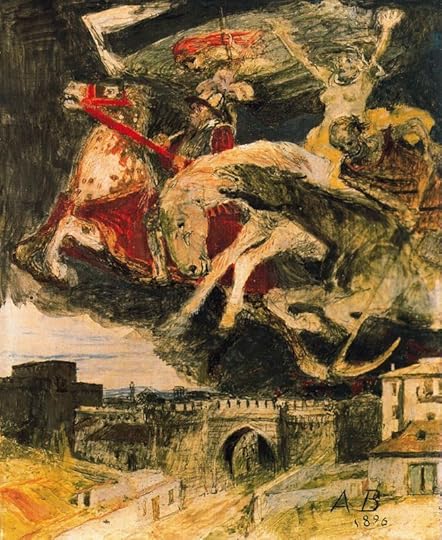
(Arnold Böcklin, Study to War, 1896)
Profile Image for Sammy.
955 reviews33 followers
October 25, 2018
What would they do with the new world which would be born when once the guns fell silent? They did not know, for the old would be somehow buried in the fateful silence of peace.”

Durrell - the master of late modernist fragmentary point-of-view series after his Alexandria Quartet - has gone deeper down the rabbit hole in his Avignon Quintet but this third volume suggests he's tunneling in the wrong direction. I quite enjoyed the absurd ramblings of Monsieur, or the Prince of Darkness and although I had my qualms, Durrell captured the beauty of multiple landscapes in Livia, or Buried Alive. But the third instalment, Constance, or Solitary Practices is bloated, and one can't help wondering if the author's age and preoccupations got the better of him.

Taking place between the early days of WWII (when "peace was not yet mortally stricken - but... a patient unconscious on a table, bleeding to death") to the hectic spring of 1944, Constance sees our five young heroes, as well as the Egyptian Prince, scattered across the Mediterranean. Aubrey Blanford joins the Prince on diplomatic duties in Egypt; Hilary and Sam report for active service; Constance joins the Red Cross on the continent; and Livia... well, she's been lost to Nazism. In fractured moments, we witness them (except Hilary, who remains a somewhat abstract addition to the cast) battle moral and philosophical dilemmas, by the end of which two of them will be deceased.

We've been aware from the first page of book one that this series would have much to say on subjects of Gnosticism, human sexuality, and Freud. But I didn't realise quite how much. Placing Constance - a therapist - at the heart of this novel allows Durrell to immerse us in Freudian psychology, rivers of menstrual blood, and so much else. Thankfully, it brings us the engaging character of Sebastian Affad, Constance's Egyptian lover, who brings his own matching set of emotional baggage, but one feels that the touch of an editor is far too light here - perhaps a sign of Durrell's recognised importance by this stage in his career.

Aside from the above, we are treated to some showy postmodernism, which is beginning to string together the separate plots of the first two books, with the arrival of the (previously revealed to be fictional) Toby, Sutcliffe, Pia and Trash into the "real" world of our WWII characters! Whether this will be taken anywhere satisfying remains to be seen, but it's at least distracting to the mind. (Frustratingly, though, one feels like we have missed out on ever getting to understand Livia, the misguided and possibly regretful Nazi, in lieu of Sutcliffe/Blanford badinage.)

Most interesting to me as a reader in 2018 are Durrell's insights into WWII, and to the thought processes of Hitler and the stand-in Nazi characters here. Durrell occasionally falls into the pitfalls of historical writing, where characters are either wickedly insightful about what is going on, and have seeming precognitive powers when it comes to predicting what will happen after the war. But the author has such fun morally demolishing the Nazis (a soldier who wets the bed from an unresolved issue of teenage shame; the Catholic general trying to find a place to confess his sins, only to realise the priest to whom he is confessing has a Jewish background; Hitler himself, keeping a shrunken head next to his bed in the hope it will tell him how to win the war), it's hard not to enjoy it. The sequences in Avignon, under Nazi control and peopled by citizens who fall somewhere along the spectrum from "collaborator" to "passive participant" make for engaging and morally conflicting reading. The questions of collaboration, and of how cultures shift so suddenly, feels pressingly relevant.

From time to time,Durrell betrays his once magisterial powers of description and character insight. Southern France and Egypt retain their "spirit of place" here, and Constance's musings on her relationship with Affad - on how two people from such different cultures can find each other, yet not quite understand each other - are powerful in their elegaic beauty.

Still, I can't help feeling Constance is far too long and unfocused. (I note that both Sebastian and Quinx- the remaining volumes - sit on my shelf looking very slender indeed.) The book is not a success, or rather its setpieces and insights are bold and powerful, but are parceled out intermittently in a haze of unrestrained wordiness. (As I have discussed the issue of race and gender in previous reviews, I will not do so here, except to say that the same problems recur but are also somewhat alleviated by the overall subject matter and evident sympathy for the side of freedom.)

I came close to upgrading this review to three stars, however, based on the final chapter, "The City's Fall", which is a little masterpiece, revealing that Durrell had by no means lost his power. As the Nazis pull out of Avignon in 1944, we witness the disgruntled General unable to convince sappers to help him blow the place to smithereens, the beguiling destruction of the mental asylum and the richly Zola-esque symbolism of the patients returning to their lives, and the heartbreak of the people's return to their city, the spirit of revenge, and a brutal farewell to one person in particular. I decided not to upgrade the review, since I read this book more fascinated by Durrell's mindset than by the book itself. Still, while I doubt Avignon will ever be Alexandra I remain hopeful that we've moved past a particular bump in the road, and will quickly carry on to Sebastian. It's not that I didn't enjoy these "sporadic annotations on the margins of history", to quote Durrell here, or the occasional cameos from characters of that earlier quartet! But I suspect these characters would be happier with either more of a narrative framework or less.

Perhaps I should end by quoting Blanford, imagining his mother, who may have said upon his birth: "This one will be introspective, cut off from ordinary life, proficient in solitude, but subject to enchantments because of his insight."

Profile Image for Armin.
1,201 reviews35 followers
September 17, 2015
Die Lektüre fordert den Leser nicht allzu sehr, das ist das Beste, was sich über diesen aufgeblähten dritten Teil des Avignon-Quartetts sagen lässt. Etwa fünfzig Seiten korrespondieren mit den ersten beiden Teilen, geben Antworten auf offene Fragen oder führen Handlungsstränge oder Lebensfäden zu Ende, bzw. liefern die Vorgeschichte zu bereits in den ersten beiden Teilen erzählte Fakten.
Wenigstens sind die beiden Folgebände zusammen nicht einmal so dick wie Constance, deren private Praktiken in einem fünfzigseitigen Liebesakt mit Affad bestehen, der mit 60% Gnostik und 30% Psychoanalyse und ein wenig Geschlechterkampf und einem Ausdauerwettbewerb beim Zurückhalten des Orgasmus gewürzt ist.
Die anderen Liebes- oder Sexszenen dürften vielleicht bis in die frühen Sechziger noch für ein gewisses Prickeln oder entsprechende Empörung gut gewesen sein, können dieses eher dahin gesudelte Buch aber so wenig retten wie die anderen Teile. Und jeder, der einigermaßen mit dem Verlauf des zweiten Weltkriegs vertraut ist, hat trotz Oberaufsicht der im Vorwort gelobten Mrs. Helen Dore immer noch genügend Gelegenheit schmerzhaft zusammenzuzucken.
Im letzten Kapitel, das die Selbstjustiz der Franzosen untereinander und die Tumulte nach dem Abzug der Nazis aus Avignon beschreibt, passiert so etwas wie ein erzählerisches Wunder, zu spät um wengistens den zweiten Stern zu retten.
199 reviews3 followers
December 16, 2025
Üçüncü kitabın çevirisi, Ülker İnce’nin olağanüstü işçiliğiyle adeta konuşuyor. Kelimenin tam anlamıyla çarptı beni. Kusursuz bir anlatım.

Ama bütün kitap ve çevirinin mükemmelliği bir yana…

Durrell’in sona koyduğu Petro’nun Vasiyetnamesi, başlı başına bir ustalık eseri. Çarpıcı, sarsıcı ve derslerle dolu. Rusya–Avrupa geriliminin, utancın ve ideolojik korkuların bugüne kadar uzanan karanlık damarına ışık tutuyor. Bu bir final değil; açık bir yüzleşme bu Vasiyetname. Metnin gerçekten kime ait olduğundan çok, gerçekmiş gibi inanılmasının yarattığı yıkım olağanüstü , Özellikle Istanbul üzerine olan maddeler .

Kitabın merkezinde tam anlamıyla savaşın kendisi var.
Mayınlar, askerler, kıtlık… Avrupa kan kusuyor. Gözü dönmüş Hitler köpekleri sokaklarda cirit atıyor. Bombaların altında, Ahmet Kaya’nın Kum Gibi’sindeki o tuhaf duygu beliriyor: hayatta kalmaya çalışan sevişmeler. İskenderiye Dörtlüsü’nü aratmayan, edebiyat tarihinde benzeri zor bulunan sevişmeler bunlar. Emsalsiz. Durrell Freud’u da eksik etmiyor; her temasın önünde arkasında Freudyen açılışlar, kapanışlar var. Bu felsefi bağlamları öyle yerli yerinde, öyle ustaca kuruyor ki hayran olmamak inkansiz.

Constance, Blanford, Hillary, Livia, Sam…
Ve Affad’ın hikâyesi devreye giriyor: ilk kitapta adı sıkça geçen, ikinci kitapta neredeyse kaybolan o gizemli simyacı. Savaş ilerledikçe eksilen dostlukları okurken insanın içi burkuluyor. Sutcliffe–Sabine–Trash–Pia hattında vagonlar yine kopuk kopuk ama rayında ilerliyor; gerçek ile kurmaca sürekli yer değiştiriyor. Bir oyunun içindeyiz ve itiraf etmeli: bu dinamik oyundan insan artık 3. Kitaba gelene kadar bitiyor.

Constance’a gelince…
Geçen kitapta tutunulan biriyken, bu kitapta artık tutunacak bir şey arayan biri. Durrell onu ne dramatik bir sona ne de net bir kurtuluşa götürüyor. Aksine, Constance savaşın insanı nasıl sessizce eksilttiğinin sembolü hâline geliyor. Büyük bir olay yaşamıyor; parça parça siliniyor. Hayattan!

Sutcliffe ise Durrell’in en bilinçli oyunlarından biri. Önceki kitaplarda bir gölge, bir kurgu ihtimali, bir maske gibiydi; varlığı hep başkalarının anlatıları, mektupları ve söylentileri üzerinden kuruluyordu. Platon’un Sokrates’i gibi demisti Durrell daha evvel. Bu kitaptaysa Durrell, Sutcliffe’in “gerçek” olduğunu söylüyor, ama bu, tarihsel ya da belgeli bir gerçeklik değil. Sutcliffe, anlatının içinde işlevsel olarak gerçek oluyor sanki. Constance’la paylaştıkları gizli bir dil, bir unsur adeta. Varligiyla bu kitapta Başkalarının hayatlarını etkiliyor, ilişkileri değiştiriyor, zincirleme sonuçlar doğuruyor. Yani Durrell şunu yapıyor: Birinin varlığına inanılıyorsa ve bu inanç dünyayı değiştiriyorsa, o kişi gerçektir. Bu noktada gerçeklik belgeli değil; anlatısal ve psikolojik bir gerçeklik. Sutcliffe’in “gerçek” olması kimliğinin sabitlenmesi değil, tam tersine Sabine, Trash, Pia ve anlatıcılar arasında parçalanması demek. Durrell burda kafa karıştırıyor , bilerek. Bakalım 4. kitapta bu semi-gercekik neye devsirilcek 🙈

Afad’a gelince…
Savaş ilerledikçe onun dili susuyor; simya, kader ve sezgi yerini kaba güce ve yıkıma bırakıyor. Bilgelik yok olmuyor belki ama artık kimse onu dinlemiyor. Constance’la yaşadıkları tutkulu aşk bu savaş kitabını dengeliyor.

Artık geriye tek soru kalıyor:
Kim gerçek? Kim değil?

“İmparatorluklar, korkular üzerine inşa edilir; korku yayıldıkça sınırlar genişler.”
(Petro’nun Vasiyetnamesi’nden)

Gelsin dördüncü kitap !
Profile Image for Selen Birce.
41 reviews5 followers
January 29, 2021
Hızla ve zevkle bitirdiğim ilk iki kitaptan sonra serinin üçüncü kitabını inanılmaz bir zorlukla tamamladım. Hatta son sayfaları biraz üstünkörü okudum bile diyebilirim. Bunun sebebi çevirmenin ilk iki kitaptan farklı olması mı yoksa yazarın bu kitapta işlediği konuların farklılığı mı bilmiyorum. Sanırım, çeviri kitap okumanın en kötü yanı da bu; farklılıklar yazarın kendisinden mi kaynaklanıyor yoksa çevirmenden mi? Sinirime dokunan bir diğer nokta da kitabın ortalarında bir yerde müstehcen olduğunu düşündüğüm kelimelerin sansürlenmiş olması; bu sansürler asıl kitapta da mevcut ve yazarın bununla iletmek istediği bir mesaj mı var, yoksa Türkiye basımıyla alakalı bir sansür mü söz konusu? Bu tarz detaylar kitaptan aldığım tüm zevki alıp götürdü ve hatta okuma sürecini bir çeşit zorunluluk hâline getirdi.
Profile Image for Colin Davison.
Author 1 book9 followers
August 5, 2019
What is the point of this deplorable, self-regarding novel?
Is it about the real and imaginary, about the craft of the novel itself? About alienation and deception of oneself and others, or about a search for a higher meaning of life through personal revelation?
Or is it just an onanistic exercise in indulgent, bogus intellectualism by an arrogant, crypto-fascist with a c*** obsession? I wish they’d put that on the cover.
The book is the central volume of Durrell’s Avignon quintet, and those who have read all five may deliver more satisfactory verdicts as a result. I haven’t; nor having read Constance am I likely to do so.
It starts well enough, Constance sharing the life of privileged, witty young wiseacres in Provence on the eve of the Second World War, before the action moves between there, neutral Egypt and Switzerland.
One has a sense of the ex-patriot author as his character Aubrey is charmed by the colour and vibrancy of Egypt and of the gilded society of his employer prince while conflict spreads across Europe. “England was an occasional twinge of conscience away,” he confides. Yet “the lack of individual responsibility is so wonderful.”
The descriptive set-pieces are inventively evocative. Vichy Avignon has “the smell of intellectual disgrace of human deceit.” Aubrey’s working-class batman Cade “wore his puritan life like a dead crow around his neck.”
And when horror intrudes, the accidental killing of Constance’s lover, or the visit of SS man Fischer to the camps, it is vividly conveyed with minimal detail – snow-covered beauty all around, but burning bodies that stank like old motor tyres and blood hissed like rain on dead leaves.
Unfortunately, Durrell gets carried away with his cleverness, firstly with the conceit of real characters who interact with everyone else but simultaneously exist only in each other’s novels. And what is one to make of the deliberate obfuscation that Constance reminds a German general of his lost sister Constanza?
Pretentiousness is never far away, in concepts and conversation. Constance’s friends don’t meet, they foregather. And the pretention ascends to ridiculous heights when it comes to sex. Here is her lover Sam on losing his virginity: “The shining Weald was there, in his inner consciousness, raising its blazing corn to heaven under a deafening sunshine.” Do I hear trumpets?
And after intercourse, her later lover Affad confesses to a moment’s reflection, “I was just lost in the liana of my lucubrations.”
This is laughable, yet one is expected to take it seriously. And it gets worse.
There are parallels with the Mitford family – Constance’s sister Livia like Unity Mitford having become a Nazi – but in the long, tedious central chapter ‘Tu Duc visited’ Affad goes into abstruse discourse on the eugenics of sperm and the need to preserve the quality of the race.
It’s a load of Freudian fascistic psycho-babble, with nonsensical utterances such as “when the asterisk marries the fig leaf all is well,” that purports to justify a new kind of sexual relation, supposedly liberating women, but whose purpose is to turn them into the perfect whore, wife and mother that is the dream of many an aged, reactionary fantasist.
Profile Image for Paul Hedeen.
108 reviews2 followers
March 26, 2021
This book is valuable for those readers loving Durrell's play of mind and style. Like all Durrell, it is mildly daring and scandalous. But its promise of projecting his modernistic and psychoanalytic forms and themes into the milieu of Provence in WWII is largely undelivered. The characters are fragmentarily developed (there is no sustained narrative) and the war all but nonexistent. Nor is Provence all that important to the main characters, except as a memory. Constance herself is widowed by the war and then launches herself into a love affair that is supposed to be understood through her doctor of psychology's lens. Not much is understandable or understood, at least by this reader. The characters (most of them silly, British caricatures) are dropped and the war ends--with both the book ends as well.
Profile Image for Stephen.
504 reviews3 followers
October 9, 2022
The most succinct one-word review of this book is the one on Goodreads that simply read: 'tedious'.

Unfortunately Durrell's Freudian meanderings on mind and madness 1939-1945 significantly pales against D.M. Thomas's 'The White Hotel', which was nominated for the Booker (1981) just the year before 'Constance' (1982). Some of the critical difference is simply stylistic preference. Durrell flashes between the neuronal twitches of his cast of bland characters, weighing down his turgid prose with allusions to the 'catafalesque', 'analphabetic' and regular snatches of French. The wonderful richness of language is one thing, but Durrell's usage feels leaden and drawn-out, with strings of excess verbiage. Shorter and sharper chapters towards the end (e.g. the flashpoint of 'The General') came too late to offer much redemption, as by this point I was speed-reading just to get this overly long book finished.

During my reading, I happened upon an article lambasting long books. To offer balance, I looked up another in praise of lengthy tomes. It made me wonder whether my low scores for highly-esteemed books (Earthly Powers, Don Quixote, Joseph, much of Iris Murdoch, as well as this) often resulted from fatigue more than the quality of the work. Certainly, I have enjoyed plenty of chunky books (The Luminaries, Tom Jones, Wolf Hall, and most of Dickens), but do accomplished books that do clever but testing things with form simply tire my patience, despite their literary qualities? The long books I have enjoyed have tended towards classical narrative fiction. It is possibly, therefore, that I might have felt similarly about Durrell as about D.M. Thomas's comparably experimental use of form if the former (nearly 400 pages) had the economy of the latter (a more standard 288 pages).

Elsewhere (cf William Boyd) I have reviewed books that see war from both sides, including Boyd's 'An Ice-Cream War' and Thomas Kennelly's 'Gossip in the Forest' and 'Confederates'. D.M. Thomas and Durrell both offer the same dual perspective, but Durrell's for me was the least successful of the five novels, because he frees thoughts into a proto-cloud of shared neurosis. The war was just in the background, and while Durrell thereby manages to draw parallels on the shared pathologies that transcend battle-lines, he lost my sympathies with the human engines that were firing these thoughts that quickly vanished from relevance like vaporous smoke. As a reader I never felt much identification with Constantine, Quatrefages, Von Esslin, Livia or anyone else. That's not to say there aren't moments of heightened drama or empathy (we get suicides, friendly fire, and enemy attacks that carry drama and sadness), but there is no sustained tension, as it is repeatedly dissipated by orgasm and by mental non-sequiturs.

On the back cover of my edition, the 'Daily Telegraph' claims that 'few readers will be able to resist the spell'. I am one of those unlucky few, perhaps, and do not think I will be tackling the rest of this 'quincunx' (series of 5x) novels.
Profile Image for Alanogue.
12 reviews
June 4, 2017
I picked this up by chance from a bookshelf containing donated volumes for charity at a local chain store. These bookshelves are springing up around the place and I wonder what the connection is between DIY and reading (or more probably the cessation thereof)? It is no longer in fashion, it seems, to display books in one's home as a sign of erudition even if they are read or consulted very rarely. Still I guess you have to find room somehow for the cinema-sized curved TV screen. My gain, I say.

To the book ... finding it as I did, I have read the book out of sequence as it is the third in Lawrence Durrell's Avignon Quintet series. I had read (most of) the Alexandria Quartet as a younger man and in fact named my border collie at the time after Balthazar one of the eponymous characters. So I thought I'd give it a try. Well peopled, as his novels generally are, I did find my interest somewhat stretched in following all of their activites and interactions perhaps because they had been introduced in the two preceding books. The central character - Constance - seems a little light despite, as some sort of psychologist/counsellor, the Freudian allusions she often espouses. Rather nostalgic and tragic (the whole book is set during WW2 against a background of tragedy really) with a flat in Switerland and a house in Provence she only really comes to life (after the death of her husband) in Durrell's metaphysical description of her sexual relationship with a young urbane Syrian millionaire - he of the 'slender wand'. Their sado-masochistic sexual antics are, of course, absurd and I'm not at all sure why this sequence is included at all. Her character would not have been complete without some sort of playing out of her Freudian fantasies, one supposes.

I thought the portrayal of the Nazi general was handled with sympathy and the conclusions about Gestapo brutality and summary executions were spot on. Although there are always too many deaths in a war I felt there were one or two too many in this novel. Her husband, her sister, her friend, the honey-man etc - some of them a little too near the end to ring entirely true - one could almost imagine someone saying: 'It's a wrap!' as we speed towards the final loose-end tying pages. The descriptive writing is quite stunning at times and as ever his sense of place is sharp and believable seeming to employ all of the reader's senses. I couldn't really follow what was happening with the asylum and its inmates although their release must have been some spectacle.

I shall search out the first two volumes (and the last two) eventually to see this work in its totality. I believe it will be worth it and I may even award an extra star!
Profile Image for MELTEM GULSOY.
115 reviews7 followers
July 25, 2024
Avignon Beşlisi'nin ikinci kitabı Livia II. Dünya Savaşı'nın eşiğinde bitmişti. Üçüncü kitap Constance ise işgal altındaki Fransa'da geçiyor ve Avignon'um savaş sonunda kurtuluşu ile bitiyor. Constance ise Libia'nın kız kardeşi. Tabii bu kitapta da artık ahbabım gibi hissettiğim kadro hep var. Bir yerlerde konuya, olaylara dahil oluyorlar. #lawrencedurrell bu defa Fransa'da konuşlandırsa da konusunu, Mısor'dan ve Mısırlılardan vazgeçmiyor. Bize illa bir dünyalar güzeli Mısırlı kadın ya da erkek kahraman armağan ediyor. Almanların Avrupa'da estirdiği terörü gözümüze sokmuyor ama yüzümüze vuruyor. Constance ve Affad'ın aşkı kadar romantik olmayan ama bir o kadar da elle tutulurcasına kuvvetli bir aşk anlatımı epeydir okumamıştım

Seriyi okumanın, özellikle aralıklı okumanın zorluğu kabalık kadrolu bu romanlarda kimin kim olduğunu hatırlamak oluyor. Ben notumu alıyorum ki sonra zorlanmayayım.

Tabii oldukça iddialı bir prosüksiyon olur ama neden İskenderiye Dörtlüsü ve Avignon Beşlisi hala dizi olmadı anlayamıyorum. Ben her yeni karakter belirdiğinde kafamda bir casting yapıyorum. Ne güzel izlenirdi ama...
Bu arada Ülker İnce çevirisi çok iyi...
#okumatutkusu #okumahalleri #booklist #bookworm #booknerd #kitapkurdu @canyayinlari #ülkerince #booksbooksbooks #bookstgramturkey #kitapgünlüğü #readingdiary
Profile Image for Val.
2,425 reviews87 followers
December 4, 2017
The group of friends from previous books have come to the end of their idyllic summer in Provence as war breaks out. We follow them and what they do; we meet more characters and there is the same blurring of reality, fiction and fiction within fiction. The new characters are given more depth when we meet them, because it is for the first time; von Esslin in particular was complex and promising.
The book starts well and the author writes beautifully, so that I was thinking of giving it five stars for the first half to two-thirds of the book. I started to lose interest when Constance took a new lover. They talk and have sex and talk during sex, and if that is pillow talk then it is more soporific than erotic. When characters are not having sex, they are chasing around with a head in a box and looking for Templar 'treasure'. The 'Holy Grail' has lent itself to mediaeval romances, comedies, scholarly works and absolute tosh; I'm not sure which of those are intended in this book.
I returned to the book after a break and finished it. There are some good bits toward the end, but I never quite regained my early enthusiasm for the book and I may not bother to read the last two parts of the quincunx.
Profile Image for Carolina.
401 reviews9 followers
December 28, 2020
Passamos ao terceiro livro do Quinteto de Avignon. Aqui falamos mais sobre a personagem de Constance, tendo como ponto de partida os dois escritores, que são um e o mesmo e parte um do outro. Neste volume os personagens entram num ponto de não retorno: a guerra. E, devo dizer, aqui está a forma mais original de falar da guerra que alguma vez encontrei.

A guerra está presente e afecta todos os personagens de uma ou de outra maneira, mas aparece como um cenário de fundo. Isto é, os personagens não são integrantes dos horrores da guerra e estão a viver as suas vidas normais, ajustadas a esta nova realidade. Isto faz com que o fim da guerra pareça mais horrendo que a própria guerra, o que é impressionante e muito diferente do habitual.

A escrita mantém-se erudita, mas com uma simplicidade narrativa que nos permite entrar no âmago de cada uma destas pessoas e conhecê-las, assim como aos seus anseios e vontades. É, verdadeiramente, uma escrita de mestre.
Profile Image for Edward Champion.
1,652 reviews130 followers
June 30, 2022
Of the three Avignon books I've read so far, this one is the best. Durrell's prose is more honed and vivacious and alive than in the previous two lethargic volumes. Weirdly enough, writing about Nazis seems to have perked up our man Larry. There are steamy affairs and globe-hopping and investigations into how we remember events and people, but this is still not on the level of The Aleandria Quartet. Some key quality of awe and wonder is missing, however. And while several sentences left me in admiration, there were many plodding passages in Geneva. For Durrell die-hards only.
Profile Image for Linda Rushby.
19 reviews3 followers
December 7, 2023
For me, this was the least enjoyable of the Avignon books so far. Rambling, confusing, and Durrell's usually elegant prose becomes a bit too overblown, especially in the sex scenes between Constance and Affad, which is why I:ve marked it down compared with the earlier books. But the details of civilian life in Provence during the Nazi occupation are fascinating and feel very authentic.
Profile Image for Sena.
119 reviews56 followers
October 21, 2024
Son bölümün muazzam tasvirleri adına dört yıldız verdim ama Lawrence Durrell bu üçüncü kitabı gereğinden fazla uzun tutup, odak noktasını kaydırarak ilk kez bir kitabını oflayarak okumama neden oldun, bilesin. Bunda Seçkin Selvi’nin çevirisinden Ülker İnce’ye geçmenin etkisi de büyük oldu maalesef.
2 reviews
February 16, 2025
Bu seriyi bulabilmem uzun zamanımı aldı. Vazgeçmeyip Lawrence Durrell’ı okuma zevkine eriştiğim için mutluyum. Tarih, felsefe, psikoloji gibi sevdiğim dalları içermesiyle, müthiş zengin edebi diliyle, her sayfası dolu dolu anlatımıyla beni çok etkiledi ve kendine hayran bıraktı. En beğendiğim yazarlar sıralamasında en üstlerde yerini aldı.
Profile Image for Hryuh.
132 reviews2 followers
August 19, 2024
Не люблю читать про вторую мировую, примерно одна и та же история, перепетая на разные лады. И тут не то чтобы исключение. В первой книге ещё была магия, во второй она местами возвращалась, в третьей ушла. Не очень понятно, в чем смысл, зачем это всё вообще.
Profile Image for Siobhan Markwell.
534 reviews5 followers
January 1, 2018
I wonder if any publisher would touch this book today. To be honest, I felt there was a thinly veiled seam of anti-semitism and even paedophile apologism in this book which made for very uncomfortable reading. There were moments when the writing came to life, particularly when describing the occupation of France. Durrell can turn a good sentence but sometimes the language is heavily over-egged and the opinion pieces, of which there are many, are based on some pretty unsavoury and indefensible conceits.
Profile Image for Ideath.
32 reviews4 followers
December 16, 2010
Waaaaay too much Freud for me. And loooooove/sex/"sexy" stuff. I can do without that. But i am committed to this quincunx now, and need to see how he makes the lines all line up. It is also exciting to me, as a fan of the Alexandria Quartet, to see characters from that swim to the surface here and there.
Profile Image for Mirvan. Ereon.
258 reviews89 followers
Read
June 18, 2012
A nice person from Bookmooch sent me this wonderful book. I will be reading and reviewing it soon.
Profile Image for Donal O Suilleabhain.
240 reviews1 follower
April 19, 2015
Starts well for the first third of the book but once the two central characters start their affair Durrel's head well and truly disappears up his own arse. Awful pretentious book.
Displaying 1 - 28 of 28 reviews

Can't find what you're looking for?

Get help and learn more about the design.