

What do you think?

The Black Panther Party: A Graphic Novel History
WINNER OF THE EISNER AWARD • A bold and fascinating graphic novel history of the revolutionary Black Panther Party .
Founded in Oakland, California, in 1966, the Black Panther Party for Self-Defense was a radical political organization that stood in defiant contrast to the mainstream civil rights movement. This gripping illustrated history explores the impact and significance of the Panthers, from their social, educational, and healthcare programs that were designed to uplift the Black community to their battle against police brutality through citizen patrols and frequent clashes with the FBI, which targeted the Party from its outset.
Using dramatic comic book-style retellings and illustrated profiles of key figures, The Black Panther Party captures the major events, people, and actions of the party, as well as their cultural and political influence and enduring legacy.
Founded in Oakland, California, in 1966, the Black Panther Party for Self-Defense was a radical political organization that stood in defiant contrast to the mainstream civil rights movement. This gripping illustrated history explores the impact and significance of the Panthers, from their social, educational, and healthcare programs that were designed to uplift the Black community to their battle against police brutality through citizen patrols and frequent clashes with the FBI, which targeted the Party from its outset.
Using dramatic comic book-style retellings and illustrated profiles of key figures, The Black Panther Party captures the major events, people, and actions of the party, as well as their cultural and political influence and enduring legacy.
183 pages, Paperback
First published January 19, 2021
About the author
David F. Walker
289 books292 followersDavid F. Walker is a writer, filmmaker, and award-winning journalist. He teaches Writing For Comics at Portland State University.
Ratings & Reviews
Friends & Following
Create a free account to discover what your friends think of this book!
Community Reviews
Displaying 1 - 30 of 492 reviews

February 14, 2021
"When people consider the Black Panther Party, thoughts are often mixed, and often negative, no matter one’s race. Through The Black Panther Party: A Graphic Novel History, David F. Walker and Marcus Kwame Anderson offer more than enough details to help a reader understand just who the Panthers were and, perhaps, reconsider their views of the party’s legacy. In the wake of a Black Lives Matter world, understanding the history of the group that came before is paramount to understanding where the fight for racial equality has been and how far it still needs to go." Full review published at WWAC

January 31, 2021
A fairly engrossing history about a very complicated group of people. It's a graphic novel that relies heavily on giant blocks of text, but still reads fairly quickly due to the subject matter.
My passing impression of the Black Panther Party reduces them to violent militants, so I was surprised to find that their initial 1966 Ten-Point Program of wants and beliefs is actually a very reasonable starting point for discussion of Black Americans' issues and civil rights. Most of them are rightly still debated today. Indeed, it's amazing how little progress has been made on some of them, such as police brutality, and how that leads directly to the protests we saw last year.
There is strong irony in how quickly California passed gun control legislation when Black Panthers showed up at the state capital with guns and how little action we have taken in the last year despite armed White militants parading and protesting.
This introduction to the Black Panther Party was very enlightening and leaves me wanting to pursue more information about the topic.
My passing impression of the Black Panther Party reduces them to violent militants, so I was surprised to find that their initial 1966 Ten-Point Program of wants and beliefs is actually a very reasonable starting point for discussion of Black Americans' issues and civil rights. Most of them are rightly still debated today. Indeed, it's amazing how little progress has been made on some of them, such as police brutality, and how that leads directly to the protests we saw last year.
There is strong irony in how quickly California passed gun control legislation when Black Panthers showed up at the state capital with guns and how little action we have taken in the last year despite armed White militants parading and protesting.
This introduction to the Black Panther Party was very enlightening and leaves me wanting to pursue more information about the topic.

March 20, 2021
An excellent and balanced history of the Black Panthers, its people, its ideals and programs, its challenges ranging from internal strife to governmental persecution to battles with other black nationalists, etc. The format as a graphic novel may not be appreciated by some, but Marcus Kwame Anderson does a fine job. The afterword discussing how today's headlines are relevant to this 40+ year old subject was interesting. Highly recommended for anyone interested in a relatively short treatise on the Panthers.

July 25, 2022
I think this is the saddest book I've ever read in my life.
I wonder if the FBI informants who infiltrated the Black Panthers ever look back on their actions and wonder if they'd made an awful, awful mistake? That they sacrificed not just their brothers and sisters, but an entire world with more sustenance, joy, and love than a $350 payout from the people who'd subjugated you in the first place.
What conditions of desperation must you be in to destroy the very organisation that could have set you free?
I'm not even angry. I'm just crushed. I can't bear this world that we live in.
I wonder if the FBI informants who infiltrated the Black Panthers ever look back on their actions and wonder if they'd made an awful, awful mistake? That they sacrificed not just their brothers and sisters, but an entire world with more sustenance, joy, and love than a $350 payout from the people who'd subjugated you in the first place.
What conditions of desperation must you be in to destroy the very organisation that could have set you free?
I'm not even angry. I'm just crushed. I can't bear this world that we live in.

January 31, 2023
A really beautiful detailed books. Illustrations gorgeous. The dialogue is clunky but the history & narration are good. I appreciated the complexity with this one.

February 28, 2021
A brilliant, beautifully illustrated, engaging graphic novel history of the Black Panther Party that’s accessible for all ages (6 and up). Read this with my 7 year old for home school, and she was so captivated that she wanted to read it before bedtime too. Highly, highly recommend.

February 20, 2023
El partit dels panteres negres · 5/5⭐ Exemplar de col·laboració
Una novel·la gràfica plena de força!
'El partit dels panteres negres' és un relat exhaustiu, de l'ascens i la caiguda d'un dels moviments més influents de la història recent dels Estats Units.
El llegat dels panteres resisteix a la simplificació i gràcies a aquesta novel·la gràfica, amb la qual podreu tenir una comprensió més àmplia del context polític i social que va propiciar el naixement i el ràpid creixement del Partit Pantera Negra, conèixer-ne els principals líders i acostar-se a la història sencera del partit, des del naixement fins a la dissolució.
El llibre també serveix per conèixer el llegat que van deixar i el seu impacte icònic i polític fins als nostres dies.
Com veureu és un llibre ple de força. No només pel relat i les biografies dels i les membres del partit, sinó també perquè l'edició que en fa @tigrepaper és immillorable i les il·lustracions tenen molta potència i caràcter. Unes il·lustracions que fan el relat molt més enèrgic i profund.
Una novel·la penetrant que no us podeu perdre!
Si us interessen aquests fets històrics, també us recomano el llibre PANTHER, de la mateixa editorial.
Una novel·la gràfica plena de força!
'El partit dels panteres negres' és un relat exhaustiu, de l'ascens i la caiguda d'un dels moviments més influents de la història recent dels Estats Units.
El llegat dels panteres resisteix a la simplificació i gràcies a aquesta novel·la gràfica, amb la qual podreu tenir una comprensió més àmplia del context polític i social que va propiciar el naixement i el ràpid creixement del Partit Pantera Negra, conèixer-ne els principals líders i acostar-se a la història sencera del partit, des del naixement fins a la dissolució.
El llibre també serveix per conèixer el llegat que van deixar i el seu impacte icònic i polític fins als nostres dies.
Com veureu és un llibre ple de força. No només pel relat i les biografies dels i les membres del partit, sinó també perquè l'edició que en fa @tigrepaper és immillorable i les il·lustracions tenen molta potència i caràcter. Unes il·lustracions que fan el relat molt més enèrgic i profund.
Una novel·la penetrant que no us podeu perdre!
Si us interessen aquests fets històrics, també us recomano el llibre PANTHER, de la mateixa editorial.

October 16, 2023
This is a good introduction to the history of the Black Panther Party.
I have read other biographies about members of the movement and I liked how this graphic novel ties them all together.
It presents a side that is not often seen in history and world culture.
The artwork in this book is amazing and very photorealistic.
If this is something that interests you, give it a go.
I have read other biographies about members of the movement and I liked how this graphic novel ties them all together.
It presents a side that is not often seen in history and world culture.
The artwork in this book is amazing and very photorealistic.
If this is something that interests you, give it a go.

March 8, 2025
I think Walker's attempt to provide an overview of the Black Panther Party was pretty successful. I learned quite a bit about the Party's origins, key figures and deeds, as well as the pressures, internal and external, that the organization faced.
I do think the reading can be a bit clunky-- fitting history (especially one so impactful and nuanced) to the shorter, easily digestible format is not without its limitations.
For example, I do appreciate the look at the contributions of women in the BPP and in civil rights, but I am left wondering how much more there is to say about these influential women. I think there are so many details that couldn't make it to the book for the sake of brevity and the intended scope of this graphic novel, but there is definitely more to uncover.
I do really like Anderson's art here, but I do kind of wish it felt a little more distinct and/or stylized. But then again, the non-fiction subject is maybe best served by a non-fiction art style. Either way, I think Walker and Anderson were a great team, and the work was highly effective.
This was an important book in 2020, and it continues to be chillingly relevant in 2025. Walker's afterward was a particularly sobering reminder of American history and current events.
I do think the reading can be a bit clunky-- fitting history (especially one so impactful and nuanced) to the shorter, easily digestible format is not without its limitations.
For example, I do appreciate the look at the contributions of women in the BPP and in civil rights, but I am left wondering how much more there is to say about these influential women. I think there are so many details that couldn't make it to the book for the sake of brevity and the intended scope of this graphic novel, but there is definitely more to uncover.
I do really like Anderson's art here, but I do kind of wish it felt a little more distinct and/or stylized. But then again, the non-fiction subject is maybe best served by a non-fiction art style. Either way, I think Walker and Anderson were a great team, and the work was highly effective.
This was an important book in 2020, and it continues to be chillingly relevant in 2025. Walker's afterward was a particularly sobering reminder of American history and current events.

April 27, 2021
So much information packed into this book—there was obviously a ton of research behind it. So tragic that we are still dealing with the same racial injustice today that the Panthers organized to fight.

December 11, 2023
This graphic novel -- an abbreviated version of the history of the Black Panthers, founded in the late 1960s, and active until it wound down in the early 1980s -- provides a great overview of the community activists, politicians, and law enforcement figures that are integral to the story. You will learn about the roles of:
Huey Newton
Bobby Seale
Angela Davis
Eldridge Cleaver
Marlon Brando
California Governor Ronald Reagan
The Oakland California police
The L.A. police
The FBI
J. Edgar Hoover
LBJ
Richard Nixon
. . . and . . . the list goes on
The narrative is a bit one-sided, in that it takes every single opportunity to paint the activities (both good and bad) of the Black Panthers and its members in the most favorable light.
But, in my view, that is forgivable, because the very things that the Black Panthers protested against -- and often violently fought against -- in the 1960s and 70s are the same exact things that are STILL WRONG in our American society today. For example, police brutality is still the norm in the law enforcement tactics used against the black community. Think of the police murder of George Floyd ("I can't breathe") during the Trump era. Think of Trump himself -- is he any different than Nixon? Trump is worse, actually.
Nothing has changed. There is a direct line of white supremacy and bigotry that connects major milestones in our national history, starting with: slavery, the Revolutionary War, the Civil War, Reconstruction, sharecropping, Jim Crow, lynching, institutionalized racism, income inequality, discrimination, civil unrest, and police brutality; and, continuing on through the mid-20th century policy ideals of Goldwater, Nixon, Reagan and Trump. Time moves on, but the story stays the same. The phrase "law and order candidates" is the extremist right wing euphemism for, "we gotta put those black people in their place." This dog whistle political divisiveness is getting old. The Civil War has been over since 1865. Or has it?
This book is the summary, the outline, that points us in the right direction, for further reading to generally explore the topic of racial inequality, and the people and the policies central to the racial struggle that has boiled and brewed nationwide since the Declaration of Independence and the Constitution were written. It is also the only book I have found that serves as the ideal springboard into more detailed reading about the Black Panthers themselves.This is a good book.
So, 4 Stars -- and, if you are not outraged, then you are not paying attention.
Huey Newton
Bobby Seale
Angela Davis
Eldridge Cleaver
Marlon Brando
California Governor Ronald Reagan
The Oakland California police
The L.A. police
The FBI
J. Edgar Hoover
LBJ
Richard Nixon
. . . and . . . the list goes on
The narrative is a bit one-sided, in that it takes every single opportunity to paint the activities (both good and bad) of the Black Panthers and its members in the most favorable light.
But, in my view, that is forgivable, because the very things that the Black Panthers protested against -- and often violently fought against -- in the 1960s and 70s are the same exact things that are STILL WRONG in our American society today. For example, police brutality is still the norm in the law enforcement tactics used against the black community. Think of the police murder of George Floyd ("I can't breathe") during the Trump era. Think of Trump himself -- is he any different than Nixon? Trump is worse, actually.
Nothing has changed. There is a direct line of white supremacy and bigotry that connects major milestones in our national history, starting with: slavery, the Revolutionary War, the Civil War, Reconstruction, sharecropping, Jim Crow, lynching, institutionalized racism, income inequality, discrimination, civil unrest, and police brutality; and, continuing on through the mid-20th century policy ideals of Goldwater, Nixon, Reagan and Trump. Time moves on, but the story stays the same. The phrase "law and order candidates" is the extremist right wing euphemism for, "we gotta put those black people in their place." This dog whistle political divisiveness is getting old. The Civil War has been over since 1865. Or has it?
This book is the summary, the outline, that points us in the right direction, for further reading to generally explore the topic of racial inequality, and the people and the policies central to the racial struggle that has boiled and brewed nationwide since the Declaration of Independence and the Constitution were written. It is also the only book I have found that serves as the ideal springboard into more detailed reading about the Black Panthers themselves.This is a good book.
So, 4 Stars -- and, if you are not outraged, then you are not paying attention.

May 3, 2025
I'm typically all for a deep dive when I read nonfiction, give me alllll the doorstopper books and I'm happy. When I stumbled onto this, though, it felt like the exact book I was looking for on the Black Panthers, a revolutionary organization I knew some about (and knew about the sort of disingenuous way history portrays them, of course) and wanted more of a quick overview on.
This graphic novel is it, tracing the entire history of the party and its leaders, as well as attempts by the FBI and U.S. government to disrupt their efforts on Black nationalism, socialism, and armed self-defense, particularly against police. It includes their ten-point program outlining the party's goals, and branches off into stories about key figures like founders Huey P. Newton and Bobby Seale.
Again, you don't get in-depth biographies of these people, but the graphic novel is engaging enough to make you want to seek out more writing on them or the organization itself. A big part of good nonfiction (for me, at least) is when one book inspires you to branch off into books on adjacent subjects, and the additional reading list you could build from this would be lengthy.
The art is solid, imo, it's not so intricately detailed as in say, a superhero book, and I think that works in that it doesn't get in the way of the history being told. It's also more text-heavy that an average graphic novel, but not in an overwhelming way. I wouldn't expect to read it in one sitting, and that's okay.
Definitely be along for the ride on this. So much of what's taught about the BPP is their militarism, intentionally so, because I guess we only find armed self-defense acceptable when committing imperialist combat against brown people overseas (and at home! But I digress). As with any socialist organization, they were targeted by the FBI's counterintelligence program, COINTELPRO (can we talk more about COINTELPRO? Feels like we should), which successfully participated in the murders of several BPP members.
tl;dr, there is sooooo much we don't talk about with the BPP. They were more than just a militarist group; they revolutionized their communities by providing care and resources, efforts that could benefit all of society if the efforts of that state would allow it.
This graphic novel is it, tracing the entire history of the party and its leaders, as well as attempts by the FBI and U.S. government to disrupt their efforts on Black nationalism, socialism, and armed self-defense, particularly against police. It includes their ten-point program outlining the party's goals, and branches off into stories about key figures like founders Huey P. Newton and Bobby Seale.
Again, you don't get in-depth biographies of these people, but the graphic novel is engaging enough to make you want to seek out more writing on them or the organization itself. A big part of good nonfiction (for me, at least) is when one book inspires you to branch off into books on adjacent subjects, and the additional reading list you could build from this would be lengthy.
The art is solid, imo, it's not so intricately detailed as in say, a superhero book, and I think that works in that it doesn't get in the way of the history being told. It's also more text-heavy that an average graphic novel, but not in an overwhelming way. I wouldn't expect to read it in one sitting, and that's okay.
Definitely be along for the ride on this. So much of what's taught about the BPP is their militarism, intentionally so, because I guess we only find armed self-defense acceptable when committing imperialist combat against brown people overseas (and at home! But I digress). As with any socialist organization, they were targeted by the FBI's counterintelligence program, COINTELPRO (can we talk more about COINTELPRO? Feels like we should), which successfully participated in the murders of several BPP members.
tl;dr, there is sooooo much we don't talk about with the BPP. They were more than just a militarist group; they revolutionized their communities by providing care and resources, efforts that could benefit all of society if the efforts of that state would allow it.

February 21, 2025
I absolutely loved this. This is a surprisingly in depth exploration of the Black Panther Party for a graphic novel under two hundred pages long. It shows what environment led to the creation of the BPP, the founding of it, the growth and running of it, the attempts by the government and law enforcement to bring them down, and its eventual end. It covers major events in the history of the party, including their best work, their major altercations, and some of their more complicated legacies. It also includes biographical information about the important figures. The art is great to look at and clear to follow and the narrative is easy to follow as well. I've learned about the Panthers before but this not only refreshed my memory, it filled in a lot of blanks and has me ready to learn more.
Highly recommended.
Highly recommended.

June 30, 2022
This close-up history of the Black Panthers is comprehensive, yet accessible. All the key personalities in the movement are discussed; as well, all the key events that followed the rise of the BPP in 1966, to the decline of the Black Panthers in the 1980s, are featured.
I learned a lot about the Black Panthers through reading this well-researched "comic book". It's funny, but the graphic novel format seems particularly well-suited for telling complex stories as an almost cinematic, yet intimate, even viseceral experience.
The artist, Marcus Kwame Anderson, deserves special attention for his amazing artwork on this project.
I tried reading a book about the Weather Underground last week, but couldn't finish it: "The Black Panther Party: A Graphic Novel History" is everything THAT book WASN'T. So, I highly recommend "The Black Panther Party: A Graphic Novel History" to anyone interested in learning more about one of the key counter-cultural movements of the 1960s and 1970s in America.
I learned a lot about the Black Panthers through reading this well-researched "comic book". It's funny, but the graphic novel format seems particularly well-suited for telling complex stories as an almost cinematic, yet intimate, even viseceral experience.
The artist, Marcus Kwame Anderson, deserves special attention for his amazing artwork on this project.
I tried reading a book about the Weather Underground last week, but couldn't finish it: "The Black Panther Party: A Graphic Novel History" is everything THAT book WASN'T. So, I highly recommend "The Black Panther Party: A Graphic Novel History" to anyone interested in learning more about one of the key counter-cultural movements of the 1960s and 1970s in America.

April 17, 2025
A factual, well-written take on the complicated true story of the rise and fall of the Black Panthers. Packed full of information and vivd art. Highly recommend.

February 14, 2021
A good, compact history of the Panthers, gloriously illustrated by Marcus Kwame Anderson. Highly recommended.

February 17, 2021
4.5 Stars. This was very informative. I learned a lot and it put so much in context that was very important. I'm looking forward to reading more about the BPP and seeing how this holds up. I do have some questions about conclusions that they come to (and the fact that they address some people who were framed and put in jail, while not addressing other instances of incarceration). But over all, this was very informative and I enjoyed the art style.

February 26, 2021
Fantastic. This fills a much needed gap in my knowledge of African-American history, and I'm pretty sure I am not alone. Beautiful summary of what led up to the forming of the Black Panther Party, and tells both the strengths and failings of the people in the party. But what I love the most is the artwork. Every single person (and there are quite a few) is uniquely drawn and instantly recognizable. I've read a few graphic novel histories, and I have to say, this is rare. I have a book about the Constitution where several of the founding fathers blur together into indistinguishable white men in wigs, even though they really looked nothing much alike. Here, everyone was distinct. This was obviously a work with great heart in it.

December 27, 2021
Meaningful history, told in comics: this is a useful summary. Biographies are effective on full-oage portraits. The literature is well presented, with a three page bibliography.
Recommended.
Thanks to Fulton County Public Library for the loan.
Recommended.
Thanks to Fulton County Public Library for the loan.

June 10, 2022
All movements have a long story with a lot of ups and downs
And David F. Walker and Marcus Kwame Anderson show that the Black Panthers were no exception.
The party was made under extreme societal difficulties, and relied on a few individuals to get things going.
Huey Newton and Bobby Seale were flawed people, and more importantly - they changed. Huey became a pacificist in later years, and Bobby, along with Eldridge Cleaver and everyone else changed over the years.
But the best way to see the most positive impact of the Black Panthers is not to look at the individuals, but to look at the other movements that followed
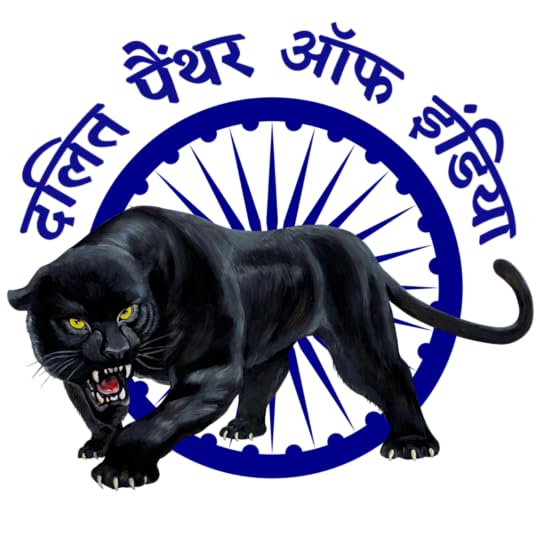
See this? It's the logo of the Dalit Panthers. They were a group of 'low-caste' and 'anti-caste' citizens in India who got tired of oppression.
So they made the Dalit Panthers group and had a voice.
Yes - you can focus on the events of this movement and find some bad turns, and you can certainly find some problems with the people.
But the movement came out of a need for justice - and this tale is a great way to show it all, with ups and downs and everything around.
In any case I highly recommend it!
And David F. Walker and Marcus Kwame Anderson show that the Black Panthers were no exception.
The party was made under extreme societal difficulties, and relied on a few individuals to get things going.
Huey Newton and Bobby Seale were flawed people, and more importantly - they changed. Huey became a pacificist in later years, and Bobby, along with Eldridge Cleaver and everyone else changed over the years.
But the best way to see the most positive impact of the Black Panthers is not to look at the individuals, but to look at the other movements that followed
See this? It's the logo of the Dalit Panthers. They were a group of 'low-caste' and 'anti-caste' citizens in India who got tired of oppression.
So they made the Dalit Panthers group and had a voice.
Yes - you can focus on the events of this movement and find some bad turns, and you can certainly find some problems with the people.
But the movement came out of a need for justice - and this tale is a great way to show it all, with ups and downs and everything around.
In any case I highly recommend it!

February 18, 2022
I knew next to nothing about the Black Panther Party going into this work of graphic non-fiction. Most of what I had heard was focused on violence. Reading this was an excellent introduction into a much more complicated history than I was aware of. Certainly the 10 Point Program: What We Want/What We Believe was not something I had ever encountered - it was good context to the starting point for the group and the ideals that led to their founding. While this was a complex group with a lot of competing ideals and there was a lot of violence - it is also worth considering what this might have looked like if there hadn’t been a concerted effort by the FBI to sow dissent, to imprison leaders for crimes that they didn’t commit, and to discredit influential leaders within the group. Also ironic is the fact that California Republicans were leading the charge to limit gun rights once the Black Panthers started to open carry. I took a lot away from this reading experience (and appreciated the graphic format), including a sense of sadness that so many of the issues that led to the organization of the group in the 1960’s still exist today.

May 21, 2022
2.5
I am not a big reader of non-fiction, and recently I have been reading a lot of heavy stuff when it comes to graphic novels; merely because that's what the library has been buying lately, and I tend to put my eyes on the new books...
Anyway, and regardless of my level of enjoyment, this is a very educational in depth approach to the story of the mythical Black Panther Party, full of interesting facts and knowledge. And as the author himself says, you can be left with a lot of doubts and an unclear opinion on where you stand when it comes to this instance after finishing this, but it's still a very necessary conversation to have, so it's ok.
I am not a big reader of non-fiction, and recently I have been reading a lot of heavy stuff when it comes to graphic novels; merely because that's what the library has been buying lately, and I tend to put my eyes on the new books...
Anyway, and regardless of my level of enjoyment, this is a very educational in depth approach to the story of the mythical Black Panther Party, full of interesting facts and knowledge. And as the author himself says, you can be left with a lot of doubts and an unclear opinion on where you stand when it comes to this instance after finishing this, but it's still a very necessary conversation to have, so it's ok.

February 9, 2021
When a book of any kind challenges the things you thought you knew, and teaches you things that as an adult you can't believe you didn't know already, it has achieved its ultimate goal. This book does that in such a remarkably straightforward way that I felt like I'd been slapped more than once. In a good way, I guess? (Is there a good way to feel like you've been slapped?)
My comic book club of awesome women read this together, slotted in our February 2021 spot sometime in mid-2020 to observe Black History Month. It led to an almost 3 hour long video call in which seven of us talked endlessly about what we'd never known and what we'll look at in new ways having had the history of the Black Panther Party spelled out so plainly for us. I grew up thinking of Angela Davis as a scary lady, and never having any idea that the organization actually started out of a need for social programs like feeding hungry kids. They built a school. These are not things my mainstream history classes taught me. I'm so glad there are books like this -- beautifully illustrated on every single page -- to fill in those gaps for me.
As far as I'm concerned, this book deserves to sit alongside legendary historical graphic novels like MAUS and the great Rep. John Lewis's MARCH series. It also called to mind a book we read as a group several years ago: THE HARLEM HELLFIGHTERS by Max Brooks. I love a good fictional comic as much as the next person, but every so often you'll come across a splash of nonfiction artwork that enriches your worldview, and this is one of those. If only they would start assigning it in schools.
Recommended reading:


My comic book club of awesome women read this together, slotted in our February 2021 spot sometime in mid-2020 to observe Black History Month. It led to an almost 3 hour long video call in which seven of us talked endlessly about what we'd never known and what we'll look at in new ways having had the history of the Black Panther Party spelled out so plainly for us. I grew up thinking of Angela Davis as a scary lady, and never having any idea that the organization actually started out of a need for social programs like feeding hungry kids. They built a school. These are not things my mainstream history classes taught me. I'm so glad there are books like this -- beautifully illustrated on every single page -- to fill in those gaps for me.
As far as I'm concerned, this book deserves to sit alongside legendary historical graphic novels like MAUS and the great Rep. John Lewis's MARCH series. It also called to mind a book we read as a group several years ago: THE HARLEM HELLFIGHTERS by Max Brooks. I love a good fictional comic as much as the next person, but every so often you'll come across a splash of nonfiction artwork that enriches your worldview, and this is one of those. If only they would start assigning it in schools.
Recommended reading:

February 14, 2021
I did not know much about the Black Panther Party other than its militancy. Only recently did I hear about their meal programs for kids. So, I welcomed the opportunity to learn more about this organization. What infuriates me most is how public resources were used to discredit BPP rather than support the social services (food, clothes, shelter, education) provided by the group, and the stark contrast in the way law enforcement agencies treated BPP and current white supremacist organizations. The book's tone is not neutral, but given the limitations of a graphic novel, I think Walker sufficiently supports and, more importantly, qualifies his claims. Such nuance helps Walker effectively convey the BPP's complicated but important history.

April 8, 2022
Ótima HQ! Uma história bem honesta e bem documentada dos Panteras. Poderia mencionar mais alguns programas que o partido tocava, mas ela não se propõe a esgotar o assunto, muito pelo contrário, é pra ser uma introdução às ideias, acertos, falhas e sabotagens que eles sofreram.

March 6, 2021
David F. Walker does it again!

February 23, 2022
We live in such an unbalanced world, and it is so important for books like these to find their way into everyone’s hands.
Would love for this to be a documentary in the style of The Chicago 8.
Would love for this to be a documentary in the style of The Chicago 8.
July 28, 2023
Wow. Truly incredible. I'm just going to sit in my feelings for a bit.

January 17, 2021
Powerful, thoughtful, and so timely. Complex, complicated , and insightful look into this much maligned organization. Well researched and developed bios, structures, and challenges faced by the Black Panthers as an organization and as a response to on-going racism in the US. A valuable read for anyone and a well timed educational piece. This book provides a thoughtful start to an expanded exploration of social justice.

January 17, 2021
An absolutely incredible work of comics history. It’s not afraid to be complicated, and it pulls no punches. It tells the entire history of the party in detail, but it moves quickly enough to read it in one (very intense) sitting. Anyone who’s interested in the BPP should start here, and then dive into the very robust bibliography at the end.
Displaying 1 - 30 of 492 reviews