On March 11, 1985, a van was pulled over in Warsaw for a routine traffic check that turned out to be anything but routine. Inside was Marek Kaminski, a Warsaw University student who also ran an underground press for Solidarity. The police discovered illegal books in the vehicle, and in a matter of hours five secret police escorted Kaminski to jail. A sociology and mathematics major one day, Kaminski was the next a political prisoner trying to adjust to a bizarre and dangerous new world. This remarkable book represents his attempts to understand that world.
As a coping strategy until he won his freedom half a year later by faking serious illness, Kaminski took clandestine notes on prison subculture. Much later, he discovered the key to unlocking that culture--game theory. Prison first appeared an irrational world of unpredictable violence and arbitrary codes of conduct. But as Kaminski shows in riveting detail, prisoners, to survive and prosper, have to master strategic decision-making. A clever move can shorten a sentence; a bad decision can lead to rape, beating, or social isolation. Much of the confusion in interpreting prison behavior, he argues, arises from a failure to understand that inmates are driven not by pathological emotion but by predictable and rational calculations.
Kaminski presents unsparing accounts of initiation rituals, secret codes, caste structures, prison sex, self-injuries, and of the humor that makes this brutal world more bearable. This is a work of unusual power, originality, and eloquence, with implications for understanding human behavior far beyond the walls of one Polish prison.
What we have here is a book that one would almost imagine could not be written. The author is a bizarre kind of miracle. He got a true insider's view of what goes on within a particular prison culture, he took the risk of honestly publicizing it, he did not aim to sensationalize it, and he rigorously pursued his theory that sociological tools and game theory can help us perceive prison behavior as fully logical, rational, and comprehensible if we can access the values and thought processes of the participants. He also presents to us a real inside view of the intricacies of a full-formed but evolving culture. How he could write about this material, in this way, is something to wonder at.
This book is fascinating, and perhaps nearly a one-of-a-kind reading experience. It gives quite a lot of insight into human nature, prison culture, the complexity of social rules, taboos, how caste systems arise, how context and circumstance lead to often brutal outcomes which appear senseless to an outsider, but can be well understood by an observing participant (which the author holds to be quite different from a "participant observer"... here he is a true participant, a prisoner motivated by his own values and desires to "maximize outcomes," i.e. survive, avoid abuse, and get the hell out of prison... along the way he observes).
The book is painful to read, and quite depressing, but not in the same way you might expect. Prison, as described here, is very very different from how any non-prisoner has likely imagined it to be, even though many of the elements we associate with prison life are present. I think the revelations in the book are bound to surprise both sociologists and the general public. But what was depressing to me was to see how human culture forms, how individuals are not really likely to be able to change an established culture once its had a few generations to evolve, and how various sorts of brutality and exploitation are just built into the way we interact in societies.
The prison culture has its appeal, it offers a certain kind of privilege and security to it's upper-caste members (which can even be the majority), but an impression from the book which I expect will be lasting is that, when "outside" foreign oppressive elements (e.g. the authorities represented by guards, prison official, etcetera) are limited in their interest or capacity to enforce discipline and conformity (in other words, at all times, because the oppressors never fully succeed in oppression)... well, when that's the case, then societies automatically spring up and form their own systems of oppression and forced conformity. Taboos, punishments, outlawry and pariah status are inevitably established. The oppressed invent ways to regularize their own oppression... they become their own oppressors. There's no solution, either. It seems to me, if somehow a prison could find every vulnerable and victimized inmate and isolate them for their own protection, it would make no difference, because society would restructure itself to create new victims.
Anyhow, those are my reflections on the book, and so I certainly recommend it. Now to my reflections on game theory. These criticisms don't actually undermine the value of this book, but I've just got to get this out of my system:
Ever since I studied a bit of game theory in university, I've thought it was quite intriguing at the same time that I've held the conviction that it's fundamentally bogus. This book helped remind me of, and reconfirm this conviction. Game theory is nuts, it's mostly worthless, and it's highly deceptive.
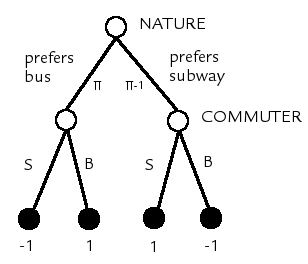
If you don't know what game theory is, or even if you do, here is a roughly sketched diagram that simultaneously shows what game theory is, and expresses my critique of it:
Note: S="take the subway" B="take the bus" Also, in case you're korean, those symbols in the middle aren't crying eyes. They are the Greek letter pi and pi minus one. Together they suggest that 100% of people either prefer the subway or the bus.
So, here we have mathematical proof that, if you prefer the subway you'll take the subway, but if you prefer the bus, you'll take the bus. This simplification assumes that both options are available, and that no other options can be elected (e.g. walking, driving, etc.)
The numbers 1 and -1 don't have any scale or objective measure. They could have been represented as -643 and -789. The point is only that we can observe that one is bigger than the other.
This doesn't address such issues as:
1) Do people actually have a consistent nature? Couldn't they just change from day to day? 2) What determines or influences individual preferences? 3) Are people even aware of their own preferences? 4) How often do actors have enough information about potential outcomes to be able to make reasonable decisions?
Of course, game theory has answers to all of these challenges. 1) If nature isn't consistent, then the chart just illustrates their behavior at the time of the decision, based on the momentary preferences, evaluations, and context. 2)We don't need to know what determines preferences, and game theory was designed to accommodate valuation differences. 3) We're simplifying here, but unconscious or barely contemplated preferences are still preferences and can be assumed to determine choice. 4) Some game theory deals with situations where information is limited, or false assumptions are made by the actors, but the actors always act based on whatever they believe to be the probable case. Absolute value can be calculated based on their perception of the likelihood of various outcomes multiplied by the value of achieving those outcomes, etc...
Now, I believe Game theory to be one more case of a predatory theory. It resists criticism by absorbing, assimilating, and adapting to all challenges to its legitimacy. You can't prove it wrong because you can't prove it right (Raul Ruiz made a similar criticism of central conflict theory in cinema, which is currently floating around in my head, so I've applied it here).
But the big, huge, enormous, gigantic, and rather-on-the-large-size assumption of game theory is that people are logical, rational decision makers. Even what appears to an outsider to be irrational or indefensible behavior is actually logical, predictable, and rational if you are aware of all relevant factors, including the actor's preferences and degree of knowledge.
Game theory "demonstrates" this to be true by assuming it to be true, and then (depending on your perspective):
A) Game theory demonstrates the reason/rationality behind human choices and illustrates this through charts.
or
B) Game theory rationalizes human choices through over-simplification and untestable assumptions, and creates charts using the semblance of math and science to add legitimacy to its claims, while dodging the tough and truly meaningful questions.
Ciekawym elementem książki jest zastosowanie teorii gier do opisu dylematów więziennego życia. Opisane relacje międzyludzkie więziennej rzeczywistości pozwalają zobaczyć w przerysowanej formie relacje często rządzące w częściowo zamkniętych grupach ludzkich.