

What do you think?

Hercule Poirot #0.18
The Double Clue: a Hercule Poirot Short Story
In Agatha Christie's short story, "The Double Clue," Poirot investigates the robbery of a collection of medieval jewelry from the safe of a dealer - including a necklace said to have belonged to Catherine de' Medici! Since the theft occurred during a dinner party, the suspects could be any of the guests. But which one? This short story originally appeared in the December 5, 1923, issue of "The Sketch" magazine.
PS. We get to meet Countess Vera Rossakoff once again! One of the author's great minor characters. And a favourite of Poirot.
Librarian's note: this entry is for the story, "The Double Clue." Collections of short stories by the author can be found elsewhere on Goodreads. Individual entries, including the characters and settings, for all 51 Poirot short stories, plus a 52nd, "Hercule Poirot and the Greenshore Folly" which was discovered in 2014, can be found by searching Goodreads for: "a Hercule Poirot Short Story."
PS. We get to meet Countess Vera Rossakoff once again! One of the author's great minor characters. And a favourite of Poirot.
Librarian's note: this entry is for the story, "The Double Clue." Collections of short stories by the author can be found elsewhere on Goodreads. Individual entries, including the characters and settings, for all 51 Poirot short stories, plus a 52nd, "Hercule Poirot and the Greenshore Folly" which was discovered in 2014, can be found by searching Goodreads for: "a Hercule Poirot Short Story."
1 pages, Audiobook
First published December 5, 1923
About the author
Agatha Christie
6,465 books79.4k followersAgatha Christie also wrote romance novels under the pseudonym Mary Westmacott, and was occasionally published under the name Agatha Christie Mallowan.
Dame Agatha Mary Clarissa Christie, Lady Mallowan, DBE (née Miller) was an English writer known for her 66 detective novels and 14 short story collections, particularly those revolving around fictional detectives Hercule Poirot and Miss Marple. She also wrote the world's longest-running play, the murder mystery The Mousetrap, which has been performed in the West End of London since 1952. A writer during the "Golden Age of Detective Fiction", Christie has been called the "Queen of Crime". She also wrote six novels under the pseudonym Mary Westmacott. In 1971, she was made a Dame (DBE) by Queen Elizabeth II for her contributions to literature. Guinness World Records lists Christie as the best-selling fiction writer of all time, her novels having sold more than two billion copies.
This best-selling author of all time wrote 66 crime novels and story collections, fourteen plays, and six novels under a pseudonym in romance. Her books sold more than a billion copies in the English language and a billion in translation. According to Index Translationum, people translated her works into 103 languages at least, the most for an individual author. Of the most enduring figures in crime literature, she created Hercule Poirot and Miss Jane Marple. She atuhored The Mousetrap, the longest-running play in the history of modern theater.
Associated Names:
Agata Christie
Agata Kristi
Агата Кристи (Russian)
Агата Крісті (Ukrainian)
Αγκάθα Κρίστι (Greek)
アガサ クリスティ (Japanese)
阿嘉莎·克莉絲蒂 (Chinese)
Dame Agatha Mary Clarissa Christie, Lady Mallowan, DBE (née Miller) was an English writer known for her 66 detective novels and 14 short story collections, particularly those revolving around fictional detectives Hercule Poirot and Miss Marple. She also wrote the world's longest-running play, the murder mystery The Mousetrap, which has been performed in the West End of London since 1952. A writer during the "Golden Age of Detective Fiction", Christie has been called the "Queen of Crime". She also wrote six novels under the pseudonym Mary Westmacott. In 1971, she was made a Dame (DBE) by Queen Elizabeth II for her contributions to literature. Guinness World Records lists Christie as the best-selling fiction writer of all time, her novels having sold more than two billion copies.
This best-selling author of all time wrote 66 crime novels and story collections, fourteen plays, and six novels under a pseudonym in romance. Her books sold more than a billion copies in the English language and a billion in translation. According to Index Translationum, people translated her works into 103 languages at least, the most for an individual author. Of the most enduring figures in crime literature, she created Hercule Poirot and Miss Jane Marple. She atuhored The Mousetrap, the longest-running play in the history of modern theater.
Associated Names:
Agata Christie
Agata Kristi
Агата Кристи (Russian)
Агата Крісті (Ukrainian)
Αγκάθα Κρίστι (Greek)
アガサ クリスティ (Japanese)
阿嘉莎·克莉絲蒂 (Chinese)
Ratings & Reviews
Friends & Following
Create a free account to discover what your friends think of this book!
Community Reviews
Displaying 1 - 30 of 75 reviews

August 26, 2024
Enjoyable short story about Poirot solving a case involving stolen jewelry.

April 19, 2020
Double Clue!? <--That's 2 clues too many, bitches.
And everyone's favorite Belgian detective is onto that shit.
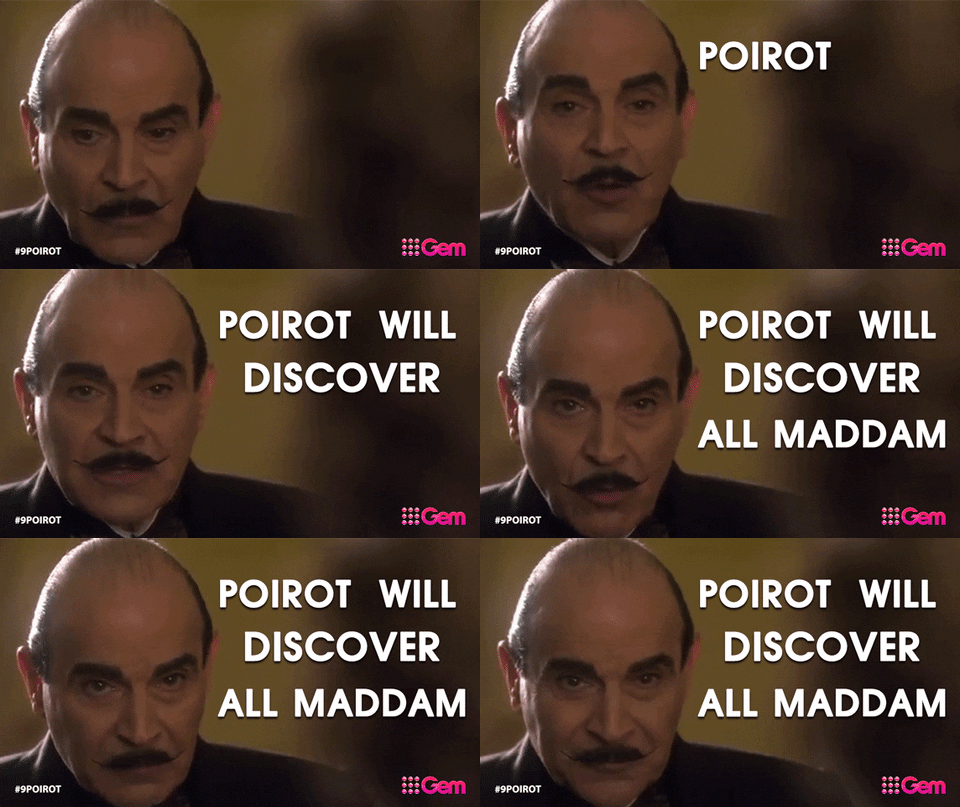
Someone from a house party made off with a goodie bag full of jewels stolen from their host. And it's up to Poirot to ferret out which guest has sticky fingers.
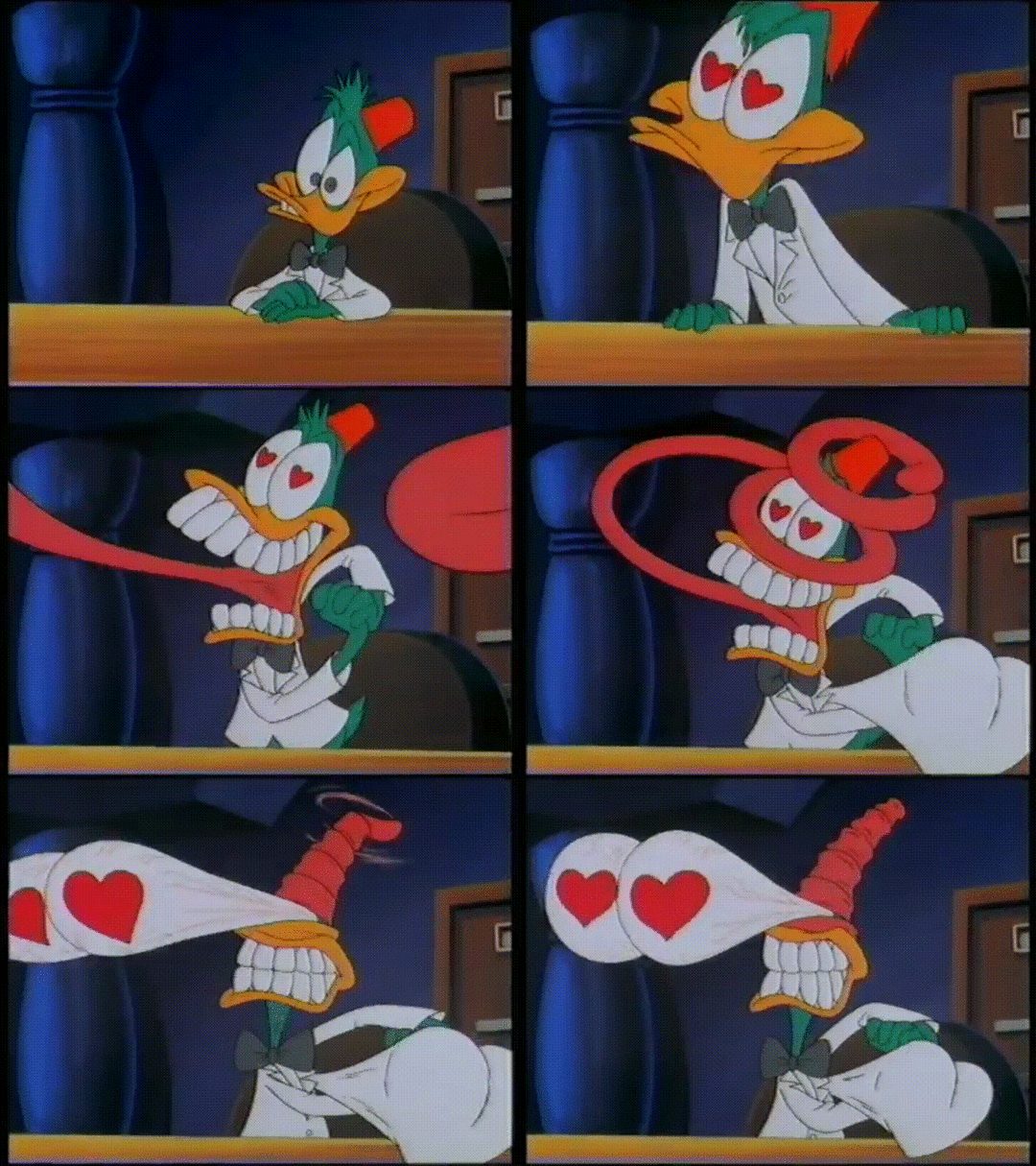
Countess Vera Rossakoff stars in this one, and I'm pretty sure Poirot's eyes turn into actual hearts and bulge out of his head.
It's cute.
If you're looking to kill 20 minutes with a cozy mystery, then this one will fit the bill.
Recommended for Christie fans.
Also read as part of the short story collection A Deadly Affair.
And everyone's favorite Belgian detective is onto that shit.
Someone from a house party made off with a goodie bag full of jewels stolen from their host. And it's up to Poirot to ferret out which guest has sticky fingers.
Countess Vera Rossakoff stars in this one, and I'm pretty sure Poirot's eyes turn into actual hearts and bulge out of his head.
It's cute.
If you're looking to kill 20 minutes with a cozy mystery, then this one will fit the bill.
Recommended for Christie fans.
Also read as part of the short story collection A Deadly Affair.

October 20, 2021
The poorest one from this series, so far.
It is too short to contain something valuable, the plot is thin, the clue with the Russian alphabet is quite obsolete. Not to mention the lack of proofs...
PS: I love Agatha and perhaps sometimes I'm too harsh on her, this could be a reason for those poor ratings.
It is too short to contain something valuable, the plot is thin, the clue with the Russian alphabet is quite obsolete. Not to mention the lack of proofs...
PS: I love Agatha and perhaps sometimes I'm too harsh on her, this could be a reason for those poor ratings.
January 3, 2021
4 Stars. A little simplistic with one pleasant surprise. It relates to my only enjoyable memory of Christie's 1927 novel, The Big Four. We'll get to that. The story was in Sketch in 1923 and Hercule Poirot The Complete Short Stories of 1999. Mr. Marcus Hardman visits Poirot about a delicate matter. "But above everything - no publicity!" He collects fine jewellry. Recently, at a small party he hosted, some rubies and emeralds disappeared from his private safe. Like good collectors to this day, he alludes to a possible provenance, an "emerald necklace said to have belonged to Catherine de' Medici." Who was there? Mr. Johnston, the South African millionaire, Lady Runcorn, a society force in various charities, Bernard Parker, a young fellow "not perhaps, quite in the swim, [who has] performed little commissions for me," and Countess Vera Rossakoff who we met in The Big Four, a member of the old regime in Russia and one of Agatha Christie's great minor characters. My pleasant surprise. The story is an early reference to gay people in main stream literature - not the best, but for a century ago, it could have been much worse. I liked it. (Ja2021/Jul2026)

January 21, 2023
OMG, Hercule what have you done (all in the name of love?)
An excellent story, Ms Christie takes Poirot where I think he has never gone before. A stunner of an ending.
An excellent story, Ms Christie takes Poirot where I think he has never gone before. A stunner of an ending.

Read
March 18, 2024Short and the tv show was definitely better! Jewels have been stolen during a party and Poirot is looking for them. Hastings was really useless in this one...


June 13, 2020
I'm pretty sure I read this in a collection of Christie shorts years back, but I didn't remember who was guilty, so it was fine.
Recommended if you're looking for a short, harmless (i.e. no one dies, or even goes to jail) mystery.
Recommended if you're looking for a short, harmless (i.e. no one dies, or even goes to jail) mystery.

September 2, 2022
বেলজিয়ান ভদ্রলোকের বুদ্ধিমত্তা সবসময়ই চমকিত করে।


February 7, 2023
"Double Clue: A Short Story" by Agatha Christie follows detective Hercule Poirot as he investigates the disappearance of valuable jewels.
The story completes, even before, you want it. Although, one can easily guess the thief, it is Hercule Poirot, who shows us how in his convincing manner.
Overall, a good story. Agatha Christie mystery that is sure a good-read and you get that satisfaction of reading a good mystery.
The story completes, even before, you want it. Although, one can easily guess the thief, it is Hercule Poirot, who shows us how in his convincing manner.
Overall, a good story. Agatha Christie mystery that is sure a good-read and you get that satisfaction of reading a good mystery.

July 8, 2021
A pretty interesting short story at the start, but one that didn't really keep my attention.

April 7, 2026
Sorry but engaging and the ending was clever without being impossible. Fraser does a good job narrating as always. [AUDIBLE]
短いだけどストーリーは色んな曲がり道あるし最後の解決予想できなかった。フレーザーのナレーションはいつも通りよかった
短いだけどストーリーは色んな曲がり道あるし最後の解決予想できなかった。フレーザーのナレーションはいつも通りよかった
May 31, 2026
حركة ذكية من بوارو ،، شابوه 🫡

October 11, 2024
Review of the short story, The Double Clue.
Marcus Hardman, an antique collector has a weakness for medieval jewels and showing off his prized collections.
At one of his parties, after showing off as usual, the safe appears not to have been closed correctly. One of four of his guests could have had the opportunity to lift the gems, so he asks Poirot to help him recover his property to save a scandal should this police become involved.
Another early story of Poirot’s cases, with the benefit of Hastings, bright but no halogen bulb. Here he echoes our struggle to see the culprit from among Hardman’s friends. Sometimes I think his confusion leads to our own. If we follow Poirot’s discoveries and actions. What he says and where he goes we’d have a better idea how to interpret the evidence presented.
Here we have two clues for the price of one in and around the safe. The Double Clue seems a little excessive but does it point to misdirection, a Red Herring or simply a careless thief?
Perhaps all three such is the web that Christie weaves.
The story is important also in introducing the character of Only four people had the opportunity to steal Marcus Hardman’s medieval jewels and when Poirot examines the scene of the crime he finds two clues which will lead to the culprit. This story is one of Poirot’s few encounters with Countess Vera Rossakoff, a woman he reciprocated a mutual respect and to be a potential love interest.
Similar to an Irene Adler as to Sherlock Holmes.
Christie trivia: What other stories does she appear in?
Marcus Hardman, an antique collector has a weakness for medieval jewels and showing off his prized collections.
At one of his parties, after showing off as usual, the safe appears not to have been closed correctly. One of four of his guests could have had the opportunity to lift the gems, so he asks Poirot to help him recover his property to save a scandal should this police become involved.
Another early story of Poirot’s cases, with the benefit of Hastings, bright but no halogen bulb. Here he echoes our struggle to see the culprit from among Hardman’s friends. Sometimes I think his confusion leads to our own. If we follow Poirot’s discoveries and actions. What he says and where he goes we’d have a better idea how to interpret the evidence presented.
Here we have two clues for the price of one in and around the safe. The Double Clue seems a little excessive but does it point to misdirection, a Red Herring or simply a careless thief?
Perhaps all three such is the web that Christie weaves.
The story is important also in introducing the character of Only four people had the opportunity to steal Marcus Hardman’s medieval jewels and when Poirot examines the scene of the crime he finds two clues which will lead to the culprit. This story is one of Poirot’s few encounters with Countess Vera Rossakoff, a woman he reciprocated a mutual respect and to be a potential love interest.
Similar to an Irene Adler as to Sherlock Holmes.
Christie trivia: What other stories does she appear in?

January 23, 2026
I did not see how Poirot figures this one out or what that countess’ motive was for absolving the young man accused of the theft. It was an interesting story and I suspect that we will hear from the countess again, given Poirot’s comment at the end, so maybe things will make more sense when we see her again.

May 7, 2020
I’m of the opinion that any story with Countess Vera Rossakoff is a good story. 20 minutes of listening, but it feels satisfying because Poirot has to do some sleuthing. And Hastings doesn’t have time to act stupid, so that’s always a plus.

May 13, 2020
I love Agatha Christie but I usually do not enjoy her short stories and this one is not an exception. I mean this jewel thief was so careless, makes me think it's almost like a kids game of Clue 🙄
2 stars for the story, 1 star for Charles Armstrong's recital of the book 🙂
2 stars for the story, 1 star for Charles Armstrong's recital of the book 🙂

May 4, 2020
This was a fun quick listen when I used Hoopla.
May 27, 2020
Short and sweet a brilliant slice of Fiction.

January 3, 2023
Rather simplistic story with no mystery but lots of charm.
Enjoyed it.
Enjoyed it.

March 13, 2026
Need to brush up on your Russian alphabet before reading this one.

November 16, 2024
I wonder that so many of these stories point out the duplicity of the class system in England. Those born to a title are everything and not to be crossed, and the rest of us are disposable and suspects. I do like the use of languages in the solving of this mystery. Good job, Poirot.

February 3, 2023
Well, the who was easy to figure out, but how did Poirot know, that was his secret.
Enjoyable short story!
Enjoyable short story!
May 9, 2021
................................................................................................
................................................................................................
The Double Clue -
a Hercule Poirot Short Story (Hercule Poirot),
by Agatha Christie.
................................................................................................
................................................................................................
Cyrillic alphabet.
................................................................................................
................................................................................................
................................................................................................
................................................................................................
July 4, 2026
A very short and simple story. I actually like the premise, stolen jewels and two (or double) clues pointing to one of the guests of the man whose jewels were stolen.
SPOILERS?
Despite the letter on a glove that was found in the crime scene pointed to said man, Poirot figured out that the letters they saw represented different letters in the Russian alphabet, and that a Russian woman was the jewel thief, who handed over the jewels with no fuss when Poirot asked for them. As I said, I liked the premise, but I would have liked it if it were a bit longer, and written a bit more elaborately.
SPOILERS?
Despite the letter on a glove that was found in the crime scene pointed to said man, Poirot figured out that the letters they saw represented different letters in the Russian alphabet, and that a Russian woman was the jewel thief, who handed over the jewels with no fuss when Poirot asked for them. As I said, I liked the premise, but I would have liked it if it were a bit longer, and written a bit more elaborately.


June 22, 2026
Interesting plot of missing jewels and not just one clue but two pointing at a young gentleman. One mistake could be an accident or a plant but two just seems wrong to poirot. What is the clue and what is the distraction. Russian language skills are a clue to the untangling the threads.

August 6, 2025
First a Marple in this collection, then a Poirot, and one that I haven't gotten to reading at that! And I'm pretty sure I've only watched the Suchet adaptation of this once, even if subsequent episodes stick Countess Vera Rasakoff in where she never was. I digress. Another short, singular puzzle, and its abruptness is a slight takeaway from it--I like spending time with Poirot and Hastings!--but it's still a fun puzzle with a surprise solution that those with a certain frame of knowledge might be able to figure out (it's a clue that Christie used again in one of her more famous novels, but it's a good one). Worth the read!
My rating: 4.25/5 (rounded down)
Would I own/re-read?: Sure!
TW: No triggers in the case of this Double Clue, honestly.
Does the animal die?: Nor are there any animals harmed!
How difficult was the mystery?: As explained above, it's short and the pool is small, so it's not an insurmountable achievement even if guessing, but there is a logical solution.
My rating: 4.25/5 (rounded down)
Would I own/re-read?: Sure!
TW: No triggers in the case of this Double Clue, honestly.
Does the animal die?: Nor are there any animals harmed!
How difficult was the mystery?: As explained above, it's short and the pool is small, so it's not an insurmountable achievement even if guessing, but there is a logical solution.
Displaying 1 - 30 of 75 reviews