

What do you think?

The Second Bell
In a world which believes her to be a monster, a young striga fights to harness the power of her second heart, while her mother sacrifices everything to stop her...
In an isolated mountain community, sometimes a child is born with two hearts. This child is called a striga and is considered a demon who must be abandoned on the edge of the forest. The child's mother must then decide to leave with her infant, or stay and try to forget.
Nineteen year-old striga, Salka, and her mother, Miriat, made the choice to leave and live a life of deprivation and squalor in an isolated village. The striga tribe share the human belief that to follow the impulses of their other hearts is dangerous, inviting unspoken horrors and bringing ruin onto them all.
Salka, a headstrong and independent young woman, finds herself in a life threatening situation that forces her to explore the depths of her true nature and test the bonds between mother and child...
In an isolated mountain community, sometimes a child is born with two hearts. This child is called a striga and is considered a demon who must be abandoned on the edge of the forest. The child's mother must then decide to leave with her infant, or stay and try to forget.
Nineteen year-old striga, Salka, and her mother, Miriat, made the choice to leave and live a life of deprivation and squalor in an isolated village. The striga tribe share the human belief that to follow the impulses of their other hearts is dangerous, inviting unspoken horrors and bringing ruin onto them all.
Salka, a headstrong and independent young woman, finds herself in a life threatening situation that forces her to explore the depths of her true nature and test the bonds between mother and child...
304 pages, Kindle Edition
First published March 9, 2021
About the author
Gabriela Houston
11 books55 followersGabriela was born and raised in Poland, brought up on a diet of mythologies and fairy tales. She spent her summers exploring the woods, foraging and animal tracking with her family. At 19, Gabriela moved to London to study English Literature and obtained a Masters degree in literatures of modernity. She has worked for as an assistant editor and as a freelance writer.
She is the author of Slavic -folklore-inspired novels for adults and children. She lives in London with her husband, children and two cats.
Sign up to her newsletter to get news, writing tips , book recommendations and more!
She is the author of Slavic -folklore-inspired novels for adults and children. She lives in London with her husband, children and two cats.
Sign up to her newsletter to get news, writing tips , book recommendations and more!
Ratings & Reviews
Friends & Following
Create a free account to discover what your friends think of this book!
Community Reviews
Displaying 1 - 30 of 144 reviews

February 9, 2021
The Second Bell by debut author Gabriela Houston is a beautiful atmospheric blend of Polish folklore, coming of age and dark fantasy.
The story centres around a mother and her newborn child who are abruptly banished from their village and cast out into the woods. Yet such cruelty is not without its reason, and this child is by no means an ordinary one, for you see she holds a second heart. It is believed that those born with the sound of double heartbeats are born a striga, a terrifying monstrous being that will wreak havoc, devour and kill humans. Fear drives the villagers to desperate measures and so every time a child is born with a double heart they summon a Dola, a woman who has visions foretelling the future, and she is to tie leather around the child’s wrist and abandon it in the forest to die. Yet every now and then a mother would refuse to give up her child, and so they both would be exiled to a striga village in the mountains, never to return. This is where our story begins, for Miriat won’t let her child Salka go, and will stop at nothing to protect her,
Nineteen years pass and Miriat and Salka have settled into life in the Striga village. Though it is not an easy one, and it is not without its hardships. Living a life of very little luxury is hard to bear, yet what becomes even harder is that all strigas who live in the village have to control their second heart‘s desires and not let their accompanying shadow possess them. If they let the striga heart take over then they become a stigoi, a savage demon. Yet as we all know beliefs do not always mean absolute truths.
“She took a deep breath in and the shadow behind her moved almost imperceptibly, with ripples like the surface of a lake. A sensation of warmth tracing the line of her spine jolted her. She held her breath and tried to force the shadow down into the listless pool on the floor, as she’d always done before.
A breath in, hold, a breath out, like she’d been taught. She gasped. For the first time, the shadow pushed back.”
Throughout the novel we see Houston weave Polish folklore into a tale of motherhood, prejudice and surviving against all odds. The striga is a well known Slavic mythological creature, one that has often been portrayed as deadly cursed beings. However, Houston takes this concept and shows us that nothing is always as it seems. Miriat and Salka are both presented as strong willed, hard-working and pragmatic women. Although their relationship is often strained, an unconditional bond is felt between them. Miriat, like any mother would, only wants her daughter to be safe and not succumb to the darkness within her. Salka, just like all the other striga’s in the village, battles her second heart and her shadow which both long for her to set them free to do as they will. Salka is curious to explore the striga within her, she desires to feel her shadow’s warmth, it’s protectiveness and its connection to the natural world. Does that make her a monster? Yes, there is a darkness within her, but she has such a gentle caring nature about her too. She longs for the chance to grow, to discover who she is, to set her own path away from her mother’s overbearing presence. In essence she is very much human.
It is, however, embedded in human nature to fear what we do not understand, prejudice is born of sheer ignorance and Houston distinctly portrays this throughout the narrative. Evil is not an innate concept, it is the choices we make in life, the morals we choose to adhere to which determines whether we have ill intent or whether we strive to do good. Houston explores this through her entire cast of characters. Yet it is Salka we empathise with the most, she lives on the borders of two worlds: one of human judgement and one of striga judgement, and neither of them will accept her true self.
’“There is no me without you, daughter, do you understand? I wouldn’t wish to stay in a place that doesn’t want you. I couldn’t.”’
Houston’s prose throughout The Second Bell is classic fairytale esque, it flows smoothly and immerses you into this dark foreboding world. The omnipresent narrative style allows the reader to see into different characters' lives and discover the secrets they each hold, which was particularly effective when it came to characters such a Dran and Alma who’s motives were more than a little devious. I had hoped to see more depth from the Dola’s character - a Dola is an aspect of Polish mythology which I’m unfamiliar with and therefore I found myself wanting to know more about her ability to see visions of the future and to also learn more about her past. The atmospheric descriptions of the village surroundings and the forest were truly beautiful, and this is where I feel Houston’s prose truly shines. Knowing that the author grew up in Poland exploring the woodlands, I can see a genuine love of nature reflected in her prose.
As we reach towards the second half of the novel we are constantly teased with small glimpses of the powers in which a striga possesses. I loved the way Houston keeps us turning the pages until we reach the last few chapters in which we discover the full force of what a strigoi can do.
The Second Bell at its heart is a book about sacrifices. What would a mother sacrifice to keep her child safe? Which lines are they willing to cross? Both Miriat and Salka sacrifice freedom for each other, but in the end those sacrifices only bring them closer together. The novel ends on a bittersweet note, much has been lost, but there is now a sense that the future could hold so much hope.
ARC provided by Caroline Lambe at AngryRobot. Thank you for the copy! All quotes used are taken from an e-ARC and are subject to change upon publication.
The story centres around a mother and her newborn child who are abruptly banished from their village and cast out into the woods. Yet such cruelty is not without its reason, and this child is by no means an ordinary one, for you see she holds a second heart. It is believed that those born with the sound of double heartbeats are born a striga, a terrifying monstrous being that will wreak havoc, devour and kill humans. Fear drives the villagers to desperate measures and so every time a child is born with a double heart they summon a Dola, a woman who has visions foretelling the future, and she is to tie leather around the child’s wrist and abandon it in the forest to die. Yet every now and then a mother would refuse to give up her child, and so they both would be exiled to a striga village in the mountains, never to return. This is where our story begins, for Miriat won’t let her child Salka go, and will stop at nothing to protect her,
Nineteen years pass and Miriat and Salka have settled into life in the Striga village. Though it is not an easy one, and it is not without its hardships. Living a life of very little luxury is hard to bear, yet what becomes even harder is that all strigas who live in the village have to control their second heart‘s desires and not let their accompanying shadow possess them. If they let the striga heart take over then they become a stigoi, a savage demon. Yet as we all know beliefs do not always mean absolute truths.
“She took a deep breath in and the shadow behind her moved almost imperceptibly, with ripples like the surface of a lake. A sensation of warmth tracing the line of her spine jolted her. She held her breath and tried to force the shadow down into the listless pool on the floor, as she’d always done before.
A breath in, hold, a breath out, like she’d been taught. She gasped. For the first time, the shadow pushed back.”
Throughout the novel we see Houston weave Polish folklore into a tale of motherhood, prejudice and surviving against all odds. The striga is a well known Slavic mythological creature, one that has often been portrayed as deadly cursed beings. However, Houston takes this concept and shows us that nothing is always as it seems. Miriat and Salka are both presented as strong willed, hard-working and pragmatic women. Although their relationship is often strained, an unconditional bond is felt between them. Miriat, like any mother would, only wants her daughter to be safe and not succumb to the darkness within her. Salka, just like all the other striga’s in the village, battles her second heart and her shadow which both long for her to set them free to do as they will. Salka is curious to explore the striga within her, she desires to feel her shadow’s warmth, it’s protectiveness and its connection to the natural world. Does that make her a monster? Yes, there is a darkness within her, but she has such a gentle caring nature about her too. She longs for the chance to grow, to discover who she is, to set her own path away from her mother’s overbearing presence. In essence she is very much human.
It is, however, embedded in human nature to fear what we do not understand, prejudice is born of sheer ignorance and Houston distinctly portrays this throughout the narrative. Evil is not an innate concept, it is the choices we make in life, the morals we choose to adhere to which determines whether we have ill intent or whether we strive to do good. Houston explores this through her entire cast of characters. Yet it is Salka we empathise with the most, she lives on the borders of two worlds: one of human judgement and one of striga judgement, and neither of them will accept her true self.
’“There is no me without you, daughter, do you understand? I wouldn’t wish to stay in a place that doesn’t want you. I couldn’t.”’
Houston’s prose throughout The Second Bell is classic fairytale esque, it flows smoothly and immerses you into this dark foreboding world. The omnipresent narrative style allows the reader to see into different characters' lives and discover the secrets they each hold, which was particularly effective when it came to characters such a Dran and Alma who’s motives were more than a little devious. I had hoped to see more depth from the Dola’s character - a Dola is an aspect of Polish mythology which I’m unfamiliar with and therefore I found myself wanting to know more about her ability to see visions of the future and to also learn more about her past. The atmospheric descriptions of the village surroundings and the forest were truly beautiful, and this is where I feel Houston’s prose truly shines. Knowing that the author grew up in Poland exploring the woodlands, I can see a genuine love of nature reflected in her prose.
As we reach towards the second half of the novel we are constantly teased with small glimpses of the powers in which a striga possesses. I loved the way Houston keeps us turning the pages until we reach the last few chapters in which we discover the full force of what a strigoi can do.
The Second Bell at its heart is a book about sacrifices. What would a mother sacrifice to keep her child safe? Which lines are they willing to cross? Both Miriat and Salka sacrifice freedom for each other, but in the end those sacrifices only bring them closer together. The novel ends on a bittersweet note, much has been lost, but there is now a sense that the future could hold so much hope.
ARC provided by Caroline Lambe at AngryRobot. Thank you for the copy! All quotes used are taken from an e-ARC and are subject to change upon publication.

January 15, 2021
⭐ 2.75 / 5 ⭐
A unique fantasy tale inspired by Slavic folklore about a young girl cursed with two hearts, and the mother who will stop at nothing to protect her.
The entire concept of this was so new to me, and I was really excited to dive into this one. I had never really read a story inspired by Slavic folklore before, and while I was disappointed by this one, it provided me with a nice entryway into reading more books like it.
^ Amazing concept, right? And it was! But it lacked that magic spark in the execution. The writing was well done, but something that I really vied for was the characters. And unfortunately, they had no depth in this book. They fell flat. Like a pancake. I hate to say it, but I was really bored. Sherlock-level bored.
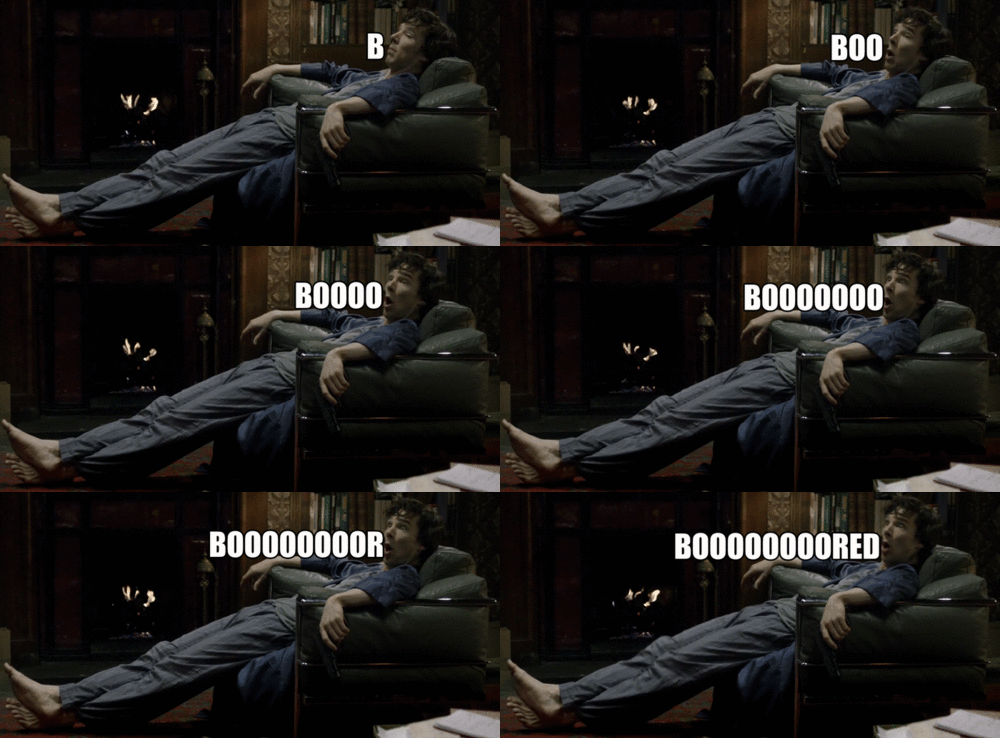
Also, a moment of silence for the complexity of a certain villainous character that I personally felt was done wrong.
All in all, I just found the characters, as well as the world, to be not as compelling. The one thing that did shine in this book, however, was the relationship between Salka and Miriat. That was really the only thing that kept me glued to the story. If not for them (if not specifically for Miriat) I would have given up.
Big thank you to Angry Robot for giving me an ARC copy of this book!
A unique fantasy tale inspired by Slavic folklore about a young girl cursed with two hearts, and the mother who will stop at nothing to protect her.
The entire concept of this was so new to me, and I was really excited to dive into this one. I had never really read a story inspired by Slavic folklore before, and while I was disappointed by this one, it provided me with a nice entryway into reading more books like it.
“In an isolated mountain community, sometimes a child is born with two hearts. This child is called a striga and is considered a demon who must be abandoned on the edge of the forest. The child's mother must then decide to leave with her infant, or stay and try to forget.
Nineteen year-old striga, Salka, and her mother, Miriat, made the choice to leave and live a life of deprivation and squalor in an isolated village. The striga tribe share the human belief that to follow the impulses of their other hearts is dangerous, inviting unspoken horrors and bringing ruin onto them all.
Salka, a headstrong and independent young woman, finds herself in a life-threatening situation that forces her to explore the depths of her true nature and test the bonds between mother and child…”
^ Amazing concept, right? And it was! But it lacked that magic spark in the execution. The writing was well done, but something that I really vied for was the characters. And unfortunately, they had no depth in this book. They fell flat. Like a pancake. I hate to say it, but I was really bored. Sherlock-level bored.
Also, a moment of silence for the complexity of a certain villainous character that I personally felt was done wrong.
All in all, I just found the characters, as well as the world, to be not as compelling. The one thing that did shine in this book, however, was the relationship between Salka and Miriat. That was really the only thing that kept me glued to the story. If not for them (if not specifically for Miriat) I would have given up.
Big thank you to Angry Robot for giving me an ARC copy of this book!

January 16, 2021
The Second Bell follows Salka, a young woman born with two hearts. That makes her a striga, a monster her townsfolk fear and try to kill in the cradle. Except, her mother, Miriat, won’t let it happen. They flee the town and find shelter in a community of outcasts high in the mountains.
Nineteen years later, Salka finds herself in a life-threatening situation. Accused of endangering others, she’s banished to a remote place. To survive the harsh winter, she must embrace her second heart’s power. And this can turn her into a monstrous stigoi.
I loved the story’s setting! Houston has a knack for creating vivid images of desolate landscapes, dangerous forests, and showing the raw beauty of nature. I could breathe the cool mountain air and feel the icy wind sting my cheeks. I found the descriptions excellent, and the imagery evocative. Houston reveals the world as the characters interact with it, and presents it through the lens of their mood and current situation. Plus, you can’t get enough of fantasy inspired by pre-Christian Slavic folklore.
The story goes small in scale; it revolves around a group of characters, their relationships, beliefs, and moments of truth. Petty behavior and small people acting small out of jealousy, greed, or fear move the plot forward. I found it frustrating. I understand the author wanted to show how much we can sacrifice for blood ties and that passionate (be it romantic or maternal) love blinds, but I found story drivers unconvincing and cliché.
Salka and Miriat’s story is nuanced and satisfying. Miriat stood up to her community (more than once) for her child, despite her society’s conviction all two-hearted children carry evil inside. She sacrificed her life for her daughter. Salka, while independent and headstrong, loves her mother and listens to her in crucial moments. Their relationship felt true, mainly because we follow the story mostly through their point-of-view. Unfortunately, other parents/child duos fall flat. We don’t get to know them, but their petty and egoistical behavior moves the story forward. Were they more nuanced and fleshed-out, the events would have played out differently.
And this leads to my biggest gripe about the story, namely inconsistent narration. The point of view switches between omniscient, third-person objective, and third-person limited deep POV, frequently in a single chapter. Sometimes, more than once in a single chapter. To make matters worse, the POV slips from one person to another in the space of a few paragraphs. I assume it’s a deliberate choice - the book is traditionally published and, as such, underwent at least a few editorial passes. I found it jarring. Sure, it gave us glimpses of the train of thought of secondary characters (Dran, Kalina, Emila, villagers) but such glimpses showed them as individuals lacking complexity and with shallow motivations. For me, it weakened the narrative instead of making it more nuanced.
Listen, I know that rules are for fools, but I can’t help it. I crave a consistent point of view. I dislike when writers drift from one point of view to another. If you, as a reader, have no issue with it, disregard the paragraph above. I won’t judge you.
Despite everything, I enjoyed the story. It takes shortcuts, but remains intriguing and heartfelt. With its immersive setting and relatable protagonists, The Second Bell offers enough to maintain readers’ immersion.
ARC through NetGalley
Nineteen years later, Salka finds herself in a life-threatening situation. Accused of endangering others, she’s banished to a remote place. To survive the harsh winter, she must embrace her second heart’s power. And this can turn her into a monstrous stigoi.
I loved the story’s setting! Houston has a knack for creating vivid images of desolate landscapes, dangerous forests, and showing the raw beauty of nature. I could breathe the cool mountain air and feel the icy wind sting my cheeks. I found the descriptions excellent, and the imagery evocative. Houston reveals the world as the characters interact with it, and presents it through the lens of their mood and current situation. Plus, you can’t get enough of fantasy inspired by pre-Christian Slavic folklore.
The story goes small in scale; it revolves around a group of characters, their relationships, beliefs, and moments of truth. Petty behavior and small people acting small out of jealousy, greed, or fear move the plot forward. I found it frustrating. I understand the author wanted to show how much we can sacrifice for blood ties and that passionate (be it romantic or maternal) love blinds, but I found story drivers unconvincing and cliché.
Salka and Miriat’s story is nuanced and satisfying. Miriat stood up to her community (more than once) for her child, despite her society’s conviction all two-hearted children carry evil inside. She sacrificed her life for her daughter. Salka, while independent and headstrong, loves her mother and listens to her in crucial moments. Their relationship felt true, mainly because we follow the story mostly through their point-of-view. Unfortunately, other parents/child duos fall flat. We don’t get to know them, but their petty and egoistical behavior moves the story forward. Were they more nuanced and fleshed-out, the events would have played out differently.
And this leads to my biggest gripe about the story, namely inconsistent narration. The point of view switches between omniscient, third-person objective, and third-person limited deep POV, frequently in a single chapter. Sometimes, more than once in a single chapter. To make matters worse, the POV slips from one person to another in the space of a few paragraphs. I assume it’s a deliberate choice - the book is traditionally published and, as such, underwent at least a few editorial passes. I found it jarring. Sure, it gave us glimpses of the train of thought of secondary characters (Dran, Kalina, Emila, villagers) but such glimpses showed them as individuals lacking complexity and with shallow motivations. For me, it weakened the narrative instead of making it more nuanced.
Listen, I know that rules are for fools, but I can’t help it. I crave a consistent point of view. I dislike when writers drift from one point of view to another. If you, as a reader, have no issue with it, disregard the paragraph above. I won’t judge you.
Despite everything, I enjoyed the story. It takes shortcuts, but remains intriguing and heartfelt. With its immersive setting and relatable protagonists, The Second Bell offers enough to maintain readers’ immersion.
ARC through NetGalley

October 6, 2020
A beautifully written fairytale that feels both small and personal, but epic in heart. At times magical and at others all-too-realistic in its portrayal of the absolute shambles of humanity, I particularly loved the exploration of parenting in the midst of all that. The sacrifices we make for our kids and then how we suffocate them with those choices later on. This is a wonderful, dark, and hopeful read.

January 11, 2021
Read for review (forthcoming) in SFX magazine. Thoroughly enjoyed this.
January 27, 2021
This will be a weird metaphor, but bear with me. I'm gluten-free, and have been for a while now. My fellow gluten-free pals will probably get this better than most, but this book felt like finding the BEST and most beautifully packaged gluten-free brownie substitute you've ever seen, taking a big bite out of it, and having it taste, tragically, bland as dust.
The premise of this novel had so much going for it! Our protagonist Salka is a Striga, born with two hearts and exiled with her mother to a remote mountain community made up of fellow rejected Strigas, due to villagers' fear of the "mystical dark powers" granted by their second heart. Why do these villagers and the strigas themselves fear the second heart? What history or precedent exists that causes this violent hatred and xenophobia? Don't ask me, because even after finishing this novel I haven't the slightest idea.
While there are some good moments, particularly between Salka and her mother Miriat, much of the books feels aimless. It is as though Houston had many different ideas for where she wanted to take the story and tried to pursue all of them while not really providing closure for the ones she abandoned, leading to a very uneven pace and a rushed, disjointed ending that stretched the limits of my belief. Furthermore, nearly all of the characters were profoundly unlikeable, and those that were like-able were forced into narrow stereotypes. Dola is "fat and nice". Miriat is "a mother". Kalina is mean, Emilia is jealous, Alma is blinded by her love for her son. One of my BIGGEST pet peeves in novels is when every woman of the protagonists age who is NOT the protagonist is pit firmly against them and subsequently villainized. If this trope hadn't been everywhere my entire childhood my "not like other girls" phase probably wouldn't have lasted nearly as long. I also really did not like how we were forced to sympathize with Dran, who begins the novel with an appalling act, proceeds to manipulate Salka for his own ends, and is still meant to be vaguely romantic and tragic? No thanks.
There are still some elements of a decent story here. My favorite parts were actually those the dealt with the harsh life of living in the mountains: descriptions of Salka and Miriat's daily life, routines, and survival strategies show that the author has clearly done her research. My favorite section of the novel was when Salka was wintering in the mountain pass and exploring her powers. If the novel had taken a different direction from that chapter forward, I think I would have liked this book a lot more than I did.
The premise of this novel had so much going for it! Our protagonist Salka is a Striga, born with two hearts and exiled with her mother to a remote mountain community made up of fellow rejected Strigas, due to villagers' fear of the "mystical dark powers" granted by their second heart. Why do these villagers and the strigas themselves fear the second heart? What history or precedent exists that causes this violent hatred and xenophobia? Don't ask me, because even after finishing this novel I haven't the slightest idea.
While there are some good moments, particularly between Salka and her mother Miriat, much of the books feels aimless. It is as though Houston had many different ideas for where she wanted to take the story and tried to pursue all of them while not really providing closure for the ones she abandoned, leading to a very uneven pace and a rushed, disjointed ending that stretched the limits of my belief. Furthermore, nearly all of the characters were profoundly unlikeable, and those that were like-able were forced into narrow stereotypes. Dola is "fat and nice". Miriat is "a mother". Kalina is mean, Emilia is jealous, Alma is blinded by her love for her son. One of my BIGGEST pet peeves in novels is when every woman of the protagonists age who is NOT the protagonist is pit firmly against them and subsequently villainized. If this trope hadn't been everywhere my entire childhood my "not like other girls" phase probably wouldn't have lasted nearly as long. I also really did not like how we were forced to sympathize with Dran, who begins the novel with an appalling act, proceeds to manipulate Salka for his own ends, and is still meant to be vaguely romantic and tragic? No thanks.
There are still some elements of a decent story here. My favorite parts were actually those the dealt with the harsh life of living in the mountains: descriptions of Salka and Miriat's daily life, routines, and survival strategies show that the author has clearly done her research. My favorite section of the novel was when Salka was wintering in the mountain pass and exploring her powers. If the novel had taken a different direction from that chapter forward, I think I would have liked this book a lot more than I did.

February 8, 2021
A 3.75 stars.
I didn’t know much about Striga/Stigoi, so I was really excited for this book.
This book is basically ‘life as a Striga’- with all it’s hardships. I never read fantasy written unlike fantasy(?), so this was a new experience. The setting was small- the story revolves around some mountains and there’s no heavy world building but the descriptions of the environment were rich.
I didn’t like Salka as the main protagonist but I did like the POVs of all the other characters. Salka despite being the main protagonist didn’t have much arc in the latter half of the story except for being the little good Stigoi. The ending was easily made comfortable for making Salka the ‘good Stigoi’- eliminate all bad guys and lift the MC as high as possible. I know that, that was the premise pointed to from the beginning but I would’ve loved if the story had taken a dark turn ending with a message for caution- to avoid Stigoi etc., just like the folklores- which would have made this a much more chilling and an interesting read.
All in all, an okay one time read- no twists and turns in the plot but with an interesting premise and a satisfactory ending.
Ps: Btw what happened to the Dola? Was she able to continue as Dola or did she give it up?
Total time spent: 5h 44min.
~ ARC received through NetGalley for an honest review.
I didn’t know much about Striga/Stigoi, so I was really excited for this book.
This book is basically ‘life as a Striga’- with all it’s hardships. I never read fantasy written unlike fantasy(?), so this was a new experience. The setting was small- the story revolves around some mountains and there’s no heavy world building but the descriptions of the environment were rich.
I didn’t like Salka as the main protagonist but I did like the POVs of all the other characters. Salka despite being the main protagonist didn’t have much arc in the latter half of the story except for being the little good Stigoi. The ending was easily made comfortable for making Salka the ‘good Stigoi’- eliminate all bad guys and lift the MC as high as possible. I know that, that was the premise pointed to from the beginning but I would’ve loved if the story had taken a dark turn ending with a message for caution- to avoid Stigoi etc., just like the folklores- which would have made this a much more chilling and an interesting read.
All in all, an okay one time read- no twists and turns in the plot but with an interesting premise and a satisfactory ending.
Ps: Btw what happened to the Dola? Was she able to continue as Dola or did she give it up?
Total time spent: 5h 44min.
~ ARC received through NetGalley for an honest review.
January 20, 2021
The Second Bell is a stunning, atmospheric debut. Based on Slavic folklore, it follows Salka, a striga born with two hearts, an affliction suffered by others that proves to be much than just the curse many people believe it to be. The setting is amazingly well-rendered and populated by complex, conflicted characters, the prose is to die for, and the ending? SO MANY FEELS. Do yourself a favor and read this book.
ARC provided by NetGalley
ARC provided by NetGalley

February 20, 2021
A little disconnected (there are events, especially at the end, that seem to come out of nowhere and solve all of the problems that were brought up even in passing throughout), but I found myself so fascinated by the world and the magic. I definitely would have wanted a bit more of the magic and how the stigoi works, but I feel like we got just enough explanation by the end to help us understand how it works. (It may also be because it's based on folklore I'm not familiar with)
I really like that the story followed both Miriat and Salka - getting to see their perspectives (plus Dran and occasionally Kalina and Alma) gave the story a great balance and kept things interesting and maintained forward momentum. Houston did a very good job addressing all the various threads brought up throughout the story as characters come and go.
However, our last big plot point hinges upon a freak rainstorm and I definitely would have expected a bit more worry about that in advance. Flooding was never brought up as a possibility until it happened, which, to me, made it feel like it was coming out of nowhere.
{Thank you Angry Robot for the advanced copy in exchange for my honest review; all thoughts are my own}
I really like that the story followed both Miriat and Salka - getting to see their perspectives (plus Dran and occasionally Kalina and Alma) gave the story a great balance and kept things interesting and maintained forward momentum. Houston did a very good job addressing all the various threads brought up throughout the story as characters come and go.
However, our last big plot point hinges upon a freak rainstorm and I definitely would have expected a bit more worry about that in advance. Flooding was never brought up as a possibility until it happened, which, to me, made it feel like it was coming out of nowhere.
{Thank you Angry Robot for the advanced copy in exchange for my honest review; all thoughts are my own}

February 7, 2021
Something amazing will be hitting bookshelves a month from now: ‘The Second Bell,’ by Gabriela Houston. I was very fortunate to have received an advance reading copy from Angry Robot through the NetGalley service I’ve written about in the past. My sincere thanks to the publisher, NetGalley, and to the author – I just finished reading this an hour ago, and still have gooseflesh.
Let’s set the stage: a mountain community seems to frequently see the arrival of babies born with two hearts – known locally as striga. The striga are known to have qualities and powers that can, and apparently often do, lead to cataclysmic events to those around them; in order to protect the little hamlet, these newborns are sent away to the Hope Tree, where their arrival is made known in advance to others similarly afflicted and banished, to be raised in another location many leagues from their birthplace. When they come of age in their new home, they are taught that they can never return whence they came, as they would then be put to death. Further, in their new home, they must abide by the rules of never tapping into the source of their power fed by their second heart due to the improbability of being able to harness it for good. Should they abuse the power or fail to abide by this rule, they will find their second heart psychically burned away, along with the striga power, leaving them a shell of their former selves. Because performing this ritual is imperfect, there is every risk that the striga will be left dead or in a vegetative state.
It should go without saying that many of the newborns’ mothers cannot accept being separated from their babies, and elect to make the journey to their children’s new homes. This choice is not reversible – once they are gone, they are dead to their old community, and would be put to death upon such a return.
‘The Second Bell’ centers around one such mother, Miriat, who flees the only home she’s ever known with her daughter, Salka, to hopefully make a new life, safe for both of them. For nineteen years, everything appears to flow smoothly, if not flawlessly – the new land’s rules are strict and unflinching, and the punishments severe for transgressors.
It would appear, with that information, that an individual could simply try to stay assimilated into the birth village, were it not for two factors: first, all births are checked for the phenomenon of the second heart; second, even if this were somehow missed, any stirring of the striga is met by an unnatural shifting of the striga’s shadow, making it apparent to all who come into contact with the individual that they possess the striga power.
I. Loved. This. Book. I’ve never read anything like it; the characters are plausible from every angle, their individual histories are compelling, the subplots are interwoven and natural, and it was an absolute thrill-ride of a storyline. There will probably be comparisons – my first thought was to look at the striga as along the lines of Lyra and her daemon from Pullman’s excellent “His Dark Materials.” But unlike Pantalaimon, who has a given and – eventually – fixed shape, the shadows are mysterious, often take on the shape of the striga-afflicted, and cannot “speak”. No good, in Houston’s story, can come of the striga’s power, but not all is as it seems.
The story isn’t perfect, but what story is? I would have preferred to see a bit more backstory for some of the characters; one character is cast out of the striga community for three months – I wish I could have read more of how she came to overcome her obstacles. These are such minor complaints that I’m actually rolling my eyes at the thought of writing them here.
Meanwhile, I did find a little more than a handful of typos in my copy, almost all associated with punctuation (one reference of “yourself” when “herself” was clearly intended). As this was a proof copy, this won’t in any way detract from your reading experience. I wholeheartedly and without reservation recommend this book to anyone who enjoys good, well-plotted fantasy.
Five stars. I vow to keep an eye on anything this author pens, and anything Angry Robot publishes.
Let’s set the stage: a mountain community seems to frequently see the arrival of babies born with two hearts – known locally as striga. The striga are known to have qualities and powers that can, and apparently often do, lead to cataclysmic events to those around them; in order to protect the little hamlet, these newborns are sent away to the Hope Tree, where their arrival is made known in advance to others similarly afflicted and banished, to be raised in another location many leagues from their birthplace. When they come of age in their new home, they are taught that they can never return whence they came, as they would then be put to death. Further, in their new home, they must abide by the rules of never tapping into the source of their power fed by their second heart due to the improbability of being able to harness it for good. Should they abuse the power or fail to abide by this rule, they will find their second heart psychically burned away, along with the striga power, leaving them a shell of their former selves. Because performing this ritual is imperfect, there is every risk that the striga will be left dead or in a vegetative state.
It should go without saying that many of the newborns’ mothers cannot accept being separated from their babies, and elect to make the journey to their children’s new homes. This choice is not reversible – once they are gone, they are dead to their old community, and would be put to death upon such a return.
‘The Second Bell’ centers around one such mother, Miriat, who flees the only home she’s ever known with her daughter, Salka, to hopefully make a new life, safe for both of them. For nineteen years, everything appears to flow smoothly, if not flawlessly – the new land’s rules are strict and unflinching, and the punishments severe for transgressors.
It would appear, with that information, that an individual could simply try to stay assimilated into the birth village, were it not for two factors: first, all births are checked for the phenomenon of the second heart; second, even if this were somehow missed, any stirring of the striga is met by an unnatural shifting of the striga’s shadow, making it apparent to all who come into contact with the individual that they possess the striga power.
I. Loved. This. Book. I’ve never read anything like it; the characters are plausible from every angle, their individual histories are compelling, the subplots are interwoven and natural, and it was an absolute thrill-ride of a storyline. There will probably be comparisons – my first thought was to look at the striga as along the lines of Lyra and her daemon from Pullman’s excellent “His Dark Materials.” But unlike Pantalaimon, who has a given and – eventually – fixed shape, the shadows are mysterious, often take on the shape of the striga-afflicted, and cannot “speak”. No good, in Houston’s story, can come of the striga’s power, but not all is as it seems.
The story isn’t perfect, but what story is? I would have preferred to see a bit more backstory for some of the characters; one character is cast out of the striga community for three months – I wish I could have read more of how she came to overcome her obstacles. These are such minor complaints that I’m actually rolling my eyes at the thought of writing them here.
Meanwhile, I did find a little more than a handful of typos in my copy, almost all associated with punctuation (one reference of “yourself” when “herself” was clearly intended). As this was a proof copy, this won’t in any way detract from your reading experience. I wholeheartedly and without reservation recommend this book to anyone who enjoys good, well-plotted fantasy.
Five stars. I vow to keep an eye on anything this author pens, and anything Angry Robot publishes.

November 4, 2021
This book actually reminds me very much of "Child of a Mad God" by R. A. Salvatore as it has a very similar situation...and just like in that book the writing is excellent. I suppose this is a mighty strange way to start a book review, comparing this book to another but it's what I find myself writing. And it's true. They are very similar tales of young women who have powers and come to know those powers while learning about themselves. If you want a book with a strong lead female this is it.
There is much I enjoyed about this story. It's fast, exciting and there is different types of danger throughout the book; both from man and from nature. Nature definitely plays a big role in this one and the unforgiving environment is at the heart of the tale. It's hard to fight mother nature once she gets going and boy does she ever go in here! We are talking major nature action!
But while nature can be cruel often the people in here were even worse. I had hated the actions of many of them in here but of course that makes a grand story. The one scene I especially hated! It was just too darn cruel. Think bullying, lying, twisting facts around in favor of someone else and you'll get the idea. I suppose that is village life but it's awful if you ask me.
The main character, Salka, faces many tough situations and she has hard choices to make. Does she use her forbidden abilities to save her own life - but if she does that she will become a monster - or does she die? What is more important, her life or her soul? You see Salka is a striga, a strange creature that has two hearts beating in her chest and a shadow that can come alive to be independent. It surely sounds like witchcraft?
The story deals a lot with culture, change and beliefs, people set in their ways. While I enjoyed the ending in truth I don't know how realistic it is? I suppose with time...people might change?
And it was definitely the beautiful cover that attracted me to this book! Stunning!
There is much I enjoyed about this story. It's fast, exciting and there is different types of danger throughout the book; both from man and from nature. Nature definitely plays a big role in this one and the unforgiving environment is at the heart of the tale. It's hard to fight mother nature once she gets going and boy does she ever go in here! We are talking major nature action!
But while nature can be cruel often the people in here were even worse. I had hated the actions of many of them in here but of course that makes a grand story. The one scene I especially hated! It was just too darn cruel. Think bullying, lying, twisting facts around in favor of someone else and you'll get the idea. I suppose that is village life but it's awful if you ask me.
The main character, Salka, faces many tough situations and she has hard choices to make. Does she use her forbidden abilities to save her own life - but if she does that she will become a monster - or does she die? What is more important, her life or her soul? You see Salka is a striga, a strange creature that has two hearts beating in her chest and a shadow that can come alive to be independent. It surely sounds like witchcraft?
The story deals a lot with culture, change and beliefs, people set in their ways. While I enjoyed the ending in truth I don't know how realistic it is? I suppose with time...people might change?
And it was definitely the beautiful cover that attracted me to this book! Stunning!

February 19, 2021
DNF
Series Info/Source: I got an eGalley of this book review through Edelweiss. This is a stand alone novel.
Story (3/5): I have always been a fan of Angry Robot publishing and was excited to see another book from them. I read the first 44% of this book. There were some things I liked about it: the isolated mountain setting, the striga and their eternal fight with their own dark heart. There was a lot I didn’t like about it: the constantly shifting POV, and the very on and off pacing. The story wanders and seems to be mostly about the striga and their way of life and their relationship to the non-striga village near them.
Characters (3/5): You feel very distanced from the characters and POV switches willy nilly. The story is supposed to be about Salka I think. However, to get to Salka’s story we wander through some of her mother’s history and read from the POVs from some of her fellow villagers. I didn’t really enjoy any of the characters because I kept being randomly bumped between them all.
Setting (4/5): I really enjoyed the isolated mountain setting here. The way the striga struggle to make a living in this harsh climate and the careful balance they have with the nearby village are intriguing.
Writing Style (4/5): Although I like the subject matter and the setting, the writing style here was just too wandering for me. Pacing was very uneven throughout and there wasn’t anything here for the reader to grab on to and engage with. The language flows fine but the abrupt changes in character POV left my head spinning at times and I ended up struggling with this book.
My Summary (3/5): Overall I realized about half way through I just didn’t care anymore and wanted to move onto something else. I have a lot of books to read right now and this one is just not engaging enough. While the subject matter of striga and the mountain setting were intriguing, the execution left quite a bit to be desired. I was really looking forward to this and ended up being pretty disappointed. In the end it just wasn’t worth my effort and time to finish it.
Series Info/Source: I got an eGalley of this book review through Edelweiss. This is a stand alone novel.
Story (3/5): I have always been a fan of Angry Robot publishing and was excited to see another book from them. I read the first 44% of this book. There were some things I liked about it: the isolated mountain setting, the striga and their eternal fight with their own dark heart. There was a lot I didn’t like about it: the constantly shifting POV, and the very on and off pacing. The story wanders and seems to be mostly about the striga and their way of life and their relationship to the non-striga village near them.
Characters (3/5): You feel very distanced from the characters and POV switches willy nilly. The story is supposed to be about Salka I think. However, to get to Salka’s story we wander through some of her mother’s history and read from the POVs from some of her fellow villagers. I didn’t really enjoy any of the characters because I kept being randomly bumped between them all.
Setting (4/5): I really enjoyed the isolated mountain setting here. The way the striga struggle to make a living in this harsh climate and the careful balance they have with the nearby village are intriguing.
Writing Style (4/5): Although I like the subject matter and the setting, the writing style here was just too wandering for me. Pacing was very uneven throughout and there wasn’t anything here for the reader to grab on to and engage with. The language flows fine but the abrupt changes in character POV left my head spinning at times and I ended up struggling with this book.
My Summary (3/5): Overall I realized about half way through I just didn’t care anymore and wanted to move onto something else. I have a lot of books to read right now and this one is just not engaging enough. While the subject matter of striga and the mountain setting were intriguing, the execution left quite a bit to be desired. I was really looking forward to this and ended up being pretty disappointed. In the end it just wasn’t worth my effort and time to finish it.

October 4, 2020
In THE SECOND BELL, striga Salka has to fight the fear and superstition of society while also struggling to control her supernatural dual nature in this wonderful debut. Houston deftly handles both characterization and pacing throughout the novel, and the world creation is very realistic –The Second Bell from the customs and beliefs of society to the people who inhabit the villages. Her descriptive prose brings the people and the landscapes alive. Another thing I really love about this story is that it’s equally full of action, suspense and danger. This is one you won’t want to miss, so put it on your TBR right now! You won’t be sorry.

March 9, 2021
I am astounded at the amazing storytelling in this book, it’s just so wonderful and beautiful, like the writing. It’s a completely magical read , I’ve never read anything like this before it’s so unique. It’s an absolute thrill-ride to read. The story isn’t perfect, I would have loved to see more background for some characters and what happened during events of the book for others, but these are t major issues I have. It’s a fantastic read overall
Thanks to netgalley and the publisher for a free copy for an honest opinion
Thanks to netgalley and the publisher for a free copy for an honest opinion
August 31, 2025
This book feels like getting a hug from your mom ♥️.

February 28, 2021
“‘Their love didn’t hold out long enough for you to heal, did it?’ ‘They hoped mine wouldn’t either,’ Miriat said, looking squarely into the old Dola’s face.”
The Second Bell starts off with a pensive tone as Salka’s mother makes the decision to accept exile from her life to keep her safe. The book quickly flashes forward to Salka’s life in the striga village, where she is expected to control her second heart or deal with the consequences. I thought it was interesting how the book brought attention to the willingness of people to accept the expectations of other people. The striga in the village are no more accepting of their inherent abilities than the humans in the town that they fled from. When generation after generation of people are told that they are evil, they start to believe it and are willing to throw their own people to the wolves.
This book is full of emotion, showing the lengths that a mother is willing to go for her child. It’s also about the journey to accepting ourselves, taking the things that are supposed to be a weakness and turning them into a strength. Salka is a warm, giving heart in a harsh environment. There’s a stark contrast here that makes for beautiful storytelling.
“‘Following your other heart will change you in ways I understand to be wrong and frightful.’
‘Are they wrong and frightful because you don’t understand them then?’ Salka said, her finger tracing an invisible pattern on her knee.”
At moments, I felt like things moved along too quickly, some things happened too conveniently but I didn’t think it took away from the overall plot too much. On the other side, I was grateful for how quickly things went at certain points. There’s a time when Salka is punished for something not entirely her fault and part of me thought that we would spend a lot of time focused on her punishment. I was actually happy that the story didn’t stall there and kept moving along.
The Second Bell is sure to delight fans of folklore and releases on March 9th, 2021. You can get your own edition from The Broken Binding, complete with a signed bookplate

March 5, 2021
Based on Slavic folklore, this novel follows Salka, a young striga born with a second heart. To her people striga’s are demons and she must do everything in her power to not let the second heart loose and consume her. When an excursion outside of the village goes wrong, Salka is condemned to a three month banishment during the harsh of winter. She is not the only one to blame though, just the only one punished. A young child left to survive on her own in brutal conditions. Will she give in to the warmth of her second heart or will she stay strong and not break the laws of her people, hoping to make it home alive.
I loved the emotional depth of this novel and the characters involved. There is a mixture of morally grey and good-hearted individuals that move the plot into different directions and outcomes as decisions are made. The curse/magic element is intriguing as the truth of its existence and capabilities becomes more defined as the story unfolds. Set in a harsh mountainous region, the feel of small community superstitions and order gives this book an almost dystopian taste with a pre 17th century vibe (if not much, much earlier). Houston does a wonderful job at weaving the theme of self-acceptance into her words as Salka learns her inner strength and the power she holds.
This novel shows humanity in all of it’s good, bad and ugly glory. It peels back the protective nature of a mother, exposing the depths one will go to for their child’s protection. Houston’s writing peeks beneath the layers of outward appearances and personas and shows what the struggles of fear, isolation and cowardice can do to a person or situation. When finally pushed to the brink, how and why different individuals release the beast within.
The progress of the plot is slow to build and the action doesn’t truly pick up until midway. Some scenes tended to go a little longer than needed while others wrapped up quicker than expected. This did not take away from the overall flow. I did hope there would be more of a lead-in to the natural disaster that came into play. I think a little deeper foreshadowing on this aspect would’ve been a perfect touch. All aside, I loved falling into this story and learning of a new lore I was not aware of. This is such a beautiful story.
I encourage everyone who loves fantasy and folklore brimming with heart, family loyalty and self-acceptance to grab this novel. This was the perfect weekend cozy read to get lost in. Thank you to Gabriela Houston and Angry Robot Publishing for the gifted copy in exchange for an honest review. All thoughts are my own.
**Releasing March 9th, 2021! Check out The Broken Binding Bookshop for a beautifully coloured and signed bookplate designed by the author!**
I loved the emotional depth of this novel and the characters involved. There is a mixture of morally grey and good-hearted individuals that move the plot into different directions and outcomes as decisions are made. The curse/magic element is intriguing as the truth of its existence and capabilities becomes more defined as the story unfolds. Set in a harsh mountainous region, the feel of small community superstitions and order gives this book an almost dystopian taste with a pre 17th century vibe (if not much, much earlier). Houston does a wonderful job at weaving the theme of self-acceptance into her words as Salka learns her inner strength and the power she holds.
This novel shows humanity in all of it’s good, bad and ugly glory. It peels back the protective nature of a mother, exposing the depths one will go to for their child’s protection. Houston’s writing peeks beneath the layers of outward appearances and personas and shows what the struggles of fear, isolation and cowardice can do to a person or situation. When finally pushed to the brink, how and why different individuals release the beast within.
The progress of the plot is slow to build and the action doesn’t truly pick up until midway. Some scenes tended to go a little longer than needed while others wrapped up quicker than expected. This did not take away from the overall flow. I did hope there would be more of a lead-in to the natural disaster that came into play. I think a little deeper foreshadowing on this aspect would’ve been a perfect touch. All aside, I loved falling into this story and learning of a new lore I was not aware of. This is such a beautiful story.
I encourage everyone who loves fantasy and folklore brimming with heart, family loyalty and self-acceptance to grab this novel. This was the perfect weekend cozy read to get lost in. Thank you to Gabriela Houston and Angry Robot Publishing for the gifted copy in exchange for an honest review. All thoughts are my own.
**Releasing March 9th, 2021! Check out The Broken Binding Bookshop for a beautifully coloured and signed bookplate designed by the author!**

May 27, 2021
The Second Bell by Gabriela Houston tackles a unique concept inspired by Slavic folklore, but it is sadly a very mediocre reading experience.
In its pages, we get introduced to the story of Salka, a girl born a stiga, a being born with two hearts and a looming shadow causing fear and prejudice among humans, and her mother who is willing to sacrifice everything for the wellbeing of her daughter.
The points of view however shatter among so many characters it is hard to find the time to connect with either one of them. Moreover, almost every single character we encounter is in some way thoroughly unpleasant. I understand it provided an interesting commentary on society, but for me, it was just an absolute killjoy without anything to break up the anger and frustration.
I did not enjoy the writing either, I found it a little bit dry, and with very odd pacing, where many sequences were just glossed over to give space to more petty village drama which I just wasn't there for.
The ending sequence, however, made me happy I pulled through as I found it was significantly better than the rest of the book. Houston managed to tie her story together well by the end of it, I just wish the first three-quarters of the book could have been a little bit more like that.
Overall, The Second Bell is a refreshing take on the fantasy genre and a clever commentary on the human nature, but with a lot of missed potential in terms of delivery.
In its pages, we get introduced to the story of Salka, a girl born a stiga, a being born with two hearts and a looming shadow causing fear and prejudice among humans, and her mother who is willing to sacrifice everything for the wellbeing of her daughter.
The points of view however shatter among so many characters it is hard to find the time to connect with either one of them. Moreover, almost every single character we encounter is in some way thoroughly unpleasant. I understand it provided an interesting commentary on society, but for me, it was just an absolute killjoy without anything to break up the anger and frustration.
I did not enjoy the writing either, I found it a little bit dry, and with very odd pacing, where many sequences were just glossed over to give space to more petty village drama which I just wasn't there for.
The ending sequence, however, made me happy I pulled through as I found it was significantly better than the rest of the book. Houston managed to tie her story together well by the end of it, I just wish the first three-quarters of the book could have been a little bit more like that.
Overall, The Second Bell is a refreshing take on the fantasy genre and a clever commentary on the human nature, but with a lot of missed potential in terms of delivery.

March 3, 2021
4.8 / 5 ✪
https://arefugefromlife.wordpress.com...
In the mountain village of Heyne Town, there exists a tree known as the Hope Tree. Here, before they are due to give birth, women will leave blankets, food or provisions outside the village—just in case. In case their children are born as stryga.
Stryga (or strzyga or strzygón in Slavic mythology) are children born with two hearts. The first heart is their primary, human one—tying them to humanity and the path of normalcy and righteousness. The second is a much darker heart connected to a second soul, one that indulges its evil desires and preys on humanity. If a stryga were to follow the darker desires of its second heart even once, it would never be able to stop, turning this human into a dark demon. Although, in Heyne Town, all born with two hearts are considered evil and banished upon birth. Thus their parents faced a choice—to abandon their child outside the village; to dispose of them some other way; or to join their inhuman offspring in seclusion, never to set foot in the village again on pain of death.
Nineteen years ago, Miriat and her newborn Salka were exiled from Heyne Town, and taken to the remote haven where all exiled stryga live. Here they live in squalor, unable to leave and hated by the outside world. Here they are taught to control their darker nature, to never once listen to their second heart.
But Salka is young and headstrong. When she is exiled to the far off Windry Pass for a moment of weakness, she must do everything she can just to survive. But as the snow piles high and the temperature plummets, food becomes scarce and predators start to hunt humans as prey, Salka will be forced into a no-win situation: will she use her second heart to survive, or pay the ultimate price for the sake of her human soul?
By in large I really enjoyed the Second Bell. While I’d heard of strygas before, Gabriela Houston introduces a fresh take on the creature more often depicted as a monster in other media. In Slavic lore, it refers to a child born with two hearts and two souls, the second pair of which transforms it into a demon much alike a vampire. In the Witcher, a striga is a child cursed before birth. It is born a demon—a foul-smelling, heavily-muscled monster that runs about on all fours and violently attacks anything that wanders too near its lair. Houston’s take on the stryga humanizes it tremendously compared to these, as the child must only suppress the desires of its second heart in order to retain its humanity. Even so, not all parts of the legend seem to hold true. As with any other story, what is fact and what isn’t is open to interpretation. The villagers in Heyne Town fear and loathe all strigoi in equal measure. Whether or not they have ver indulged their second heart is immaterial. All are evil.
Note: I’ve been talking a lot about stryga being cursed children, born with two hearts. This is true, but not complete. While the affliction dooms from birth, strigoi will grow up like anything does. The only cure (in this book, at least) is death. Likewise, one can’t catch stryga. You’re either born one or you’re not—there’s no in-between.
The Second Bell is all about the story and its characters. Salka and Miriat share a unique relationship that should be quite relatable, and yet unlike any other. While they are obviously kin, only one is human. Her mother is Salka’s link to her humanity—by refusing to indulge her second heart, she feels closer to her mother, to her humanity, but in denying it she feels like she is cutting off a part of her own soul. The Second Bell is therefore a tale of what it means to be human. Salka is Miriat’s child and her whole world. But if her daughter were to listen to her demon heart, would she lose her humanity, the main connection she has to her mother? The Second Bell is also a tale of a mother and a daughter, and their bond.
While the world-building of this story was a bit patchwork, I understand the choice was instead to focus on the story of Salka and Miriat, the story of what it means to be human. Still, I would’ve liked to see a bit more from the world. There are some things—like the tree and the dola and more—though the entire world seems like it was built for ‘men and strygoi, but nothing more. While the story centers on the strygoi, they cannot possibly by the only legend in this land: I would’ve liked to hear about some of the others, if only just in passing. The land itself was often painted in greens and browns and white, rather than showing any real detail.
Otherwise, I really have no other notes. The story was good and thorough and made for a quick and immersive read, while still leaving lasting connotations after the book is finished. I hope to see more from the author and this world!
https://arefugefromlife.wordpress.com...
In the mountain village of Heyne Town, there exists a tree known as the Hope Tree. Here, before they are due to give birth, women will leave blankets, food or provisions outside the village—just in case. In case their children are born as stryga.
Stryga (or strzyga or strzygón in Slavic mythology) are children born with two hearts. The first heart is their primary, human one—tying them to humanity and the path of normalcy and righteousness. The second is a much darker heart connected to a second soul, one that indulges its evil desires and preys on humanity. If a stryga were to follow the darker desires of its second heart even once, it would never be able to stop, turning this human into a dark demon. Although, in Heyne Town, all born with two hearts are considered evil and banished upon birth. Thus their parents faced a choice—to abandon their child outside the village; to dispose of them some other way; or to join their inhuman offspring in seclusion, never to set foot in the village again on pain of death.
Nineteen years ago, Miriat and her newborn Salka were exiled from Heyne Town, and taken to the remote haven where all exiled stryga live. Here they live in squalor, unable to leave and hated by the outside world. Here they are taught to control their darker nature, to never once listen to their second heart.
But Salka is young and headstrong. When she is exiled to the far off Windry Pass for a moment of weakness, she must do everything she can just to survive. But as the snow piles high and the temperature plummets, food becomes scarce and predators start to hunt humans as prey, Salka will be forced into a no-win situation: will she use her second heart to survive, or pay the ultimate price for the sake of her human soul?
By in large I really enjoyed the Second Bell. While I’d heard of strygas before, Gabriela Houston introduces a fresh take on the creature more often depicted as a monster in other media. In Slavic lore, it refers to a child born with two hearts and two souls, the second pair of which transforms it into a demon much alike a vampire. In the Witcher, a striga is a child cursed before birth. It is born a demon—a foul-smelling, heavily-muscled monster that runs about on all fours and violently attacks anything that wanders too near its lair. Houston’s take on the stryga humanizes it tremendously compared to these, as the child must only suppress the desires of its second heart in order to retain its humanity. Even so, not all parts of the legend seem to hold true. As with any other story, what is fact and what isn’t is open to interpretation. The villagers in Heyne Town fear and loathe all strigoi in equal measure. Whether or not they have ver indulged their second heart is immaterial. All are evil.
Note: I’ve been talking a lot about stryga being cursed children, born with two hearts. This is true, but not complete. While the affliction dooms from birth, strigoi will grow up like anything does. The only cure (in this book, at least) is death. Likewise, one can’t catch stryga. You’re either born one or you’re not—there’s no in-between.
The Second Bell is all about the story and its characters. Salka and Miriat share a unique relationship that should be quite relatable, and yet unlike any other. While they are obviously kin, only one is human. Her mother is Salka’s link to her humanity—by refusing to indulge her second heart, she feels closer to her mother, to her humanity, but in denying it she feels like she is cutting off a part of her own soul. The Second Bell is therefore a tale of what it means to be human. Salka is Miriat’s child and her whole world. But if her daughter were to listen to her demon heart, would she lose her humanity, the main connection she has to her mother? The Second Bell is also a tale of a mother and a daughter, and their bond.
While the world-building of this story was a bit patchwork, I understand the choice was instead to focus on the story of Salka and Miriat, the story of what it means to be human. Still, I would’ve liked to see a bit more from the world. There are some things—like the tree and the dola and more—though the entire world seems like it was built for ‘men and strygoi, but nothing more. While the story centers on the strygoi, they cannot possibly by the only legend in this land: I would’ve liked to hear about some of the others, if only just in passing. The land itself was often painted in greens and browns and white, rather than showing any real detail.
Otherwise, I really have no other notes. The story was good and thorough and made for a quick and immersive read, while still leaving lasting connotations after the book is finished. I hope to see more from the author and this world!

January 26, 2022
Oof, this was ROUGH.
It's never a good sign when I'm reading a book and get so bored with it that I start making Cinema Sins-type comments in my reading notes. The one thing that kept me from DNF'ing this book is that it's short. It's a cute 275 pages, and by the time I realized this book was not for me, I was over 100 pages in. Frankly, DNF'ing at that point felt like defeat.
I'll give The Second Bell this much: the concept kicks ass. Drawing from Slavic mythology, Houston introduces us to the world of striga, humans born with two hearts. Striga must deny the power of their second heart, lest they become stigoi, a figure born from using their second hearts. Humans fear the striga and most striga born to human parents are abandoned to die, but those who survive have formed their own village, away from human society. The Second Bell tells the story of Miriat, a human woman who gives birth to a striga daughter, Salka, and elects to leave the village rather than let Salka die. 19 years later, tensions arise between Salka and Miriat when Salka starts to give in to the power of her second heart.
Doesn't that sound like the coolest book ever? Boy, do I wish The Second Bell had delivered at all on this premise.
If I had to describe The Second Bell in one word, it would be amateurish. This book, to be blunt, read like a first draft. The bones of something interesting are there, but they never materialize in a satisfying way. Everything in this book feels undercooked, like pasta that was left in boiling water for all of 30 seconds and is still too crunchy to be edible.
How does the magic work in this world? What exactly can striga do, and why is it so bad if they turn into stigoi? Keep wondering, because The Second Bell sure has no idea. The best I could come up with is that using the power of their second heart saps a striga's life force away, which is, to be fair, a pretty bad time. But otherwise, so much of the magic and mythos around the striga was so shrouded in mystery that it was hard to get invested in the stakes. Why should I care that Salka's using her power if I don't really get what she can do in the first place? It seems like striga can heal people and they can also control nature, but none of this is explored in any depth, so it's hard to work up the same concern the striga do about using their second hearts. It's a shame, because I think the idea of having a second heart that you have to learn to control is really cool. I like the idea that it's not necessarily the power that's bad, but rather how it's wielded and whether you can do it safely. But The Second Bell never explores any of these ideas with an complexity or nuance, so we're left with a magic system that's more vague than the dragon from Merlin.
The characters and plot don't fare any better. The characters are thinner than the paper they're printed on, and they never seem to possess more than one personality trait at at a time. Salka is headstrong. She's also stupid, although I'm not sure that was a conscious choice by the author. Miriat cares about Salka. Miriat is probably the most interesting character in this book, although I'm not sure that's high praise when there's not much competition on that front. The side characters...exist. There are a million side characters, none of whom have any personality beyond what the whims of the plot dictates. We're told that Salka and Emila are best friends, but we never actually see them interact in any friendly capacity, and Emila seems like a complete airhead who betrays Salka at any given opportunity. Maladia and Dola sort of provide support to Salka at the end of the novel, which would be nice if I felt like those three characters had any bond. Alma, the village leader, is stringent in her rule and doesn't look kindly on anyone so much as humoring the idea of giving in to their second heart. One thing that bothered me about this book was, for a book that had so many female characters, there were few positive female relationships in this book. I'm not saying women can't turn on each other, but the fact that there were virtually no solid female friendships--aside from the relationship between Maladia, Dola, and Salka that feels more plot-contrived than genuine--was odd. Why, for example, does Trina, Miriat's best friend and fellow human mother of a striga, randomly turn on Miriat at one point and encourage her to give up Salka? Idk ~*conflict*~ or something.
One character I'd like to rant about specifically, because he seems to epitomize so many of this books problems, is Dran. Dran is Alma's son, who will one day succeed Alma as leader of the striga. Dran is described as handsome and attractive to the women of the village, but he also has a club foot. This detail is handled with great sensitivity, which is to say we are beaten over the head over and over again with how broken and hideous Dran feels because of his club foot. (Spoiler tagging now. I don't know if it's a huge spoiler, but I'll play it safe).
Because I cared so little about this cardboard characters, I can't say I got invested in the plot. But even apart from the one-dimensional characters, the plot was a mess. For about 100 pages, this book doesn't have much of a plot, and then it descends into a series of events that feel only loosely related. If ever a book needed a Chekhov's gun, it was this one, because so much of what happens in this book feels out of nowhere, because nothing is set up in the beginning of the book. The climax of this book Since the climax comes out of nowhere, I guess I shouldn't be surprised that the ending is so abrupt and neatly tied up, either.
The writing itself was also awkward. This book suffers from a terrible case of head-hopping, and it doesn't feel intentional enough for me to be generous and say it's supposed to be told in third-person omniscient. No, it just seems like the author sometimes forgot whose point of view she was telling a chapter from and accidentally slipped into some other character's head. I know "show, don't tell" is a common complaint in reviews, almost to the point of cliche, but if any book was ever going to make me whip out my "too much telling, not enough showing" card, it's this one. The dialogue feels about as natural as a five-legged giraffe, with characters helpfully stating exactly what they're feeling, because that is how people talk and that is what makes for engaging dialogue. A small sampling of the scintillating conversation hiding in the pages of The Second Bell:
"No, Dran. We were neighbors, but we've never been friends." (This quickly establishes the relationship between characters who have known each other for years because showing that to readers would take way too long, and besides, don't people ALWAYS sum up their relationships to each other when they talk? I mean, I know that's how I always greet my coworkers. "Hello, Bob. We are coworkers, but we're not friends.")
"I know you might not like me. I'm not very likable." (Says the villain. Thanks, dude, I was otherwise unclear about your general demeanor and how others perceive you.)
"We're getting banished, that's what." (I don't have my copy on hand to check, but I think this is Miriat speaking to Salka, although she sounds less like a mother telling her daughter life-changing news and more like the protagonist of a Disney Channel show reporting a minor inconvenience.)
"You're my people." (So says Torik, Miriat's husband and Salka's father, at the end of the book, as though he hasn't spent the last 19 years seemingly not caring at all that his wife and daughter were banished from his village. He later claims he didn't go along because Miriat never asked how he felt about things or if he wanted to be banished too, but it's like, dude, is that the kind of thing you have to wait for your wife to ask you about? Why didn't you just GO with her?)
"My home! My beautiful home!" (These are the cries of the villages , in dialogue that's vaguely reminiscent of the cabbage guy from Avatar: The Last Airbender.)
And look, this is BEYOND nitpicky, considering I've rambled about this book long enough--so why keep beating this dead horse--but it seems like the copyeditor fell asleep on the job more than a few times. Maybe this has been changed in later editions, but I caught multiple misplaced or missing punctuation marks, and that's including parts of the book where I was skimming. If I could catch these things when I was only marginally paying attention, surely a paid editor should have caught these things. I mean, rosehip is spelled both as one word and two words, and though my two seconds of research shows that it can be spelled both ways, it feels like the book should have committed to one or the other. (Was there no style guide?) When Salka is talking to Miriat, sometimes "Mama" is capitalized and sometimes it isn't. Misplaced commas abound, in sentences like "For no reason you, attacked her" or . What are commas doing in either of these sentences? Go home, commas. You're not needed here.
There's also moments where the writing is just...confusing. I read this sentence like ninety-eight times and still couldn't make sense of it: "The two men lunged at Torik, who punched the fist in the jaw." Wait...so who's punching who? There's three men in this sentence, so whom does "the first" belong to? The way the sentence is written, it almost sounds like Torik is doing the punching, but we get descriptions of how beat up he is later on, so he must have been the one getting punched? In that case, which of the two men is doing the punching? Why is this sentence written this way? I don't want to be unnecessarily cruel, because I understand the author is Polish and I don't believe English is her first language. However, her writing throughout the rest of the book is clear (my issues with the plot/characters/magic are on a developmental level, not so much in the technical elements of the writing), so I don't think it's because English is her second language that this sentence is so confusing. I think an editor just...missed the fact that it's impossible to tell who's doing what in this sentence..
Anyway, I've rambled about this book long enough. The Second Bell is a book with so much unrealized potential. There's a good, compelling story somewhere in here--I just think it needed more rounds of aggressive editing to bring that story to light.
It's never a good sign when I'm reading a book and get so bored with it that I start making Cinema Sins-type comments in my reading notes. The one thing that kept me from DNF'ing this book is that it's short. It's a cute 275 pages, and by the time I realized this book was not for me, I was over 100 pages in. Frankly, DNF'ing at that point felt like defeat.
I'll give The Second Bell this much: the concept kicks ass. Drawing from Slavic mythology, Houston introduces us to the world of striga, humans born with two hearts. Striga must deny the power of their second heart, lest they become stigoi, a figure born from using their second hearts. Humans fear the striga and most striga born to human parents are abandoned to die, but those who survive have formed their own village, away from human society. The Second Bell tells the story of Miriat, a human woman who gives birth to a striga daughter, Salka, and elects to leave the village rather than let Salka die. 19 years later, tensions arise between Salka and Miriat when Salka starts to give in to the power of her second heart.
Doesn't that sound like the coolest book ever? Boy, do I wish The Second Bell had delivered at all on this premise.
If I had to describe The Second Bell in one word, it would be amateurish. This book, to be blunt, read like a first draft. The bones of something interesting are there, but they never materialize in a satisfying way. Everything in this book feels undercooked, like pasta that was left in boiling water for all of 30 seconds and is still too crunchy to be edible.
How does the magic work in this world? What exactly can striga do, and why is it so bad if they turn into stigoi? Keep wondering, because The Second Bell sure has no idea. The best I could come up with is that using the power of their second heart saps a striga's life force away, which is, to be fair, a pretty bad time. But otherwise, so much of the magic and mythos around the striga was so shrouded in mystery that it was hard to get invested in the stakes. Why should I care that Salka's using her power if I don't really get what she can do in the first place? It seems like striga can heal people and they can also control nature, but none of this is explored in any depth, so it's hard to work up the same concern the striga do about using their second hearts. It's a shame, because I think the idea of having a second heart that you have to learn to control is really cool. I like the idea that it's not necessarily the power that's bad, but rather how it's wielded and whether you can do it safely. But The Second Bell never explores any of these ideas with an complexity or nuance, so we're left with a magic system that's more vague than the dragon from Merlin.
The characters and plot don't fare any better. The characters are thinner than the paper they're printed on, and they never seem to possess more than one personality trait at at a time. Salka is headstrong. She's also stupid, although I'm not sure that was a conscious choice by the author. Miriat cares about Salka. Miriat is probably the most interesting character in this book, although I'm not sure that's high praise when there's not much competition on that front. The side characters...exist. There are a million side characters, none of whom have any personality beyond what the whims of the plot dictates. We're told that Salka and Emila are best friends, but we never actually see them interact in any friendly capacity, and Emila seems like a complete airhead who betrays Salka at any given opportunity. Maladia and Dola sort of provide support to Salka at the end of the novel, which would be nice if I felt like those three characters had any bond. Alma, the village leader, is stringent in her rule and doesn't look kindly on anyone so much as humoring the idea of giving in to their second heart. One thing that bothered me about this book was, for a book that had so many female characters, there were few positive female relationships in this book. I'm not saying women can't turn on each other, but the fact that there were virtually no solid female friendships--aside from the relationship between Maladia, Dola, and Salka that feels more plot-contrived than genuine--was odd. Why, for example, does Trina, Miriat's best friend and fellow human mother of a striga, randomly turn on Miriat at one point and encourage her to give up Salka? Idk ~*conflict*~ or something.
One character I'd like to rant about specifically, because he seems to epitomize so many of this books problems, is Dran. Dran is Alma's son, who will one day succeed Alma as leader of the striga. Dran is described as handsome and attractive to the women of the village, but he also has a club foot. This detail is handled with great sensitivity, which is to say we are beaten over the head over and over again with how broken and hideous Dran feels because of his club foot. (Spoiler tagging now. I don't know if it's a huge spoiler, but I'll play it safe).
Because I cared so little about this cardboard characters, I can't say I got invested in the plot. But even apart from the one-dimensional characters, the plot was a mess. For about 100 pages, this book doesn't have much of a plot, and then it descends into a series of events that feel only loosely related. If ever a book needed a Chekhov's gun, it was this one, because so much of what happens in this book feels out of nowhere, because nothing is set up in the beginning of the book. The climax of this book Since the climax comes out of nowhere, I guess I shouldn't be surprised that the ending is so abrupt and neatly tied up, either.
The writing itself was also awkward. This book suffers from a terrible case of head-hopping, and it doesn't feel intentional enough for me to be generous and say it's supposed to be told in third-person omniscient. No, it just seems like the author sometimes forgot whose point of view she was telling a chapter from and accidentally slipped into some other character's head. I know "show, don't tell" is a common complaint in reviews, almost to the point of cliche, but if any book was ever going to make me whip out my "too much telling, not enough showing" card, it's this one. The dialogue feels about as natural as a five-legged giraffe, with characters helpfully stating exactly what they're feeling, because that is how people talk and that is what makes for engaging dialogue. A small sampling of the scintillating conversation hiding in the pages of The Second Bell:
"No, Dran. We were neighbors, but we've never been friends." (This quickly establishes the relationship between characters who have known each other for years because showing that to readers would take way too long, and besides, don't people ALWAYS sum up their relationships to each other when they talk? I mean, I know that's how I always greet my coworkers. "Hello, Bob. We are coworkers, but we're not friends.")
"I know you might not like me. I'm not very likable." (Says the villain. Thanks, dude, I was otherwise unclear about your general demeanor and how others perceive you.)
"We're getting banished, that's what." (I don't have my copy on hand to check, but I think this is Miriat speaking to Salka, although she sounds less like a mother telling her daughter life-changing news and more like the protagonist of a Disney Channel show reporting a minor inconvenience.)
"You're my people." (So says Torik, Miriat's husband and Salka's father, at the end of the book, as though he hasn't spent the last 19 years seemingly not caring at all that his wife and daughter were banished from his village. He later claims he didn't go along because Miriat never asked how he felt about things or if he wanted to be banished too, but it's like, dude, is that the kind of thing you have to wait for your wife to ask you about? Why didn't you just GO with her?)
"My home! My beautiful home!" (These are the cries of the villages , in dialogue that's vaguely reminiscent of the cabbage guy from Avatar: The Last Airbender.)
And look, this is BEYOND nitpicky, considering I've rambled about this book long enough--so why keep beating this dead horse--but it seems like the copyeditor fell asleep on the job more than a few times. Maybe this has been changed in later editions, but I caught multiple misplaced or missing punctuation marks, and that's including parts of the book where I was skimming. If I could catch these things when I was only marginally paying attention, surely a paid editor should have caught these things. I mean, rosehip is spelled both as one word and two words, and though my two seconds of research shows that it can be spelled both ways, it feels like the book should have committed to one or the other. (Was there no style guide?) When Salka is talking to Miriat, sometimes "Mama" is capitalized and sometimes it isn't. Misplaced commas abound, in sentences like "For no reason you, attacked her" or . What are commas doing in either of these sentences? Go home, commas. You're not needed here.
There's also moments where the writing is just...confusing. I read this sentence like ninety-eight times and still couldn't make sense of it: "The two men lunged at Torik, who punched the fist in the jaw." Wait...so who's punching who? There's three men in this sentence, so whom does "the first" belong to? The way the sentence is written, it almost sounds like Torik is doing the punching, but we get descriptions of how beat up he is later on, so he must have been the one getting punched? In that case, which of the two men is doing the punching? Why is this sentence written this way? I don't want to be unnecessarily cruel, because I understand the author is Polish and I don't believe English is her first language. However, her writing throughout the rest of the book is clear (my issues with the plot/characters/magic are on a developmental level, not so much in the technical elements of the writing), so I don't think it's because English is her second language that this sentence is so confusing. I think an editor just...missed the fact that it's impossible to tell who's doing what in this sentence..
Anyway, I've rambled about this book long enough. The Second Bell is a book with so much unrealized potential. There's a good, compelling story somewhere in here--I just think it needed more rounds of aggressive editing to bring that story to light.

February 6, 2021
I really liked the premise of the book delving into the Eastern European mythology about Striga. Unfortunately, the mythology was never fully fleshed out. In the novel striga have a second heart that gives them the power to do things like heal or kill, but exactly what they power is and why everyone fears it is never really explained.
Still I generally thought it was an interesting concept and would have rated it a little higher if not for the novel's main villan. Dran is the only disabled character in the book, and all of his cruel actions drive from his desire to get his disability healed by whatever means necessary. It was disappointing, and the character as a whole didn't feel necessary for the more interesting story about striga and a society that fears them.
Still I generally thought it was an interesting concept and would have rated it a little higher if not for the novel's main villan. Dran is the only disabled character in the book, and all of his cruel actions drive from his desire to get his disability healed by whatever means necessary. It was disappointing, and the character as a whole didn't feel necessary for the more interesting story about striga and a society that fears them.

August 17, 2025
I love fantasy based on Slavic folklore, there's just something about it that always hits the spot. The Second Bell is a standalone fantasy set in an unfair world. Some children are born as Strigas, people with two hearts who are hated and feared. The parents can choose to give up their child or they will be banished with the child to the Striga village. Life in the Striga village is harsh, and even there they are restricted and judged. If they give into the magical powers of their second heart, they will be banished from the Striga village or have their power burned out of them. It's a world that just feels so unfair, and I was so angry for the main characters, Miriat and her daughter Salka, who are the victims of other people's lies and schemes as well as victims of the unfair world they find themselves in.
I devoured this story, and I was definitely rooting for Miriat and Salka. It made me cry near the end so I was definitely invested in the story! I've had this one on my TBR shelf for a while and I'm only sad that I didn't get to it sooner.
I devoured this story, and I was definitely rooting for Miriat and Salka. It made me cry near the end so I was definitely invested in the story! I've had this one on my TBR shelf for a while and I'm only sad that I didn't get to it sooner.
March 12, 2021
This was an arc that I received from @angryrobotbooks and @gabrielahouston1
This is a powerful story that truly portrays mother's unconditional love and the importance of self acceptance even when others tell you to shun parts of yourself to be accepted in the society. We see in our world how people fear the unknown, and how we have different coping mechanisms to deal with this fear.
This is an entertaining fantasy story where abovementioned topics are very thoughtfully put together. The subtle nuances in each of her characters, showing their morally grey side is brilliant.
It definitely is a ⭐⭐⭐⭐⭐read for me and I highly recommend reading it.
This is a powerful story that truly portrays mother's unconditional love and the importance of self acceptance even when others tell you to shun parts of yourself to be accepted in the society. We see in our world how people fear the unknown, and how we have different coping mechanisms to deal with this fear.
This is an entertaining fantasy story where abovementioned topics are very thoughtfully put together. The subtle nuances in each of her characters, showing their morally grey side is brilliant.
It definitely is a ⭐⭐⭐⭐⭐read for me and I highly recommend reading it.
March 10, 2021
The way they kicked out Marcus isn't right. Dran is unbelievable. Salka being sent away was not necessary. The babies were something else. I know Alma thinks she's protective but she's being crazy. I was NOT expecting the ending at all. I enjoyed reading this.
January 2, 2025
I wished Dran got his just deserts. Other than that, great read :)
This entire review has been hidden because of spoilers.

February 15, 2021
This review was originally posted on Queen's Book Asylum.
I got an ARC via Netgalley in exchange of an honest review. Thanks to Angry Robot for the copy!
I think what got me interested in The Second Bell at first was the fact that it’s inspired by Eastern European based myths and folklore. You do not often come across something like that – The Witcher series probably being the most prominent. Though I did not read that series and I’m not familiar with said Eastern European myths and folklores. So I pretty much went blindly into The Second Bell and I really can’t comment on how much was taken away from old folk tales or how well that part of the story was done – reading some Wikipedia pages did not give me sufficient knowledge on the matter, though it still was interesting to read about the stryzga which inspired the striga in this novel.
But first things first. The Second Bell is the story of Salka and Miriat, striga daughter and human mother. But it’s also a story of prejudice and superstition. At the beginning of the book, Miriat decides to leave her home, Heyne Town to go up higher in the mountain to live in the striga village because she can’t bear the thought of abandoning her child. Which would have been Salka’s fate otherwise. Being born with two hearts is something to be feared. But living among the striga does not mean she is free to be whoever she wants to be. The striga fear their own powers and they are to repress themselves, no matter what. The striga treat their own just as harshly as the humans of Heyne Town treat strigas. I think this was the most interesting aspect of the book, which also delivered an important lesson. It not only deals with topics of
While I found The Second Bell compelling enough to read it to the end, overall I walked away from it a bit underwhelmed. For starters, I didn’t like any of the characters. And there was only a handful I could tolerate – Salka (so, so, so naive, OMG), Maladia and Dola, and even then they weren’t the most loveable out there. Most of the villagers and townspeople were just horrible. Look, I get it, they are leading a hard life, but it doesn’t mean they have to be selfish bastards. And they are mostly pretty one dimensional to add anything extra to the story. They all had one purpose which they fulfilled, but they are more disposable than interesting. And this novel was supposed to be a character-driven one. Too bad it fell flat in the execution.
The story is pretty small scale. It’s not action-packed and there isn’t much happening, not toward the last third anyway- it has a bit of slice-of-life feel to it – but that was actually refreshing in a way. I quite liked that as I’m not really into big epic fantasy and Houston did an awesome job at bringing nature and the environment to life. I would have liked a bit more showing than telling when it came to the strigas and stigois though, to better understand where the deep fear for their kind is coming from. Besides of “that’s how it is”.
The Secon Bell is a refreshing read with its Slavic setting. If you like dark themed folktale inspired stories, you probably will like it. Personally, I have mixed feelings and think it could have been better at some aspects, but it also did well in others. It shows the deep bond between mothers and their child as well as how closed groups work especially when it comes to beliefs and age-old prejudices. The need to fit in even if one’s nature is against everything the rules represent. Sometimes you need to follow your other heart in order to find happiness. Even if it comes with a price.
I got an ARC via Netgalley in exchange of an honest review. Thanks to Angry Robot for the copy!
I think what got me interested in The Second Bell at first was the fact that it’s inspired by Eastern European based myths and folklore. You do not often come across something like that – The Witcher series probably being the most prominent. Though I did not read that series and I’m not familiar with said Eastern European myths and folklores. So I pretty much went blindly into The Second Bell and I really can’t comment on how much was taken away from old folk tales or how well that part of the story was done – reading some Wikipedia pages did not give me sufficient knowledge on the matter, though it still was interesting to read about the stryzga which inspired the striga in this novel.
But first things first. The Second Bell is the story of Salka and Miriat, striga daughter and human mother. But it’s also a story of prejudice and superstition. At the beginning of the book, Miriat decides to leave her home, Heyne Town to go up higher in the mountain to live in the striga village because she can’t bear the thought of abandoning her child. Which would have been Salka’s fate otherwise. Being born with two hearts is something to be feared. But living among the striga does not mean she is free to be whoever she wants to be. The striga fear their own powers and they are to repress themselves, no matter what. The striga treat their own just as harshly as the humans of Heyne Town treat strigas. I think this was the most interesting aspect of the book, which also delivered an important lesson. It not only deals with topics of
While I found The Second Bell compelling enough to read it to the end, overall I walked away from it a bit underwhelmed. For starters, I didn’t like any of the characters. And there was only a handful I could tolerate – Salka (so, so, so naive, OMG), Maladia and Dola, and even then they weren’t the most loveable out there. Most of the villagers and townspeople were just horrible. Look, I get it, they are leading a hard life, but it doesn’t mean they have to be selfish bastards. And they are mostly pretty one dimensional to add anything extra to the story. They all had one purpose which they fulfilled, but they are more disposable than interesting. And this novel was supposed to be a character-driven one. Too bad it fell flat in the execution.
The story is pretty small scale. It’s not action-packed and there isn’t much happening, not toward the last third anyway- it has a bit of slice-of-life feel to it – but that was actually refreshing in a way. I quite liked that as I’m not really into big epic fantasy and Houston did an awesome job at bringing nature and the environment to life. I would have liked a bit more showing than telling when it came to the strigas and stigois though, to better understand where the deep fear for their kind is coming from. Besides of “that’s how it is”.
The Secon Bell is a refreshing read with its Slavic setting. If you like dark themed folktale inspired stories, you probably will like it. Personally, I have mixed feelings and think it could have been better at some aspects, but it also did well in others. It shows the deep bond between mothers and their child as well as how closed groups work especially when it comes to beliefs and age-old prejudices. The need to fit in even if one’s nature is against everything the rules represent. Sometimes you need to follow your other heart in order to find happiness. Even if it comes with a price.
March 1, 2021
Might just turn out to be Angry Robot’s very own Marmite… ‘You’ll either love it or hate it’.
When I first learnt of The Second Bell’s conception I knew I needed a copy at the earliest opportunity. After reading the synopsis and seeing that amazing cover with its strong and bold colours I was sold. I have never before read anything based off of Slavic folklore before and I do enjoy my fair share of folklore so I should enjoy this one right? That’s what I thought anyway. Now I’m not going to say that I didn’t enjoy The Second Bell because I did but there are a few key aspects that stopped me from falling in love with this one.
I want to get straight into the element of this tale that just didn’t gel for me. For me it is a big issue because if it worked then this read would have been a top pick for sure. The issue is with the characters. There is a good host of characters and several are strong independent women of which Salka comes straight to mind and this is always great to see in a book however they are all a little flat in detail. I would have loved a little more background info on Salka and Miriat, the daughter and mother the story revolves around, and I would have been able to establish a deeper connection with them. Then there is the actual folklore surrounding the Striga. The book intrigued me enough to look into the Striga a little more and I like what I found out and I wish the Striga received a little more background in the book. We just arrive at the ‘they’re not good’ conclusion without any build up as to why. I think this would have gone a long way to help build the story more.
Don’t worry though it’s not all bad. Remember when I referenced Marmite? Well let’s get into what I believe to be some great strong points about The Second Bell and why some people will love it. Gabriela Houston clearly has a talent for world building. The level of detail is brilliant and just how Houston unravels the world around the reader is fully immersive and I found myself absolutely in love with the setting. I could easily imagine the rolling hills breaking off as we hit the monstrous pine covered mountains. This level of detail really helps put the reader into the shoes of the characters traversing the land. There is a section in the book where Salka finds herself being punished and during that section I truly found escapism at its finest. The world around me melted away and I was there with Salka in the snow-capped mountains. Perfect. I often wondered, while reading, if Houston pulled any inspiration from her own life and if this area exists in real life.
The second aspect I loved is that of the view of parenting. We often get the trope of children/teens being unintentionally oppressed by their parents and how this can damage the child however what we see less of is the view of the parent and why they do what they do and that came as a nice breath of fresh air. I found a slight connection here with Miriat as a parent myself and I could find her actions and choices relatable. Hats off the Houston for highlighting this view in The Second Bell.
Overall I would lean towards liking The Second Bell but I could have been totally in love if the characters held up to the beautiful world in which they live. A little more backstory and depth to the characters could have gone a long way. The Second Bell is worth the read and I think a lot of reads will really enjoy the story however if you are like me and like more depth to your characters then The Second Bell might leave you a little deflated. Going forward I will without doubt be keeping an eye on Gabriela Houston’s future works.
When I first learnt of The Second Bell’s conception I knew I needed a copy at the earliest opportunity. After reading the synopsis and seeing that amazing cover with its strong and bold colours I was sold. I have never before read anything based off of Slavic folklore before and I do enjoy my fair share of folklore so I should enjoy this one right? That’s what I thought anyway. Now I’m not going to say that I didn’t enjoy The Second Bell because I did but there are a few key aspects that stopped me from falling in love with this one.
I want to get straight into the element of this tale that just didn’t gel for me. For me it is a big issue because if it worked then this read would have been a top pick for sure. The issue is with the characters. There is a good host of characters and several are strong independent women of which Salka comes straight to mind and this is always great to see in a book however they are all a little flat in detail. I would have loved a little more background info on Salka and Miriat, the daughter and mother the story revolves around, and I would have been able to establish a deeper connection with them. Then there is the actual folklore surrounding the Striga. The book intrigued me enough to look into the Striga a little more and I like what I found out and I wish the Striga received a little more background in the book. We just arrive at the ‘they’re not good’ conclusion without any build up as to why. I think this would have gone a long way to help build the story more.
Don’t worry though it’s not all bad. Remember when I referenced Marmite? Well let’s get into what I believe to be some great strong points about The Second Bell and why some people will love it. Gabriela Houston clearly has a talent for world building. The level of detail is brilliant and just how Houston unravels the world around the reader is fully immersive and I found myself absolutely in love with the setting. I could easily imagine the rolling hills breaking off as we hit the monstrous pine covered mountains. This level of detail really helps put the reader into the shoes of the characters traversing the land. There is a section in the book where Salka finds herself being punished and during that section I truly found escapism at its finest. The world around me melted away and I was there with Salka in the snow-capped mountains. Perfect. I often wondered, while reading, if Houston pulled any inspiration from her own life and if this area exists in real life.
The second aspect I loved is that of the view of parenting. We often get the trope of children/teens being unintentionally oppressed by their parents and how this can damage the child however what we see less of is the view of the parent and why they do what they do and that came as a nice breath of fresh air. I found a slight connection here with Miriat as a parent myself and I could find her actions and choices relatable. Hats off the Houston for highlighting this view in The Second Bell.
Overall I would lean towards liking The Second Bell but I could have been totally in love if the characters held up to the beautiful world in which they live. A little more backstory and depth to the characters could have gone a long way. The Second Bell is worth the read and I think a lot of reads will really enjoy the story however if you are like me and like more depth to your characters then The Second Bell might leave you a little deflated. Going forward I will without doubt be keeping an eye on Gabriela Houston’s future works.

January 25, 2021
Thanks to NetGalley and the publisher for an ARC.
'The Second Bell' tells the story of the 'strigas'. It are creatures born with two hearts. Whenever they are born in a certain village, the citizens put the baby's outside the town. Mothers can choose to go with them or leave the child behind. Many strigas end up in a closed community, somewhere in the mounts. Where they live in a very strict community.
When I first read the synopsis, I was interested right away. I remember a few old Slavic and Polish tales which talk about the strigas. Since it are my roots, I really wanted to read this modern fairy tale - like story.
The creatures are a mix of witches (not pagans but the fairy tale non-fiction witches) and vampires. Yet, I didn't notice much about that in the story. The striga creatures were very flat and not explained that well. I also missed the curse which makes a human a striga. They seemed to only be born that way which is not fully what stories say. The creature is nowadays mostly used in games and movies, so people know about them. Yet they are so different. I'm not sure if the author intended to creature a somewhat different type of creature, of if they were way too flat explained.
Overall, the writing style wasn't my cup of tea. The author is technical very strong, but the way of telling a story didn't grab my attention unfortunately.
For me, the story also went a bit slow. I expected more action, but it takes a while before something happens and even then it gets a bit boring after a while.
The setting and atmosphere in the book was great. I loved the world building because it was subtle and not over the top. The author gave it some sort of historical feeling. As if it took place hundreds of years ago somewhere in East-Europe or the Islamic world. The setting suits the story and shows off the best qualities.
Daring to put such old tales in a modern coat is truly amazing. Even when I didn't like it as much as I thought I would, I believe there is an audience for this book. Simply because others might recognize it as one of their childhood stories.
I think it's clear that it wasn't my cup of tea after all. Yet, I do believe that the author has talent. There is an audience for the story.
'The Second Bell' tells the story of the 'strigas'. It are creatures born with two hearts. Whenever they are born in a certain village, the citizens put the baby's outside the town. Mothers can choose to go with them or leave the child behind. Many strigas end up in a closed community, somewhere in the mounts. Where they live in a very strict community.
When I first read the synopsis, I was interested right away. I remember a few old Slavic and Polish tales which talk about the strigas. Since it are my roots, I really wanted to read this modern fairy tale - like story.
The creatures are a mix of witches (not pagans but the fairy tale non-fiction witches) and vampires. Yet, I didn't notice much about that in the story. The striga creatures were very flat and not explained that well. I also missed the curse which makes a human a striga. They seemed to only be born that way which is not fully what stories say. The creature is nowadays mostly used in games and movies, so people know about them. Yet they are so different. I'm not sure if the author intended to creature a somewhat different type of creature, of if they were way too flat explained.
Overall, the writing style wasn't my cup of tea. The author is technical very strong, but the way of telling a story didn't grab my attention unfortunately.
For me, the story also went a bit slow. I expected more action, but it takes a while before something happens and even then it gets a bit boring after a while.
The setting and atmosphere in the book was great. I loved the world building because it was subtle and not over the top. The author gave it some sort of historical feeling. As if it took place hundreds of years ago somewhere in East-Europe or the Islamic world. The setting suits the story and shows off the best qualities.
Daring to put such old tales in a modern coat is truly amazing. Even when I didn't like it as much as I thought I would, I believe there is an audience for this book. Simply because others might recognize it as one of their childhood stories.
I think it's clear that it wasn't my cup of tea after all. Yet, I do believe that the author has talent. There is an audience for the story.

January 25, 2021
Despite a lot of rough edges, I found 'The Second Bell' to be very readable, and I finished it in no time!
The central concept of the striga is from Slavic mythology, and Houston does it great justice. It's a simple, almost beautiful creation - sometimes people are born with two hearts, and two souls, one of them a shadowy magical being that must always be kept in check lest the person become an evil stigoi.
The story begins in the most intriguing of ways - a woman being exiled from her village with her baby. I loved the pacing with which the author answered my questions as I read, smoothly introducing the world of the strigas piece by piece.
The plot itself is more uneven. While the striga concept and the characters Salka and Miriat (Miriat most of all!) compelled me to keep reading, the author's hand was all too plain to see in the events and characters' actions. Dran serves as one villain, though the addition of another in the form of Kalina didn't work, and neither did Alma's choices/introspection. Salka herself, at one point, suddenly and quite randomly gives in to her second soul despite all her previous determination not to. There was also a total lack of foreshadowing of the natural disaster that sets the stage for the final act; it really came out of nowhere, and would have felt a lot less convenient if characters had discussed the possibility of it.
Criticism aside, I am glad to have read the book - Houston has a huge amount of promise (but could probably do with a better editor). And the final sentence was simply exquisite!
(With thanks to Angry Robot and NetGalley for this ebook in exchange for an honest review)
The central concept of the striga is from Slavic mythology, and Houston does it great justice. It's a simple, almost beautiful creation - sometimes people are born with two hearts, and two souls, one of them a shadowy magical being that must always be kept in check lest the person become an evil stigoi.
The story begins in the most intriguing of ways - a woman being exiled from her village with her baby. I loved the pacing with which the author answered my questions as I read, smoothly introducing the world of the strigas piece by piece.
The plot itself is more uneven. While the striga concept and the characters Salka and Miriat (Miriat most of all!) compelled me to keep reading, the author's hand was all too plain to see in the events and characters' actions. Dran serves as one villain, though the addition of another in the form of Kalina didn't work, and neither did Alma's choices/introspection. Salka herself, at one point, suddenly and quite randomly gives in to her second soul despite all her previous determination not to. There was also a total lack of foreshadowing of the natural disaster that sets the stage for the final act; it really came out of nowhere, and would have felt a lot less convenient if characters had discussed the possibility of it.
Criticism aside, I am glad to have read the book - Houston has a huge amount of promise (but could probably do with a better editor). And the final sentence was simply exquisite!
(With thanks to Angry Robot and NetGalley for this ebook in exchange for an honest review)

January 30, 2021
The Second Bell is a fantasy story about a young striga and her exiled mother, living and surviving in the harsh conditions of an isolated mountain village. Strigas, who are born with two hearts and a shadow they have trouble controlling, are demonised among humans and seen as blood-drinking monsters. When Miriat gives birth to a baby girl with twin heartbeats, she takes on the banishment from her human village, and goes with her daughter, Salka, to live in a nearby striga village.
There's a lot that I liked in this novel. I love narratives that take known monsters from old stories, folk tales and such and give a new interpretation to their potential monstrosity. I immensely enjoyed the way striga powers were presented in The Second Bell. The detailed descriptions of a life in the mountains were also full of interesting tidbits, with the miniscule approach to village life, hunting, cattle herding, wool spinning and survival on your own in the winter woods.
But the novel has some problems in pacing and structure. It starts out fast paced, then slows down, then nearing the end, pacing picks up again, and it’s a rush to the end. There is also a problem of too many characters having a point of view, but not as good characterization among all of them. They were mostly there to move the plot along because Salka, most of the time, was a passive protagonist, and their characterization suffered for it.
Because of these problems, the ending wasn’t as powerful for me as I believe it was intended to be. I felt like some of the conclusions were too convenient, some good and interesting issues resolved too easily. While there were satisfactory payoffs, it was still superficial at some parts.
That said, when the story picks up again, it gets really engaging and I had no problems staying up until 1 AM to finish it. All in all, a solid debut novel with an interesting twist to strigas.
I want to thank NetGalley and Angry Robot for a chance to read this ARC in exchange for an honest review.
There's a lot that I liked in this novel. I love narratives that take known monsters from old stories, folk tales and such and give a new interpretation to their potential monstrosity. I immensely enjoyed the way striga powers were presented in The Second Bell. The detailed descriptions of a life in the mountains were also full of interesting tidbits, with the miniscule approach to village life, hunting, cattle herding, wool spinning and survival on your own in the winter woods.
But the novel has some problems in pacing and structure. It starts out fast paced, then slows down, then nearing the end, pacing picks up again, and it’s a rush to the end. There is also a problem of too many characters having a point of view, but not as good characterization among all of them. They were mostly there to move the plot along because Salka, most of the time, was a passive protagonist, and their characterization suffered for it.
Because of these problems, the ending wasn’t as powerful for me as I believe it was intended to be. I felt like some of the conclusions were too convenient, some good and interesting issues resolved too easily. While there were satisfactory payoffs, it was still superficial at some parts.
That said, when the story picks up again, it gets really engaging and I had no problems staying up until 1 AM to finish it. All in all, a solid debut novel with an interesting twist to strigas.
I want to thank NetGalley and Angry Robot for a chance to read this ARC in exchange for an honest review.
Displaying 1 - 30 of 144 reviews