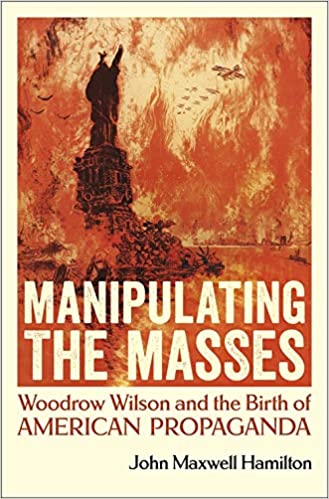
Manipulating the Masses tells the story of an enduring threat to American democracy that arose out of World War I: the establishment of pervasive, systematic propaganda as an instrument of the state. During the Great War, the federal government exercised unprecedented power to shape the views and attitudes of American citizens. Its agent for this was the Committee on Public Information (CPI), established by President Woodrow Wilson one week after the United States entered the war in April 1917.
Driven by its fiery chief, George Creel, the CPI established a national newspaper, cranked out press releases, and interfaced with the press at all hours of the day. It spread the Wilson administration’s messages through articles, cartoons, books, and advertisements in newspapers and magazines; through feature films and volunteer Four Minute Men who spoke during intermission; through posters plastered on buildings and along highways; and through pamphlets distributed by the millions. It enlisted the nation’s leading progressive journalists, advertising executives, and artists. It harnessed American universities and their professors to create propaganda and add legitimacy to its mission.
Even as Creel insisted that the CPI was a conduit for reliable, fact-based information, the office regularly sanitized news, distorted facts, and played on emotions. Creel extolled transparency but established front organizations. Overseas, the CPI secretly subsidized news organs and bribed journalists. At home, it challenged the loyalty of those who occasionally questioned its tactics. Working closely with federal intelligence agencies eager to sniff out subversives and stifle dissent, the CPI was an accomplice to the Wilson administration’s trampling of civil liberties.
Until now, the full story of the CPI has never been told. John Maxwell Hamilton consulted over 150 archival collections in the United States and Europe to write this revealing history, which shows the shortcuts to open, honest debate that even well-meaning propagandists take to bend others to their views. Every element of contemporary government propaganda has antecedents in the CPI. It is the ideal vehicle for understanding the rise of propaganda, its methods of operation, and the threat it poses to democracy.
John Maxwell Hamilton is the Hopkins P. Breazeale Professor in Manship School of Mass Communication, Louisiana State University, and a senior scholar at the Woodrow Wilson International Center for Scholars in Washington, D.C. Before that he was a journalist for the Milwaukee Journal, the Christian Science Monitor, and ABC radio. His work was also published in The Washington Post Foreign Affairs, The Nation, and the New York Times.
He served in the military as a Marine Corps platoon commander in Vietnam and as a reconnaissance company commander in Okinawa. As a public servant he served as an advisor to the head of the U.S. foreign aid program in Asia during the Carter administration and was working on nuclear non-proliferation issues for the House Foreign Affairs Committee.
In Manipulating the Masses: Woodrow Wilson and the Birth of American Propaganda, John Maxwell Hamilton provides a comprehensive study of propaganda used to galvanize American public opinion in support of America’s entry into World War I. Hamilton’s study largely focuses on the Committee on Public Information (CPI), which the government established at the beginning of the war and disbanded not long after the war’s end. As Hamilton notes, when surveyed in 1937, 70 percent of Americans “believed it had been a mistake to enter the war.” Yet the public largely supported the war as it occurred. How propaganda was used mobilize public support for a cause that Americans largely came to reject is the book’s strongest point. The book is notably weakest when attempting correlate World War I era propaganda with modern propaganda in the Internet age.
Prior to and during America’s involvement in World War I, propaganda was an international phenomenon. There was French, German, and especially British propaganda. These governments and the U.S. Government sometimes concealed the extent or even the existence of propaganda and their role in it. This was especially true of the British government. America largely followed the British example by distancing itself from its own wartime propaganda.
A key first step in establishing wartime propaganda was controlling the flow of information. The British successfully isolated Germany by cutting transatlantic cables, monitoring German mail, and monitoring German communication entering the United States. This also allowed Britain to influence the terms of debate over American entry into the war.
The British also benefited from German aggression in Belgium and the German sinking of the British passenger ocean liner, the Lusitania, resulting in the death of 1,200 people, including 128 Americans. The Lusitania contained ammunition headed for Britain. Those in the United States urging neutrality noted the crippling effects of the British blockade on Germany’s food supply. However, as one observer noted, Americans had difficulty visualizing, “German children starving by slow degrees as a result of the British blockade, but they can visualize the pitiful face of a child drowning amidst the wreckage caused by a German torpedo.”
Perhaps the decisive event in triggering America’s entry into the war was what would become known as the Zimmerman Telegram. This audacious ploy involved the German state secretary for foreign affairs, Arthur Zimmerman, sending a telegram to the Mexican government, offering German help in reclaiming United States territory formerly part of Mexico in exchange for a Mexican-German alliance in the war. The telegram reached Mexico via the United States. Monitoring German communications entering the United States, British intelligence read the telegram. The British then ensured that its content was leaked to the American press. The telegram caused a sensation in official Washington, all but ensuring American entry into the war. In describing the telegram’s effect, a British official wrote, “No more perfect propaganda could have been conceived.”
As America prepared to enter the war, military mobilization was urgent. But the mobilization of American public opinion in support of the war was even more urgent. This led the Wilson administration to establish the Committee on Public Information (CPI), with muckraking journalist George Creel selected as its head. Hamilton ably analyzes the philosophical underpinnings of the CPI and their relation to wartime propaganda.
Wilson and others who were part of or aided the CPI during the war had a social reform mindset. As governor of New Jersey, Wilson thought that publicity would have a cleansing effect on exposing the state’s political corruption. Some of those involved in wartime propaganda held a similar philosophy. The idea was that just as slums could be cleared, prohibition enacted, and poor working conditions and business trusts exposed, propaganda would expose the pure rationale for entering the war and its just aims.
Alongside a reformist zeal, the Wilson administration and some of those aiding the CPI held a patrician mindset: the best-educated portion of the population had an obligation to persuade the plebian public to support the war. Speaking to an affluent audience at Chicago’s City Club, educator and lecturer Arthur Bestor noted that “America entered the war chiefly on account of the belief of its intelligent classes.” And because the war was one “for which the intellectual group was so largely responsible, the educated people of the country must see to it that America keeps steadfast to its job.” Similarly, Wilson believed that the public should be guided into the correct opinions that it should have about the war and that it was the president’s duty to direct that effort.
Along with noblesse oblige on the part of the ruling class, the operation of the CPI also depended in large part on patriotic obligation. Academics, businesspeople, journalists, filmmakers, cartoonists, writers, and others volunteered their time and money and put their lives on hold to support the CPI. This largely occurred without government coercion. Regardless of party affiliation, Americans across a wide spectrum of fields were willing participants in supporting the CPI’s propaganda mission.
America’s entry into the war coincided with the establishment of sociology and related disciplines as academic fields. Along with rapid technological change, this opened up the possibility of mass persuasion and the scientific measurement of public opinion. In 1901, Edward Alsworth Ross published Social Control: A Survey of the Foundations of Order. The popular academic text helped to establish sociology as an academic discipline. As Hamilton notes, Ross’ book contended that “just as experts should engineer solutions on uncompetitive business practices and tuberculosis in slums, so should they engineer public opinion on a broad range of economic, social, and political issues.” Justice Oliver Wendell Holmes was among the book’s enthusiastic readers and recommended the book to President Theodore Roosevelt. In correspondence with Ross, Roosevelt wrote, “You insist, as all healthy-minded patriots should insist, that public opinion, if only sufficiently enlightened and aroused, is equal to necessary regenerative tasks and can yet dominate the future.”
The CPI directed government propaganda in support of the war in a variety of formats. Among the most influential formats was a nationwide network of speakers known as “The Four Minute Men.” At the dawn of the war, movie theaters showed silent films. In between portions of the film were four-minute breaks. The Four Minute Men were tasked to fill this timeslot with a patriotic speech in support of the war. The speech might urge audience members to purchase Liberty Bonds or donate binoculars to the U.S. Navy. The Four Minute Men speaking campaign was a wide-ranging success, so much so that it expanded beyond theaters to include speakers in foreign languages in urban areas, speakers on Indian reservations, Hispanic community speakers, speakers at women’s groups, and speakers at gatherings in the black community. Almost no group in America was left untouched by the Four Minute Men.
Advertising was a key component of the CPI’s wartime propaganda campaign. Ads appeared in magazines, newspapers, and on billboards, posters, and buttons. The CPI ads were also distributed to American households via bulk mail. Advertisers were eager to demonstrate the integrity and capabilities of their profession and its application for patriotic purposes. The CPI recruited advertising man Bruce Barton to write title cards (used in silent films) for patriotic CPI films. Following the war, Barton wrote the bestselling book, The Man Nobody Knows (1925), which “portrayed Jesus as a modern business executive adept at advertising.”
Working closely with the CPI’s advertising division was the Division of Pictorial Publicity. The division recruited some of the country’s best artists, including James Montgomery Flagg, best known for “the iconic ‘I Want You’ recruiting poster with Uncle Sam pointing a finger at the viewer (inspired by a British poster showing Lord Kitchener in a similar pose).”
Alongside its advertising and art divisions, the CPI also had a film division that produced pro-war propaganda for theatrical distribution nationwide. America’s Answer to the Hun was one such film. A showing of the film at New York City’s Strand theater began “with the national anthem sung by one hundred sailors and a tableau vivant of American soldiers poised to ‘go over the top’.” Additionally, “music that accompanied the film had artillery sound effects.”
The CPI also mobilized academia as part of its mission. At the dawn of the war, traditional academic fields such as history were transforming from scholarly gentlemen’s pursuits to professional research fields with academic journals and graduate schools modeled on those in Germany. In theory, adherence to these new professional standards entailed maintaining scholarly objectivity, free of bias. However, in practice, the war proved that academics (like those in other fields) were willing to conform their research to the government’s wartime propaganda aims. One case in point is publication, The War Cyclopedia: A Handbook for Ready Reference. This reference work contained numerous entries that portrayed German influence and propaganda against the United States in a negative light. Yet, it contained “nothing comparable on British propaganda or British conflicts with the United States.” At the University of Minnesota, professors faced “loyalty interrogations.” One suggestion for professors failing such a loyalty test but wanting to redeem themselves was to write “a patriotic entry for the War Cyclopedia.”
At the war’s start, there were numerous foreign-language newspapers. The CPI faced the challenge of appealing to the American patriotism of Germans and those of other immigrant communities. One such CPI-led effort to encourage immigrant patriotism was a Loyalty Day, organized on July 4, 1918. In Washington, D.C., President Wilson and “representatives of foreign-language groups boarded the presidential yacht the Mayflower at the Navy Yard for a trip up the Potomac River” to Mount Vernon, where Wilson gave a rousing patriotic speech and where “the foreign-born laid wreaths on George Washington’s tomb.” Similar CPI-organized Loyalty Day celebrations occurred in other cities, such as New York and San Francisco. Today, it is difficult to imagine the denunciations from the establishment media that such celebrations would incur. Yet, at the time, The New York Times declared the celebrations to be a “demonstration of the loyalty of Americans of foreign birth.”
The CPI’s propaganda mission depended in large part on the patriotism of Americans and their willingness to support the CPI’s mission. However, not all Americans were consistently supportive of the CPI’s mission, and some actively opposed it outright. The potential for such an opposition created a climate of suspicion and (in some cases) the need for the CPI to censor certain publications. Illustrative of such suspicion is Samuel Hopkins Adams’s novel Common Cause (1919). In this novel, a German-American woman is overheard objecting to a speech by the Four Minute Men at a theater in her community. When the woman “complains that she is being spied upon,” she is told that she is “a suspicious person” because of her German accent.
Today, it would be unthinkable for librarians to censor their collections to be pro-government or report borrowers of certain books to government authorities. However, at the time, “Herbert Putnam, the librarian of Congress, gave office space to the CPI, where it screened books, altered Creel [CPI director] to books that others deemed questionable, and informed Creel of individuals who checked out such volumes.”
On September 15, 1918, The New York Times published a front page story under the headline, which read in all caps, “DOCUMENTS PROVE LENIN AND TROZKY HIRED BY GERMANS.” Yet, the story relied on documents that were (at the time) suspected of being forgeries and were later proven to be so. Although, as Hamilton notes, historians have established that the Bolsheviks received German funding, the Bolsheviks were not (as the documents alleged) German agents, but rather, communists intent on spreading revolution to Germany and elsewhere. The Sisson Documents, as they came to be called, were named after CPI’s Russian representative Edgar Sisson, who was largely responsible for convincing the Wilson administration that the documents were authentic. Once the government officially authenticated the documents, the CPI declared any deviation from full acceptance of the documents to be un-American. With this looming threat, nearly all of the establishment press complied. The New York Evening Post was “the lone establishment newspaper with temerity to question the documents when they first appeared.”
As aggressively as the United States pursued domestic propagandization of its civilian population, the U.S. Military displayed an odd reluctance to incorporate propaganda in military operations against Germany in World War I. Herbert Blankenhorn is today remembered as “the father of military psychological operations.” However, in World War I, he was derided as “Captain Papers” for wanting to drop leaflets on the German side of the fighting, urging surrender. Only after demonstrating that some German soldiers had surrendered as a result of reading such leaflets did Blankenhorn receive a measure of regard for his efforts in war.
The CPI ceased operations shortly after the official end of the war. Propaganda helped to mask the severity of the war and its death toll. CPI filtered the rationale for entering (and continuing) the war through a lens of unquestioned patriotism. The removal of this filter prompted Americans to reexamine the rationale for the war and the limited gains America realized from the peace agreement. From his wartime experience in serving the military in helping to shape American propaganda, journalist Walter Lippmann came to believe that “public opinion can be manufactured” and that the Wilson administration had succeeded “in creating something that might be called one public opinion all over America.” Because of this, Lippmann came to believe that “it was no longer possible to believe in the original dogma of democracy” in America. Lippman argued that Americans should focus on understanding issues in their local communities rather than risk manipulation by attempting to understand national events.
Government propaganda has continued in the modern age. The Obama administration established a government Social and Behavioral Sciences Team, which encouraged Americans “to behave responsibly” and to make sound decisions, such as “to stop smoking or start a retirement savings program.” The government employed behavioral science research found in the book Nudge: Improving Decisions about Health, Wealth, and Happiness. Hence, the government team became known as “the nudge unit.” Similarly, researchers affiliated with the Defense Advanced Research Projects Agency (DARPA) have conducted neurological research in which researchers “traced blood flow to the brain to measure the effectiveness of messages.” The DARPA research is supposed to be targeted against “foreign enemies.” Likewise, at first glance, government nudge research appears benign. Yet, as Hamilton wisely notes, “nudging and brain study breakthroughs can be repurposed for partisan political propaganda at home.”
Omitted from mention in Hamilton’s book is the Obama administration’s 2013 enactment of the Smith-Mundt Modernization Act, included as part of the National Defense Authorization Act (NDAA). This legislation removed the legal restraints on the use of government-produced propaganda for a domestic audience. Defenders of the legislation argue that government-produced propaganda is still legally required to be objective and, in essence, can’t really be labelled as propaganda. However, in World War I or now, government propaganda rarely explicitly identifies itself. It’s also hard to imagine that any court would enforce standards of objectivity on government-produced propaganda. Republican Congressman Thomas Massie has introduced legislation calling for the repeal of the 2013 Smith-Mundt Modernization Act. The congressman has noted the following: “I voted against that NDAA, and I offered an amendment to the 2026 NDAA to reinstate the original prohibition, but Speaker Johnson blocked a vote. The Smith-Mundt Modernization Act needs to be repealed. Taxpayer-funded fake news should not be used by the federal government to wage influence campaigns against the American people.”
A really terrific book that was the product of an enormous amount of research. When we see Presidents tweeting today and government agencies encouraging Americans to do or not do various things---all these activities blossomed under Woodrow Wilson's administration. These various doings raise vexing issues for representative democracy: should government shape the opinions of the public? How much of the truth can government withhold from voters? Is government propaganda to encourage collective action (to fight a war or virus) o.k.? To what degree? Hamilton's book is a rich history of the Wilson era and the journalists and advertising men and women who were on the cutting edge of propaganda, and who founded the modern Information State.
The story of the Wilson administration’s efforts to establish a propaganda bureau during WWI is one that anyone who has an interest in the deep state needs to understand. HE called it the Committee on Public Information. Wilson chose a person named George Creel to lead the effort which did all the things a ministry of information would do in a totalitarian nation - distorting the news, supplying friendly (and not) papers with copy and a host of other projects. Most of these efforts escaped public scrutiny. The CPI lasted for 2 years but the things they put in place are present today.
Hamilton did an exhaustive bit of research. Those of us who are interested in the risks of having a pervasive government should have a good understanding of the history - many of the trends which were started in the CPI have carried over to modern efforts in government and the media.
One of the most useful parts of this book is a summary of the major figures that were involved in the CPI - those included people like Walter Lippman. This is a long book but well worth the time
By laying out the history of the US’s first systematized attempt at controlling communications (the Committee on Public Information), Hamilton makes the reader grapple with the double edged-sword of propaganda: how it both helps and hurts democracy. That something so universally condemned as bad has its roots in such (Wilsonian) idealism is a stark reminder of how easily our best laid plans, even when we act in good faith, can have awful unforeseen consequences. But maybe it’s beside the point to try to come to some blanket opinion or judgement about the goodness or badness of states using propaganda. It is a thing that states do for better or for worse. Maybe we should judge the message rather the medium.
This book covers a mix of Wilson's second term in office along with the propaganda agency formed during the first World War to affect domestic and foreign opinion. It was interesting to see how the agency worked, along with its many failures. It was interesting how the press took the project with such hostility rather than be pushed around so easily.
I did find the book a bit too long and that it dragged on a little. It's an interesting piece of history.
I highly recommend this book to those seeking to obtain and understanding of how public opinion is influenced by propaganda with real world examples beginning with WW 1
The book odd REALLY dry, but that’s because it’s so comprehensive. If you read the first 100 pages and the last chapter I think you’d walk away with a pretty clear picture. It’s a very informative book, but tough to get through.