Pablo Cartaya is a professional code switcher and lover of all things Latinx. He talks a lot and writes a lot which are paradoxical conundrums to overcome on a daily basis. He is the author of the acclaimed middle-grade novel, The Epic Fail of Arturo Zamora (Viking Children’s Books/Penguin Random House) which earned him a Publisher's Weekly "Flying Start" and starred reviews from Kirkus, Booklist, and Publisher's Weekly. For his performance recording the audiobook of his novel, Pablo received an Earphone Award from Audiofile Magazine and a Publisher's Weekly Audiobooks starred review. His novel Marcus Vega Doesn’t Speak Spanish, also with Viking, is set for publication in summer 2018, with two forthcoming titles to follow in 2019 and 2020. Follow him on Twitter @phcartaya
One of the jobs of a good librarian is to advocate for her people. I feel the need to advocate for my people today.
I'm Hispanic. Not by birth, but by a somewhat precarious adoption into the tribe. I've worked hard to gain this admission by studying Spanish for thirty years and working and living with children, friends, and family who have close ties to Hispanic cultures.
So please trust me when I say that children are not often able to find their Hispanic cultures represented in books. And that is very sad.
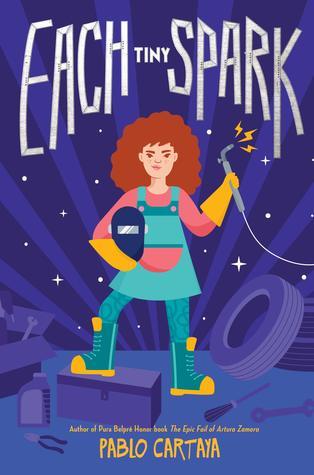
But today I have good news. I present to you Each Tiny Spark by Pablo Cartaya.
Each Tiny Spark is the delightful story of young Emilia Torres, a girl who has difficulty keeping focused in school, who has a wonderful mom who helps her stay on track, a loving dad who has just returned from a deployment overseas, an assertive grandma who would like to guide her toward a traditional female Hispanic path, and a huge assortment of teachers and friends who tug her and prod her and encourage her and hinder her in the life she is creating for herself.
It's the conversations I love most in this book, the conversations with a generous mix of English and Spanish, the kind of conversations I hear all the time when I am among my friends and family.
If you speak Spanish, you are going to love Each Tiny Spark. If you don't, I urge you to give it a try. And to help you, I've created A Little Guide to Spanish, using words from this book. If you are like me, and you'd like to become just a bit more Hispanic or to simply connect with others a little better, you might try inserting these words into your everyday conversations and see what happens.
Full disclosure: I don't know every word in Spanish, so please bear with me if I've a few boo-boos here.
I really wanted to like this book. But there were so many things that annoyed me about it that I will not be recommending it to students. First of all, let's tackle the big issues: ADHD, PTSD, immigration, redistricting, racism, overbearing adults, deployment... this book has them all. ALL. OF. THEM. It was exhausting.
Second, let's work in some history lessons by having our main characters have completely unrealistic conversations. AUTHORS, stop doing this! The last book I read that did this was Breakout by Kate Messner. Find a better way to educate your readers than by getting your characters to suddenly become experts in something so they can share it with their friends (and readers).
Next, let's talk about the public library. It is inconceivable to me that Emilia does not know how a library works. C'mon. And the microfiche machine?!?!? I know that the kids' assignment didn't allow them to use internet, but most libraries have digitized their microfilm collections by now. OMG it is 2020.
I listened to the author read this book, and his voice for Clarissa was SO annoying. I'm sure he didn't mean for her to sound like a gay man from Arkansas.
My last rant is a throwaway line somewhere toward the end of the book about Catholics not being Christian. I am still trying to process if this was the character saying this or if this is what the author actually believes. How does such stuff get past editors? I would've put a big question mark next to that demanding clarification.
Emilia has a hard time focusing on topics that don't interest her, but when she is interested in something, she becomes laser-focused on it. This neuro-diversity makes school challenging; her mom tries to help her compensate by planning out her school week for her and staying on top of her assignments. How is Emilia supposed to cope when her mom goes out of town for business at the exact same time her father is returning from deployment. To make matters worse, her grandmother is becoming super annoying; all she wants to talk about is how Emilia is going to be a young lady soon. Gross! Abuela wants to buy Emilia dresses and start prepping for her quinceanera, which is only three years away. Emilia would rather spend her time fixing up old cars with her dad or making horror movies with her best friend Gus.
When her favorite teacher asks her class to come up with a tourism guide for their hometown, Emilia discovers disturbing information about the treatment of immigrants in her state and community. This information along with a highly contested district rezoning makes her see her community and old friends in a new light. Is Emilia willing to stand by and let things happen to those she loves, or will she take a stand for what is right?
Pablo Cartaya's latest novel is very timely. His main character learns that immigrants were asked to come to Atlanta to help build the Olympic park and stadium; however, once their work was done, people expected them to leave. With immigration reform at the forefront of the next presidential election, this book may help middle-grade students develop their own opinions about the topic. I think it would be really interesting for teachers to use this book as a catalyst to inspire students to research their own communities and the contributions immigrants have made to them.
I've enjoyed every Pablo Cartaya book I've read so far, and this one wasn't any different. I might write a longer review of this sometime soon but I would definitely recommend this book. It's a good one.
An old coworker recommended this book to me YEARS ago because of its focus on the Cuban culture and I will admit that it sat on my ARCs shelves for a while. But having finally read EACH TINY SPARK and I can completely see why she thought this book would be for me.
I LOVED the Cuban representation. The Spanish, the machismo-culture of what is "appropriate" for women and girls to do, and the reminder that there isn't one way to look in order to be recognized as a Cuban were some of the prominent things I really appreciated in this book. I think representation of these specific topics--especially the latter of the three points--is incredibly important for young readers.
I also appreciated the exploration of ADHD and how it can look different from one person to the next, and how important it is to notice when other kids need help, especially when they don't have such strong advocacy for them in school.
One of the main topics explored in this book was social justice and how it can affect and divide a community. The number of micro-aggressions in this book was staggering. I'm glad the MC had such great character growth that she recognized them and also decided to use her voice to stand up for what was right.
Some people might think that this book is "too woke" or "too busy", but I thought it was both a wonderful representation of how the MC's brain works and a reminder that younger generations are becoming more aware and outspoken about the social justice issues happening in their communities. I find that books like EACH TINY SPARK is an important reminder to kids reading (and some older readers too) that it's okay to be outspoken when you see an injustice taking place.
We also get to see a family that might look a bit different from the traditional families in MGLit and again, I saw this as something a lot of readers might be able to relate to--especially Latine readers!
Overall, I really enjoyed this book! I loved the friendships, the complex relationships that the MC has with her grandmother and father, and the exploration of the Cuban culture in a setting that isn't Florida.
Each Tiny Spark is a book about a girl named Emilia who has ADHD. It is about her journey trying her best to deal with the challenges of ADHD by herself when her mom goes away for a week and her dad comes back from being deployed. I enjoyed reading the book and being able to have her perspective. Although I do wish the book was more detailed on her real and true emotions that I felt like she was sort of hiding. I recommend this book to someone who is looking for a good story about ADHD and how it affects some simple tasks.
I got an ARC of this book at a conference. I find all of Cartaya's books so poignant and relevant to kids. I love how this one covers important political topics from a middle school point of view. I will be recommending this book in my classroom.
Each Tiny Spark by Pablo Cartaya was not my favorite book. It is about a girl named Emilia with ADHD and how her mom, who usually helps her with her homework, is gone for a week due to work. On top of that, Emilia's dad comes home after being deployed in the army. I found this book was very slow-paced and not very eventful. If you love realistic fiction books, I recommend this one.
Each Tiny spark was a book about how a girl's father is coming home and how her mother is leaving at the same time. I liked the book a lot it was fun to read and interesting. The book taught me a bit about how immigration used to be from Emilia's report she was doing. The book also showed how Emilia the main character was able to make her voice heard about what she thought about a problem there was from her district and the neighboring one. While she is working hard at school she is also trying to repair her relationship with her father who had just come home.
Each Tiny Spark was an ok book. There was no humor what so ever and I never really reached a point in the book when I was sad to stop reading it. Based on other reviews I anticipated to read a book that I would be very excited about picking back up, this was sort of a disappointment. I did not really reach a climax in this book or any point with much tension of suspense.
The story: Emilia Torres has a lot going on in her life. Her mom's interviewing for a new job out of town; her dad just got done with a long deployment, and when he gets home, there's something "not quite right" with him. Emilia has ADHA; her Abuela is trying to run her life; and a school project goes badly wrong, leaving members of her class on opposite side of a local politial issue. Can Emilia figure out how to get through all her challenges and, at the same time, find her own voice enough to stand up against injustice?
June Cleaver's rating: Language PG; Violence G; Sexual content G; Nudity G; Substance abuse G; Magic & the occult G; GLBT content G; adult themes (Possible PTSD; controlling or absent parents; racism and prejudice, local inequalities) PG; overall rating PG. Best for grades 4-7.
Liz's comments: I really like Pablo Cartaya's books, and I was excited to read this one. However, I feel he did a somewhat better job with the boys' voices in his earlier books, and his use of context to help non-Spanish speakers figure out what's being said can be confusing for younger readers. Even so--fans of his earlier books will like this one too. Emilia is in 6th grade, so it's best for grades 4-7.
Although this was not my favorite Pablo Cartaya book, Emilia Rosa Torres is my favorite of his characters. Emilia struggles with ADHD, and her world is rocked when her father returns home from deployment, distant and despondent. This book explores PTSD, and how difficult it can be for those surrounding one who suffers from this harsh disorder. It discusses redistricting and how it affects all socioeconomic parties. It poignantly explains the sense of belonging that all immigrants hope to achieve at any cost. And, at the heart of all Pablo’s books, there is the close-knit family and friend relationships that Emilia holds dear. I especially loved the relationship between Emilia and Abuela, as well as the jigsaw puzzle metaphor that places each character together in a complicated but perfect fit. Can’t wait for Pablo’s visit on January 8th!
Whoa! I wish that this book had existed when I was a kid. To see myself (ADHD kid constantly making connections and having big feelings and wanting adults to talk me through them) represented in a book would have been so validating. There are SO MANY themes in this book it’s like being inside of my brain.
Edit: After reading some of the 1 and 2 star reviews I want to add some things to my review.
First of all to all the people complaining about the multiple themes and to the person who called it “exhausting” - guess what? I found it to be an accurate portrayal of a young girl with ADHD. I wish that someone had noticed this in me as a child. It IS exhausting to have a brain that is constantly going and constantly making connections. And the judgement from folks that don’t understand us makes it that much worse. Always being told we are too much or we shouldn’t ask so many questions.
Second to the folks complaining about the Spanish, she’s Hispanic for crying out loud! How dare she speak Spanish and maybe you don’t understand. I’m not an expert in Spanish by any means but it definitely did not detract from the story. And it is in fact an important part of the story. And if you don’t understand, use Google.
And lastly to the people who think that the conversations are unrealistic, I don’t know what kids you’ve been hanging out with but kids are having more in depth conversations than you realize. My daughter was talking about police brutality in her second grade class. Life is messy and kids can be dealing with multiple things - acculturation, racism, neurodiversity, bullying, gender roles, etc. I’m glad that this book exists and I hope more kids feel seen and validated after reading it.
This book could have been great but, sadly, it wasn't. For starters, I couldn't get invested in a single character in this story. They were all flat. Then there were the middle schoolers having unrealistic conversations in the name of lessons in history or societal issues. Give me a break. There are much better ways of sparking these ideas in readers. Also, why were there so many huge issues thrown into one story? Immigration, veterans issues, ADHD, school district zoning, discrimination, etc. These are all important topics, but when thrown together in one MG book, none of them are represented well. At least not in this book. It's also (in my opinion) lazy writing to overuse a foreign language to demonstrate culture. Again, there are better ways to do this. In the case of this book, there's a lot of Spanish interspersed in conversation with little context to make sense of what's being said. If you speak Spanish or are trying to learn it, this is great. If not, it gets repetitive and stalls out the story.
Absolutely chock-full of great themes -- ADHD, growing up, racism, deployment, reintegration, absence, Latinx family culture, redistricting, voting rights. A bunch of appealing characters, including a beautifully frustratingly protective family that struggles with their own internal feelings about Cuban heritage and how to get along in a white neighborhood in a town in Georgia. Really, there's a ton of things to love here, but it is very slow paced. It centers on daily life, and delivers daily life with exhaustive detail. Emilia's mom is a away for 5 days, and it felt like I got to live every moment of those days in a 4 hour audio book.
What it's about: Emilia Rosa's mother leaves for a conference just as her father is returning from an eight month military deployment. This change in routine is a bit difficult for Emilia; she has ADHD, which makes focusing on some things difficult for her, and that difficulty grows when there's a lot going on around her.
In addition to dealing with the change to her routine, she also has to figure out how to reconnect with her father. He's returned in body, but his mind seems to be somewhere else most of the time, and he's reacting very strongly and in unpredictable ways.
To top it all off, Emilia's history teacher has assigned a great big project - each student has to create a tourist guide to important places in their town.
Emilia has no idea what to focus on - either for her project, or in her classes, or at home.
But with some help from her friends, and her family, and the friendly librarian, Emilia starts to put together some ideas about what to do, and how to do them in her own way.
What I thought: I really didn't expect some of the directions this book went in. Often, middle grades and YA books tend to focus on one particular element and built a story around it. I thought this one would focus on the difficulties of being a kid with ADHD. But Cartaya weaves together so many different threads to weave a really amazing tapestry of a story. This is middle grades realistic fiction at its best - it's complex, but it's also engaging, and educational without being preachy.
Why my chosen shelves: In addition to Emilia Rosa and her familia, this book includes many characters who are Cuban, South American, and other "flavors" of Latino/a. There are also some other characters who are Asian and Black. While one of Emilia Rosa's best friends, Clarissa, is white, it becomes clear over the course of the story that Clarissa is prejudiced.
Emilia's father is returning home from a deployment with the Marines, and he ends up having a difficult time reintegrating with his family and society. Also, Clarissa's father was in the Armed Forces and was killed in action. These are some heavy topics for a book about and for middle school kids, but these issues are handled very deftly.
There is also a subplot about the school district considering redistricting and bringing kids from the "bad" part of town to Emilia's school, which causes some polarization among the students and community members. This is also handled very well, in a way that provides a template for readers who might disagree with others.
There's a great thread about the public library (the kids' school doesn't seem to have a library, which is a problem; but the other side of town doesn't have a library at all, and the kids come to realize how valuable a resource a library can be). The librarian is new and engaging and provides some outstanding assistance to Emilia when E starts researching for a project.
Emilia's research delves into the history of the Atlanta region, particularly how, in the run-up to the 1996 Olympics, workers were invited to the area to ensure that construction was completed on time; then, after the work was done, locals started agitating for the "foreigners" to leave. This leads Emilia into learning a bit about immigration and rights and voting (which is also related to the school redistricting).
Emilia is working with ADHD, which requires her to have some supports and strategies that not every kid might need. But even better than just having one character with ADHD is that there is at least one other character who Emilia suspects has it; and Emilia is very thoughtful about wanting to share her school supports with that other student, and any others who might need them. It's a great reminder that we may not know what is happening in someone's head, but we can be supportive and help them in a variety of ways.
There is also a teacher who has a project turn into a parent-angering subject; Emilia hears the teacher get told by the principal to knock it off and teach something inoffensive, and the teacher manages to be a bit subversive, as some of the kids are really engaged by the somewhat contentious topics they are exploring for the project.
Between the redistricting, the history of the area, the talk about immigration and voting, and the teacher getting shut down, there are several political angles in this book, but none of them may read like "politics" to kids - which could provide a great handle for a discussion about what "politics" is and how it impacts us all every day, in ways big and small.
Emilia is into hands-on projects like making circuit boards and helping her father in the family's auto repair shop; and she dislikes her grandmother's attempts to make her more "girly" (which, for Abuela, consist of learning to clean and cook, wanting beautiful and styled hair, and getting dresses).
Emilia's other best friend, Gus, is really into making movies. There are a few threads of the story that spin off about movie making and how even entertaining movies can have some important messages behind them. I love that message, and hope readers will consider it, and how they can bring messages that are important to them into whatever they create.
Why I rated it like I did: At first, I thought this book was OK. The more I read, the harder it was to put it down! There are so many great lessons for middle grades readers in here - about growing up, about being themselves, about standing up for themselves, about the importance of history and politics, about family and friendship.
Emilia Torres' father has returned from another tour of duty across seas, and he isn't quite the same. A classroom project turns into delving into a town's history that's crucial to understand important decisions being made today. Emilia learns what it takes to heal a family and the community she lives in.
Dealing with PTSD no easy feat and it was handled with care in this book as well as ADHD.
This is a great book for late elementary and middle school students with great lessons in standing up for something you believe in, regardless of your own struggles, differences or judgments. Emilia is a great inspiration! This book is available as an e-book on Libby / Overdrive.
Reviewed by: Vinita Hulyalkar, Circulation, Vernon Area Public Library
Definitely a cycle 3 book. Touches upon Diversity, immigration, ADHD, army PTSD and friendship dynamics (so so many things). The main character is a strong female lead and her family is endearing as heck - this is a perfect classroom/literacy circle read.
Ohhh! I love this book so much! It about standing for what you believe in and family problems , I could relate to it regarding family issues in someway and this made me cry as her father told her the reason why he didn't respond to those letters. This book is amazinggggggg.
This entire review has been hidden because of spoilers.
I really liked Cartaya's first book, quite liked his second book, but this one not so much. The protagonist has ADHD, and by the end of this book I felt her pain. There is a lot of "oh shiny" in this book without much actual plot!
Battle of the Books 2025 #1 I just love a good story with real, easy to get at emotions and peaks into the lives of others. There was a LOT going on for Emilia in this book, it made me overwhelmed right along with her. Written with compassion. Glad to have read with my Middle School daughters.
This was such a cute book! I love the main character and all of the side characters. I love how the author depicts the Torres family and all of their relationships. When I was a kid, I also had an overbearing Nana that used to drive me mad and it's really nice to see a real heartfelt look at why a grandmother might be overbearing. This book made me cry and I wish I had read it when I was a child because I definitely could have used the ADHD representation as a kid.
I like how the main character speaks english and Spanish. As a student who would like to learn Spanish, it really helps me. It also helped that the main character explained what was said in Spanish. Emilia goes through what many people have gone through and I don’t blame her. It is very difficult to have many friends and your two closest friends don’t get along. I like how she finds a way to be friends with both of them without causing to much conflict.
This entire review has been hidden because of spoilers.
Loved this book! Some heavy topics for children but done well. Fell in love with the main character and her family, especially her mother. As a teacher, I connected to the SS teacher and enjoyed the perspectives of students who want to do well, care about their learning, while struggling with learning disabilities and family conflicts.
I'm disappointed about how little I liked this since it was recommended by a friend. I wasn't invested in Emilia much at all and other than Gus, her best friend, I didn't like any of the secondary characters either. Her mother is supposed to be a great supporter but I found her overbearing without giving Emilia an inch to breathe - even when she was 2500 miles away she did a daily check in with Emilia's teachers, telling them what to do. Her grandmother is totally out of touch with who Emilia really is, pushing her toward a persona that is not at all what she wants. Emilia's father can be forgiven because he is obviously struggling with PTSD but there's not much for me to like about him either since he is so totally withdrawn into his pain that the reader doesn't get to know him. My biggest issue with the book, however, is that it is filled with a lot of IMPORTANT THINGS YOU SHOULD LEARN rather than a good story. I usually find this phenomenon in historical fiction books which have lots of lessons blatantly written into the dialogue but this author has found a way to bring it into this realistic fiction story. There are so many of these learning experiences, but I particularly remember a discussion about the Cherokee rose flower that goes approximately like this (paraphrased): Emilia: Look at this beautiful Cherokee rose. I know what it is because my mother made me memorize all the state symbols last year. Gus: It's called the Cherokee rose because of the Cherokee Trail of Tears. Emilia: What's that? Gus: The Trail of Tears was when (gives factual, much too detailed for a middle schooler explanation of this event). I'll bet the seven petals of the flower symbolize the seven tribes of Cherokees and the yellow center represents (something meaningful to the Trail of Tears). Emilia: I never knew that. Thank you for explaining that to me Gus. A history lesson (poorly) disguised as everyday dialogue between two pre-teens. This does not make for a compelling story for me nor for my students. I also can't forgive that Emilia goes to the library with Gus and the librarian directs her to a microfilm machine. And no, this book does not take place in 1975.
🌟🌟🌟🌟🌟/5 LOVED THIS BOOK!!! Recommended for anyone who wants to read about a neurodivergent character who uses her strengths to help fight for justice! . 〰️ 〰️ Emilia Torres is Cuban American and has ADHD. Her mind wanders and she relies on her mother to help her navigate homework and relationships. Her mother is away at a conference in California, however, so she is home with her abuela and her father who has just returned from deployment. Her father struggles with anxiety and PTSD from his time in the military, but he finds his groove and opens up while working on restoring an old car in the garage. Similarly, Emilia finds that her mind settles and focuses when she is either working on the car with her father or researching for her social studies project on her community. . 〰️ 〰️ As Emilia researches the immigrant community in her town, she discovers injustice and prejudice in her Atlanta suburb and her interest expands to discover the root of the conflict. Emilia is inspired to act: "I know I have to do something, but I don't know what or if a kid can even make a difference." Other issues addressed include colorism (Emilia is light-skinned and her abuela emphasizes their European roots) and gender roles. . 〰️ 〰️ This sounds like a lot, but the story flows effortlessly and all these topics are woven into the book perfectly. . 〰️ 〰️ Emilia is a character to root for and I especially love how her ADHD brain is described as both scattered and focused, depending on the topic. Anyone who knows someone with ADHD (as I do!) understands that the ADHD neurodivergent brain has assets like hyperfocus. Spanish is integrated throughout the text, but isn't always fully translated, which requires the reader to use context clues to decipher the meaning sometimes. Emilia Torres is one of my favorite characters of 2019 thus far; I love her activist spirit and I love that neurodiversity is represented and celebrated in this stellar novel. Don't miss this book! Grades 3+ . 〰️ 〰️ Book 64 for #30booksummer #librariesofinstagram #librariansofinstagram #mglit #mgbooks #ilovemg #booksbooksbooks #bookstagram #bookreview #lovetoread #amreading #eachtinyspark #pablocartaya