"The Use of Force" is a short story by the American author William Carlos Williams. It was first published in his short story collection Life Along the Passaic River (1938).
The story is narrated in the first person by a physician, who is making a house call to tend to a sick girl. Fearing she may have diphtheria, the doctor decides to check her throat. However, the girl refuses to open her mouth, and the doctor uses force to restrain her and examine her throat with a spoon, which angers the girl. The doctor finds that, against her own self-interest, the girl has hidden the symptoms of diphtheria from her parents and the doctor.
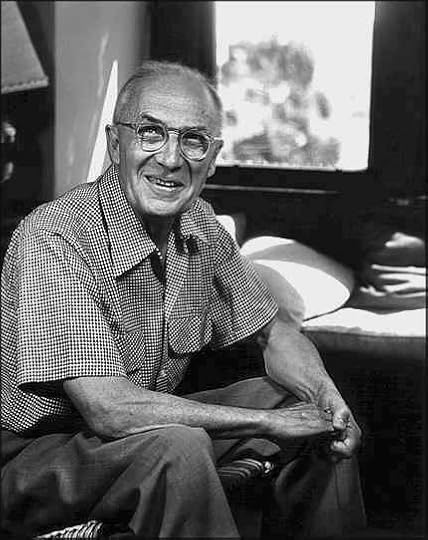
William Carlos Williams was an American poet closely associated with modernism and Imagism. He was also a pediatrician and general practitioner of medicine. Williams "worked harder at being a writer than he did at being a physician," wrote biographer Linda Wagner-Martin. During his long lifetime, Williams excelled both as a poet and a physician.
Although his primary occupation was as a doctor, Williams had a full literary career. His work consists of short stories, poems, plays, novels, critical essays, an autobiography, translations, and correspondence. He wrote at night and spent weekends in New York City with friends—writers and artists like the avant-garde painters Marcel Duchamp and Francis Picabia and the poets Wallace Stevens and Marianne Moore. He became involved in the Imagist movement but soon he began to develop opinions that differed from those of his poetic peers, Ezra Pound and T. S. Eliot. Later in his life, Williams toured the United States giving poetry readings and lectures.
In May 1963, he was posthumously awarded the Pulitzer Prize for Pictures from Brueghel and Other Poems (1962) and the Gold Medal for Poetry of the National Institute of Arts and Letters. The Poetry Society of America continues to honor William Carlos Williams by presenting an annual award in his name for the best book of poetry published by a small, non-profit or university press.
Williams' house in Rutherford is now on the National Register of Historic Places. He was inducted into the New Jersey Hall of Fame in 2009.
An unpleasant story, as the title suggests (from 1938).
A doctor recounts a house-call: “The child was fairly eating me up with her cold, steady eyes, and no expression to her face whatever. She did not move and seemed, inwardly, quiet; an unusually attractive little thing, and as strong as a heifer in appearance. But her face was flushed, she was breathing rapidly, and I realized that she had a high fever. She had magnificent blonde hair, in profusion. One of those picture children often reproduced in advertising leaflets and the photogravure sections of the Sunday papers.”
The fear is that she has deadly diphtheria, but Mathilda insists she doesn't have a sore throat and won't open her mouth for him to look.
He's a horrible man. Lecherous towards a child, judgemental, short-tempered, insensitive - and rough:
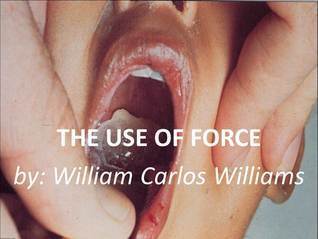
The cover image is horribly apt, with a touch of ambiguity.
Image: Close-up photo of large hands holding a mouth open, with a thumb on the lips
Short story club I read this with The Short Story Club.
William Carlos Williams and I have history. We spent many a nights in my room driving me crazy. It's not all sexy as it sounds, but he really drove me crazy as I had to write 4 paragraph essays about his 16-word poems. My bitching aside, I love William Carlos Williams' poetry, this short story not so.
First of all, the title The Use of Force
So sensational, but really the story is nothing of the sort.
I read this because it's in almost, if not all, all the lists of best short stories, but this just didn't do it for me. When I read short stories, I expect some sort of story arc, this had none. It's still a 3 because it's William Carlos Williams and the man is a painter of words, and no one does imagery as good as he does.
3★ " Such a nice man, put in the mother. Look how kind he is to you. Come on, do what he tells you to. He won't hurt you.
At that I ground my teeth in disgust. If only they wouldn't use the word "hurt" I might be able to get somewhere. But I did not allow myself to be hurried or disturbed but speaking quietly and slowly I approached the child again."
This was written in 1938. The doctor narrating has been called to a house where a little girl is running a high fever, and they all fear it might be diphtheria, although nobody dares mention the word.
She's sitting on her father's lap, but they haven't been able to see down her throat, and she refuses to open her mouth for the doctor.
[I had a child like that – used to hide under the bed when the doctor came (back in the day when they made house calls). I'm sure mine wasn't the only child who hid. But I digress.]
The doctor tries again, but the father is so worried about hurting his daughter himself, that he keeps letting go at just the wrong moment.
"As I moved my chair a little nearer suddenly with one catlike movement both her hands clawed instinctively for my eyes and she almost reached them too."
This is getting serious now. He asks the father to hold both of her wrists, but the child immediately screams that they are hurting her.
"But I have seen at least two children lying dead in bed of neglect in such cases, and feeling that I must get a diagnosis now or never I went at it again."
This is a very short story, free, quick, and easy to read as far as the language goes. Not so easy to read about tempers and temperament.
Upon first reading this, the doctor seems like he's trying to diagnose a stubborn child with Diphtheria. The second time reading this it seems comparable to a rape. Seriously.
You know the story: the patient says, “Doctor my head is killing me,” so the doctor cuts off the patient’s index finger and says: “The head… Not so bad now… Right?”
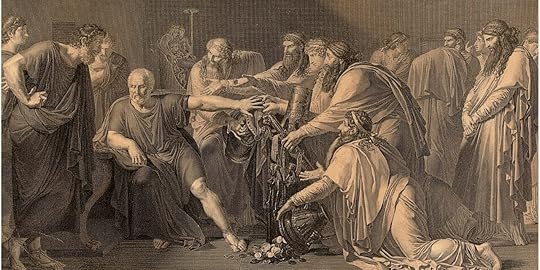
It’s effective... practical, if not somewhat archaic. The art of distraction. I’ve been a doctor for five years. I’m modern, compassionate. I’ll break the finger instead. What can I say? Hippocratic Oath.
Anne-Louis Girodet de Roucy-Trioson: Hippocrates Refuses the Gifts of Artaxerxes
[2026 Re-Read]: The unnamed doctor in this story, the narrator, does not present himself as being completely admirable. Why does his frustration lean towards violence? The most charitable explanation is that he's seen too many young patients with diphtheria and has reached a breaking point.
[Original review]: Very sparse prose, almost clinical in its directness.
A power struggle between doctor and patient, a young girl. Diphtheria was in her school and she’s had a fever. The doctor fell in love with the “savage brat” but found her parents “contemptible” — perhaps because their love for their daughter made them hesitant and soft, unwilling to crush their child’s panic.
An unusually short piece of prose, for the times (1933) and one that still has the power to disturb, to provoke, and to trouble.
The more I read it and the more we discussed about it in the class, the more it sounded like a scene of rape! The little girl is not the person who is sick, it's the doctor!
This entire review has been hidden because of spoilers.
هل يمكن تبرير استخدام القوة لتحقيق غاية ما؟ ماذا إن كانت القوة هي الوسيلة الوحيدة ربما لإنقاذ حياة شخص؟ هل يُعتبر هذا مبرراً لاستخدامها؟ على الرغم من بساطة هذه الأسئلة ... إلا أنها مهمة جداً... وعميقة فلسفياً. وهذه بالضبط هي الأسئلة التي ناقشتها هذه القصة الرائعة للكاتب الرائع ويليام كارلوس ويليامز.
ولكن القصة ليست مجرد تعاطي مع الأسئلة، بل تتعدى ذلك إلى توضيح الانعاكاسات البشرية والتفاعلات النفسية العميقة معها - بشكل طريف نوعاً ما.
القصة تتلخص في طبيب يأتي ليفحص طفلة صغيرة يشك أهلها في أنها تعاني من مرض مميت (في ذلك الوقت - كالتهاب اللوزتين مثلاً!!) ولكن الطفلة ترفض أن تفتح فمها للفحص .. بل وتضرب الطبيب أيضاً!! في النهاية يتمكن الطبيب بالعنف أن يفتح فمها رغماً عنها بملعقة حديدية وسط صراخ الطفلة وتألمها! ولكن المسألة ليست في أنه تمكن من معرفة مرضها وعلاجها .. بل هي في أن الطبيب كما وصف نفسه (لأنه هو راوي القصة ..) قد استمتع في إرغامها!! ووصف تمكنه من فتح فمها بأنه "انتصار" وقال عن الفتاة بعد إرغامها بأن "دموع الهزيمة تملأ عينيها"!!! نعم .. انتقلت الصورة من عنف مبرر ربما .. إلى عنف اغتصابي مقزز! وربما لذلك يحس القارىء في مرحلة ما أثناء قراءته للقصة بأنها تتحدث عن حالة اغتصاب .. لا علاج! ويعود السؤال ذاته يطرح نفسه بعد الانتهاء من القصة: هل يمكن تبرير العنف؟! وهل يوجد في العرف البشري عنف مبرر؟!
قصة رائعة .. جداً جداً. وعميقة جداً جداً. أنصح بها :)
Many reviewers seem to have missed the point on this short story. Some insist that no, of course there aren't any rape overtones to this story, the narrator is just trying to do his job--which is absurd. Everything from the title to the doctor's admitting that it's a "pleasure" to attack the damned brat--whom he was in love with, he says--is meant to make us think that we are watching the violation of a child.
But those reviewers who have grasped this point too often dismiss the story as showing that the doctor is a sicko. He is not. He starts off trying to do his job, and only becomes worked up as the visit progresses. More importantly, we are MEANT to feel this incongruity between the-doctor-as-helper and the-doctor-as-assaulter. Diphtheria was often fatal when Williams practiced, and if this child had gone long enough to have developed a membrane there was quite a substantial chance she would die without treatment. We are, however, forced ourselves to admire the spirit and spunk of this child, and perhaps to be uneasy about the rigid paternalism that sets up such a violent encounter between doctor and patient.
I don't think anyone reading this story should come away from it with a sense of deep satisfaction, but this brilliant tale persists long in the memory; twenty years after I read it I can still remember it in considerable detail. This is a classic for a reason--haunting, powerful, and troubling, told simply but evocatively.
I read this once; waited a moment, and then read it again. At first I thought nothing at all, but then it started to sink in and I thought too many thoughts.
A favorite poet of mine, William Carlos Williams also wrote short stories, it seems, although I can’t say I’ll be going out of my way to look for more. Here, he narrates a house call gone awry where a doctor (perhaps much like himself) faces a battle of wills with a recalcitrant young patient who may be suffering from diphtheria, and the encounter grows violent.
I can’t help but read this short tale today through the lens of current events in my benighted country where sadly hordes of unwashed, misguided anti-vaxxer lunatics under the sway of MAHA and the foul RFKjr and other assorted purveyors of misinformation are rejecting science and medicine in favor of ignorance and superstition. Hello, measles. And polio!
I read The Use of Force by William Carlos Williams. This is a short story about a doctor who goes to the Olson family’s house to inspect their daughter. The little girl was with her parents as the doctor examined her. Her parents were very nervous about what might be wrong with her and asked several unnecessary questions. She has already had a fever for the last three days, but looks fairly healthy. The doctor knew that Diphtheria was going around in her school, so he needed to check her throat for symptoms. The little girl refused to let this happen and fought back with everything that she had. She even bit down on the wooden tongue depressor, causing it to splinter in her mouth. With the help of her parents the doctor was able to determine that she has a mucous membrane on her tonsils.
The doctor is obviously knowledgeable about his field and has done this kind of thing before. In the story he notices that the parents tell him things that he doesn’t need to know, as they usually do. This lets me know that he has had experience with other patients. It is a good thing that this doctor was persistent, and didn’t wait to check on her again. She had been hiding this from her parents for three days, but the doctor was able to find out the cause of the problem immediately.
This book probably takes in the early nineteen hundreds. I’m assuming this because of the time that the author was alive, and the context of the story. The doctor in the story showed up at the family’s house instead of setting up an appointment like we do today. The appointment only cost three dollars, which is probably a fair price considering the time period.
The meaning behind this story is to show that the use of force and perseverance is very necessary in some situations. The doctor did not give up when trying to look in her throat, because she might die from Diphtheria if she had it. There was a time when the doctor was frustrated at the parents because they didn’t try their hardest to get her mouth open. This was probably because they were scared for their daughter and wanted to be more gentle with her.
I would recommend this book to anyone, because it shows how hard someone must try to make the most out of a situation. It gets right to the point and is an easy read.
William Carlos Williams. American poet, essayist and short story writer. A physician too who had delivered more than three thousand babies in a working-class neighborhood of Rutherford, New Jersey where he was born.
This is a story of a sick, young, pretty girl who has a fever, sick for several days already, with her worried parents. The doctor (most probably Williams) wants to check her throat. But she won't open her mouth...
A very short story that describes the battle of wills between a doctor and a young girl who is quite determined that he won't examine her throat. It is set in the early 1930s, when the potentially fatal diphtheria still occurred, and early detection was vital for treatment and the prevention of spread. This is one disease that is now easily prevented by vaccination, although anti-vaxxers might have occasion to see the devastating effects if herd immunity doesn't cover them.
I enjoyed it. The doctor's frustration was really palpable and the desperation from Mathilda's parents was on full display. It didn't wow me but it was still an enjoyable read.
William Carlos Williams is a genius of a poet but this story reads as if it was deliberately written to provoke discussion about power and violence . While it has done its job and will continue to do so the lack of nuance and subtlety stripped it of the best features of storytelling .
The use of Force is a short story about a doctor who visits a girl and wants to see whether the girl is suffering from Diphtheria or not. The story was fast-paced and a bit humorous. Though I don't know why the girl was being over-sentimental and wild. Overall, it was a good read
It's strange how an entire story unfolds in the total of five minutes. The pacing between the emotional heightening of the characters seemed a bit off, in that it progressed fairly naturally linearly until a certain point, and then escalated into chaos. This surprisingly violent little girl does not want to be examined by the doctor, for fear of discovering an illness that could kill her. The conflict of rationality between the doctor's desire to help and the patient's desire to remain sick lends the story an almost absurdist sort of air, as if children cannot be reasoned with.
There's no way to review this short story without total spoilers. I will say, however, that I found The Use of Force to be both humorous and sad after helping raise four children and remembering doctor appointments as a child in the 40s and 50s. I found the story to be strangely compelling, and I'm going to investigate more works of William Carlos Williams.
It is interesting to me, coming from the perspective of a chronically ill woman who has spent hours, both in adolescence and adulthood with doctors who were supposed to help me but often didn’t, to begin seeing medicine from the doctors perspective.
We could travel all the way back to pre anaesthesia (the first surgical use of which (in the west anyway) was a mere 175 years ago), when doctors had to cut into their patients flesh, hack of a limb even, primed only with alcohol and possibly laudanum.
Whilst it is easy to sympathise with the patient, and almost automatic for most of us to do so, when I begin to think about the doctors, performing surgeries to try and prolong a life or end someone’s pain, knowing your patient may die anyway, knowing the pain they’re in, seeing the pain their in, hearing the pain they’re in, suddenly I can’t decide which party had it worse.
In a bid to, I guess, save myself from the thought of a medical misfortune, I often forget that doctors are human too. I’ll take jabs at their collective ego and forget that the only thing holding them back from treating me as un-human, as an object void of pain and possible violation, is their promise to be hippocratic. One cannot forget that the doctor in this story is human, because he is more human than we’d wish him to be. Do doctors have to stave off their humanity to continue being hippocratic? And is their lack of humanity, and their god like status, the cause of most medical mishaps?
This story encompasses every aspect of humanities relationship to medicine, and we are all everyone in it.
The doctor went to the Olsen’s house to check on their daughter because she was sick. The doctor tries to look in the daughter’s throat but she tries to fight him by keeping her mouth shut. After a couple of tries the doctor succeeds to get a silver spoon into the daughter’s mouth so he can look in her throat. The doctor made the dad hold her down so she wouldn’t hurt him.
The doctor is a round, stock character. The mom does not change much so she is a static character. The dad changes in the story, he goes from being afraid of hurting his daughter to helping the doctor so he is a dynamic character. The daughter is a dynamic character also, she goes from quiet to screaming.
The setting was at the Olsen’s house. Everything is happening at the Parents’ house which means that the doctor had to go to the house. The time period that the short story takes place in would have to be in the 1900’s.
The age of the audience should be thirteen and up and male and female can read it. I would not recommend it because it was too short to even find out any names of the characters. I thought that it was not very good.
What a disturbing story (not the writing but the circumstances)…
Concerned parent call for the Dr. to examine their young daughter who is burning up with fever. She claims that her throat does not hurt, but there is a diptheria epidmic and the Dr. needs to check her throat. She refuses to open her mouth and what ensues is the Dr.'s violent battle for control over the child to see the job through. Yes, diptheria is serious and can be fatal, but one would expect at least a modicum of compassionate behavior from the physician and not a violent and abusive examination.
It reminds me of the time, back in the day, when one of my kids came home from kindergarten with a mild case of jaundice…his siblings had to go to the clinic to have preventive vaccinations. My 6-year-old red-headed “angel” absolutely refused to have the injection. Two nurses and I, and his three siblings (aged 4,8&9), went chasing him up and down the corridor (picture a scene from the Keystone Cops). We finally caught up with him and held him down for a couple of seconds - he was still kicking and fighting us when we let go. I can still see the smirk on his face when he thought he had “won” the battle. Of course, he never even realized (felt) that he had gotten the shot! I have a ton of anecdotes from raising that red-head, he was (and still is) soooo cute, but wow did he wear us out when he was a kid!
BTW, when a child says “no” these days, everything stops. Sometimes I find that infuriating (although the Doctor in this story was horrid). Today’s motto seems to be: No battle of the wills anymore, just let the kid get sick.
(In my opinion) the Doctor in this story was not worthy of his profession. His behavior became increasingly vicious, as he spiraled out of control. He should never have been treating children and his distain for the concerned parents was also beneath contempt.