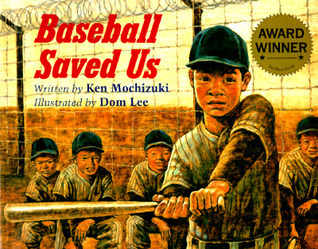
Shorty and his family, along with thousands of Japanese Americans, are sent to an internment camp after the attack on Pearl Harbor. Fighting the heat and dust of the desert, Shorty and his father decide to build a baseball diamond and form a league in order to boost the spirits of the internees. Shorty quickly learns that he is playing not only to win, but to gain dignity and self-respect as well.
Baseball Saved Us is the ultimate rite of passage story. It will appeal again and again to readers who enjoy cheering for the underdog.
Baseball season's coming around, and lately I have been reading WWII--and specifically internment--books, never in my youth having learned about anything of this from my educational system, so I thought I would read a book about baseball. . . and racism, just to cheer myself up, obviously. As you may now know, after the bombing of Pearl Harbor the U. S. decided to imprison Japanese-American families in the desert for around three years, no questions asked, because of their possible threat to American safety and well-being. With no evidence of there being any danger from any specific individuals.
i just read the similar Barbed Wire Baseball, by Marissa Moss, illustrated by Yuko Shimizu, which has as its advantage that it is about an actual heroic Japanese-American coach and player, Zeni Zenimura, who took the lead in building a baseball field and stands in one of these camps, developing multiple leagues with many teams.
In Baseball Saved us we have a fictional story, presumably based in part in the story of Ken Mochizuki's own father's internment in a camp. It's illustrated by Don Lee, in a similar style to Shimizu's Barbed Wire, a sepia-toned period style. But the story features a nameless boy and his father, who like Zenimura, leads the project of building a baseball field.
This story focuses on a short kid who overcomes among other things racism to become a good player. Baseball, in a sense, saves him, but it is only when he plays well that he seems to get white teammates on his side, as happened with Jackie Robinson. There's a silent white (and armed) guard in a tower who gives him a thumbs up when he gets a winning hit, but this moment isn't a huge victory, right? Why should they have to be "saved" at all?!
This is a good way to introduce young kids to this shameful historical moment. The internment and racism is definitely there in the story to ask questions about. I like the idea of using both books (and more; Farewell to Manzanar, and many others). A bittersweet nod to baseball, the "All American" sport. . .
This book might be a good starting point for introducing youngsters to the period of U.S. history in which the government forced Japanese-American families into so-called internment camps after Pearl Harbor, even though there’s no concrete sense of historical facts in the story, such as how long the family was confined or the condition of their house after they were allowed to return it.
Other discussions might arise from the text, I would hope, such as the acceptance the boy is afforded only after he becomes a better ballplayer. For the same age group, there’s also Barbed Wire Baseball.
This “banned” book was an easy five stars and evidence that people Want to erase our shameful history rather than learn from it. I found the story’s way into the discussion of Japanese internment camps through a young boy’s experience with baseball to be a nice way to introduce it to children. It’s not exaggerating or shaming, but clearly giving voice to children and families who were put into camps. In short, this story should be told and discussed. Let’s not erase history, but find ways to not repeat it.
A young Japanese-American boy narrates this story of his experiences in an internment camp during World War II, describing how his father helped to create a baseball field and league in the camp, and how he played with one of the children's teams. Not very good at first, the boy improves, and when he and his family return home after the war, his new skills give him a means of finding his place with his peers...
Having recently read Marissa Moss's Barbed Wire Baseball, a picture-book biography of Kenichi "Zeni" Zenimura, a Japanese-American baseball player who did indeed create a baseball league at the Gila River internment camp, I was reminded of Baseball Saved Us, which I read years ago, when it first came out. It's clear that Ken Mochizuki's fictional story is inspired by Zenimura's real life one, although his own parents' experiences in the Minodoka camp in Idaho must surely have also been an influence. I found the story here moving, although I did think that the transition from camp to post-camp life was very abrupt. One moment the boy is hitting a home run in a baseball game at the camp, and then on the next page his family is back home on the west coast. Although this was rather jarring - there needed to be some bridging incident, to tie the two parts of the story together, I think - I nevertheless found the narrative engaging, and entered into the main character's feelings throughout. The artwork was likewise engrossing, building upon the emotional undercurrents in each scene. Created in an unusual medium - scratched out from encaustic beeswax on paper, and then colored with oil paint - it was very expressive, and often had an interesting sepia tone that matched the story quite well. If half stars were available, this would get a 3.5 rating from me, given the somewhat disjointed narrative, but my enjoyment of the artwork bumped it up to four stars. All in all, a solid children's book about a very difficult and shameful moment in American history, one I would recommend to picture-book readers looking for stories about the internment of the Japanese in World War II, or about baseball as a meaningful experience in a child's life.
This book describes how baseball helped the Japanese who were in internment camps during World War II find meaning and worth during their struggle.
This book is a wonderful asset to the Social Studies curriculum. It allows students to see that different groups of people were treated poorly during World War II. It also shows students that everyone can achieve great things no matter what their race is.
The illustrations also allow children to notice that the characters could be anyone. The facial features are not very distinct. The textures of the drawings also enhance the setting -- the camps were in deserts.
I’m forever amazed at the number of poignant stories swirling around the great game of baseball. Has any other game ever provided as many life lessons? Baseball Saved Us involves a Japanese-American boy whose family is part of the internment camp program during World War II. As he becomes aware of the hatred aimed at him and his race, he channels his emotions into baseball. This picture book is an excellent choice for helping young readers better understand many topics and issues: prejudice, World War II, governmental mistakes, emotional self-control, etc. Baseball Saved Us would work well for a read-aloud, book group discussion, or stand-alone text.
When Baseball Saved Us was published 25 years ago, it was described by reviewers as being about an important but neglected part of American history. Well, times have changed and more books for children about the internment of Japanese Americans during WWII have been written about this shameful period in our country's history. Yet, Baseball Saved Us is as important a book today as it was when it was first published.
The story is told in the first person by a young boy in an unnamed internment camp, whose father has decided to make a baseball field in the desert where the camp is located to give people something to do. Not particularly excited about that, the boy recalls that in school before being order to leave his home with his family, he was never picked to play on any sports teams when the other kids were choosing sides because of he was so much shorter and smaller that the other kids.
Everyone pulls together and soon the baseball field is finished, mattress ticking is turned into uniforms, teams are forms and it's time to play ball. Playing on one of these teams is easier for the boy because the other kids were pretty much the same size, but it didn't really help his game much.
During one game, he notices that the soldier in the guardhouse is watching him. Taking a few practice swings, the boy puts all his resentment and anger into his next swing, and sure enough, he made his first home run.
After the war, when the Japanese Americans who were held in internment camps are finally released and allowed to return home, the narrator finds himself once again alone at school. But when baseball season comes around, this time he proves himself a pretty good player, earning the nickname "Shorty." At a game, when it's his turn at bat, Shorty can hear the crowd screaming and calling him names. Thinking about the guard in the watchtower and how he took his anger out on the bat, Shorty once again calls on the feeling as the crowd jeers him and putting it all into his swing, sends the ball over the fence, saving the day for his team.
Of course, this isn't really a story about baseball, but it is one about racism and offers a constructive way of dealing with feelings of anger and resentment, while gaining a sense of dignity and self-respect. It's interesting that the narrator has no name until the boys at school after the war give him a nickname. It's as though he had lost his identity until he began believing in himself.
Baseball Saved Us is not just a good story with an important message. It is also a good book for introducing the whole history of Japanese American internment to young readers without overwhelming them. In the course of the story, Shorty says that he was taken out of school by his parents one day, and that his family soon found themselves living in horse stalls before moving to the camp in the desert, where they were subjected to dust storms and sand everywhere. He also points out that people were forced to lived in barracks without walls, to wait in line to eat or to use the bathroom, where there was no privacy. His older brother ate with his friends, but soon was refusing to do what his parents requested - a big problem with older kids in the internment camps. This offers a wonderful opportunity to expand on how people perceived to be an enemy of the United States can be treated so badly.
Supporting Shorty's narration and done in somber shades of brown and tan with splashes of color, Dom Lee's realistically detailed illustrations really bring this story, that has its roots in the author's parent's internment experiences, to life.
This is a book that many kids will find resonates in today's world even though it was written 25 years ago about the racism and prejudice that was so prevalent in WWII more than 70 years ago.
This book is recommended for readers age 7+ This book was borrowed from the NYPL
I was excited to see a picture book about the Japanese internment. On the one hand, I am thrilled that there is a book at this level that addresses this topic, but on the other hand, the story felt disconnected, and I didn't feel it had a clear message.
The book starts with a short paragraph introducing the Japanese internment. It sets just a little bit of context, enough for young audiences.
The opening scene is from within the internment camp. At first the book is like a non-fiction presentation of Japanese internment camps. Being narrated in the first person by a Japanese-American boy, there are glimpses into the past that show how the narrator felt different and picked on in school, before being sent to the camp. Even though he's just a boy, I didn't quite like how he happened to be smaller than all his classmates, and not very good at sports, perpetuating the "emasculated Asian man" stereotype.
At one point, there is a scene in which the narrator's older brother shockingly talks back to his father. This moment is meant to be the catalyst for the creation of the baseball field, but the connection isn't explained, and the story feels disjointed.
Just as the story starts to get into how everyone in the camp is getting into baseball, it suddenly jumps to after the war. The narrator is back to playing baseball with his white teammates, and the events of a particular game parallel a dramatic game he played inside the camp. There is a climactic moment - and then the book ends. I didn't get a good sense of closure.
I did appreciate the sepia-toned illustrations. I thought the images of the barren desert, long lines outside of barracks, barbed-wire fences, and armed guards were poignant and accurate depictions of Japanese internment camps.
I also think any young baseball fan would really enjoy this book. It's perhaps less of a book about Japanese-Americans playing baseball in internment camps, and more about a Japanese-American boy who learned to play baseball while in an internment camp, which later on helped him to fit in better with his white classmates.
My favorite part of the book “Baseball Saved Us” was when the Japanese people were in the camp playing baseball and were clowning on the player and then he proved that he was good at playing baseball. This book is about the Japanese war. The Japanese people were being sent to concentration camps because they were not trusted because they thought that they were gunna be connections to the Japanese soldiers. Well I think that this book should be like for 2nd- 4th graders because in my prospective I think it will show them how you can always move forward and ignore most of all of the bad comments that are being said about them. I think that a parent would want to choose this book for their child because it will show their son/daughter how life is going to be while there growing up. The theme of this book is that even if you’re different from others you can still be someone in life. Well what I mostly enjoyed about this book is that the boy never gave up even though people were talking about him and saying bad thing to him he got to believe in himself and move ahead.
Definitely not a shining moment for America; but it is something that needs to be remembered so that it never happens again.
Ages: 7 - 12
Cleanliness: the word "Jap" is used twice. A boy gets angry and disrespectful to his dad.
**Like my reviews? Then you should follow me! Because I have hundreds more just like this one. With each review, I provide a Cleanliness Report, mentioning any objectionable content I come across so that parents and/or conscientious readers (like me) can determine beforehand whether they want to read a book or not. Content surprises are super annoying, especially when you’re 100+ pages in, so here’s my attempt to help you avoid that!
So Follow or Friend me here on GoodReads! And be sure to check out my bio page to learn a little about me and the Picture Book/Chapter Book Calendars I sell on Etsy!
Baseball Saved Us is a story written by Ken Mochizuki and illustrated by Dom Lee. This book was originally published in 1993 but the version I read was an anniversary edition published in 2018. The main character is a young Asian American boy who is never named, but is referred to in the later pages of the book as Shorty. This story is a fictionalized account of real events that took place in America in the 1940s. Though it is unclear if the author himself went to an internment camp, his parents were sent to one in Idaho (Minidoka Camp). I found this book originally in the Historical Fiction chapter of the Children's Books in Children's Hands textbook, but discovered the newer, updated version on Amazon's list of 100 best-selling historical fiction picture books for children. This book is recommended for ages 11-12 to read independently, but recommended for grades k-2. I think this is way off though. This book has a lot of text and children in younger grades would need to sit through multiple reading sessions. There is also a lot of vocabulary that is most likely unfamiliar or complex for young students, so there would need to be a lot of pre-teaching. I also just think that this book would be beneficial in grades older than the recommended grade levels. This book could even be used with middle school grades because the content and themes would be more deeply understood by them. This book has won a few awards, including a Lee and Low Books Award, a Best Multicultural title Cuffies Award, and an Editor's Choice for the San Francisco Chronicle. It has also been selected as a "Not Just for Children Anymore" selection from the Children's Book Council and a Cooperative Children's Book Center Choice. It has also been praised in reviews by School Library Journal, Kirkus Reviews, Publisher's Weekly, and Asian Reporter. I read this book in an ebook/read aloud format on Epic books. There was the option to flip through the ebook on your own or listen to the book and follow along. I chose to listen to the book. I like that the book was read aloud by the author because it gave the story a more authentic feel. I also liked that I could follow along and see the words and the pictures clearly as I listened to the story.
Synopsis/Diversity:This is a story about a dark time in American history. Shorty and his family are Japanese Americans living in the 1940s in America. After Pearl Harbor was attacked by Japan, Shorty and his family, along with many other Japanese Americans are forced to relocate from their homes and are placed in internment camps with guards in towers and barbed-wire fences keeping them in, in the middle of deserts and swamplands around the US. They are forced to endure brutal cold, heat, and hunger, among other issues at these camps. They all need something to look forward to and enjoy, so Shorty’s father and many other families pitch in to help create a baseball field in the middle of this unlikely place. Thus, a baseball league was born. Shorty and all the other inmates at the Camp are saved by the creation of this league, which gives them hope, strength, courage, and the endurance to fight through this injustice and make it safely back home one day.
This is also a diverse perspective story. This story is about Asian Americans, specifically Japanese Americans. Though these are really the only people featured in the book, aside from other children that appear white who are mocking Shorty when he returns home, this is a perspective that is not really featured too much in literature. I never even really knew about the Japanese American internment camps until only a few years ago. I never learned about it in school, let alone read any books told from the perspective of people who may have been there or fictionalized accounts from a first person perspective. I think this book is one of the first, at least for children, to focus on this topic and handle it in such a way that would make sense to children and explains the horrors in child-appropriate ways. This also seems to be an own voice story. The author and illustrator are both Asian Americans, with the author being Japanese, specifically. It doesn’t appear that he was ever in an internment camp, but he does speak from some experience because his parents were sent to an internment camp.
Illustrations/Text: The illustrations are so beautiful and are very reminiscent of a time in the past. The coloring of the pictures also create a mood for the reader. The tone of the pictures is somber and the illustrations are colored in a lot of grey/brown. The photos are not extremely colorful, except for when they are playing baseball. Even when they are playing baseball at the camp though, there isn’t too much color. The grass is green and the sky is a little blue with a lot of clouds. When Shorty and his family leave the internment camp and go back home, the colors are a little more vivid when he is playing baseball, signifying that maybe these experiences are more positive. The pictures look as though they have been painted and you can actually see some of the brush strokes still present. The settings are very simple, but I love how the focus is on the characters. The illustrator uses so much detail in the characters to bring them to life and add to the words in the story. For example, on one page, Shorty’s brother Teddy talks back to their father. Shorty says that the older men are all shocked and cannot believe the way he spoke to his dad. Shorty himself has also never seen his brother talk to his father that way. Readers can see the literal shock on everyone’s faces in the background, including Shorty. When Shorty goes back to school after getting out of the internment camp, readers can see how lonely and sad he is and can feel what he is feeling through the pictures. It evokes strong emotion and helps readers see that just because they have left the internment camps, it didn’t mean that there weren’t still very real problems facing Japanese Americans in the real world. There are different kinds of illustrations throughout the book. Some are double page illustrations, there are some single page illustrations with text on the page, and others are similar to comic strip illustrations, with three or four panels of pictures on a page, with the other page featuring the text.
I think that the story is so much more powerful when it is told in the first person perspective. I also think that it is helpful and more relatable when it is told from the perspective of the young boy. The author does a nice job of explaining and saying things in Shorty’s voice and it actually sounds like a kid speaking. One of my favorite parts is when Shorty explains that “He said people needed something to do in Camp. We weren’t in a camp that was fun, like summer camp. Ours was in the middle of nowhere, and we were behind a barbed-wire fence”. The author makes the character speak like he is talking to children. It makes sense that children would have the misconception that camp is a fun place, so Shorty had to make sure to let them know that this was a different kind of camp. He also explained what made this camp different from the kind of camp most children are used to, with its barbed-wire and men with guns forcing them to stay there. The author does a good job of showing how camp can change people as well. In one instance, Shorty watches his brother talk to his dad disrespectfully. Shorty even mentions that he has never heard his brother talk to his father that way and that at home, no one ever dared to talk to their elders in such a way. This goes to show that the camp has changed him, and not for the better. It goes to show that no one understands what they are all going through and that they are facing some really difficult things and that everyone handles them in different ways. The authors created a very emotional piece of literature through the words and pictures. I felt so many different feelings when reading this story. Much like with my other review this week, I felt so bad for the families that had to go through this. I felt disgusted and angry that something like this was allowed to happen in history. I felt so sad for Shorty when he returned home and people were calling him names and isolating him. I have felt that way before, so I could relate to Shorty and wished that there was something I could do to help him (even though he is a fictional character). I felt joy and felt proud of Shorty when he was able to win the baseball game for his team.
Historical Fiction Elements: I would definitely say that this story is classified as a high quality historical fiction story based on the criteria in the textbook (Children’s Books in Children’s Hands). One of the criteria for evaluating historical fiction is whether the author brings the setting to life by using authentic details that don’t overwhelm the story. This is definitely true about this story. Because the story takes place in an internment camp in the middle of a desert or swampland, the details of the setting are minimal, but still very powerful. Readers can see how miserable it must be to live in this camp during this time. All of the inmates have to use the bathroom in large groups in a small tin house. They have to wait in line outside in the scorching sun. This is shown in one of the pictures. The barbed-wire fences and towers with soldiers with guns watching over them are shown in numerous pictures as well. These details don’t overwhelm the reader though, but still makes it feel like we know exactly where this story is taking place. Another aspect to consider is whether the characters behave in ways that are believable for the time period they live in. Again, this is present in this story. Shorty definitely feels like an authentic and believable character. Even his brother, Teddy, does too. As I mentioned above, Teddy goes off on his father in the camp, but has never done this when they were living at home. This is also believable because they are under a lot of stress and dealing with a lot of unpleasant conditions while living at this camp, so this can make people behave in ways they wouldn’t normally behave. The conflicts are plausible as well. They are living in such a bad situation in the internment camps, so why not make the bad situation a little better by giving themselves something that they can get excited about and that can bring them a little joy during their despair. Lastly, the story may be set in the past, but the themes are very much relevant. Themes of bullying, isolation, war, self-identity, tolerance, acceptance, family, teamwork, and how sports can make a difference and provide people with hope are all things that are still very relevant today.
Classroom Uses: This is definitely a book I would use in the classroom. I would use it as a read aloud, but also make the book available in my classroom library for students to read on their own. As a read aloud, I would engage students in discussions about fairness and how this was allowed to happen in American history. Discussions about if they think this was fair or not and why would be a good companion to this book. This could even be used as a writing prompt. Students could also write in a journal and pretend that they are Shorty, or any child living in a Japanese internment camp and share what they think that experience would be like, using this book and other literature to support their writing. It would be a good read aloud to just expose students to this tragic time in American history, especially during Asian American Pacific Islander Month. As I mentioned, I didn’t even know about the internment of Japanese Americans in our history until a few years ago, so I am sure many other students aren’t aware of this either. This would be a good book to expose them to this topic in a developmentally appropriate way.
My son and I loved this book due to our love for baseball and the history that it tells within the story. It shows how a child rises up from a tragedy. This would be a great history book based on baseball and the past in general.
Text Set: Social Tragedy Subject Matter: Interment Camp / Discrimination Published: 1993 Book 5
This books deals with an often overlooked social tragedy in United State's history, the interment of Japanese citizens during WWII.
In Baseball Saved US Ken Mochizuki uses a young boy nicknamed Shorty, because of his size, as a vehicle to show different groups of people were treated poorly during WWII. More than that, though, this is a story of resilience and how triumph is possible in the most difficult and unlikely of times.
The story starts with Shorty and his family being taken to an interment camp. His father explains to him what is going on and the injustice of the situation. After being moved around and squalling in the desert prison Shorty's father decides it is time to build a baseball field. The community rallies around the sport to boost moral and it works. Shorty is not very good but practices to get better. He is oddly motivated by a guard who is constantly watching them from atop his watch tower. In a dramatic scene when Shorty is in a game winning situation he looks at the guard and feels anger, and resolves to hit the ball all the way to the tower. He does, and his team wins the game.
My favorite part of this book is what happens next. He finds himself alone in a school cafeteria dealing with the prejudice towards Japaneses that followed WWII. It would have been easy for Mochizuki to end the book with the home-run, but there was more to this injustice that must be shared. So the story continues and Shorty experiences isolation, racial slurs and mocking by many around him. Then at the end of the story he is again up to bat, facing a game winning situation. The crowd is heckling him but he remembers that guard in the tower and blocks out the noise. Again, Shorty comes up big for his team.
Baseball Saved Us shows the reader the difficult time Japanese-American citizen had during and after WWII, but Mochizuki uses baseball as vehicle to show the battle one wages in finding their spot in society. His team is behind him but he still has prove himself to the crowd and ultimately that is who he is trying to show his skills to.
The illustrations by Dom Lee are brilliant and truly bring this book to life. His use of frames and space bring so much more to this book. This text describes the painful reality of this dark moment in American history in a frank, perhaps understated way. This frank approach is necessary because it's a story that is often overlooked, especially when the focus of much of WWII literature is on what happened in Europe. It is an uplifting story of resilience but one that teaches lessons on racism, prejudice, and discrimination.
Genre: Historical Fiction Grade Levels: 2-5 Special Notes: Challenged Book (New Milford, Conn. Schools, 2006); Published in 1993 (this book is my one exception to the contemporary rule!) "Baseball Saved Us" is a great book to read to children when discussing Pearl Harbor. We often neglect to look at how Japanese-Americans were affected by this event. In this story, a Japanese American child was living in a Japanese internment camp because what had happened at Pearl Harbor. He described the conditions and hardships faced at the camp. As an escape, the people in the camp worked together to build a baseball field. It was neat to see how the characters used baseball as a way to escape what was going on. It was very upsetting when the child was released from the camp and still called names by his peers, who did not look like him. This book allows for us to get a first hand look into how Japanese Americans were treated and how they might have felt as others looked down upon them and felt as they were a danger just because of the way they looked. Written from the perspective of a child, I think it allows students to easily imagine what it would have been like to be the kid in the internment camp. Students can further relate to the book because of baseball (or sports in general.) Students see that no matter your ethnicity/sitautions, you may have more in common than you think. I think it is very important as a teacher to teach from many different perspectives and this book gives an awesome way to do that. This book also introduces the idea of treating everyone the way we want to be treated. If we are playing sports and do not want to be called names, we shouldn't call others names. This is a challenged book because of the few racial slurs when characters use "Jap" as a taunt. For example, they say "The Jap's no good!" Because the book itself is not promoting that language use and is actually showing how it is hurtful, I do not believe that the book should be challenged or banned. It truly shows what might have been said during the time of tension after Pearl Harbor, and I think it is important for students to learn about the realities of that. I think this book also opens up the discussion of why books are challenged/banned and if students think it should be banned or not.
Summary/A Thoughtful Review: Baseball Saved Us, appropriate for upper elementary readers, tells the story of a young boy's experience while imprisoned in the Japanese internment camps in the early 1940s. The illustrations and text work together in beautiful harmony as they create images of the dismal, desolate, conditions of this "camp" in the American desert. A place with "dry, cracked dirt," dust storms blowing sand everywhere, public bathroom facilities, and the small, wall-less barracks where "babies cried at night and kept [everyone:] up," all fenced in by barbed-wire fences and armed soldiers to make sure everyone stayed there. As a reader, you are taken to this unpleasant residence through the eyes of a young Japanese boy as you follow his experiences and journey of emotions. It begins with his confusion as he asks his father, "why are we here" and his disbelief as cultural and family dynamics have changed at "camp" (elders sitting/standing around, children disrespecting parents). We experience the intense desperation and depression of these Japanese American prisoners, until the young boy's father proposes a change: baseball! The entire community of prisoners finds a new purpose and sense of hopefulness as they build the field and bleachers, sew uniforms, and practice/play together! Through practice and determination, baseball helps the boy to find courage and true skill within himself. Ken Mochizuki draws an interesting parallel between the game of baseball and that of life as we experience this boy’s struggle to be a part of the “team” (both baseball and society) and find a “position” where he feels confident and successful. Through his emotional journey of confusion, pain, hopefulness, and determination, we see this young boy find his true strength within himself. What a deep message! It is also interesting to read about this unpleasant time in American history, as it is not commonplace in textbooks or historical fiction works. Mochizuki, again, does a dynamite job drawing readers into this time period, however uncomfortable it may be.
Baseball Saved Us by Ken Mochizuki was written about how the main character Shorty and his family were sent away to internment camp after the attack on Pearl Harbor. During their time at the camp Shorty and his dad decided to create a baseball field, with the help of other people at the camps. This allowed them time to do something they wanted, and distracted them from life at the camp. “Baseball Saved Us” helps tell the story of life before, during and after the time at the camp while showing the negatives of the camp. Throughout Shorty’s time playing baseball, he was always thought to be the little guy who was not very good. Overtime, Shorty was motivated to play really well because of the guard that was always watching him. After camp, Shorty was being made fun of at school because he was being called “Jap,” which he knew was rude from his classmates. Towards the end he was playing baseball and everyone thought that he was not going to do well, but he hit a homerun to help win the game. This proves how perseverance can help you get through tough situations in life, and help prove who you are to other people.
This book is often controversial because it includes some touchy subjects that many teachers do not want to elaborate on if they do not need to. In Baseball Saved Us, there are many different topics that many teachers do not know how to deal with. It is often not their place, to talk about racism and the history of the Japanese internment camps after Pearl Harbor, and is often overlooked in classrooms.
I think that I would use this book in my classroom because it shows a different story of life post Pearl Harbor, that also show determination and perseverance. Throughout the book, Shorty was always the underdog but continued to show his strong will to win the game as well as determination through the tough battles of bullying. This book would be a beneficial book to introduce students to WWII, and the internment camps that are too often overlooked. I think that students would be able to connect to this story because of the baseball aspect and how Baseball Saved Us is from a childs perspective.
Baseball Saved Us by Ken Mochizuki Genre: Historical Fiction Interest level: Grades 3-5 Guided reading: O Lexile level: 550L Main Characters: "Shorty" POV: Summary: This is the story of a boy who describes his time in a Japanese internment camp in the United States during World War II. He talks about how boring it was in the camp and one day, the adults and kids decided to make a baseball field in the dirt to help pass the time. It took a while, but when they were done, they would play. The boy wasn’t very good at baseball and frequently struck out which caused the other kids to make fun of him. One day he came up to bat at a crucial time in the game, he was down to his last strike when he saw an American soldier looking over the camp and watching the game, which made him mad. That energy helped him swing as hard as he could and win the game for his team. After he was out of the internment camp, he faced the same situation in another baseball game. He was made fun of again, but this time for being Japanese. The book ends with him hitting a homerun and winning the game for him team.
Classroom use: This is a great story because it uses the point of view of a child during a difficult time in history. I think kids would be able to connect with since it’s from a boy’s point of view and incorporates baseball, something they’re familiar with. Despite this book’s interest level, I would use it as part of an introduction to a unit on World War II for older students. Japanese internment camps in the United States is an aspect that is frequently looked over, since it’s such a shameful time for the country. I think this book would bring a focus to that time and the experiences of innocent people in our own country and how we treated them out of fear. Also, this book can serve as a way to bring about the equally important Pacific side of the war since the European side is what is often focused on when World War II comes up.
I absolutely loved Baseball Saved Us by Ken Mochizuki and Dom Lee. I listened to the audio version, narrated by Nate Connelly.
"One day my dad looked out at the endless dessert and decided then and there that he would build a baseball field..."
This story takes place a time when America was at war with Japan. As the dad explains in the story, the government placed Japanese Americans into internment camps because the government assumed they could not be trusted. The Japanese were torn from their homes and thrown in horse stables before moving into camps. The place was small and had no walls, babies screamed at night, and it was freezing at night. People started losing their sanity and became angry and tense. Dad decided to build a baseball field so that the Japanese prisoners could be distracted from their pain and suffering and find some sort of happiness and excitement again!
I would recommend this book for 1st through 6th graders. It is a 3rd grade reading level. Before students read the story, you might want them to discuss one of the following questions as a motivation for reading. Prior to reading, I would teach students about Japanese internment camps. I would explain how the Japanese Americans did not do anything wrong, but they were forced away from their homes. I would ask a "before reading" discussion question, such as "Do you think it was fair the government to take them from their home and make them move far away? How would you feel if this happened to your family?" I would also discuss themes of tolerance and equality.
Awards: Lee & Low Books Award Winner Best Multicultural Title - Cuffies Award- Publisher's Weekly Choices- Cooperative Children's Book Center (CCBC) Editor's Choice- San Francisco Chronicle Not Just for Children Anymore Selection- Children's Book Council
A brief note: This Historical Fiction children’s book was listed as “challenged, restricted, removed, or banned in 2006–2007 as reported in the Newsletter on Intellectual Freedom from May 2006 through May 2007.”
This story follows a young Japanese-American boy and his family as they make their way in an Internment Camp in the U.S. During WW2. The boy watches as his father organizes members of the camp in order to create a baseball field for the prisoners. Everyone imprisoned in the camp chips in -- uniforms are made from mattress covers, fields are irrigated and bleacher created from cast-off scrap wood. The prisoners gain community and some comfort from this uniquely American game, while, as Americans, they struggle to survive in this terrible situation.
In general, I think this chapter of American History gets forgotten or glossed-over, and it is important that at any age, we continue to teach the truth about our country’s past mistakes. On a closer level, this book would be a good companion piece to any discussions concerning bullying. The main character deals with his own peers in the camp teasing him about his short stature, and the teasing ramps up to bullying when he is attending school again after the war. There are many points throughout the story that in a Read-Aloud, a teacher could ask some very difficult but important questions on how we should treat each other. This book could also open up a discussion when a class is creating a Social Contract.
As an added bonus, the way in which the prisoners Engineer a baseball field using the materials available to them could tie into several Engineering Challenges, or introduce the Engineering Design Process itself.
In this picture book, a boy named Shorty is one of the main characters. He is given that nickname because of his size. They year takes place in 1942 during World War II. Shorty and his family are sent to an internment camp after the Japanese attack Pearl Harbor. During the camp, Shorty and his father decide to have the whole camp build a baseball diamond and form a league. They make uniforms and find equipment that will work. His father believed that people needed to take their mind off of the current situation and find something to do. It was a good distraction for everybody. One day during the game Shorty got mad about being a prisoner and got so mad that it gave him the motivation to hit a game winning home run. The war soon ends and he is able to return home. He continues to play baseball and channels his anger towards what happened to them through baseball. I liked this book because it had a lot off good aspects in it. I liked how it talked about the war and what happened to the Japanese people. I thought it was a great way to teach about the internment camp and why they did what they did. I also liked how they used baseball as a distraction. This is a sport that a lot of fathers and sons can relate to because they play it so much. They were able to act normally even when there are bad things surrounding them. It is a very inspiring story and I think kids should really read it. It teaches kid about the history and gives them a good story to go with it. I also thought the illustrations were good and kept the book interesting. I would definitely recommend this to other people.
I read this book during an undergraduate children's literature class and have always thought it was a really great story. The illustrations are powerful and play a big part in the telling of Mochizuki's story, which is actually based on his own parents experiences in a Japanese internment camp. An activity that really turned me on to this story was the "in their shoes" activity where the students take on the role of a story character and answer questions asked by their peer audience. The challenge is that the students have to think like their character and answer as that person might actually answer. The audience is just as engaged because they are challenged to come up with questions that might stump the actors and also bring up issues and ideas from the story. I also enjoy way the illustrations occupy each page in a different way. Some illustrations are a full page with a white border, others are a series of three illustrations separated by the same thick white border, and even others cover both pages of a two page spread, but are slightly off balance. When I first read this book I thought the illustrations were some kind of Japanese woodblock print due to the scratched surface and lack of detail. However, after I looked further into it I found that the illustrator actually created these rough images by applying encaustic beeswax onto paper, then scratching out images, and adding oil paint for color. This technique definitely added a somber tone, which went well with the story.
I loved this book. I used it often in teaching. I first stumbled upon this book when I was browsing for sports book to fill my Fifth Grade classroom library. I thumbed through it, and thought it would be a nice choice. Little did I know what a great tool it would be come for an entirely different reason.
When I finally sat down with "Baseball Saved Us" I soon realized I could use this as an enforcer to the World War II Unit we would be studying soon. The book tells the story of a boy and his family in a Japanese-American internment camp during WW II. The parents of the camp see the need to give their children a focus and happiness in sucha gloomy situtation. The children learn to work together and excell at the game of baseball. Upon "release" from the internement camp, the boy uses this understanding of the game as a way to assimilate back into the community he was ripped from.
This was a perfect book not only to teach the history of World War II, but of tolerence and discrimination. And having a sports-themed picture book could hook most students in!
The illustrations (by Dom Lee) in the book are wonderful. They depict the horrible injustice of the Japanese-American internment camp, as well as the joyful ending when you see Japanases and White kids jumping and hugging together becasue they won the baseball game.
I would recommend having this one at arms reach to open a lesson, or simply to have around the classroom for students to explore themselves.
I am personally a huge fan of baseball therefore I enjoy almost any book that revolves around the sport. Not only did I enjoy the sports aspects of it, I enjoyed the historical aspects as well, such as Pearl Harbor and the internment camps, as I was reading it I could feel the boredom everyone faced in the beginning and then the excitement they felt when they started playing baseball. The story was very realistic and will be very enjoyable for most students. Purposes in the Classroom: As I was reading the book I could not help but think how useful this book will be in the classroom. If I were to read this book aloud I would incorporate with my social studies unit regarding World War II, Pearl Harbor and the internment camps. I believe the students could make really good connections between the literature and the history. When it comes to independent reading, I would have this book in my classroom library if I were teaching fourth or fifth grade. Any student who is interested in sports and America’s history would find this book very enjoyable. Literary Elements: There are a few literary elements that are very strong throughout this story. The illustrations add so much to the story and the setting. It makes the story so much more realistic and able to connect to. Also I feel like the theme is an important message for all students, that anything great can come out of something awful if you put your mind to it.
In Baseball Saved Us the main character was a kid who was living throughout World War 2 with his family but was playing baseball. There were many things going on, things that the main character couldn't ignore but wanted to. Baseball was a way of distraction for the child.Throughout many things that were happening during the war in Japan, the main character was able to be strong enough with the help of going away for a while to camp and playing baseball.
I think this book would be best suited for 11 years olds or 4th and 5th graders because kids this age can somewhat relate to the main character in this book. They can see how rough it was for the main character to be living with war ,away from his family, in camp and how strong he was able to stay, that there are things that can help not be so nagative about situations.
A parent might choose this book becuase this book would give children the learning and image of strength and positive attitude that they can use in their lifes.In the book the encouragment of his friends in camp helped him pick himself up more with how he was feeling and baseball was also something that had been picking him up.
What I enjoyed most about this book was the message this book was giving out and also how one can relate to it in real life.
Ken Mochizuki reads aloud his book, Baseball Saved Us. The story takes place during and briefly after WWII. The author’s own parents were sent to an internment camp in Idaho during the war. With knowledge of his own family history, Mochizuki creates a story about a boy and his family who suddenly find themselves in an internment camp. Their boredom and frustration leads them to build a baseball field within the barbed-wire fences that they live. The game brings people together and gives the boy a sense of joy until the war is over. When his family finally returns home, the boy is not welcomed by his neighbors and classmates. He experiences racism because he is Japanese. He continues his baseball career and in the end proves himself in an over the fence hit. Mochizuki reads his story in the audio CD. His voice is calm, perhaps too calm as it lacks excitement. The story is told very simply with basic sequential events, perhaps showing how the story would be told from a young boy’s perspective. It would be a good book to introduce the idea of racism or internment camps to younger readers. The simple language would not interfere with readers understanding the historical features and concept of racism.
In this moving tribute to human courage and dignity (written by the child of Japanese internees), a young Japanese boy describes his time in the American internment camps during WWII. Recognizing that enforced idleness is detrimental to their humanity, the inmates build a baseball field and organize teams to pass the time of their imprisonment. They choose an American game, rejecting their label as non-Americans, and the boy grows in his skill by playing all through the camp. It is through this skill that he young boy faces the hatred and prejudice of his home community when his family is finally released.
In a climactic closing scene, the young boy stands up to bat amid the racist jeers of the opposing team, and sees in his mind the accusing guard, standing on the watchtower, watching Japanese-American families play baseball below him. In response to this memory, his courage rises, and instead of wilting in defeat he rallies to meet the challenge. We see him finally being celebrated by his teammates in jubilant celebration of his winning hit.
The illustrations are breathtaking, and the text describes the painful reality of this dark moment in American history in a clear, understated way, without bitterness. An unusual and outstanding book.
We borrowed this book from our local library as part of a kit with a paperback book and an audiocassette that is narrated by the author. It was a touching story and while I was afraid at first that it would appeal more to boys because of the baseball theme, we all really liked it.
It tells about the internment of over 100,000 Japanese Americans and Japanese citizens who lived along the Pacific coast of the United States during WWII. It speaks of the hatred and prejudice of Americans for the Japanese, especially following the bombing of Pearl Harbor. But it also shines with the strength of human spirit and the determination to have something to hang on to, something to believe in, even if it's just a game of baseball.
This is just one boy's story, about what he experiences in the camps and immediately following his family's release. It's not an easy story and I was grateful that we were able to listen to the author in his own words. The illustrations are great and complement the story nicely. While the story evokes mixed emotions throughout, it is an important tale to tell and I'm so very glad that I was able to share this one with our girls. We really enjoyed listening to this story together.
This book is seriously one of my favorites. Being a long time baseball fan and of had playing the game for over 13 years I appreciate this book a ton. The book revolves around an Asian family during the WW2 area. The author's own parents we sent to an internment camp in Idaho during the war. This book I can only imagine was written directly from the heart and is extremely important to the author. Knowing this information makes the book 10 times better. The book talks about how the family out of their boredom find their way to a baseball field. The games brought people together. For a short while nothing outside the diamond mattered. It took the boys mind off war, for a short time he was at peace. The boy is treated horribly and experiences harsh racism until one day he hits a homerun over the fence and earns the other kids respect. This book is so close to the author that I can't but love this book. It;s not just reading a story, it's reading about someones life. The illustrations are well done, you almost live vicariously through the images themselves to get a better understanding of how tough his life was at such a young age.
This book is a great one to share with students, particularly grades 3-5 maybe even 2nd. In this story Shorty a Japanese boy shares his experience during the time Japan and the US were at war. The main character expresses what it was it like to be a Japanese American during that time and how baseball gave them something to look forward to during their hardships. A teacher can use this book in their instruction to discuss the issues of racial injustice from a students point of view. In reading this story students will be able to understand racial injustice more clearly because it comes from a child's perspective. A teacher can also use the story as the basis of a interactive lesson. He/she could have their students confined to a place to see exactly what it was like for the Japanese Americans that were discussed in this book. This book is such a great example of historical fiction and opens up students eyes to see and understand that children just like them were effected by racial injustice in America. Never loosing hope and knowing that you can always make the best out of horrible situation is great lesson that can be taught through this book. Just look at Shorty and his family.