

What do you think?

Sadako will leben
Davno je izrečeno kako je povijest učiteljica života. Da bismo bili mudriji, plemenitiji, bolji i suosjećajniji moramo ponekad zagledati u sudbine koje iz nekih prošlih vremena i okolnosti zrcale stradavanja i patnje drugih. Ova knjiga priča dirljivu priču o djevojčici Sadako, koja u bolu, dvojbama, razmišljanjima i nadi provodi posljednje dane u borbi za život osuđen na prerani kraj, uslijed eksplozije atomske bombe i radioaktivnog zračenja kao posljedice.
Hardcover
First published January 1, 1961
Ratings & Reviews
Friends & Following
Create a free account to discover what your friends think of this book!
Community Reviews
Displaying 1 - 30 of 129 reviews

August 5, 2017
Alle soglie della seconda guerra mondiale, Hiroshima è una grigia città sede di diverse basi militari. Scigheo, 10 anni, e la sorellina Sadako, di 4, girano tutto il giorno per i suoi poveri quartieri alla ricerca di cibo, trascurati dalla madre, che lavora duramente in fabbrica, e dal padre, soldato.
Poi, un giorno tutto cambia. E un gran sole pare scendere dal cielo sulla terra, come un girone infernale che inghiotte la città e i suoi abitanti. E’ la bomba atomica, sganciata su Hiroshima dall’esercito americano in contro risposta all’offensiva giapponese di Pearl Harbour: in pochi istanti la città viene completamente rasa al suolo e i suoi abitanti annientati come polvere. Si parla di oltre 80.000 vittime solo al momento dell’esplosione, che fu il primo attacco nucleare dall’effetto così devastante in tutta la storia moderna. Scigheo e Sadako riescono miracolosamente a sopravvivere, e tornano a casa dove, a poco a poco, tentano di ricostruirsi una vita. Ma se pensiamo che la storia finisca così, con una consolante happy ending, beh, purtroppo ci sbagliamo. Perché la bomba non ha smesso di uccidere dopo essere scoppiata, i suoi malefici effetti si sono insinuati sotto l’anima e la pelle dei sopravvissuti e lì hanno covato, per anni e anni, portando poi ad esiti tragici anche per chi pensava di esserne scampato.
Di fatto, nessuno è sopravvissuto da Hiroshima, ma Sadako, la piccola Sadako, riuscirà, con la sua forza e col suo coraggio, a dare una lezione di vita a tutti, anche al lettore.
Ho trovato questo libro, che volevo leggere da un po’, ad un mercatino del libro usato, alla modica cifra di 0,50 centesimi…e me ne stupisco, visto che ci sono sul commercio libri che costano 20 volte tanto e non valgono un’unghia di questo piccolo grande capolavoro. Il suo valore è immenso, sia come romanzo sia come documento storico. E non capisco perchè venga bollato come “romanzo per bambini o ragazzi”, non è una lettura facile da assimilare, è una testimonianza forte, cruda, amara che necessita di tempo per essere digerita, capita e assimilata. A distanza di giorni mi resta dentro una forte emozione per la storia che ha travolto i personaggi e per il modo dignitoso in cui ne sono venuti fuori…ma anche la triste consapevolezza di cosa l’uomo, nel corso della storia, è stato capace di concepire: l’annientamento totale di se stesso. Ancora oggi non è riuscito a concentrare la sua mente, la sua intelligenza, le sua abilità per inventare che so, un modo per salvaguardare dalla malattie mortali facendo del bene all’umanità intera. Però è riuscito benissimo ad escogitare un modo per annientare se stesso, su larga scala. Quanta amarezza.
Poi, un giorno tutto cambia. E un gran sole pare scendere dal cielo sulla terra, come un girone infernale che inghiotte la città e i suoi abitanti. E’ la bomba atomica, sganciata su Hiroshima dall’esercito americano in contro risposta all’offensiva giapponese di Pearl Harbour: in pochi istanti la città viene completamente rasa al suolo e i suoi abitanti annientati come polvere. Si parla di oltre 80.000 vittime solo al momento dell’esplosione, che fu il primo attacco nucleare dall’effetto così devastante in tutta la storia moderna. Scigheo e Sadako riescono miracolosamente a sopravvivere, e tornano a casa dove, a poco a poco, tentano di ricostruirsi una vita. Ma se pensiamo che la storia finisca così, con una consolante happy ending, beh, purtroppo ci sbagliamo. Perché la bomba non ha smesso di uccidere dopo essere scoppiata, i suoi malefici effetti si sono insinuati sotto l’anima e la pelle dei sopravvissuti e lì hanno covato, per anni e anni, portando poi ad esiti tragici anche per chi pensava di esserne scampato.
Di fatto, nessuno è sopravvissuto da Hiroshima, ma Sadako, la piccola Sadako, riuscirà, con la sua forza e col suo coraggio, a dare una lezione di vita a tutti, anche al lettore.
Ho trovato questo libro, che volevo leggere da un po’, ad un mercatino del libro usato, alla modica cifra di 0,50 centesimi…e me ne stupisco, visto che ci sono sul commercio libri che costano 20 volte tanto e non valgono un’unghia di questo piccolo grande capolavoro. Il suo valore è immenso, sia come romanzo sia come documento storico. E non capisco perchè venga bollato come “romanzo per bambini o ragazzi”, non è una lettura facile da assimilare, è una testimonianza forte, cruda, amara che necessita di tempo per essere digerita, capita e assimilata. A distanza di giorni mi resta dentro una forte emozione per la storia che ha travolto i personaggi e per il modo dignitoso in cui ne sono venuti fuori…ma anche la triste consapevolezza di cosa l’uomo, nel corso della storia, è stato capace di concepire: l’annientamento totale di se stesso. Ancora oggi non è riuscito a concentrare la sua mente, la sua intelligenza, le sua abilità per inventare che so, un modo per salvaguardare dalla malattie mortali facendo del bene all’umanità intera. Però è riuscito benissimo ad escogitare un modo per annientare se stesso, su larga scala. Quanta amarezza.
July 10, 2022
Nekada davno kao školsku lektiru sam pročitala ovaj roman i sjećam se da sam na kraju plakala nad sudbinom djevojčice koja umire od posljedica atomske bombe. Tada nisam u potpunosti razumjela društveno-historijski kontekst II svjetskog rata i bombardovanja Japana od strane Amerike.
Djevojčica Sadako vjeruje u narodno praznovjerje da će joj bogovi ispuniti jednu želju ukoliko napravi 1000 papirnih ždralova. Taj zadatak joj okuplja misli i pažnju posljednje dane na samrtnoj postelji, na kojoj umire od leukemije uzrokovane zračenjem. Njena borba za život prerasta u simbol i je u njenu čast je podignut spomenih djeci žrtvama atomske bombe.
Namjenjen dječijem uzrastu, roman osvjetljava tragediju koja je ostavila neizbrisiv trag na jedan narod i na cijeli svijet. Sama poruka romana je poziv da se takva nesreća nikad nigdje i nikome ne ponovi.
Tužno, bolno i potresno.
Djevojčica Sadako vjeruje u narodno praznovjerje da će joj bogovi ispuniti jednu želju ukoliko napravi 1000 papirnih ždralova. Taj zadatak joj okuplja misli i pažnju posljednje dane na samrtnoj postelji, na kojoj umire od leukemije uzrokovane zračenjem. Njena borba za život prerasta u simbol i je u njenu čast je podignut spomenih djeci žrtvama atomske bombe.
Namjenjen dječijem uzrastu, roman osvjetljava tragediju koja je ostavila neizbrisiv trag na jedan narod i na cijeli svijet. Sama poruka romana je poziv da se takva nesreća nikad nigdje i nikome ne ponovi.
Tužno, bolno i potresno.

March 25, 2012
I admire the story told by the Austrian writer Karl Bruckner. Vividly he pictures the situation in Japan at the end of World War II and the preparations by the American army to force Japan to surrender by dropping the first atom bomb in the town of Hiroshima.
The two principal characters survive the blast that followed the detonation of the bomb, but ten years afterwards fourteen year old Sadako gets seriously ill, because she had been exposed to the gamma radiation.
Her brother teaches her to fold cranes from square pieces of gold paper and she starts to fold a thousand cranes. If she succeeds she will be healthy again for every crane flies to the gods with a wish for good health. Before Sadako dies 989 cranes are flying above her hospital bed.
In Hiroshima there is a Paper Cranes and the Children's Peace Monument where a statue of Sadako with in her hand a crane commemorates the horror for thousands of victims of the blast.
Years ago I used this story, when I was given workshops of Origami. I told the story at the end of the workshop while folding a flying crane which I presented to the chairman of the organization who invited me.
After reading this book once again I have folded a flying crane which I present to my fellow readers on GR and as respect for Sadako.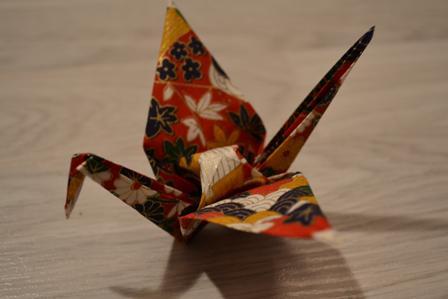
The two principal characters survive the blast that followed the detonation of the bomb, but ten years afterwards fourteen year old Sadako gets seriously ill, because she had been exposed to the gamma radiation.
Her brother teaches her to fold cranes from square pieces of gold paper and she starts to fold a thousand cranes. If she succeeds she will be healthy again for every crane flies to the gods with a wish for good health. Before Sadako dies 989 cranes are flying above her hospital bed.
In Hiroshima there is a Paper Cranes and the Children's Peace Monument where a statue of Sadako with in her hand a crane commemorates the horror for thousands of victims of the blast.
Years ago I used this story, when I was given workshops of Origami. I told the story at the end of the workshop while folding a flying crane which I presented to the chairman of the organization who invited me.
After reading this book once again I have folded a flying crane which I present to my fellow readers on GR and as respect for Sadako.


November 13, 2022
tužna sudbina djevojčice sadako sasaki koja je umrla od leukemije 12 godina nakon bacanja atomske bombe na hirošimu, od posljedica zračenja, bila je inspiracija za ovaj polubiografski roman karla brucknera. ne baš talentirani pisac više se pokušao izvući na emocionalnu stranu cijelog događaja i nije pokazao neku kvalitetu pisanja, a ni u meni pobudio želju da posegnem za još kojim njegovim djelom. ipak, kao dokument jednog tragičnog događaja, može imati svoje mjesto među literaturom koja se bavi 2. svjetskim ratom, a koja je namijenjena mlađoj populaciji.

May 9, 2019
Jako jako rijetko posegnem za audio knjigom jer se ne mogu skoncentrirati i dovoljno „udubiti“ pa je možda baš zato izostao onaj osjećaj potpunosti nakon pročitane knjige. Možda baš zato i „samo“ četvorka za ovaj klasik dječje književnosti. Obećala sam sebi da ću se vratiti Sadako, ali drugo čitanje bit će s knjigom u rukama.

February 25, 2013
I read this book years, and years ago when I was a preteen, and still it's very precious to me. The book had a huge impact on me as a child and as a result of reading it I took an interest in Japan and anything Japanese, but even more importantly I discovered that the world could be even more cruel, than I had ever imagined. Even today I remember the images that this book left in my mind, and I recall more parts of this book in minute detail, than any other I have ever read since. This might be due to my being young, and impressionable, at the time of reading it, but still, the book offers a very vivid insight into a harsh and devastatingly cruel part of American and Japanese history that I think, not many, at least not many Europeans, have heard enough about.
The writing in itself isn't brilliant, but the story rings so terrifyingly true, that the stellar presentation isn't really important. What is, is the message - that man is capable of extreme cruelty, and that the repercussions of such acts are dire and irrevocable. Not only in counts of casualties, but even more so in loss of humanity. What Bruckner accomplished perfectly with this book is giving the victims a face, and a voice. In Hiroshima the catastrophe was voiced through that of a two children, the 4 year old Sadako, who survived, and went on to live for another ten years before the repercussions of the bombing claimed her, and her brother, who did everything he could to protect her. As well as from that of the two American pilots who were tasked with completing this severe act of cruelty.
To me this book was sad, yet hopeful, and very, very important.. It raises so many very important questions and it does shed some very disturbing light on the lack of humanity during times of war. As much as the holocaust in Europe this is a part of history that no one should ever forget, and while I don't want to burden today's teenagers with tons of accounts of the cruelties of our past, I definitely don't want anyone to not know about it either. I recommend this book to any and all, with an interest in history, or humanity or a heart wrenchingly beautiful story even.
The writing in itself isn't brilliant, but the story rings so terrifyingly true, that the stellar presentation isn't really important. What is, is the message - that man is capable of extreme cruelty, and that the repercussions of such acts are dire and irrevocable. Not only in counts of casualties, but even more so in loss of humanity. What Bruckner accomplished perfectly with this book is giving the victims a face, and a voice. In Hiroshima the catastrophe was voiced through that of a two children, the 4 year old Sadako, who survived, and went on to live for another ten years before the repercussions of the bombing claimed her, and her brother, who did everything he could to protect her. As well as from that of the two American pilots who were tasked with completing this severe act of cruelty.
To me this book was sad, yet hopeful, and very, very important.. It raises so many very important questions and it does shed some very disturbing light on the lack of humanity during times of war. As much as the holocaust in Europe this is a part of history that no one should ever forget, and while I don't want to burden today's teenagers with tons of accounts of the cruelties of our past, I definitely don't want anyone to not know about it either. I recommend this book to any and all, with an interest in history, or humanity or a heart wrenchingly beautiful story even.

October 6, 2012
Sadako vivrà
Recuperare da adulti i grandi classici della letteratura per l'infanzia può non essere una buona idea, soprattutto se l'opera è datata e non fa nulla per nasconderlo (soprattutto nella traduzione).
Lo stile didattico e l'enfasi spesso stucchevole di alcuni passaggi non inficiano, però, il valore di un'opera che interpreta con semplicità l'orrore della guerra, e sceglie di raccontarlo proprio a chi, nato dalle macerie di un mondo morto, ha il dovere di curarne i rari fiori.
Recuperare da adulti i grandi classici della letteratura per l'infanzia può non essere una buona idea, soprattutto se l'opera è datata e non fa nulla per nasconderlo (soprattutto nella traduzione).
Lo stile didattico e l'enfasi spesso stucchevole di alcuni passaggi non inficiano, però, il valore di un'opera che interpreta con semplicità l'orrore della guerra, e sceglie di raccontarlo proprio a chi, nato dalle macerie di un mondo morto, ha il dovere di curarne i rari fiori.

June 22, 2020
Dimentichiamo tutti troppo facilmente. Ho riletto questo libro a distanza di circa 40 anni... la traduzione è datata? Il libro è per ragazzi? Non importa, leggetelo ugualmente e scoprirete che un "piccolo" romanzo può essere molto più potente di un libro di storia.
February 18, 2026
Zanima me kako bi doživjela tu knjigu da nisam znala o čemu se radi i kako će završiti.
Bravo za pisca!
Bravo za pisca!

July 21, 2019
This book is like nothing that I've read before. It's themes and portrayal of war as a bloody business, rather than heroic struggle, were shocking, as well as it's consequences. It was, also, my first contact with the events regarding World War II. It's not the conflicts, reasons or justifications, which aren't shown here, but rather survival under difficult circumstances and humanity which gives the weight to this amazing book. The fact that the horrors of war are shown through the perspective of those caught between two fires is as tragic, as it's deep with it's clear message. I've also used the opportunity to watch Japanese anime movie from 1988, called ,,Grave of the fireflies'', as there were similarities between two works, although the original idea behind a movie wasn't so much about war in general, but feeling of happiness and guilt around personal experience. No matter the differences, both the book and the anime are worth reading and watching, as they stand as testaments to tragedies and losses, as well as a remainder that no such things would ever happen.
September 11, 2007
You'd never know what happens and how it is like during these times in Japan. This little girl, protected by her family and her dear brother, still keeps her positive spirit, and when catching an incurable illness, she still sticks on to her believes to fold 1000 golden origami cranes that shall be able to release her from her indefeatable destiny. And she fights - until the end. What a spirit !
August 4, 2022
sad sam se sjetila da smo ovo čitali i da sam isplakala dušu nad ovom knjigom

January 20, 2018
A children's book about one of the greatest tragedies of human history. That seems crazy, right? Well, it's not. The themes this book deals with are surely heavy, but Karl Bruckner managed to tell this heartbreaking story in a simple yet beautiful way, while remembering (and teaching, for younger readers!) about the horrors of war.
To be honest, I had almost forgotten about this book for a very long time. But then last year it all came back to mind when I visited Hiroshima during my semester in Japan. In the Hiroshima Museum of the Atom Bomb there is an entire wall dedicated to Sadako. I remember standing there, staring at all the little paper cranes she -the actual Sadako! the real one!- made , my brain trying to get around the idea that yes, Sadako was actually a real girl. I don't know why it was so difficult for me to realize all this. Maybe my memories of reading this as a kid and imagining Sadako and Shigeo in my own head made it all so complicated.
To be honest, I had almost forgotten about this book for a very long time. But then last year it all came back to mind when I visited Hiroshima during my semester in Japan. In the Hiroshima Museum of the Atom Bomb there is an entire wall dedicated to Sadako. I remember standing there, staring at all the little paper cranes she -the actual Sadako! the real one!- made , my brain trying to get around the idea that yes, Sadako was actually a real girl. I don't know why it was so difficult for me to realize all this. Maybe my memories of reading this as a kid and imagining Sadako and Shigeo in my own head made it all so complicated.

September 22, 2017
Sadako Sasaki
Ho riletto questo libro, scegliendo volutamente il periodo attorno al 6 agosto. Il dovere della memoria. In rete ho poi trovato diverse opinioni secondo cui "Il gran sole di Hiroshima dovrebbe essere dato in mano ai bambini delle scuole elementari".
Mi permetto di dissentire. Non è un libro accattivante, di facile assorbimento. Dovrebbe essere "letto" in classe dall'insegnante (non "dato in mano" e... arrangiati tu!), a piccole dosi. Meglio ancora, dovrebbe essere preceduto -senza alcun avvertimento preventivo- dalla costruzione di qualche piccola gru di carta. L'ho verificato sul campo (dopo aver passato qualche notte insonne sui libri di origami...): così "funziona". E non te ne dimentichi più.
Ho riletto questo libro, scegliendo volutamente il periodo attorno al 6 agosto. Il dovere della memoria. In rete ho poi trovato diverse opinioni secondo cui "Il gran sole di Hiroshima dovrebbe essere dato in mano ai bambini delle scuole elementari".
Mi permetto di dissentire. Non è un libro accattivante, di facile assorbimento. Dovrebbe essere "letto" in classe dall'insegnante (non "dato in mano" e... arrangiati tu!), a piccole dosi. Meglio ancora, dovrebbe essere preceduto -senza alcun avvertimento preventivo- dalla costruzione di qualche piccola gru di carta. L'ho verificato sul campo (dopo aver passato qualche notte insonne sui libri di origami...): così "funziona". E non te ne dimentichi più.

February 23, 2015
In questo solo secondo, raggi mortali di neutroni e raggi gamma, bombardarono il luogo dell’esplosione per un raggio di un chilometro e mezzo.
In questo secondo, l’uomo, che Dio aveva creato a propria immagine e somiglianza, aveva compiuto, con l’aiuto della scienza, il primo tentativo per annientare se stesso.
Il tentativo era riuscito.
In questo secondo, l’uomo, che Dio aveva creato a propria immagine e somiglianza, aveva compiuto, con l’aiuto della scienza, il primo tentativo per annientare se stesso.
Il tentativo era riuscito.
February 6, 2015
Definitely an insightful read. The characters thoroughly reflect the horrible events that occurred in Hiroshima, and truly show the human sufferings many really did experience. I was touched after reading about such sad happenings.
September 25, 2016
A heartfelt story
This is a simple story, almost written as a fairy tale but in its simplicity lies its power. Its moral sneaks quietly under your radar and eats at you in ways a more obvious story might not.
This is a simple story, almost written as a fairy tale but in its simplicity lies its power. Its moral sneaks quietly under your radar and eats at you in ways a more obvious story might not.

February 24, 2018
Късове от живота на хора свързани с един ужасен акт на човешка жестокост. Изобретяването на атомната бомба и нейното използване над Хирошима.
Ако някога отида в Япония ще посетя статуята на Садако и ще поставя пред нея мой оригами жерав.
Ако някога отида в Япония ще посетя статуята на Садако и ще поставя пред нея мой оригами жерав.

September 16, 2012
Madonnina, quanto ci ho pianto su questo libro …
January 17, 2022
Als Kind habe ich dieses Buch zuletzt gelesen und es hatte mich damals zutiefst berührt. Als es mir beim Aufräumen in die Hände fiel bekam ich Lust es erneut zu lesen um zu schauen wie gut es gealtert sei, schließlich ist es nicht unbedingt unproblematisch wenn weiße Autor*innen über andere Kulturen schreiben. Ich bin natürlich kein Maßstab, habe aber nur sehr wenige Formulierungen gefunden, die ich minimal abändern würde. Bruckners Schreibstil zieht einen in die Geschichte und es gelingt ihm, dass ich mich schnell mit allen Protagonist*innen verbunden fühlte. Das Buch hatte dieselbe Wirkung auf mich wie bei der ersten Lektüre: Ein eindringliches und wichtiges Mahnmal gegen Krieg und für mehr Menschlichkeit.
April 12, 2025
I liked the points of views and the ending was bittersweet to a good extent 😌

September 18, 2016
Nonostante la prima metà di questo libro non mi avesse particolarmente colpita, tanto da spingermi a prendere una pausa e recuperare la lettura dopo qualche mese, Il Gran Sole di Hiroshima ha lasciato un segno profondo nel mio cuore.
L'unico consiglio che mi sento di dare è di leggere questo libro, fino alla fine. Potreste imbattervi in capitoli abbastanza noiosi, ma non lasciatevi dissuadere: è una storia che deve essere letta, per essere maggiormente consapevoli del fatto che il mondo in cui noi oggi viviamo è stato edificato sulle macerie di un mondo inserito in un passato non troppo lontano, annientato dalla crudele forza distruttiva dell'uomo.
L'unico consiglio che mi sento di dare è di leggere questo libro, fino alla fine. Potreste imbattervi in capitoli abbastanza noiosi, ma non lasciatevi dissuadere: è una storia che deve essere letta, per essere maggiormente consapevoli del fatto che il mondo in cui noi oggi viviamo è stato edificato sulle macerie di un mondo inserito in un passato non troppo lontano, annientato dalla crudele forza distruttiva dell'uomo.

June 2, 2016
I first read this book about 50 years ago, when I checked it out from the book mobile. It's a fictionalized account of a young Japanese girl who is living in Hiroshima in 1945 when the atomic bomb is exploded. She survives the explosion and the subsequent problems of living in the destroyed city and then, 10 years later, falls victim to the effects of radiation sickness. It's a beautifully written book.
April 5, 2018
كتاب از نويسنده اتريشي است و اولين چاپ آن در ايران كه مربوط است به سال ١٣٦٥ را در كتابخانه پيدا كردم با كاغذ هايي كه به زردي گراييده!
داستان غم انگيزيست مربوط به جرياناتجنگ جهاني دوم، ژاپن، هيروشيما، آلودگي به راديواكتيو و دختري به نام ساداكو...
داستان غم انگيزيست مربوط به جرياناتجنگ جهاني دوم، ژاپن، هيروشيما، آلودگي به راديواكتيو و دختري به نام ساداكو...

July 21, 2019
“Pronalazacki covjecji duh tog dvadesetog stoljeca stvorio je atomsku bombu, ali ne i lijekove za rane sto ih je zadala ta bomba. I on, lijecnik ovog stoljeca, sjedi ovdje i prisiljen je da mirno gleda kako jedno dijete umire od posljedica gama-zraka. Jer ovog ce sata dogorjeti i posljednja iskrica u tijelu te djevojcice.”
This entire review has been hidden because of spoilers.

May 11, 2021
Stalno mi se nameće pitanje zašto ovu knjigu nisam pročitala ranije.
November 14, 2021
Con lo scorrere delle pagine è aumentato anche il macigno sul petto.

July 22, 2022
Ich musste so weinen bei dem Buch. Herzzerreißend und mahnend.
Nie wieder Hiroshima …
Nie wieder Hiroshima …
January 10, 2023
Bel libro, unica pecca che mi ha spinto a non dare cinque stelle è stata la traduzione italiana. L'edizione della Giunti, Tag Ragazzi, sembra come esser stata tradotta da Cannarsi; molti dialoghi tra i bambini risultano essere decisamente fuori luogo per la loro età. Scherzi a parte, il testo non è interamente stravolto ma, a mio avviso, ci sono alcune parti da rivedere.
Displaying 1 - 30 of 129 reviews