

What do you think?

The Emperor's Edge #1-3
The Emperor's Edge Collection
An enforcer wanted dead for crimes she didn’t commit...
An assassin wanted dead for crimes he did commit…
Normally, they would be enemies, but they both seek the same thing: exoneration.
Unfortunately, a nefarious underground organization is attempting to kill the one man who could grant it to them, the emperor. If they want to win their freedom, they’ll have to battle powerful wizards, outscheme master schemers, and defeat bloodthirsty monsters, all while dodging friendly fire and evading the law. Exoneration isn’t easy.
This boxed set includes the first three novels in this high fantasy adventure series:
The Emperor’s Edge
Dark Currents
Deadly Games
For those who enjoy heroic fantasy, steampunk, and heroes who are just as likely to battle with words as with swords, the first three Emperor’s Edge novels are now available in one collection.
Follow enforcer-turned-outlaw Amaranthe Lokdon, the infamous assassin Sicarius, and their team of aspiring heroes as they attempt to clear their names by thwarting evils aimed at the young emperor.
An assassin wanted dead for crimes he did commit…
Normally, they would be enemies, but they both seek the same thing: exoneration.
Unfortunately, a nefarious underground organization is attempting to kill the one man who could grant it to them, the emperor. If they want to win their freedom, they’ll have to battle powerful wizards, outscheme master schemers, and defeat bloodthirsty monsters, all while dodging friendly fire and evading the law. Exoneration isn’t easy.
This boxed set includes the first three novels in this high fantasy adventure series:
The Emperor’s Edge
Dark Currents
Deadly Games
For those who enjoy heroic fantasy, steampunk, and heroes who are just as likely to battle with words as with swords, the first three Emperor’s Edge novels are now available in one collection.
Follow enforcer-turned-outlaw Amaranthe Lokdon, the infamous assassin Sicarius, and their team of aspiring heroes as they attempt to clear their names by thwarting evils aimed at the young emperor.
1163 pages, Kindle Edition
First published April 28, 2012
About the author
Lindsay Buroker
203 books6,483 followersI'm a full-time indie fantasy and science fiction author. When I'm not writing, I'm ferrying my dogs to hiking trails for adventures.
Ratings & Reviews
Friends & Following
Create a free account to discover what your friends think of this book!
Community Reviews
Displaying 1 - 30 of 187 reviews
July 10, 2014
CAUTION: This book may cause loss of responsibilities, antisocial characteristics, eye strain, decreased weight, and bed sores.
Have you ever read a book and suddenly stopped sleeping, eating, moving....practically stopped doing everything except for the occasional i-have-to-pee-run. (Having to go to the bathroom was never more annoying than when I was reading this book.) This book sucks you in and makes you forget that you have a life outside the Empire. These books have it all. Action, Adventure, Comedy, Romance, Fantasy in form of steam-punk, and ....well you get the point.
The best part about the books are the characters. The main characters are Amaranthe and Sicarious. (if you're looking for a damsel in distress, stop reading and try Twilight) Amaranthe is a small time police officer who stumbles upon a threat to the emperor and in a unusual turn of events, ends up partnering up with the infamous Assassin Sacarius who is known for lacking emotion/empathy. They eventually form a mismatched band of heroes that includes Akstyr, a teenage magician w/ fattitude, Books, an elderly intellectual, and Maldynado, a flirtatious rake who has a great sense of humor (my personal favorite).
I can go on and on, but instead take my advice along with all the other reviews here and read this book ASAP. The Emperor's Edge series has made me laugh out loud like a creep in public, tear up (I'm not one prone to tears), get butterflies in my stomach without having the romance get cheesy, gasp out loud, and overall feel that amazing content feeling you get after reading a great book.
This book is for boys and girls, young and old, fans of Harry Potter series, The Hunger Games Trilogy Boxset, Angelfall, Obernewtyn, Poison Study and anyone wanting to drown in a good read that has it all.
Have you ever read a book and suddenly stopped sleeping, eating, moving....practically stopped doing everything except for the occasional i-have-to-pee-run. (Having to go to the bathroom was never more annoying than when I was reading this book.) This book sucks you in and makes you forget that you have a life outside the Empire. These books have it all. Action, Adventure, Comedy, Romance, Fantasy in form of steam-punk, and ....well you get the point.
The best part about the books are the characters. The main characters are Amaranthe and Sicarious. (if you're looking for a damsel in distress, stop reading and try Twilight) Amaranthe is a small time police officer who stumbles upon a threat to the emperor and in a unusual turn of events, ends up partnering up with the infamous Assassin Sacarius who is known for lacking emotion/empathy. They eventually form a mismatched band of heroes that includes Akstyr, a teenage magician w/ fattitude, Books, an elderly intellectual, and Maldynado, a flirtatious rake who has a great sense of humor (my personal favorite).
I can go on and on, but instead take my advice along with all the other reviews here and read this book ASAP. The Emperor's Edge series has made me laugh out loud like a creep in public, tear up (I'm not one prone to tears), get butterflies in my stomach without having the romance get cheesy, gasp out loud, and overall feel that amazing content feeling you get after reading a great book.
This book is for boys and girls, young and old, fans of Harry Potter series, The Hunger Games Trilogy Boxset, Angelfall, Obernewtyn, Poison Study and anyone wanting to drown in a good read that has it all.

January 3, 2017
This is the second series I've started by this very prolific and entertaining Scifi/Fantasy author. Other reviews warned me that the heroine Amaranthe was annoyingly Mary Sue at the start and that's true. But she settled down and the story really took off at about 10% so I can live with it.
These books are pure escapist fantasy. The author has a signature style - an ensemble cast of misfits lead by a plucky smart young woman. The romance is exactly what I like in fantasy - low-key and slow-burn. It never takes precedence over the story. The hero is always a strong silent type who is brought into the light through the love of a good woman. The plots are full of action and adventure. Chase scenes, fight scenes, noble quests, underwater battles with mythical creatures, evil mages, rooftop escapes. You hardly draw a breath from page one to the end. It's great to see a female author writing such entertaining action!
These books are pure escapist fantasy. The author has a signature style - an ensemble cast of misfits lead by a plucky smart young woman. The romance is exactly what I like in fantasy - low-key and slow-burn. It never takes precedence over the story. The hero is always a strong silent type who is brought into the light through the love of a good woman. The plots are full of action and adventure. Chase scenes, fight scenes, noble quests, underwater battles with mythical creatures, evil mages, rooftop escapes. You hardly draw a breath from page one to the end. It's great to see a female author writing such entertaining action!

April 14, 2017
Book 1
Not reading the rest of this series. I looked forward into the other books reviews and there is nothing I care about. I only finished book 1 because of Sespian who I THOUGHT was going to end up with Amaranthe.. but apparently not. So I'm done.
2 stars..only because I finished it.
Plot driven.. which is not my type of read. I prefer character driven or a mix of both.
Almost quit. Kept going because of Sespian only, clearly to me, the best character.
MC's
Amaranthne-Heroine. (TSTL IMO) Supposed to be an "Enforcer" or millitary person. The ONLY female Enforcer, yet she doesn't kill, WON'T kill, and isn't skilled at fighting. She instead talks to brutal people who are holding guns to her head, believing this will convince them to listen to her and let her go. Yet she apparently has an affection for the assassin who is a cold hearted killer, and tries to prevent him from killing, even though it will endanger them or get them killed.
Sespian-Young emperor who is more of an artist, a pacifist..he has an affection for Amaranthne. The best character and least seen. He is being controlled by his regent who of course wants to continue to rule through him. I grow tired of this typical plot.
Sicarius-Assassin he seems fond of Amaranthe but it is not clear.
Possible love triangle? It seems that way. The story at first leads the reader to think Sespian and Amaranthe will be together..but then it changes. Sespian still appears to care for her up to the end and I wont know for sure how the romance plays out until I read the next book. SOmething I am still debating.
Negatives:
No sense of time period. Not medievalish, not contemporary..not sure what type of feel the author was going for. It seemed like a mish mash of pieces taken from various times. It didn't work for me.
There is little to no steampunk flavor. All I've seen is that there are steam powered carriages. That's
it folks! Steampunk? ummm not yet anyway.
-Flat characters.
-Modern dialogue..not a good thing.
-Humor inserted during inappropriate times came off as childish and idiotic..not funny.
-Descriptions were lacking. Ex: "business dress" is all the heroine seems to have worn. Overused.
-The world building was terrible. Non existant.
-The beginning and middle were boring. In fact most of this book was boring. I skimmed most of it. Especially all the tedious details of their stupid counterfeiting plan. Seriously THAT's the best they could do? I mean you have an assassin who can kill in seconds a whole millitary batalon yet can't get to one or two bad guys? Counterfeiting is the answer?
-Predictable
-Too long
- WTF was that all about in the end with the monster? Did it die? We don't know because as all hell broke loose, we are suddenly having conversations and stitching of wounds. Talking about intimate secrets. WTF?
-And what I absolutely LOATHE is the cartooinshly long monologues explaining intent before killing.
-Stereotypical "bad guys"
-Horrible fight scenes
-"Good guys" always survive without injury
-Magic, history, monsters vaguely explained
I can go on but I suppose I should give some positives:
There was some good action and conflict at times. There were a few instances where I felt on the edge of my seat.
I do not recommend. I will not be reading more of this author.
Content: Violence. Attempted rape. Some romance but not romance driven.
Not reading the rest of this series. I looked forward into the other books reviews and there is nothing I care about. I only finished book 1 because of Sespian who I THOUGHT was going to end up with Amaranthe.. but apparently not. So I'm done.
2 stars..only because I finished it.
Plot driven.. which is not my type of read. I prefer character driven or a mix of both.
Almost quit. Kept going because of Sespian only, clearly to me, the best character.
MC's
Amaranthne-Heroine. (TSTL IMO) Supposed to be an "Enforcer" or millitary person. The ONLY female Enforcer, yet she doesn't kill, WON'T kill, and isn't skilled at fighting. She instead talks to brutal people who are holding guns to her head, believing this will convince them to listen to her and let her go. Yet she apparently has an affection for the assassin who is a cold hearted killer, and tries to prevent him from killing, even though it will endanger them or get them killed.
Sespian-Young emperor who is more of an artist, a pacifist..he has an affection for Amaranthne. The best character and least seen. He is being controlled by his regent who of course wants to continue to rule through him. I grow tired of this typical plot.
Sicarius-Assassin he seems fond of Amaranthe but it is not clear.
Possible love triangle? It seems that way. The story at first leads the reader to think Sespian and Amaranthe will be together..but then it changes. Sespian still appears to care for her up to the end and I wont know for sure how the romance plays out until I read the next book. SOmething I am still debating.
Negatives:
No sense of time period. Not medievalish, not contemporary..not sure what type of feel the author was going for. It seemed like a mish mash of pieces taken from various times. It didn't work for me.
There is little to no steampunk flavor. All I've seen is that there are steam powered carriages. That's
it folks! Steampunk? ummm not yet anyway.
-Flat characters.
-Modern dialogue..not a good thing.
-Humor inserted during inappropriate times came off as childish and idiotic..not funny.
-Descriptions were lacking. Ex: "business dress" is all the heroine seems to have worn. Overused.
-The world building was terrible. Non existant.
-The beginning and middle were boring. In fact most of this book was boring. I skimmed most of it. Especially all the tedious details of their stupid counterfeiting plan. Seriously THAT's the best they could do? I mean you have an assassin who can kill in seconds a whole millitary batalon yet can't get to one or two bad guys? Counterfeiting is the answer?
-Predictable
-Too long
- WTF was that all about in the end with the monster? Did it die? We don't know because as all hell broke loose, we are suddenly having conversations and stitching of wounds. Talking about intimate secrets. WTF?
-And what I absolutely LOATHE is the cartooinshly long monologues explaining intent before killing.
-Stereotypical "bad guys"
-Horrible fight scenes
-"Good guys" always survive without injury
-Magic, history, monsters vaguely explained
I can go on but I suppose I should give some positives:
There was some good action and conflict at times. There were a few instances where I felt on the edge of my seat.
I do not recommend. I will not be reading more of this author.
Content: Violence. Attempted rape. Some romance but not romance driven.

February 7, 2025
Unwanted, Unimaginative and Unfunny Chick Lit in Steampunk Environment.
(Initially wanted to give 4 stars but it's down to 2 star.)
The Emperor’s Edge Collection by Lindsay Buroker may have all the hallmarks of a thrilling steampunk adventure with political intrigue, but it's impossible to ignore the glaring foolishness of its main character, Amaranthe Lokdon. While the trilogy (The Emperor’s Edge, Dark Currents, and Deadly Games) offers an exciting premise of a group of mercenaries facing impossible odds, Amaranthe’s unrelenting idealism and often reckless decisions make for a frustrating journey.

A rollercoaster of action, hindered by a naïve and overly optimistic protagonist.
Book 1: The Emperor’s Edge

The first book introduces us to Amaranthe, who, despite being framed for treason, stubbornly clings to the idea that she can still "do good" in a system rife with corruption. This blind optimism leads her to form a team with an infamous assassin, Sicarius, and a band of misfits. While her determination is admirable, it often crosses the line into sheer naiveté. Time and again, Amaranthe throws herself into dangerous situations without a solid plan, relying on her charm and wits to fix things later. It's as if she believes that pure good intentions will magically lead to success—a belief that repeatedly puts her team at risk.
Though the world-building and ensemble cast provide a solid foundation, Amaranthe’s poor decision-making often drags down the narrative. For a former enforcer, she seems oddly oblivious to the ruthlessness of the world she operates in. While other characters—particularly Sicarius—are cautious and pragmatic, Amaranthe's misguided belief that she can talk her way out of anything makes you question how she survived in law enforcement at all.
Book 2: Dark Currents
By Dark Currents, Amaranthe's reckless leadership reaches new heights. Her team faces ever-greater challenges, yet she insists on pursuing the same foolhardy strategies, hoping that persistence and positivity will carry the day. Her refusal to acknowledge the brutal realities of the empire, even as her own life hangs by a thread, becomes increasingly frustrating. How many times can a leader make the same mistakes before learning?
Meanwhile, her idealism often clashes with the cold pragmatism of Sicarius, and while this dynamic adds tension, it also highlights just how absurd her thinking can be. For someone leading a group of criminals and mercenaries, Amaranthe's decisions are often bafflingly out of touch with the danger surrounding them.
Book 3: Deadly Games
In Deadly Games, Amaranthe takes her questionable judgment to gladiatorial arenas, where the stakes couldn’t be higher. Despite all she’s been through, she continues to underestimate her enemies and overestimate her ability to control situations. Her stubborn refusal to recognize the gravity of their circumstances forces her team into perilous situations, with her continual reliance on "hope" instead of solid strategy coming across as irresponsible. Yes, there are moments where her perseverance pays off, but they feel more like strokes of luck than a result of her leadership skills.
Her interactions with Sicarius—whose cold, calculating nature could have served as a much-needed balance to her recklessness—are often frustrating because she refuses to adapt or take his more grounded advice seriously. Amaranthe's insistence on seeing the best in everyone, including dangerous opponents, borders on delusional. By this point in the series, the repeated pattern of her foolish choices becomes grating, and you can't help but feel sorry for the team that keeps getting dragged along into her misadventures.
Verdict
While The Emperor’s Edge trilogy delivers on action, humor, and an interesting ensemble cast, it’s hard to ignore the flaws in its lead character. Amaranthe Lokdon's endless optimism and often foolhardy decisions make her a problematic protagonist. Her leadership is marked by a refusal to face reality, and it’s only through the sheer competence of her team—especially Sicarius—that they survive. In the end, Amaranthe may have heart, but her impractical approach to leading a group of misfit mercenaries leaves much to be desired.
A fun, fast-paced series—if you can overlook the reckless idealism of its lead.
Amaranthe Lokdon, the protagonist of The Emperor’s Edge Trilogy, is presented as a determined, justice-driven character, but her story arc reveals a leader who is dangerously idealistic, impractical, and, frankly, often foolish. Spanning across The Emperor’s Edge, Dark Currents, and Deadly Games, Amaranthe consistently makes poor decisions that jeopardize not only her life but also the lives of her team. Her refusal to adapt to the brutal realities of the corrupt Turgonian Empire is frustrating, and while Lindsay Buroker attempts to frame her as a competent leader, her actions suggest otherwise.
Amaranthe's Character Overview
Amaranthe starts off as a former enforcer of the Turgonian Empire, a figure who should understand the lawless, corrupt system she’s up against. After being framed for treason, she forms a group of misfits to fight against the empire’s corruption, yet she remains doggedly optimistic that she can somehow "fix" everything. Her idealism is not only unrealistic but also dangerously naive for someone operating in such a treacherous environment. Despite facing life-threatening situations repeatedly, she clings to the belief that good intentions alone can overcome the most insurmountable odds.
Her story arc is riddled with moments where her blind optimism leads her into reckless situations. She often relies on her charm, wits, or idealism instead of planning and pragmatism, which makes her appear out of her depth in nearly every encounter. Amaranthe fails to learn from her experiences and continues to repeat the same mistakes, which stunts her growth as a character.
Foolish Idealism
Amaranthe’s idealism is her defining trait—and her greatest flaw. Throughout the trilogy, she operates under the delusion that she can change the world through sheer force of will and unwavering optimism. In The Emperor’s Edge, she believes she can recruit an assassin, Sicarius, and an oddball team of mercenaries and lead them successfully despite lacking any real experience in such high-stakes situations. She constantly underestimates the dangers around her and overestimates her ability to talk her way out of trouble, often relying on hope rather than any kind of solid strategy.
Her idealism becomes infuriating when she repeatedly places her team in danger. Instead of adapting to the harsh realities of the empire, she stubbornly sticks to her idealistic vision of doing "good," which, at times, makes her appear delusional. For example, she frequently ignores Sicarius’ sound advice, believing she can achieve victory without the necessary ruthlessness. Time and again, she believes in the "good" in her enemies, often trusting the wrong people, only to be surprised when they betray her.
Leadership Failures
As a leader, Amaranthe is deeply flawed. Her leadership style is a curious mix of blind optimism and poor decision-making. While she is meant to hold her team of misfits together, her choices frequently put them at risk, and it’s often through sheer luck or the competence of others that they survive. Her repeated failures to listen to more experienced or pragmatic voices—particularly Sicarius—are emblematic of her poor leadership.
In Dark Currents, Amaranthe continues to lead her team into danger with ill-conceived plans. Her refusal to accept the brutal truths of the empire makes her leadership questionable at best, particularly when compared to the more level-headed, strategic approaches of characters like Sicarius. Amaranthe’s decisions feel more like acts of desperation than of careful leadership, and while she has the charisma to rally her team, she lacks the tactical foresight to keep them safe.
One of the most significant criticisms of Amaranthe is that she refuses to learn from her mistakes. As the stakes rise, her idealism doesn’t fade or evolve; it remains constant, even in the face of clear evidence that her methods are not working. In Deadly Games, Amaranthe leads her team into a deadly gladiatorial contest, and her decision-making process continues to be riddled with wishful thinking rather than pragmatism. Her reckless behavior endangers her team time and again, and her inability to evolve into a more grounded leader becomes more glaring as the series progresses.
The Sicarius Dynamic: Missed Potential
Amaranthe’s relationship with Sicarius, the cold and calculating assassin, offers a wealth of potential, but it’s another aspect of her character arc that feels underdeveloped and frustrating. Sicarius is pragmatic and ruthlessly efficient, the exact opposite of Amaranthe, and while their dynamic should have led to a deeper exploration of their opposing worldviews, it instead falls flat due to Amaranthe’s insistence on seeing Sicarius through her naive lens.
Rather than learning from Sicarius’ pragmatic approach to survival, Amaranthe continually tries to "redeem" him, convinced that she can unlock some hidden humanity within him. This not only highlights her own lack of self-awareness but also weakens their partnership. Instead of understanding Sicarius for who he is, Amaranthe forces her idealistic views onto him, creating unnecessary tension and diminishing the potential for a more meaningful, balanced relationship.
Plot-Driven Growth vs. Real Development
Amaranthe’s character arc feels more like it’s driven by the demands of the plot than by any meaningful personal growth. Despite being placed in increasingly dangerous situations, she never truly learns from her mistakes. She continues to rely on luck, good intentions, and the strength of her team rather than adapting to the harsh realities of the world she’s navigating.
By the time we reach Deadly Games, Amaranthe has faced numerous life-threatening challenges, yet she still operates with the same blind optimism she had at the beginning of the series. This lack of character development becomes tiresome. Readers expect characters to grow and adapt, especially when faced with such dire circumstances, but Amaranthe remains frustratingly static.
Spoiler-free note: Despite the challenges Amaranthe faces, her story concludes without any significant transformation, leaving readers with a sense of frustration at her lack of growth.
Final Verdict
Amaranthe Lokdon’s character is one of the most frustrating aspects of The Emperor’s Edge Trilogy. While the steampunk setting, political intrigue, and supporting cast offer plenty of excitement, Amaranthe’s idealism, poor leadership, and failure to grow as a character weigh the series down. Her unyielding optimism might be seen as charming in small doses, but over the course of three books, it becomes a liability.

The Emperor’s Edge offers readers a fast-paced, action-filled journey, but Amaranthe Lokdon’s reckless decision-making and refusal to adapt make her a difficult protagonist to root for.

Highly recommended for readers who enjoy action and steampunk worlds, but those looking for realistic character growth may find Amaranthe a disappointment.

Final Verdict: While The Emperor’s Edge is recommended for fans of steampunk, action, and strong supporting characters, Amaranthe’s foolishness and idealism can detract from the story’s otherwise engaging elements.
September 17, 2013
In my quest to read good fiction and spend almost no money on it, I found this collection on sale for $.99 and thought, "why not?"
I had already read the first book, "The Emperor's Edge", and liked it.
What I discovered was that while the first book was good, each successive book got better and better. This is a unique and believable fantasy world with a well-thought out plot, a strong heroine, and a cast of characters that really 'grow on you'.
The "Emperor's Edge" series is High Fantasy, with a fun mixture of Romance, Steampunk, and Science Fiction. Somehow Lindsay Buroker manages to blend all of this together without making the story corny.
I also recommend reading another series first, set in the same world. The books are: "Encrypted", "Enigma", and "Decrypted". But whichever you read first, read BOTH series. You will love them!
I had already read the first book, "The Emperor's Edge", and liked it.
What I discovered was that while the first book was good, each successive book got better and better. This is a unique and believable fantasy world with a well-thought out plot, a strong heroine, and a cast of characters that really 'grow on you'.
The "Emperor's Edge" series is High Fantasy, with a fun mixture of Romance, Steampunk, and Science Fiction. Somehow Lindsay Buroker manages to blend all of this together without making the story corny.
I also recommend reading another series first, set in the same world. The books are: "Encrypted", "Enigma", and "Decrypted". But whichever you read first, read BOTH series. You will love them!

January 17, 2015
I abandoned the first book a while back, but picked up the omnibus version based on positive reviews to see if it was a case of “right book, wrong mood”. It’s a story that doesn’t take itself too seriously. Two of the main characters sounded a bit too alike and perhaps there’s too much snarkiness for me, but the raw story is there. So - fun romps with some humour, but there's not enough emotional depth for me to want to carry on with the series right now.

December 27, 2018
Hooked :-)
Great story, simple set of characters but with endearing traits that give the novels a nice dynamic. Enjoyed each three volumes quite a lot and will move on to the 4th volume ASAP! Well worth the discovery on that one.
Great story, simple set of characters but with endearing traits that give the novels a nice dynamic. Enjoyed each three volumes quite a lot and will move on to the 4th volume ASAP! Well worth the discovery on that one.
May 17, 2019
I finished book one, but I think I'm putting the collection down for now.
The story is solid and I really like Amaranthe - she's a refreshing main character. She's optimistic and clever. I loved her resourcefulness.
I didn't like that the plot occasionally relied on luck a little much. The book is also kind of painfully heteronormative. And the team needs more ladies.
Overall, the plot is good, the characters are fun, and it's got all the elements of a good heist novel but I'm not loving where it's going with I'll take a little break and come back to it if I think of it later.
The story is solid and I really like Amaranthe - she's a refreshing main character. She's optimistic and clever. I loved her resourcefulness.
I didn't like that the plot occasionally relied on luck a little much. The book is also kind of painfully heteronormative. And the team needs more ladies.
Overall, the plot is good, the characters are fun, and it's got all the elements of a good heist novel but I'm not loving where it's going with I'll take a little break and come back to it if I think of it later.
May 20, 2015
The A Team
When I was about halfway threw the first book, I realised that the story reminded me of something, and then it hit me at the end The A Team. A group of mercenaries trying to be exonerated fit crimes they didn't comment. The ending line almost mirrored the a team's into.
All in all though ask the books are a good read, a but dry at times and a little predictable, but there was enough witty one liners and creativity to keep me interested.
When I was about halfway threw the first book, I realised that the story reminded me of something, and then it hit me at the end The A Team. A group of mercenaries trying to be exonerated fit crimes they didn't comment. The ending line almost mirrored the a team's into.
All in all though ask the books are a good read, a but dry at times and a little predictable, but there was enough witty one liners and creativity to keep me interested.

February 17, 2014
The Emperors Edge
https://www.goodreads.com/review/show...
Dark Currents
https://www.goodreads.com/review/show...
Deadly Games
https://www.goodreads.com/review/show...
https://www.goodreads.com/review/show...
Dark Currents
https://www.goodreads.com/review/show...
Deadly Games
https://www.goodreads.com/review/show...

March 19, 2014
I already had the first two books read,but, for 99 cents I couldn't pass it up. The third book picks up while most of the team is on vacation. I am glad I bought and definetly want to finish the series.
February 4, 2015
Couldn't put it down
Well written and imaginative with great character development and exciting adventure that keeps you on the edge of your seat and up past bed time. I'll be reading the whole series.
Well written and imaginative with great character development and exciting adventure that keeps you on the edge of your seat and up past bed time. I'll be reading the whole series.

May 15, 2015
Awesome
I purchased the trilogy bundle. I have been unable to put this down unless I absolutely had too. It is very well written and it makes you feel as though you are right there with the characters
I purchased the trilogy bundle. I have been unable to put this down unless I absolutely had too. It is very well written and it makes you feel as though you are right there with the characters

April 15, 2016
You know when sometimes you feel like reading something a little different? Something that has your favourite elements but does not constantly make you angsty? You know, simply a cleverly laid out adventure which a bunch of solid characters and no bull...? That is what The Emperor's edge was like for me. The series had me thoroughly entertained till the end, and that is no easy feat when it spans a full 7 books! Set in a world with strong steampunk elements and a dash of scifi, it is bound to fall a little out of the box but has something to suit almost anyone.

Let me start by saying I love our main girl Amaranthe. She is smart, she is funny, and overall she does not feel sorry for herself whilst trying to turn each bad situation into an opportunity. She is not 'pretty' or 'special', but comes up with plans and acts on them, with or without help from the others which I can appreciate. She is creative too, which she demonstrates in becoming a leader to a gang full of flawed guys. Pushing them toward a goal benefiting each on of them and help a kingdom full of unrest. Man if that is not a kick ass accomplishment, I dont know what is..
The crew is made up out of very diverse characters. All with their own strengths and weaknesses. Not have I had so much fun reading about a male assassin since Poison Study.
And what about other things such as romance you ask?.. Yeah readers looking for that may be a little disappointed. Whilst there is a little tug on the cord that is meant to have our team banners flying, it is most definitely more of an adventure as a whole. Instead you can expect a slow and realistic build up. If anything this book has a great flair of capturing relationships in a good way, be it on friendship, family or love.

The multiple POV's have been worked out great. There are generally 2 main POV's for each book. Each instalment features a different team member and our main girl. It's extremely clever as it keeps you diving in for more and get a more in depth glimpse of them. I absolutely love to get to know their way of thinking and their view of the situations as they face them. The backdraw of the approach is that some of the characters might not be everyone's cup of tea, I definitely gravitated toward some and others did end up grinding on me a bit.. (Akstyr *Cough*).
I was really looking forward to reading Maldynado's side of the adventure. He is probably my favorite characters of the group . His inappropriate sense of humor and the fact he takes it all in his stride makes him extremely likeable. However since I was really looking forward to his insight, the actual book with his POV was slightly disappointing to me. Hoping for a deeper look into him, the only thing that really got shown was the amount of hostility toward him. No deeper insight was given of his inner workings and instead the book got filled with mindless banter between him and Yara. Yeah, I am sad to say I am not a big fan of Yara. To me she is Amaranthe's clone with a few male tendencies and a foul mood 80% of the time. The pairing could be seen a mile away so there was no surprise there, but I would have liked to see him actually get a lady he deserves and she just.. mehh...he desevred better.. (if you ever come to your senses, you know where to find me Maldynado.. XD)

The next 2 instalments are with Sicarius's shared POV. And another one I have really been hanging out for! His character is probably the hardest to get to know through the others, making him appear as an incredible hard ass without much of a conscious or any aptitude for emotion. And you know what else? I was really pleasantly suprised with how much more is in his character. I would have expected Sicarius to really be a bit more stoic or at least his neutral self.. Instead there is so much more wanders through his mind at times. If anything, it has made me love this series even more.
By this stage I got a little sad that the series was heading to an end. Ohh boy was it working up to one hell of a finale. How can it not. A good dose of alien technology, political overthrowing, battles of armies and magic combined with more of Amaranthe's crazy schemes. It literally had me feeling like the GIF below:
What about the ending you ask?!.Well lets just say, it winds up all the craziness neatly...

A lot of what has been hinted throughout the books comes to a good conclusion. I was caught a bit of guard at a certain 'event' at the end and was still waiting for it to be some grand scheme that they where pulling.. I can not give to much away here but needless to say , I got depressed. It took away from the grandiose 'Happily ever after' I was hoping for. The Epilogue however made up for it however and saved me from a melancholic death.
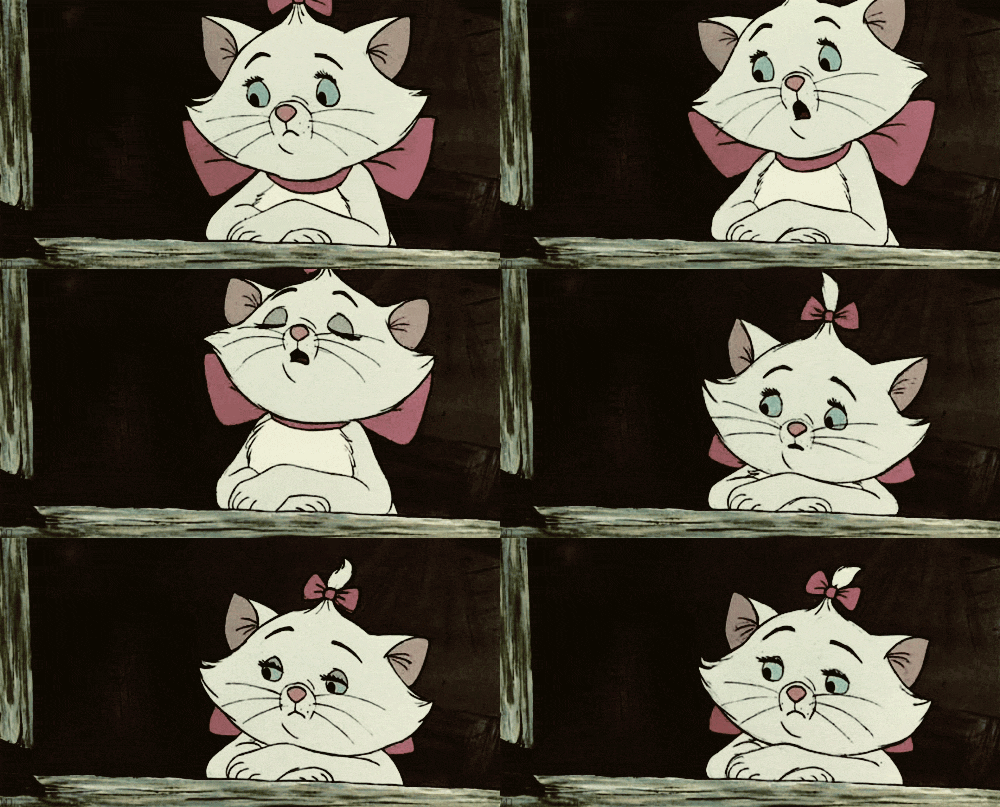
Okay, so apart from that little explosive going off in my brain, I highly recommend this series to anyone that enjoys a good action packed fantasy steampunk series.. Yes there where certainly moments where I got a bit distracted and had to concentrate to get back into it, but I finished all 7 instalments after one another without reading other any books in between'.. that in itself is a awesome accomplishment so kudos to Ms Buroker.
March 8, 2025
Steampunk, assassin, mystery, slowburn romance, found family, humor, lots of bad guys to defeat.
1 - at the capital, forming team, making billz
2 - wilderness, mecha, poisoned water
3 - tournament, under water testing, kraken, eugenics
The 'romantic' elements only appear at the last chapter of each book, after going through some harrowing adventure and someone admits one personal thing to the other. Mainly steampunk fantasy with the barest sliver of a romance, but the silent assassin who only cracks a little for the other lead is satisfying as heck.
Lots of CWs to check out
1 - at the capital, forming team, making billz
2 - wilderness, mecha, poisoned water
3 - tournament, under water testing, kraken, eugenics
The 'romantic' elements only appear at the last chapter of each book, after going through some harrowing adventure and someone admits one personal thing to the other. Mainly steampunk fantasy with the barest sliver of a romance, but the silent assassin who only cracks a little for the other lead is satisfying as heck.
Lots of CWs to check out

August 24, 2017
ugh. i have no idea how i got this trilogy on my Kindle. i am a cheapskate. i only buy books that cost 99cents. maybe if it is a really good study (nonfic) book i'll pay full price. so to get a 3 book collection on my Kindle it must have been free or on sale. either way. i don't remember how i got i. i was bored and decided to actually read it. and i was hooked. books 4-9 are NOT 99cents. sigh. they are $5 and$6. sigh. i may actually buy a FICTION series for my Kindle.
why you say? um cuz it is that freaking good.
this story has soooooo many things i love.
1. plucky cute kickass heroine
2. a lil romance
3. witty repartee and just plain fun
4. a cool team full of characters that are different and all have their own complex stories that you can't wait to discover
5. adventure/action
6. a lil supernatural not a lot
7. different worlds and peoples but it doesn't take 6 chapters to explain the world the story is in.
8. redemption of the characters- they need forgiving/pardoning
9. Viva la revolución = government needs to change and they are helping to do it.
10. the books end with you knowing another adventure is about to take place but the ones in that novel are done and finished. you are not left with that kind of cliffhanger but more like "ok... this is about to happen and another layer of so and so's personality/past is going to be revealed in the next novel.
basically like a Joss Whedon tv show/film. a group of folks only with more depth and less witty repartee fighting for a cause. adventures ensue; missions fail/succeed. sometimes they are working with the govt; sometimes running from it but there intent is always for good. their world is not real but not so fantastical you need a separate book to understand it. just so good. so very good. sigh.
so i went and read the book summaries on amazon for volumes 4-9. something i don't normally do since i read so much, blurbs/book covers by publishers always give too much away. but since i was like i am not buying them anytime soon i NEED to know what i am missing. that was a Mistake. i am actually contemplating spending $50 on these books. FICTION books!!! trust me when i tell you i do not buy fiction books. that is why God invented a library, used books, and sales on Amazon.
i am going to see if i have reward points on my credit card so i can get an Amazon gift card. i mean, it goes against everything in me to BUY fiction books i know i will only read once at full price. i just can't. so if anybody want to donate to the cause...inbox me. ;-)
why you say? um cuz it is that freaking good.
this story has soooooo many things i love.
1. plucky cute kickass heroine
2. a lil romance
3. witty repartee and just plain fun
4. a cool team full of characters that are different and all have their own complex stories that you can't wait to discover
5. adventure/action
6. a lil supernatural not a lot
7. different worlds and peoples but it doesn't take 6 chapters to explain the world the story is in.
8. redemption of the characters- they need forgiving/pardoning
9. Viva la revolución = government needs to change and they are helping to do it.
10. the books end with you knowing another adventure is about to take place but the ones in that novel are done and finished. you are not left with that kind of cliffhanger but more like "ok... this is about to happen and another layer of so and so's personality/past is going to be revealed in the next novel.
basically like a Joss Whedon tv show/film. a group of folks only with more depth and less witty repartee fighting for a cause. adventures ensue; missions fail/succeed. sometimes they are working with the govt; sometimes running from it but there intent is always for good. their world is not real but not so fantastical you need a separate book to understand it. just so good. so very good. sigh.
so i went and read the book summaries on amazon for volumes 4-9. something i don't normally do since i read so much, blurbs/book covers by publishers always give too much away. but since i was like i am not buying them anytime soon i NEED to know what i am missing. that was a Mistake. i am actually contemplating spending $50 on these books. FICTION books!!! trust me when i tell you i do not buy fiction books. that is why God invented a library, used books, and sales on Amazon.
i am going to see if i have reward points on my credit card so i can get an Amazon gift card. i mean, it goes against everything in me to BUY fiction books i know i will only read once at full price. i just can't. so if anybody want to donate to the cause...inbox me. ;-)

July 21, 2015
I haven't had this much fun in awhile. Which may comment more on my state of being rather than this series, though I'd really prefer it to be the latter. I may go back and review the individual books, but since I'm both lazy and read them as an omnibus, that is unlikely to occur.
Problems:
-2D character development, and in some cases almost no character development, though I hear this is rectified in the next few books
-convenient spells of unconsciousness to gloss over tricky plots (though not as many as Sherwood Smith's Crown Duel--an all-time fav of mine, but c'mon Mel, keep it together)
-almost an excessive amount of plot
-things work out a little /too/ well, but I'm mostly okay with that
-world development is slow. Like realllllly slow. And sparse
-tbh it's kind of a half-assed steampunk world
-suuuuuper long. It doesn't drag though, and normally don't mind except for the fact that at the end of 1000 pages/3 books I found myself wondering, did this need to take that long? However, seeing as I only asked that afterwards, it's not that big of an issue.
-dialogue occasionally just sounds like the author rather than two or more distinct characters, but it's so fun that I don't mind too much
The Good Stuff
-Amaranthe is a capable heroine (occasionally a little too capable, which I never thought I'd write)--she's the leader of the group, and is intelligent, sassy, and capable of using her wits/knowledge of people and sincerity to accomplish things
-Sicarius (yassssss)
-adorable Scooby team antics
-interesting beginnings of a love triangle, which may never even triangulate but we'll see
-Fascinating late-Roman Empire type fantasy steampunk world from the details we do get
-a hell of a lot of witty repartee all up in here
So these kinds of problems/cons would normally outweigh the good stuff, but seeing as I finished this in a record amount of time and still have stars in my eyes, it's getting a 5/5 (if only 4.5 was a thing!)
Problems:
-2D character development, and in some cases almost no character development, though I hear this is rectified in the next few books
-convenient spells of unconsciousness to gloss over tricky plots (though not as many as Sherwood Smith's Crown Duel--an all-time fav of mine, but c'mon Mel, keep it together)
-almost an excessive amount of plot
-things work out a little /too/ well, but I'm mostly okay with that
-world development is slow. Like realllllly slow. And sparse
-tbh it's kind of a half-assed steampunk world
-suuuuuper long. It doesn't drag though, and normally don't mind except for the fact that at the end of 1000 pages/3 books I found myself wondering, did this need to take that long? However, seeing as I only asked that afterwards, it's not that big of an issue.
-dialogue occasionally just sounds like the author rather than two or more distinct characters, but it's so fun that I don't mind too much
The Good Stuff
-Amaranthe is a capable heroine (occasionally a little too capable, which I never thought I'd write)--she's the leader of the group, and is intelligent, sassy, and capable of using her wits/knowledge of people and sincerity to accomplish things
-Sicarius (yassssss)
-adorable Scooby team antics
-interesting beginnings of a love triangle, which may never even triangulate but we'll see
-Fascinating late-Roman Empire type fantasy steampunk world from the details we do get
-a hell of a lot of witty repartee all up in here
So these kinds of problems/cons would normally outweigh the good stuff, but seeing as I finished this in a record amount of time and still have stars in my eyes, it's getting a 5/5 (if only 4.5 was a thing!)

March 14, 2015
"Lindsay Buroker is awesome," I was told, and then I spotted three of her books in a box set for next to nothing. So this sat on my Kindle for a while, lonely and ignored, until it came to the top of my TBR list...that was about a fortnight ago.
Why'd it take me so long to write a review? Um...because there are 8 books in the series, plus some incidental novellas and short stories, and all the books are a decent length and...all right, Lindsay Buroker IS a legend and I've been binge reading the whole series because of this box set.
It started out like something from one of the late Terry Pratchett's novels...a female police-officer-equivalent making excuses for a less-than-conscientious co-worker...then stumbling on a crime with far-reaching consequences for herself and her nation. Amaranthe is unique, from her OCD tendencies to her irresistible silver tongue, so that despite her talent for causing explosions, she manages to charm the most hostile individuals.
Then there's Sicarius...assassin, target and with significant similarities to a steampunk Terminator. At the beginning, I wasn't sure what to make of him...but by the end of Book 3, I was dying to know what he'd do next.
Yes, there's a cast of other, very strange characters and I admit to wanting to know everyone's story...it's no wonder I give this set five stars.
Why'd it take me so long to write a review? Um...because there are 8 books in the series, plus some incidental novellas and short stories, and all the books are a decent length and...all right, Lindsay Buroker IS a legend and I've been binge reading the whole series because of this box set.
It started out like something from one of the late Terry Pratchett's novels...a female police-officer-equivalent making excuses for a less-than-conscientious co-worker...then stumbling on a crime with far-reaching consequences for herself and her nation. Amaranthe is unique, from her OCD tendencies to her irresistible silver tongue, so that despite her talent for causing explosions, she manages to charm the most hostile individuals.
Then there's Sicarius...assassin, target and with significant similarities to a steampunk Terminator. At the beginning, I wasn't sure what to make of him...but by the end of Book 3, I was dying to know what he'd do next.
Yes, there's a cast of other, very strange characters and I admit to wanting to know everyone's story...it's no wonder I give this set five stars.

September 8, 2019
This is officially one of my favourite book series.
Book 1: Bloody loved it! The characters are so fun and lovable, not to mention the great plot. i was never bored/ It met every marker for me. The action was great, the comedy was delicios and I even found myself caring for most of the characters (it's only usually one or two). Overall, it was a pleasure to read.
Book 2: Beautiful. Loved seeing Book's POV and learning how much he actually cares about Amaranthe and the rest of the gang. How heartwarming. Also, that confession? Wa wa wee wa - that was my reaction.
Book 3: Another great addition to the Emperors Edge series. I'm really loving it. In this one we had a greater look into Basilard's life which was fasinating. Not to mention that we were introduced to a new character who I'd like to see more of in the following books, and that I thought we saw some great interactions between Amaranthe and Maldynado (who is one of my favs). But I must mention, there was one particular chapter that really got me going. Chapter 19 - Oh m goodness, I couldn't stop smiling. I finally got what I'd been waiting for (kinda).
Overall, I am loving this. i really can't wait to read the next installation. Bravo.
Book 1: Bloody loved it! The characters are so fun and lovable, not to mention the great plot. i was never bored/ It met every marker for me. The action was great, the comedy was delicios and I even found myself caring for most of the characters (it's only usually one or two). Overall, it was a pleasure to read.
Book 2: Beautiful. Loved seeing Book's POV and learning how much he actually cares about Amaranthe and the rest of the gang. How heartwarming. Also, that confession? Wa wa wee wa - that was my reaction.
Book 3: Another great addition to the Emperors Edge series. I'm really loving it. In this one we had a greater look into Basilard's life which was fasinating. Not to mention that we were introduced to a new character who I'd like to see more of in the following books, and that I thought we saw some great interactions between Amaranthe and Maldynado (who is one of my favs). But I must mention, there was one particular chapter that really got me going. Chapter 19 - Oh m goodness, I couldn't stop smiling. I finally got what I'd been waiting for (kinda).
Overall, I am loving this. i really can't wait to read the next installation. Bravo.

December 17, 2014
The "A" Team meets The Princess Bride!
This book was a real find. I think I got it as a kindle deal sometime ago, and it sat on my to read list for awhile. Finally, I gave it a chance. It is really good. It is like The "A" Team in that there is a band of characters wrongly charged and trying to clear their name, and taking on adventures to further that goal. It is like The Princess Bride in that the characters are completely endearing and fun. I am not saying there are as many quotable line as in "Bride", but there are quite a few. It is witty, tongue in cheek, touching, adventurous, suspenseful, and just an overall good time. I can't wait to read more books in the series and could see me rereading it again just for the fun time it is.
This book was a real find. I think I got it as a kindle deal sometime ago, and it sat on my to read list for awhile. Finally, I gave it a chance. It is really good. It is like The "A" Team in that there is a band of characters wrongly charged and trying to clear their name, and taking on adventures to further that goal. It is like The Princess Bride in that the characters are completely endearing and fun. I am not saying there are as many quotable line as in "Bride", but there are quite a few. It is witty, tongue in cheek, touching, adventurous, suspenseful, and just an overall good time. I can't wait to read more books in the series and could see me rereading it again just for the fun time it is.

March 15, 2015
Lindsay takes us on a raucous ride with Amaranthe and her bumbling, rag-tag team of do-gooders. Though reluctant to follow Amaranthe into some of her crazy schemes, ok, MOST of her crazy schemes, the team manages to bond to one another while solving the Empire's problems.
Wizards and magic (which don't exist, by the way), magically created creatures, monsters, high-tech doo-hickies, and even evil school teachers make Amaranthe's job more difficult along the way.
This entire series had me turning pages until the wee hours, and genuinely wanting to put off closing the back cover, as it were (it's an electronic book). I highly recommend all of Lindsay Buroker's adventures. They're a great deal of fun!
Wizards and magic (which don't exist, by the way), magically created creatures, monsters, high-tech doo-hickies, and even evil school teachers make Amaranthe's job more difficult along the way.
This entire series had me turning pages until the wee hours, and genuinely wanting to put off closing the back cover, as it were (it's an electronic book). I highly recommend all of Lindsay Buroker's adventures. They're a great deal of fun!

August 4, 2016
when good is bad and bad is better
Amaranthe is an excellent enforcer... ex-enforcer. Sicarius is the most dangerous assassin in Turgonia. through no doing of her own, Amaranthe is forced to work with the man was sent to kill in order to save her life and the life of the emperor. with the aid of several other disenfranchised members of the populace, Amaranthe sets out on an adventure to save her empire and herself.
what a fun series! it has a great deal of humor, a pinch of sword play, a dash of magic and a whisker of romance. the characters stay true to form and evolve so well all the way through the trilogy. i highly recommend this rollicking fun series of sword play and magic
Amaranthe is an excellent enforcer... ex-enforcer. Sicarius is the most dangerous assassin in Turgonia. through no doing of her own, Amaranthe is forced to work with the man was sent to kill in order to save her life and the life of the emperor. with the aid of several other disenfranchised members of the populace, Amaranthe sets out on an adventure to save her empire and herself.
what a fun series! it has a great deal of humor, a pinch of sword play, a dash of magic and a whisker of romance. the characters stay true to form and evolve so well all the way through the trilogy. i highly recommend this rollicking fun series of sword play and magic

September 19, 2013
Finished the first book in this collection on 7th February, and will reviewed it on my blog. Follow me to get blog updates on Goodreads.
The second book in the collection is also finished and reviewed on the Dark Currents Goodreads entry.
Review of the third book will be on my blog in July. Great ending - roll on the fourth in the series!
The second book in the collection is also finished and reviewed on the Dark Currents Goodreads entry.
Review of the third book will be on my blog in July. Great ending - roll on the fourth in the series!

April 28, 2015
A must read
This is a great series! The characters are well-developed. The plot is not predictable. Each book has it's own arc, so I never felt cheated at the end--like the cliff-hanger was forcing me to read the next book--I want to read the next book & I don't even resent that there are more than three books because the characters are growing & changing as the books progress & the plots stay strong.
This is a great series! The characters are well-developed. The plot is not predictable. Each book has it's own arc, so I never felt cheated at the end--like the cliff-hanger was forcing me to read the next book--I want to read the next book & I don't even resent that there are more than three books because the characters are growing & changing as the books progress & the plots stay strong.

Read
December 18, 2015I started with this 3 book collection and became hooked. I am now reading book 6 part 2 (#7). I think it was originally supposed to conclude the series, and I was sad to be reaching the end, but it looks like more books have been added not only to the end of the story, but .5 versions in between those I've read, so I'm happy to say I can stay immersed in this terrific cast of characters a while longer.

January 2, 2016
The Emperors Edge Collection 1-3 was very interesting with unexpected adventures
The Emperor Edge had so many twists and turns it kept me interested to see the next adventure the little group of do gooders were going to get tangled up in. The Emperors Edge has so many activities happening at the same time it made interesting reading. I believe teenagers through adults would enjoy this collection.
The Emperor Edge had so many twists and turns it kept me interested to see the next adventure the little group of do gooders were going to get tangled up in. The Emperors Edge has so many activities happening at the same time it made interesting reading. I believe teenagers through adults would enjoy this collection.

May 20, 2015
Absolutely super read. I got hooked with the first book in the series and just had to find out what happened next. And then I discovered she had other series! WOOHOO. Just finished the Dragon Blood series and it was another group of fabulous stories with great characters. I highly recommend these.
June 24, 2015
I love a good heroine...
I always love a good female role but this work is absolutely fantastic. I particularly appricate the fact that the lead is not a flake, promiscuous, or any of the other ugly things women are sometimes portrayed as. She e is strong, and a leader by wits- LOVED IT!
I always love a good female role but this work is absolutely fantastic. I particularly appricate the fact that the lead is not a flake, promiscuous, or any of the other ugly things women are sometimes portrayed as. She e is strong, and a leader by wits- LOVED IT!
January 8, 2016
Recommend
Really enjoyed these books. The sense of humour and rapport between the characters helped to bring them to life. Nice to have a good strong female lead. I liked the whole fantasy/sci-fi/steam-punk crossover of the setting. Looking forward to reading the next instalment of the collection. Will definitely try other books by this author..
Really enjoyed these books. The sense of humour and rapport between the characters helped to bring them to life. Nice to have a good strong female lead. I liked the whole fantasy/sci-fi/steam-punk crossover of the setting. Looking forward to reading the next instalment of the collection. Will definitely try other books by this author..

June 6, 2017
An entertaining read and probably my first series in the "steampunk" genre. Kind of reminds me of the TV show Leverage, if set in a steampunk world. Similar concept and the characters have similar banter with each other. Definitely not super deep, could've done without some of the crude humor, but enjoyable nonetheless. I'd be interested to read the other books in the series.
Displaying 1 - 30 of 187 reviews