

What do you think?

Andrea Dworkin: The Feminist as Revolutionary
The definitive biography of the radical feminist from one of America’s leading biographers—essential reading for our #MeToo era
“You may think you know Dworkin, and there may indeed be things that you can’t stand about Dworkin . . . but there is so much about her work that is prescient, terrifying in its acuity, raucous and daring and very much of this moment.”
—Rebecca Traister
Fifteen years after her death, Andrea Dworkin remains one of the most important and challenging figures in second-wave feminism. Although frequently relegated to its more radical fringes, Dworkin was without doubt a formidable and influential writer, a philosopher, and an activist—a brilliant figure who inspired and infuriated in equal measure. Her many detractors were eager to reduce her to the caricature of the angry, man-hating feminist who believed that all sex was rape, and as a result, her work has long been misunderstood. It is in recent years, especially with the #MeToo movement, that there has been a resurgence of interest in her ideas.
This biography is the perfect complement to the widely reviewed anthology of her writing, Last Days at Hot Slit, published in 2019, providing much-needed context to her work. Given exclusive access to never-before-published photographs and archives, including her letters to many of the major figures of second-wave feminism, award-winning biographer Martin Duberman traces Dworkin’s life, from her abusive first marriage through her central role in the sex and pornography wars of the following decades. This is a vital, complex, and long overdue reassessment of the life and work of one of the towering figures of second-wave feminism.
“You may think you know Dworkin, and there may indeed be things that you can’t stand about Dworkin . . . but there is so much about her work that is prescient, terrifying in its acuity, raucous and daring and very much of this moment.”
—Rebecca Traister
Fifteen years after her death, Andrea Dworkin remains one of the most important and challenging figures in second-wave feminism. Although frequently relegated to its more radical fringes, Dworkin was without doubt a formidable and influential writer, a philosopher, and an activist—a brilliant figure who inspired and infuriated in equal measure. Her many detractors were eager to reduce her to the caricature of the angry, man-hating feminist who believed that all sex was rape, and as a result, her work has long been misunderstood. It is in recent years, especially with the #MeToo movement, that there has been a resurgence of interest in her ideas.
This biography is the perfect complement to the widely reviewed anthology of her writing, Last Days at Hot Slit, published in 2019, providing much-needed context to her work. Given exclusive access to never-before-published photographs and archives, including her letters to many of the major figures of second-wave feminism, award-winning biographer Martin Duberman traces Dworkin’s life, from her abusive first marriage through her central role in the sex and pornography wars of the following decades. This is a vital, complex, and long overdue reassessment of the life and work of one of the towering figures of second-wave feminism.
384 pages, Hardcover
First published September 8, 2020
About the author
Martin Duberman
67 books91 followersMartin Bauml Duberman is a scholar and playwright. He graduated from Yale in 1952 and earned a Ph.D. in American history from Harvard in 1957. Duberman left his tenured position at Princeton University in 1971 to become Distinguished Professor of History at Lehman College in New York City.
Ratings & Reviews
Friends & Following
Create a free account to discover what your friends think of this book!
Community Reviews
Displaying 1 - 28 of 28 reviews

October 18, 2021
Two years after her first book called Woman Hating along came a fake snuff movie called Snuff in 1976.

Andrea campaigned against it. No, she didn’t think it was real but by its very existence it
suggests that sexual violence against women as entertainment and for profit will be condoned by a callous community and protected by a corrupt law
This began the nearly lifelong fight. Andrea and a few others would campaign to suppress misogynistic pornography, and everyone else would vigorously oppose them and support the porn merchants in the name of free speech, aka the First Amendment. Andrea said whose free speech are you worried about here? The pornographer’s? Well, what about the bound gagged woman? What about her speech?
Andrea would continually find to her eternal distress that those who enthusiastically agreed with her campaigns were the right wing moral majority Christian crowd, and those who vociferously opposed her were most of her fellow feminists along with every leftist liberal man in the USA. Whether it was fake snuff movies or violent pornography, most feminists and all leftist liberal men supported its right to be published freely. They would tell you they hated the stuff, but they hated censorship even more.
Let Nat Hentoff sum up their position
Cutting off thought, cutting off expression, for the greater good of us all, only results in the cutting off of more thought and more expression. Where does one stop after one has begun snuffing out expression, however repellent and frightening?
Let Maureen Mullarkey chime in also :
MacKinnon and Dworkin are mountebanks strutting on a feminist stage. Women have much to lose by submitting to the regressive "protection" of these neobarbaric thought police and self-appointed arbiters of "correct" sexuality. Despite the reservations we might have about pornography, the only proven danger to date is the censorship mentality itself.
SATURDAY NIGHT AT THE MOVIES
Since 1976 there has of course been a steady stream of movies depicting women being tortured and chopped up. Nobody really can be bothered to raise much of an eyebrow anymore.




Enough. Back to the story.
ANDREA’S DISMAL CAREER
She would painfully ferociously write a book, then her agent would finally pin down a teeny publisher who would put it out, then no one would review it except for three people who thought it was hysterical lunatic drivel or “hatemongering tantrums”. Then no one would buy it. Then she would painfully ferociously write another gloomy book. Martin Duberman, our brilliantly readable author, is a big Dworkin fan but even he says that sometimes her writing is over the top :
The hyperbole itself is sometimes fetching, expressed with a power and certitude that prove captivating even when we blink in disbelief at the actual content.
Sample quote from p 220:
At age 42, with five substantial books behind her, Andrea had become increasingly well known, thanks to a trail of brutal, demeaning reviews, more as a figure of derision than esteem.
She was in a life-long cohabiting relationship with a gay man named John. (That part of the story is very sweet and not at all dismal.)
She was poor all her life. She always wore overalls. She never said all men are rapists. She never said all intercourse is rape. But she did say a whole lot of other stuff. She never once made life easy for herself. But apparently she was a terrific barnstorming speaker. Even that didn’t go down well with some. Susan Brownmiller called her style “dramatized martyrdom and revival-tent theatrics”.
She tended to offend people. For instance John got a job at a writers’ retreat in Cummington, Massachusetts. But the residents and Andrea did not get along –
A lot of ignorant, sadistic males and their colonized docile women
She said. So then Andrea and John volunteered to reorganise the community library. They did this by dividing all the shelves into “books by men” and “books by women”. The result was 273 shelves of men’s books and 29 of women’s books. This annoyed the residents.
THE PORN WARS
We want a world in which men can live without pornographic incitements to “masculine” violence that now saturate male-controlled media. We want women to live without the fear and rage that come from seeing our humiliation sold as entertainment.
And
Pornography is not a harmless outlet for sexual fantasies. It is fascistic, misogynistic propaganda that fosters acts of violence against women
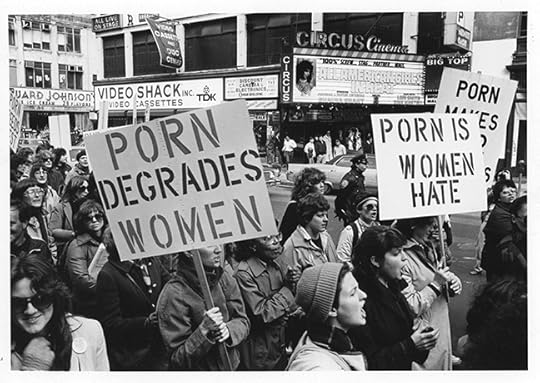
Well, naturally, this kind of nonsense really upsets all right-thinking men. More seriously, it’s true that many have tried and many have failed to find a causal link between fictitious representations of violence and actual violence.
The quixotic attempt to suppress violent porn took up most of Andrea’s career. One main problem was that definitions proved impossible. The word “pornography” was used by everyone on all sides of the free-for-all as if everyone knew what it meant. (A similar thing happens in theological debates when people use the word “God”as if we all mean the same thing.)
There were painful attempts to distinguish “erotica” from porn. Then there was a whole rigmarole about sadomasochism or BDSM as it is now called. Andrea thought lesbian women should not do it! Because in so doing
They were profoundly conformist, offering strict allegiance to the pre-existing division of sex roles between those who dominate and those who submit
Or in other words they were importing gross straight male violent sexuality into women’s lives. So THAT didn’t go down well with some people.
It wasn’t just evil men yelling Hands Off Our Porn. There was a group called FACT formed – Feminists Against Censorship Taskforce. And there was an enormous tussle about the lack of non-white feminists in this group. Andrea constantly raged that middle class anti-censorship white women turned blind eyes to the exploitation of non white poor women.
The comfy women, to keep what’s theirs, are prepared to let the powerless women be hurt forever… if this is feminism it deserves to die
What a tremendous minefield all this was! Andrea was trashed, bashed and mashed – she was a fascistic ugly mad dyke! Etc etc.
LET’S CUT TO THE CHASE HERE
Professor Duberman lets the cat out of the bag on page 192:
Of course in the era of the internet, with mounting billions being spent on pornography, the entire notion of trying to curtail its potential harm becomes something of a fool’s errand.
So, Andrea, give it up. The game is over.
EVENTUALLY
I didn’t really warm to Andrea during this fascinating book. In spite of many people saying that in person she was kind and soft-spoken and a great listener, it seems she fell out with nearly everybody, she would not compromise on anything. And she did come across like a righteous pulpit orator, hopeless at persuading, only good at hectoring in a way almost guaranteed to lose the audience. It seems she was always driving 90 miles an hour down a dead end street. Her failed crusades against misogyny and the open hate she met with fill the reader with sorrow. I’m glad she has not been forgotten.
Andrea campaigned against it. No, she didn’t think it was real but by its very existence it
suggests that sexual violence against women as entertainment and for profit will be condoned by a callous community and protected by a corrupt law
This began the nearly lifelong fight. Andrea and a few others would campaign to suppress misogynistic pornography, and everyone else would vigorously oppose them and support the porn merchants in the name of free speech, aka the First Amendment. Andrea said whose free speech are you worried about here? The pornographer’s? Well, what about the bound gagged woman? What about her speech?
Andrea would continually find to her eternal distress that those who enthusiastically agreed with her campaigns were the right wing moral majority Christian crowd, and those who vociferously opposed her were most of her fellow feminists along with every leftist liberal man in the USA. Whether it was fake snuff movies or violent pornography, most feminists and all leftist liberal men supported its right to be published freely. They would tell you they hated the stuff, but they hated censorship even more.
Let Nat Hentoff sum up their position
Cutting off thought, cutting off expression, for the greater good of us all, only results in the cutting off of more thought and more expression. Where does one stop after one has begun snuffing out expression, however repellent and frightening?
Let Maureen Mullarkey chime in also :
MacKinnon and Dworkin are mountebanks strutting on a feminist stage. Women have much to lose by submitting to the regressive "protection" of these neobarbaric thought police and self-appointed arbiters of "correct" sexuality. Despite the reservations we might have about pornography, the only proven danger to date is the censorship mentality itself.
SATURDAY NIGHT AT THE MOVIES
Since 1976 there has of course been a steady stream of movies depicting women being tortured and chopped up. Nobody really can be bothered to raise much of an eyebrow anymore.
Enough. Back to the story.
ANDREA’S DISMAL CAREER
She would painfully ferociously write a book, then her agent would finally pin down a teeny publisher who would put it out, then no one would review it except for three people who thought it was hysterical lunatic drivel or “hatemongering tantrums”. Then no one would buy it. Then she would painfully ferociously write another gloomy book. Martin Duberman, our brilliantly readable author, is a big Dworkin fan but even he says that sometimes her writing is over the top :
The hyperbole itself is sometimes fetching, expressed with a power and certitude that prove captivating even when we blink in disbelief at the actual content.
Sample quote from p 220:
At age 42, with five substantial books behind her, Andrea had become increasingly well known, thanks to a trail of brutal, demeaning reviews, more as a figure of derision than esteem.
She was in a life-long cohabiting relationship with a gay man named John. (That part of the story is very sweet and not at all dismal.)
She was poor all her life. She always wore overalls. She never said all men are rapists. She never said all intercourse is rape. But she did say a whole lot of other stuff. She never once made life easy for herself. But apparently she was a terrific barnstorming speaker. Even that didn’t go down well with some. Susan Brownmiller called her style “dramatized martyrdom and revival-tent theatrics”.
She tended to offend people. For instance John got a job at a writers’ retreat in Cummington, Massachusetts. But the residents and Andrea did not get along –
A lot of ignorant, sadistic males and their colonized docile women
She said. So then Andrea and John volunteered to reorganise the community library. They did this by dividing all the shelves into “books by men” and “books by women”. The result was 273 shelves of men’s books and 29 of women’s books. This annoyed the residents.
THE PORN WARS
We want a world in which men can live without pornographic incitements to “masculine” violence that now saturate male-controlled media. We want women to live without the fear and rage that come from seeing our humiliation sold as entertainment.
And
Pornography is not a harmless outlet for sexual fantasies. It is fascistic, misogynistic propaganda that fosters acts of violence against women
Well, naturally, this kind of nonsense really upsets all right-thinking men. More seriously, it’s true that many have tried and many have failed to find a causal link between fictitious representations of violence and actual violence.
The quixotic attempt to suppress violent porn took up most of Andrea’s career. One main problem was that definitions proved impossible. The word “pornography” was used by everyone on all sides of the free-for-all as if everyone knew what it meant. (A similar thing happens in theological debates when people use the word “God”as if we all mean the same thing.)
There were painful attempts to distinguish “erotica” from porn. Then there was a whole rigmarole about sadomasochism or BDSM as it is now called. Andrea thought lesbian women should not do it! Because in so doing
They were profoundly conformist, offering strict allegiance to the pre-existing division of sex roles between those who dominate and those who submit
Or in other words they were importing gross straight male violent sexuality into women’s lives. So THAT didn’t go down well with some people.
It wasn’t just evil men yelling Hands Off Our Porn. There was a group called FACT formed – Feminists Against Censorship Taskforce. And there was an enormous tussle about the lack of non-white feminists in this group. Andrea constantly raged that middle class anti-censorship white women turned blind eyes to the exploitation of non white poor women.
The comfy women, to keep what’s theirs, are prepared to let the powerless women be hurt forever… if this is feminism it deserves to die
What a tremendous minefield all this was! Andrea was trashed, bashed and mashed – she was a fascistic ugly mad dyke! Etc etc.
LET’S CUT TO THE CHASE HERE
Professor Duberman lets the cat out of the bag on page 192:
Of course in the era of the internet, with mounting billions being spent on pornography, the entire notion of trying to curtail its potential harm becomes something of a fool’s errand.
So, Andrea, give it up. The game is over.
EVENTUALLY
I didn’t really warm to Andrea during this fascinating book. In spite of many people saying that in person she was kind and soft-spoken and a great listener, it seems she fell out with nearly everybody, she would not compromise on anything. And she did come across like a righteous pulpit orator, hopeless at persuading, only good at hectoring in a way almost guaranteed to lose the audience. It seems she was always driving 90 miles an hour down a dead end street. Her failed crusades against misogyny and the open hate she met with fill the reader with sorrow. I’m glad she has not been forgotten.

August 30, 2020
“It’s the Nazism,” Andrea writes, that you “have to kill, not the Nazis. People die pretty easily, but cruelty doesn’t.”
Such an outstanding, emotionally raw and complex biography about one of our more brilliant, passionate and complicated feminist foremothers. As someone who has read most of Dworkin’s books (though not in years; I’ll have to rectify that) I was very pleased to see that the brilliance of her mind and the fire of her writing were fully depicted here.
The book starts with an intimate, upsetting but inspiring description of Dworkin’s foundations as a feminist, including a horrendous abuse at a women’s prison after a protest, a terrible abusive relationship, and more. This is all sensitively written and tied critically to many of her writings, and really helps the reader see how her brilliant philosophy was born.
The easy (and expected) way to go in this book would be to devote most of it to Dworkin’s controversial views and activism on pornography. I was so happy that this author clearly knows Dworkin was so much more than that one corner of her brilliant mind.
The book also has intriguing new (to me) and moving info on Dworkin’s lifelong relationship with John Stoltenberg. The two were in love in every way, mind, body and soul, for decades even though she identified as a lesbian and he identified as gay. I also loved, and lamented, some of the descriptions of the complexity of her relationships with other leading feminists of the era.
It also does a great job showing how particularly gross the word “feminazi” is as applied to Dworkin, who wrote a great deal of important work on anti-Semitism.
Oh - and! Now that the world knows who Allen Dershowitz REALLY is, hopefully people will see Andrea’s debates with him in a whole new way.
If anyone ever wrote a biography of me, I would want it to be every bit as intellectually rigorous, affectionate, and well-researched as this one. One of the best biographies I’ve read this year. Even if you think Dworkin might be a bit too radical for you, if you’re a feminist you should read this. She is of critical importance to the movement and perhaps even more relevant today, post #MeToo, than ever.
Thanks so much to Martin Duberman, The New Press, and NetGalley for the ARC of this beautiful work.
Such an outstanding, emotionally raw and complex biography about one of our more brilliant, passionate and complicated feminist foremothers. As someone who has read most of Dworkin’s books (though not in years; I’ll have to rectify that) I was very pleased to see that the brilliance of her mind and the fire of her writing were fully depicted here.
The book starts with an intimate, upsetting but inspiring description of Dworkin’s foundations as a feminist, including a horrendous abuse at a women’s prison after a protest, a terrible abusive relationship, and more. This is all sensitively written and tied critically to many of her writings, and really helps the reader see how her brilliant philosophy was born.
The easy (and expected) way to go in this book would be to devote most of it to Dworkin’s controversial views and activism on pornography. I was so happy that this author clearly knows Dworkin was so much more than that one corner of her brilliant mind.
The book also has intriguing new (to me) and moving info on Dworkin’s lifelong relationship with John Stoltenberg. The two were in love in every way, mind, body and soul, for decades even though she identified as a lesbian and he identified as gay. I also loved, and lamented, some of the descriptions of the complexity of her relationships with other leading feminists of the era.
It also does a great job showing how particularly gross the word “feminazi” is as applied to Dworkin, who wrote a great deal of important work on anti-Semitism.
Oh - and! Now that the world knows who Allen Dershowitz REALLY is, hopefully people will see Andrea’s debates with him in a whole new way.
If anyone ever wrote a biography of me, I would want it to be every bit as intellectually rigorous, affectionate, and well-researched as this one. One of the best biographies I’ve read this year. Even if you think Dworkin might be a bit too radical for you, if you’re a feminist you should read this. She is of critical importance to the movement and perhaps even more relevant today, post #MeToo, than ever.
Thanks so much to Martin Duberman, The New Press, and NetGalley for the ARC of this beautiful work.

September 11, 2020
Andrea Dworkin was one of second-wave feminism’s most important (and most polarising) figures, so I was excited to read a biography which promised to cut through decades of rumour and misinformation to tell the true story of her life and career. Martin Duberman kept his promise and did just that, using primary sources as well as extensive interviews to produce an honest and compelling portrait of a pioneering feminist.
It wasn’t always a flattering portrait. Andrea was a volatile individual who resisted any hint of compromise and had a (sometimes unfortunate, sometimes justified) habit of burning bridges among her friends and allies, often over seemingly minor things. A lot of the criticism levelled at her is based on a wilfully ignorant misunderstanding of her work — something which Duberman skilfully addressed in this biography — but there are definitely legitimate issues to consider as well. (Personally, I hate the fact that she insisted on identifying as a lesbian. I detest political lesbianism — along with anything else that suggests sexuality is a choice — and it’s even more egregious when practiced by a woman who has a consensual sexual relationship with her husband.)
The secondary title of this book — The Feminist as Revolutionary — is an extremely fitting one. Andrea was definitely revolutionary. Some of her writing is a little dated now, but her work on pornography in particular is just as relevant today as it was when it was first written. I wish Duberman had been a bit bolder about validating her prophetic comments in the reference section — he continued to cite older studies when making his own observations, but there is an abundance of contemporary evidence about the deleterious effects of pornography — and I wish he hadn’t conflated sex and gender as often as he did. Above all, however, I wish that Andrea was alive to experience the renaissance of her much-maligned but groundbreaking work.
It wasn’t always a flattering portrait. Andrea was a volatile individual who resisted any hint of compromise and had a (sometimes unfortunate, sometimes justified) habit of burning bridges among her friends and allies, often over seemingly minor things. A lot of the criticism levelled at her is based on a wilfully ignorant misunderstanding of her work — something which Duberman skilfully addressed in this biography — but there are definitely legitimate issues to consider as well. (Personally, I hate the fact that she insisted on identifying as a lesbian. I detest political lesbianism — along with anything else that suggests sexuality is a choice — and it’s even more egregious when practiced by a woman who has a consensual sexual relationship with her husband.)
The secondary title of this book — The Feminist as Revolutionary — is an extremely fitting one. Andrea was definitely revolutionary. Some of her writing is a little dated now, but her work on pornography in particular is just as relevant today as it was when it was first written. I wish Duberman had been a bit bolder about validating her prophetic comments in the reference section — he continued to cite older studies when making his own observations, but there is an abundance of contemporary evidence about the deleterious effects of pornography — and I wish he hadn’t conflated sex and gender as often as he did. Above all, however, I wish that Andrea was alive to experience the renaissance of her much-maligned but groundbreaking work.

Read
October 19, 2020Very much from Andrea's POV, derived primarily from diaries and her letters and in this way adds new information. But key areas are glossed over or ignored completely. While Duberman makes a very strong argument that her ideas were misrepresented by the male and corporate media, her ideological battles with other women and gay people are barely engaged, and not with depth. In particular, the impact of her work on The Butler decision in Canada is underplayed, and the existence of an extensive court case against a queer Bookstore, Little Sisters, for importing gay books is NOT MENTIONED. There is a weird tonal quality where Marty describes events and Andrea's reactions from her own perspective, in a pitch of constant sorrow, but it makes her come off as a person who expected the world to take care of her, and never considered getting a real job to deal with her financial problems. It's very odd. Would love to hear what other people think.

May 13, 2020
Andrea Dworkin is dead. As far as I know, Duberman did not meet her but had exclusive access to her archives, in which there were a lot of letters.
The book kicks off by showing Dworkin’s fierce sides as she, nineteen years old, joined a sit-in at the U.S. Mission to the United Nations to protest the escalating U.S. involvement in Vietnam:
This is not a wishy-washy biography about a simple bougie girl but a nuanced book about a person who desperately fought against injustice, be it real, imagined, against herself, or others.
Duberman does the reader a service by contrasting how Dworking was treated with disrespect and even hatred with how she treated others, both with love, hatred, and everything inbetween. She worked and lived in a time and place where feminism was not rated highly, in an extremely patriarchal society.
Dworkin met Cornelius Dirk de Bruin, a.k.a. Iwan, who abused her terribly:
To read of de Bruin’s horrific abuse and harassment of Dworkin is harrowing. The pain she suffered is described via her own words, in explicit detail.
Dworkin read a lot of modern feminist theory, formed her own theories, and put her words into action. As Duberman writes, ‘Andrea’s transition from abused hausfrau to formidably independent feminist, had been rapid—and astonishingly absolute.’
'Woman Hating' contains stories about the history of anti-feminist abuse and Dworkin’s vision about the future. She worked furiously from thereon, establishing herself as a key figure in the American 1970s feminist scene. She spoke out against pornography, gave speeches, moved south (which was a very bad idea), and solidified her (unconventional) partnership with John Stoltenberg.
Dworkin was vehement against those who opposed her, and this in spite of some even being her friends. An example, where Gloria Steinem edited Dworkin carelessly:
Dworkin could be isolated, destitute, even starving, and would yet express her thoughts in contrast to a massive wall of hatred against her, e.g. as Larry Flynt, owner of Hustler, a porn magazine, made sure that she was ridiculed and hated in many pages of his magazine.
There are salient points in the book.
The book also goes into her non-explicit feminist work, for example, Scapegoat:
This is, strangely, both an impersonal book and a personal one; while Duberman goes through the motions of Dworkin’s life, he does not seem to have interviewed a single person to contrast what he is writing about. This kind of armchair biography brings light, but not enough, in my experience, and this book suffers because of it.
When Duberman gets personal, some weird stuff pours through. An example of this:
I most certainly agree that The New York Times has a lot to answer for, but this type of writing sidetracks Dworkin in a way that I feel she does not deserve.
The weirdness aside—of which there are really only remnants—this book does delve into Dworkin’s life and her interactions with others, mainly thanks to Duberman’s exclusive access to Dworkin’s archives.
The book does breathe and is quite exciting to read at times. Dworkin was an unabashed firebrand, a beacon of modern feminism: brash, outrageous, angry, and free. We all have things to learn from her and this book reminds us to do just that.
The book kicks off by showing Dworkin’s fierce sides as she, nineteen years old, joined a sit-in at the U.S. Mission to the United Nations to protest the escalating U.S. involvement in Vietnam:
Minutes later, the police suddenly descended, and Andrea was among those carted off to night court. Her legal-aid attorney tried to persuade the presiding judge to free her on her own recognizance, arguing that she posed no danger to society during the period that would precede sentencing.
The judge rejected the plea, fixed bail at $500 and, when Andrea said she couldn’t pay, remanded her to the notorious bastille in the heart of Greenwich Village known as the Women’s House of Detention. After being showered and searched, she was subjected to a “vaginal exam” by a prison nurse, then taken up to her cell and locked in. The following afternoon she was brought back to the examination room for another “inspection”; when an alarmed Andrea asked a policewoman why, the reply was another question: “Are you a virgin?” Andrea refused to answer.
At that point two male doctors entered the room, one explaining loudly to the other that he suspected venereal disease. Andrea was ordered onto the table and told to put her legs in the stirrups. While the one doctor stood by, the other applied pressure initially to Andrea’s stomach and then to her breast. “You’re hurting me,” Andrea protested. Ignoring her, he put on a rubber glove and inserted his hand first into her rectum, then into her vagina. Removing his hand, he explained to the other doctor that he would now probe further with a speculum. Andrea had never heard the word before.
As the exam proceeded and her pain mounted, the second doctor plied her with questions: How many girls at Bennington are virgins? I don’t know, Andrea said. How many freshmen at Bennington are virgins? I don’t know, Andrea said, as the pain from the forceps grew worse. “That’s what you should know about,” he barked, “not Vietnam.”
When Andrea started to bleed—it would continue for the next two weeks—the doctor withdrew the forceps and ordered her back to the cell block. On the way, Andrea asked the accompanying policewoman if she could make a phone call. “It’s Friday,” the officer said. “No calls are allowed on weekends. Monday is George Washington’s birthday. You can call on Tuesday.” Released within a few days, Andrea decided to write to every newspaper listed in the Yellow Pages describing conditions at the House of Detention (built to house 400, it currently held 657 inmates) and her own mistreatment there.
This is not a wishy-washy biography about a simple bougie girl but a nuanced book about a person who desperately fought against injustice, be it real, imagined, against herself, or others.
Duberman does the reader a service by contrasting how Dworking was treated with disrespect and even hatred with how she treated others, both with love, hatred, and everything inbetween. She worked and lived in a time and place where feminism was not rated highly, in an extremely patriarchal society.
Dworkin met Cornelius Dirk de Bruin, a.k.a. Iwan, who abused her terribly:
The beatings escalated to the point where Iwan was kicking her in the stomach, banging her head against the floor, even hitting her with a beam of wood that bruised her so badly she could hardly walk for days. She managed, once, to get herself to a doctor; he told her he could write her a prescription for Valium or have her committed; she chose the Valium. Sometimes Iwan beat her into unconsciousness.
Her pain and fear became so great that she would scream out in agony, but no neighbor appeared to check on her. “If you scream for years,” she later wrote, “they will look through you for years.” They “see the bruises and injuries—and do nothing. . . . They say it’s your fault or you like it or they deny it is happening . . . you begin to feel you don’t exist . . . you begin to believe that he can hurt you as much as he wants and no one will help you. . . . Once you lose language, your isolation is absolute. . . . I wanted to die. . . . When I would come to after being beaten unconscious, the first feeling I had was a sorrow that I was alive.”
At age twenty-five, the brilliant, dynamic Andrea had become (as she subsequently described it) “a woman whose whole life was speechless desperation. . . . Smothering anxiety, waking nightmares, cold sweats, sobs that I choked on were the constants of my daily life. . . . I was nearly dead, catatonic, without the will to live.”
To read of de Bruin’s horrific abuse and harassment of Dworkin is harrowing. The pain she suffered is described via her own words, in explicit detail.
Gradually, very gradually, the forgotten emotion of anger began to resurface. And “the anger of the survivor” (as she later wrote) “is murderous. It is more dangerous to her than to the one who hurt her. She does not believe in murder; she wants him dead but will not kill him. She never gives up wanting him dead.”
Clarity also began to return, and with it the knowledge that in the future (as she wrote) “it will be very difficult to lie to her or to manipulate her. She sees through the social strategies that have controlled her as a woman, the sexual strategies that have reduced her to a shadow of her own native possibilities. . . . The emotional severity of the survivor appears to others, even those closest to her, to be cold and unyielding, ruthless in its intensity. She knows too much about suffering to try to measure it when it is real, but she despises self-pity. She is self-protective, not out of arrogance, but because she has been ruined by her own fragility.”
Dworkin read a lot of modern feminist theory, formed her own theories, and put her words into action. As Duberman writes, ‘Andrea’s transition from abused hausfrau to formidably independent feminist, had been rapid—and astonishingly absolute.’
'Woman Hating' contains stories about the history of anti-feminist abuse and Dworkin’s vision about the future. She worked furiously from thereon, establishing herself as a key figure in the American 1970s feminist scene. She spoke out against pornography, gave speeches, moved south (which was a very bad idea), and solidified her (unconventional) partnership with John Stoltenberg.
Dworkin was vehement against those who opposed her, and this in spite of some even being her friends. An example, where Gloria Steinem edited Dworkin carelessly:
This wasn’t the last time that Andrea made Gloria, in her position as editor-in-chief of Ms., the target of complaint—though what Andrea called the “tenderness” she felt for Gloria to some extent stayed her hand. Over the years their run-ins were few, especially when put in the context of the trench warfare that periodically engulfed the feminist movement. But on at least one other occasion a serious conflict arose over what Andrea regarded as a breach of contract; she went so far—in a letter to Robin Morgan—as to accuse Gloria of “dishonesty” and “repeated lies.”
Having learned better over the years than to tamper with Andrea’s prose without her express consent, Gloria—facing an eleventh-hour deadline, and following legal advice—rewrote a sentence in one of Andrea’s articles, and for the word “Porsche” substituted “auto.”
It deeply upset Andrea. Ferdinand Porsche, head of the auto company, had been imprisoned for twenty months after World War II for war crimes (though never brought to trial), and in her Ms. article Andrea had deliberately called the firm out for its complicity in cooperating with the Nazis. To Andrea, establishing the linkage between the name “Porsche” and anti-Semitism was profoundly important. In response, Gloria implied that Andrea’s extreme distress about the changing of a single word was disproportionate—which upset Andrea still more.
“If you believe that it is all trivial and that I wasted time and energy on something not very important,” Andrea responded, “then I simply don’t know how to be clear and understood, and I can’t operate in a context that reduces my deepest concerns to a misguided personal overzealousness. I am absolutely lost . . . how can I hope to be understood and respected if you don’t understand the issues involved here?”
Gloria pleaded ignorance of the Porsche connection to the Nazis, and Andrea in turn repeated that “I care a great deal for you, as I told you. . . Surely you must know that I have been a loyal friend, and that, while I must protect my work and my ethics, I do not want to harm either you or the magazine.” Gloria never again touched a word of Andrea’s prose without prior consultation, and Andrea never again found fault with her standards, either ethical or journalistic.
Dworkin could be isolated, destitute, even starving, and would yet express her thoughts in contrast to a massive wall of hatred against her, e.g. as Larry Flynt, owner of Hustler, a porn magazine, made sure that she was ridiculed and hated in many pages of his magazine.
There are salient points in the book.
Andrea and Kitty felt secure enough in their relationship to read each other’s work with an eye toward improving, not simply admiring, it (though they usually did). When Kitty, for example, read Andrea’s book Pornography in manuscript, she pulled no punches: “You take certain things on the level of their own self-presentation, which is myth, and hold them to that standard, rather than criticizing deeper realities, which in each case are even more open to attack. Example . . . where you say ‘the objective scientists’ find such and such, it is not clear whether you are faulting their objectivity or questioning objectivity itself. It seems more like the former, and I think the latter is more devastating and telling.”
Conversely, though Andrea praised Kitty’s speech “Violence Against Women—A Perspective” as “wonderful,” she felt free to tell her that “I think it is just patently wrong to say that ‘lesbian eroticism’ per se is not from the male standpoint, and also that therefore from the male standpoint it is the most obscene. . . . The Well of Loneliness is I think saturated with the ‘male viewpoint.’”
The book also goes into her non-explicit feminist work, for example, Scapegoat:
Scapegoat is something of an anomaly in Andrea’s body of work. Her long-standing theme of misogyny shares the stage this time around, and is often crowded off it, by her impassioned discussions of anti-Semitism and the militaristic turn taken by the state of Israel. Scapegoat is also the most traditionally academic of Andrea’s books (though her insights go deeper and the pulsating intensity of her prose is more riveting than can be said for most academic works); it seems a surprising anomaly for a writer who in earlier books experimented with twisting autobiography into fiction, and then back again, to end up in Scapegoat with all the scholarly apparatus of the professoriate and a prose style all but free of onrushing proclamation.
Singular, too, is the near absence in Scapegoat of those occasional apocalyptic outbursts that previously studded her work. Aside from the innate drama of the subject matter itself, Scapegoat is notably free of showy theatricality or grandiloquence. The tone throughout is highly sophisticated, the analysis measured, deliberate, exquisitely cerebral. The central theme of Scapegoat is the analogous dehumanization of Jews and women in Nazi Germany, and Palestinians and women in the state of Israel. Andrea nowhere suggests any equation between the unmitigated vileness of the German Nazis and the current behavior of Israeli men. In her view, the link between the two, though only marginal, is the cultivation in both instances of a hyper-masculinity reliant for believability and force on the scapegoating of others. The matter of scale is all-important, as is the differing cultural context in which the warrior model emerged in the two countries, and the ways in which it was publicly deployed.
This is, strangely, both an impersonal book and a personal one; while Duberman goes through the motions of Dworkin’s life, he does not seem to have interviewed a single person to contrast what he is writing about. This kind of armchair biography brings light, but not enough, in my experience, and this book suffers because of it.
When Duberman gets personal, some weird stuff pours through. An example of this:
The New York Times, weighing in a month after the publication of Scapegoat, managed to put a damper—as only the Times can—on whatever momentum might have been building for the book
I most certainly agree that The New York Times has a lot to answer for, but this type of writing sidetracks Dworkin in a way that I feel she does not deserve.
The weirdness aside—of which there are really only remnants—this book does delve into Dworkin’s life and her interactions with others, mainly thanks to Duberman’s exclusive access to Dworkin’s archives.
The book does breathe and is quite exciting to read at times. Dworkin was an unabashed firebrand, a beacon of modern feminism: brash, outrageous, angry, and free. We all have things to learn from her and this book reminds us to do just that.
January 4, 2021
I won this book in a Goodreads Giveaway. Thank you!
When I picked this up, I'm not sure I'd ever heard the name Andrea Dworkin before. Reading her story made me feel like I don't know as much about the history of feminism in this country as I ought and that perhaps I need to do more research.
That said, the biography starts when Andrea is 18 and ends with her death. It focuses largely on her work, and while well researched, I come away feeling that I don't really know who she was. Personal tidbits are injected occasionally, but I fail to understand her motivation for her beliefs and writings, and wish I did better - a better picture inside her head.
This book was somewhat hard for me to read- it reads almost like a textbook. I wish it were a bit more engaging and accessible, because there are good information, great questions and ideas presented that really made me think, question, and discuss. Overall, I'm glad that I read it and gained what insights and knowledge that I did, but it's not one I will rush to recommend to others.
When I picked this up, I'm not sure I'd ever heard the name Andrea Dworkin before. Reading her story made me feel like I don't know as much about the history of feminism in this country as I ought and that perhaps I need to do more research.
That said, the biography starts when Andrea is 18 and ends with her death. It focuses largely on her work, and while well researched, I come away feeling that I don't really know who she was. Personal tidbits are injected occasionally, but I fail to understand her motivation for her beliefs and writings, and wish I did better - a better picture inside her head.
This book was somewhat hard for me to read- it reads almost like a textbook. I wish it were a bit more engaging and accessible, because there are good information, great questions and ideas presented that really made me think, question, and discuss. Overall, I'm glad that I read it and gained what insights and knowledge that I did, but it's not one I will rush to recommend to others.

August 18, 2020
Andrea Dworkin: The Feminist as Revolutionary by Martin Duberman is a well-researched critical biography of an important and often controversial figure of second wave feminism.
I should probably admit upfront to having appreciated Dworkin's work for a long time so I came to this with a positive opinion of her and her ideas. I didn't always agree 100% with her thoughts but she never failed to make me reconsider my position and often shift it or outright change it.
Duberman did know Dworkin so his analysis and narrative are not strictly from his access to archives, though mostly so. It is subtly mentioned in the book that they met during the days of the Vietnam protests, but if someone just cherry-picked long quotes rather than read the book they would miss that. But such is what passes for certain types.
Duberman has written a critical biography here, not to be confused with a biography that is critical of Dworkin. He presents her ideas and tries to explain what she was arguing for and what she advocated for. In such a biography it is not necessary to present every counter argument, this is not a book of theory, this is a biography, so an explication of Dworkin's ideas to correct misunderstandings (all intercourse is rape, for example), intentional or not, is part of telling her story. Biography, yes, book of theory, no. The only people who will be upset that counter arguments weren't presented in greater detail will be those who likely disagree with Dworkin. Understandable but disingenuous as well.
This work presents Dworkin as an often difficult person though generally not from being mean or uncaring but from her approach to feminism and life itself. She sometimes saw things as easily distinguishable between right and wrong and gave no harbor to those she believed advocated, even unconsciously, for wrong. Yet reading her with an open mind, trying to understand what she was saying on her terms, was always a rewarding experience, even when she didn't persuade you. And if you're not reading any thinker to understand them on their terms, then you're really just halfway reading, you're looking for little bits that you can counter regardless of the accuracy of those bits to the larger argument. Dworkin did, and still does, make many readers take that approach because her truths are often uncomfortable.
I would recommend this to anyone who wants to better understand both the person and her ideas. Whether you're new to her or have read all of her work, this makes many connections that have previously been hidden.
Reviewed from a copy made available by the publisher via NetGalley.
I should probably admit upfront to having appreciated Dworkin's work for a long time so I came to this with a positive opinion of her and her ideas. I didn't always agree 100% with her thoughts but she never failed to make me reconsider my position and often shift it or outright change it.
Duberman did know Dworkin so his analysis and narrative are not strictly from his access to archives, though mostly so. It is subtly mentioned in the book that they met during the days of the Vietnam protests, but if someone just cherry-picked long quotes rather than read the book they would miss that. But such is what passes for certain types.
Duberman has written a critical biography here, not to be confused with a biography that is critical of Dworkin. He presents her ideas and tries to explain what she was arguing for and what she advocated for. In such a biography it is not necessary to present every counter argument, this is not a book of theory, this is a biography, so an explication of Dworkin's ideas to correct misunderstandings (all intercourse is rape, for example), intentional or not, is part of telling her story. Biography, yes, book of theory, no. The only people who will be upset that counter arguments weren't presented in greater detail will be those who likely disagree with Dworkin. Understandable but disingenuous as well.
This work presents Dworkin as an often difficult person though generally not from being mean or uncaring but from her approach to feminism and life itself. She sometimes saw things as easily distinguishable between right and wrong and gave no harbor to those she believed advocated, even unconsciously, for wrong. Yet reading her with an open mind, trying to understand what she was saying on her terms, was always a rewarding experience, even when she didn't persuade you. And if you're not reading any thinker to understand them on their terms, then you're really just halfway reading, you're looking for little bits that you can counter regardless of the accuracy of those bits to the larger argument. Dworkin did, and still does, make many readers take that approach because her truths are often uncomfortable.
I would recommend this to anyone who wants to better understand both the person and her ideas. Whether you're new to her or have read all of her work, this makes many connections that have previously been hidden.
Reviewed from a copy made available by the publisher via NetGalley.
December 2, 2020
Historian, biographer, celebrated gay activist and prolific author, Martin Duberman has written a well-balanced biography of late feminist activist, Andrea Dworkin (1946-2005) in Andrea Dworkin: The Feminist as Revolutionary. Dworkin’s history of activism began in earnest in 1965 during an antiwar protest at the United Nations. Scarcely 18 years old and a freshman at Bennington College, Dworkin was swiftly sent to the New York Women’s Detention Center for her participation in the protest, where she was underwent a roughly administered pelvic exam by a male doctor. She bled for weeks following. Duberman begins the biography in 1965 when Dworkin’s career as an activist begins.
Duberman recounts Dworkin’s personal ife including two marriages to Dutch anarchist Iwan DeBruin in the late 1960s and much later to John Stoltenberg, who she retained a largely sexless marriage with. The marriage to DeBruin was short-lived as she suffered much domestic violence at his hands. Later, the relationship with Stoltenberg lasted several decades, though Dworkin identified as a lesbian and Stoltenberg, also a staunch feminist, as a gay man.
Much of the book focuses on Dworkin’s prolific writing career spanning more than three decades and including more than 12 publications in nonfiction, fiction, and poetry. As a her biographer and lifelong friend, Duberman is even-handed with his characterization of her as she had conflicts with Gloria Steinem over lengthy pieces she submitted to the magazine, for example. Duberman notes that Dworkin was a prolific writer beginning with Woman Hating (1974). However, it was her activism in the antipornography movement begun in 1976 that put her on the map. She published her most famous work Pornography: Men Possessing Women in 1981, arguing that pornography dehumanizes women both in terms of its production and consumption by men. Her activism in the antipornography movement continued through work on the antipornography civil rights ordinance.
The book is a comprehensive tour de force and a must-read for those interested in feminism and the life of Andrea Dworkin.
Duberman recounts Dworkin’s personal ife including two marriages to Dutch anarchist Iwan DeBruin in the late 1960s and much later to John Stoltenberg, who she retained a largely sexless marriage with. The marriage to DeBruin was short-lived as she suffered much domestic violence at his hands. Later, the relationship with Stoltenberg lasted several decades, though Dworkin identified as a lesbian and Stoltenberg, also a staunch feminist, as a gay man.
Much of the book focuses on Dworkin’s prolific writing career spanning more than three decades and including more than 12 publications in nonfiction, fiction, and poetry. As a her biographer and lifelong friend, Duberman is even-handed with his characterization of her as she had conflicts with Gloria Steinem over lengthy pieces she submitted to the magazine, for example. Duberman notes that Dworkin was a prolific writer beginning with Woman Hating (1974). However, it was her activism in the antipornography movement begun in 1976 that put her on the map. She published her most famous work Pornography: Men Possessing Women in 1981, arguing that pornography dehumanizes women both in terms of its production and consumption by men. Her activism in the antipornography movement continued through work on the antipornography civil rights ordinance.
The book is a comprehensive tour de force and a must-read for those interested in feminism and the life of Andrea Dworkin.

November 25, 2020
It's rather embarrassing to admit, before reading this book, I had no idea who Andrea Dworkin was. With gratitude to Martin Duberman, for filling me in, I write this review. She was a dynamo! What I found most amazing was her ability to overcome seemingly insurmountable obstacles: poverty, lack of emotional parental support, terrible domestic abuse, rape, and slander. Not only did she overcome but she remained gracious and open to everyone she encountered. She never caved in on her principles, despite extreme, external pressures and continual negative press.
But as one sends out work and meets with constant editorial abuse, and then slowly as one's work gets printed here and there and one experiences the anger and vilification so often directed at feminist work --then, even sitting down to work at all becomes more and more difficult. One knows that there is no place to publish; one knows the rejection letters that will come before they are written; one knows the abuse that will come if the work is printed. Ironically, as one learns more and more about the nature of women's oppression through one's work, it becomes harder to work. One's work in the world meets the same kind of abuse of one's body. 80-81
She wrote many books and I don't believe she ever actually graduated from college. She was a prolific and gifted orator and accepted numerous speaking engagements and lecture opportunities, often simply to pay the bills. Andrea Dworkin's main fight was against pornography, especially overcoming the pornographers' arguments in favor of free speech.
Women who protest pornography as both an expression of male sadism and a further incitement to it were once again being counseled to remain silent -- in the name, bizarrely, of freedom of speech. 135
She spoke out forcefully --and got a tumultuous response when she insisted that women "will never again accept any depiction of us that has as its first principle, its first premise, that we want to be abused, that we enjoy being hurt, that we like being forced." Those are male assumptions about women's lives. "Some people say that pornography is only fantasy. What part of it is fantasy? Women are beaten and raped and forced and whipped and held captive. The violence depicted is real. The acts of violence depicted in pornography are actual acts committed against real women and real female children. The fantasy is that women want to be abused." 135
She did, though, successfully convey the essence of her defense against the standard charge that curtailing pornography was an affront to the First Amendment's guarantee of free speech: "women as a class are excluded from being able to exercise speech--rape, battery, and incest all being ways of keeping a class of people from being able to speak at all." The overflow crowd remained hushed throughout her talk--and gave her a standing ovation at its close. 155
As Andrea put it, "Pornography has precisely to do with the situation of poor women--which in my view is why we are getting so much shit thrown at us in the women's movement. People have no idea how middle-classed and privileged their liberal First Amendment stuff is--how power and money determine who can actually speak in this society." Besides, she argued, the First Amendment did not intend a free pass to any form of speech; both libel and perjury had never been forms of protected expression. 206
When Andrea herself testified before the Commission, she spoke with such moving simplicity that one of the commissioners, Park Elliott Dietz, director of the Institute of Law, Psychiatry and Public Policy at the University of Virginia, later said that he'd been brought to tears. ("I am asking you as individuals," Andrea had said, "to have the courage, because I think it's what you will need, to actually be willing yourselves to go and cut that woman down and untie her hands and take the gag out of her mouth, and to do something, for her freedom.") 207
In writing about her novel, Ice and Fire Andrea had this to say, it cannot resonate for anyone who refuses to acknowledge "the intersection of poverty and sexual exploitation. You needed to give a damn about that interconnection before the novel could mean anything to you. It is probably easier to celebrate prostitution as a so-called feminist option for women, the current liberal dogma in this country, than to read Ice and Fire and feel the cost of being bought and sold." 215
I can imagine Andrea rolling over in her grave over the likes of Kavanaugh's nomination to the Supreme Court; escalating sexual trafficking across the United States; the scandalous behavior of Epstein and his ilk, trafficking women and children for the upper echelons of society; and an American President who claims he can do whatever he wants with women, "Grab 'em by the pussy. You can do anything". Too much male, privileged freedom of speech and the continued silencing of women. Oh yeah, this book has me fired up!
If you've read enough of my reviews you know that I love photos and there's an entire section of photos. Baby Andrea Dworkin photos! The overalls! Photos spanning the timeline of her life are included. The photo of Andrea with John Stoltenberg is especially endearing, as they appear happy and relaxed together. Martin Duberman describes their relationship, and eventual marriage (mainly for health insurance reasons), but they did seem to love each other and care for each other deeply. For which I'm grateful, because it brings some relief and satisfaction to know that, eventually, Andrea had someone consistently in her life, rooting for her and loving her, unconditionally. She died at the age of 58 from heart inflammation. To say she had a difficult life is mild, it's no wonder she died of a broken heart.
4.5 stars, as it was a bit of a behemoth, at times. For example, the repetition of naming her books, Mostly out of financial necessity she again began, soon after the double publication in 1987 of Ice and Fire and Intercourse...220. That was already mentioned, earlier, etc. I'm being super picky, though, it's an excellent biography.
But as one sends out work and meets with constant editorial abuse, and then slowly as one's work gets printed here and there and one experiences the anger and vilification so often directed at feminist work --then, even sitting down to work at all becomes more and more difficult. One knows that there is no place to publish; one knows the rejection letters that will come before they are written; one knows the abuse that will come if the work is printed. Ironically, as one learns more and more about the nature of women's oppression through one's work, it becomes harder to work. One's work in the world meets the same kind of abuse of one's body. 80-81
She wrote many books and I don't believe she ever actually graduated from college. She was a prolific and gifted orator and accepted numerous speaking engagements and lecture opportunities, often simply to pay the bills. Andrea Dworkin's main fight was against pornography, especially overcoming the pornographers' arguments in favor of free speech.
Women who protest pornography as both an expression of male sadism and a further incitement to it were once again being counseled to remain silent -- in the name, bizarrely, of freedom of speech. 135
She spoke out forcefully --and got a tumultuous response when she insisted that women "will never again accept any depiction of us that has as its first principle, its first premise, that we want to be abused, that we enjoy being hurt, that we like being forced." Those are male assumptions about women's lives. "Some people say that pornography is only fantasy. What part of it is fantasy? Women are beaten and raped and forced and whipped and held captive. The violence depicted is real. The acts of violence depicted in pornography are actual acts committed against real women and real female children. The fantasy is that women want to be abused." 135
She did, though, successfully convey the essence of her defense against the standard charge that curtailing pornography was an affront to the First Amendment's guarantee of free speech: "women as a class are excluded from being able to exercise speech--rape, battery, and incest all being ways of keeping a class of people from being able to speak at all." The overflow crowd remained hushed throughout her talk--and gave her a standing ovation at its close. 155
As Andrea put it, "Pornography has precisely to do with the situation of poor women--which in my view is why we are getting so much shit thrown at us in the women's movement. People have no idea how middle-classed and privileged their liberal First Amendment stuff is--how power and money determine who can actually speak in this society." Besides, she argued, the First Amendment did not intend a free pass to any form of speech; both libel and perjury had never been forms of protected expression. 206
When Andrea herself testified before the Commission, she spoke with such moving simplicity that one of the commissioners, Park Elliott Dietz, director of the Institute of Law, Psychiatry and Public Policy at the University of Virginia, later said that he'd been brought to tears. ("I am asking you as individuals," Andrea had said, "to have the courage, because I think it's what you will need, to actually be willing yourselves to go and cut that woman down and untie her hands and take the gag out of her mouth, and to do something, for her freedom.") 207
In writing about her novel, Ice and Fire Andrea had this to say, it cannot resonate for anyone who refuses to acknowledge "the intersection of poverty and sexual exploitation. You needed to give a damn about that interconnection before the novel could mean anything to you. It is probably easier to celebrate prostitution as a so-called feminist option for women, the current liberal dogma in this country, than to read Ice and Fire and feel the cost of being bought and sold." 215
I can imagine Andrea rolling over in her grave over the likes of Kavanaugh's nomination to the Supreme Court; escalating sexual trafficking across the United States; the scandalous behavior of Epstein and his ilk, trafficking women and children for the upper echelons of society; and an American President who claims he can do whatever he wants with women, "Grab 'em by the pussy. You can do anything". Too much male, privileged freedom of speech and the continued silencing of women. Oh yeah, this book has me fired up!
If you've read enough of my reviews you know that I love photos and there's an entire section of photos. Baby Andrea Dworkin photos! The overalls! Photos spanning the timeline of her life are included. The photo of Andrea with John Stoltenberg is especially endearing, as they appear happy and relaxed together. Martin Duberman describes their relationship, and eventual marriage (mainly for health insurance reasons), but they did seem to love each other and care for each other deeply. For which I'm grateful, because it brings some relief and satisfaction to know that, eventually, Andrea had someone consistently in her life, rooting for her and loving her, unconditionally. She died at the age of 58 from heart inflammation. To say she had a difficult life is mild, it's no wonder she died of a broken heart.
4.5 stars, as it was a bit of a behemoth, at times. For example, the repetition of naming her books, Mostly out of financial necessity she again began, soon after the double publication in 1987 of Ice and Fire and Intercourse...220. That was already mentioned, earlier, etc. I'm being super picky, though, it's an excellent biography.

September 23, 2026
Se eu sou alguma coisa, sou discípula de dworkin

June 24, 2024
The Feminist as Manifestation of Dysgenics

February 8, 2021
I'm giving this 5* because I acknowledge that Andrea Dworkin was way ahead of her time, and not enough people respect her when she was alive. I can remember reading some of her books when I was a fledgling feminist, and not really understanding them ... now that I'd like to read them again (especially Pornography and Right Wing Women) I find that the public library doesn't carry them, and the only way to get hold of them for purchase is via abebooks.
Dworkin proposed the notion of gender fluidity way before the rest of the world wised up, and was also never anti-sex; but she was clear in her belief that violent pornography was detrimental to both women and children, and the rights of these women and children should supersede the rights of the first amendment to free speech.
She experienced so much vitriol and personal attacks in her life but remained committed ... I would like to shake her hand and say thank you for what she managed to do (the battle still raging on, 20 or 30 years later).
Dworkin proposed the notion of gender fluidity way before the rest of the world wised up, and was also never anti-sex; but she was clear in her belief that violent pornography was detrimental to both women and children, and the rights of these women and children should supersede the rights of the first amendment to free speech.
She experienced so much vitriol and personal attacks in her life but remained committed ... I would like to shake her hand and say thank you for what she managed to do (the battle still raging on, 20 or 30 years later).

August 4, 2020
The book is well researched and the author's affection for his subject shines through. Andrea Dworkin and the radical feminism of the 1970's is a compelling subject. Her life as a young adult as well as her perspective in the anti-pornography battles of the 80's is well documented.
What the book suffers from is being too willing to accept Dworkin's position and the author often argues her points for her without presenting a fair accounting of her critics. Her support for Linda Lovelace and her claims of being raped and mistreated have been countered. None of that is present in the book. The position of women working within pornography who disagree with Dworkin is not presented. Arguments by feminists like the ACLU's Nadine Strossen not presented fairly but are argued against by the author.
The book is a good read and I would recommend it. However, anyone really interested in either radical feminism or the pornography wars would do well to supplement this with other materials.
What the book suffers from is being too willing to accept Dworkin's position and the author often argues her points for her without presenting a fair accounting of her critics. Her support for Linda Lovelace and her claims of being raped and mistreated have been countered. None of that is present in the book. The position of women working within pornography who disagree with Dworkin is not presented. Arguments by feminists like the ACLU's Nadine Strossen not presented fairly but are argued against by the author.
The book is a good read and I would recommend it. However, anyone really interested in either radical feminism or the pornography wars would do well to supplement this with other materials.

December 14, 2020
a very good, extremely readable biography. a bit scant on some details (on one of the last pages of the book, it's revealed that hitchens invited her for dinner with david frum - how did she know hitchens? did they like each other? i so want to know...), but overall a very worthy book that does its subject right.
my only gripe is that there is a lack of constructive criticism in some areas. no doubt dworkin was subjected to all manner of shoddy critical abuse, and the author was right to condemn that. but he's far too accepting of her view of gender as a thing that's imposed by culture, with no biological footprint. even if he's personally of that blank state hogwash, he should have at least found room for a scientific pov on that matter.
my only gripe is that there is a lack of constructive criticism in some areas. no doubt dworkin was subjected to all manner of shoddy critical abuse, and the author was right to condemn that. but he's far too accepting of her view of gender as a thing that's imposed by culture, with no biological footprint. even if he's personally of that blank state hogwash, he should have at least found room for a scientific pov on that matter.

December 12, 2020
I knew nothing about Andrea Dworkin except her name and the fact that she was a militant feminist. This biography introduced the individual and her work to me, and it’s a comprehensive, detailed and thoroughly researched work which is both illuminating and engaging. It’s an affectionate and sympathetic portrait of a difficult and conflicted woman, and perhaps felt a little too partisan at times, but overall I didn’t feel that this was a fault as it made Dworkin much more human and approachable. This rather subjective approach in fact enhanced the reading for me. All in all, an excellent and highly recommended biography of a key figure in the women’s movement.

November 23, 2020
A deep dive into someone who was a contentious figure, correcting the record on any number of mischaracterizations. A little fawning (the author was a friend/acquaintance of many of those involved), but all-in-all an insightful look into this much-maligned writer and activist.

September 22, 2022
Andrea Dworkin was an uncompromising idealist, which is to say, a monumental pain in the ass. Although Andrea Dworkin could be charming in private, her public persona was brash, blunt and abrasive. Andrea Dworkin's conscious avoidance of tact, subtlety, or nuance doomed her to a life of marginalization and failure (and I think she'd agree with that statement). Andrea Dworkin's decades-long quest to eliminate pornography is now used in online dictionaries as examples of "quixotic" and "ill-fated." Although Andrea Dworkin never claimed "penetration is rape," a quote often misattributed to her, her unrelenting attack on masculinity got her labeled, not unjustly, as a misandrist. She was a minor, polarizing figure on the radical fringe of second-wave feminism who made ten enemies for every ally.
So . . . why does Andrea Dworkin even deserve a biography?
Because Andrea Dworkin was right about a lot of things.
No one could inspire as much hatred as Andrea Dworkin did without being a real threat. I doubt that Penthouse and Hustler would have heaped such scorn on an author whose book sales rarely threatened quadruple digits unless they feared there was at least some truth to Andrea Dworkin's assertion that pornography leads to sexual violence. I've got a little trouble with that theory myself, but I really don't doubt that heterosexual porn is premised upon the subjugation of women, and Andrea Dworkin is hardly the first person to conflate a symptom and a disease. Believe it or not, Andrea Dworkin's questionable tactic of holding pornographers liable for rape and abuse was part of an entirely laudable crusade to eliminate violence against women. Most people missed that, often intentionally. I've got to believe that Andrea Dworkin's many liberal detractors, including civil libertarians and sex-positive feminists, criticized her not out of opposition to censorship but a desire to protect and preserve pornography. Give me smut and nothing but.
So, this is kind of a heavy book. In fact, it's a fairly epic downer. In addition to detailing pretty much every injury and injustice that Andrea Dworkin suffered, Mr. Duberman paints the bleakest picture imaginable of the American left and its bottomless capacity for self-sabotage. Wanna know how the Christian Right succeeded in their 40-year quest to overturn Roe V Wade? Mr. Duberman answers the question, albeit indirectly, with his depiction of the non-stop, petty infighting that has destroyed progressivism in this country. Did Andrea Dworkin, with her knack for demonizing her critics, contribute to this dissolution? Yeah, probably, but oh boy, did she have her share of accomplices.
Which is not to say that one shouldn't question some of Mr. Duberman's claims. For example, he claims that Henry Kissinger was Richard Nixon's major co-conspirator in Watergate. You can blame Kissy-Kiss for a lot of things, but I don't think that third-rate burglary was one of them. Still, I appreciate his tough but fair assessment of a tough but (mostly) fair woman.
So . . . why does Andrea Dworkin even deserve a biography?
Because Andrea Dworkin was right about a lot of things.
No one could inspire as much hatred as Andrea Dworkin did without being a real threat. I doubt that Penthouse and Hustler would have heaped such scorn on an author whose book sales rarely threatened quadruple digits unless they feared there was at least some truth to Andrea Dworkin's assertion that pornography leads to sexual violence. I've got a little trouble with that theory myself, but I really don't doubt that heterosexual porn is premised upon the subjugation of women, and Andrea Dworkin is hardly the first person to conflate a symptom and a disease. Believe it or not, Andrea Dworkin's questionable tactic of holding pornographers liable for rape and abuse was part of an entirely laudable crusade to eliminate violence against women. Most people missed that, often intentionally. I've got to believe that Andrea Dworkin's many liberal detractors, including civil libertarians and sex-positive feminists, criticized her not out of opposition to censorship but a desire to protect and preserve pornography. Give me smut and nothing but.
So, this is kind of a heavy book. In fact, it's a fairly epic downer. In addition to detailing pretty much every injury and injustice that Andrea Dworkin suffered, Mr. Duberman paints the bleakest picture imaginable of the American left and its bottomless capacity for self-sabotage. Wanna know how the Christian Right succeeded in their 40-year quest to overturn Roe V Wade? Mr. Duberman answers the question, albeit indirectly, with his depiction of the non-stop, petty infighting that has destroyed progressivism in this country. Did Andrea Dworkin, with her knack for demonizing her critics, contribute to this dissolution? Yeah, probably, but oh boy, did she have her share of accomplices.
Which is not to say that one shouldn't question some of Mr. Duberman's claims. For example, he claims that Henry Kissinger was Richard Nixon's major co-conspirator in Watergate. You can blame Kissy-Kiss for a lot of things, but I don't think that third-rate burglary was one of them. Still, I appreciate his tough but fair assessment of a tough but (mostly) fair woman.
November 29, 2023
Don't have time to describe my 1980s run-ins with Dworkin but she was formidable. Got to engage in a brief debate on a certain campus. If you don't know Dworkin, you should.

May 9, 2021
Ms. Dworkin's life story is challenging to get through. Talented and incisive as a writer, gifted as a speaker, and known for her searing critiques of injustice against women, she seems never to have found satisfaction in her role as a public intellectual. Her efforts to change society, especially her battle with woman-defiling pornography, ultimately met with failure. She also suffered immensely in her personal life.
Duberman's biography balances admiration with measured criticism. He elucidates key achievements and set-backs in Dworkin's life by mining her correspondence and journals. However, her life was so punctuated with bitter disappointments, betrayals (real and imagined), physical/sexual abuse, and often vicious and sexist attacks against her analysis, proposals and personhood (her looks and weight), that reading becomes burdensome. I also found the internecine strife within the feminist community confounding.
Upon completing the book, I felt admiration for Dworkin's intellect and force of will, but also weariness from having learned of the varied and unending ways in which she suffered. This book is NOT uplifting: it can be summarized as "She fought and lost--bitterly." (The only hint at redemption is when the author suggests that Dworkin's uncompromising demands for equality, which were ridiculed in her lifetime by powerful chauvinist forces AND which were opposed by a significant camp within the feminist community, are being reevaluated--more positively--in today's #metoo era.)
I find that this biography--disappointingly and likely unintentionally--paints her life as largely ineffectual. (Perhaps the noble fight is justification enough, regardless of the outcome?) I am interested in reading a work by Dworkin, herself. And, I would consider reading a biography of her life by another author.
Lastly, a list of factoids regarding Dworkin from this work:
-As a young woman living abroad, she married an insecure and violent Dutchman, who abused her. This experience deeply affected her and colored much of her writing and animated her activism.
-Though she identified as a lesbian, she lived most of her adult life with a male partner, John Stoltenberg, who identified as gay.
-She wrote nine non-fiction books, as a soloist, and co-authored another three books with Katharine A. MacKinnon.
-She and MacKinnon authored an ordinance that empowered "victims" of pornography (featuring the sexualized-subordination of women) to seek damages. The US Supreme Court declared an adopted version of the law unconstitutional in 1986.
-She wrote many published articles.
-She also wrote books of fiction and poetry.
Duberman's biography balances admiration with measured criticism. He elucidates key achievements and set-backs in Dworkin's life by mining her correspondence and journals. However, her life was so punctuated with bitter disappointments, betrayals (real and imagined), physical/sexual abuse, and often vicious and sexist attacks against her analysis, proposals and personhood (her looks and weight), that reading becomes burdensome. I also found the internecine strife within the feminist community confounding.
Upon completing the book, I felt admiration for Dworkin's intellect and force of will, but also weariness from having learned of the varied and unending ways in which she suffered. This book is NOT uplifting: it can be summarized as "She fought and lost--bitterly." (The only hint at redemption is when the author suggests that Dworkin's uncompromising demands for equality, which were ridiculed in her lifetime by powerful chauvinist forces AND which were opposed by a significant camp within the feminist community, are being reevaluated--more positively--in today's #metoo era.)
I find that this biography--disappointingly and likely unintentionally--paints her life as largely ineffectual. (Perhaps the noble fight is justification enough, regardless of the outcome?) I am interested in reading a work by Dworkin, herself. And, I would consider reading a biography of her life by another author.
Lastly, a list of factoids regarding Dworkin from this work:
-As a young woman living abroad, she married an insecure and violent Dutchman, who abused her. This experience deeply affected her and colored much of her writing and animated her activism.
-Though she identified as a lesbian, she lived most of her adult life with a male partner, John Stoltenberg, who identified as gay.
-She wrote nine non-fiction books, as a soloist, and co-authored another three books with Katharine A. MacKinnon.
-She and MacKinnon authored an ordinance that empowered "victims" of pornography (featuring the sexualized-subordination of women) to seek damages. The US Supreme Court declared an adopted version of the law unconstitutional in 1986.
-She wrote many published articles.
-She also wrote books of fiction and poetry.
This entire review has been hidden because of spoilers.

August 24, 2021
I read Andrea’s book on pornography when I was 19 and it is the book I credit with making me a feminist proper, that is, an ANGRY feminist. I found this biography incredibly moving and powerful, and I’ve come away feeling a deeper appreciation, in fact, a love, for Andrea, and - in her honour - I’m now angrier than ever.

November 23, 2020
Reads like a novel. A kind and sympathetic portrayal of an important figure, without stinting on the dogmatism and (justified) rage that made her so controversial.
Read
February 9, 2021The power exercised by white men, day to day, in life is power that is institutionalised. It is protected by law. It is protected by religion and religious practice. It is protected by universities, which are strongholds of male supremacy. It is protected by a police force. It is protected by those whom Shelley called “the unacknowledged legislators of the world”: the poets, the artists. Against that power, we have silence.” Andrea Dworkin was motivated by an innate desire to rid the world of pain and oppression. Had more of us listened to Dworkin during her decades of activism, and taken her work more seriously, more women would have signed up to an uncompromising feminism, as opposed to the fun kind, the sloganeering sort you read on high-street T-shirts, that is all about individual “girl power” and being able to wear trousers, rather than a collective movement to emancipate all women from the tyranny of oppression. Her central theory is that the right exploits women’s fear and offers us a chivalrous protection. It reassures us that we do not need to change the status quo, but accept it, and take whatever access to power is available to us. Dworkin despaired at what has come to be known as “lean-in feminism” which focuses on the ability of individual, privileged women to climb to the top, and always said that until women at the “bottom of the pile” were liberated, none of us could be. Women live “inside a system of humiliation from which there is no escape”. We are living in terrible times for women. Thankfully, our resistance to the global pandemic of sexual and domestic violence is growing. But this resistance is being curtailed by a concerted attempt to silence women – just look at the inexorable rise of non-disclosure agreements to gag women speaking out about discrimination or harassment. In 1988, Dworkin was widely pilloried for describing sexual intercourse as “mandatory”, arguing that men claim an inalienable right to penetrate women during sex, and that this is one of the tools of patriarchy. Just last month, however, during a case in the high court, a judge was asked to consider imposing an order preventing a man from having sex with his wife because she now lacked the mental capacity to give consent. He said: “I cannot think of any more obviously fundamental human right than the right of a man to have sex with his wife.” Rape convictions are as rare as hen’s teeth; revenge porn is a daily reality for many women and girls; and trafficking of women into the sex trade is endemic. One investigation into major pimping gangs in England found that police were happy to blame the victims for their fate. The soft feminism most prevalent today is inadequate for the climate of misogyny that women are being forced to endure. The focus, particularly of young and university-based women, on individual identity and lifestyle choice will not withstand the onslaught of the men’s rights movement. “Women will come back to feminism, because things are going to get far, far worse for us before they get better.”
Can a woman fight the power when he shares her bed?
Can a woman fight the power when he shares her bed?

May 25, 2022
When I first saw this book at a library I visited, I was so happy to at last get my hands on it to see just what Martin Duberman, this man had to say about Andrea Dworkin. I flipped first and foremost to the gloss pictures in the middle, and I felt smug--I'd seen these before. But as I flipped further, the tears started to prickle. I'd only ever seen photographs of her in the 80s and 90s, really. And there were some that showed her in a way I'd never seen her. Upright, wide-smiled, and wearing her overalls. She looked older in that photo than in any other pictures I'd seen. And suddenly, there I was, in the middle of a library with tears flowing.
I bought the book that night.
What I received was an inner detailing of her life and activism, from her parents' support and criticism, through her first marriage, her return to the United States, and her work and activism. Duberman draws upon her works, letters, photographs, any piece of evidence from the Dworkin Estate that gives us insight into her unrelenting and fastidious mind. Thank goodness he did because I wanted to know everything. Duberman's chronicling of her life in themes offered a constructive manner to look at her life. It wasn't dry, but held together with literary narrative and plenty of sources.
I read this volume in about 24 hours, existing within the constraints of my ups and downs. Her work and dedication left me ecstatic, her disappointments and struggles left me bereft. How could the world have done this to you, Ms. Dworkin? I wondered.
And here I was, better off in part largely due to her work. The emotions are still all mangled up inside me--what would she think of the world now? Could she have foreseen the internet destroying the sanctity of her work, opening up a digital landscape for women to be torn apart? Or was I thankful that she isn't here to see what this world has become?
Mostly, I'm grateful to her for giving me insight, clarity, and hope for the future. For her, the world was hard. But she fought so it wouldn't have to be for the rest of us.
I bought the book that night.
What I received was an inner detailing of her life and activism, from her parents' support and criticism, through her first marriage, her return to the United States, and her work and activism. Duberman draws upon her works, letters, photographs, any piece of evidence from the Dworkin Estate that gives us insight into her unrelenting and fastidious mind. Thank goodness he did because I wanted to know everything. Duberman's chronicling of her life in themes offered a constructive manner to look at her life. It wasn't dry, but held together with literary narrative and plenty of sources.
I read this volume in about 24 hours, existing within the constraints of my ups and downs. Her work and dedication left me ecstatic, her disappointments and struggles left me bereft. How could the world have done this to you, Ms. Dworkin? I wondered.
And here I was, better off in part largely due to her work. The emotions are still all mangled up inside me--what would she think of the world now? Could she have foreseen the internet destroying the sanctity of her work, opening up a digital landscape for women to be torn apart? Or was I thankful that she isn't here to see what this world has become?
Mostly, I'm grateful to her for giving me insight, clarity, and hope for the future. For her, the world was hard. But she fought so it wouldn't have to be for the rest of us.

July 19, 2026
I learned a lot from this book. As a young feminist in the 1980s, I knew about Dworkin, of course, but her reputation and public image were complicated and often off-putting. This book filled in a lot of the details about who she was, what she wrote, what she fought for. She could be abrasive, certainly, and she was carrying enough trauma for a dozen women, and that trauma made her prickly and sometimes reactive. Really, who could blame her? But her ideals were impressive and her commitment to fighting for them even more impressive. She was alert to some things (class, race, the violence underlying both male and white supremacy, the fluidity and multiplicity of gender and sexuality, for example) that mainstream feminism (white, middle-class, willing to accomodate in the name of access) took much longer to even begin to address adequately. It’s too bad that she didn’t live long enough to become a kind of elder stateswoman, to start reaping some of the respect she had earned but rarely saw the fruits of.
October 6, 2022
This is a beautiful book, Andrea lived a life of commitment to improving the lives of women. She couldn’t let it go. She had principles. Loved reading about the long campaign against pornography that was essentially destroyed by the ACLU! the Right, even when they campaigned on family values! and liberal feminists! The impact of pornography on poorer women and trafficked girls is horrific.
Her strange relationship with her essentially gay partner, she as essentially lesbian, she was so lucky to have a partner in her tough life. The other famous feminists she interacted with.
You might have to be in to the detail of feminist arguments to enjoy this book, I don’t know, I am. Or maybe a persistent interest in the lives of more famous New York Jews is enough.
Inspiring.
Her strange relationship with her essentially gay partner, she as essentially lesbian, she was so lucky to have a partner in her tough life. The other famous feminists she interacted with.
You might have to be in to the detail of feminist arguments to enjoy this book, I don’t know, I am. Or maybe a persistent interest in the lives of more famous New York Jews is enough.
Inspiring.

June 9, 2023
I wish I read Dworkin’s work before I read this but I loved it. Being a “survivor”/“victim” the trauma you deal with is unforgiving to your minds. The people you love and the world you live in can escalate it too.

Want to Read
October 29, 2020really opened my mind to from a females perspective. I wish all the kids in the high school senior class could read this before they leave high school. Highly proclaimed in my eyes.
February 21, 2023
thorough, careful biography of a radical feminist who lived a tragic life, defined by male violence, controversy, and sexual assault.
Displaying 1 - 28 of 28 reviews