The Neolithic ('New Stone Age') marks the time when the prehistoric communities of Europe turned their backs on the hunter-gatherer lifestyle that they had followed for many thousands of years, and instead, became farmers. The significance of this switch from a lifestyle that had been based on the hunting and gathering of wild food resources, to one that involved the growing of crops and raising livestock, cannot be underestimated. Although it was a complex process that varied from place to place, there can be little doubt that it was during the Neolithic that the foundations for the incredibly complex modern societies in which we live today were laid. However, we would be wrong to think that the first farming communities of Europe were in tune with nature and each other, as there is a considerable (and growing) body of archaeological data that is indicative of episodes of warfare between these communities. This evidence should not be taken as proof that warfare was endemic across Neolithic Europe, but it does strongly suggest that it was more common than some scholars have proposed.Furthermore, the words of the seventeenth-century English philosopher, Thomas Hobbes, who famously described prehistoric life as 'nasty, brutish, and short', seem rather apt in light of some of the archaeological discoveries from the European Neolithic.
A relatively short book that seeks to provide a summary of the current archaeological evidence for warfare in Neolithic Europe. The book also examines this evidence by comparing it to the customs of warfare practised by tribal peoples in more recent times.
Archaeology is of course a matter of interpretation. One of the best illustrations of this is the case of “Ötzi the Iceman”, a naturally mummified corpse found high in the Tyrolean Alps in 1991, and dated to around 5,000 years ago. Ötzi was a sensational discovery and was intensively studied, subject to literally hundreds of CT scans and X-rays. Despite this, it took 10 years for someone to notice that Ötzi had an arrowhead buried in his left shoulder, with a corresponding small tear in his coat. Further study then revealed a number of cuts and bruises, including one cut on a thumb that went to the bone, as well as the blood of 4 other people on his clothes and belongings. The fact that this was all missed during 10 years of detailed study gives us reason to be cautious about archaeological analyses in other cases.
It’s sometimes argued that the existence of organised states is a prerequisite for waging war, but the author presents a convincing case that armed conflict/warfare between groups was not uncommon in Neolithic Europe.
To use the author’s own words “the most obvious signs of Neolithic warfare are intentional or malevolent, unhealed perimortem injuries (occurring at or near the time of death) seen on skeletons, and arrows embedded in bones provide an obvious and well-documented example.” Other types of evidence are “settlement data (e.g. fortifications in the form of substantial walls and ditches, evidence of attack and destruction of settlements), war weaponry, and iconography.”
Numerous examples are cited of locations where massacres undoubtedly occurred, as revealed by numerous skeletons with large and/or multiple fractures that had not healed prior to death, as well as the telltale embedded arrows. Forearm “parry fractures” are also often in evidence. The author comments that the skeletons of young women and children tend to be under-represented in these events, suggesting perhaps that some were spared death but were abducted to become slaves or be forcibly assimilated into the victors’ society.
Evidence from settlement styles is disputed, with some academics arguing that walls, ditches and other apparently defensive features actually enclosed ritual centres and were designed to impress rather than exclude. The author argues, quite persuasively I thought, that these uses need not have been mutually exclusive.
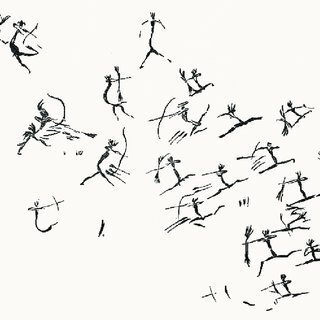
Some of the most intriguing evidence of Neolithic warfare comes from rock art found in the Iberian Peninsula, such as the example below of an archery battle.
Many archaeologists have argued, and continue to argue, that the Neolithic era was a more peaceful time. The author casts doubt on this, although he is careful to assert that we should not swing the pendulum too far the other way.
Although this is a short book, parts of it become a bit repetitive, with site after site being described as displaying similar types of evidence. Some of the information I found most interesting was that relating to more recent tribal cultures elsewhere in the world. There is much of interest in here though, and it will be an extremely useful reference document.
I have to say I really enjoyed this book and found it incredibly useful.
The author readily admits that the book is not a comprehensive survey of possible conflict sites in Neolithic Europe, and presents the alternative scenarios when discuss possible conflict sites, acknowledging their validity. That right there is a signal to me that this is a professional work, written with objectivity. Whenever I read non-fiction, I engage my academician’s training and look to see if the author only discusses their own hypothesis and claims that it is the correct one, or if they spend time talking about alternate hypotheses, their strong points, and why they think it is not the most likely conclusion. Good science, where a case is not proven, involves considering all the angles and admitting when other proposals have a good case. So the book wins points there.
For me it was the subject matter that engaged my interest. The Stone Age is the longest era of human existence, and yet because writing was not yet invented (as far as we know so far, although there are some ongoing studies attempting to determine whether or not certain artistic symbols may have been an early proto-writing), the specific events and individuals of that era are mostly lost to us. By examining evidence of possible conflict, we can, in some small way, reclaim a few of those specific events. That, to me, is fascinating.
The author achieves this mainly through two types of evidence: examining settlement sites to see what kind of defences they had, which naturally implies the expectation of conflict, and by examining actual human remains which show signs of a violent death. The first case is more indirect, and the author discusses at length why some archaeologists think that certain earthwork and palisade features might be more about ceremony and restricting access to a high-status place. That is certainly plausible; but the author’s argument for practical defences is plausible too, and perhaps, as the author themselves suggests, there is nothing to preclude that such constructions could not have served multiple functions, some peaceful, some for defence. The human remains represent more direct evidence of conflict. In some of these cases it is possible that the wound could have been a hunting accident or other such unintended injury, but in other cases it seems quite clear that human conflict is the cause. Use of killing weapon, for example, is important – a bow and arrow, for example, could be used for either hunting or in warfare; but clubs and maces are nearly useless as hunting tools, and signs of their use on human skulls strongly suggest that warfare was planned. Arrowheads actually embedded in the bones of a skeleton are also fairly conclusive proof that the New Age myth of the Stone Age as a peaceful idyll should be taken no more seriously than children’s fairytales.
The writing is clear throughout, and the author’s case is well-argued; I think he has a real case in many of the sites he examines. More importantly, although the writing is professional, it is also lucid and accessible – a non-historian could pick this up and have no problems understanding the evidence and the arguments. So definitely a book I would recommend to all.
Een goede verzameling van het archeologische bewijsmateriaal voor grootschalig geweld in het Neolitische tijdperk. Als er nog enige mensen over waren die geloofden in de vreedzaamheid van Gimbutas' 'grote moeder beschaving' maakt dit boek daar definitief korte mette mee. Voorbij de beschrijving van het harde bewijs is er echter niet veel te vinden in dit boek. Er wordt zo goed als geen theoretisch kader gegeven voor het materiaal te interpreteren. En als die gegeven wordt is het best raar; theorieën van een soort 'frontier' tussen de verbreidende landbouw-samenlevingen en de jager-verzamelaar gemeenschappen lijkt mij enorm reductief en onwaarschijnlijk. Wél verlichtend was een uitleg over de prominentie van schermutselingen, rooftochten en overvallen tegenover 'veldslagen', die desondanks even fataal konden zijn wegens de relatief lage bevolkingsaantallen. Gelijkaardige patronen vinden we in inheems Noord-Amerika, waar de strategie van overweldigende overvallen en rooftochten in plaats van grote leger-mobilisaties archeologen/antropologen vaak om de tuin geleid hebben met hoe gewelddadig deze samenlevingen werkelijk konden zijn.
I have to admit that, at the beginning, I had totally different expectations from this book. To clarify, I was looking for something more technical and, well, boring, and I was, for some reason, really looking forward to it. Also, I was greatly disappointed when, in the first chapter, author went on and on about cultures and practices outside of Europe as I already had books covering those subjects waiting to be read.
However, I am really happy that I am one of those people that never give up on a book - no matter how boring it is (looking at you Herodotus) - because this one is seriously that good. Next to being very well researched, it's written so well and so simple that I understood everything (and I have no background in either archaeology or anything related).
At the end, if you are wondering whether or not to read this book, take my advice and do it - you will not regret it.
This book is gracefully short, its writing is concise, and does exactly as it says in the title. The author covers the current understanding of the history of violence in the neolithic period which ranges from broken arrowheads inside of bones, mass burials and massacre sites, evidence of cannibalism, destruction events in archaeological sites, and the kinds of fortifications built in the period. Some sections of this book can get rather dry as you read some iteration of "this site has human remains with evidence of violent death" on repeat while others (the section on warfare cannibalism for me) were absolutely fascinating and I could not set my ebook down for a second. I chose this as the first of several books on Neolithic Europe to read in part due to its size and also because I like castles and battle axes. This book did not disappoint me in either reason. Solid recommend.
Julian Maxwell Heath's Warfare in Neolithic Europe is a compelling and meticulously argued survey of the evidence for interpersonal violence from the earliest farmers of Greece to the megalith builders of Britain and Ireland, demonstrating through detailed case studies that warfare was neither rare nor exceptional in Neolithic society. The volume's greatest strength is its systematic coverage of the skeletal evidence—from the massacre sites of Talheim and Asparn-Schletz to the arrowhead injuries at San Juan ante Portam Latinam and the cranial trauma at Hambledon Hill—presented within a robust interpretive framework drawing on anthropology and forensic science. Heath's treatment of the LBK massacres is particularly chilling, and his discussion of the "Stonehenge Archer" and Ötzi the Iceman brings the evidence vividly to life. The book's accessible prose and clear organization make it suitable for students and general readers alike, though some specialists may find the interpretive discussions less theoretically sophisticated than they might wish. For anyone interested in the darker side of the Neolithic, however, this is an essential and sobering read.
This entire review has been hidden because of spoilers.