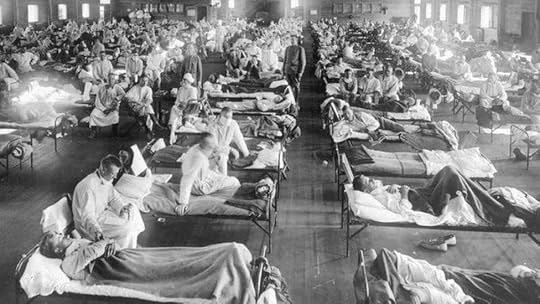
The 1918 outbreak of the H1N1 strain of influenza, popularly known as the Spanish flu, killed more people worldwide than World War I, which ended the same year. It infected nearly one-third of the world’s population and killed ten percent of those it struck. In its wake, schools and businesses closed, hospitals became overwhelmed, and the sick spilled out into makeshift care centers in public spaces. Policemen, public transportation workers, and everyday citizens in face masks were a common—and eerie—sight. Yet, discussion of this global pandemic often takes a backseat to World War I and other contemporary events.
Importante que mencione que, por mucho que se la siga conociendo por “La fiebre española”, España poco tuvo que ver con ello, ya que lo más probable es que se originara en EEUU o en Francia. A diferencia del resto del mundo, que estaba inmerso en plena guerra mundial, y con una censura que intentaba mantener la moral de las tropas, en España sí se publicó y se habló de la pandemia, por lo que nos cargaron el mochuelo a nosotros. Aún no entiendo cómo no se ha pedido una restitución moral por los daños causados, pues la mayoría de la población, poco ávida de investigar el origen de las cosas, sigue pensando que fuimos los españolitos quienes la exportamos. ¡Porca miseria!
Por lo demás contrastar lo poco que hemos aprendido, a pesar de haber transcurrido un siglo. Se han cometido los mismos errores ante la actual pandemia de Covid-19 que los que se cometieron por entonces, con muchos menos medios y conocimiento científico. Aquella tuvo tres oleadas a lo largo de dos años. Aquí vamos por la primera, y cruzando los dedos. El número de víctimas en total fue incluso superior al de la misma guerra… y, sin embargo, poca gente había oído hablar de ello hasta ahora. Y aún se desconoce el origen real de la misma, fuese por mutación o por cualquier otro hecho. Las condiciones laborales y de higiene de principios del siglo XX contribuyeron enormemente a la desgracia, amén de los continuos desplazamientos de soldados por casi todo el planeta. Y hoy, con muchas mejoras en ambos sentidos (salvo en el tema desplazamientos, con millones de personas atravesando el globo de una punta a otra en unas pocas horas), seguimos cayendo víctimas de la mala planificación y de la ceguera de muchos gobernantes.
Altamente recomendable, al menos para atestiguar que, una vez más, la historia se repite. Breve, pero muy informativo.
short review for busy readers: A pretty good, shortish, chronological overview of the strange strain of influenza that killed more people than WW1 and reached every nation. The information is good and informative, but the introduction and opening chapters are repetitive and a bit awkward in writing style. Later chapters are much better done.
in detail: More people died in the year and a half influenza pandemic (1918) than were killed in World War I—civilian and military deaths combined. It's estimated that around 1/3 of the global human population was infected. Yet strangely, until recently, little was written about it.
Why is that? Several factors...
a) lack of historical sources from that time period.
Governments massively censored reporting and warnings about the Flu because they didn't want to harm the war effort. They feared a civilian panic and flagging of support for the armed forces who were the major spreaders of the virus.
The only exception was Spain, which was neutral and allowed their journalists to report, making Spanish news the only real source of information. (Hence the name: Spanish Flu)
This deliberate holding back of vital health information meant that most people were taken completely unawares by how widespread and dangerous that flu strain was. There were no warnings or preventative measures taken until the middle of the second wave (of three waves) and those largely in places far away from original hot spots.
b) misunderstanding of the illness
At the time, doctors believed flu to be caused by bacteria and attempted to treat it as a bacterial infection. Only later once the pandemic had been over for years and when the science of virology began to gain traction would they realise it was a virus.
Even today, scientists are not sure what made this particular strain so virulent or exactly why it killed so many people globally. It remains something of a mystery.
c) how it spread.
No one knows exactly where the Flu first broke out, but it spread like wildfire due to military and troop movements. Ships transporting soldiers and goods, overcrowded army camps, troop hospitals and the deployment of units from England onto the European continent (and elsewhere) and back again all assisted in the contagion.
Researching the path the Flu took would entail going through military documents, registries and similar records that militaries of several countries were not keen for civilians to see until well after the fact. As ever, the miliary and governments are sensitive to being publicly embarrassed or seen to endanger their own populace, even unintentionally, as they certainly did in this case.
Interestingly, the Spanish Flu is still with us today! All flu type A strains carry its genetic material along with material from later, less virulent, outbreaks.
This is a short read with historical events about the Spanish flu and World War I. The devastation and despair that was rampant during that time. It was a dark and devastating time.
So, It happened before, and so far, COVID-19, included, no pandemic has rivaled the Spanish flu.
Ez egy kifejezetten rövid, de annál informatívabb könyvecske a spanyolnátháról, mely az 1918–1920-as időszakban három hullámban pusztított, és összesen kb. 50 millió ember esett áldozatául.
A könyv a járvány kialakulásának körülményeivel indít, pontosabban azzal, hogy milyen óriási szerepe volt az első világháborúnak a járvány terjedésében. Ezek közül van, ami teljesen nyilvánvaló, mint pl. a zsúfoltság, a rossz körülmények mind a katonák, mind pedig a civilek vonatkozásában* és természetesen az egyik legfontosabb a néptömegek (főleg a katonák) mozgása. Viszont olyan okra is rámutatott, amire egyáltalán nem gondoltam: a háború miatti cenzúrából fakadóan az újságok egész egyszerűen nem írhattak a járványról, így a lakosság sem volt megfelelően tájékoztatva, legalábbis az első két hullám idején. Nagyon érdekesnek találtam azt a tényt, hogy most a COVID-19-nél mennyi olyan óvintézkedést használunk, amit ezekben az időkben a spanyolnátha miatt találtak ki és próbáltak meg több-kevesebb sikerrel alkalmazni (maszk, karantén, távolságtartás). Ez egyébként, ha belegondolunk kicsit ijesztő is lehet, hogy az eltelt majd 100 év alatt sem sikerült modernebb védekezést kitalálni, szóval 100 éves módszereket alkalmazunk. Ettől függetlenül ezek a módszerek, ha betartják őket elég hatékonynak bizonyulnak, erre kettő amerikai várost, St. Louist és Philadelphiát hozta fel példaként. Philadelphia városvezetése ragaszkodott hozzá, hogy a minden évben megrendezésre kerülő parádét igenis meg kell tartani, járvány ide vagy oda. Ennek az lett a következménye, hogy a halálozási ráta itt volt a legmagasabb az USA-ban, majdnem elérte a 18000-et! Volt olyan nap, amikor 837-en haltak meg, a legdurvább héten 4500 ember esett áldozatául a spanyolnáthának. Ezzel szemben St. Louis-ban nagyon hamar bevezették az óvintézkedéseket, így a spanyolnáthában elhunytak száma kicsivel haladta meg az 1700-at. Maga a járvány, mint említettem 1918–1920-ban pusztított, és amilyen hirtelen megjelent, kb. olyan hirtelen el is tűnt, és csakúgy mint a járvány pontos eredetének, a hirtelen eltűnésének okai is tisztázatlanok. Van olyan vélemény, hogy a vírus mutálódott, és így már nem volt halálos az emberekre. De ez csak egyetlen elmélet, a pontos okot senki nem tudja. A könyv az utolsó két fejezetben foglalkozik azzal, hogy milyen következményei lettek a spanyolnáthának**, nem feledkezve meg arról sem, hogy a korabeli embereknek ezzel az első világháború árnyékában kellett szembenézniük.
Az olvasás során akaratlanul is párhuzamot vontam a COVID-19 járvánnyal, és konkrétan úgy érzem, hogy semmi nem változott, nem vagyunk felkészültebbek, de még csak okosabbak sem, hiszen egyáltalán nem tanultunk a történtekből. Régen legalább senki nem jött azzal, hogy a spanyolnátha az 5G miatt van…
Összességében ezt a könyvet annak ajánlanám, akit bár érdekel a téma, de nem szeretne több száz oldalas könyvet elolvasni ezzel kapcsolatban, viszont nagyobb mélységre vágyik egy újság- vagy Wikipédia cikknél.
3.5 star. The book is written in May 2020, so there are comparisons to COVID-19.
I believe, wikipedia has a more comprehensive summary of this epidemic than this book. More opinions than facts which surprised me as I was expecting facts summarized in hourly history books.
This book is extremely short…and while it had some interesting tidbits about the Spanish Flu, overall I found it to be lacking in depth. I understand it’s part of a series titled Hourly History, which provides concise historical narratives that can be read in less than an hour; so it definitely met its objective, but because I actually enjoy reading about viruses, I was left feeling quite underwhelmed.
Although the pandemic did not originate in Spain, it came to be called the Spanish flu because only Spain spoke freely about it. In 1918, World War I was being fought, and many countries involved in the war suppressed all information about the illness. It was widely spread by the movement of troops.
The Spanish flu was responsible for three times as many deaths as World War I. Some 500 million cases were reported, approximately one third of the world population at the time, and there were 50 million deaths from the virus. The pandemic lasted for three years.
All A strains of flu since that time have been descendants of the Spanish flu. Although it has mutated numerous times since then, it remains deadly as in the Asian flu, the Hong Kong flu, the swine flu, H1N1, and so forth.
This brief history should be read by everyone as it also discusses COVID-19.
A clarification made in this book, as I’d read in many other books, is that "The Spanish Flu" was not born in Spain. However, someone named it because some Spanish doctors were the first to notice it.
I read elsewhere that the Spanish newspapers called it "The British Flue" because doctors who worked as volunteers in the French army in southern France saw hundreds of British soldiers die from the 1918 Flu, almost instantly, between two or three hours, after their first symptoms.
Yet, the author of this book tells us that someone first detected it in France; still, they kept it a secret until a Spanish newspaper spread to the world what those Spanish doctors had noticed.
Remember, Spain didn’t involve in the First World War, which means they had more time to analyze WWI’s produced.
I think we should be grateful to those Spanish doctors. Despite of names and all the speculations, the first outbreak is unknown, even a hundred years later; possibly was started in Kansas, USA, Etaples, France, or China.
Rather than focus on the names of the 1918’s flu pandemic, we should have given high recognition and probably a Nobel Prize to those brave doctors who warned people of the risks of the pandemic and educated the public that started quarantining and did better sanitation globally. That is what we must embrace. Good actions!
The book fulfills its first purpose as a "history" book: Recommended for "literally" anyone.
(Kindle Ed. p. 21) ...The fact that it spread so quickly, reaching the entire globe once again, is a reflection of both the unreadiness of the world to handle this kind of outbreak, and the devastated economies and societies that limped out of the First World War. It was also evidence that the world was, in some ways, becoming smaller. While the war caused unprecedented destruction, it also brought peoples and countries together in different ways. National economies began to become more integrated with other countries around the world, and travel increased. Contact with more of the world meant that disease could spread globally much more quickly.
(Kindle Ed. p. 24) As flu cases abated in the late spring and summer of 1919, many health professionals worried that it would again see a resurgence in the fall, since they had already seen three waves. It was not until months later, well into the winter, that it was clear that this particularly deadly strain of flu was not to return. At that point, governments and all people worldwide could begin to assess the damage and come to an understanding about what had happened...Clearly, a deadly illness, commonly called the Spanish flu, had killed millions and sickened millions more. Years later, the closest estimates hold that one-third of the world’s population suffered from the flu...
I felt impressed reading this book. It is really timely and meaningful to read this one since we've been suffering from a global pandemic ourselves right now. With its great quality of a "complete" book, this publication has fulfilled its true purpose as a history book in attempt to look for the current and future sol-ut'ions from our Human experiences in the past. That’s exactly why we bother learning our hi-stor’y.
The book opens with a fine entr'/ intr'o-duct'ion and fairly a nice assessment about the cause of pandemic. Besides, by the time you flip the last page, you will have read many insightful lines to learn much more about our path under the current COVID-19 pandemic.
This is pretty much the only error I've found in this book: (Kindle Ed. p. 31) ...during the COVID-19 outbreak of the coronavirus...
Redundant: COVID-19 stands for the COrona VIrus Disease-2019.
The book is a great quality, and it is super informative while you can finish the reading only in a few hours. I do recommend this book for anyone, literally anyone.
This little book at 43 pages is especially interesting now during our own pandemic. There will always be viruses in the world and looming pandemics. We can learn from history. It’s interesting how similar the 1918 Spanish flu is to COVID-19. People isolated and wore masks and had a fear of foreigners. Today worldwide travel exacerbates the problem of spreading viruses between countries. The books in this series always have a few errors but are otherwise very good.
There is no doubt in my mind that the coronavirus and its concomitant COVID-19 has sparked an interest in other pandemics. It no doubt behooves us to examine the Spanish Flu of 1918 in light of current conditions.
World War I played a definite role in the spread of the Spanish flu, which you might think originated in Spain, but it did not. Politics and the war effort produced a kind of coverup where "Germany, the United States, France, and Great Britain all censored information about the flu within their borders and kept it quiet, until it hit Spain. Because Spain was a non-combatant, journalists and media were free to report on it there." It is unclear exactly where this strain of influenza first appeared and is still a matter of study today.
This short history was surely written in response to the current COVID-19 pandemic since comparisons to the Spanish flu are made. There are several big takeaways in this book.
First, and foremost in my mind, is that governments suppress information to the detriment of their citizens. In 1918 it was the war effort, in which Spain was not a participant, thus the falsely blamed source of the pandemic. In the 2019 COVID-19 pandemic, government inaction and incompetence, particularly in the United States, has (as of this writing) caused over 100,00 deaths in this country.
Second, these pandemics aren't one and done; they come in waves. The second wave of the Spanish flu was far worse than the first. The third wave was on a par with the second. The COVID-19 pandemic, still in its technical first wave, is starting to see a second wave immediately on top of the first due to a lack of mandatory federal rules governing social behavior.
Third, and probably most obvious, is that history always repeats itself. The Black Death, the Spanish flu, and now COVID-19 all have in common the decimation of populations.
It would be unfair not to point out that during the time of Spanish flu medicine was not what it is today. To get a real feel for the disease that took the lives of strong, healthy human beings, in 1918-1920, along with this book, I highly recommend watching "Influenza 1918," part of PBS American Experience series.
This is a great way to learn about pandemics since they happen infrequently. Between 1918 and the end of 1920, the Spanish flu affected over 500 million people worldwide. Part of the reason for the massive infections was the huge transportation of large numbers of military troops worldwide. When they went home, they took the flu with them.
The flu had a devastating effect on the economies of countries. Because so many people were malnourished during the war, it allowed the virus to spread. There are differing theories about where the flu began. But one overriding problem is that various governments downplayed the effects to keep the emphasis on winning the war at the forefront. Besides the world war, Russia was in the midst of its revolution, which caused starvation.
There are theories about the flu outbreak in the US, Asia, and Europe. The epicenter in the US was Kansas, with so many men returning from war. However, it is not considered the beginning of the flu worldwide. By March of 1918, the first wave of the flu had peaked. However, this first wave was nothing compared to the second and third waves of the disease.
At the same time, doctors were generally at war, so they did not have the information to staunch the disease early. Medical info was not as available then as it is today. There were no antiviral drugs at the time, nor penicillin. With few medicines, quarantine was the most effective way to decrease deaths.
The second wave abated in November and December of 1918. However, the third wave started in Australia in January 1919 and spread globally. However, panic came with the third wave. The populations were decimated, thinking there was no end to the death. Suddenly, the virus disappeared.
The book ends with a short summary of the pandemics since the Spanish Flu. This flu killed more people than during all of World War I.
I had always seen these hourly history books on Amazon, and after reading this one, I doubt sincerely I will get any of the other ones! I've taught about vaccines and pathophysicology for years in a variety of universities and colleges. I have written papers and for medical groups on line about the 1918 influenza. I've read about every book out there on the influenza. Part of my fixation with this is not just my medical history knowledge, but my great grandmother died of the 1918 flu in an insane asylum, where she was put after her own mother died, and because she had severe epilepsy.
This book was a huge disappointment. I guess, if there were not other very good books out there about this influenza, it would be okay. But this writer simply used the work of others to write this book to make money. It was horribly disorganized, full of generalizations...the author did little research on his own, and left questions that were answered in other books. This book was done very quickly due to the outbreak of COVID-19, and in order to take advantage of those wishing to understand why we haven't moved forward from the 1918 flu and the current rage over wearing masks, quarantining, etc. this group and author decided to make money off of a scary situation..
If you love medical history, if you interested in epidemiology, in public health, in how epidemics and pandemics occur, please go elsewhere. Don't bother with this book. It isn't worth it!
Excellent 👍 This is an excellent introduction to a period of history that has been under reported. In conjunction with the end of the First World War, this deadly and highly contagious version of the H1N1 flu continues to be felt to this day. The end of the most devastating war left Europe in shambles, only to be hit with a wave of flu as horrible as the war itself. The people of Europe, victor and loser alike, were victims of an illness that left death in it's wake and unforeseen reverberations for decades. In America, soldiers and civilian's suffered as well. Even Woodrow Wilson found himself a victim while in France attending to the peace. The British P.M. would nearly succumbed to the flu himself. Reading this book, while sheltering in place from the Covid19 in 2020, I see history repeating itself. We must, make the right decisions based upon science, not superstition. If we are to avoid a second, and more deadly outbreak, like the Spanish flu; we must put our faith in our doctors and scientist's to make those decisions for us. If not we could be looking at a repeat of the mistakes made one hundred years ago. Any such mistakes would be so much more tragic for us today. To know so much more scientifically and allow the deaths of innocents in as great (or greater) numbers, would truly be a singular setback in the history of humankind.
The similarities between the Spanish Flu (as it was named) and COVID-19 are striking. I am so glad I read this Hourly History. Though much is known about the Spanish Flu and therefore also COVID-19, there is much to be taken from the earlier pandemic. Our World has utilized many of the techniques attempted in 1918-1920 to try to control this newest of flu outbreaks. This report, if you will, makes you stop and think about how history does repeat itself, and how there is so much to be learned. Living through COVID-19 seems challenging, but after reading about the Spanish Flu and all that was lost, I can only be grateful that we are handling ourselves the way we are with “Stay in Place” and “Social distancing” orders. COVID-19 has impacted us in so many ways, but though there has been some devastation, it has yet (and hopefully will not) reach the catastrophic numbers of the Spanish Flu. If you pick up this short report and read it, may you have stayed safe during this most recent pandemic.
From an economic standpoint, the second wave of the virus was nothing short of disastrous.
But as the virus spread to more and more countries, businesses began to close. Some closed willingly in an attempt to avoid exposure for owners and workers. In other cases, local governments forced businesses to close and citizens to remain in quarantine in an effort to contain the virus. In still other cases, either owners or too many employees perished, which also forced businesses to close.
Many countries not only did not have adequate healthcare systems to deal with the sick, but they did not have adequate welfare systems either, and poverty and starvation became serious threats as well.
The essay writers obviously politicizes the 1918-1920 pandemic to make the case of how things went wrong with combating the current COVID-19 crisis. It was odd when the writer(s) describe how the COVID-19 virus was successfully fought early on and I quote: “...cities and other places that issued lockdown orders early and enforced them strictly saw fewer deaths and infections than other places.” No mention of the cities and “other places” are referenced of this supposedly “success.” A convenient omission? The narrative was interesting to read, but there does appear to be an underlying motive as to why this essay is being released at this time. I wanted facts, not a political commentary.
Being completely new to this topic, I thought to start with the book to understand about the Spanish Flu. It gave a good understanding about the flu, like how did it spread, what was the impact, how the waves originated and spread, how many peoples were killed etc. What my biggest learning was that Spanish flu never originated from Spain and it was just named that way because they first looked into this.
Conclusion Its a good and short read for beginners who want to take basic understanding about the Spanish flu.
The 1918 outbreak of the H1N1 strain of influenza, popularly known as the Spanish flu, killed more people worldwide than World War I, which ended the same year. It infected nearly one-third of the world’s population and killed ten percent of those it struck. In its wake, schools and businesses closed, hospitals became overwhelmed, and the sick spilled out into makeshift care centers in public spaces. Policemen, public transportation workers, and everyday citizens in face masks were a common—and eerie—sight. Yet, discussion of this global pandemic often takes a backseat to World War I and other contemporary events.
I learned much from this short look at the Spanish influenza. I particularly found the information about how the Spanish Influenza impacted the world afterward to be enlightening. Reading this with the on going pandemic happening, it brings up some interesting similarities. It also explains a bit about transmission and detection issues doctors faced. Now these were obviously drastically different circumstances but it is hard to read this with out drawing obvious parallels between the two situations.
Καλογραμμένο και ενδιαφέρον, ακόμη ένα βιβλιαράκι από την Hourly History, αποκαλύπτει σκληρά γεγονότα, όχι μόνο για την ισπανική γρίπη και πώς αυτή εξαπλώθηκε παγκοσμίως, αλλά και για τον Α' Παγκόσμιο Πόλεμο. Μαθαίνουμε πως πολλοί άνθρωποι πέθαναν, πως η γρίπη δεν ήρθε από την Ισπανία, καθώς και πως η χώρα προέλευσης δεν έχει επιβεβαιωθεί ακόμα. Αν μη τι άλλο, σε προκαλεί να θέλεις να μάθεις περισσότερα για την ισπανική γρίπη, τι την προκάλεσε και πως κατάφερε να αποδεκατίσει εκατομμύρια κόσμου!
This book covers some interesting territory about the 1918 pandemic. It's very short but what's there is succinct and to the point. Even though I was familiar with that pandemic some of the information, particularly how it related to WWI was quite shocking. They're still studying it, btw, and there's a lot they still don't know. Worth the quick read.
I have read quite a number of these "Hourly Histories" and this is one of the better ones I have read. The information was logical and straightforward. The writing was good and I saw no obvious typos or misspellings. In a few places some information was repeated but nothing too annoying. In the end, I felt like I learned a lot from this book. It is work the read.
Very neat brief of the Spanish Flu of 1918-1919 which enabled me to fill in the gaps I had about this catastrophic pandemic which took lives of 50m. Reading it made me think that if Covid-19 had happened during the conditions of those times, it would have caused a similar, if not more damage than the Spanish Flu...
Really good write-up on the 1918-20 Pandemic and how it is relating to our current worldwide situation- just over a hundred years later. Fortunately humankind is not in the midst of a world war, nor revolutions in major countries and we are able to communicate much faster to ourselves just what needs to be done to prevent the spread of the virus.
The lives of thousands may have been lost to Coronavirus as we slowly remembered the forgotten lessons of the 1918-1920 Pandemic. This short book represents a good starting point for learning about the impact of a pandemic beyond the obvious biological statistics.
Spanish Flu, during 1918-1920, was one of the biggest pandemic the world had ever seen. Similar to the black death, more than half of the world's people had either died or infected. This book provides a brief history of this disease. Very less is given about the first wave, and more is given on the second and third wave, and their outcomes.