

What do you think?

Where Mathematics Come From: How the Embodied Mind Brings Mathematics into Being
This book is about mathematical ideas, about what mathematics means-and why. Abstract ideas, for the most part, arise via conceptual metaphor-metaphorical ideas projecting from the way we function in the everyday physical world. Where Mathematics Comes From argues that conceptual metaphor plays a central role in mathematical ideas within the cognitive unconscious-from arithmetic and algebra to sets and logic to infinity in all of its forms.
512 pages, Paperback
First published January 1, 2000
About the author
George Lakoff
58 books888 followersGeorge Lakoff is Richard and Rhoda Goldman Distinguished Professor of Cognitive Science and Linguistics at UC Berkeley and is one of the founders of the field of cognitive science.
He is author of The New York Times bestseller Don't Think of an Elephant!, as well as Moral Politics: How Liberals and Conservatives Think, Whose Freedom?, and many other books and articles on cognitive science and linguistics.
He is author of The New York Times bestseller Don't Think of an Elephant!, as well as Moral Politics: How Liberals and Conservatives Think, Whose Freedom?, and many other books and articles on cognitive science and linguistics.
Ratings & Reviews
Friends & Following
Create a free account to discover what your friends think of this book!
Community Reviews
Displaying 1 - 30 of 47 reviews

July 27, 2020
Linguistic Overreach?
Get ready; here’s the headline news: MATHEMATICS IS A HUMAN CONSTRUCTION JUST LIKE LANGUAGE. In fact mathematics is a language and employs the same parts of the human brain and nervous system as any other language. It’s arguably the most precise language we have. But there is no truth to the rumour, first formulated by Plato, that the central elements of mathematics - numbers - have any existence beyond our use of them.
That’s it, ladies and gentlemen. We can rest easy in our beds. Mathematics, it appears, has the same metaphorical structure as any other language. If some alien civilisation has mathematical knowledge, it will resemble ours only to the extent that their bodies and physical environment resemble our own. Sci-fi writers as well as philosophers have got it wrong. Mathematics is in our bodies.
Well, that’s not right either. Mathematics is not in our heads. Like all language, it exists among us when we communicate with each other. We condition each other to recognise and respond to mathematical language. So it only seems to be external to us entirely. But technically speaking, mathematics is more like the Christian God than the pagan god of Plato - it is in us, among us and beyond us, all at the same time.
To some extent this conclusion is passé. Linguists have known about the realities of language for some time. The proposition that mathematics is just a kind of language is hardly revolutionary. So the authors feel compelled to venture out on some thin ice: “To make our discussion of classical mathematics tractable while still showing its depth and richness, we have limited ourselves to one profound and central question: What does Euler's classic equation*... mean?”
This is a very silly question it seems to me. The equation means exactly what it says, no more, no less. Each of its terms is ultimately defined circularly by the other terms, just as in any language. Like the meaning of a Beethoven Symphony or a novel by Jane Austen, its meaning is entirely contained in its expression, or rather in the various interpretations of its expression, which are simply more expressions. To suggest otherwise would be to re-introduce Plato’s religious vision of a realm of eternal forms. Mathematics may be generated by human physiology and its needs but this does not imply that mathematics - including ideas like infinity, imaginary numbers, negative numbers, irrational numbers, etc. - have any definite meaning perceptible to our bodies.
The elements of Euler’s equation may indeed be, as the authors claim, metaphors. But as such the interpretive problem merely has been moved from mathematics to natural language. This is not an advance. It gets us no closer to its meaning other than how it is used by mathematicians. So their discussion of the equation seems seriously off the mark. On the other hand, perhaps it’s just my interpretation that is deficient!
* Euler’s Equation is certainly a profound and profoundly disturbing statement. It summarises the relationship among some of the most important, and on the face of it incommensurable, kinds of mathematical entities. See here for further discussion: https://www.goodreads.com/review/show...

Get ready; here’s the headline news: MATHEMATICS IS A HUMAN CONSTRUCTION JUST LIKE LANGUAGE. In fact mathematics is a language and employs the same parts of the human brain and nervous system as any other language. It’s arguably the most precise language we have. But there is no truth to the rumour, first formulated by Plato, that the central elements of mathematics - numbers - have any existence beyond our use of them.
That’s it, ladies and gentlemen. We can rest easy in our beds. Mathematics, it appears, has the same metaphorical structure as any other language. If some alien civilisation has mathematical knowledge, it will resemble ours only to the extent that their bodies and physical environment resemble our own. Sci-fi writers as well as philosophers have got it wrong. Mathematics is in our bodies.
Well, that’s not right either. Mathematics is not in our heads. Like all language, it exists among us when we communicate with each other. We condition each other to recognise and respond to mathematical language. So it only seems to be external to us entirely. But technically speaking, mathematics is more like the Christian God than the pagan god of Plato - it is in us, among us and beyond us, all at the same time.
To some extent this conclusion is passé. Linguists have known about the realities of language for some time. The proposition that mathematics is just a kind of language is hardly revolutionary. So the authors feel compelled to venture out on some thin ice: “To make our discussion of classical mathematics tractable while still showing its depth and richness, we have limited ourselves to one profound and central question: What does Euler's classic equation*... mean?”
This is a very silly question it seems to me. The equation means exactly what it says, no more, no less. Each of its terms is ultimately defined circularly by the other terms, just as in any language. Like the meaning of a Beethoven Symphony or a novel by Jane Austen, its meaning is entirely contained in its expression, or rather in the various interpretations of its expression, which are simply more expressions. To suggest otherwise would be to re-introduce Plato’s religious vision of a realm of eternal forms. Mathematics may be generated by human physiology and its needs but this does not imply that mathematics - including ideas like infinity, imaginary numbers, negative numbers, irrational numbers, etc. - have any definite meaning perceptible to our bodies.
The elements of Euler’s equation may indeed be, as the authors claim, metaphors. But as such the interpretive problem merely has been moved from mathematics to natural language. This is not an advance. It gets us no closer to its meaning other than how it is used by mathematicians. So their discussion of the equation seems seriously off the mark. On the other hand, perhaps it’s just my interpretation that is deficient!
* Euler’s Equation is certainly a profound and profoundly disturbing statement. It summarises the relationship among some of the most important, and on the face of it incommensurable, kinds of mathematical entities. See here for further discussion: https://www.goodreads.com/review/show...

April 4, 2025
I think it will be very easy to misunderstand what Lakoff and Núñez are attempting to do with this book, and the problem is not helped at all by the book’s provocative title. To call mathematics the product of “embodied minds” suggests that the authors will argue that mathematics is a social construction, but this is not their goal. In fact, the authors explicitly say that “mathematics is not purely subjective” and it “is not a matter of mere social agreement” (365). It is, however, a form of rational expression that reflects embodiment: the experience of how we materially (and socially … I insist) occupy space. It’s the material part that is easy to overlook, but the basic conclusion that Lakoff and Núñez reach is that how we experience things in space forms the basis by which we developed and understand math. Math is an expression of the regularities we experience, via our bodies, every day, as containers, with insides and outsides, or how we experience time as a linear progression of events, or numbers existing on a line, or how more of a thing occupying more space than less of the same thing. Math developed to describe the regularity of those experiences and so the brain can map from those experiences to make sense of math. Even infinity and infinitesimals, the authors argue, are based on experience grounded in imperfect verbs of continuous action. For example, the imperfect verb “swimming” implies a continuing action of discrete strokes, and walking is an action of discrete steps. When one no longer makes a stroke they are no longer “swimming,” and when they fail to take a step they are no longer “walking.” Infinity is just a continuous string of these discrete steps just as infinity is a continuous line of discrete numbers. Mathematics is a descriptive tool (378) that depends on embodied experience to understand.
The authors lay out the evidence for the above argument in painstaking and sometimes exceedingly dull detail. They start with the overarching argument that the Platonic view of numbers and mathematics as idealized forms that exist apart from human experience is faulty. Although there are certainly regularities, there can be no scientific proof that the Platonic view of math is correct (4). Working from subitizing (19) and basic arithmetic (67), the authors make a case for some mathematical processing being grounded in innate cognitive functions. And those mathematic cognitive functions are integrated with other cognitive functions, sense making, awareness, and intentional thinking that the brain supports in all areas of our daily lived experience. This is where metaphor comes into the picture, as a mechanism by which Lakoff and Johnson argue that the brain processes abstract ideas (see Metaphors We Live By ). These metaphors allow the brain to process more abstract mathematical concepts like algebra (110) or “the study of mathematical form,” sets (141), infinity (155), infinitesimals (223), and onward to more abstract mathematical formulations, which are all traceable, via the mapping of core metaphoric expressions (e.g., sets, lines, limits, ranges, length, order, space, etc.), to the human experience of self in space. Math never stops being descriptive. Even symbolic logic (133) maps a set of obligatory descriptive relationships based on actual engagement with the world, and in this way seems to lend some support to Wittgenstein’s mapping of logic to an isomorphic representation of the real (in theTractatus).
One point that I was surprised not to see in this book was a discussion of the way that mathematics act as concepts, not as references to sets of things in the world but as ideas with situated meaning in a particular time and semiotic system. Lakoff and Núñez work so hard to separate their arguments from radical social constructionism that they don’t take up how the truth of some mathematical processing and expression is, in fact, grounded within a particular setting of use. Maybe that point is intended to go without saying.
Ultimately, the goal of this book is to introduce a way of doing “mathematical idea analysis […] to explain why theorems are true on the basis of what they mean” (338) which is maybe inclusive of the idea that theorems and products of mathematical operations have sense. The other aim is to dispel the “romantic” notion of math as somehow transcendent but for which there can never be proof of its transcendence (344). Neither, however, does it seem that there can be a scientific way of proving that the mathematics is fully explained by cognitive science and the human predilection to rely on metaphors as concept categories that facilitate cognition (39). Certainly Lakoff and Núñez make a compelling case for why this perspective ALSO explain mathematics but the causal chain of their arguments seems insufficiently supported.
The authors lay out the evidence for the above argument in painstaking and sometimes exceedingly dull detail. They start with the overarching argument that the Platonic view of numbers and mathematics as idealized forms that exist apart from human experience is faulty. Although there are certainly regularities, there can be no scientific proof that the Platonic view of math is correct (4). Working from subitizing (19) and basic arithmetic (67), the authors make a case for some mathematical processing being grounded in innate cognitive functions. And those mathematic cognitive functions are integrated with other cognitive functions, sense making, awareness, and intentional thinking that the brain supports in all areas of our daily lived experience. This is where metaphor comes into the picture, as a mechanism by which Lakoff and Johnson argue that the brain processes abstract ideas (see Metaphors We Live By ). These metaphors allow the brain to process more abstract mathematical concepts like algebra (110) or “the study of mathematical form,” sets (141), infinity (155), infinitesimals (223), and onward to more abstract mathematical formulations, which are all traceable, via the mapping of core metaphoric expressions (e.g., sets, lines, limits, ranges, length, order, space, etc.), to the human experience of self in space. Math never stops being descriptive. Even symbolic logic (133) maps a set of obligatory descriptive relationships based on actual engagement with the world, and in this way seems to lend some support to Wittgenstein’s mapping of logic to an isomorphic representation of the real (in theTractatus).
One point that I was surprised not to see in this book was a discussion of the way that mathematics act as concepts, not as references to sets of things in the world but as ideas with situated meaning in a particular time and semiotic system. Lakoff and Núñez work so hard to separate their arguments from radical social constructionism that they don’t take up how the truth of some mathematical processing and expression is, in fact, grounded within a particular setting of use. Maybe that point is intended to go without saying.
Ultimately, the goal of this book is to introduce a way of doing “mathematical idea analysis […] to explain why theorems are true on the basis of what they mean” (338) which is maybe inclusive of the idea that theorems and products of mathematical operations have sense. The other aim is to dispel the “romantic” notion of math as somehow transcendent but for which there can never be proof of its transcendence (344). Neither, however, does it seem that there can be a scientific way of proving that the mathematics is fully explained by cognitive science and the human predilection to rely on metaphors as concept categories that facilitate cognition (39). Certainly Lakoff and Núñez make a compelling case for why this perspective ALSO explain mathematics but the causal chain of their arguments seems insufficiently supported.

April 13, 2015
An utter disappointment but not devoid of value. I doubt i'll bother to continue reading, so here are my initial thoughts.
I'm far too dim to understand Lakoff + Núñez's ideas.
Or maybe they're not saying anything other than people have to use language to express and explain mathematical ideas and language is entirely metaphorical.
Or maybe they're saying that mathematics is entirely metaphorical and language is fundamental.
There's a philosophical chicken-and-egg problem with this entire book.
Or maybe i don't know what i'm talking about.
Or maybe i don't know what L+N are talking about.
I'm a 25 watt bulb in an array of Klieg lights.
I've always wanted to share my love for this crazy Chick Publication and now might be my best/only chance. While reading L+N's first few "mappings" of a "metaphor" from a "source domain" onto a "target domain," i couldn't stop thinking of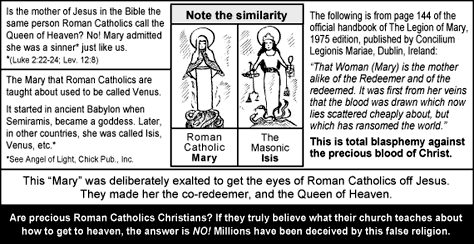
from the Chick Publication Are Roman Catholics Christians? (note: Chick Pubs are only good if you wanna laugh at a fundamentally disabled mind)
Obviously L+N's book is yet another that i'm unqualified to critique so i searched the interwebs for reviews and found one by a professional mathematician that i wish i'd written.
Assuming you hold no strong prejudices regarding "cognitive science" or "the embodied mind" or "Platonism" or "Aristotelianism," maybe the following quotes from James Madden's article (Notices of the AMS. 2001;48[10]:1182–88) will convince you to be on my side of this futile debate.
Madden damns with faint praise and cuts deep into the heart of L+N's premise:
I'm far too dim to understand Lakoff + Núñez's ideas.
Or maybe they're not saying anything other than people have to use language to express and explain mathematical ideas and language is entirely metaphorical.
Or maybe they're saying that mathematics is entirely metaphorical and language is fundamental.
There's a philosophical chicken-and-egg problem with this entire book.
Or maybe i don't know what i'm talking about.
Or maybe i don't know what L+N are talking about.
I'm a 25 watt bulb in an array of Klieg lights.
I've always wanted to share my love for this crazy Chick Publication and now might be my best/only chance. While reading L+N's first few "mappings" of a "metaphor" from a "source domain" onto a "target domain," i couldn't stop thinking of
from the Chick Publication Are Roman Catholics Christians? (note: Chick Pubs are only good if you wanna laugh at a fundamentally disabled mind)
Obviously L+N's book is yet another that i'm unqualified to critique so i searched the interwebs for reviews and found one by a professional mathematician that i wish i'd written.
Assuming you hold no strong prejudices regarding "cognitive science" or "the embodied mind" or "Platonism" or "Aristotelianism," maybe the following quotes from James Madden's article (Notices of the AMS. 2001;48[10]:1182–88) will convince you to be on my side of this futile debate.
Presumably, when an individual is engaged in mathematical work, that person is guided by metaphors that are somehow represented in his or her own brain.... Unfortunately, Lakoff and Núñez do not provide any illustrations of what they suppose goes on in "real time," so this is about as much as I can say."After a while, the notion of metaphor seems to become a catchall." (1185) Did Madden grow as tired of the vagueness and ubiquity of the term metaphor as i did?
This brings me to my first main criticism concerning the metaphor hypothesis: What is the quality of the evidence for it?... I would like to have seen direct support for the metaphor hypothesis from the observation of mathematical behaviors. (1184-5)
Madden damns with faint praise and cuts deep into the heart of L+N's premise:
The idea that metaphors play a role in mathematical thinking is quite attractive, but what is needed is a notion specific and precise enough so that people working independently and without consulting one another can discover the same metaphors and agree on the functions they perform. I do not think we have this yet. (1185)And a summary of sorts:
If I think about the portrayal of mathematics in the book as a whole, I find myself disappointed by the pale picture the authors have drawn. In the book, people formulate ideas and reason mathematically, realize things, extend ideas, infer, understand, symbolize, calculate, and, most frequently of all, conceptualize. These plain vanilla words scarcely exhaust the kinds of things that go on when people do mathematics. (1187)Madden does give L+N credit for "shar[ing] with us their intuitions about the way the mathematical mind operates," but he's not convinced that anything they said has been scientifically tested even though it's presented to us as if it had been proven.

December 20, 2012
Recently completed reading this challenging journey through Lakoff's embodied mind theory with our Philosophy of Math study group at Saint Martin's University. The group, made up of math, philosophy, and computer science professors, struggled with Lakoff's approach to how fundamentals of number, arithmetic, algebra, and infinitesimals are grounded in bodily metaphor and permutations of such metaphors through conceptual blending (for a more detailed look at conceptual blending see Fouconnier/Turner's The Way We Think: Conceptual Blending and The Mind's Hidden Complexities). There was considerable consternation with Lakoff/Nunez in that they often didn't go far enough with explanation to back up their claims and that, according to the math folks, their presentation of math concepts was sometimes plain inaccurate. Some of the group participants were clearly disturbed by the authors' full-frontal attack on Platonic mathematics and disembodied thought and chose not to attend while we read this book. Clearly many are not ready to entertain a worldview where embodiment, immanence, and emergent properties become the basis for the sacred cows of reason, math, and philosophy.
Much of the trouble my colleagues had with understanding and appreciating Lakoff/Nunez's embodied mind approach was due to their lack of background with cognitive science, the philosophy of mind, consciousness studies, and of course systems and complexity theory. Their struggle highlighted to me the truism that, in today's world, specialization has a particular cost to it in that one misses out on the insights gained from contemporary approaches that are multidisciplinary or interdisciplinary such as cognitive science and systems theory. As we know from postmodern thought, we live in a pluralistic world of multiple interdependent-interacting perspectives and bodies of knowledge so to isolate oneself within a specialty or field cuts one off from the often profound insights gained from the cross-fertilization that multidisciplinarity offers. My recommendation is to read other introductory books on cognitive science and embodied mind theory such as Howard Gardner's The Mind's New Science: A History Of The Cognitive Revolution, Varela, Thompson, Rosch's The Embodied Mind: Cognitive Science and Human Experience, or Lawrence Shapiro's Embodied Cognition to get a general sense of the context in which Lakoff and Nunez are doing their work. It also helps to read Lakoff/Johnson's other books on embodied metaphor, in particular 1) Philosophy in the Flesh: The Embodied Mind and its Challenge to Western Thought, 2) Women, Fire, and Dangerous Things: What Categories Reveal About the Mind, and 3) the introductory Metaphors We Live By to get a sense of his approach.
And, if I may complain a bit now, it's pretty tiring to read reviews by folks who haven't done their homework, who've only read this one book and not read others by these authors, who also don't seem to know anything about the field of embodied mind cognitive science, the embodied philosophy of Merleau-Ponty, embodied linguistics, and their related disciplines enactivism, complexity theory, and literally hundreds of related volumes. For a longer list of related titles, see my "Embodied Cognition" list in Listopia here on Goodreads.
Much of the trouble my colleagues had with understanding and appreciating Lakoff/Nunez's embodied mind approach was due to their lack of background with cognitive science, the philosophy of mind, consciousness studies, and of course systems and complexity theory. Their struggle highlighted to me the truism that, in today's world, specialization has a particular cost to it in that one misses out on the insights gained from contemporary approaches that are multidisciplinary or interdisciplinary such as cognitive science and systems theory. As we know from postmodern thought, we live in a pluralistic world of multiple interdependent-interacting perspectives and bodies of knowledge so to isolate oneself within a specialty or field cuts one off from the often profound insights gained from the cross-fertilization that multidisciplinarity offers. My recommendation is to read other introductory books on cognitive science and embodied mind theory such as Howard Gardner's The Mind's New Science: A History Of The Cognitive Revolution, Varela, Thompson, Rosch's The Embodied Mind: Cognitive Science and Human Experience, or Lawrence Shapiro's Embodied Cognition to get a general sense of the context in which Lakoff and Nunez are doing their work. It also helps to read Lakoff/Johnson's other books on embodied metaphor, in particular 1) Philosophy in the Flesh: The Embodied Mind and its Challenge to Western Thought, 2) Women, Fire, and Dangerous Things: What Categories Reveal About the Mind, and 3) the introductory Metaphors We Live By to get a sense of his approach.
And, if I may complain a bit now, it's pretty tiring to read reviews by folks who haven't done their homework, who've only read this one book and not read others by these authors, who also don't seem to know anything about the field of embodied mind cognitive science, the embodied philosophy of Merleau-Ponty, embodied linguistics, and their related disciplines enactivism, complexity theory, and literally hundreds of related volumes. For a longer list of related titles, see my "Embodied Cognition" list in Listopia here on Goodreads.

March 8, 2015
It is the worst rating I have ever given to a book! Simply speaking, the whole book is trying to convince you that it has a more realistic explanation of the nature of mathematics, and believe me, it cannot even fake it! The most obvious examples are infinite series and Taylor expansion.
In former, the authors propose a (loosely defined) "metaphor" to show how the infinite series work, which cannot even show the convergence or divergence of the series! It actually gets help from math and is faking to claim so, as if it is its direct conclusion!
For the latter, the Taylor expansion, the authors try to show "in terms of cognitive science" why does the Taylor expansion in one point can construct the whole function everywhere! Everyone with sufficient math knowledge, can confirm that is it not true for most functions, but the authors obviously did not know this fact and got really excited about this invalid claim!
To be positive, the whole long book is a good example of scientific misconduct; one can be more harsh and say that it is a scientific fraud: to claim that you are saying where math comes from, and all you say, is to feed your weak or even wrong arguments with math again.
In former, the authors propose a (loosely defined) "metaphor" to show how the infinite series work, which cannot even show the convergence or divergence of the series! It actually gets help from math and is faking to claim so, as if it is its direct conclusion!
For the latter, the Taylor expansion, the authors try to show "in terms of cognitive science" why does the Taylor expansion in one point can construct the whole function everywhere! Everyone with sufficient math knowledge, can confirm that is it not true for most functions, but the authors obviously did not know this fact and got really excited about this invalid claim!
To be positive, the whole long book is a good example of scientific misconduct; one can be more harsh and say that it is a scientific fraud: to claim that you are saying where math comes from, and all you say, is to feed your weak or even wrong arguments with math again.
April 20, 2008
Although I am a Mathematical Platonist. I couldn't help but be fascinated by Lakoff account of how concrete metaphors from the body and everyday experience inform our mathematical abstractions of the most aetherial and least earthy types. My only answer to Lakoff repudiation of platonism for a cognitive origin of mathematics is where does the regularity of the world (that cognitive patterns are built on) originate. An excellent Book.

January 5, 2021
A really good book on how people build from concrete to the abstract in the field where abstraction is most recondite Mathematics. I think that human abilities like mathematical reasoning start like all things human from quotidian day to day aspects of our lives, walking, talking, eating, drinking, socializing, tieing out shoes, and we abstract away via metaphorical thinking into loftier and more ethereal realms of thought. We are social animals, not gods so that is how human reason builds itself. Obviously, it is an imperfect and kludgy thing but stuff designed by Chuck Darwin's natural selection tends to be but it usually gets us by. Anyway, I disagree with my Darwinian constructed brain that mathematics is constructed by us (I take the Platonist position on metaphysical matters like this) but I enjoyed the book greatly and Lakoff and Nunez's insight to human nature of the human endeavor of mathematics is a treat and it has some good approaches for pedagogy so I am not knocking it. I love this book and I come back to it from time to time.

January 30, 2015
Cognitive linguistics has at its underlying aesthetic the very literal understanding that how we think of things is what they are. This follows post-structural rhetoricians like Paul Ricoeur who argue that the connective tissue of language is metaphor -- where metaphor is the substantiation of the naked copula form is through content. We forget the form of the copula in metaphors and thus experience the content as a variation of the copula form instead of being the actual connection. In other words we understand our world through representations, never understanding that an ontologically reified point of view is only possible because metaphors position the copula through its latent content so that the form of the copula becomes seen as the "ding as such". In other words, representations only appear to be representations because one of the formal representations comes to represent nothing but the pure presence of its own linguistic connectivity.
Having said this, I was surprised (but also not surprised) by the comments below. Many people were confused by this book, blaming either the psychologists for not living up to their expectations (of not being neurologists), or blaming the thickness of the mathematical concepts presented. We often think of the pure formalism of math as being objectively isometric (as one reviewer said) to the proposition that reality is always present beneath our representations. One key connection that Lakoff and Nunez said repeatedly is that many mathematical formalisms (such as zero, negative numbers, complex numbers, limits, and so on) were not accepted even long after their calculatory prowess was proven effectual... what made these concepts acceptable wasn't their caculatory significance, but rather their introduction to the cannon of mathematical concepts via metaphoric agency. For instance, we take zero for granted as being "real" even though we understand it to not be a true number. It only was after a new metaphoric concept was presented for zero to be sensible (numbers as containers and origin on a path) was then zero incorporated into the cannon of what was acceptable. This understanding proves to be the very "twist" needed for Lakoff and Nunez to write this book. While many of the concepts are perhaps difficult for some of us non-mathematicians to grasp, I found their presentation to be concise and illuminating. Their tabulatory presentation of metaphors side by side allow us to grasp the mapping of logically independent factors from one domain into another. This basic movement is in fact a methodology they may have picked up from analytic geometry as invented by Rene Descartes: the translation of continuums into discrete points.
While it is understandable that they trace the building of conceptual metaphors via simple to the more complex, I did find their delay of speaking of analytic geometric to be confusing. When a topic is presented I want it to be explained, rather than having to wait half a book to read on it again. This is really my only possible complaint.
Overall, this book helped me connect the observation of formalism being prevalent as an organizing feature of pretty much all procedure and knowledge formation today with the root of that formalization, being the atomization of discrete epistemes of knowledge, whether that knowledge is granular or point or vector, or some other kind of rigor. We can also thus understand mathematics as being synthetic, contrary to what most philosophers in the west (excluding the great Immanuel Kant, Alain Badiou and Gilles Deleuze) understood.
Today, through our rockstar mathematicians and physicists we revisit the old Platonic hat that math is somehow natural, only apparent in our minds and yet more real than anything else this world has to offer. This is a troubling and definitely cold and etymologically naive sentiment. It's mysterious that anything in this world is the way that is, let alone consistent as though following laws, but that isn't any reason to be hypnotized by our own intellectual conceptions. As Lakoff and Nunez point out, while some math is applicable in the physical world most conceptual math remains beyond application of the physical world, as there is no physical correlation with those domains. Such application may be possible in alternate universes, but such universes remain the sole conception of our mind.
In other words, how we think of something is what we understand it to be, that is true, but it's also how we experience what we understand to be to be what it is. To get into that deeper thought requires an unpacking of the most erudite philosophical concept of all -- that of the number One, arguably the only number there ever has been and in fact the only thing there has ever been. Understandably this is beyond the scope of mathematics itself, or at least beyond the tenants of what most mathematicians are willing to go. I don't want to belabor the point here, but I will state that the case study at the back of the book is quite compelling. If Euler's equation may work in formal procedure alone, but as Lakoff and Nunez point out, the construction of that equation is only possible through the discrete projections of layered metaphors to understand equivalence of conception regardless of the different construction domains these metaphors originate from (logarithms vs trigonometry, vs Cartesian rotation vs complex numbers)... ultimately a unity is made possible because such closure is driven by the singular domain of our minds. In our minds, with their ornate metaphors, their clearly trained disciplines and their innate mechanisms of spacial orientation, we are able to combine complex concepts into the most brilliant of abstractions.
As such this book may be too difficult for most of us to read, because it requires we re-orient our thinking along different parameters, different assumptions about who we are and what we are doing when we study and create math. This probably won't jive with most people, as it seems for most people, knowledge is less about reworking what they already know into a new arrangement, and more about filling in gaps in the arrangements they already have.
I'm not saying that this cognitive linguistic approach is equivocally true, I'm saying that truth is more than how we arrange something, but the entire range of what we can conceive of to be a relation that brings to light new connections. In the end, I think for most of us, the only legitimatizer of reason remains one's singular emotions, of what feels to be acceptable. To get around this, requires the most stern of discipline and the most unabashed eagerness to learn something new. This is also a reminder that math is not formal procedure as we learned long division in our elementary grades. Rather, math is the unabashed conceptualization of formal arrangements in their absolute complexity. In this way, even understanding how highly educated mathematicians think of math is illuminating to how you and I can understand something (ourselves and the universe) in new light. That alone is worth reading this book.
So do read this book because it's beautiful, but also read this book because it's another way of considering something you already think you know. After all, learning isn't a matter of facts. Facts are boring; the world is full of facts we can never memorize (such as where your car was on such and such date and time. Kind of useless, except in special cases, such as in the immediate). Learning is the mastery of how to conceptualize, how to arrange information and how to further that arrangement through metaphor of what is.
Having said this, I was surprised (but also not surprised) by the comments below. Many people were confused by this book, blaming either the psychologists for not living up to their expectations (of not being neurologists), or blaming the thickness of the mathematical concepts presented. We often think of the pure formalism of math as being objectively isometric (as one reviewer said) to the proposition that reality is always present beneath our representations. One key connection that Lakoff and Nunez said repeatedly is that many mathematical formalisms (such as zero, negative numbers, complex numbers, limits, and so on) were not accepted even long after their calculatory prowess was proven effectual... what made these concepts acceptable wasn't their caculatory significance, but rather their introduction to the cannon of mathematical concepts via metaphoric agency. For instance, we take zero for granted as being "real" even though we understand it to not be a true number. It only was after a new metaphoric concept was presented for zero to be sensible (numbers as containers and origin on a path) was then zero incorporated into the cannon of what was acceptable. This understanding proves to be the very "twist" needed for Lakoff and Nunez to write this book. While many of the concepts are perhaps difficult for some of us non-mathematicians to grasp, I found their presentation to be concise and illuminating. Their tabulatory presentation of metaphors side by side allow us to grasp the mapping of logically independent factors from one domain into another. This basic movement is in fact a methodology they may have picked up from analytic geometry as invented by Rene Descartes: the translation of continuums into discrete points.
While it is understandable that they trace the building of conceptual metaphors via simple to the more complex, I did find their delay of speaking of analytic geometric to be confusing. When a topic is presented I want it to be explained, rather than having to wait half a book to read on it again. This is really my only possible complaint.
Overall, this book helped me connect the observation of formalism being prevalent as an organizing feature of pretty much all procedure and knowledge formation today with the root of that formalization, being the atomization of discrete epistemes of knowledge, whether that knowledge is granular or point or vector, or some other kind of rigor. We can also thus understand mathematics as being synthetic, contrary to what most philosophers in the west (excluding the great Immanuel Kant, Alain Badiou and Gilles Deleuze) understood.
Today, through our rockstar mathematicians and physicists we revisit the old Platonic hat that math is somehow natural, only apparent in our minds and yet more real than anything else this world has to offer. This is a troubling and definitely cold and etymologically naive sentiment. It's mysterious that anything in this world is the way that is, let alone consistent as though following laws, but that isn't any reason to be hypnotized by our own intellectual conceptions. As Lakoff and Nunez point out, while some math is applicable in the physical world most conceptual math remains beyond application of the physical world, as there is no physical correlation with those domains. Such application may be possible in alternate universes, but such universes remain the sole conception of our mind.
In other words, how we think of something is what we understand it to be, that is true, but it's also how we experience what we understand to be to be what it is. To get into that deeper thought requires an unpacking of the most erudite philosophical concept of all -- that of the number One, arguably the only number there ever has been and in fact the only thing there has ever been. Understandably this is beyond the scope of mathematics itself, or at least beyond the tenants of what most mathematicians are willing to go. I don't want to belabor the point here, but I will state that the case study at the back of the book is quite compelling. If Euler's equation may work in formal procedure alone, but as Lakoff and Nunez point out, the construction of that equation is only possible through the discrete projections of layered metaphors to understand equivalence of conception regardless of the different construction domains these metaphors originate from (logarithms vs trigonometry, vs Cartesian rotation vs complex numbers)... ultimately a unity is made possible because such closure is driven by the singular domain of our minds. In our minds, with their ornate metaphors, their clearly trained disciplines and their innate mechanisms of spacial orientation, we are able to combine complex concepts into the most brilliant of abstractions.
As such this book may be too difficult for most of us to read, because it requires we re-orient our thinking along different parameters, different assumptions about who we are and what we are doing when we study and create math. This probably won't jive with most people, as it seems for most people, knowledge is less about reworking what they already know into a new arrangement, and more about filling in gaps in the arrangements they already have.
I'm not saying that this cognitive linguistic approach is equivocally true, I'm saying that truth is more than how we arrange something, but the entire range of what we can conceive of to be a relation that brings to light new connections. In the end, I think for most of us, the only legitimatizer of reason remains one's singular emotions, of what feels to be acceptable. To get around this, requires the most stern of discipline and the most unabashed eagerness to learn something new. This is also a reminder that math is not formal procedure as we learned long division in our elementary grades. Rather, math is the unabashed conceptualization of formal arrangements in their absolute complexity. In this way, even understanding how highly educated mathematicians think of math is illuminating to how you and I can understand something (ourselves and the universe) in new light. That alone is worth reading this book.
So do read this book because it's beautiful, but also read this book because it's another way of considering something you already think you know. After all, learning isn't a matter of facts. Facts are boring; the world is full of facts we can never memorize (such as where your car was on such and such date and time. Kind of useless, except in special cases, such as in the immediate). Learning is the mastery of how to conceptualize, how to arrange information and how to further that arrangement through metaphor of what is.

February 15, 2013
I find some of the arguments in this book tautological, thought it is difficult to articulate why. The section on an Embodied Philosophy of Mathematics is one of the most interesting in the book. The authors argue against "The Romance of Mathematics" (Platonism, plus some cultural effects) and against Postmodernism as a philosophy of mathematics. Their solution to "what is mathematics" lies somewhere in the middle: every human has certain basic cognitive capabilities. Based on these capabilities, we create metaphors; from these metaphors we build up mathematics. Therefore math is not totally arbitrary, because it is based on universal human neurological characteristics; neither is it universal or somewhere "out there", because it is created and practiced by humans. This philosophy allows room for both cultural and historical contingency and universality.
The writing is very clear, but readers with little or no recollection of calculus might find parts of it difficult.
The writing is very clear, but readers with little or no recollection of calculus might find parts of it difficult.

October 3, 2021
اگر کتاب رو به عنوان یه کسی که تو حوزه شناخت پژوهش میکنه بخونید،بسیار براتون لذتبخش خواهد بود
اگر بعضی ادعاها و راه حل ها رو در نظر نگیریم در کل کتاب بسیار ارزشمندیه.
اگر بعضی ادعاها و راه حل ها رو در نظر نگیریم در کل کتاب بسیار ارزشمندیه.

January 23, 2012
George Lakoff, a cognitive linguist, and Rafael E. Núñez, a published their work "Where Mathematics Comes From: How the Embodied Mind Brings Mathematics into Being" in 2000 as a 'cognitive science' study of how mathematics is 'embodied' and based on 'conceptual methaphors'. Cognitive science in an interdisciplinary approach towards studying how the mind works and the processes which characterize it, namely thinking. In this book, mathematics is regarded as embodied or shaped by aspects of the body. That is, the neurological or perceptual system built into the brain. However, any neural engrams involved in mathematical processing are described only at a high, abstract, hypothetical level. The book is primarily about the conceptual metaphors that underlie the foundations of mathematics. One of the most important of which the authors call the Basic Metaphor of Infinity (BMI), which is used to represent many areas of mathematics that deal of endless, unlimited sequences or processes described in numbers. I found this to be a fascinating, intriguing work, although I imagine some professional mathematicians and philosophers would still regard the substance of mathematics as existing outside of the minds of mathematicians, a view the authors reject as Platonism. George Lakoff, the better known of the two authors, would be recognized by his recent work on how conceptual metaphors can affect the narrative of political discourse. His observations on how conservatives have overtaken and undermined liberals and progressive by framing the political discussion to their advantage; e.g. the day George Bush took office "tax relief" in place of "tax burden" or "tax responsibility" began to frame how the issue would be viewed.

June 12, 2011
Reading this book seemed like watching a picture come in and out of focus constantly. The authors start the book with the great promise to explicitly present the underlying metaphors of all of mathematics and they begin quite well. They explain arithmetic from innate counting abilities in humans and clarifying the metaphors by which those innate abilities are extended to all of what we know as arithmetic. Unfortunately, the book starts to see-saw on the following chapter on algebra. The authors start talking about everything in terms of sets and while their explanations are lucid every once in a while, the reader – at least the reader not thoroughly familiar with such concepts as hypersets, hyperreal numbers, quaternions, etc. – start to find less and less room to grasp the concepts that the authors are trying to “clarify”. The picture comes back into focus on the chapter of the philosophy of embodied mathematics, but unfortunately the authors try to present the previously incomprehensible examples as evidence of their philosophy. In all honesty the best part of this book was the case study of Euler’s equation at the end. The only people I would recommend this to would be mathematicians, as I suspect they would have the necessary background to understand the authors’ intent.

September 8, 2021
I'm a professional mathematician so I would be lying if I said that I was surprised by the mathematical content of the book. I didn't find it innovative, nor have I learned some new mathematics from it.
Why the perfect score then? Because this book gave me that feeling that I found myself thinking page after page "Well, of course, this is obvious!". But then I think that since it is so obvious, why haven't I myself thought about it? It's sometimes hard to explain, but I think that books which seem to not say anything new to you but at the same time you're surprised that you or no one you met had thought about it deserve special praise. It's simultaneously a great find, almost strike of genius and the most natural thing one can think of. Obviously I'm biased and I can only appreciate it given my very limited knowledge of both mathematics and psychology. But I like it so much when I find such things and I consider them worthy of one's time for a great read.
Why the perfect score then? Because this book gave me that feeling that I found myself thinking page after page "Well, of course, this is obvious!". But then I think that since it is so obvious, why haven't I myself thought about it? It's sometimes hard to explain, but I think that books which seem to not say anything new to you but at the same time you're surprised that you or no one you met had thought about it deserve special praise. It's simultaneously a great find, almost strike of genius and the most natural thing one can think of. Obviously I'm biased and I can only appreciate it given my very limited knowledge of both mathematics and psychology. But I like it so much when I find such things and I consider them worthy of one's time for a great read.

May 3, 2009
I read Lakoff's earlier book, Metaphors we live by, and loved it. This is way more in depth. It starts strong with an introduction to what are best thought of as "hard wired" cognitive faculties like "subitizing" (instantaneous number recognition, this is also seen in other animals to a lesser extent). The authurs then build on visual schema to lay the basis for useful metaphors to comprehend higher math, at least through arithmetic and elementary logic. After that, the book goes off the rails. The embodiment idea is obscured and the authors do a poor job of making their increasingly complex case. More examples would be useful to understand the math, but they seem more concerned with showing off than being clear. The parts that were good, make the early part of the book useful so I am scoring it higher than it may deserve.
April 17, 2008
Very educational even if you don't have a strong background in math. If you are a fan of Lakoff's previous works (like "Metaphors We Live By" or "Philosophy in the Flesh") this is definitely a must read. The primary argument is that traditional conceptions of mathematics are incorrect because they make the fundamental mistake of presuming that axioms "just are" and have no subjective context. The authors do a great job of laying down the groundwork for showing that the mind has an innate ability process very small mathematical quantities and basic operations of addition and subtraction. They outline the conceptual metaphors which are formulated by these innate abilities and show that all of mathematics can be extrapolated from them.

April 7, 2017
Thsi book could be regarded as a sequel to 'Philosophy in the Flesh', by Lakoff and Johnson. It presents a connectionist view of how the human brain might emulate logic to perform mathematics. I happen to agree with much of what the authors' thesis, so this may bias me in favor of their presentation, but even if you disagree, this book has much to recommend it. If you've been wondering why some mathematical concept seem to come so naturally ("I saw three lions. Now I only see two. This means one lion is probably sneaking up on me.") and others lead to confusion ("If the lion can travel half the distance from that tree to where I'm standing, then half of what remains, then half of what remains... ho ho! That means it can never reach me!") this book is worth reading
September 8, 2019
Engaging but full of errors and inaccuracies.

July 23, 2020
So, what is going on that gives the human brain the power to concoct mathematics or any abstract logical system? The purpose of this book is to explore this question. The authors start with innate perception, basic schemas (as defined by Piaget in his conception of cognitive development), relations expressed linguistically, and ordinary manipulation of objects (gathering things together, parceling them out, cutting them into pieces). They identify a set of 'grounding metaphors' that show the connection between a particular concrete operation on the world and an abstract mathematical operation. They do this for arithmetic (based on object collection), geometry (based on spatial relations), etc.
It is wonderful to see this all laid out in detail. However, in practice, reading about these details is a bit dry, and I found a lot of the points repetitive (the process is iterative). I am sorry to say that I abandoned the book halfway through Part 2. Revisiting it to write this review may lead to my going back to finish reading it.
It is wonderful to see this all laid out in detail. However, in practice, reading about these details is a bit dry, and I found a lot of the points repetitive (the process is iterative). I am sorry to say that I abandoned the book halfway through Part 2. Revisiting it to write this review may lead to my going back to finish reading it.

February 3, 2012
Like language, simple arithmetic has an instinctual basis. People can immediately see whether there is one object in front of them, two, or three, and expect that one object and one more object make two. What of more complicated mathematics? The authors argue that it is built up from simple arithmetic using metaphors, the mechanism that, as Lakoff has argued in another book, is central for cognition. For example, the conceptual jump from real to complex numbers is akin to the conceptual jump in such expressions as "time is money": time is not literally money, but there is a manner of looking at time that shows it being akin to money in some ways. Likewise, there is a manner of looking at pairs of real numbers that shows them as the real and the imaginary parts of a single complex number, akin to real numbers in some ways. Axioms are like essences in folk categories. A car usually has four wheels; there have been some three-wheel vehicles that are like cars; the definition of a car may have to change to accommodate them but not the three-wheelers that are like two-wheel motorcycles. The search is on for a definition that calls what is usually thought to be a car a car, and doesn't call what isn't. Likewise, there have been several attempts to axiomatize set theory; each either included pathological mathematical objects or excluded useful ones. The authors build up a hierarchy of mathematical objects, going all the way to nonstandard analysis, transfinite ordinals and space-filling curves, and describe the metaphors taken at each step. They take Euler's equation eπi=-1 and explain the metaphorical sense in which it is true.
Frankly, I do not see the purpose of this exercise. Terence Tao proved that arithmetic progressions of prime numbers can be arbitrarily long. This proof is stored in Professor Tao's brain and in the brains of the mathematicians who have read the published proof. We do not know how it is encoded there. Although the particular encoding is specific to human biology, we do not know whether the proof itself is. Right now humans are the only beings on Earth who could understand it; yet it is very possible that within 100 years electronic computers will too. There has been an attempt to construct an automatic discoverer of mathematical concepts; although it did not progress very far, it did discover a great deal more than the overwhelming majority of students of mathematics. If mathematics is defined as the metaphorical extension of instinctual behaviors, then what it discovered is not mathematics, since a machine has no instincts. The authors mention Eugene Wigner asking why mathematics is unreasonably effective in describing the physical world and answer that it is because mathematics exists only in the brains of the physicists who are doing the describing. Yet other disciplines exist in human brains that are far less effective in describing the physical world, such as religion and philosophy; why is mathematics different?
What is also lacking from the book is a sense of how unnatural mathematics is for people. Grade school arithmetic is useless except as a foundation for high school mathematics, which is useless except as a foundation for undergraduate mathematics, which is useless except as a foundation for graduate mathematics. American universities graduate about 1,200 Ph.D.s in mathematics a year, of whom half are U.S. citizens. Even if 10 times as many people are capable of mastering the program but do not, choosing other careers instead, it is still a tiny fraction of the 3-4 million babies born in the United States each year. That's not much for something that supposedly has an instinctual basis, is it?
Frankly, I do not see the purpose of this exercise. Terence Tao proved that arithmetic progressions of prime numbers can be arbitrarily long. This proof is stored in Professor Tao's brain and in the brains of the mathematicians who have read the published proof. We do not know how it is encoded there. Although the particular encoding is specific to human biology, we do not know whether the proof itself is. Right now humans are the only beings on Earth who could understand it; yet it is very possible that within 100 years electronic computers will too. There has been an attempt to construct an automatic discoverer of mathematical concepts; although it did not progress very far, it did discover a great deal more than the overwhelming majority of students of mathematics. If mathematics is defined as the metaphorical extension of instinctual behaviors, then what it discovered is not mathematics, since a machine has no instincts. The authors mention Eugene Wigner asking why mathematics is unreasonably effective in describing the physical world and answer that it is because mathematics exists only in the brains of the physicists who are doing the describing. Yet other disciplines exist in human brains that are far less effective in describing the physical world, such as religion and philosophy; why is mathematics different?
What is also lacking from the book is a sense of how unnatural mathematics is for people. Grade school arithmetic is useless except as a foundation for high school mathematics, which is useless except as a foundation for undergraduate mathematics, which is useless except as a foundation for graduate mathematics. American universities graduate about 1,200 Ph.D.s in mathematics a year, of whom half are U.S. citizens. Even if 10 times as many people are capable of mastering the program but do not, choosing other careers instead, it is still a tiny fraction of the 3-4 million babies born in the United States each year. That's not much for something that supposedly has an instinctual basis, is it?

June 21, 2020
Started off pretty well; I liked the info on how they've determined that infants have a grasp of basic addition and subtractions, and I learned a cool new word: subitization, which means the action of instantly knowing how many objects are present in a group. These guys say we all have an inherent ability to do this for a number of objects up to three or four. I recall Glenn Doman claiming one could train a baby to be able to do it for much larger numbers, but my younger child wasn't interested when she was a baby, and I didn't know about it when the older one was. Any how, this book is very academic and it quickly got beyond my interest level in abstruse (and very well-documented) minutiae. Oh well.
2020 Review transferred here from printed (2005) version.
2020 Review transferred here from printed (2005) version.

June 6, 2020
The book offers an attempt at a cognitive science theory of mathematical knowledge.
It can be seen as a form of psychologism, in which more sophisticated mathematics/logic concepts are derived from innate mental concepts that are based in genes/evolution (parts of language of thought in a sense) and that happen to be useful in relatively accurate human models of reality.
I think the book caused a lot of controversy among actual mathematicians reading it, because of its opposition to the platonic philosophy of mathematics many of them implicitly adopt: that Mathematical facts are truths in reality to be discovered by mathematicians.
Instead this book argues that mathematical concepts/propositions are more like useful mental tools for building reasonable models of reality, but with no claim to being certain truths external to the human mind. I don't think the book contradicts a more formalistic/structural perspective in which logic/mathematics propositions are just analytic derivations as part of a language invented by humans. But it provides a basis for linking the mathematics language game to reality (equivalently discussing why the rules of a mathematical structure are usually chosen in certain non-arbitrary ways based on human intuitions).
I think this book is a relatively early effort in a more developed cognitive science of mathematics, so it should be seen as such, rather than a definitive theory of mathematics. From this perspective and given the importance of the question of epistemology of math/logic, 4/5 stars seems justified.
It can be seen as a form of psychologism, in which more sophisticated mathematics/logic concepts are derived from innate mental concepts that are based in genes/evolution (parts of language of thought in a sense) and that happen to be useful in relatively accurate human models of reality.
I think the book caused a lot of controversy among actual mathematicians reading it, because of its opposition to the platonic philosophy of mathematics many of them implicitly adopt: that Mathematical facts are truths in reality to be discovered by mathematicians.
Instead this book argues that mathematical concepts/propositions are more like useful mental tools for building reasonable models of reality, but with no claim to being certain truths external to the human mind. I don't think the book contradicts a more formalistic/structural perspective in which logic/mathematics propositions are just analytic derivations as part of a language invented by humans. But it provides a basis for linking the mathematics language game to reality (equivalently discussing why the rules of a mathematical structure are usually chosen in certain non-arbitrary ways based on human intuitions).
I think this book is a relatively early effort in a more developed cognitive science of mathematics, so it should be seen as such, rather than a definitive theory of mathematics. From this perspective and given the importance of the question of epistemology of math/logic, 4/5 stars seems justified.

July 12, 2026
Another thorough book from Lakoff. This is a monumental effort on his and Nunez’s part, taking time to decompose major branches of mathematics to show “under the hood” where their meanings spring from metaphor and conceptual blends. I was very impressed by the sheer amount of work that went into a cognitive scientist who specializes in linguistics and a physchologist to effectively write a primer mathematical text on all the dominant forces in mathematics — trigonometry, analytical geometry, differential calculus, transfinite arithmetic, and set theory (to name a few). Their premise is that mathematics is invented by the human brain via the conceptual metaphors that form our experience, mapping embodied existence onto ideas. Most primitive are subitizing, forming collections, and basic arithmetic. From these and other conceptual metaphors, we can construct more abstract mathematics. "More abstract" might roughly mean “involving more complex metaphorical blends.” For example, negative numbers utilize mental rotations such that -1 is a 180-degree rotation and therefore all other negative numbers are multiplicative combinations of this -1 rotation. The number line itself uses motion schemas as conceptual grounding. You could then extend this line in two directions to form a Cartesian plane. That plane could then be used in a blend with Euclidean geometry to form analytic geometry such that calculations can be performed on geometric objects. And so on... Different branches of mathematics have different metaphors and blends, but they are all metaphorical. This is something C.S. Lewis wrote presciently about in his "Bluspels and Flalansferes" paper, which I would highly recommend for those who take their discipline too seriously.
I personally like these ideas because they are so close to my own: math is an a priori discipline that arises from a posteriori experience. Our experience of regularities in nature allow us to form a descriptive language that is metaphorical extension such that physical phenomena can be described in insane detail. Further, this language can be done for its own sake in a manner much like discovery. Just as a game is defined by a set of rules and then its play shows all kinds of surprising consequences, the axioms we choose to define a branch of mathematics also allow all kinds of crazy consequences that we discover by "doing math." This sort of thinking also aligns the idea that there is no THE set theory or no THE number system. Rather, there are set theroieS, number systemS, etc, each with its own formalism and consequences. Lakoff sees the need for having ONE ultimate mathematic theory as a western cultural phenomenon where the pursuit of "essences" can lead us to a false sense of an ultimate conformity. I happen to also agree with him in this regard. While "essence" distinctions are useful tools for our philosophies, we should be hesitant to reify them.
One topic Lakoff touched on that I wish he had explored even further was that of continuous versus discrete mathematics. His description of the move to discretize continuous maths was a welcome discussion as it touches another pet theory of mine, which is that reality is ultimately continuous and geometric (as our experience would have us believe), but we have to discretize it to perform our calculations and make sense of it. One could think of this along the same lines of a video recorder having to take sequential frames because of the technological limitation of recording the continous flow of an event as such. Similarly, our neurons either fire or they don't, but they cannot stay firing in some continuous sense. Therefore, we might have some sense of the discrete despite reality actually being continuous. The computational age adds to this since computers, by their nature, have to process data discretely.
Now, the most interesting aspect of the book and the general philosophy of math for me is the "applicability" problem. The problem is described quite well by Wigner in his 1960 paper on the unreasonable effectiveness of mathematics in the natural sciences. There, Wigner tries to wrestle with just how extremely abstract maths developed purely for its own mathematical interest could somehow be used to describe physical phenomena so accurately (think borel sets, complex analysis, linear algeberas, etc.). Lakoff provides a convincing answer by way of connecting our embodied cognition to the metaphors of mathematics that can then be blended to describe all sorts of phenomenon. Because math is so "infinite," we should expect we would have such resources. Imagine if natural language had a near infinite amount of words and phrases: surely SOME of them could accurately describe quantum fluctuations to astonishing accuracy! But how is it, if maths arise from the mathematician's brain, that it is so consistent? Here, Lakoff points out that the metaphors that form mathematics are deeply entrenched in our most basic neural circuits, so of course there would be stability in how humans perform their maths. Further, humans are social and therefore share the ideas that are then build upon over the eons. The mystery then is not so much why math is applicable, but why 1) there should be any regularities in nature at all for the math to make sense of and 2) why our brains should apprehend it at all. These two ideas are just assumptions Lakoff is happy to accept, but I see them as deeply problematic to any naturalist theory. I will also add that he once again missteps in assuming evolutionary affordances to our cognition are truth-tracking instead of survival-tracking. So, ultimately, the embodied mathematics theory still needs a firmer foundation, but I am happy to put my weight behind it once those are established. For now at least!
At any rate, if you are interested in where math comes from, this is a great book for it. I did find that my lack of formal mathematics was limiting in my awe of the project, so a mathematician will probably find it all the more interesting!
I personally like these ideas because they are so close to my own: math is an a priori discipline that arises from a posteriori experience. Our experience of regularities in nature allow us to form a descriptive language that is metaphorical extension such that physical phenomena can be described in insane detail. Further, this language can be done for its own sake in a manner much like discovery. Just as a game is defined by a set of rules and then its play shows all kinds of surprising consequences, the axioms we choose to define a branch of mathematics also allow all kinds of crazy consequences that we discover by "doing math." This sort of thinking also aligns the idea that there is no THE set theory or no THE number system. Rather, there are set theroieS, number systemS, etc, each with its own formalism and consequences. Lakoff sees the need for having ONE ultimate mathematic theory as a western cultural phenomenon where the pursuit of "essences" can lead us to a false sense of an ultimate conformity. I happen to also agree with him in this regard. While "essence" distinctions are useful tools for our philosophies, we should be hesitant to reify them.
One topic Lakoff touched on that I wish he had explored even further was that of continuous versus discrete mathematics. His description of the move to discretize continuous maths was a welcome discussion as it touches another pet theory of mine, which is that reality is ultimately continuous and geometric (as our experience would have us believe), but we have to discretize it to perform our calculations and make sense of it. One could think of this along the same lines of a video recorder having to take sequential frames because of the technological limitation of recording the continous flow of an event as such. Similarly, our neurons either fire or they don't, but they cannot stay firing in some continuous sense. Therefore, we might have some sense of the discrete despite reality actually being continuous. The computational age adds to this since computers, by their nature, have to process data discretely.
Now, the most interesting aspect of the book and the general philosophy of math for me is the "applicability" problem. The problem is described quite well by Wigner in his 1960 paper on the unreasonable effectiveness of mathematics in the natural sciences. There, Wigner tries to wrestle with just how extremely abstract maths developed purely for its own mathematical interest could somehow be used to describe physical phenomena so accurately (think borel sets, complex analysis, linear algeberas, etc.). Lakoff provides a convincing answer by way of connecting our embodied cognition to the metaphors of mathematics that can then be blended to describe all sorts of phenomenon. Because math is so "infinite," we should expect we would have such resources. Imagine if natural language had a near infinite amount of words and phrases: surely SOME of them could accurately describe quantum fluctuations to astonishing accuracy! But how is it, if maths arise from the mathematician's brain, that it is so consistent? Here, Lakoff points out that the metaphors that form mathematics are deeply entrenched in our most basic neural circuits, so of course there would be stability in how humans perform their maths. Further, humans are social and therefore share the ideas that are then build upon over the eons. The mystery then is not so much why math is applicable, but why 1) there should be any regularities in nature at all for the math to make sense of and 2) why our brains should apprehend it at all. These two ideas are just assumptions Lakoff is happy to accept, but I see them as deeply problematic to any naturalist theory. I will also add that he once again missteps in assuming evolutionary affordances to our cognition are truth-tracking instead of survival-tracking. So, ultimately, the embodied mathematics theory still needs a firmer foundation, but I am happy to put my weight behind it once those are established. For now at least!
At any rate, if you are interested in where math comes from, this is a great book for it. I did find that my lack of formal mathematics was limiting in my awe of the project, so a mathematician will probably find it all the more interesting!

November 30, 2013
Lakoff and Nunez are cognitive scientists with a deep interest in mathematics and in this book, they try to explain mathematics from a cognitive perspective. The result is fascinating. I am a mathematical realist and, as such, I have some philosophical disagreements with the authors of this book, but their explanation of the metaphors involved in some mathematical concepts I found fascinating. Furthermore, I think their ideas of embodied mathematics is fully reconcilable with an Aristotelian hylemorphic concept of reality (if not a Platonist concept of reality). Lakoff and Nunez clearly subscribe to materialism and scientism, and they conflate the brain and the mind. However, despite some clear flaws, I think all mathematics teachers and everyone interested in the ideas of mathematics should read this book.

July 31, 2014
I was hoping for so much more from this book based upon the way it was described. At the time of reading this book, I was searching for a research-supported narrative delineating the cognitive development of mathematics as a complex web of neural networks. This book fragments the web into a series of mathematical topics and argues how the mind processes the algorithm(s) associated with that topic. There are times when pre-requisite thinking is discussed, but there is no information on how these topics bridge to others or how possibly non-mathematical topics influence the conceptualization of mathematical topics. Written by a linguist and a psychologist, there was an opportunity for the authors to discuss the formation of mathematics as a function of language and bring in cross-cultural comparisons, but nothing of this sort was part of the book.
July 30, 2012
A superbly written mathematics book for geeks and non-geeks alike. OK it's better if you're a little geeky. The author is a linquist, and provides compelling metaphorical explanations for difficult concepts. The Appendix contains a lucid explanation of the famous Euler 'Magic equation'. That alone is worth the price of the book. I honestly haven't read this book in its entirety, it's not that kind of book. I just keep going back to it again and again, based on my interest of the moment.

July 4, 2009
Quite the wonderful blending of my two favorite areas -- mental science and mathematics. Lakoff discusses the mental models/metaphors underlying much of modern mathematics, with special implications for how mathematics should be taught. As a special treat, he ends by describing the meaning (metaphorically, of course) of the equation e^(i*pi)=-1.

January 28, 2012
I found that this book was too cognitive for mathematicians and too mathematical for cognitive psychologists. Some of the metaphors were useful, but mostly I felt that they were just one way of looking at things and not universal, like the authors claim. Overall, I thought the book needed more pedagogical applications.

May 29, 2012
Perhaps this book was way above my way of thinking about certain math concepts, but I found the reading to be too dry. Especially coming from a cognitive science major. Although I may change my rating once I've re-read it outside of a term paper kind of setting, it might be a while before I would want to takle this book again.

January 28, 2016
Cute and sometimes neat ideas on metaphors driving our basic mathematical reasoning. I read an uncorrected proof, so not sure what's still in the published version. It didn't give insights into the problem-solving process, as I was hoping, instead focusing more on "what IS a logarithm" or "what metaphors do we use to conceptualize the infinite."

Read
August 20, 2007Really provoking and intereasting. An evolutionary and Psychobiological essay on emergence of Mathematical basic entities.
Displaying 1 - 30 of 47 reviews