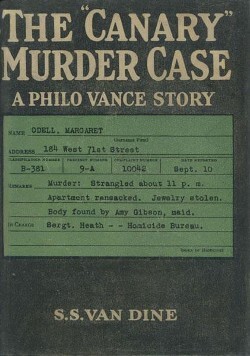
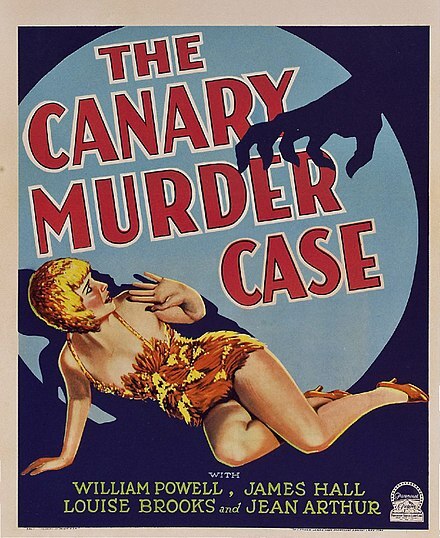
The literate, intelligent, and almost insufferably smug at times creation of culturally influential art critic Willard Huntington Wright, amateur detective Philo Vance, was Wright incognito. Philo Vance could drone on about art, dogs, arcane historical facts and languages all while solving the most intricately designed murder puzzle. The Philo Vance mysteries made Wright, who eventually owned up to writing them and embraced the celebrity hoisted upon him by the masses who read mysteries — as he viewed them — a literary sensation. William Powell’s portrayal of the urbane know-it-all who helped DA Markham solve the unsolvable cases in the movie adaptation of the wildly popular books added glamour to the mix.
Van Dine’s detective was a sensation in print and in the movies. Wright’s creation would eventually become out of step with the genre as it gravitated to the hardboiled detective, but there’s no denying his impact on the genre; if you doubt it, read the Spenser series by Robert B. Parker sometime; you’ll run across several fun references to Philo Vance.
Today, Van Dine’s mystery novels and his creation Philo Vance seem more arcane than some of the tidbits about ancient history and art that would come out of the detective’s mouth while he was deciphering clues. But these mysteries are very nostalgic of another time — specifically the jazz age — and the murder puzzles are still top-notch, some of the best ever, in fact. But you as a reader will either loathe them, or love them. And in a strange irony many other reviewers have noted, the reason some readers loathe them is much the same reason others like myself love them. Vance is like escargot — there’s no middle ground; you either partake, or you don’t.
Canary is a very early Vance novel, with Vance the ultimate version of the urbane intellectual know-it-all. Trouble is, he seemingly does know it all, and expects the people around him to understand even the most arcane cultural reference he applies to working the Canary case. Markham usually does, but not everyone else, don’t y’ know?
The brutal strangulation of Broadway’s Margaret Odell is as sensational as she was to the opposite sex. But there seems no way possible for anyone to have been present with her at the time of her demise. But there’s a closet locked from the inside, and a steel box opened with a steel chisel; but only after someone tried to open it another way. An amateur? Did she interrupt a robbery? Was it one of her lovers? Or does it all point to blackmail?
What makes matters worse, is the more people Markham, his man Heath, and Vance talk to, the murkier it all gets. The more details they have, the more impossible the murder seems at all. This leads to Vance good-naturedly needling his old pal, DA Markham:
“Y’ know, Markham, it appears to me that the testimony in this case constitutes conclusive legal proof that no one could have been with the deceased at the hour of her passing, and that, ergo, she is presumably alive. The strangled body of the lady is, I take it, simply an irrelevant circumstance from the standpoint of legal procedure. I know that learned lawyers won’t admit a murder without a body; but how, in Heaven’s name, do you get around a corpus delicti without a murder?”
As one possible avenue of inquiry after another leads to solid alibis or no possibility of the suspect having anything to do with the murder, Vance jokes with the frustrated Markham:
“I say, if you keep up this elimination much longer,” observed Vance, “you won’t have anything left but the lady’s corpse.”
When there finally appears to be a break in the case regarding who the man hiding in the closet may have been, Vance turns the murder investigation upside down with an entirely new theory he’s been holding back:
“Markham,” said Vance quietly, but with unwonted seriousness, “if that’s what you really believe, you might as well drop the case now; for you’re foredoomed to failure. You think it’s an obvious crime. But let me tell you, it’s a subtle crime, if ever there was one. And it’s as clever as it is subtle. No common criminal committed it — believe me. It was done by a man of very superior intellect and astoundin’ ingenuity.”
Eventually when the case seems like a circular dead end, Vance, his lawyer Van Dine (our narrator) in tow, does a bit of sleuthing sans Markham and Heath, altering alibis and the suspects various connections to Odell and each other. But when he passes what he can on to Markham, all this info only creates new conundrums. That is until the person who was actually in the room when Odell was strangled makes arrangements to spill the beans. Only in an epiphany which arrives too late to Vance — his mind had been on Monet, don’t y’ know — does he realize the real reason for the call, and the imminent danger.
Despite the highfalutin banter and attitude, it’s a poker game with all the suspects who clues Vance into the real killer. But that alibi can’t be broken. Or can it?
Hidden beneath the erudite goings on, obscured by the two dollar words and the intellectual highhandedness, and veiled by the delicious murder puzzle of Canary, and every other Philo Vance novel penned by S.S. Van Dine, is pulp-style movement. Yes, you read that correctly. Philo Vance is/was touted as a mystery and detective series for the smarter and more intellectual members of the reading public; by design, it began as a lark by a man not dissimilar to his own creation. How ironic then that the thing which makes these so readable and enjoyable to those who’ve acquired an appreciation for them — and Philo Vance is undoubtedly an acquired taste — is the most basic staple of pulp writing: movement within the narrative.
You may feel like you’ve read 25 pages when you look up to discover that you’ve only read 10 in a Philo Vance novel; the reason is because it’s overflowing with dialog and actions that create movement in the story. Van Dine may have been a culture-centric snob, but my oh my could he write! There is a sweeping sense of being carried along somewhere by the highfalutin jargon flying between Vance and Markham in Canary. That’s no accident; it can’t be, because it’s an earmark of every Philo Vance novel. One has to surmise that somewhere in Heaven, Willard Huntington Wright, aka S.S. Van Dine, is probably smirking, because the masses finally figured it out, don’t y’ know, eh what?
While it’s impossible to in good conscience make a general recommendation to readers on a book like this — because you may end up in the camp who just can’t stand Philo Vance, rather than the camp who embrace him and the classic mystery novel in which he appears — for fans of Van Dine and his high-brow detective of the jazz age, this one is great fun. This particular edition I have doesn't have the map diagrams, but I'm not big on that stuff anyway, and happen to adore the art deco cover. Highly recommended — for some.