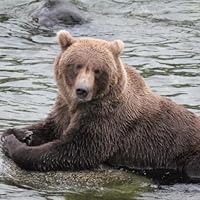
On the Alaska Peninsula, where exceptional landscapes are commonplace, a small river attracts attention far beyond its scale. Each year, from summer to early fall, brown bears and salmon gather at Brooks River to create one of North America’s greatest wildlife spectacles. As the salmon leap from the cascade, dozens of bears are there to catch them (with as many as forty-three bears sighted in a single day), and thousands of people come to watch in person or on the National Park Service’s popular Brooks Falls Bearcam.
The Bears of Brooks Falls tells the story of this region and the bears that made it famous in three parts. The first forms an ecological history of the region, from its dormancy 30,000 years ago to the volcanic events that transformed it into the Valley of Ten Thousand Smokes. The central and longest section is a deep dive into the lives of the wildlife along the Brooks River, especially the bears and salmon. Readers will learn about the bears’ winter hibernation, mating season, hunting rituals, migration patterns, and their relationship with Alaska’s changing environment. Finally, the book explores the human impact, both positive and negative, on this special region and its wild population.
This is going to be one the nonfiction books I own rather than get from the library because I loved it so much! Very informative and fascinating; the history of the landscape, bear behavior and physiology (which I especially loved) and human interaction with bear populations. I love how he interweaves personal stories about the bears you see on the cams and during Fat Bear Week, including some oldies I had not heard of. Perfect for nature lovers and anyone who loves Fat Bear Week like I do lol
The focus of this marvelous book was not just the bears of Brooks Falls (made famous by their explore.org bearcam), but the interdependence of bears, fish, humans, and nutrients from the river and the volcanic ash of the region. Author Michael Fitz demonstrates his expertise in a riveting way, fascinating readers with details of the life cycles of the inhabitants of the area, and saddening them with explanations of how global warming and the exploitation of natural resources might imperil their existence. I love watching the webcam each summer, but now I feel that I've gained so much more from reading this book, written intelligently with considerable scientific detail, but definitely for the layperson who wants to learn. Highly recommended.
I love bears! Anyone who knows me already knows this. I started watching the bears at Brooks Falls on the Bear Cams on Explore.org a few years ago. This is such a fascinating experience. I was so excited to buy my copy of Michael Fitz's book, The Bears of Brooks Falls: Wildlife and Survival on Alaska's Brooks River. There are so many details about the area and the bears themselves that were so fascinating. I wanted to read this book before Fat Bear Week. It's the online tournament to see which bear has had the most productive year, gaining weight, defeating nature, and basically ruling Brooks Falls. Everyone has a favorite bear or two but the beauty of this worldwide well-known tournament is that people are learning about the bears in Katmai National Park. Also, people are getting interested in Bears everywhere. I wanted to add here, that one of my favorite bears won this year: Grazer!! She's a fierce but wonderful Mama bear that can handle any bear- boar or sow at Brooks Falls. I also really love the old King of the Falls, Otis. Grazer: The Queen of Brooks Falls! Fat Bear Champion 2023! (See her picture on my blog)
Mike Fitz is known as a bear expert. As you read this book you quickly realize this man knows A LOT about the bears at Brooks Falls and the habitat they live in. Personally, I've learned so much from Mike and the rangers at Katmai National Park. They have live chats that people can listen to on explore.org. Sadly, it's almost time for all of the bear cams to sign off for the season and for the bears to go off for a nice winter's nap. You can still go and watch videos from this year or years past. The best thing you can do is go and read this book because I know once you do, you'll be heading to explore.org to watch videos of all of the bears you learned about in this book. This is a must-buy book for all bear lovers. https://whynotbecauseisaidso.blogspot...
Because I’m too lazy to keep entering my password to unlock my work computer when I’ve been away for a few minutes, I open up the Brooks Falls livestreams where I get to see a part of Katmai National Park and beautiful, massive brown bears. Mike Fitz is still at it with explore.org giving us all he knows about bears every livestream, it’s fantastic. I found this history of Katmai and how to evolved to livestreams on YouTube today super intriguing. Mike Fitz’s writing style is also lovely - it’s matter of fact, witty, and so full of love for the wilderness and recognizing that Brooks Falls belongs to the ecosystem that exists there first and not the national park itself and its tourists. I found the way Mike weaves from topic to topic about Katmai and the salmon run, to soil chemistry, to personalities of its brown bears very natural. It’s not just a lot of great information and arguments for preserving and respecting the park! It’s also heartfelt and Mike’s awe and appreciation for bears shines through in every word. It makes me feel enthusiastic as well. Lovely read overall, and I will tune into these streams and Fat Bear Week pretty much for the rest of time.
I have so much respect for Mike Fitz. I could listen to him talk about bears forever. In this book, he tells the story of Brooks Falls from beginning to the present time and it’s beautiful. He teaches about the salmon, their life journey and the major impact they have in ways I never imagined possible. Most importantly, he emphasizes the impact we, as humans, have when we visit Brooks Falls and any other area where we come in contact with bears (or any other wildlife). We need to remember we are visitors in their home and give them the respect and space they deserve.
Everyone has their own idea of the perfect balance between scientific writing and anecdotes, but for me the book got it exactly right. I thoroughly enjoyed the history of the geology, flora, fauna, and human activity of the Brooks Falls area, and the ongoing discussion between human impact and conservation.
Very interesting but a slow read on nature conservation, bear habitat in the region, salmon habitat and the politics involved in conservation of a species.
“On the Alaska Peninsula, where exceptional landscapes are commonplace, a small river and its namesake waterfall attract attention far beyond its scale. Physically, Brooks River rarely inspires superlatives. Barely a mile and a half long and 50 yards wide, it hasn’t carved any deep and torturous canyons. It isn’t prone to flood nor does it begin from a tumultuous cascade high in the mountains. Its water is not appropriated for human thirst, agriculture, shipping, or hydropower. Even the river’s single waterfall could be regarded as ordinary in a land filled with active volcanoes, pristine lakes, and a wild, storm-lashed coastline.”
Really clear, fascinating view of a wild place that exists with humans in myriad ways, and the author hits all the high notes and you can feel his love for the place. I had never watched the bear cams before and fell into that mesmerizing wormhole, with the underwater view of fish and bears swimming unforgettable.
I began to recognize their individuality, seeing, perhaps for the first time, that wild animals weren’t mindless automatons acting solely on instinct. They were individuals with personas, personalities. Out of ignorance and a lack of awareness I never realized such a possibility, like I had been sleepwalking and Brooks River woke me.
Both bears and salmon are inseparably enmeshed in the area’s culture, and the spectacle at Brooks Falls is not entirely natural. People influence the behavior and abundance of the animals that make the scene so special.
Brooks Lodge sits on beach and river terraces that have been used by people for 2,000 years, the hummocky ground under the cabins exhibiting where people built their homes and buried their dead. Walking anywhere along the river is an experience shared by people for thousands of years.
As Jeffrey Masson and Susan McCarthy posit in their book, When Elephants Weep: The Emotional Lives of Animals, “That feelings may be complex and multifaceted or difficult to interpret does not mean they do not exist.” Masson and McCarthy later explain, “If humans are subject to evolution but have feelings that are inexplicable in survival terms, if they are prone to emotions that do not seem to confer any advantage, why should we suppose that animals act on genetic instinct alone?”
In many respects, the scale of Katmai and adjacent protected lands are a triumph of conservation. Encompassing almost 3.7 million acres, Katmai is larger than Connecticut. The park’s waters contain no dams, dikes, diversions, reservoirs, or flood-control structures, nor do any exist outside its boundaries. Along with the Becharof and Alaska Peninsula national wildlife refuges, the scope of federally protected lands extends across hundreds of miles and millions of acres of the Alaska Peninsula.
Katmai sustains not only one of the largest populations of bears on Earth but also one where the population is naturally regulated—it operates at the carrying capacity of the habitat and humans are not a significant cause of mortality.
Yet, parklands were never unpeopled. The formation of parks followed on the heels of the United States’ final wars on Native Americans. With the forced removal and genocide of indigenous peoples, as historian William Cronon explains in his essay “The Trouble with Wilderness; or Getting Back to the Wrong Nature,” we created an “‘uninhabited wilderness’—uninhabited as never before in the human history of the place.”
The infrastructure allows tens of thousands of people per year to visit the tree while attempting to protect its health and continued longevity. Providing for both enjoyment and protection is a dichotomy in national parks. The US national park system is guided by the Organic Act of 1916 where the fundamental purpose of the parks is “to conserve the scenery and the natural and historic objects and the wild life therein and to provide for the enjoyment of the same in such manner and by such means as will leave them unimpaired for the enjoyment of future generations.”
Brooks River occupies a unique position. Its salmon, bears, and human history combine to make it one of the most storied and dynamic places in all of America’s national parks. In an increasingly human-dominated world we must ask ourselves, how much of its evolution are we willing to shape?
the NPS should forever maintain its webcams along the river. It should devote at least three rangers (one full-time year-round ranger and two seasonal rangers) to the most watched webcams in the National Park System so that anyone with an internet connection can have a meaningful bear-viewing opportunity and national park experience.
The bears and salmon, having no conception of humankind’s issues, went about their business as normal and Bristol Bay experienced another large and healthy sockeye run. Even though the commercial salmon fishery in Bristol Bay ran at near capacity and caught tens of millions of fish, the sockeye run in Naknek River set an all-time record high for escapement when more than 4 million salmon entered the river….No bear appeared to have trouble getting its fill of salmon or finding space to fish. Along with millions of other people, I watched the events play out through the webcams at the river and took comfort in viewing the scene of wild health.
Super interesting and informative read before my trip to Brooks Falls. Packed with information about bears in general and the bears of Katmai specifically.
*I reread this summer of 2024 and got even more out of after having visited last year and during my visit this year. I would consider it a must read for anyone planning a visit to Brooks Falls.
I got out of the habit of reviewing but I usually noted how many stars. I'll go back into reviews in 2024 and try to rectify, but I'm injured and just going to do the star ratings and copy and paste this explanation. Happy Reading!
It was June and the word was out--the King had returned to Brooks River. Until then, I had watched the explore.org bear cams sporadically, enjoying the serenity of watching the bears of Brooks Falls make their living. Who was this King and why were so many relieved and overjoyed to see him? Then, I wouldn't have been able to pick him out of a crowd, didn't know it was 480 Otis that had the bear can viewers abuzz. Holly, I knew, as the reigning Queen of Corpulance, the 2019 Fat Bear champion. By the end of the season, watching Otis swim off towards his den, I could have identified him anywhere, along with Holly and her coy, the massive 747 and the dominant 856, the fierce Grazer and the Prince, 503. Resident naturalist Mike Fitz, through his live chats, became even more recognizable, a teaching voice guiding viewers through the day-to-day dramas at the Falls and through the tumultuous year that was 2020. When I heard he had a book coming out, I didn't hesitate to pre-order it and I was not disappointed.
A history of the region spilled out, from prehistoric days, to volcanic eruptions, to the present. Then, the bears, their story from den to death and everything inbetween, offers readers great insight into this keystone species, going beyond reputations and stereotypes to reveal individual creatures, each unique. Fitz paid tribute to perhaps the world's last great salmon runs, demonstrating that these incredible fish are more than something that is consumable, but a vital part of their ecosystem. Unapologetic, he takes readers through the human impact on not just Katmai, but the wild using science and experience to reveal human/bear conflict and environmental impact. The biggest takeaway, is the author's profound love and passion for Katmai and it's bears and through his lens, we come to a greater, more informed understanding of the importance of this unique area. Fabulous read.
One of the best and most comprehensive Alaska wildlife books I have read. Fitz explores the geological history of the region and explains how this benefited resident bears, delves into their evolution and biology, traces the life cycle of the salmon they feed on, tells the history of how Katmai National Park came into being, examines the complexities of managing humans at the viewing platforms and around the falls, discusses the impacts of climate change, and much more. He frequently tells stories of his own experiences as a ranger in the park in ways that highlight the points he is making without ever turning the book into a memoir about himself; the stories are enhanced by his presence without distracting from the points he is making. He also never overwhelms readers despite packing an enormous amount of information in this book.
Whether readers have visited Brooks Falls or not, after reading this book they will share his passion for the place and it’s overall natural state, including bears, fish, plant life, and even water temperatures. He shows how remarkable the whole ecosystem is and how it is fully dependent on the planet’s ecology. He uses solid science, and on scientific points he suggests conclusions from his own observations but doesn’t present them as fact. On management of the area his critiques and proposals draw from what has been done and what he has witnessed, but are tempered with a call for gathering more data, so that decisions are as informed as possible. He’s incredibly knowledgeable, yet humble about the limits of his knowledge.
Fitz said in his afterword that writing is difficult and arduous, but despite being a first time writer, he makes it look easy. Highly, highly recommended.
A Front-Row Seat to the Wild: Discovering the Heart of Brooks Falls
This is a truly lovely and informative book, an absolute must-read for anyone interested in Alaska’s wildlife or planning a trip to Brooks Falls. Written by former National Park Service ranger Michael Fitz, The Bears of Brooks Falls offers a fascinating and accessible deep dive into the lives of the brown bears that gather each summer at the Brooks River to feast on spawning salmon.
What makes this book special is how it blends scientific detail with personal observation. Fitz explains the behavior, ecology, and survival strategies of the bears and salmon, and shares stories from his years at Katmai National Park. His love and respect for the animals and the ecosystem shine through on every page, making the book feel both educational and deeply heartfelt.
Whether you’re a longtime fan of the bear cams or just starting to learn about this iconic spot, Fitz’s writing will enhance your understanding and appreciation of what makes Brooks Falls so unique. The book is well-researched, easy to read, and full of memorable insights into how wildlife and landscape shape one another.
The Bears of Brooks Falls is the perfect companion for a future trip to Katmai (I am going this summer), or simply for anyone who wants to be transported to one of the most extraordinary places in the natural world. I loved every page.
I love the Brooks Falls bear cam on explore.org, and I'm familiar with Mike Fitz as the "resident" naturalist helping viewers understand what they're seeing online. This book is a great resource for people who love the bears and love watching them. Fitz goes into the history of the Katmai area in Alaska, the history of the park, the bears, and the salmon. He also writes about the challenges - mainly climate and political - facing the park going forward. In the course of the book, there are many anecdotes from his time there that give insight into what it's like to work at or just visit the Falls as well as stories about the individual bears the webcam viewers have followed over the years. His years spent with park and webcam visitors have clearly helped him develop his communication skills. He conveys a lot of information in a way that's easy for a casual reader to follow. If you don't follow the bears, this probably won't interest you much. If you look forward to their arrival at the Falls every year, you'll enjoy this a lot. I loved it and will be hanging on to is so I can look at it each June as I wait for the bears to return.
This book is a must-read for anyone planning a trip to the Brooks Falls region of Katmai National Park in Alaska. It's also a great resource for those who can't get enough of Fat Bear Week, bears, national parks, fish, livecams, or wilderness. The author was a park ranger at Katmai for many years and is very knowledgeable about the history of the park and the impact of human activity on bear life. Readers will learn more about some of the beloved bears that frequent the falls including Holly, 747, Otis, and Grazer, and the unique process of bear hibernation. It's also fascinating to learn about the odyssey of the sockeye salmon, who travel hundreds of miles out to sea and undergo transformation only to return to the exact spot of their freshwater birth to spawn - or die trying. The author explains the balancing act between allowing humans to enjoy the area while preserving the vital source of food the bears need to survive harsh winters.
Wow. I listened to this audiobook to learn more about the incredible bear hierarchy at Katmai National Park ahead of my visit there. Mike Fitz’s book is incredible - He delves so deeply into the history of Katmai, the development of the bear hierarchy at the falls and the current environment at Katmai.
As someone who watches the bear cams on explore.org, it was powerful to hear stories about some of the infamous bears like 856 and 128 Grazer. Chapter six on bear infanticide was tough to listen to, but important to understand why boars occasionally attack cubs. This hit home after witnessing bear 88’s attack on 26’s coy this year. Mike Fitz balances fact with human emotion, helping us to understand why nature can occasionally be heart breaking.
For anyone traveling to Katmai, this book is a MUST. If you love brown bears/national parks, it’s also worth a read!
Mike Fitz brings his experience as a wildlife and nature interpreter to the written page in this fascinating look into the history, culture, and experience that is Brooks River. I thoroughly enjoyed the stories behind what has happened at Katmai National Park and how it has crafted what we experience today. Mike also gives us a look into the future, highlighting what will happen if we don’t take steps now to protect the wildlife and nature we so enjoy and treasure. This was an easy read, with accompanying photos that added to my enjoyment. And the scientific facts and figures were not overwhelming or intrusive. Mike balances his storytelling and fact-based arguments well and it makes this book more accessible than most. Highly recommended.
This book was very informative, data-driven, and engaging. In sharing about the bears of Brook Falls, Fitz acknowledged how they fit into their setting, taking time to explain the geography of the landscape, the lifecycle of the salmon the bears eat, and the impact of humans on bears. As for the bears themselves, Fitz took time to share about general bear behavior and anatomy (I found the details about hybernation interesting), as well as sharing interactions between specific bears to emphasize points. Overall, an informative and enjoyable book. Before finishing it I had already recommended it to someone. I would recommend this to anyone who has interest in nature and the science of animals.
I've been a casual bear cam viewer for many years, and have watched a number of author Mike Fitz's youtube bear talks over the years as well. I didn't realize there was a book, but I was happy to find it recommended. I do read a lot of natural history books, and I found this one to be an excellent representative of the genre. While an extra star got added probably becuase of how much I know and love the bears and bear cam, it's a really solid read. The author makes it engaging and doesn't go on too long about any one thing, which keeps it from feeling textbooky - but he manages to weave in the natural history of the area, the salmon, and the bears along with visitor and bear anecdotes. Glad I found this book.
I am a huge fan of Mike Fitz and his work with explore.org, who I discovered through my obsession with the Brooks Falls webcams. Turns out he is as excellent a writer as he is an orator about his experiences with the bears in Katmai National Park. I was expecting to live my dream of visiting Brooks Falls very soon, but his writing showed me that the bears are majorly affected my the massive human presence in the area. I will show my love for the bears by continuing to give my support financially and by watching from afar on the cams. I hope to persuade others to practice the same restraint until the National Parks Service puts more emphasis on controlling the number of visitors to the falls and their impact on this incredible, fragile ecosystem.
The Bears of Brooks Falls by Mike Fitz is a wonderful book for anyone who loves bears and wild places. Written by a former Katmai National Park ranger, the book is part natural history and part love letter to the brown bears and salmon of Alaska's Brooks River. Fitz weaves together the ecology of the region, the lives and behaviors of the bears, and the impact humans have had on this special place. I've been watching and reading about the Brooks Falls bears for a while now, and I love tuning in to the live bear cams inside Katmai National Park. If you enjoy these things too, you will love this book.
I really got into watching the bears on the live cams this year. It is a great community and we are doing Bear book club with this book. I loved this book as it is very informative and empathetic to the ever changing environment for the bears. Mike Fitz goes into the hurdles that Katmai will be facing especially with mining and people. This is the bears home and we should be protecting it for them and this book makes me more fiercely want to protect Katmai and all of our National Parks.
I’ve been following Mike Fitz for awhile now by way of explore.org and the Katmai Conservancy, and I’ve always loved his nature first perspective on things. This book is fantastic, especially for those of us who are avid bear watchers through explore.org’s live nature cams. I love reading about the Brooks Falls bears, and the thorough explanation of the journey that salmon must take to complete their life cycle was captivating. I will be reading this again.
I love the bear cam at Brooks Falls and look forward to having it going every season. This book is absolutely a love letter to those bears and the ecosystem in which they play a part. Mr. Fitz's knowledge shines through every page. This book gets put on the "Will Read Again For Sure" shelf! Some of this book is not an easy read, as it is absolutely dense with information and education, but it is worth the time it takes to read it.
This is a must read if you’re not just content with visiting a national park and saying “ohh, beautiful bear”. If you want to know ‘about’ bears, how they live, how they die, and what is abundantly necessary for their well-being, this is the book. And Mike makes it so easy to read. You don’t need a degree in biology to find a deeper understanding of the beauty and balance in ecosystems.
This book is easy to read but still contains a great deal of bear behavior, and information on the ecosystem that’s supported by salmon. Mike hits just the right tone, showing that these bears are more than just apex predators. It’s a multidimensional view of a creature that so many of us find fascinating
First time I started with sections of most interest and jumped around, making it hard to pick up to read after setting it aside some during the hectic winter & spring of 2026. The audiobook is a great companion. Love the book, Mike Fitz's passion for the bears & all things Katmai National Park. An excellent read.
Full of fascinating information about bears, salmon, and Katmai National Park, the strength of this book is its storytelling and the personal experiences Fitz brings to the stories. Exceptionally well-written and highly-recommended for anyone who enjoys great nature and science writing.
This was really good and interesting. I started watching the bear cams a couple years ago, and while it was nice to learn about the lifecycles of salmon, and berry harvests, I wish there was a bit more content about the bears.