“The brief and putrescible flesh that forms us is the fugitive & mystifying site of devotion & erotic energy in these poems by Mark Ward, ‘the place itself primordial’ wherein we are made solid in a world of light. Exciting, mysterious, seductive, frightening . . . these are poems lit by moonlight & intense curiosity & speculative tomorrows.” –D.A. Powell
MARK WARD is the author of the chapbook, Circumference (Finishing Line Press, 2018) . He was the Poet Laureate for Glitterwolf & his poems have been featured in The Irish Times, Poetry Ireland Review, Banshee, Boyne Berries, Skylight47, Assaracus, Tincture, Cordite, Softblow & many more, as well as anthologies, the most recent of which is Lovejets: Queer Male Poets on 200 Years of Walt Whitman. He was Highly Commended in the 2019 Patrick Kavanagh Poetry Award & in 2020 he was shortlisted for the Cúirt New Writing Prize. His poem, “Vegas Epithalamion,” was recorded & broadcast for Irish National Broadcaster RTÉ’s Radio 1 show, Arena. He is the founding editor of Impossible Archetype, an international journal of LGBTQ+ poetry, now in its fourth year. A full-length collection, Nightlight, is forthcoming from Salmon Poetry in 2022.
In "The Structure of Rime V" (1960), Robert Duncan acknowledged the dark, lunar side of the imagination: “Have you heard the broken limbs of the world-tree knocking, knocking?” The world-tree knocks in Duncan’s poem because, in the language of the Hermetic Tarot, the Hanged Man swings from the Hebrew letter D, Daleth, the Door, and the carcass of the slain man/god knocks on the doorway that leads into death. In the world of the archetypes, the soul “swings on the hinges of destroy’d face”. Desire’s mutilated tree is Yggdrasil, the tree that hung Odin, king of the Norse gods. Have you seen “the Abbatoir” asks an infernal voice in Duncan’s poem. In Carcass, Ward shows that he has looked and seen.
Carcass is a pamphlet of thirteen poems, a number that evokes death, and it is a small volume that sets its tone in the shockingly raw “A Rent Boy Becomes Yggdrasil”. This intense terza rima sonnet alludes to both Dante’s Hell and love song, and presents a bare vision of love, a struggle against the body of language:
his line of vision a vanishing point
of banished sensation.
In a Beckettian way, the poems in Carcass are concerned with a language falling apart, with what Yeats termed the “foul rag and bone shop of the human heart.” Ward’s poems, however, pick up the word “foul” rather than Yeats’s love for romantic elegy. These are poems that stare into the darkness of human sexuality.
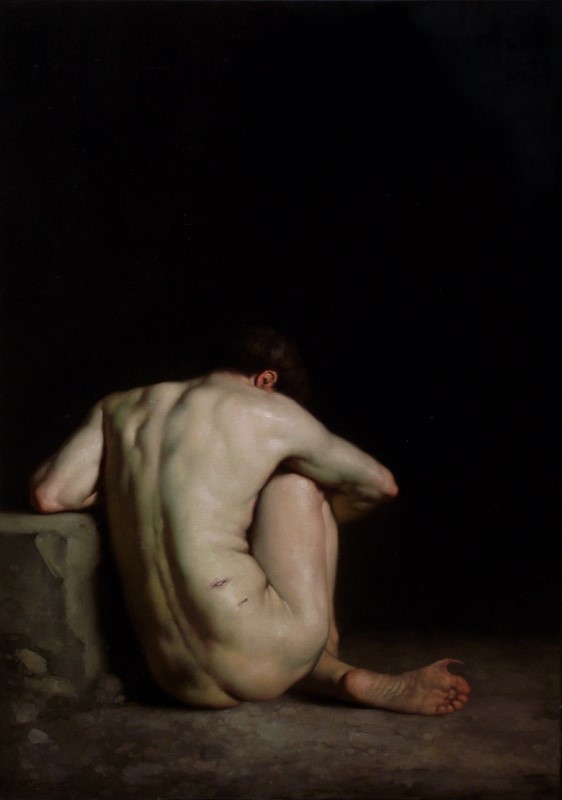
The thirteen poems are amazingly varied. They range from the bold, sweeping monologue on homophobia, violence, and twisted desire that is “Blue Boy” to the tight villanelle that forms “Urge”. “Swordswallower” is sharp and to the point. Ekhphrastic poems need careful handling as they have to pay tribute to the source and find something new and personally relevant in it. Ward’s “The Swamp” truly connects to Roberto Ferri’s La Palude. Initially, the painting appears like a re-working of Caravaggio, one in which the divine body is rendered sensually, until a claw is noticed rising from the human foot, a sign of the reptilian brain within civilised man. Ferri’s painting strikes just the right note for Carcass. Perhaps, the finest poem amongst the thirteen is “Mitko”, which references Greenwell’s first novel, or rather one aspect of it: how the everyday can become “myth”. In this exploration of language, deadness, primitiveness, Ward notes how sexual attention can be “atavistic”, ancestral, swirling from memory’s boglands. We are returned back to the symbol of the world-tree that grows like an erection (in Hermetic manuscripts) from man’s naked body – like the “tree now growing out” from the rentboy “like fruit”.
Carcass attempts much in a short space and achieves a probing and unsettling vision of gay desire.
Carcass by Mark Ward is not only an enticing short collection of poems with dark and speculative elements ("Blue Boy" was a particular highlight for me) but a beautiful physical artifact with that amazing cover and the maroon thread tying the pages together.